Battery Integration &
Energy Storage Options
Jake McKee
Vice President Engineering, Solar PV
E.ON Climate & Renewables
Energy Storage USA
July 8th, 2015
 Opportunities and monetizing
 PG&E, PJM, TEP
 Experiences in Puerto Rico
 Developing, Engineering & Optimizing – Solar & Battery Projects
 Design Considerations
 Battery Technologies
 Contracting
Overview
OPPORTUNITIES AND MONETIZING
BATTERIES
4
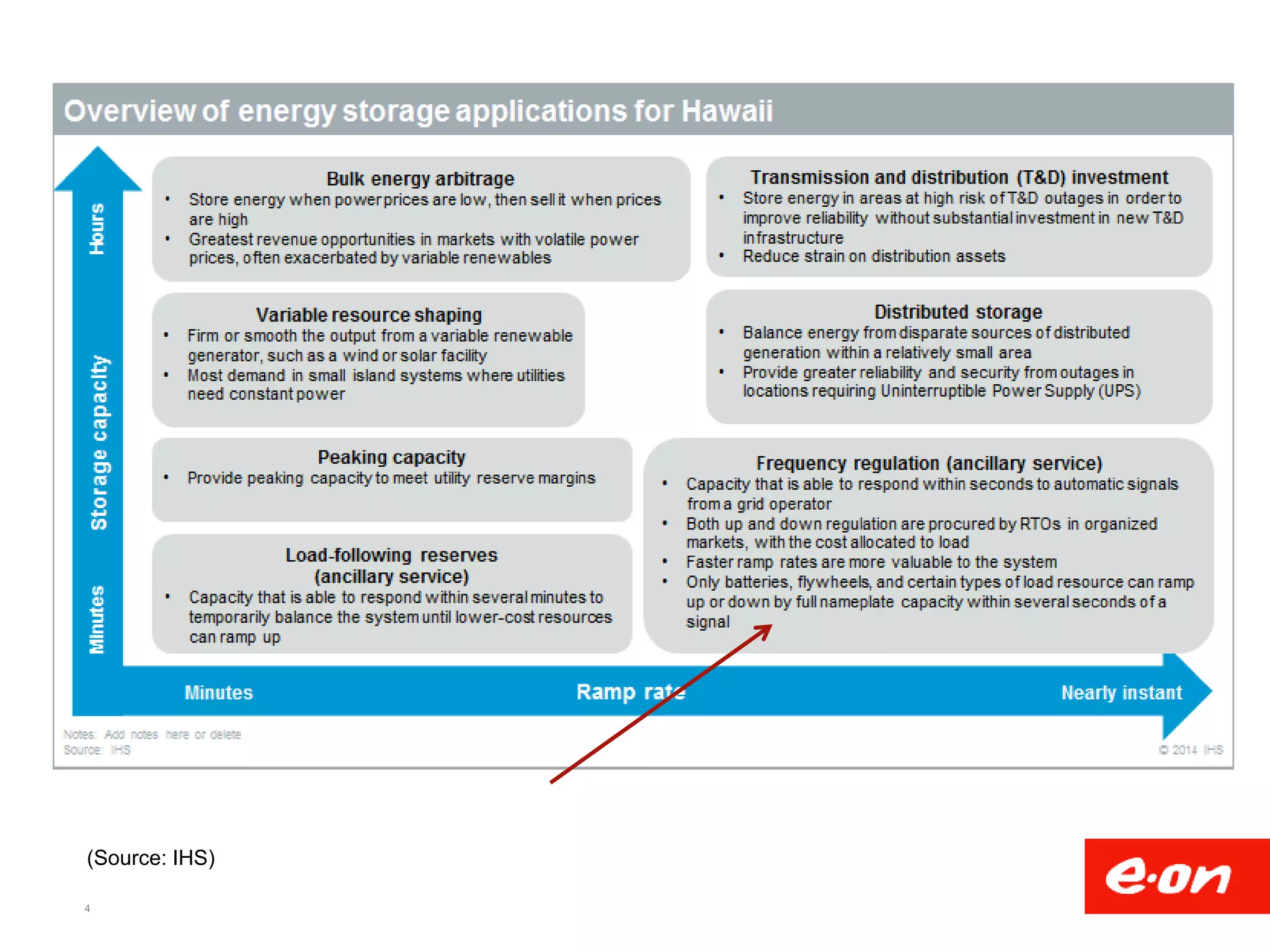
(Source: IHS)
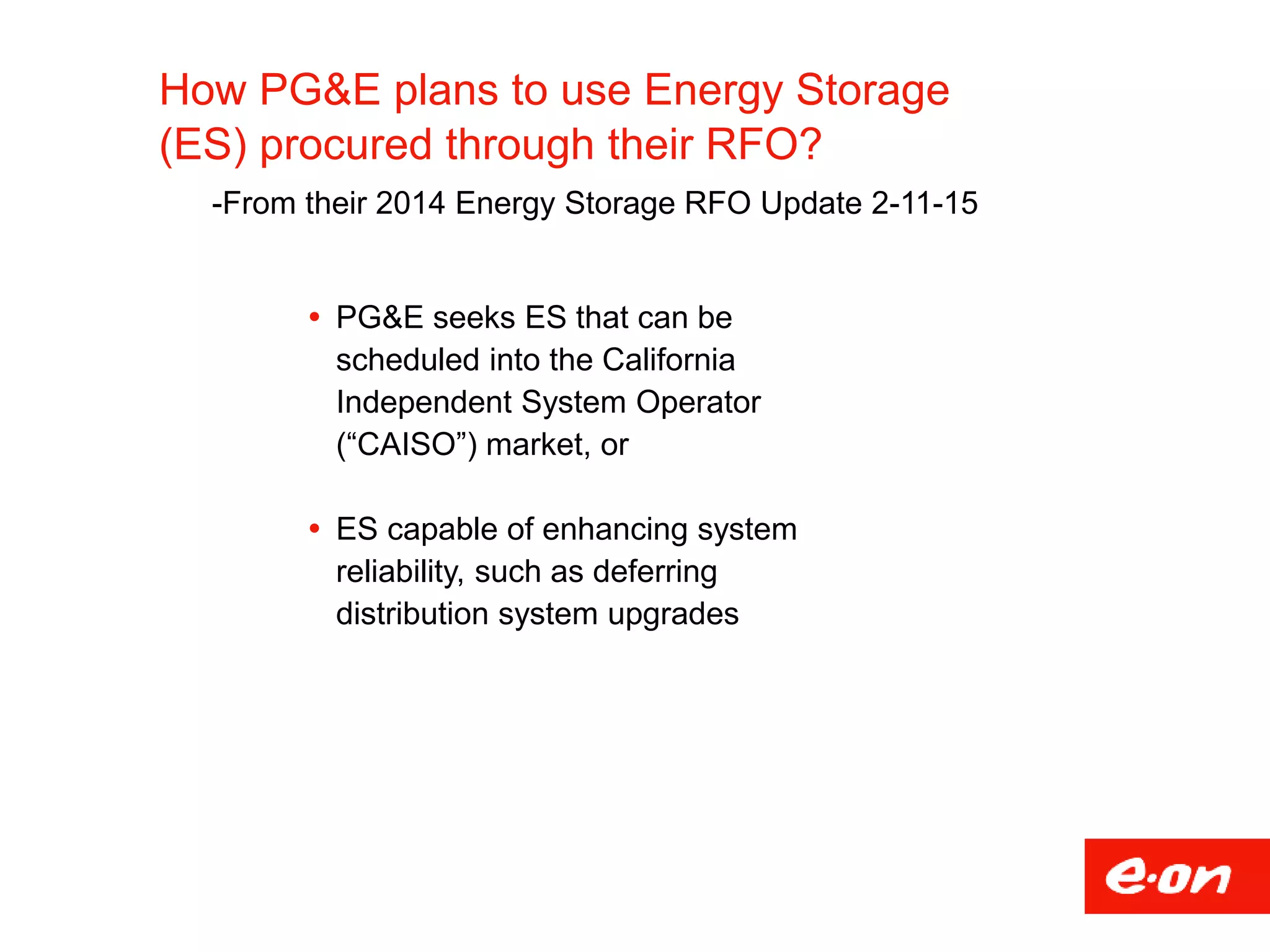
How PG&E plans to use Energy Storage
(ES) procured through their RFO?
-From their 2014 Energy Storage RFO Update 2-11-15
 PG&E seeks ES that can be
scheduled into the California
Independent System Operator
(“CAISO”) market, or
 ES capable of enhancing system
reliability, such as deferring
distribution system upgrades
6
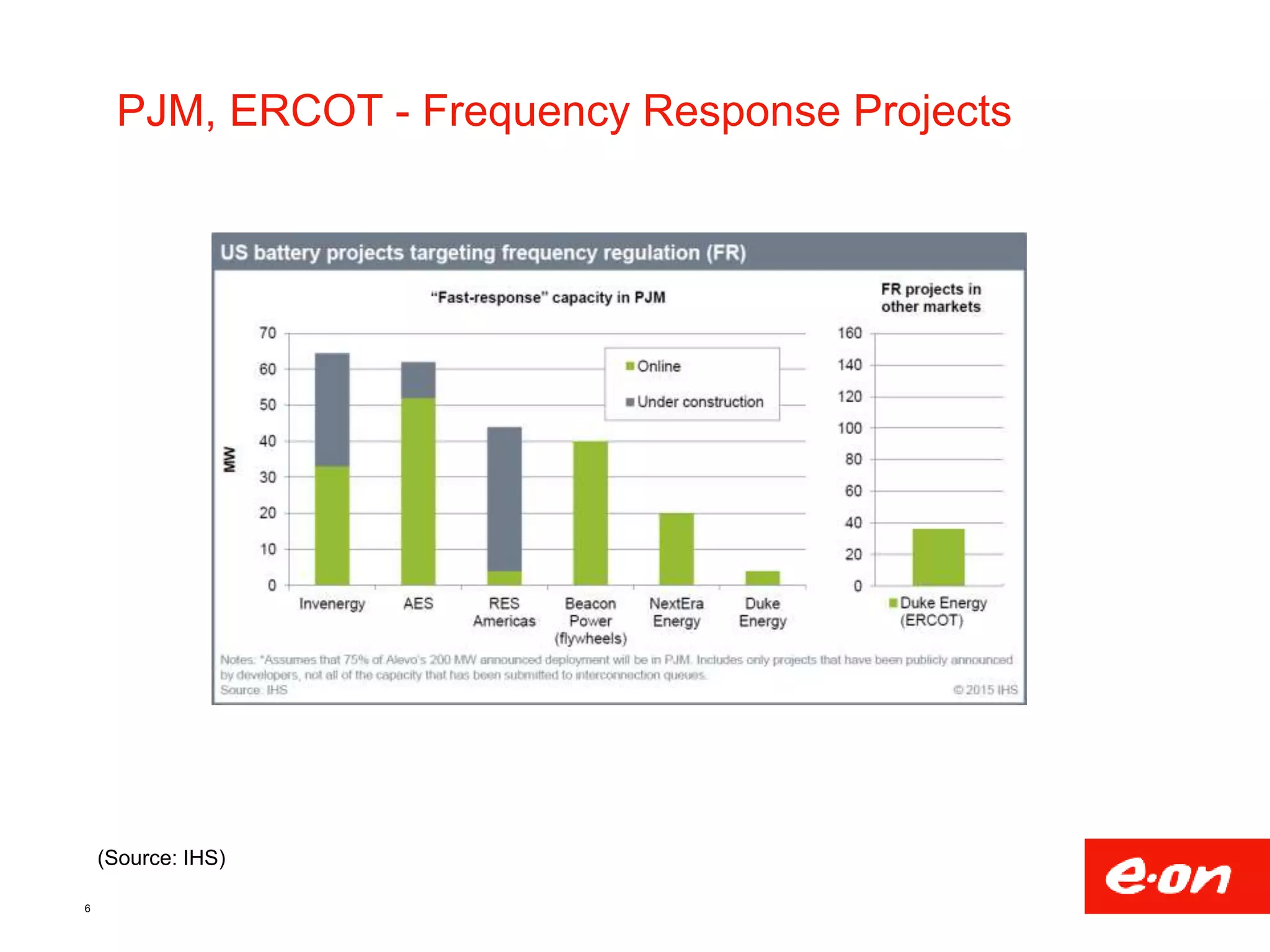
PJM, ERCOT - Frequency Response Projects
(Source: IHS)
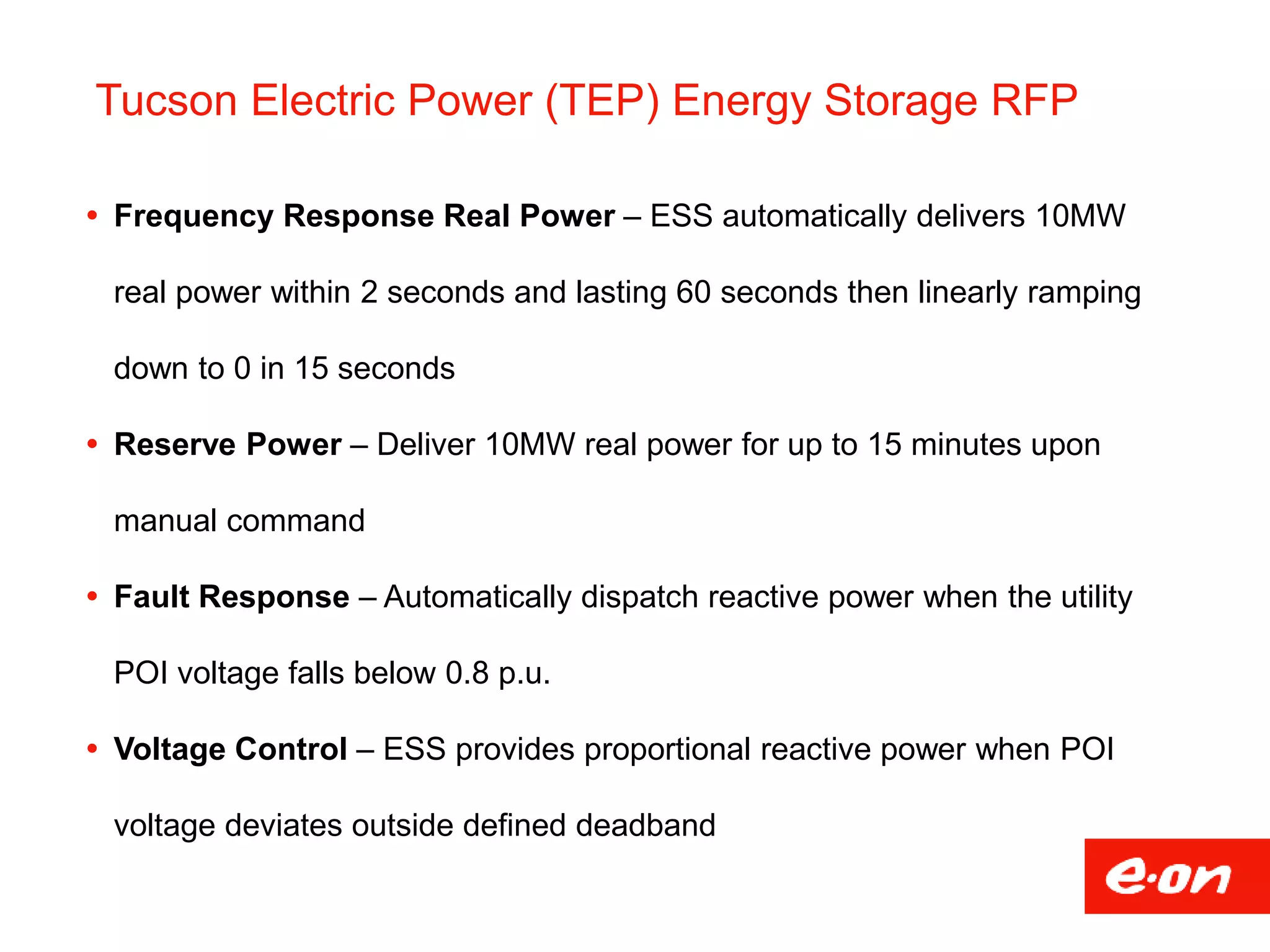
Tucson Electric Power (TEP) Energy Storage RFP
 Frequency Response Real Power – ESS automatically delivers 10MW
real power within 2 seconds and lasting 60 seconds then linearly ramping
down to 0 in 15 seconds
 Reserve Power – Deliver 10MW real power for up to 15 minutes upon
manual command
 Fault Response – Automatically dispatch reactive power when the utility
POI voltage falls below 0.8 p.u.
 Voltage Control – ESS provides proportional reactive power when POI
voltage deviates outside defined deadband
PUERTO RICO EXAMPLE
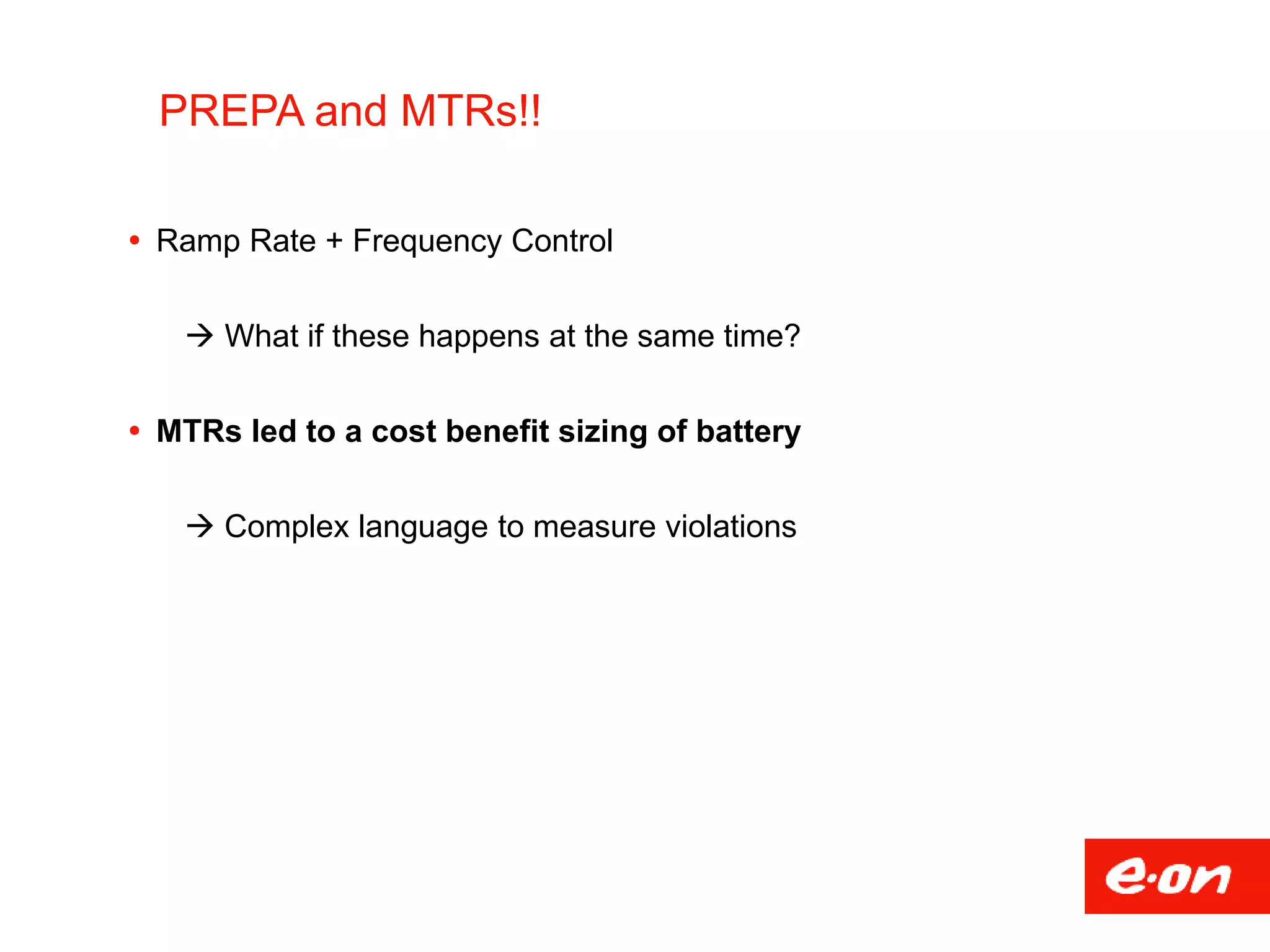
PREPA and MTRs!!
 Ramp Rate + Frequency Control
 What if these happens at the same time?
 MTRs led to a cost benefit sizing of battery
 Complex language to measure violations
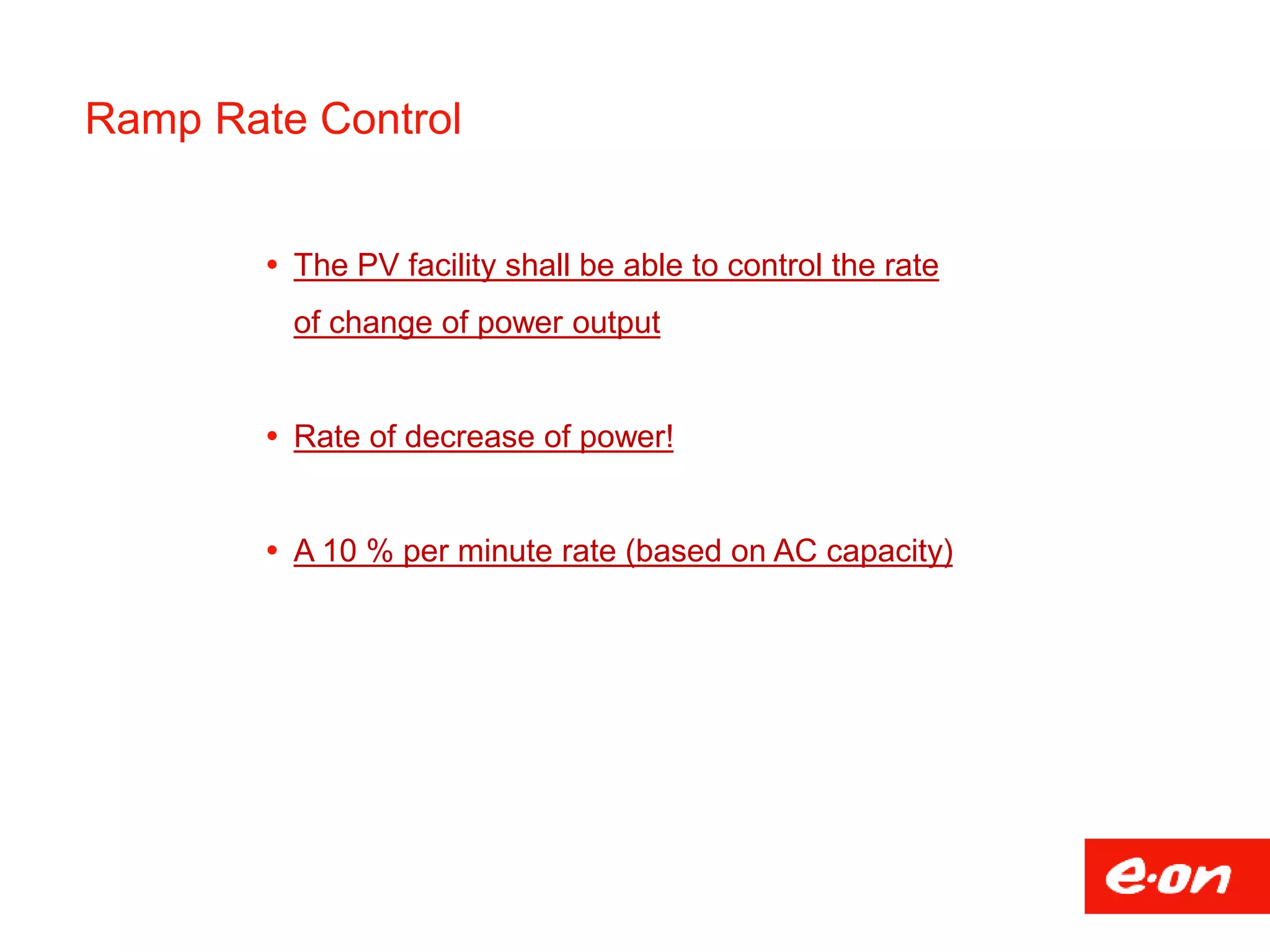
Ramp Rate Control
 The PV facility shall be able to control the rate
of change of power output
 Rate of decrease of power!
 A 10 % per minute rate (based on AC capacity)
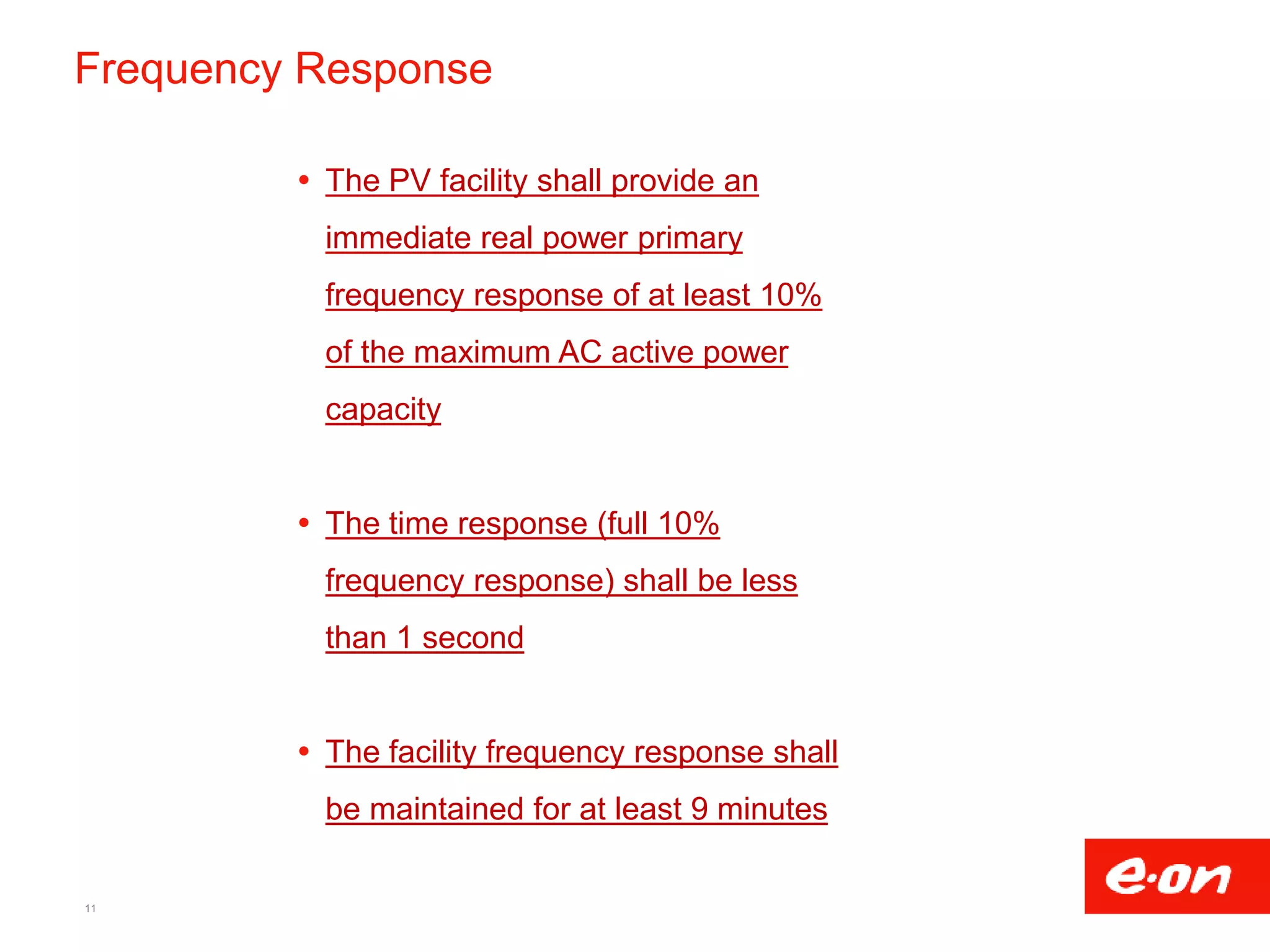
Frequency Response
 The PV facility shall provide an
immediate real power primary
frequency response of at least 10%
of the maximum AC active power
capacity
 The time response (full 10%
frequency response) shall be less
than 1 second
 The facility frequency response shall
be maintained for at least 9 minutes
11
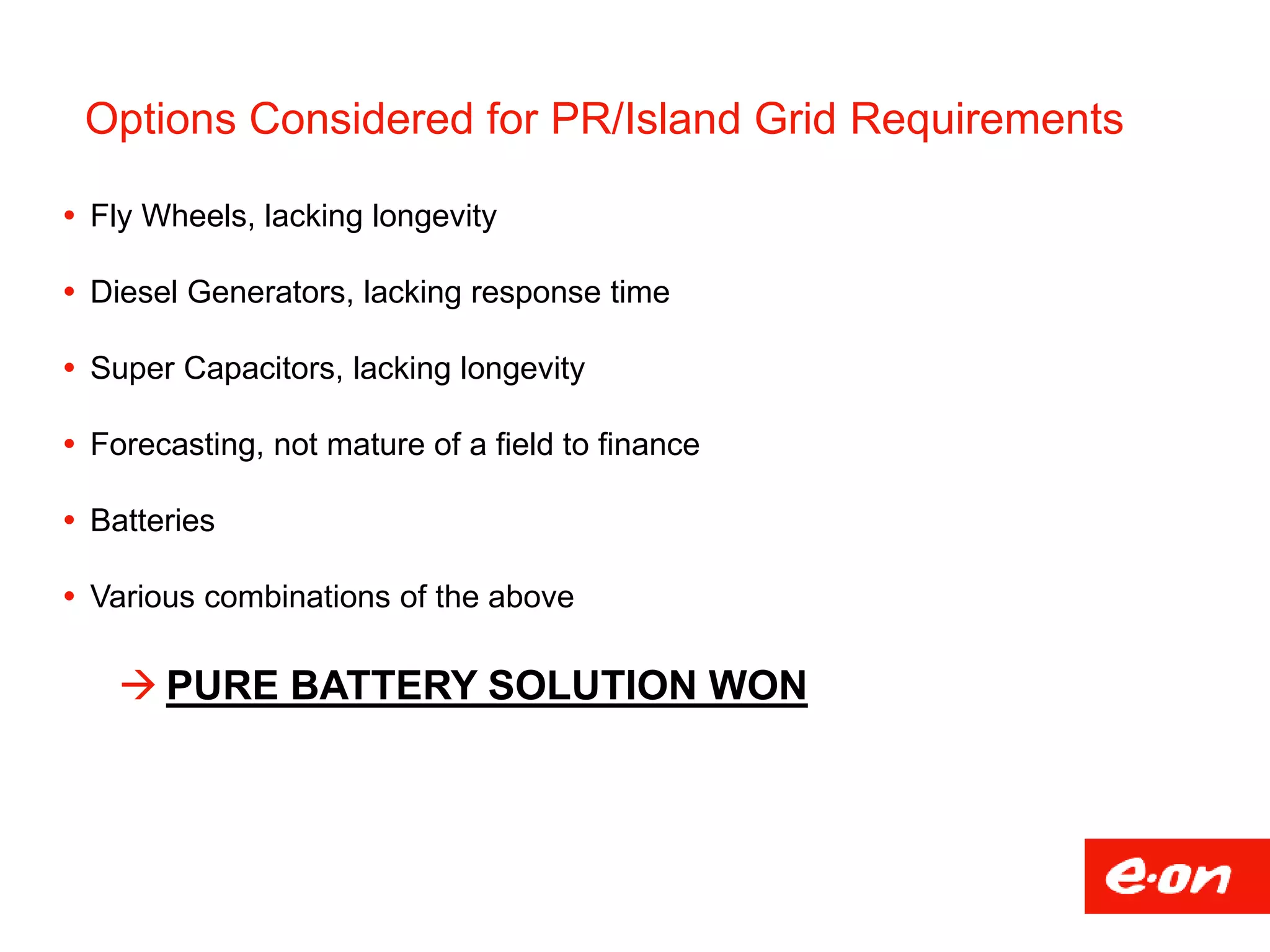
Options Considered for PR/Island Grid Requirements
 Fly Wheels, lacking longevity
 Diesel Generators, lacking response time
 Super Capacitors, lacking longevity
 Forecasting, not mature of a field to finance
 Batteries
 Various combinations of the above
 PURE BATTERY SOLUTION WON
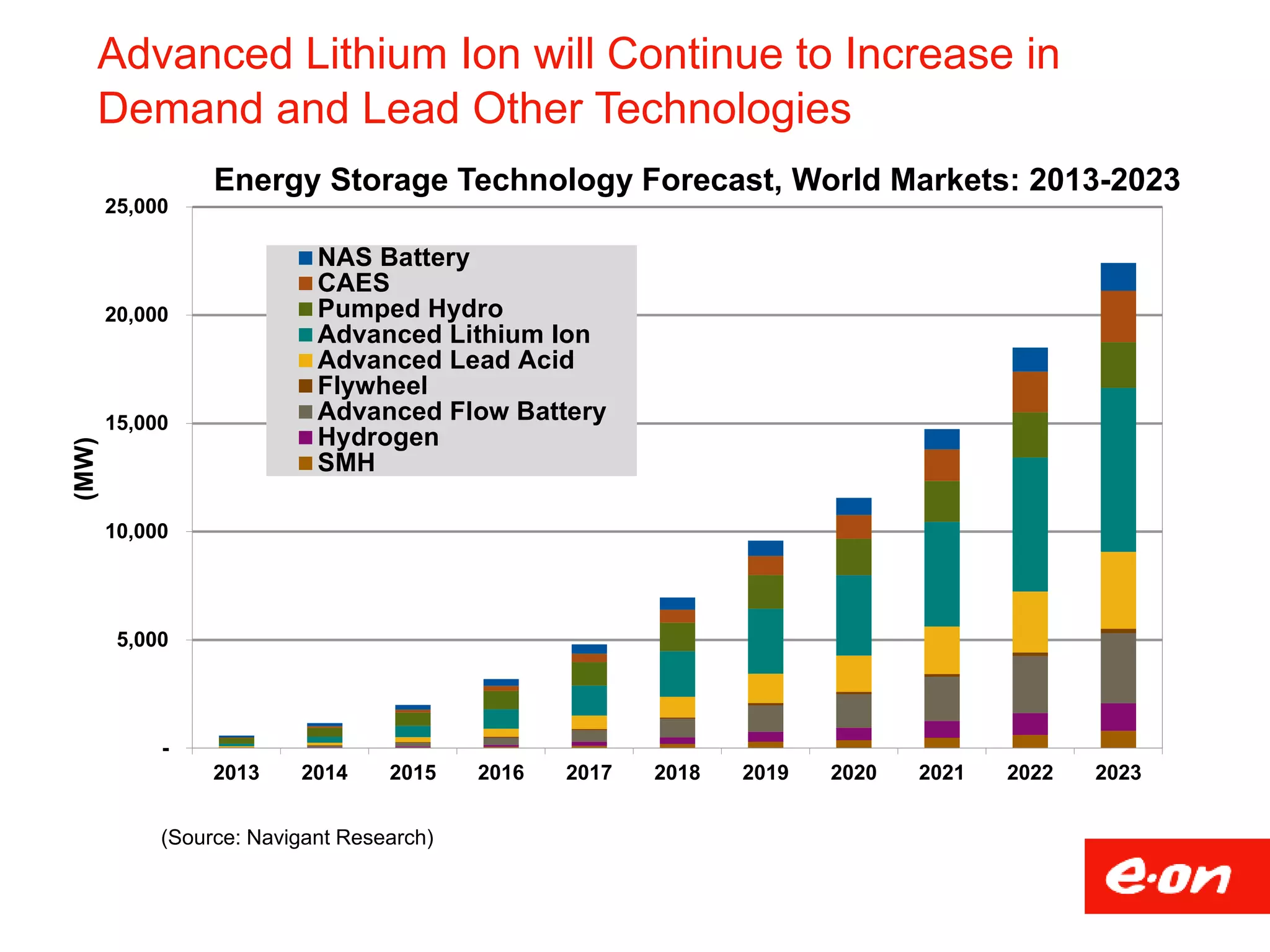
MOST PROMINENT ES TECHNOLOGY…
FOR DEVELOPERS ?
-
5,000
10,000
15,000
20,000
25,000
2013 2014 2015 2016 2017 2018 2019 2020 2021 2022 2023
(MW)
NAS Battery
CAES
Pumped Hydro
Advanced Lithium Ion
Advanced Lead Acid
Flywheel
Advanced Flow Battery
Hydrogen
SMH
Energy Storage Technology Forecast, World Markets: 2013-2023
(Source: Navigant Research)
Advanced Lithium Ion will Continue to Increase in
Demand and Lead Other Technologies
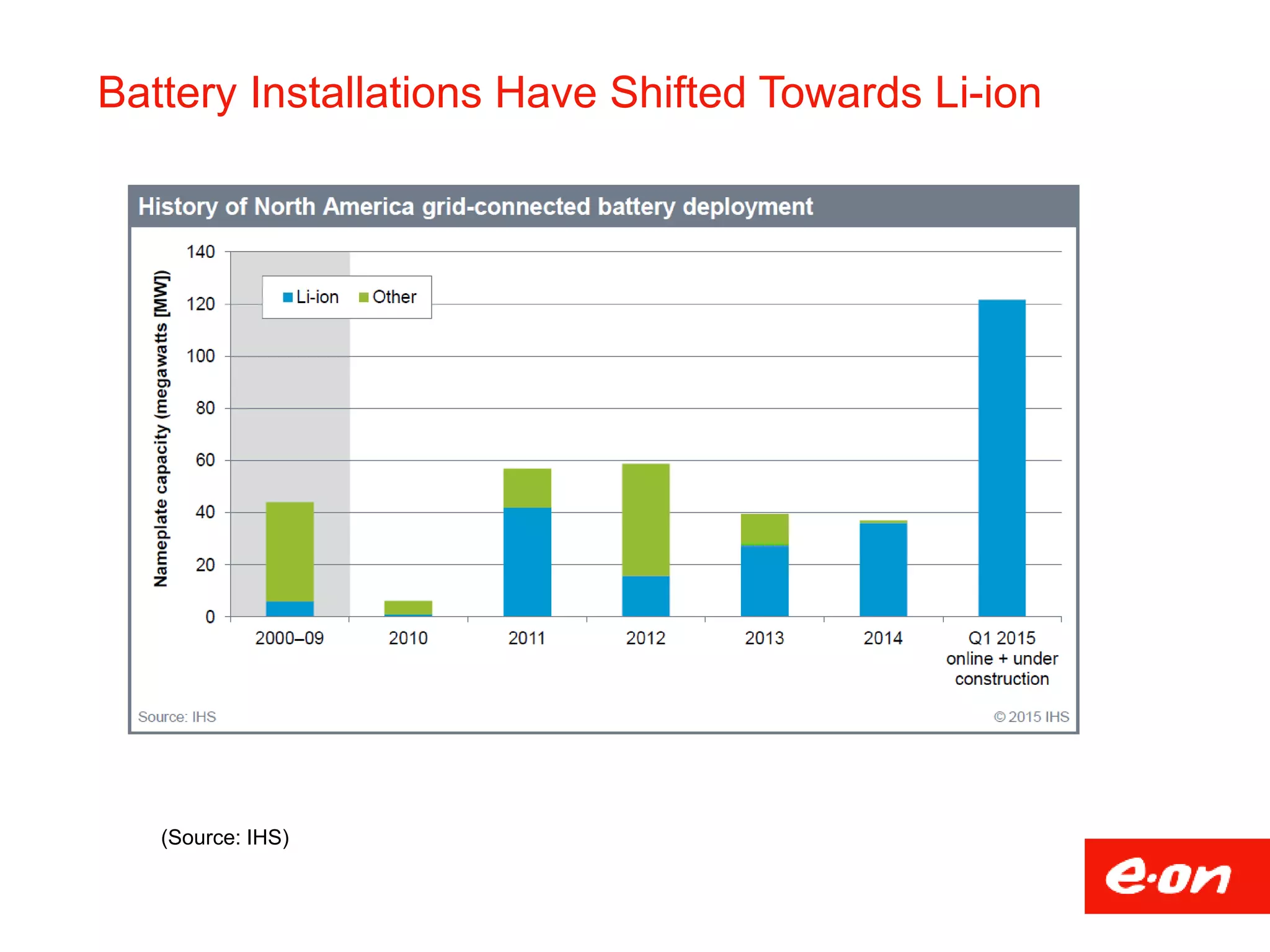
(Source: IHS)
Battery Installations Have Shifted Towards Li-ion
DEVELOPING, ENGINEERING & OPTIMIZING –
SOLAR AND ES PROJECTS
 Design Considerations
 Battery Technologies
 Contracting
DESIGN CONSIDERATIONS
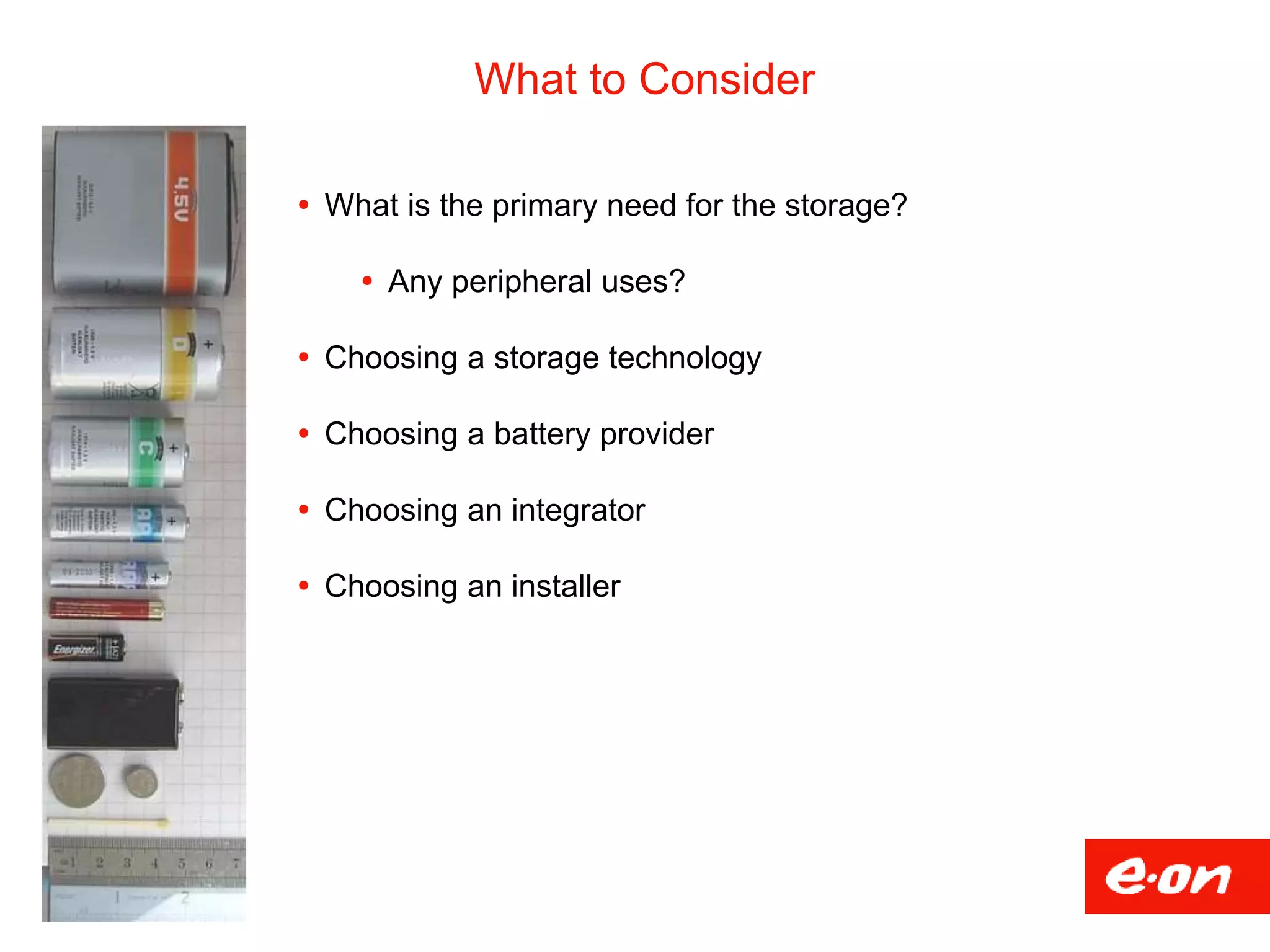
What to Consider
18
 What is the primary need for the storage?
 Any peripheral uses?
 Choosing a storage technology
 Choosing a battery provider
 Choosing an integrator
 Choosing an installer
Goals for the Storage
 Renewable Energy Smoothing (ramp rate)
 Renewable Energy Shifting and Firming
 Ancillary Services
 Arbitrage
 Peaking Capacity
 Transmission and distribution investment deferment
 Distributed Generation Support / Distributed Storage
19
BATTERY TECHNOLOGIES
Selecting the Battery Technology for your Project
 Flow
 NaS
 Li-Ion
 Advanced Lead Acid
Selecting the Battery Technology for your Project
 Flow technologies
 Higher Cycle Lifetimes
 Low Maintenance
 Quick Response Time
 Applications requiring longer duration
 Break point to go to flow is ~2 hours
Selecting the Battery Technology for your Project
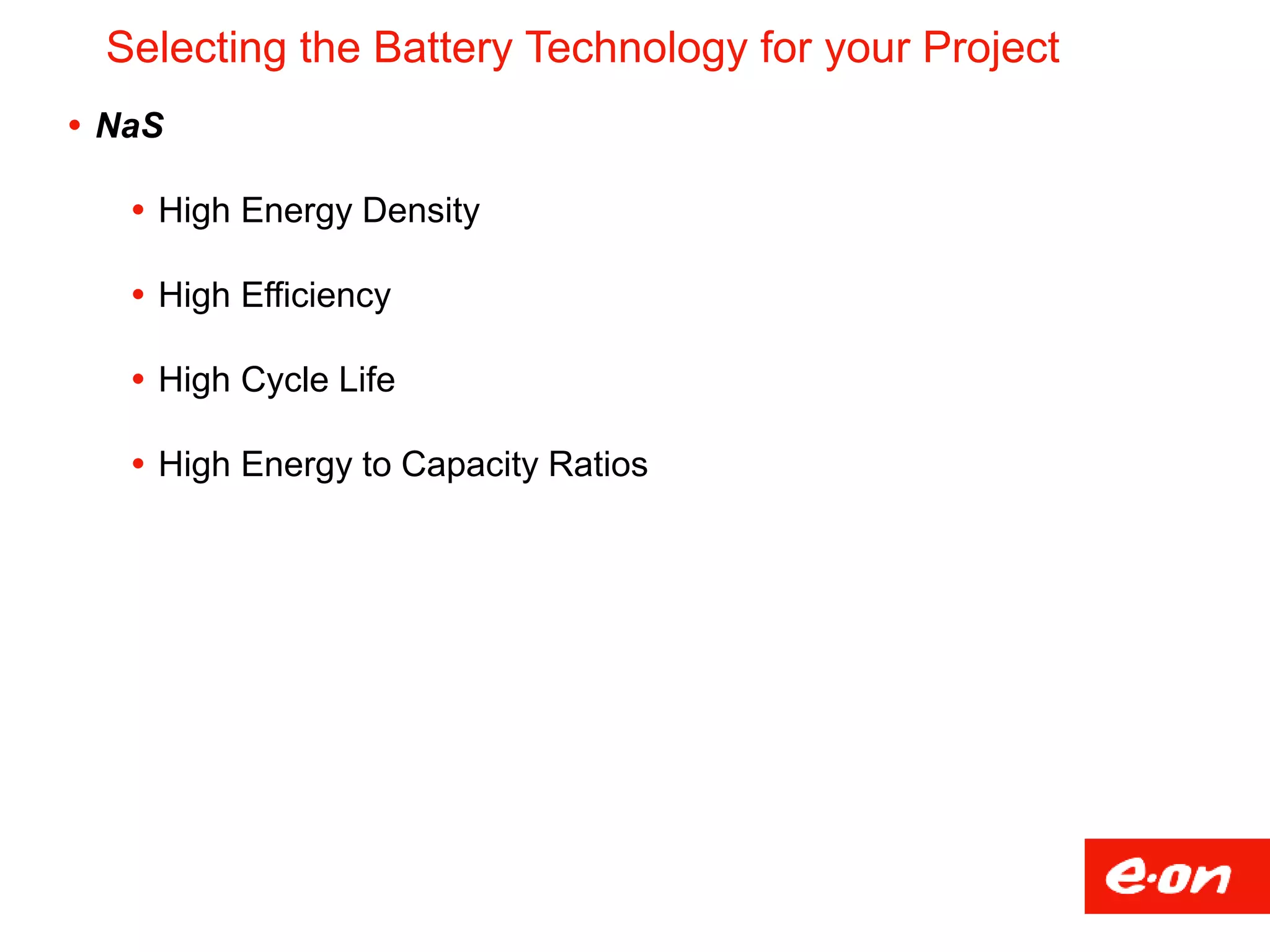
 NaS
 High Energy Density
 High Efficiency
 High Cycle Life
 High Energy to Capacity Ratios
Selecting the Battery Technology for your Project
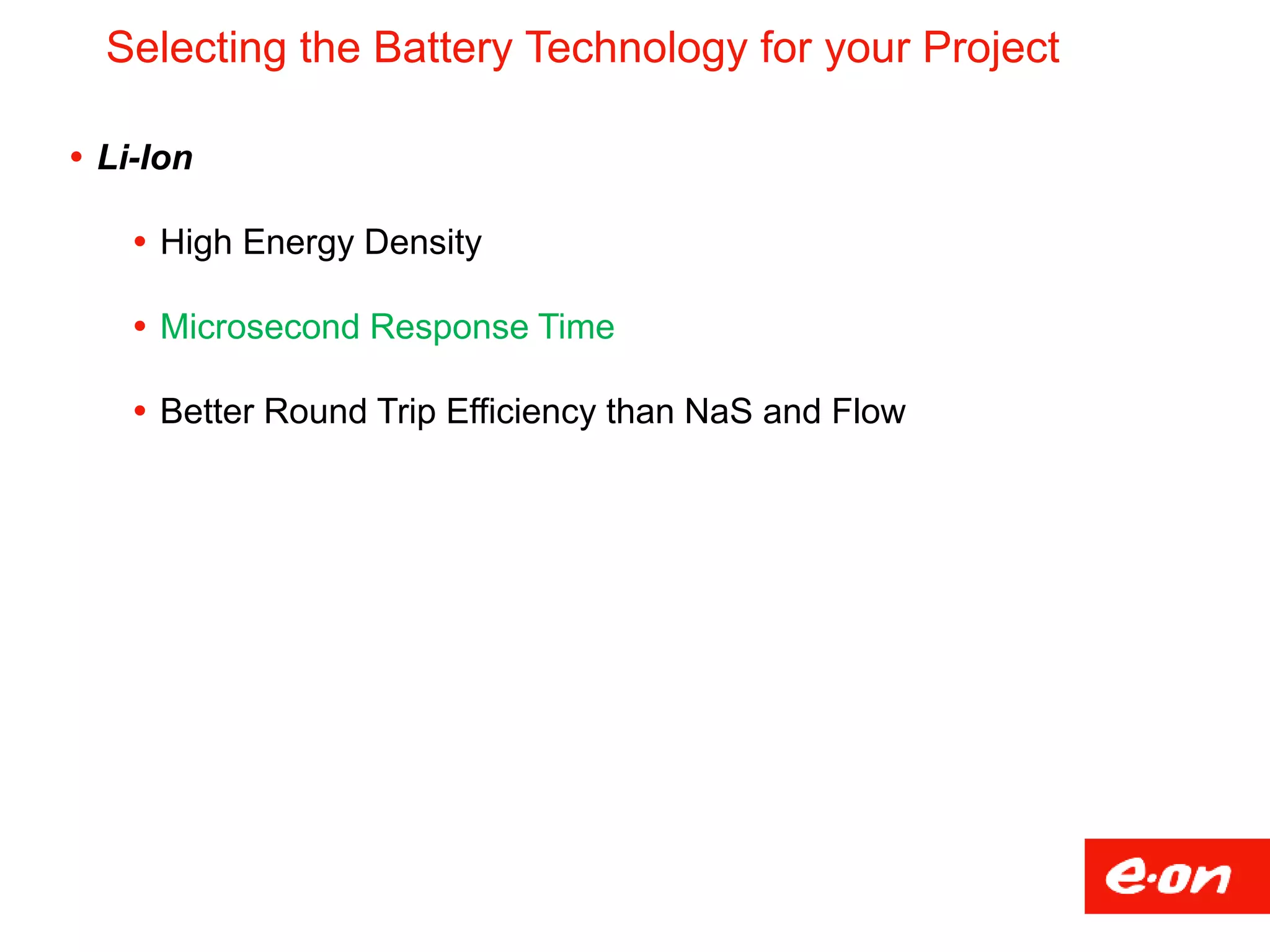
 Li-Ion
 High Energy Density
 Microsecond Response Time
 Better Round Trip Efficiency than NaS and Flow
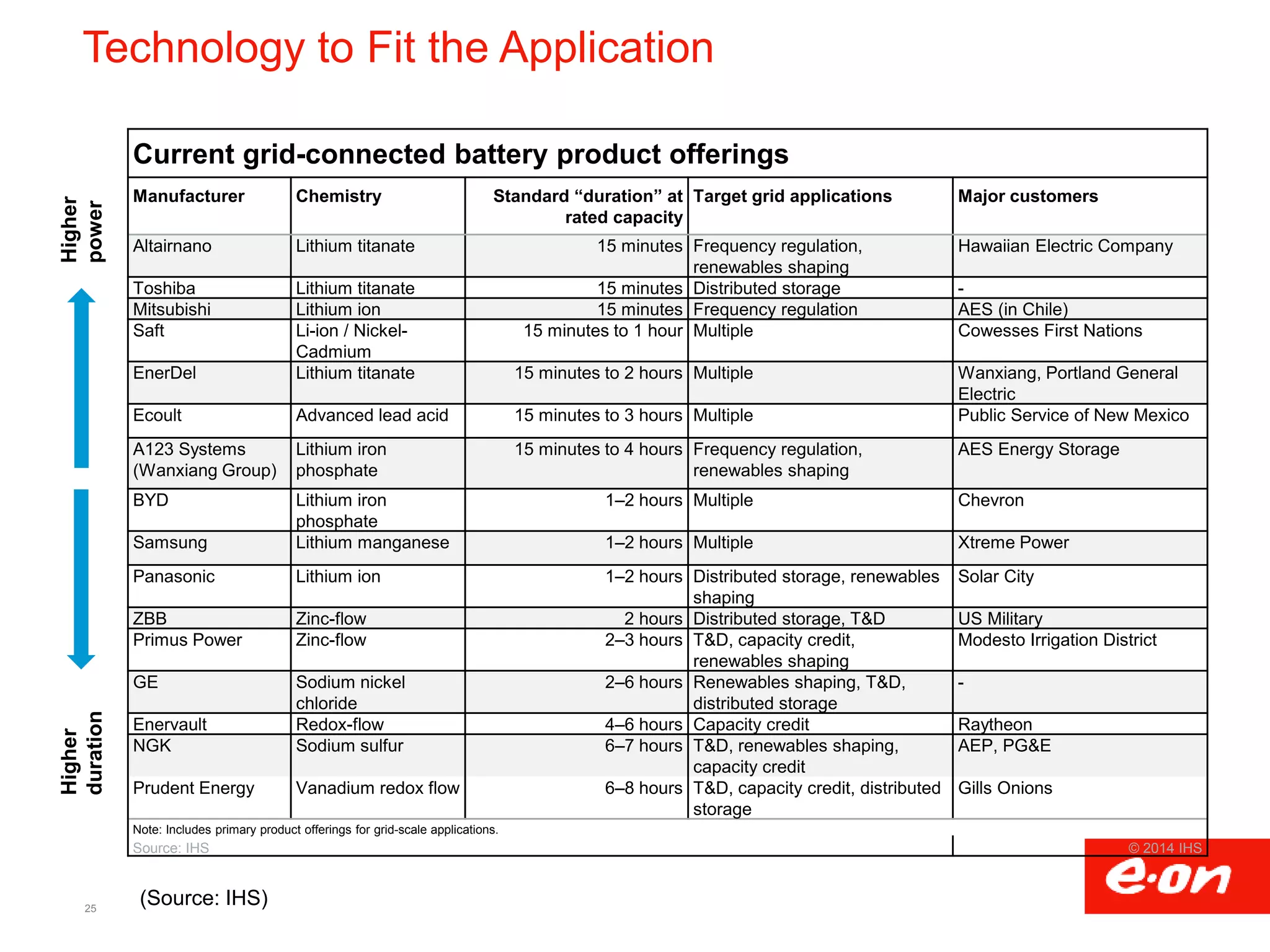
Technology to Fit the Application
25
Current grid-connected battery product offerings
Manufacturer Chemistry Standard “duration” at
rated capacity
Target grid applications Major customers
Altairnano Lithium titanate 15 minutes Frequency regulation,
renewables shaping
Hawaiian Electric Company
Toshiba Lithium titanate 15 minutes Distributed storage -
Mitsubishi Lithium ion 15 minutes Frequency regulation AES (in Chile)
Saft Li-ion / Nickel-
Cadmium
15 minutes to 1 hour Multiple Cowesses First Nations
EnerDel Lithium titanate 15 minutes to 2 hours Multiple Wanxiang, Portland General
Electric
Ecoult Advanced lead acid 15 minutes to 3 hours Multiple Public Service of New Mexico
A123 Systems
(Wanxiang Group)
Lithium iron
phosphate
15 minutes to 4 hours Frequency regulation,
renewables shaping
AES Energy Storage
BYD Lithium iron
phosphate
1–2 hours Multiple Chevron
Samsung Lithium manganese 1–2 hours Multiple Xtreme Power
Panasonic Lithium ion 1–2 hours Distributed storage, renewables
shaping
Solar City
ZBB Zinc-flow 2 hours Distributed storage, T&D US Military
Primus Power Zinc-flow 2–3 hours T&D, capacity credit,
renewables shaping
Modesto Irrigation District
GE Sodium nickel
chloride
2–6 hours Renewables shaping, T&D,
distributed storage
-
Enervault Redox-flow 4–6 hours Capacity credit Raytheon
NGK Sodium sulfur 6–7 hours T&D, renewables shaping,
capacity credit
AEP, PG&E
Prudent Energy Vanadium redox flow 6–8 hours T&D, capacity credit, distributed
storage
Gills Onions
Note: Includes primary product offerings for grid-scale applications.
Source: IHS © 2014 IHS
Higher
power
Higher
duration
(Source: IHS)
Comparison of three Li-Ion Chemistries
 Nickel Manganese Cobalt (NMC)
 Lithium Iron Phosphate (LFP)
 Lithium Titanate Oxide (LTO)
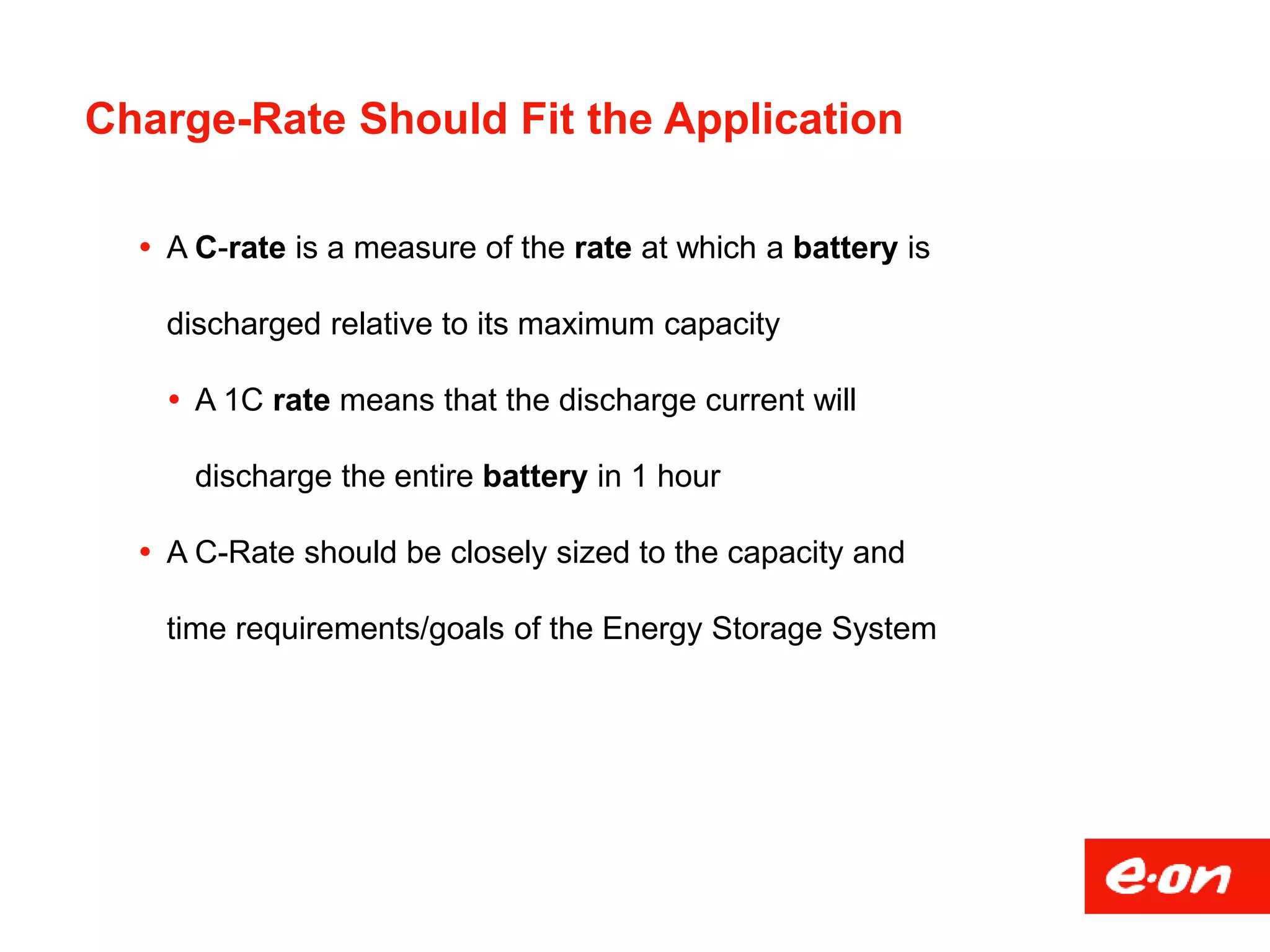
Charge-Rate Should Fit the Application
 A C-rate is a measure of the rate at which a battery is
discharged relative to its maximum capacity
 A 1C rate means that the discharge current will
discharge the entire battery in 1 hour
 A C-Rate should be closely sized to the capacity and
time requirements/goals of the Energy Storage System
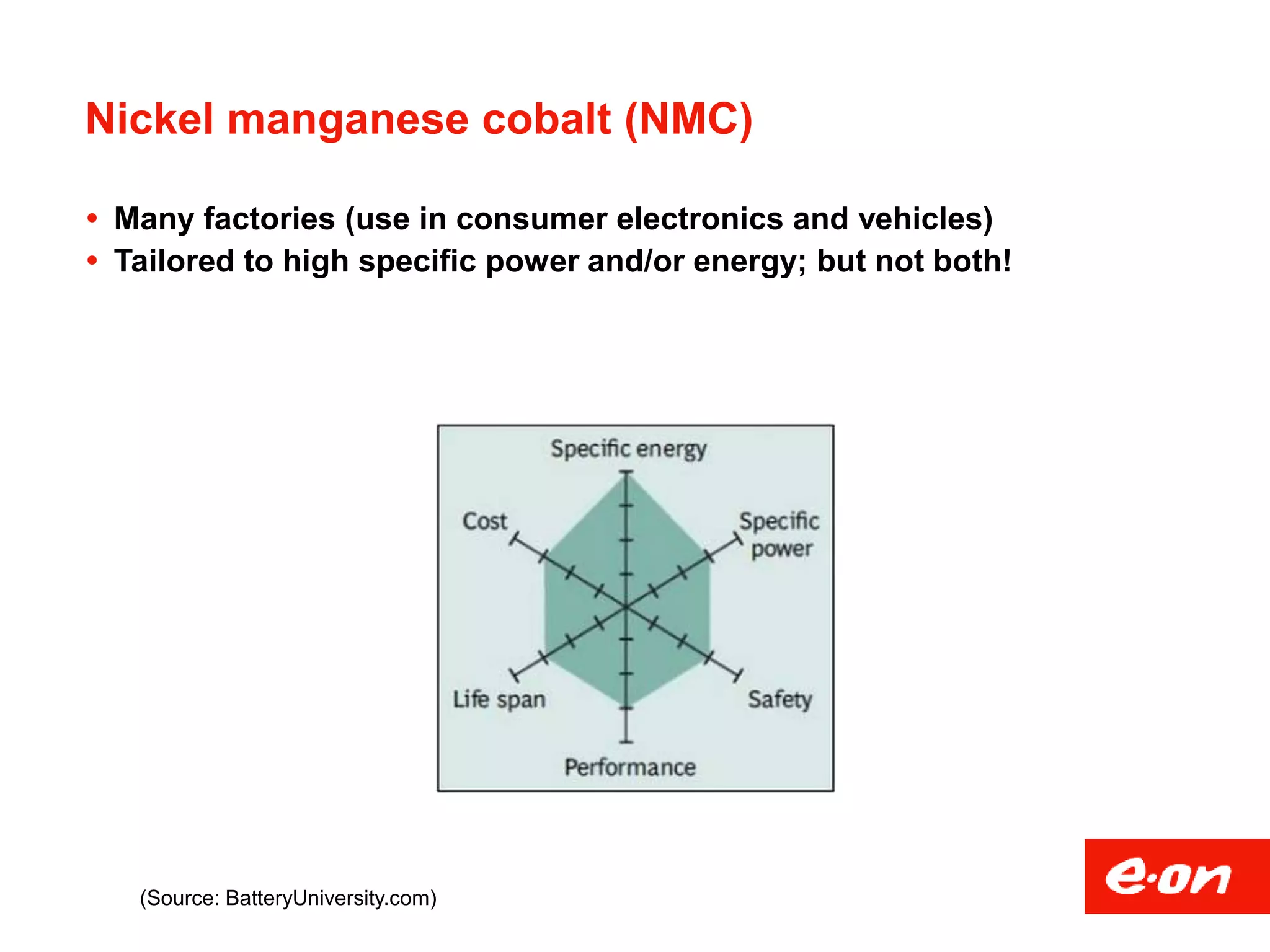
Nickel manganese cobalt (NMC)
 Many factories (use in consumer electronics and vehicles)
 Tailored to high specific power and/or energy; but not both!
(Source: BatteryUniversity.com)
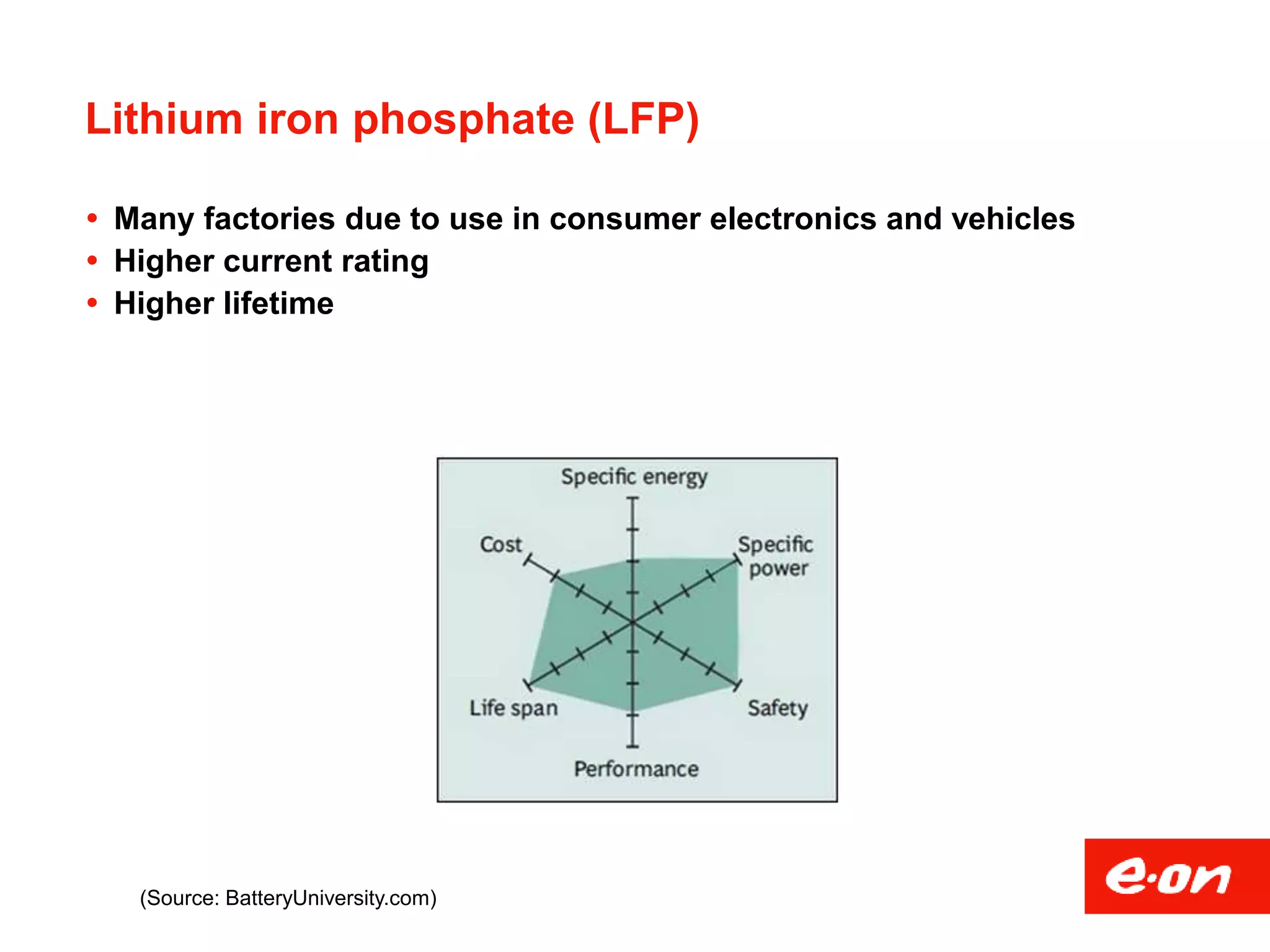
Lithium iron phosphate (LFP)
 Many factories due to use in consumer electronics and vehicles
 Higher current rating
 Higher lifetime
(Source: BatteryUniversity.com)
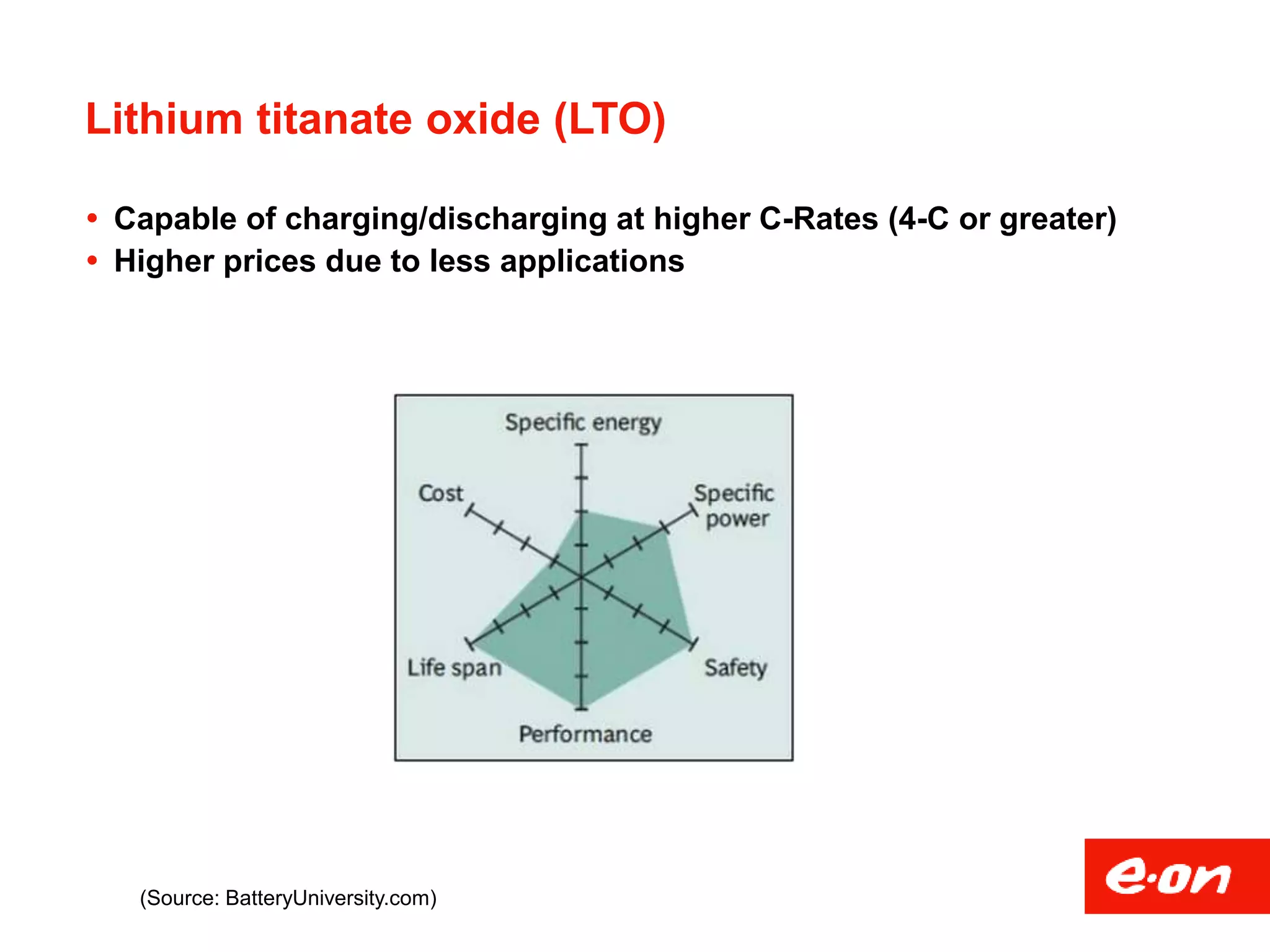
Lithium titanate oxide (LTO)
 Capable of charging/discharging at higher C-Rates (4-C or greater)
 Higher prices due to less applications
(Source: BatteryUniversity.com)
Cost
 Cost per MWhr
 Battery
 Cost per MW
Battery
BOP
31
CONTRACTING
Contracting the BESS
 Wrap as much as possible
 Battery supplier, integrator, installer, O&M
A wrap?
With a large balance sheet
 If tied to a longer solar PPA  Battery replacement plan
 Not to exceed replacement price
  Lifetime NPV evaluation
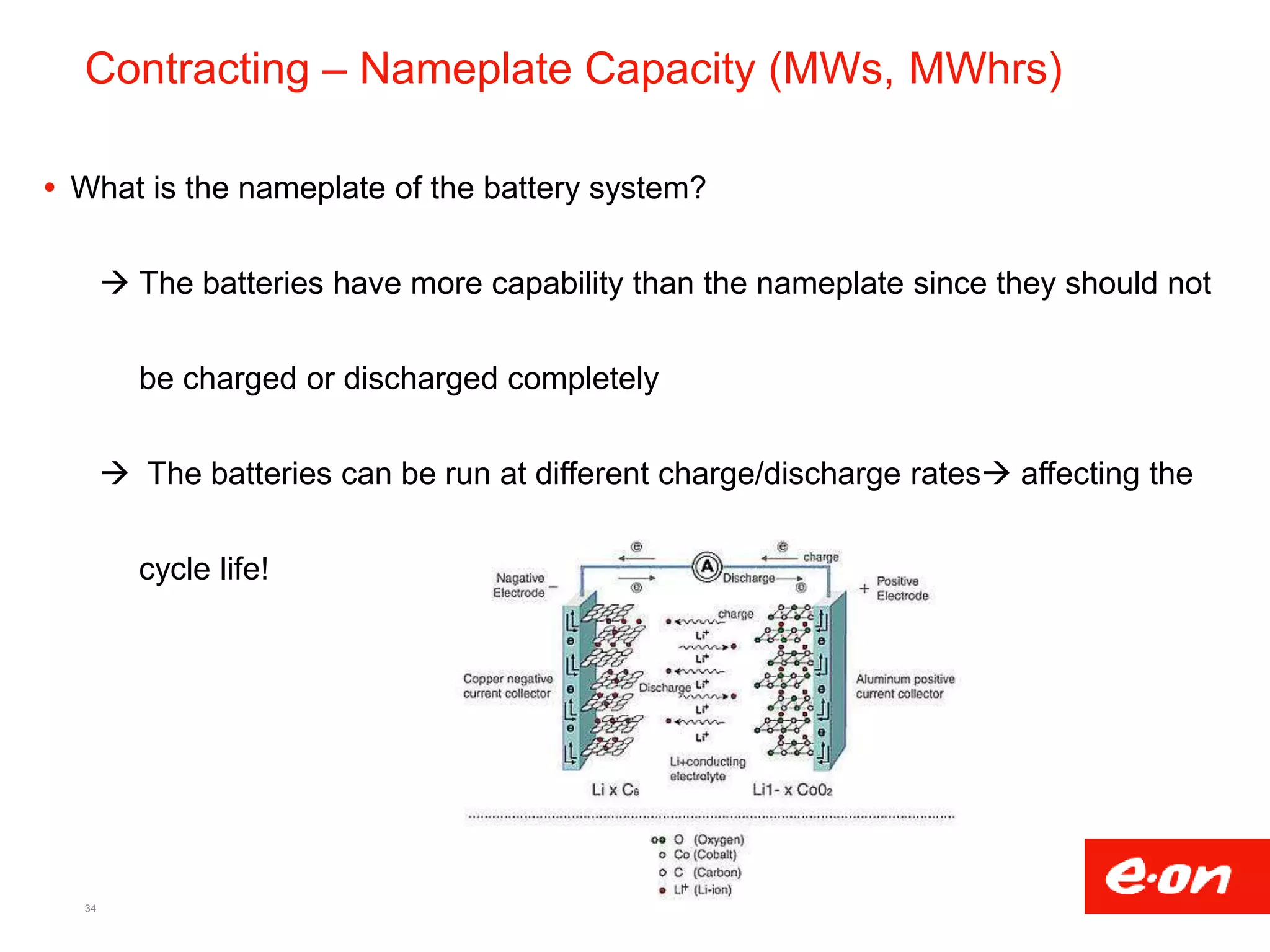
Contracting – Nameplate Capacity (MWs, MWhrs)
 What is the nameplate of the battery system?
 The batteries have more capability than the nameplate since they should not
be charged or discharged completely
 The batteries can be run at different charge/discharge rates affecting the
cycle life!
34
35
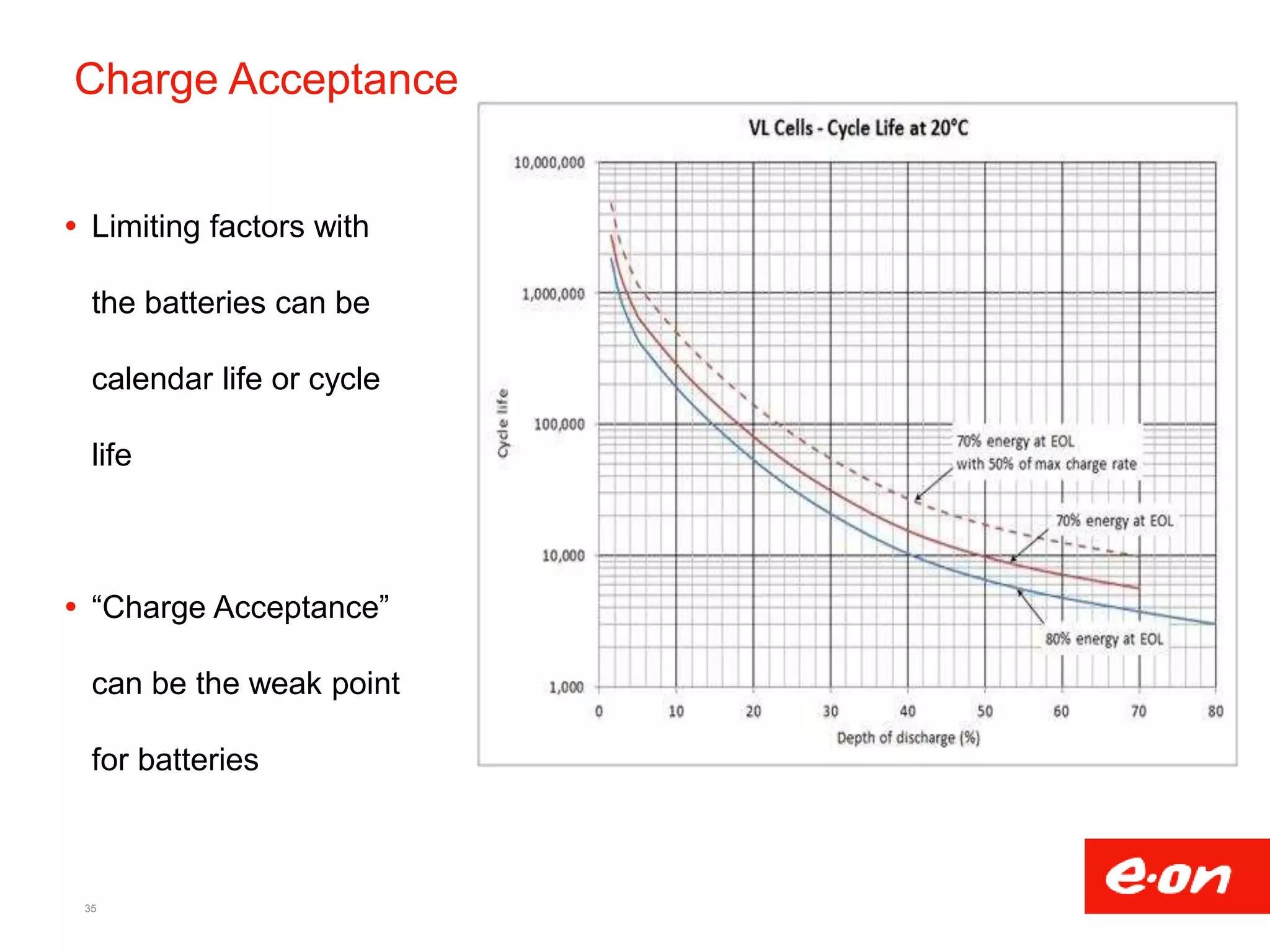
 Limiting factors with
the batteries can be
calendar life or cycle
life
 “Charge Acceptance”
can be the weak point
for batteries
Charge Acceptance
Contracting -- Guarantees
 Language to guarantee performance
 Rigorous Approach
Typical weather year for ramp
 Standard deviation doesn’t exceed
Existing grid frequency data for frequency
 Cycles and DOD - standard deviation again
 Number of cycles
Define a Depth of Discharge (DOD) for the cycle
  Guarantees come at a price
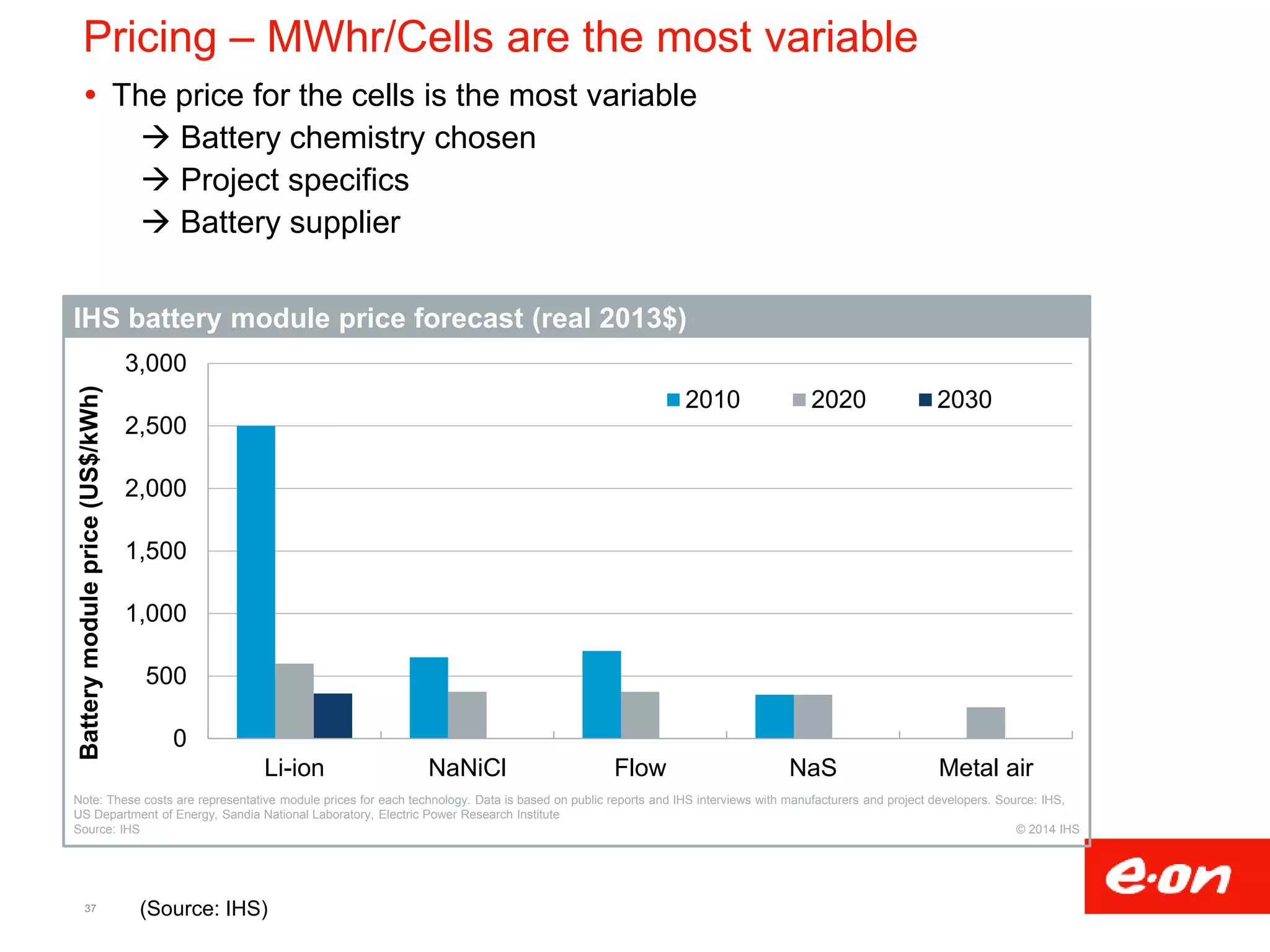
Pricing – MWhr/Cells are the most variable
37
0
500
1,000
1,500
2,000
2,500
3,000
Li-ion NaNiCl Flow NaS Metal air
2010 2020 2030
Batterymoduleprice(US$/kWh)
IHS battery module price forecast (real 2013$)
© 2014 IHS
Note: These costs are representative module prices for each technology. Data is based on public reports and IHS interviews with manufacturers and project developers. Source: IHS,
US Department of Energy, Sandia National Laboratory, Electric Power Research Institute
Source: IHS
 The price for the cells is the most variable
 Battery chemistry chosen
 Project specifics
 Battery supplier
(Source: IHS)
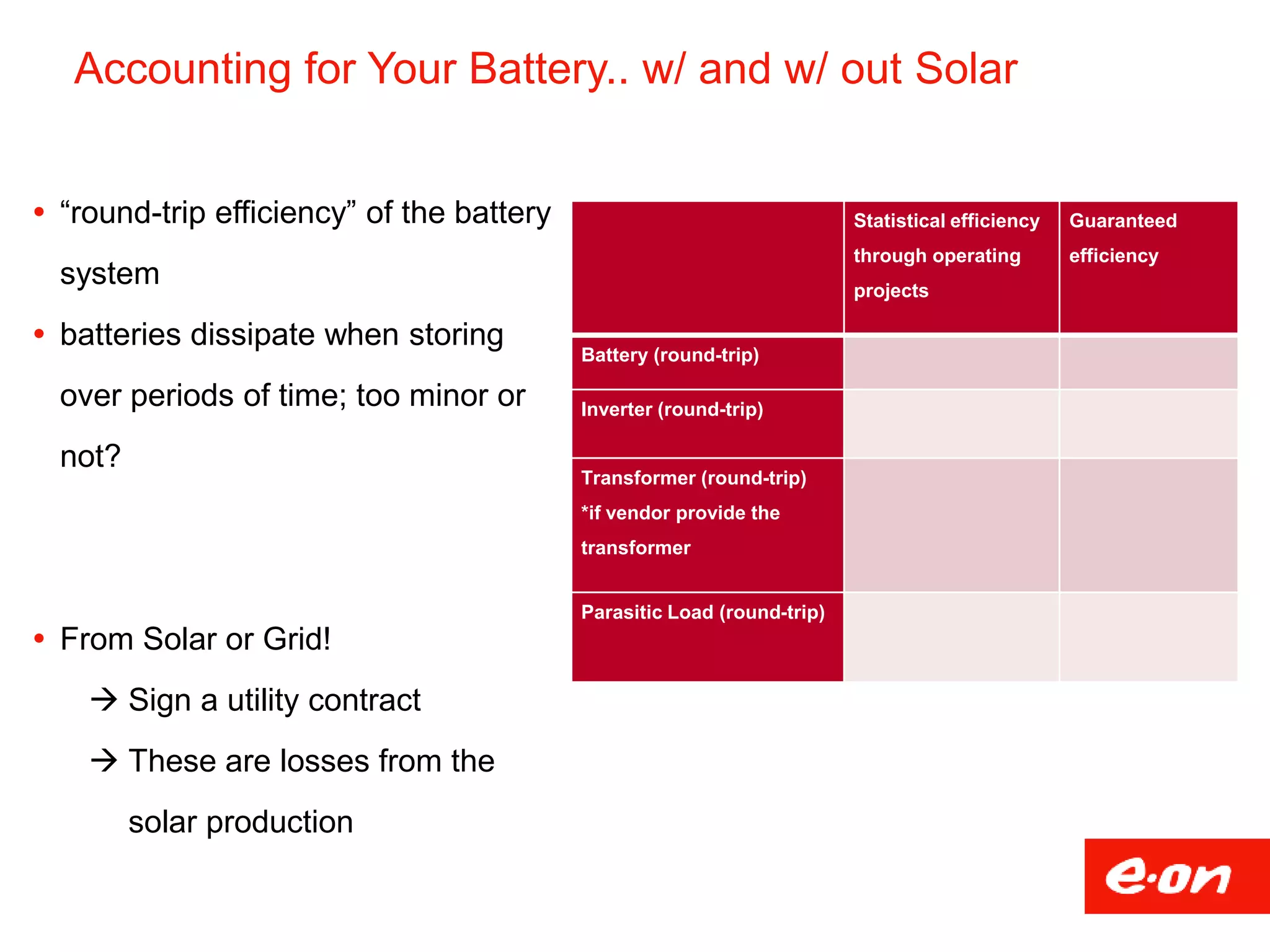
Accounting for Your Battery.. w/ and w/ out Solar
 “round-trip efficiency” of the battery
system
 batteries dissipate when storing
over periods of time; too minor or
not?
 From Solar or Grid!
 Sign a utility contract
 These are losses from the
solar production
Statistical efficiency
through operating
projects
Guaranteed
efficiency
Battery (round-trip)
Inverter (round-trip)
Transformer (round-trip)
*if vendor provide the
transformer
Parasitic Load (round-trip)
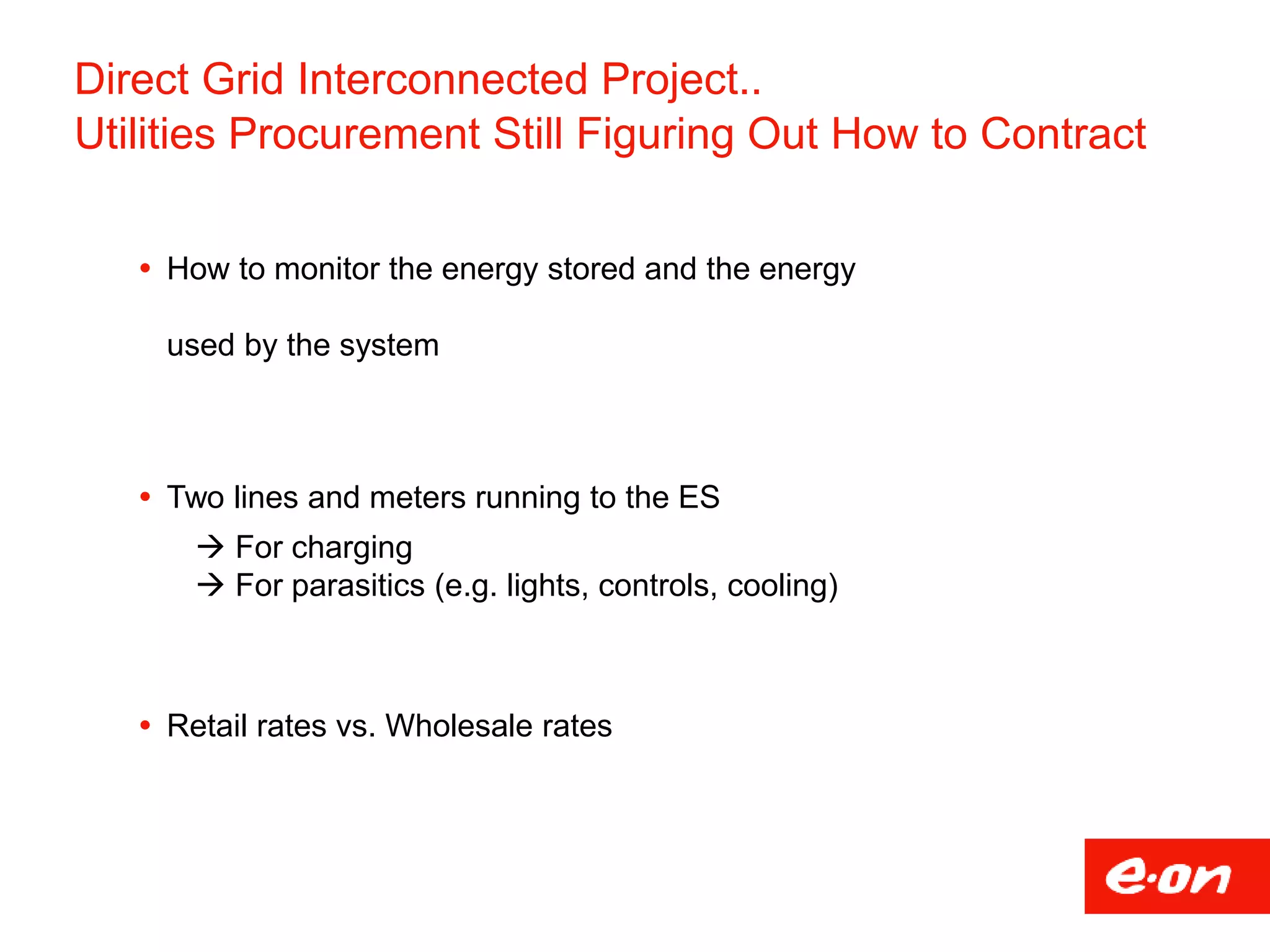
Direct Grid Interconnected Project..
Utilities Procurement Still Figuring Out How to Contract
 How to monitor the energy stored and the energy
used by the system
 Two lines and meters running to the ES
 For charging
 For parasitics (e.g. lights, controls, cooling)
 Retail rates vs. Wholesale rates
Contact:
Jake McKee
Vice President Engineering, PV
E.ON Climate & Renewables
jake.mckee@eon.com

Battery Integration & Technology Compare 7-7-15

  • 1.
    Battery Integration & EnergyStorage Options Jake McKee Vice President Engineering, Solar PV E.ON Climate & Renewables Energy Storage USA July 8th, 2015
  • 2.
     Opportunities andmonetizing  PG&E, PJM, TEP  Experiences in Puerto Rico  Developing, Engineering & Optimizing – Solar & Battery Projects  Design Considerations  Battery Technologies  Contracting Overview
  • 3.
  • 4.
  • 5.
    How PG&E plansto use Energy Storage (ES) procured through their RFO? -From their 2014 Energy Storage RFO Update 2-11-15  PG&E seeks ES that can be scheduled into the California Independent System Operator (“CAISO”) market, or  ES capable of enhancing system reliability, such as deferring distribution system upgrades
  • 6.
    6 PJM, ERCOT -Frequency Response Projects (Source: IHS)
  • 7.
    Tucson Electric Power(TEP) Energy Storage RFP  Frequency Response Real Power – ESS automatically delivers 10MW real power within 2 seconds and lasting 60 seconds then linearly ramping down to 0 in 15 seconds  Reserve Power – Deliver 10MW real power for up to 15 minutes upon manual command  Fault Response – Automatically dispatch reactive power when the utility POI voltage falls below 0.8 p.u.  Voltage Control – ESS provides proportional reactive power when POI voltage deviates outside defined deadband
  • 8.
  • 9.
    PREPA and MTRs!! Ramp Rate + Frequency Control  What if these happens at the same time?  MTRs led to a cost benefit sizing of battery  Complex language to measure violations
  • 10.
    Ramp Rate Control The PV facility shall be able to control the rate of change of power output  Rate of decrease of power!  A 10 % per minute rate (based on AC capacity)
  • 11.
    Frequency Response  ThePV facility shall provide an immediate real power primary frequency response of at least 10% of the maximum AC active power capacity  The time response (full 10% frequency response) shall be less than 1 second  The facility frequency response shall be maintained for at least 9 minutes 11
  • 12.
    Options Considered forPR/Island Grid Requirements  Fly Wheels, lacking longevity  Diesel Generators, lacking response time  Super Capacitors, lacking longevity  Forecasting, not mature of a field to finance  Batteries  Various combinations of the above  PURE BATTERY SOLUTION WON
  • 13.
    MOST PROMINENT ESTECHNOLOGY… FOR DEVELOPERS ?
  • 14.
    - 5,000 10,000 15,000 20,000 25,000 2013 2014 20152016 2017 2018 2019 2020 2021 2022 2023 (MW) NAS Battery CAES Pumped Hydro Advanced Lithium Ion Advanced Lead Acid Flywheel Advanced Flow Battery Hydrogen SMH Energy Storage Technology Forecast, World Markets: 2013-2023 (Source: Navigant Research) Advanced Lithium Ion will Continue to Increase in Demand and Lead Other Technologies
  • 15.
    (Source: IHS) Battery InstallationsHave Shifted Towards Li-ion
  • 16.
    DEVELOPING, ENGINEERING &OPTIMIZING – SOLAR AND ES PROJECTS  Design Considerations  Battery Technologies  Contracting
  • 17.
  • 18.
    What to Consider 18 What is the primary need for the storage?  Any peripheral uses?  Choosing a storage technology  Choosing a battery provider  Choosing an integrator  Choosing an installer
  • 19.
    Goals for theStorage  Renewable Energy Smoothing (ramp rate)  Renewable Energy Shifting and Firming  Ancillary Services  Arbitrage  Peaking Capacity  Transmission and distribution investment deferment  Distributed Generation Support / Distributed Storage 19
  • 20.
  • 21.
    Selecting the BatteryTechnology for your Project  Flow  NaS  Li-Ion  Advanced Lead Acid
  • 22.
    Selecting the BatteryTechnology for your Project  Flow technologies  Higher Cycle Lifetimes  Low Maintenance  Quick Response Time  Applications requiring longer duration  Break point to go to flow is ~2 hours
  • 23.
    Selecting the BatteryTechnology for your Project  NaS  High Energy Density  High Efficiency  High Cycle Life  High Energy to Capacity Ratios
  • 24.
    Selecting the BatteryTechnology for your Project  Li-Ion  High Energy Density  Microsecond Response Time  Better Round Trip Efficiency than NaS and Flow
  • 25.
    Technology to Fitthe Application 25 Current grid-connected battery product offerings Manufacturer Chemistry Standard “duration” at rated capacity Target grid applications Major customers Altairnano Lithium titanate 15 minutes Frequency regulation, renewables shaping Hawaiian Electric Company Toshiba Lithium titanate 15 minutes Distributed storage - Mitsubishi Lithium ion 15 minutes Frequency regulation AES (in Chile) Saft Li-ion / Nickel- Cadmium 15 minutes to 1 hour Multiple Cowesses First Nations EnerDel Lithium titanate 15 minutes to 2 hours Multiple Wanxiang, Portland General Electric Ecoult Advanced lead acid 15 minutes to 3 hours Multiple Public Service of New Mexico A123 Systems (Wanxiang Group) Lithium iron phosphate 15 minutes to 4 hours Frequency regulation, renewables shaping AES Energy Storage BYD Lithium iron phosphate 1–2 hours Multiple Chevron Samsung Lithium manganese 1–2 hours Multiple Xtreme Power Panasonic Lithium ion 1–2 hours Distributed storage, renewables shaping Solar City ZBB Zinc-flow 2 hours Distributed storage, T&D US Military Primus Power Zinc-flow 2–3 hours T&D, capacity credit, renewables shaping Modesto Irrigation District GE Sodium nickel chloride 2–6 hours Renewables shaping, T&D, distributed storage - Enervault Redox-flow 4–6 hours Capacity credit Raytheon NGK Sodium sulfur 6–7 hours T&D, renewables shaping, capacity credit AEP, PG&E Prudent Energy Vanadium redox flow 6–8 hours T&D, capacity credit, distributed storage Gills Onions Note: Includes primary product offerings for grid-scale applications. Source: IHS © 2014 IHS Higher power Higher duration (Source: IHS)
  • 26.
    Comparison of threeLi-Ion Chemistries  Nickel Manganese Cobalt (NMC)  Lithium Iron Phosphate (LFP)  Lithium Titanate Oxide (LTO)
  • 27.
    Charge-Rate Should Fitthe Application  A C-rate is a measure of the rate at which a battery is discharged relative to its maximum capacity  A 1C rate means that the discharge current will discharge the entire battery in 1 hour  A C-Rate should be closely sized to the capacity and time requirements/goals of the Energy Storage System
  • 28.
    Nickel manganese cobalt(NMC)  Many factories (use in consumer electronics and vehicles)  Tailored to high specific power and/or energy; but not both! (Source: BatteryUniversity.com)
  • 29.
    Lithium iron phosphate(LFP)  Many factories due to use in consumer electronics and vehicles  Higher current rating  Higher lifetime (Source: BatteryUniversity.com)
  • 30.
    Lithium titanate oxide(LTO)  Capable of charging/discharging at higher C-Rates (4-C or greater)  Higher prices due to less applications (Source: BatteryUniversity.com)
  • 31.
    Cost  Cost perMWhr  Battery  Cost per MW Battery BOP 31
  • 32.
  • 33.
    Contracting the BESS Wrap as much as possible  Battery supplier, integrator, installer, O&M A wrap? With a large balance sheet  If tied to a longer solar PPA  Battery replacement plan  Not to exceed replacement price   Lifetime NPV evaluation
  • 34.
    Contracting – NameplateCapacity (MWs, MWhrs)  What is the nameplate of the battery system?  The batteries have more capability than the nameplate since they should not be charged or discharged completely  The batteries can be run at different charge/discharge rates affecting the cycle life! 34
  • 35.
    35  Limiting factorswith the batteries can be calendar life or cycle life  “Charge Acceptance” can be the weak point for batteries Charge Acceptance
  • 36.
    Contracting -- Guarantees Language to guarantee performance  Rigorous Approach Typical weather year for ramp  Standard deviation doesn’t exceed Existing grid frequency data for frequency  Cycles and DOD - standard deviation again  Number of cycles Define a Depth of Discharge (DOD) for the cycle   Guarantees come at a price
  • 37.
    Pricing – MWhr/Cellsare the most variable 37 0 500 1,000 1,500 2,000 2,500 3,000 Li-ion NaNiCl Flow NaS Metal air 2010 2020 2030 Batterymoduleprice(US$/kWh) IHS battery module price forecast (real 2013$) © 2014 IHS Note: These costs are representative module prices for each technology. Data is based on public reports and IHS interviews with manufacturers and project developers. Source: IHS, US Department of Energy, Sandia National Laboratory, Electric Power Research Institute Source: IHS  The price for the cells is the most variable  Battery chemistry chosen  Project specifics  Battery supplier (Source: IHS)
  • 38.
    Accounting for YourBattery.. w/ and w/ out Solar  “round-trip efficiency” of the battery system  batteries dissipate when storing over periods of time; too minor or not?  From Solar or Grid!  Sign a utility contract  These are losses from the solar production Statistical efficiency through operating projects Guaranteed efficiency Battery (round-trip) Inverter (round-trip) Transformer (round-trip) *if vendor provide the transformer Parasitic Load (round-trip)
  • 39.
    Direct Grid InterconnectedProject.. Utilities Procurement Still Figuring Out How to Contract  How to monitor the energy stored and the energy used by the system  Two lines and meters running to the ES  For charging  For parasitics (e.g. lights, controls, cooling)  Retail rates vs. Wholesale rates
  • 40.
    Contact: Jake McKee Vice PresidentEngineering, PV E.ON Climate & Renewables jake.mckee@eon.com

Editor's Notes

  • #3 E.ON not the fully allotted 2 minutes!
  • #5 Renewable energy shifting and firming (charge in off peak and release in peak to follow a predefined pattern). = Variable resource shaping. Renew Energy Smoothing (smooth intermittent generation) = above Ancillary Service = provide or absorb active power (reactive power) to keep the grid frequency (respectively voltage) within allowed boundaries. Microgrid Diesel Abatement = Distributed Storage
  • #7 Investor owned utility - CUT
  • #24 Performs as a: capacity resource distributed storage to defer (T&D) upgrades capable of performing frequency backup generation to avoid outages at remote sites transmission and distribution asset upgrades on overstressed lines and substations
  • #25 There is currently a surplus of Li-ion manufacturing capacity due to slower than anticipated growth in electric vehicle (EVs) demand, which has contributed to recent price declines in Li-Ion
  • #28 Higher C-Rates can be advantageous because they require lower energy/less cells. (Incorrect above)
  • #36 By Q2/Q3 2015 there should be symmetric charge-discharge due to better charge acceptance
  • #38 Suppliers selling below their cost?