Redesigning Courses Online
Using Active Higher Education
Learning Theories
Jace Hargis, PhD
Day 1
•
How to Learn Online: Learning Theory
•
What to do BEFORE you go online…
•
Course [Re]Design
•
Teaching Goals and Alignment
•
Assessment Strategies, Objectives Matrix
•
Teaching Models and Effective Lectures
Day 2
•
E-learning 101: Delivery technologies
− Skype, IM, Google Docs, E-Whiteboards and
Second Life, Sakai, blogs, podcasts, wikis
•
E-Learning Tools: Creating digital
− Audio/video, developing learning objects,
using Flip cameras, iPod Nanos, netbooks
Day 3
•
Online Learning Tools:
− Collaboration, Student-Centeredness:
Methods focused on individual learning styles
•
Facilitating Learning Online:
− Discussion Boards, Chats, Managing
Students
•
Web 2.0 Tools for Active BL/OL
− Emerging instructional technologies,
Assessing and Grading Online
What is Learning?
•
Driscoll (2002)
a) occurs in context;
b) is active;
c) social; and
d) reflective.
•
Schunk (1996)
e) change in the capacity for behavior;
f) endures over time; and
g) occurs through experience.
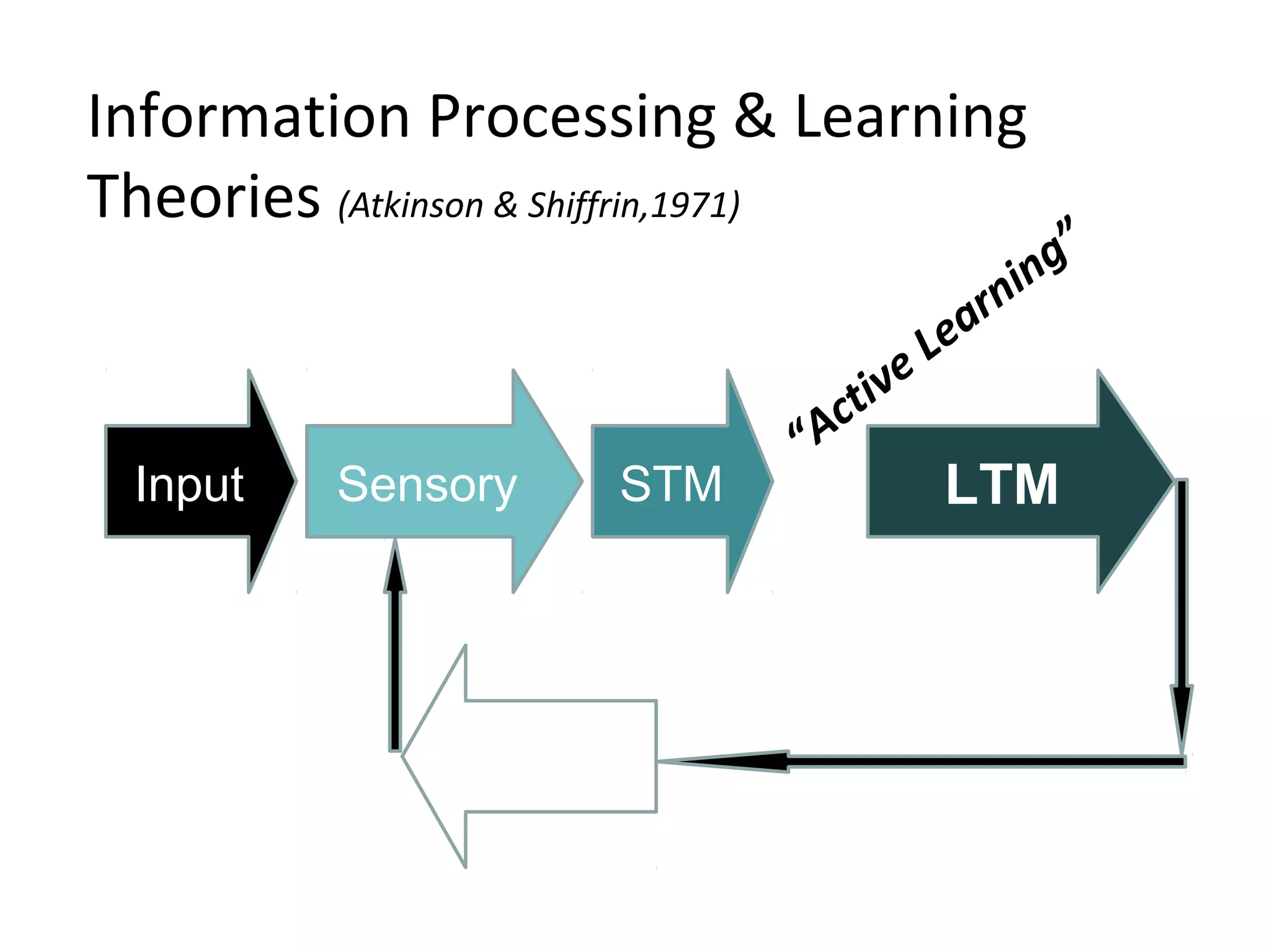
Information Processing & Learning
Theories (Atkinson & Shiffrin,1971)
Input Sensory STM LTM
Recall
“Active Learning”
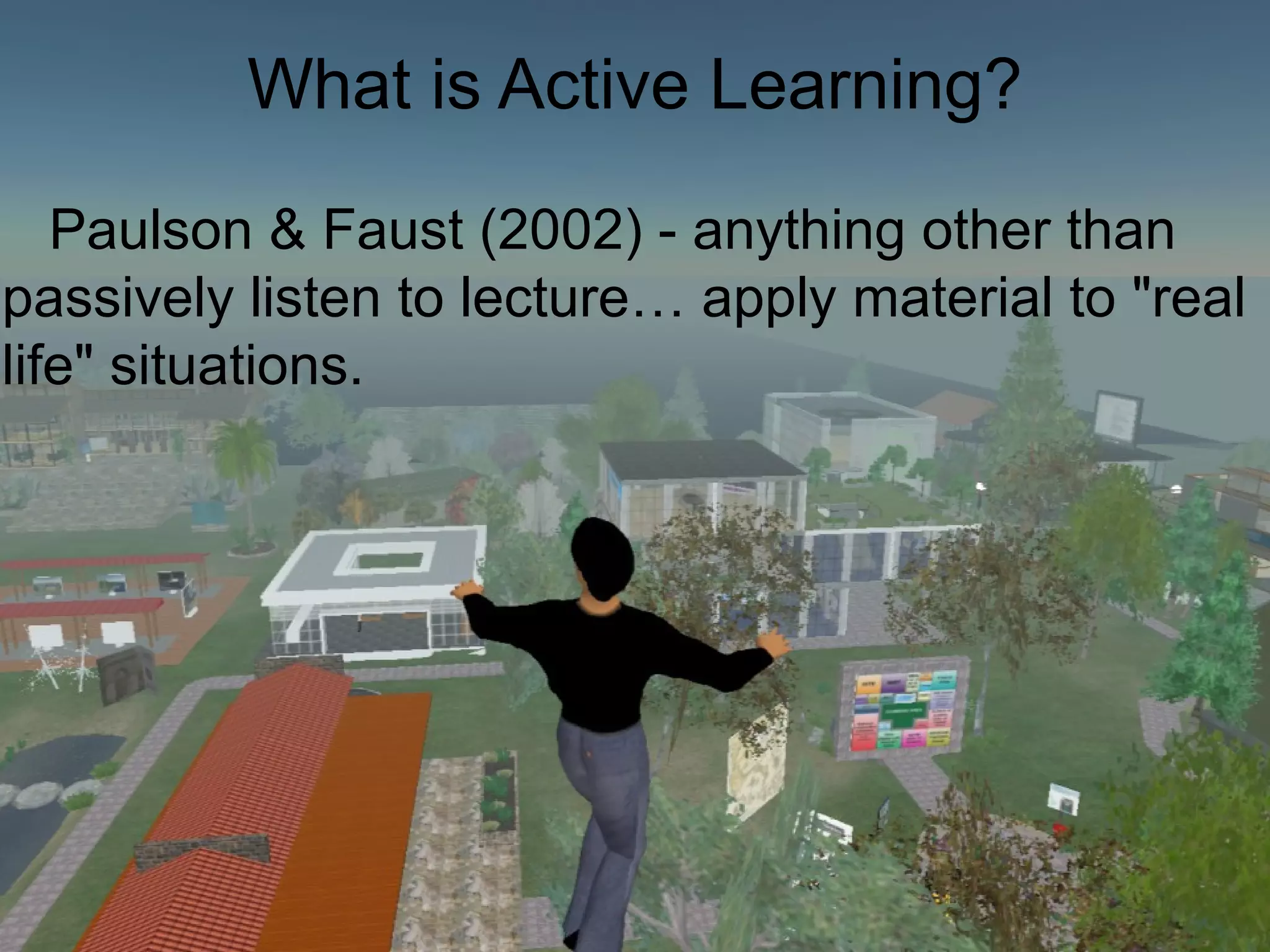
What is Active Learning?
Paulson & Faust (2002) - anything other than
passively listen to lecture… apply material to "real
life" situations.
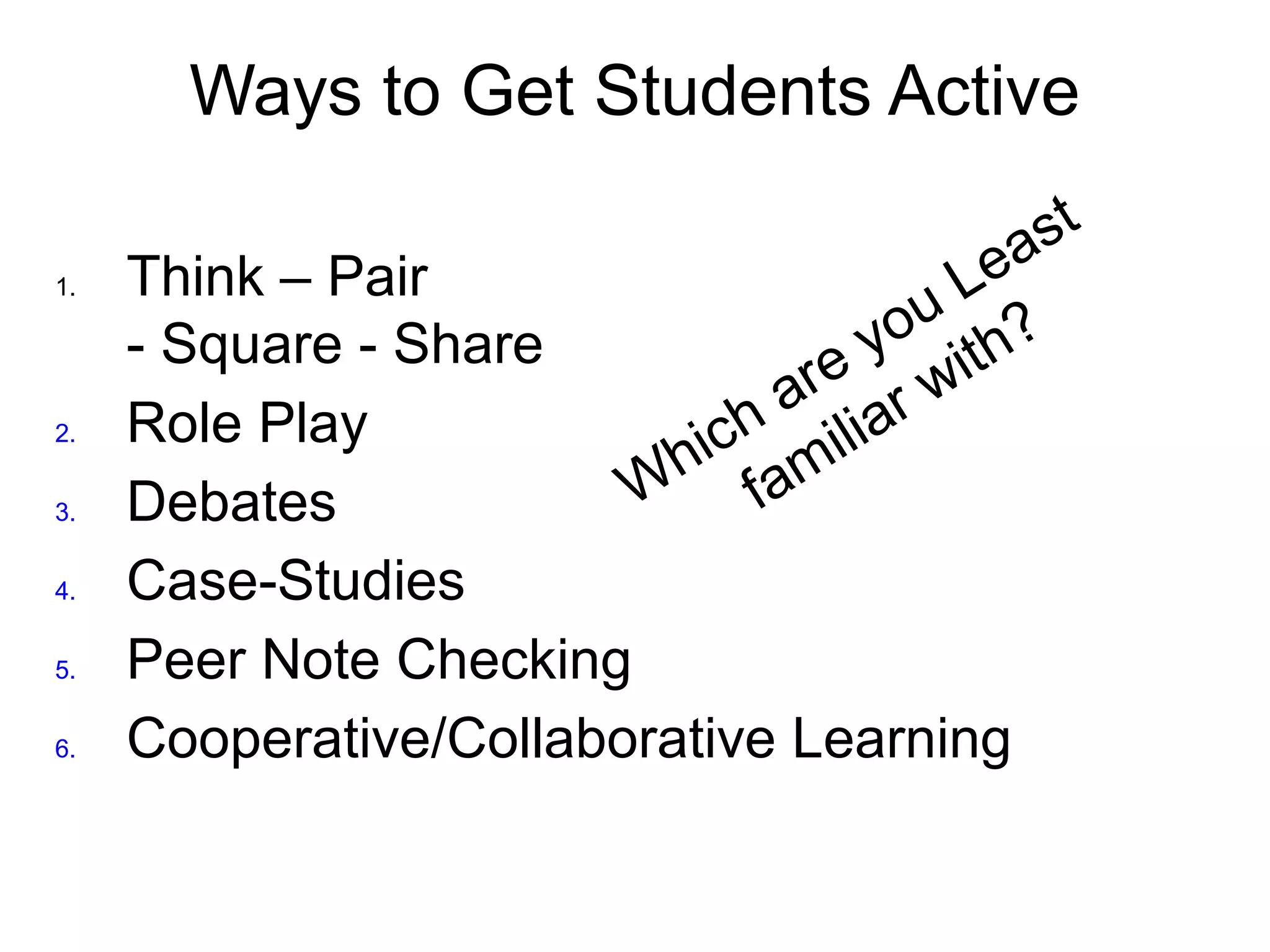
Ways to Get Students Active
1. Think – Pair
- Square - Share
2. Role Play
3. Debates
4. Case-Studies
5. Peer Note Checking
6. Cooperative/Collaborative Learning
Which are you Least
familiar with?
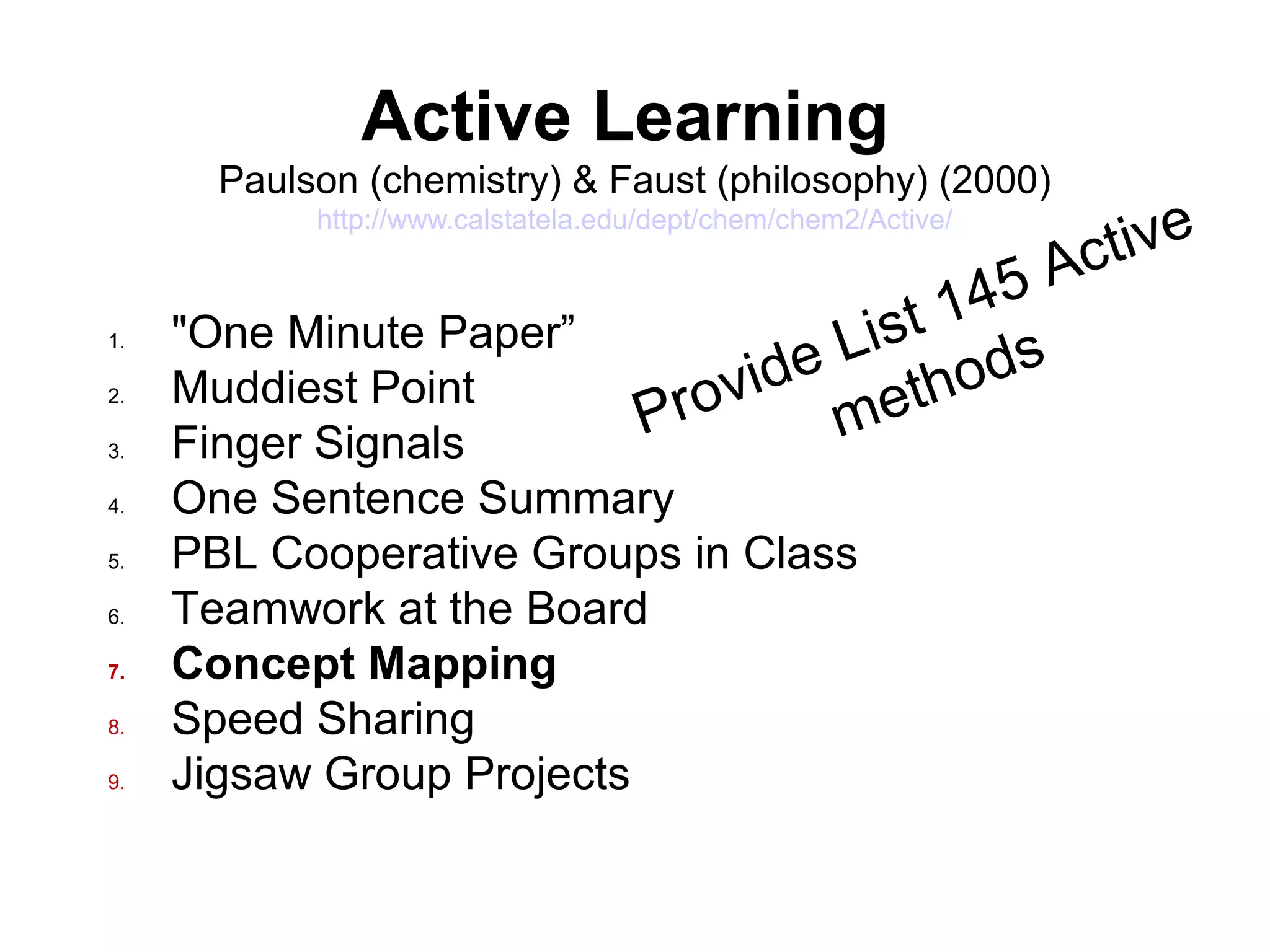
Provide List 145 Active
methods
Active Learning
Paulson (chemistry) & Faust (philosophy) (2000)
http://www.calstatela.edu/dept/chem/chem2/Active/
1. "One Minute Paper”
2. Muddiest Point
3. Finger Signals
4. One Sentence Summary
5. PBL Cooperative Groups in Class
6. Teamwork at the Board
7. Concept Mapping
8. Speed Sharing
9. Jigsaw Group Projects
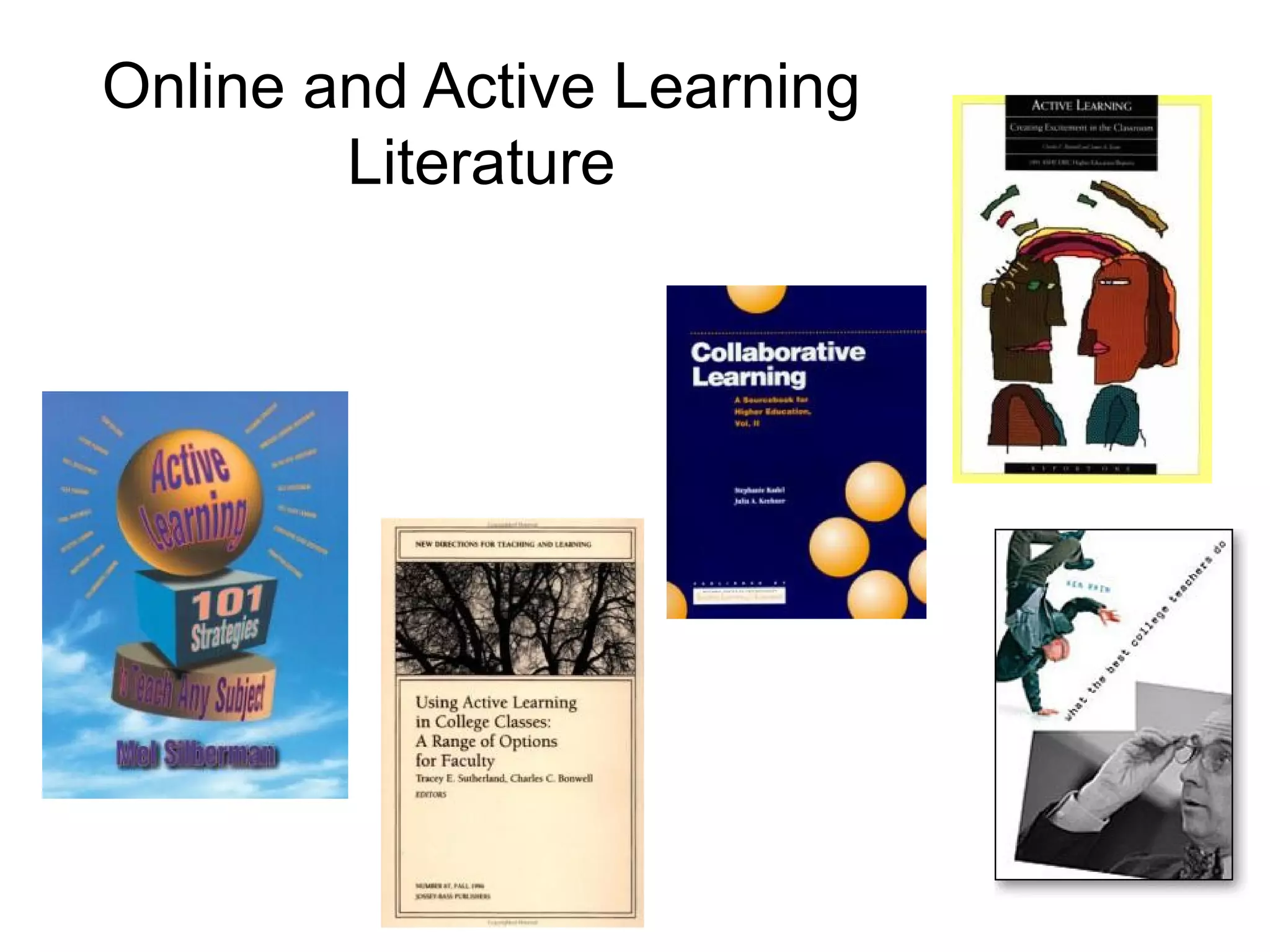
Online and Active Learning
Literature
Concept Mapping
(Novak, 1984)
• Brain Storming
• Complex ideas
• Explicitly integrating new/old knowledge
• Assess and diagnose understanding
Let’s Map OUR Courses!
Course Design: Outcomes
•
Design your courses BACKWARDS.
Start with outcomes, use these desired outcomes to guide
decisions to attain those outcomes. Do not simply build a
course from Day One and then go forward…
•
What will the students know when they are complete?
•
What will the students be able to do at the end?
•
How will you know if they have achieved your learning goals?
•
What skills will they need to become lifelong learners?
•
What tools will you need to expand learning opportunities?
•
What activities will you need to engage students?
•
What do they need to know when they come to your course?
•
How will students need to relate to the discipline to become
professionals?
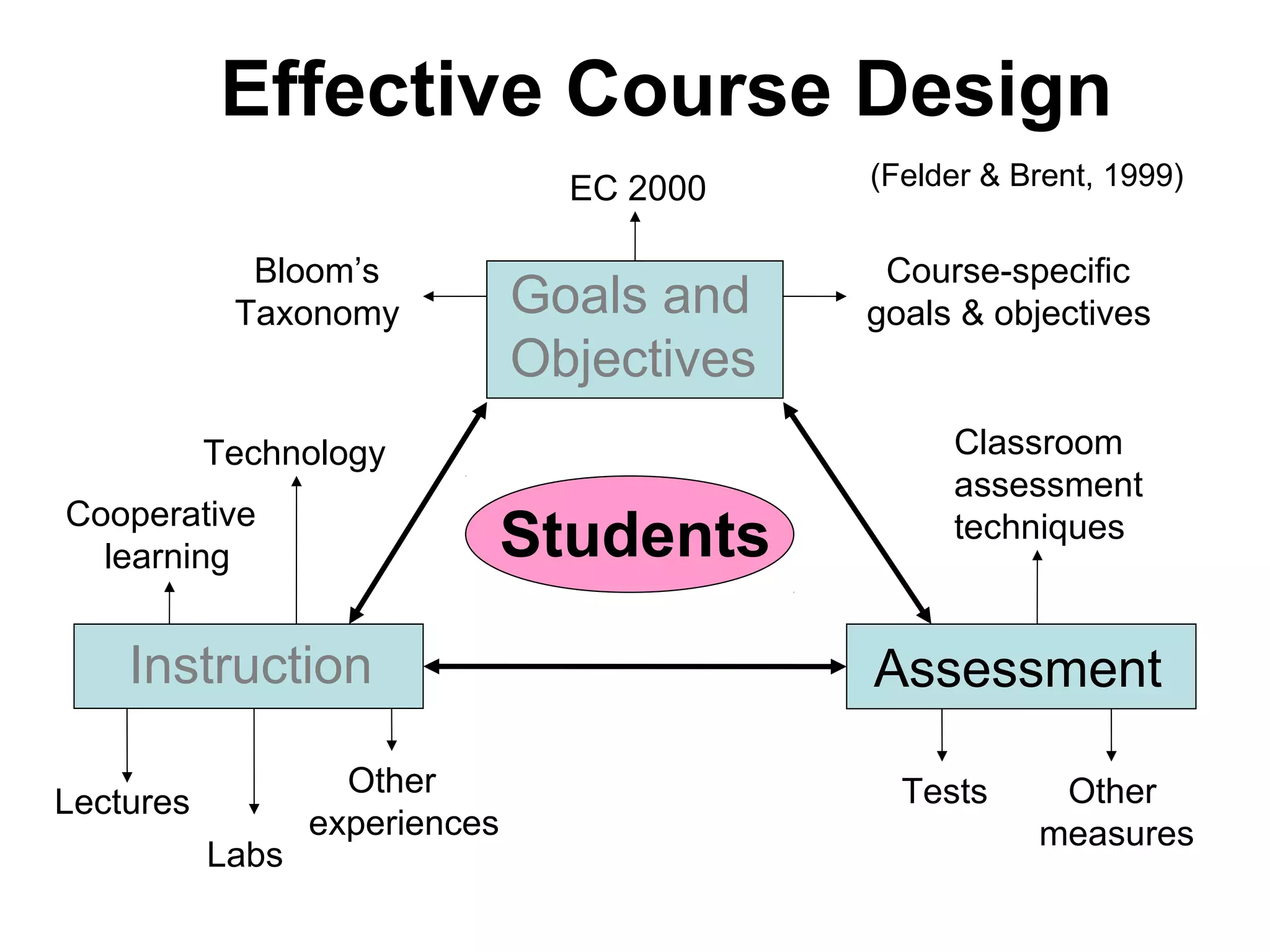
Effective Course Design
Students
Goals and
Objectives
Assessment
EC 2000
Bloom’s
Taxonomy
Course-specific
goals & objectives
Cooperative
learning
Lectures
Labs
Other
experiences
Classroom
assessment
techniques
Tests
Instruction
Other
measures
Technology
(Felder & Brent, 1999)
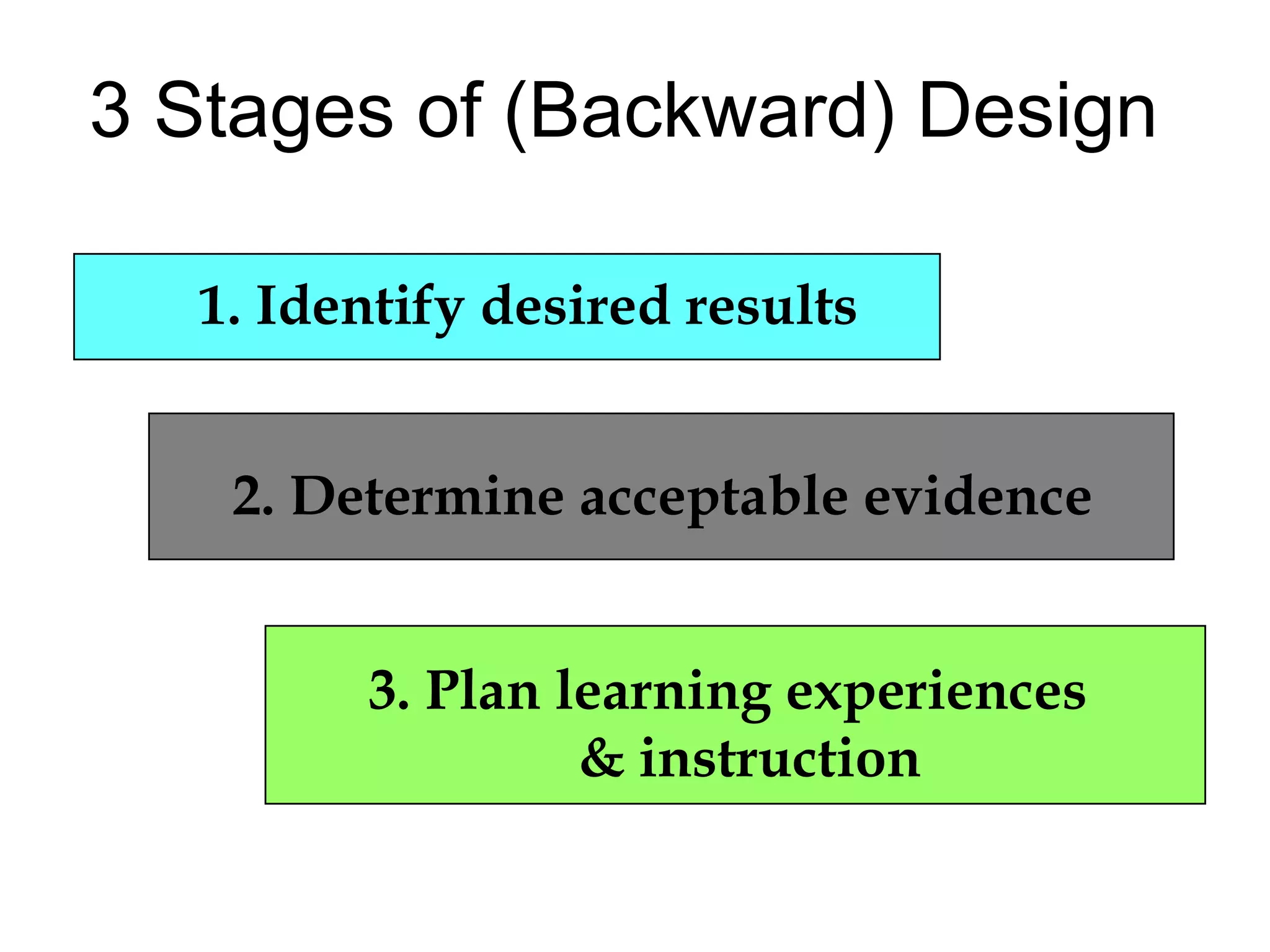
1. Identify desired results
2. Determine acceptable evidence
3. Plan learning experiences
& instruction
3 Stages of (Backward) Design
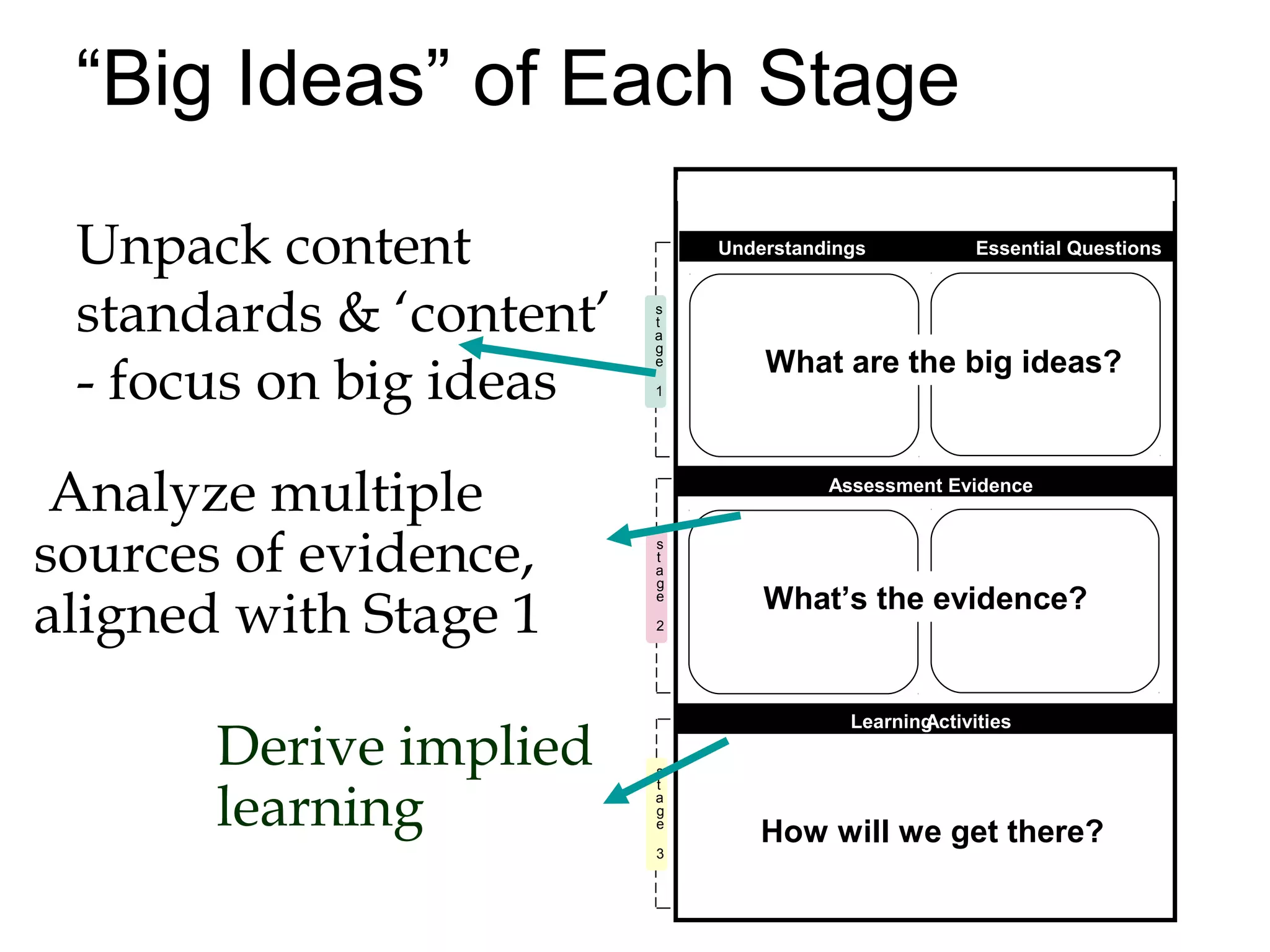
“Big Ideas” of Each Stage
Assessment Evidence
LearningActivities
Understandings Essential Questions
s
t
a
g
e
2
s
t
a
g
e
3
Standard(s):
s
t
a
g
e
1
PerformanceTask(s): Other Evidence:
Unpack content
standards & ‘content’
- focus on big ideas
Analyze multiple
sources of evidence,
aligned with Stage 1
Derive implied
learning
What are the big ideas?
What’s the evidence?
How will we get there?
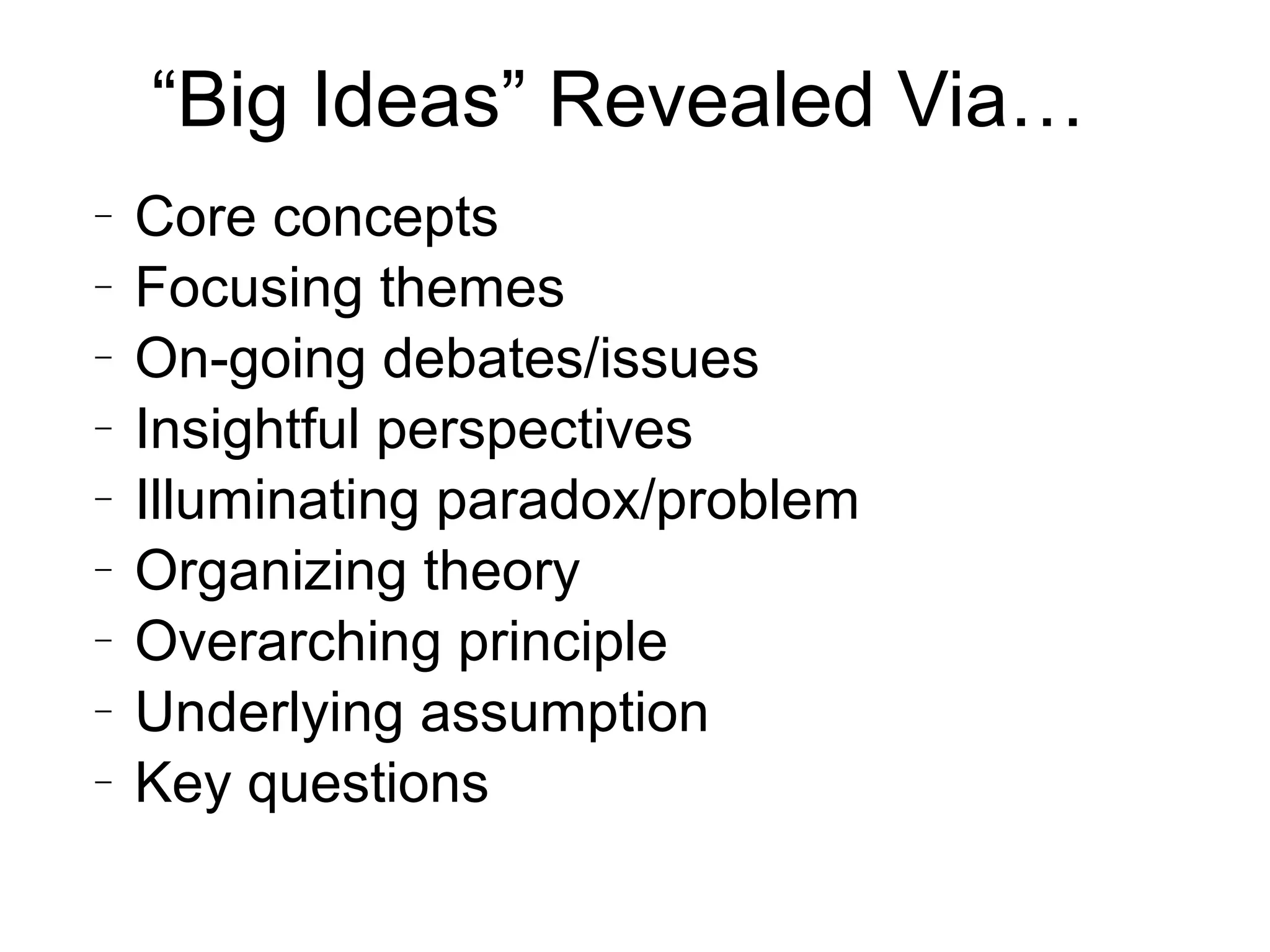
“Big Ideas” Revealed Via…
− Core concepts
− Focusing themes
− On-going debates/issues
− Insightful perspectives
− Illuminating paradox/problem
− Organizing theory
− Overarching principle
− Underlying assumption
− Key questions
Essential Questions
•
What questions –
− are arguable - and important to argue about?
− are at the heart of the subject?
− recur - and should recur - in professional work,
adult life, as well as in classroom inquiry?
− raise more questions – provoking and sustaining
engaged inquiry?
− often raise important conceptual or philosophical
issues?
− can provide organizing purpose for meaningful &
connected learning?
SLOs
•
Knowledge, skills and disposition which the active, higher level
processing, student-centered learner should be able to DO,
specifically under these conditions and to what degree these
expected outcomes will be measured.
•
Include substance (subject) and form (action must the learner
perform -analyze, demonstrate, derive, evaluate, integrate,
interpret, justify, propose, synthesize...). For instance …
•
-propose effective instruction through intentional, appropriate
integration of empirically-based active teaching strategies, which
will be a success when deployed and assessed in the classroom;
•
-actively explore and pursue Boyer's(1990) Scholarship of
Teaching and Learning (SoTL) model as a method for examining
and improving teaching and learning, resulting in a publication.
Teaching Models based on LTs
•
IP Models - Inquiry-based, Scientific, Creativity
•
Social Learning - Collaborative, Role playing
•
Personal - Developmental models, Learner-centered
•
Behavioral Systems – Mastery, Directed, Simulations, Feedback-
centered, Problem & Project-based
•
Scientific Method – Observe, Describe, Predict, Design, Test, Interpret
•
Synectics – Brainstorm, Visualization, Divergent, Metaphoric, Analogical
•
Jurisprudential- Orientation to the case, Identify issues and positions,
Explore assumptions for different positions
•
Behaviorist Models - Positively reinforced will reoccur; intermittent
reinforcement is particularly effective
•
Andragogy - “Involve Adults in planning/evaluation of their instruction.
•
Constructivist Models - Cooperative, Experiential/authentic, Situated,
Case-based learning, Discovery
Effective Lectures
•
Maximize clarity and organization.
•
Do not attempt to “cover” all the material, but rather
“uncover” what you can.
•
Create a supportive environment.
•
Recognize different learning styles.
•
Teach for long-term memory.
•
Integrate higher-level thinking skills into learning.
•
Use a variety of authentic assessments.
•
Promote real-world application of the learning.
•
Require students to become “active learners”.
•
Be an engaging speaker…
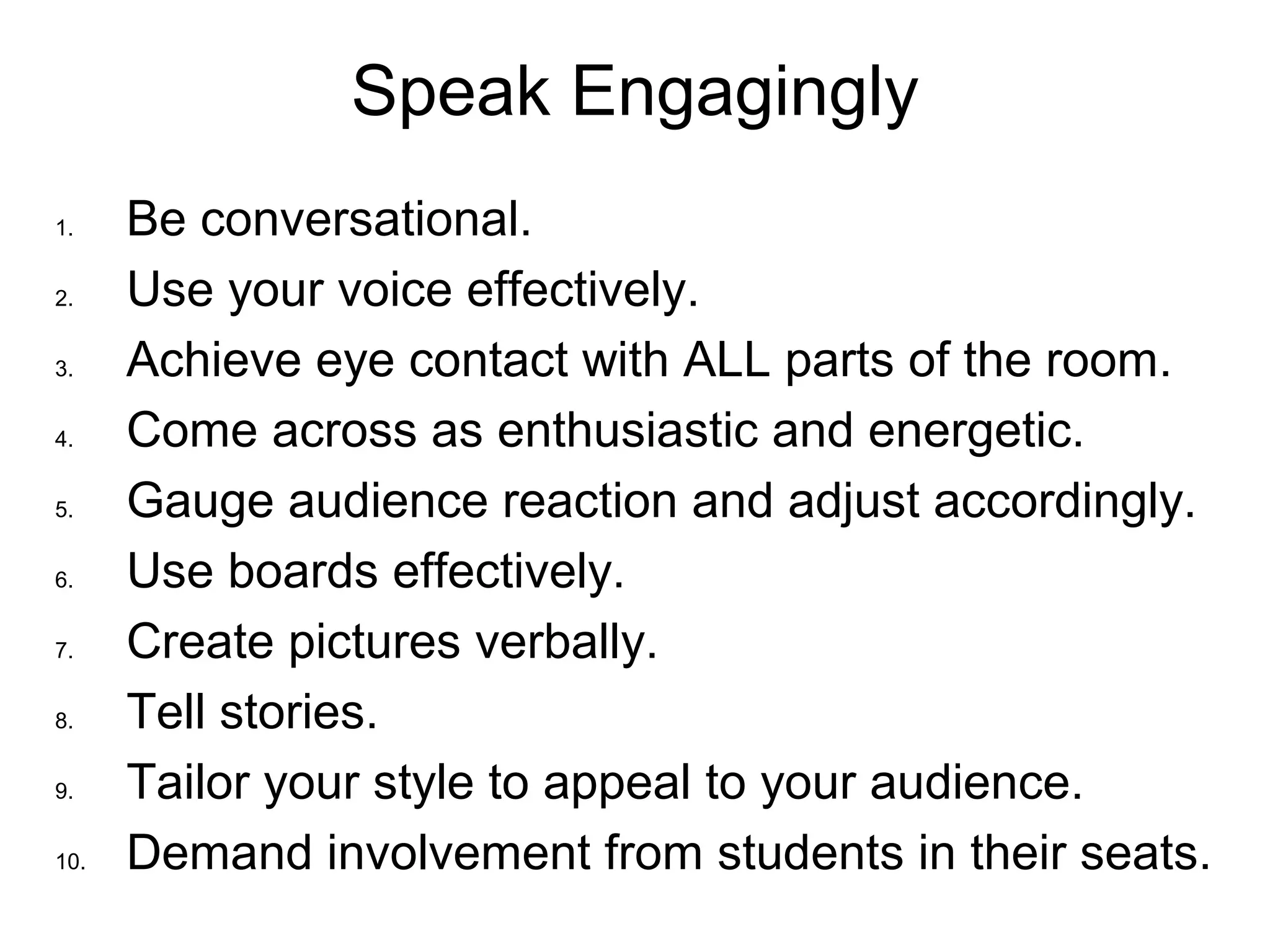
Speak Engagingly
1. Be conversational.
2. Use your voice effectively.
3. Achieve eye contact with ALL parts of the room.
4. Come across as enthusiastic and energetic.
5. Gauge audience reaction and adjust accordingly.
6. Use boards effectively.
7. Create pictures verbally.
8. Tell stories.
9. Tailor your style to appeal to your audience.
10. Demand involvement from students in their seats.
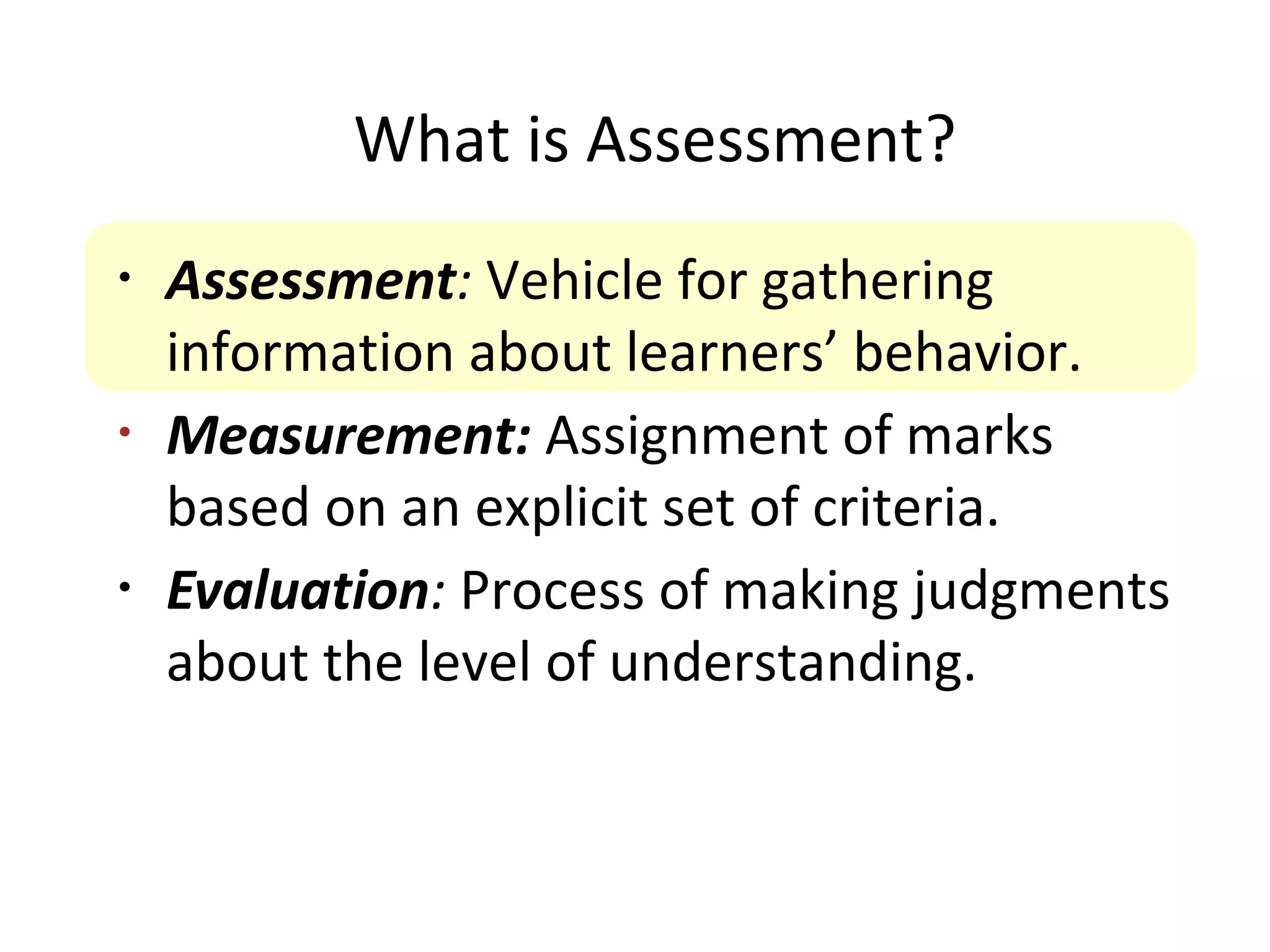
What is Assessment?
•
Assessment: Vehicle for gathering
information about learners’ behavior.
•
Measurement: Assignment of marks
based on an explicit set of criteria.
•
Evaluation: Process of making judgments
about the level of understanding.
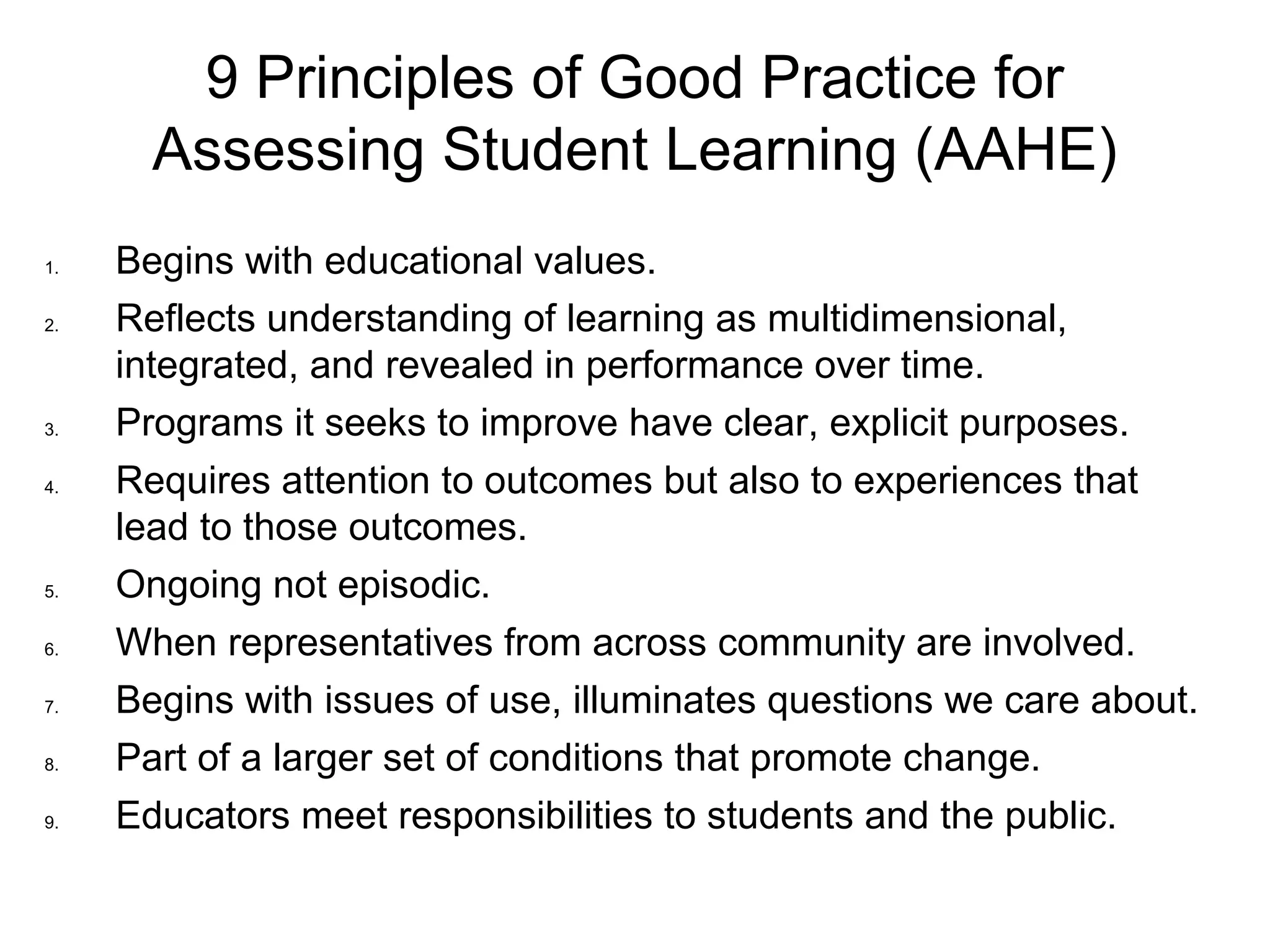
9 Principles of Good Practice for
Assessing Student Learning (AAHE)
1. Begins with educational values.
2. Reflects understanding of learning as multidimensional,
integrated, and revealed in performance over time.
3. Programs it seeks to improve have clear, explicit purposes.
4. Requires attention to outcomes but also to experiences that
lead to those outcomes.
5. Ongoing not episodic.
6. When representatives from across community are involved.
7. Begins with issues of use, illuminates questions we care about.
8. Part of a larger set of conditions that promote change.
9. Educators meet responsibilities to students and the public.
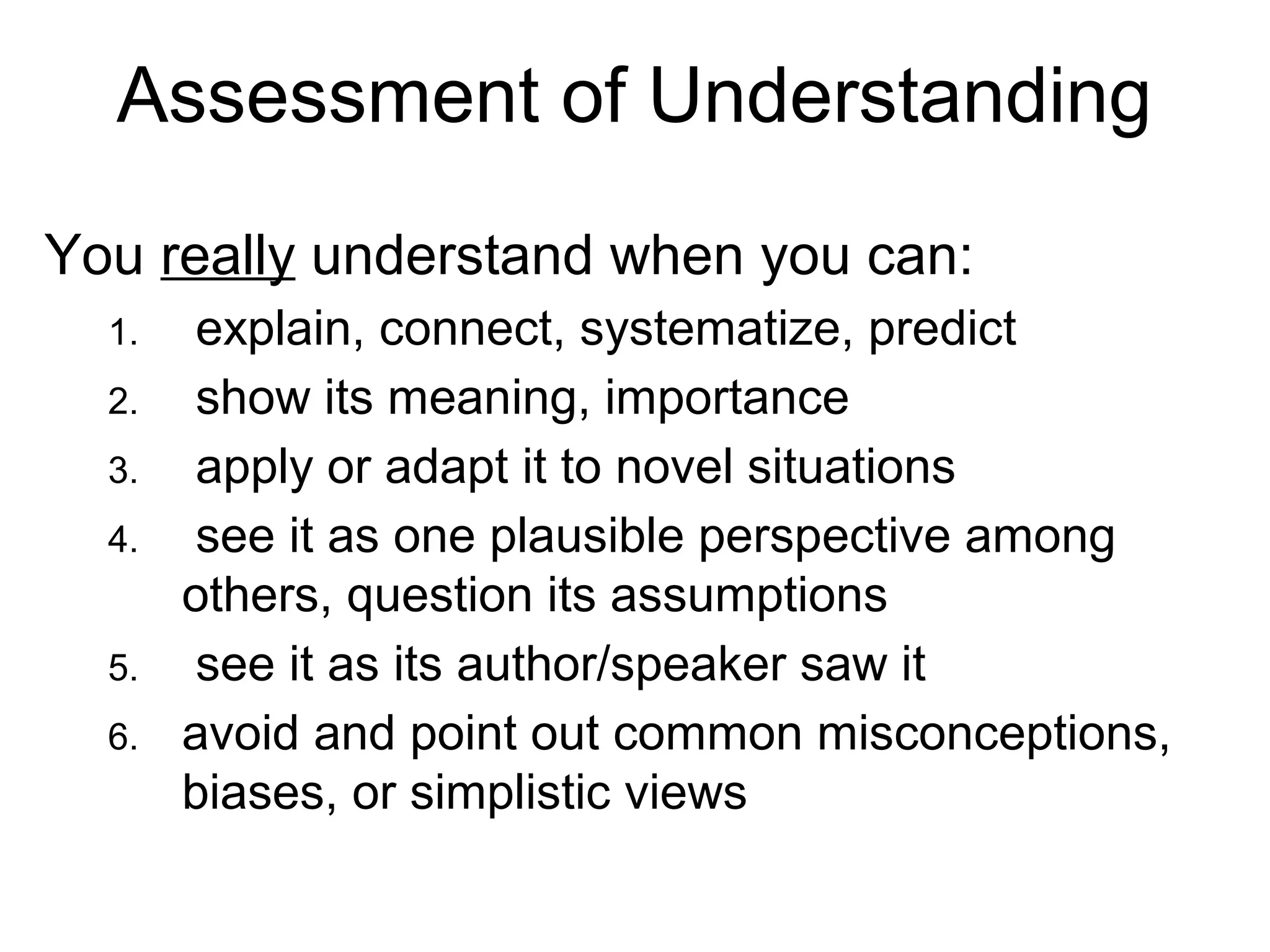
Assessment of Understanding
You really understand when you can:
1. explain, connect, systematize, predict
2. show its meaning, importance
3. apply or adapt it to novel situations
4. see it as one plausible perspective among
others, question its assumptions
5. see it as its author/speaker saw it
6. avoid and point out common misconceptions,
biases, or simplistic views
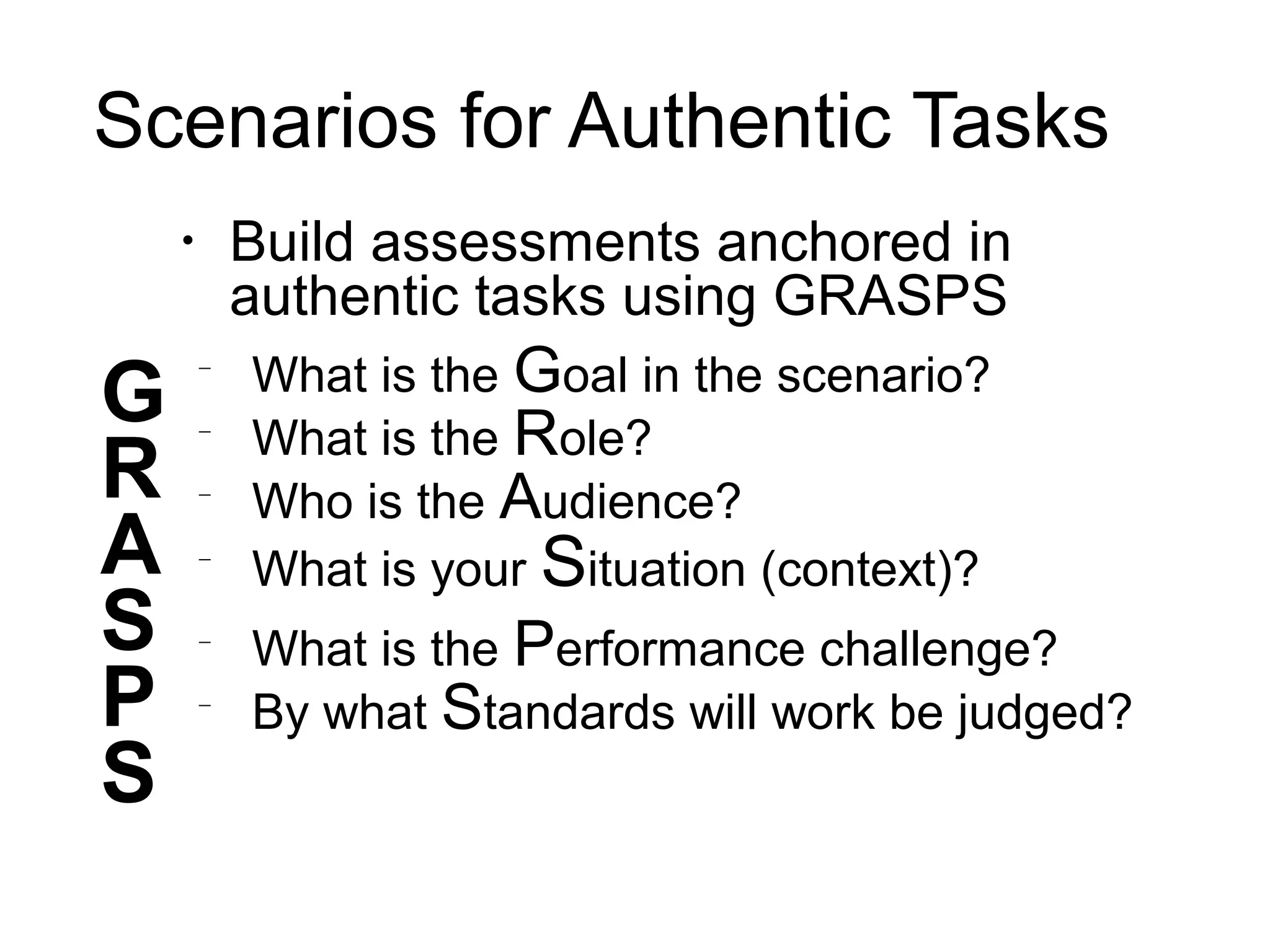
Scenarios for Authentic Tasks
•
Build assessments anchored in
authentic tasks using GRASPS
−
What is the Goal in the scenario?
−
What is the Role?
−
Who is the Audience?
−
What is your Situation (context)?
−
What is the Performance challenge?
−
By what Standards will work be judged?
S
P
S
G
R
A
Assessment Matrix
•
Write down all the assessments you plan
to use in your course (exam, paper, etc).
•
Connect these to a SLO
Formative Assessment
•
Part of the instructional process - provides
information to adjust teaching while happening.
•
Informs both teacher and student at a point when
timely adjustments can be made.
•
Black & William (1998) determined formative
assessment produce significant learning gains…
•
Challenges: how and when to provide and
ultimately determining if and when adjustments are
needed.
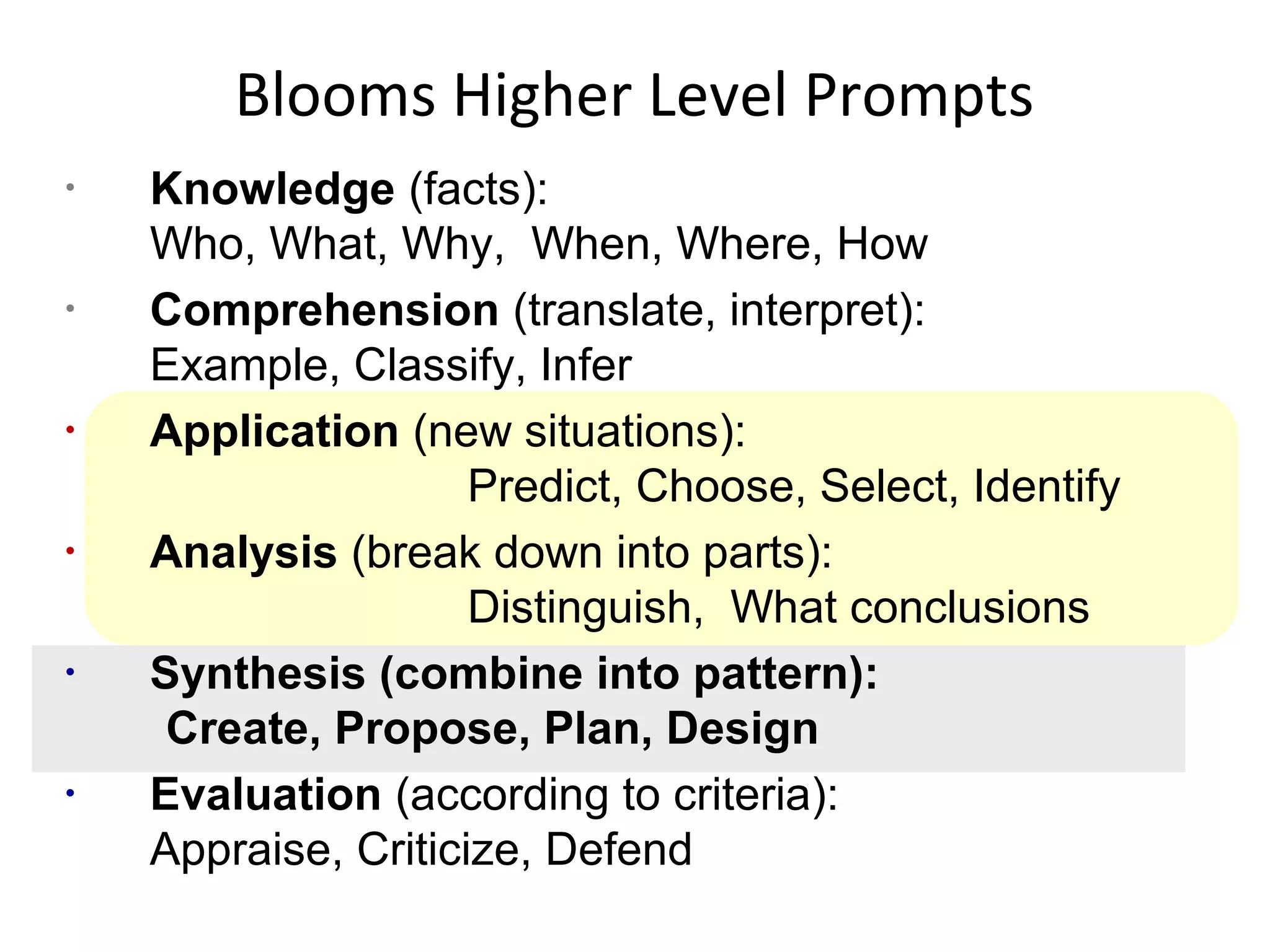
Blooms Higher Level Prompts
•
Knowledge (facts):
Who, What, Why, When, Where, How
•
Comprehension (translate, interpret):
Example, Classify, Infer
•
Application (new situations):
Predict, Choose, Select, Identify
•
Analysis (break down into parts):
Distinguish, What conclusions
•
Synthesis (combine into pattern):
Create, Propose, Plan, Design
•
Evaluation (according to criteria):
Appraise, Criticize, Defend
Measuring Formative Assessment
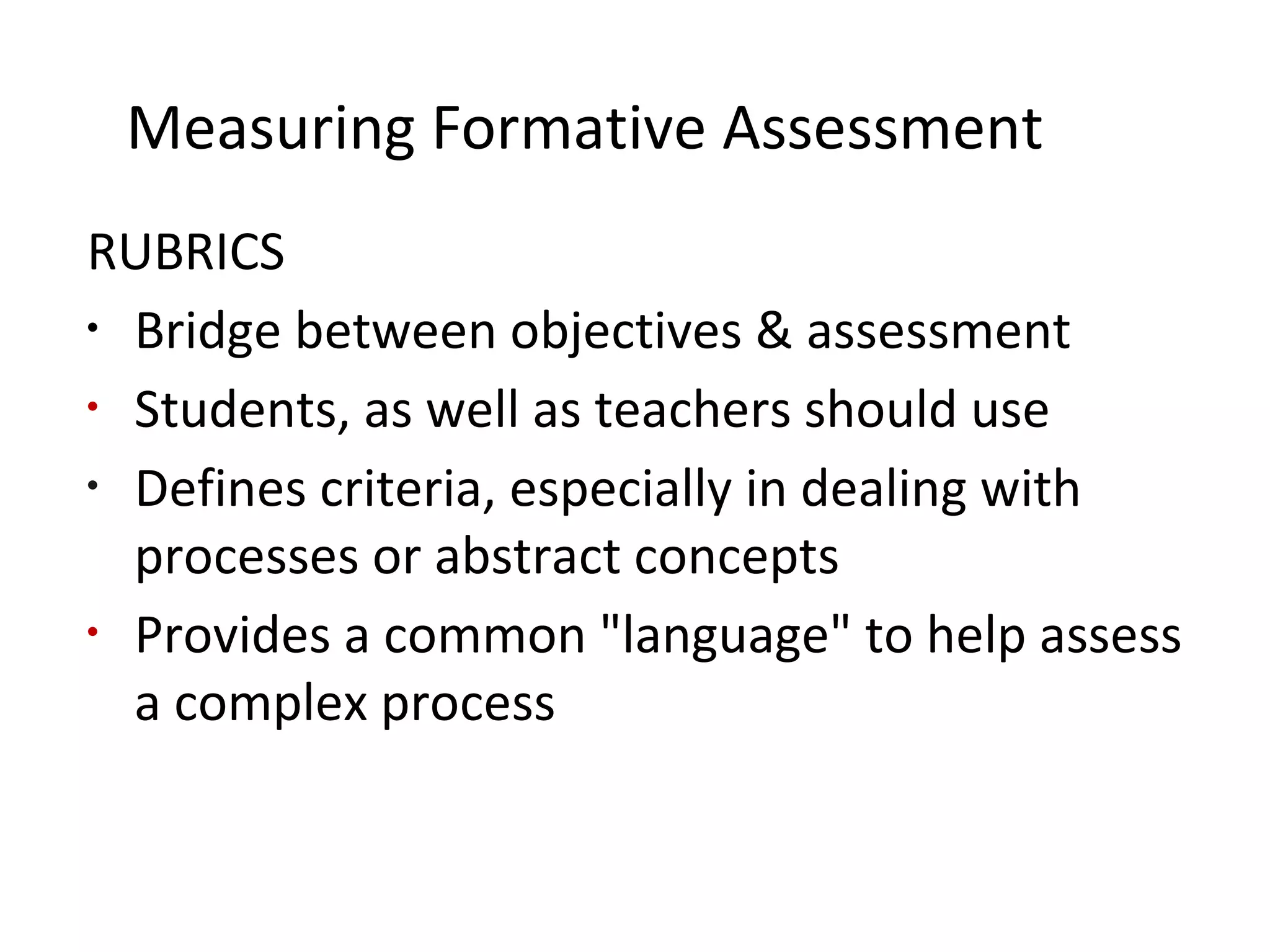
RUBRICS
•
Bridge between objectives & assessment
•
Students, as well as teachers should use
•
Defines criteria, especially in dealing with
processes or abstract concepts
•
Provides a common "language" to help assess
a complex process
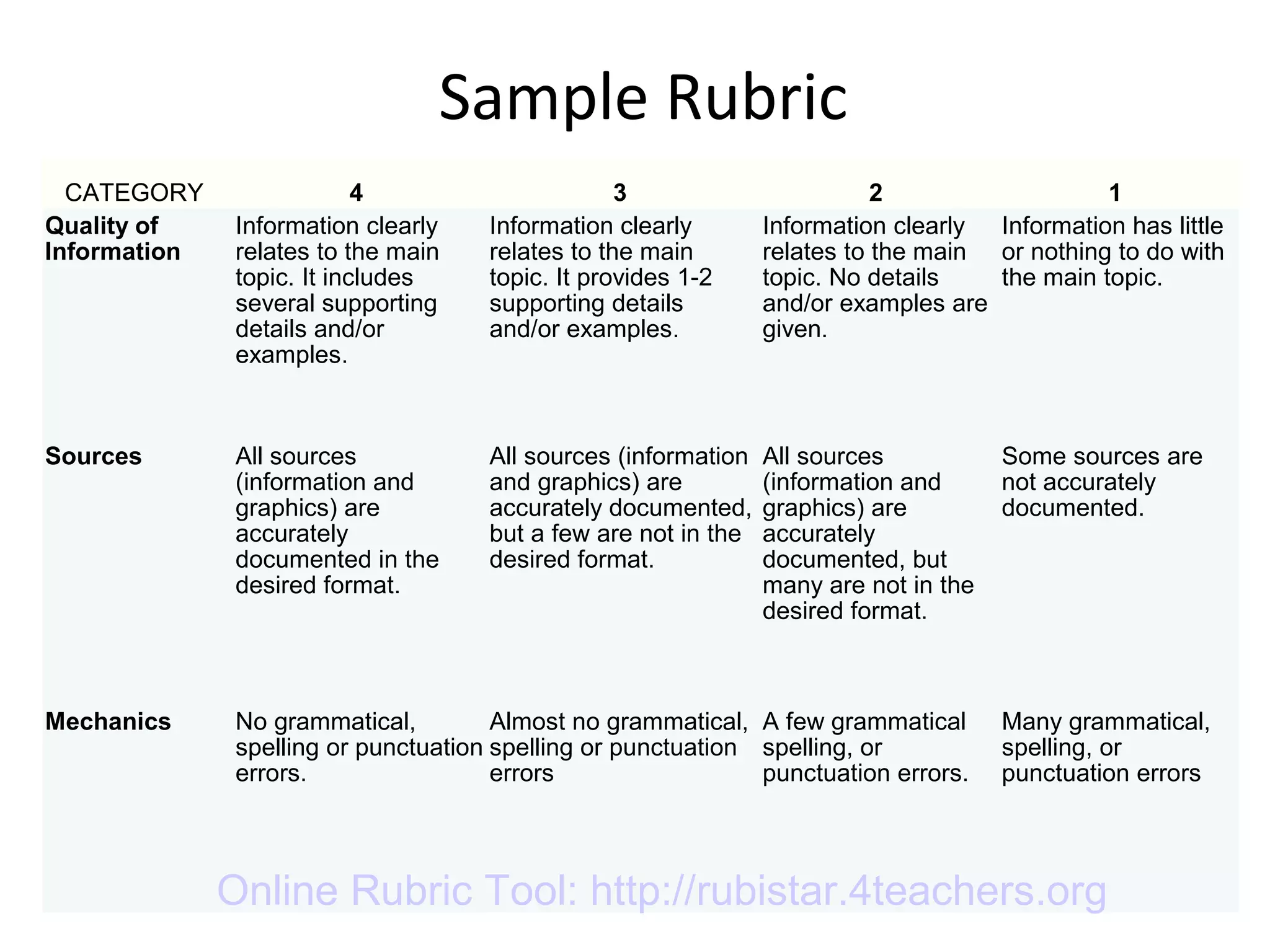
Sample Rubric
CATEGORY 4 3 2 1
Quality of
Information
Information clearly
relates to the main
topic. It includes
several supporting
details and/or
examples.
Information clearly
relates to the main
topic. It provides 1-2
supporting details
and/or examples.
Information clearly
relates to the main
topic. No details
and/or examples are
given.
Information has little
or nothing to do with
the main topic.
Sources All sources
(information and
graphics) are
accurately
documented in the
desired format.
All sources (information
and graphics) are
accurately documented,
but a few are not in the
desired format.
All sources
(information and
graphics) are
accurately
documented, but
many are not in the
desired format.
Some sources are
not accurately
documented.
Mechanics No grammatical,
spelling or punctuation
errors.
Almost no grammatical,
spelling or punctuation
errors
A few grammatical
spelling, or
punctuation errors.
Many grammatical,
spelling, or
punctuation errors
Online Rubric Tool: http://rubistar.4teachers.org
Thank You!
Jace

Jace Hargis Designing Online Teaching

  • 1.
    Redesigning Courses Online UsingActive Higher Education Learning Theories Jace Hargis, PhD
  • 2.
    Day 1 • How toLearn Online: Learning Theory • What to do BEFORE you go online… • Course [Re]Design • Teaching Goals and Alignment • Assessment Strategies, Objectives Matrix • Teaching Models and Effective Lectures
  • 3.
    Day 2 • E-learning 101:Delivery technologies − Skype, IM, Google Docs, E-Whiteboards and Second Life, Sakai, blogs, podcasts, wikis • E-Learning Tools: Creating digital − Audio/video, developing learning objects, using Flip cameras, iPod Nanos, netbooks
  • 4.
    Day 3 • Online LearningTools: − Collaboration, Student-Centeredness: Methods focused on individual learning styles • Facilitating Learning Online: − Discussion Boards, Chats, Managing Students • Web 2.0 Tools for Active BL/OL − Emerging instructional technologies, Assessing and Grading Online
  • 5.
    What is Learning? • Driscoll(2002) a) occurs in context; b) is active; c) social; and d) reflective. • Schunk (1996) e) change in the capacity for behavior; f) endures over time; and g) occurs through experience.
  • 6.
    Information Processing &Learning Theories (Atkinson & Shiffrin,1971) Input Sensory STM LTM Recall “Active Learning”
  • 7.
    What is ActiveLearning? Paulson & Faust (2002) - anything other than passively listen to lecture… apply material to "real life" situations.
  • 8.
    Ways to GetStudents Active 1. Think – Pair - Square - Share 2. Role Play 3. Debates 4. Case-Studies 5. Peer Note Checking 6. Cooperative/Collaborative Learning Which are you Least familiar with?
  • 9.
    Provide List 145Active methods Active Learning Paulson (chemistry) & Faust (philosophy) (2000) http://www.calstatela.edu/dept/chem/chem2/Active/ 1. "One Minute Paper” 2. Muddiest Point 3. Finger Signals 4. One Sentence Summary 5. PBL Cooperative Groups in Class 6. Teamwork at the Board 7. Concept Mapping 8. Speed Sharing 9. Jigsaw Group Projects
  • 10.
    Online and ActiveLearning Literature
  • 11.
    Concept Mapping (Novak, 1984) •Brain Storming • Complex ideas • Explicitly integrating new/old knowledge • Assess and diagnose understanding
  • 12.
  • 13.
    Course Design: Outcomes • Designyour courses BACKWARDS. Start with outcomes, use these desired outcomes to guide decisions to attain those outcomes. Do not simply build a course from Day One and then go forward… • What will the students know when they are complete? • What will the students be able to do at the end? • How will you know if they have achieved your learning goals? • What skills will they need to become lifelong learners? • What tools will you need to expand learning opportunities? • What activities will you need to engage students? • What do they need to know when they come to your course? • How will students need to relate to the discipline to become professionals?
  • 14.
    Effective Course Design Students Goalsand Objectives Assessment EC 2000 Bloom’s Taxonomy Course-specific goals & objectives Cooperative learning Lectures Labs Other experiences Classroom assessment techniques Tests Instruction Other measures Technology (Felder & Brent, 1999)
  • 15.
    1. Identify desiredresults 2. Determine acceptable evidence 3. Plan learning experiences & instruction 3 Stages of (Backward) Design
  • 16.
    “Big Ideas” ofEach Stage Assessment Evidence LearningActivities Understandings Essential Questions s t a g e 2 s t a g e 3 Standard(s): s t a g e 1 PerformanceTask(s): Other Evidence: Unpack content standards & ‘content’ - focus on big ideas Analyze multiple sources of evidence, aligned with Stage 1 Derive implied learning What are the big ideas? What’s the evidence? How will we get there?
  • 17.
    “Big Ideas” RevealedVia… − Core concepts − Focusing themes − On-going debates/issues − Insightful perspectives − Illuminating paradox/problem − Organizing theory − Overarching principle − Underlying assumption − Key questions
  • 18.
    Essential Questions • What questions– − are arguable - and important to argue about? − are at the heart of the subject? − recur - and should recur - in professional work, adult life, as well as in classroom inquiry? − raise more questions – provoking and sustaining engaged inquiry? − often raise important conceptual or philosophical issues? − can provide organizing purpose for meaningful & connected learning?
  • 19.
    SLOs • Knowledge, skills anddisposition which the active, higher level processing, student-centered learner should be able to DO, specifically under these conditions and to what degree these expected outcomes will be measured. • Include substance (subject) and form (action must the learner perform -analyze, demonstrate, derive, evaluate, integrate, interpret, justify, propose, synthesize...). For instance … • -propose effective instruction through intentional, appropriate integration of empirically-based active teaching strategies, which will be a success when deployed and assessed in the classroom; • -actively explore and pursue Boyer's(1990) Scholarship of Teaching and Learning (SoTL) model as a method for examining and improving teaching and learning, resulting in a publication.
  • 20.
    Teaching Models basedon LTs • IP Models - Inquiry-based, Scientific, Creativity • Social Learning - Collaborative, Role playing • Personal - Developmental models, Learner-centered • Behavioral Systems – Mastery, Directed, Simulations, Feedback- centered, Problem & Project-based • Scientific Method – Observe, Describe, Predict, Design, Test, Interpret • Synectics – Brainstorm, Visualization, Divergent, Metaphoric, Analogical • Jurisprudential- Orientation to the case, Identify issues and positions, Explore assumptions for different positions • Behaviorist Models - Positively reinforced will reoccur; intermittent reinforcement is particularly effective • Andragogy - “Involve Adults in planning/evaluation of their instruction. • Constructivist Models - Cooperative, Experiential/authentic, Situated, Case-based learning, Discovery
  • 21.
    Effective Lectures • Maximize clarityand organization. • Do not attempt to “cover” all the material, but rather “uncover” what you can. • Create a supportive environment. • Recognize different learning styles. • Teach for long-term memory. • Integrate higher-level thinking skills into learning. • Use a variety of authentic assessments. • Promote real-world application of the learning. • Require students to become “active learners”. • Be an engaging speaker…
  • 22.
    Speak Engagingly 1. Beconversational. 2. Use your voice effectively. 3. Achieve eye contact with ALL parts of the room. 4. Come across as enthusiastic and energetic. 5. Gauge audience reaction and adjust accordingly. 6. Use boards effectively. 7. Create pictures verbally. 8. Tell stories. 9. Tailor your style to appeal to your audience. 10. Demand involvement from students in their seats.
  • 23.
    What is Assessment? • Assessment:Vehicle for gathering information about learners’ behavior. • Measurement: Assignment of marks based on an explicit set of criteria. • Evaluation: Process of making judgments about the level of understanding.
  • 24.
    9 Principles ofGood Practice for Assessing Student Learning (AAHE) 1. Begins with educational values. 2. Reflects understanding of learning as multidimensional, integrated, and revealed in performance over time. 3. Programs it seeks to improve have clear, explicit purposes. 4. Requires attention to outcomes but also to experiences that lead to those outcomes. 5. Ongoing not episodic. 6. When representatives from across community are involved. 7. Begins with issues of use, illuminates questions we care about. 8. Part of a larger set of conditions that promote change. 9. Educators meet responsibilities to students and the public.
  • 25.
    Assessment of Understanding Youreally understand when you can: 1. explain, connect, systematize, predict 2. show its meaning, importance 3. apply or adapt it to novel situations 4. see it as one plausible perspective among others, question its assumptions 5. see it as its author/speaker saw it 6. avoid and point out common misconceptions, biases, or simplistic views
  • 26.
    Scenarios for AuthenticTasks • Build assessments anchored in authentic tasks using GRASPS − What is the Goal in the scenario? − What is the Role? − Who is the Audience? − What is your Situation (context)? − What is the Performance challenge? − By what Standards will work be judged? S P S G R A
  • 27.
    Assessment Matrix • Write downall the assessments you plan to use in your course (exam, paper, etc). • Connect these to a SLO
  • 28.
    Formative Assessment • Part ofthe instructional process - provides information to adjust teaching while happening. • Informs both teacher and student at a point when timely adjustments can be made. • Black & William (1998) determined formative assessment produce significant learning gains… • Challenges: how and when to provide and ultimately determining if and when adjustments are needed.
  • 29.
    Blooms Higher LevelPrompts • Knowledge (facts): Who, What, Why, When, Where, How • Comprehension (translate, interpret): Example, Classify, Infer • Application (new situations): Predict, Choose, Select, Identify • Analysis (break down into parts): Distinguish, What conclusions • Synthesis (combine into pattern): Create, Propose, Plan, Design • Evaluation (according to criteria): Appraise, Criticize, Defend
  • 30.
    Measuring Formative Assessment RUBRICS • Bridgebetween objectives & assessment • Students, as well as teachers should use • Defines criteria, especially in dealing with processes or abstract concepts • Provides a common "language" to help assess a complex process
  • 31.
    Sample Rubric CATEGORY 43 2 1 Quality of Information Information clearly relates to the main topic. It includes several supporting details and/or examples. Information clearly relates to the main topic. It provides 1-2 supporting details and/or examples. Information clearly relates to the main topic. No details and/or examples are given. Information has little or nothing to do with the main topic. Sources All sources (information and graphics) are accurately documented in the desired format. All sources (information and graphics) are accurately documented, but a few are not in the desired format. All sources (information and graphics) are accurately documented, but many are not in the desired format. Some sources are not accurately documented. Mechanics No grammatical, spelling or punctuation errors. Almost no grammatical, spelling or punctuation errors A few grammatical spelling, or punctuation errors. Many grammatical, spelling, or punctuation errors Online Rubric Tool: http://rubistar.4teachers.org
  • 32.