9
Turkish Online Journal of Distance Education-TOJDE January 2011 ISSN 1302-6488 Volume: 12 Number: 1 Notes for Editor-1
SNAPP:
Graphing Student Interactions in a
Learning Management System
Kevin YEE, Ph.D.
Assistant Director, Faculty Center for Teaching and Learning
University of Central Florida
Orlando, FL, USA
Jace HARGIS, Ph.D.
Assistant Provost for Faculty Development
University of the Pacific
Stockton, California, USA
One of the more vexing problems in teaching fully-online classes concerns the
development of community. As Rovai (2001) identified, online courses must combat
feelings of isolation and impart a sense of personal and individual attention. To create a
sense of belonging and togetherness, instructors typically need to surmount numerous
technological hurdles inherent in online delivery, not least of which is the inescapable
conclusion that the one factor most basic to the formation of community-face to face
interaction-is by definition absent in an online class. Many new tech-based teaching tools
have been developed in an attempt to ameliorate the digital alienation and promote
interaction, such as discussion boards, synchronous chat rooms, and emerging media like
wikis, blogs and podcasts, as well as virtual worlds, such as Second Life. As the
frequency of interaction grows, so does the sense of belonging to a learning community
(Dawson, 2008).
Yet as difficult as it is to craft a community among online learners, it is even harder to
measure where and when the community is functioning (and perhaps more crucially, to
know when it is not). Most Learning Management Systems (LMS) usually provide crude
frequency data, so instructors will know how often students are visiting pages, and
perhaps reading or posting information. However, what is lacking in this less-than-
dynamic system is an overview of the type, amount and direction of activity, which
students‘ may be engaging (Mazza & Dimitrova, 2007).
The tracking tools merely report the number of posts, but it is possible that students are
replying only to the instructor‘s prompt and not to each other. Also, engagement alone
does not necessitate or guarantee learning. Although the importance of engagement has
been elevated, as many U.S. universities are using the National Student Survey of
Engagement (NSSE) to gain a perception of student engagement, this is only part of the
picture. The type, richness and interconnected engagement, within an authentic context,
―in response to what students have learned‖ are critical (Bowen, 2005).
10
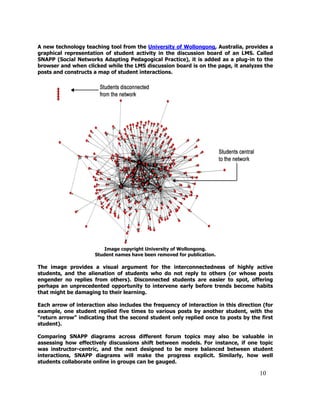
A new technology teaching tool from the University of Wollongong, Australia, provides a
graphical representation of student activity in the discussion board of an LMS. Called
SNAPP (Social Networks Adapting Pedagogical Practice), it is added as a plug-in to the
browser and when clicked while the LMS discussion board is on the page, it analyzes the
posts and constructs a map of student interactions.
Image copyright University of Wollongong.
Student names have been removed for publication.
The image provides a visual argument for the interconnectedness of highly active
students, and the alienation of students who do not reply to others (or whose posts
engender no replies from others). Disconnected students are easier to spot, offering
perhaps an unprecedented opportunity to intervene early before trends become habits
that might be damaging to their learning.
Each arrow of interaction also includes the frequency of interaction in this direction (for
example, one student replied five times to various posts by another student, with the
―return arrow‖ indicating that the second student only replied once to posts by the first
student).
Comparing SNAPP diagrams across different forum topics may also be valuable in
assessing how effectively discussions shift between models. For instance, if one topic
was instructor-centric, and the next designed to be more balanced between student
interactions, SNAPP diagrams will make the progress explicit. Similarly, how well
students collaborate online in groups can be gauged.
11
The SNAPP Web site lists these benefits to the program:
 identify disconnected (at risk) students;
 identify key information brokers within your class;
 identify potentially high and low performing students so you can plan
interventions before you even mark their work;
 indicate the extent to which a learning community is developing in your
class;
 provide you with a ―before and after‖ snapshot of what kinds of
interactions happened before and after you intervened/changed your
learning activity design (useful to see what effect your changes have had
on student interactions and for demonstrating reflective teaching practice
e.g. through a teaching portfolio); and
 allow your students to benchmark their performance without the need for
marking.
SNAPP works on multiple LMS‘s, including BlackBoard, WebCT Vista, WebCT CE, Sakai,
Moodle, and Desire2Learn. The software is free to download and requires Internet access
to perform its functions.
BIODATA and CONTACT ADDRESSES of AUTHORS
Dr. Kevin YEE has published extensively in the field of faculty development
and his disciplinary research field of German Literature. His present
position is Assistant Director of the Faculty Center for Teaching and
Learning at the University of Central Florida. His undergraduate and
graduate degrees are in German Literature, and he has worked in faculty
development since 2004.
Assistant Director, Kevin Yee, PhD
Faculty Center for Teaching and Learning
University of Central Florida
PO Box 160066, Orlando FL 32816
Phone: (407) 823-3544 or (407) 823-3544
Email: kevinyee@mail.ucf.edu
Dr. Jace HARGIS has authored two books and over fifty academic articles as
well as over one hundred national and international presentations.
Currently, he is an Assistant Provost at the University of the Pacific and an
Associate Professor of Education. His undergraduate and graduate degrees
are in the chemical sciences and he has earned a Ph.D. from the University
of Florida in Science Education, specializing in the area of informal learning
settings, including how we integrate appropriate, meaningful uses of instructional
technology into how we learn.
Associate Professor Jace HARGIS, PhD
Assistant Provost for Faculty Development
Director, Center for Teaching and Learning
University of the Pacific, 3601 Pacific Avenue, Stockton, CA 95211
Phone: (209) 946-2409 or (209) 946-2409
Email: jhargis@pacific.edu
12
LINKS
SNAPP home page: Learning Networks / Seeing Networks. University of Wollongong,
Australia.http://research.uow.edu.au/learningnetworks/seeing/about/index.html.
Online accessed 2010/12/21.
REFERENCES
Bowen, S. (2005). Engaged learning: Are we all on the same page? Peer Review, 7 (2), 4-7.
Dawson, S. (2008). A study of the relationship between student social networks and
sense of community. Educational Technology & Society, 11(3), 224–238.
Mazza, R. and Dimitrova, V., (2007). CourseVis: A graphical student monitoring tool for
supporting instructors in web-based distance courses. International Journal of Human-
Computer Studies, 65(2): 125-139.
Rovai, A. P. (2001). Building classroom community at a distance: A case study.
Educational Technology, Research and Development, 49(4), 33-48.

636 published

  • 1.
    9 Turkish Online Journalof Distance Education-TOJDE January 2011 ISSN 1302-6488 Volume: 12 Number: 1 Notes for Editor-1 SNAPP: Graphing Student Interactions in a Learning Management System Kevin YEE, Ph.D. Assistant Director, Faculty Center for Teaching and Learning University of Central Florida Orlando, FL, USA Jace HARGIS, Ph.D. Assistant Provost for Faculty Development University of the Pacific Stockton, California, USA One of the more vexing problems in teaching fully-online classes concerns the development of community. As Rovai (2001) identified, online courses must combat feelings of isolation and impart a sense of personal and individual attention. To create a sense of belonging and togetherness, instructors typically need to surmount numerous technological hurdles inherent in online delivery, not least of which is the inescapable conclusion that the one factor most basic to the formation of community-face to face interaction-is by definition absent in an online class. Many new tech-based teaching tools have been developed in an attempt to ameliorate the digital alienation and promote interaction, such as discussion boards, synchronous chat rooms, and emerging media like wikis, blogs and podcasts, as well as virtual worlds, such as Second Life. As the frequency of interaction grows, so does the sense of belonging to a learning community (Dawson, 2008). Yet as difficult as it is to craft a community among online learners, it is even harder to measure where and when the community is functioning (and perhaps more crucially, to know when it is not). Most Learning Management Systems (LMS) usually provide crude frequency data, so instructors will know how often students are visiting pages, and perhaps reading or posting information. However, what is lacking in this less-than- dynamic system is an overview of the type, amount and direction of activity, which students‘ may be engaging (Mazza & Dimitrova, 2007). The tracking tools merely report the number of posts, but it is possible that students are replying only to the instructor‘s prompt and not to each other. Also, engagement alone does not necessitate or guarantee learning. Although the importance of engagement has been elevated, as many U.S. universities are using the National Student Survey of Engagement (NSSE) to gain a perception of student engagement, this is only part of the picture. The type, richness and interconnected engagement, within an authentic context, ―in response to what students have learned‖ are critical (Bowen, 2005).
  • 2.
    10 A new technologyteaching tool from the University of Wollongong, Australia, provides a graphical representation of student activity in the discussion board of an LMS. Called SNAPP (Social Networks Adapting Pedagogical Practice), it is added as a plug-in to the browser and when clicked while the LMS discussion board is on the page, it analyzes the posts and constructs a map of student interactions. Image copyright University of Wollongong. Student names have been removed for publication. The image provides a visual argument for the interconnectedness of highly active students, and the alienation of students who do not reply to others (or whose posts engender no replies from others). Disconnected students are easier to spot, offering perhaps an unprecedented opportunity to intervene early before trends become habits that might be damaging to their learning. Each arrow of interaction also includes the frequency of interaction in this direction (for example, one student replied five times to various posts by another student, with the ―return arrow‖ indicating that the second student only replied once to posts by the first student). Comparing SNAPP diagrams across different forum topics may also be valuable in assessing how effectively discussions shift between models. For instance, if one topic was instructor-centric, and the next designed to be more balanced between student interactions, SNAPP diagrams will make the progress explicit. Similarly, how well students collaborate online in groups can be gauged.
  • 3.
    11 The SNAPP Website lists these benefits to the program:  identify disconnected (at risk) students;  identify key information brokers within your class;  identify potentially high and low performing students so you can plan interventions before you even mark their work;  indicate the extent to which a learning community is developing in your class;  provide you with a ―before and after‖ snapshot of what kinds of interactions happened before and after you intervened/changed your learning activity design (useful to see what effect your changes have had on student interactions and for demonstrating reflective teaching practice e.g. through a teaching portfolio); and  allow your students to benchmark their performance without the need for marking. SNAPP works on multiple LMS‘s, including BlackBoard, WebCT Vista, WebCT CE, Sakai, Moodle, and Desire2Learn. The software is free to download and requires Internet access to perform its functions. BIODATA and CONTACT ADDRESSES of AUTHORS Dr. Kevin YEE has published extensively in the field of faculty development and his disciplinary research field of German Literature. His present position is Assistant Director of the Faculty Center for Teaching and Learning at the University of Central Florida. His undergraduate and graduate degrees are in German Literature, and he has worked in faculty development since 2004. Assistant Director, Kevin Yee, PhD Faculty Center for Teaching and Learning University of Central Florida PO Box 160066, Orlando FL 32816 Phone: (407) 823-3544 or (407) 823-3544 Email: kevinyee@mail.ucf.edu Dr. Jace HARGIS has authored two books and over fifty academic articles as well as over one hundred national and international presentations. Currently, he is an Assistant Provost at the University of the Pacific and an Associate Professor of Education. His undergraduate and graduate degrees are in the chemical sciences and he has earned a Ph.D. from the University of Florida in Science Education, specializing in the area of informal learning settings, including how we integrate appropriate, meaningful uses of instructional technology into how we learn. Associate Professor Jace HARGIS, PhD Assistant Provost for Faculty Development Director, Center for Teaching and Learning University of the Pacific, 3601 Pacific Avenue, Stockton, CA 95211 Phone: (209) 946-2409 or (209) 946-2409 Email: jhargis@pacific.edu
  • 4.
    12 LINKS SNAPP home page:Learning Networks / Seeing Networks. University of Wollongong, Australia.http://research.uow.edu.au/learningnetworks/seeing/about/index.html. Online accessed 2010/12/21. REFERENCES Bowen, S. (2005). Engaged learning: Are we all on the same page? Peer Review, 7 (2), 4-7. Dawson, S. (2008). A study of the relationship between student social networks and sense of community. Educational Technology & Society, 11(3), 224–238. Mazza, R. and Dimitrova, V., (2007). CourseVis: A graphical student monitoring tool for supporting instructors in web-based distance courses. International Journal of Human- Computer Studies, 65(2): 125-139. Rovai, A. P. (2001). Building classroom community at a distance: A case study. Educational Technology, Research and Development, 49(4), 33-48.