BIOELECTRONIC MEDICINES
CONTENT :
 INTRODUCTION
 DEFINITION
 MECHANISAM
 HOW IT’S WORK
 Examples of diseases
 Developing More Effective Materials
 Clinical issues & Education
 Research Needs
INTRODUCTION
 The nervous system uses electrical signals to communicate information
throughout the body. Virtually every cell and organ of the body is directly or
indirectly controlled by these neural signals.
 Our researchers are learning the language of these neural signals so that we can
listen for signals of disease or injury.
 We are also using bio electronic medicine technologies to record, stimulate, and
block neural signals which will change the way we treat diseases, injuries and
conditions such as rheumatoid arthritis, diabetes, paralysis, bleeding, and even
cancer.
 Bioelectronic medicines are fundamentally different because they are
combinations of devices and drugs and in some cases may not be considered to
be pharmaceuticals at all.
 Bioelectronic devices have already been tested successfully to treat
inflammatory diseases such as rheumatoid arthritis and Crohn’s disease.
 The leading figure in the research has been Dr. Kevin Tracey of the Feinstein
Institute in New York who discovered around 15 years ago the inflammatory
reflex, a neural circuit between the brain and the vagus nerve regulating the
immune system.
CONT...
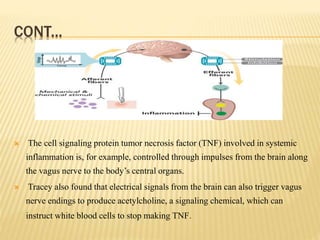
 The cell signaling protein tumor necrosis factor (TNF) involved in systemic
inflammation is, for example, controlled through impulses from the brain along
the vagus nerve to the body’s central organs.
 Tracey also found that electrical signals from the brain can also trigger vagus
nerve endings to produce acetylcholine, a signaling chemical, which can
instruct white blood cells to stop making TNF.
DEFINITION
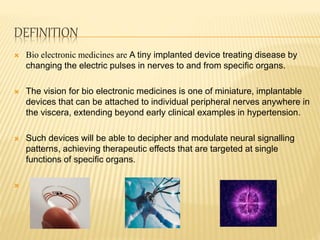
 Bio electronic medicines are A tiny implanted device treating disease by
changing the electric pulses in nerves to and from specific organs.
 The vision for bio electronic medicines is one of miniature, implantable
devices that can be attached to individual peripheral nerves anywhere in
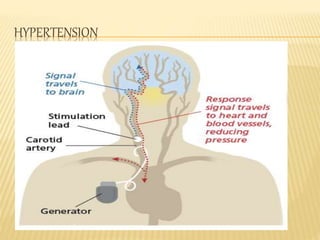
the viscera, extending beyond early clinical examples in hypertension.
 Such devices will be able to decipher and modulate neural signalling
patterns, achieving therapeutic effects that are targeted at single
functions of specific organs.

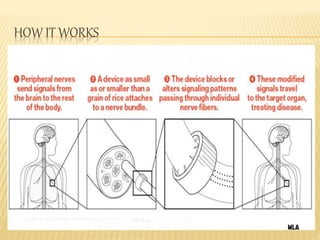
HOW IT WORKS
ARTHRITIS:
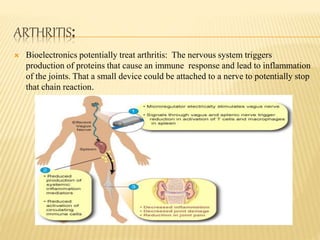
 Bioelectronics potentially treat arthritis: The nervous system triggers
production of proteins that cause an immune response and lead to inflammation
of the joints. That a small device could be attached to a nerve to potentially stop
that chain reaction.
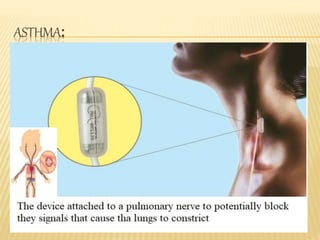
ASTHMA:
HYPERTENSION
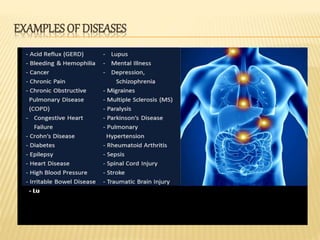
EXAMPLES OF DISEASES
NEXT-GENERATION NEUROMODULATION:
Next-generation neuromodulation devices are expected to improve three
key areas:
 Sensitivity, i.e. able to sense signals from neurons in the cortex and nerve
fascicles and fibers in the periphery, in a highly sensitive manner against other
background interference.
 Selectivity, i.e. able to precisely target nerves near visceral organs central in
chronic diseases with clear endpoints.
 Responsiveness, i.e. form closed-loop around recording of neural signatures
and detection of biomarkers (several communicating devices may be needed for
the close-loop biomarker detection and stimulation)
 Acceptance, i.e. miniaturized low power devices that can be delivered with
minimally invasive implantation thereby reducing patient burden and improving
acces
DEVELOPING MORE EFFECTIVE MATERIALS
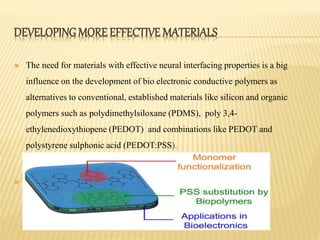
 The need for materials with effective neural interfacing properties is a big
influence on the development of bio electronic conductive polymers as
alternatives to conventional, established materials like silicon and organic
polymers such as polydimethylsiloxane (PDMS), poly 3,4-
ethylenedioxythiopene (PEDOT) and combinations like PEDOT and
polystyrene sulphonic acid (PEDOT:PSS).
 .
 Indium-tin oxide (ITO), for example, a conductor used in solar cells, sensors an
electronic displays, has been considered by researchers to be inappropriate for bio
electronic devices because of its brittleness, need for high-temperature processing
and limited transparency. As a result it is being replaced by materials like graphene,
which is regarded as more adaptable to neural interfacing requirements.
 An essential task in developing future bio electronic medicine technologies is three
major components:
 1. Creation of a visceral nerve atlas
 2. Advancement of neural interfacing technology
 3. Early establishment of therapeutic feasibility
SCIENCE AND TECHNOLOGY
 Many start ups have failed here, and very few people understand the
science. Technology is an enabler. We need smarter devices
(IQ/mm3) that can improve treatment, reach new targets, be cheaper,
reduce the service burden, and be less invasive.
 Neuro modulation has such a broad range of power and energy
needs, so there may not be a one size fits all.
 Surgical tools can make a big difference. A new device size and
implant location can enable new surgical tools, and vice versa.
CLINICAL ISSUES & EDUCATION
Clinical issues: On the physician’s side, neuromodulation is not a medical
discipline. Cardiologists or neurologists are not “neuromodulators”.
How do we connect the dots in the clinical practices? It’s very hard to
find a physician who knows how to implant a device! They just don’t
learn that.
 We need simpler, faster, implant procedures, that can be performed by
more physicians at a lower cost.
 Will patients accept therapy? Patients don’t want to deal with their
device, just want to be healthy.
 People in R&D need to go out and talk to patients and physicians, so
don’t lose sight of reality.
Education:
 Medical schools don’t teach neuromodulation - we need
Neuromodulation to become a medical discipline.
ECONOMICS
 Economics Changing reimbursement levels issue - You build your
business case based on some reimbursement level, and that can
change all of a sudden To really get COGS down, we need to get
volumes up. But to get volumes up, we need to get total price as
seen by the payer down.
Regulations:
Changing regulatory requirements: FDA may change the
threshold for acceptability, by e.g. requesting a control study with
place.
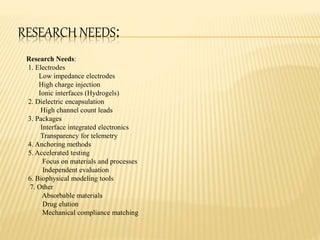
RESEARCH NEEDS:
Research Needs:
1. Electrodes
Low impedance electrodes
High charge injection
Ionic interfaces (Hydrogels)
2. Dielectric encapsulation
High channel count leads
3. Packages
Interface integrated electronics
Transparency for telemetry
4. Anchoring methods
5. Accelerated testing
Focus on materials and processes
Independent evaluation
6. Biophysical modeling tools
7. Other
Absorbable materials
Drug elution
Mechanical compliance matching
BIO ELECTRONIC MEDICINE

BIO ELECTRONIC MEDICINE

  • 1.
  • 2.
    CONTENT :  INTRODUCTION DEFINITION  MECHANISAM  HOW IT’S WORK  Examples of diseases  Developing More Effective Materials  Clinical issues & Education  Research Needs
  • 3.
    INTRODUCTION  The nervoussystem uses electrical signals to communicate information throughout the body. Virtually every cell and organ of the body is directly or indirectly controlled by these neural signals.  Our researchers are learning the language of these neural signals so that we can listen for signals of disease or injury.  We are also using bio electronic medicine technologies to record, stimulate, and block neural signals which will change the way we treat diseases, injuries and conditions such as rheumatoid arthritis, diabetes, paralysis, bleeding, and even cancer.
  • 4.
     Bioelectronic medicinesare fundamentally different because they are combinations of devices and drugs and in some cases may not be considered to be pharmaceuticals at all.  Bioelectronic devices have already been tested successfully to treat inflammatory diseases such as rheumatoid arthritis and Crohn’s disease.  The leading figure in the research has been Dr. Kevin Tracey of the Feinstein Institute in New York who discovered around 15 years ago the inflammatory reflex, a neural circuit between the brain and the vagus nerve regulating the immune system.
  • 5.
    CONT...  The cellsignaling protein tumor necrosis factor (TNF) involved in systemic inflammation is, for example, controlled through impulses from the brain along the vagus nerve to the body’s central organs.  Tracey also found that electrical signals from the brain can also trigger vagus nerve endings to produce acetylcholine, a signaling chemical, which can instruct white blood cells to stop making TNF.
  • 6.
    DEFINITION  Bio electronicmedicines are A tiny implanted device treating disease by changing the electric pulses in nerves to and from specific organs.  The vision for bio electronic medicines is one of miniature, implantable devices that can be attached to individual peripheral nerves anywhere in the viscera, extending beyond early clinical examples in hypertension.  Such devices will be able to decipher and modulate neural signalling patterns, achieving therapeutic effects that are targeted at single functions of specific organs. 
  • 7.
  • 8.
    ARTHRITIS:  Bioelectronics potentiallytreat arthritis: The nervous system triggers production of proteins that cause an immune response and lead to inflammation of the joints. That a small device could be attached to a nerve to potentially stop that chain reaction.
  • 9.
  • 10.
  • 11.
  • 12.
    NEXT-GENERATION NEUROMODULATION: Next-generation neuromodulationdevices are expected to improve three key areas:  Sensitivity, i.e. able to sense signals from neurons in the cortex and nerve fascicles and fibers in the periphery, in a highly sensitive manner against other background interference.  Selectivity, i.e. able to precisely target nerves near visceral organs central in chronic diseases with clear endpoints.  Responsiveness, i.e. form closed-loop around recording of neural signatures and detection of biomarkers (several communicating devices may be needed for the close-loop biomarker detection and stimulation)  Acceptance, i.e. miniaturized low power devices that can be delivered with minimally invasive implantation thereby reducing patient burden and improving acces
  • 13.
    DEVELOPING MORE EFFECTIVEMATERIALS  The need for materials with effective neural interfacing properties is a big influence on the development of bio electronic conductive polymers as alternatives to conventional, established materials like silicon and organic polymers such as polydimethylsiloxane (PDMS), poly 3,4- ethylenedioxythiopene (PEDOT) and combinations like PEDOT and polystyrene sulphonic acid (PEDOT:PSS).  .
  • 14.
     Indium-tin oxide(ITO), for example, a conductor used in solar cells, sensors an electronic displays, has been considered by researchers to be inappropriate for bio electronic devices because of its brittleness, need for high-temperature processing and limited transparency. As a result it is being replaced by materials like graphene, which is regarded as more adaptable to neural interfacing requirements.  An essential task in developing future bio electronic medicine technologies is three major components:  1. Creation of a visceral nerve atlas  2. Advancement of neural interfacing technology  3. Early establishment of therapeutic feasibility
  • 15.
    SCIENCE AND TECHNOLOGY Many start ups have failed here, and very few people understand the science. Technology is an enabler. We need smarter devices (IQ/mm3) that can improve treatment, reach new targets, be cheaper, reduce the service burden, and be less invasive.  Neuro modulation has such a broad range of power and energy needs, so there may not be a one size fits all.  Surgical tools can make a big difference. A new device size and implant location can enable new surgical tools, and vice versa.
  • 16.
    CLINICAL ISSUES &EDUCATION Clinical issues: On the physician’s side, neuromodulation is not a medical discipline. Cardiologists or neurologists are not “neuromodulators”. How do we connect the dots in the clinical practices? It’s very hard to find a physician who knows how to implant a device! They just don’t learn that.  We need simpler, faster, implant procedures, that can be performed by more physicians at a lower cost.  Will patients accept therapy? Patients don’t want to deal with their device, just want to be healthy.  People in R&D need to go out and talk to patients and physicians, so don’t lose sight of reality. Education:  Medical schools don’t teach neuromodulation - we need Neuromodulation to become a medical discipline.
  • 17.
    ECONOMICS  Economics Changingreimbursement levels issue - You build your business case based on some reimbursement level, and that can change all of a sudden To really get COGS down, we need to get volumes up. But to get volumes up, we need to get total price as seen by the payer down. Regulations: Changing regulatory requirements: FDA may change the threshold for acceptability, by e.g. requesting a control study with place.
  • 18.
    RESEARCH NEEDS: Research Needs: 1.Electrodes Low impedance electrodes High charge injection Ionic interfaces (Hydrogels) 2. Dielectric encapsulation High channel count leads 3. Packages Interface integrated electronics Transparency for telemetry 4. Anchoring methods 5. Accelerated testing Focus on materials and processes Independent evaluation 6. Biophysical modeling tools 7. Other Absorbable materials Drug elution Mechanical compliance matching