Africa RISING in the Ethiopian highlands: Phase
one R4D initiatives and Phase two priorities
Training of Trainers (ToT) Workshop
Michew, Tigray, 19-21 April 2017
Kindu Mekonnen and Peter Thorne, ILRI
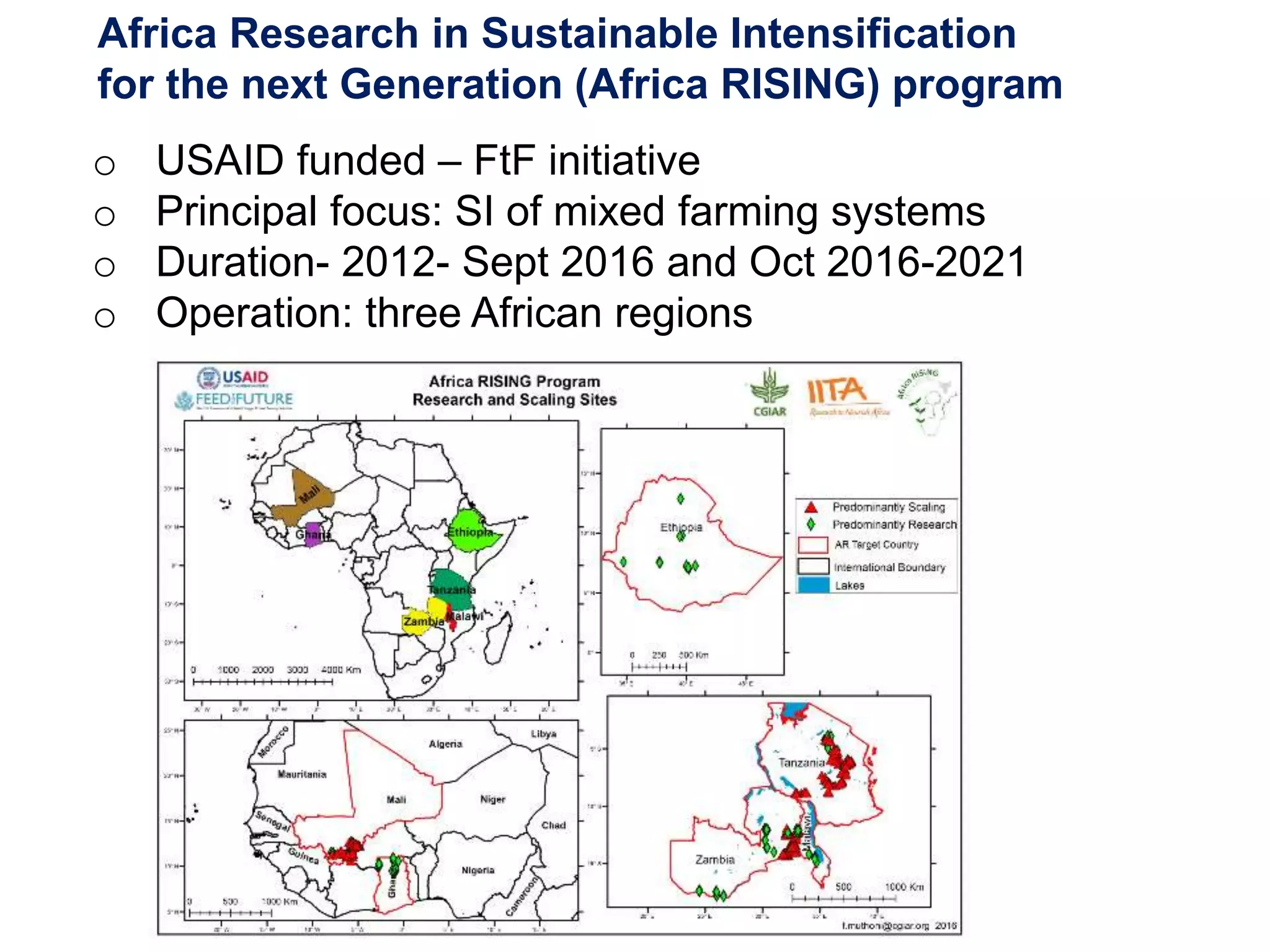
Africa Research in Sustainable Intensification
for the next Generation (Africa RISING) program
o USAID funded – FtF initiative
o Principal focus: SI of mixed farming systems
o Duration- 2012- Sept 2016 and Oct 2016-2021
o Operation: three African regions
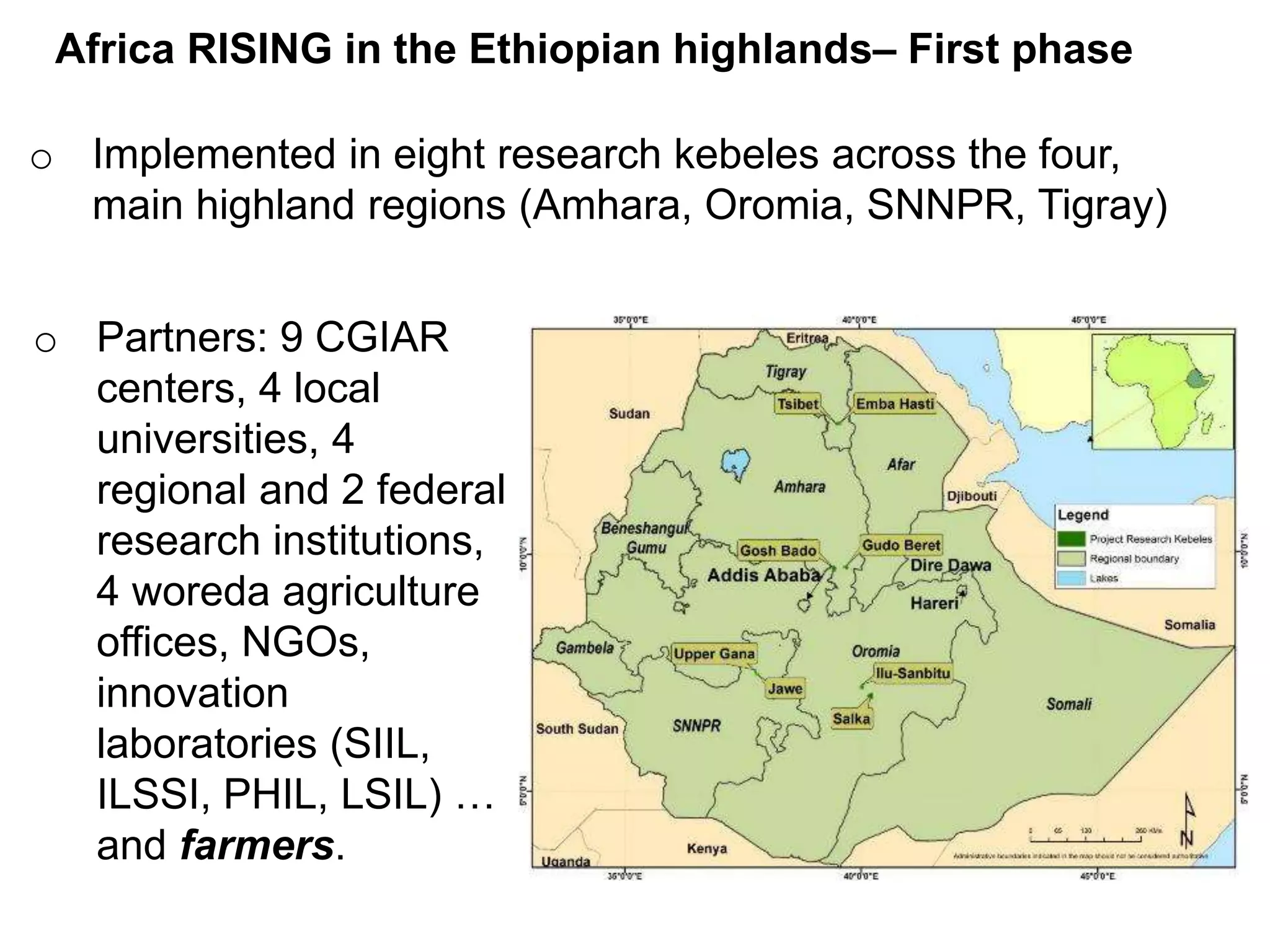
o Implemented in eight research kebeles across the four,
main highland regions (Amhara, Oromia, SNNPR, Tigray)
o Partners: 9 CGIAR
centers, 4 local
universities, 4
regional and 2 federal
research institutions,
4 woreda agriculture
offices, NGOs,
innovation
laboratories (SIIL,
ILSSI, PHIL, LSIL) …
and farmers.
Africa RISING in the Ethiopian highlands– First phase
Systems understanding/diagnosis: Tools
and methods
o Rapid Telephone Survey (RTS)
o Livelihood survey using SLATE
o Participatory Community Analysis (PCA)
o IMPACTlite survey: hhs detailed characterization
o Survey on Agro-ecological knowledge,
community knowledge groups – AKT5 tool
o FEAST and TECHfit
o Market/ Value chain studies
o Climate variability;
o Low crop yields (< 1 t ha-1);
o Soil fertility depletion, erosion and poor drainage;
o High price and poor access to fertilizer;
o Crop pests, weeds and diseases;
o Post harvest losses (30-40%);
o Lack of improved farm implements;
o Acute shortage of animal feed;
o Poor access to veterinary drugs and animal health
services;
o Seasonal water shortages;
o Poor household nutrition;
o Shortage of wood for fuel;
o Weak links to markets. l
Major constraints and challenges identified in
Africa RISING sites
1. Feed and forage development.
2. Field crop varietal selection and management.
3. Integration of high value products into mixed farming
systems.
4. Improved land and water management for
sustainability.
5. Improving the efficiency of mixed farming systems
through more effective crop-livestock integration.
6. Cross-cutting problems and opportunities (markets,
gender, nutrition).
7. Knowledge management, exchange and capacity
development.
Thematic areas formulated: seven broad areas
Addressed through 17 action research protocols and
implemented in collaboration with volunteer farmers.
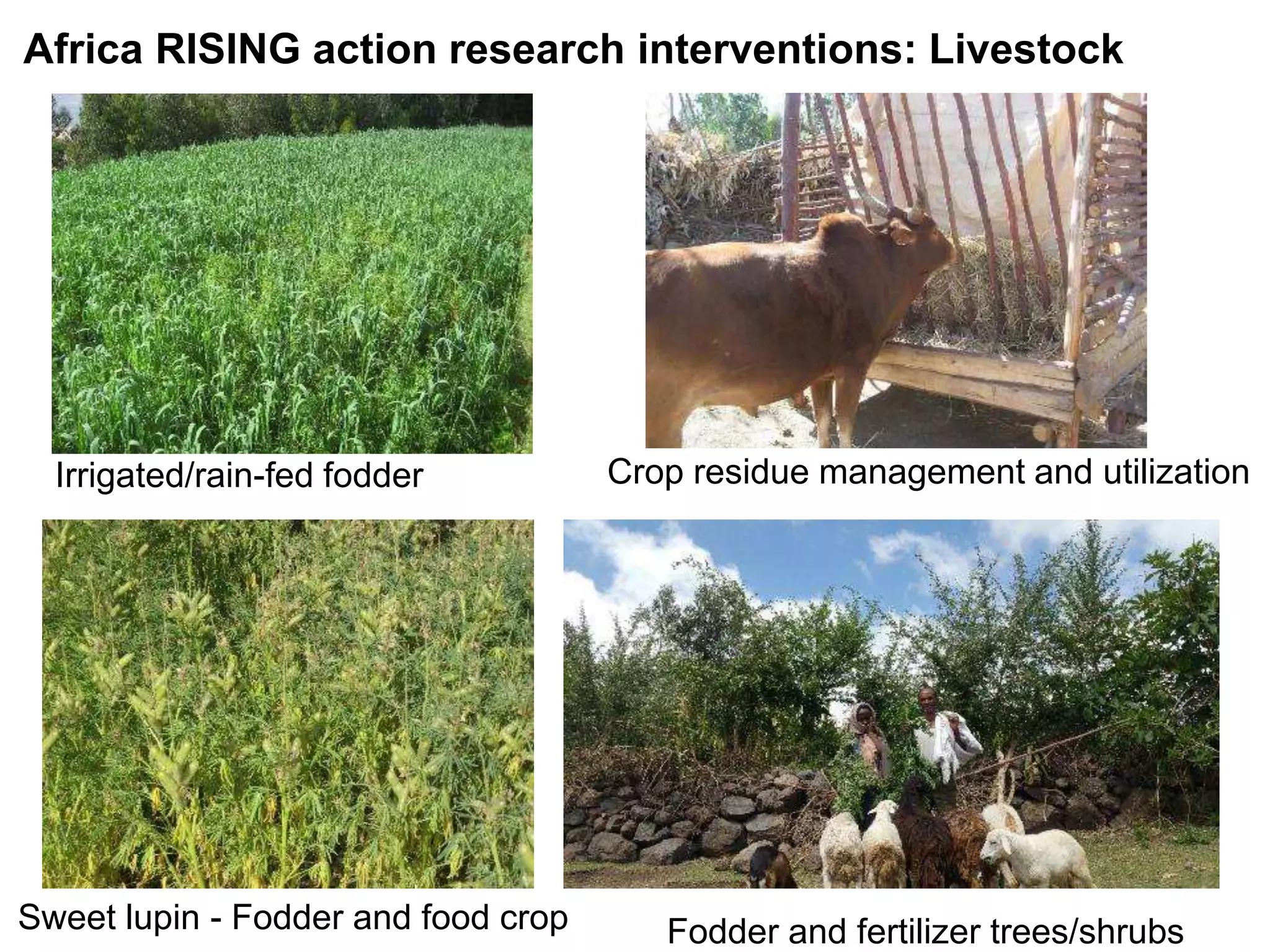
Irrigated/rain-fed fodder Crop residue management and utilization
Sweet lupin - Fodder and food crop Fodder and fertilizer trees/shrubs
Africa RISING action research interventions: Livestock
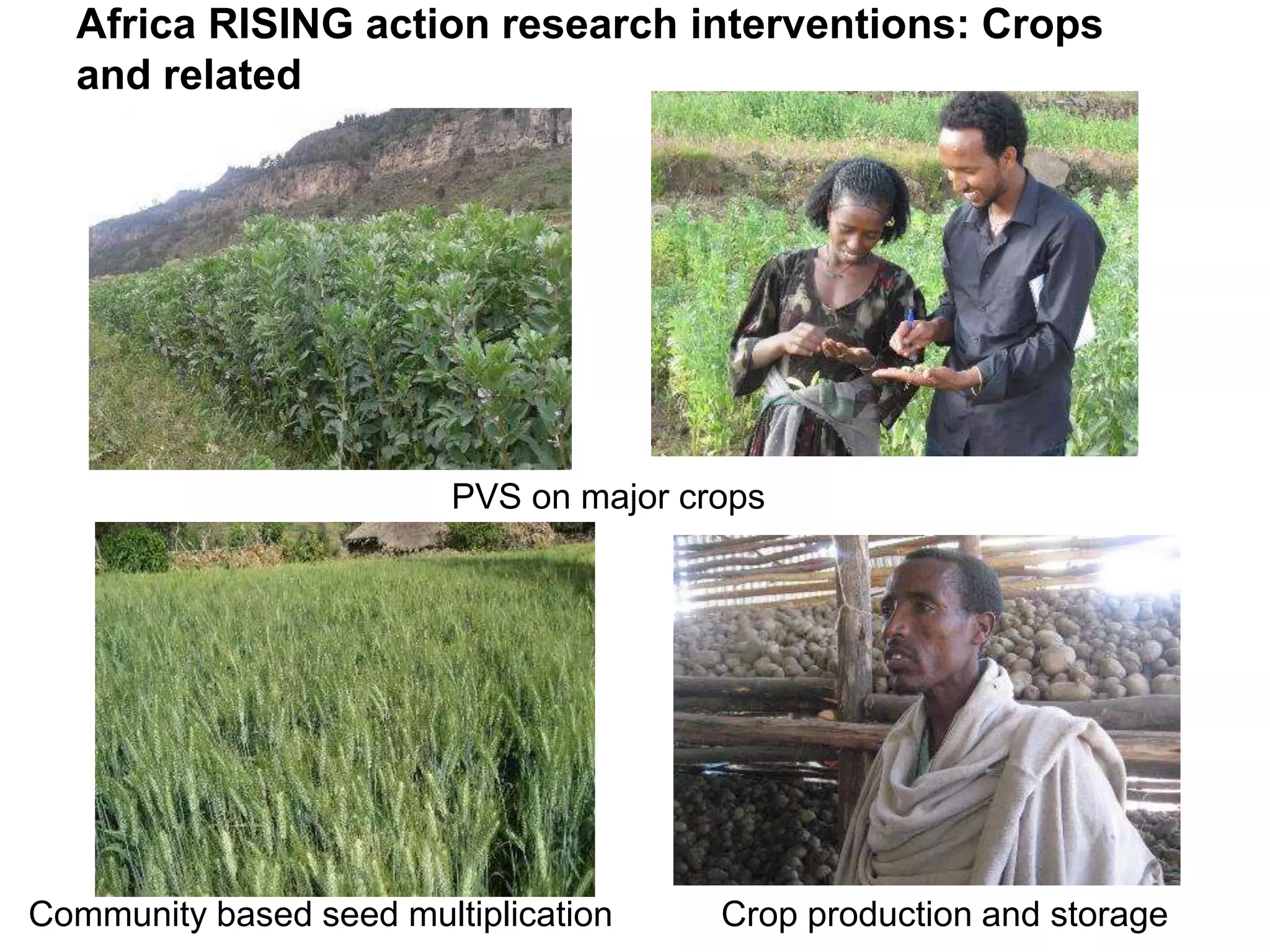
Community based seed multiplication
PVS on major crops
Crop production and storage
Africa RISING action research interventions: Crops
and related
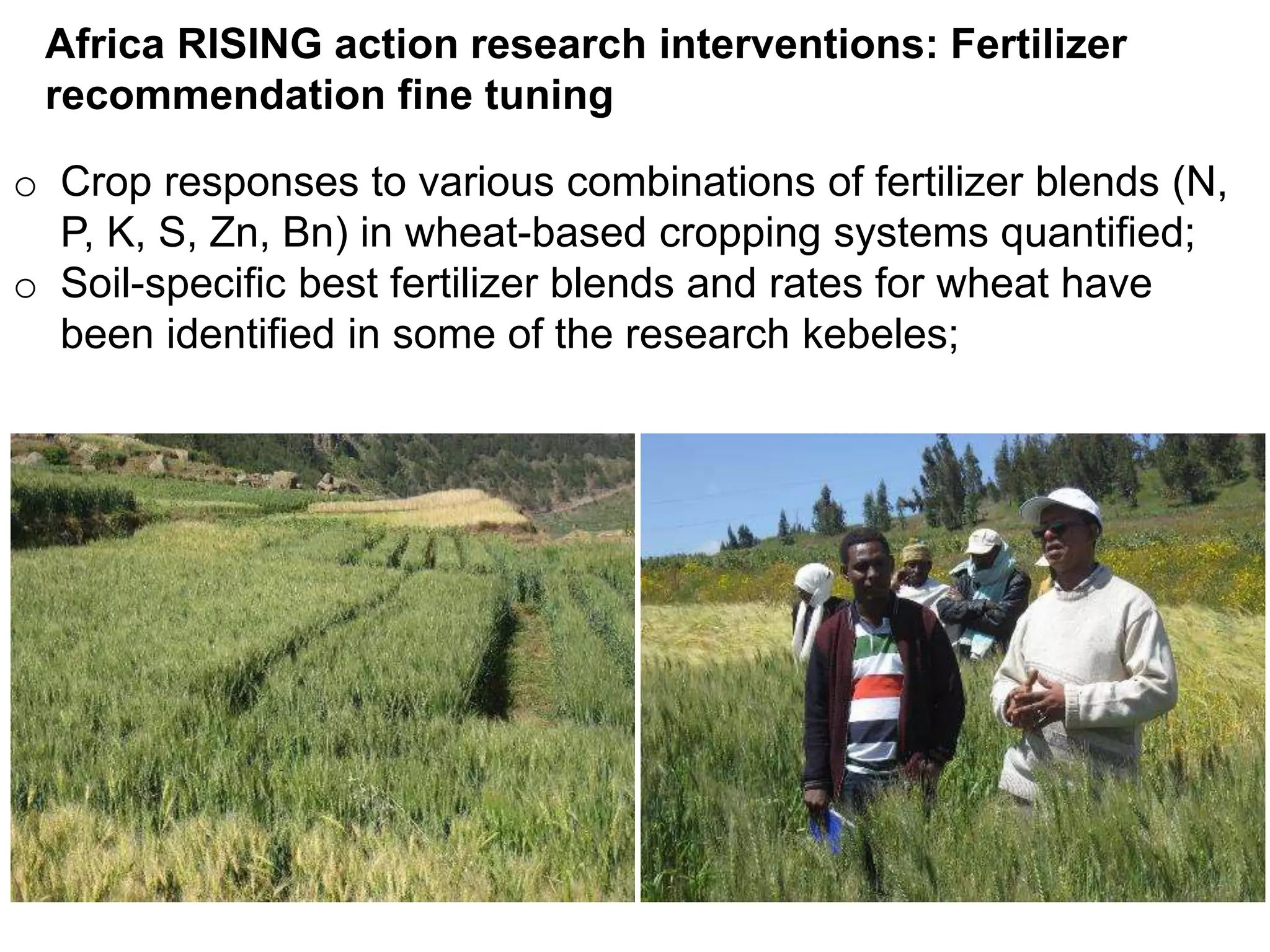
o Crop responses to various combinations of fertilizer blends (N,
P, K, S, Zn, Bn) in wheat-based cropping systems quantified;
o Soil-specific best fertilizer blends and rates for wheat have
been identified in some of the research kebeles;
Africa RISING action research interventions: Fertilizer
recommendation fine tuning
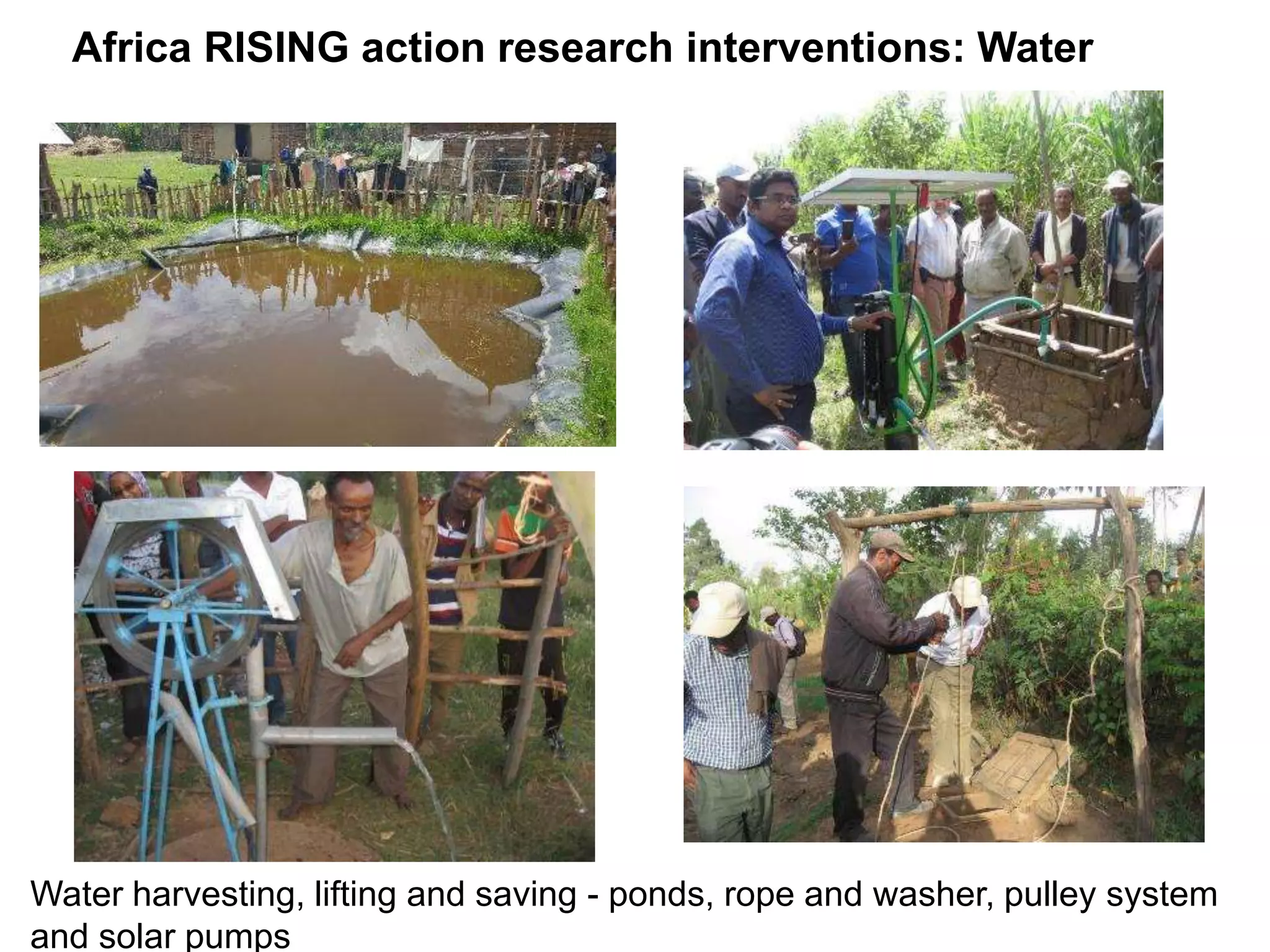
Water harvesting, lifting and saving - ponds, rope and washer, pulley system
and solar pumps
Africa RISING action research interventions: Water
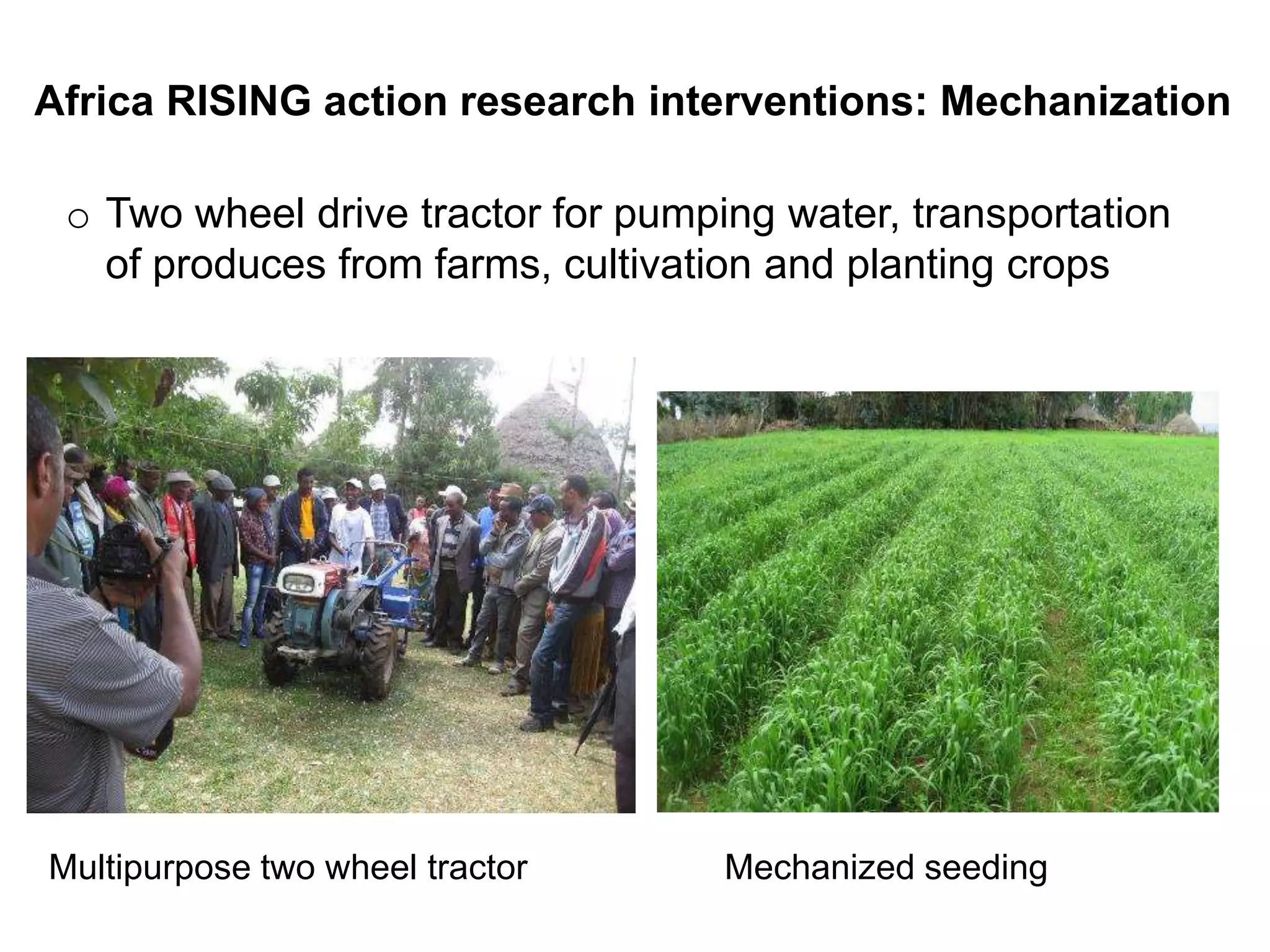
Multipurpose two wheel tractor Mechanized seeding
Africa RISING action research interventions: Mechanization
o Two wheel drive tractor for pumping water, transportation
of produces from farms, cultivation and planting crops
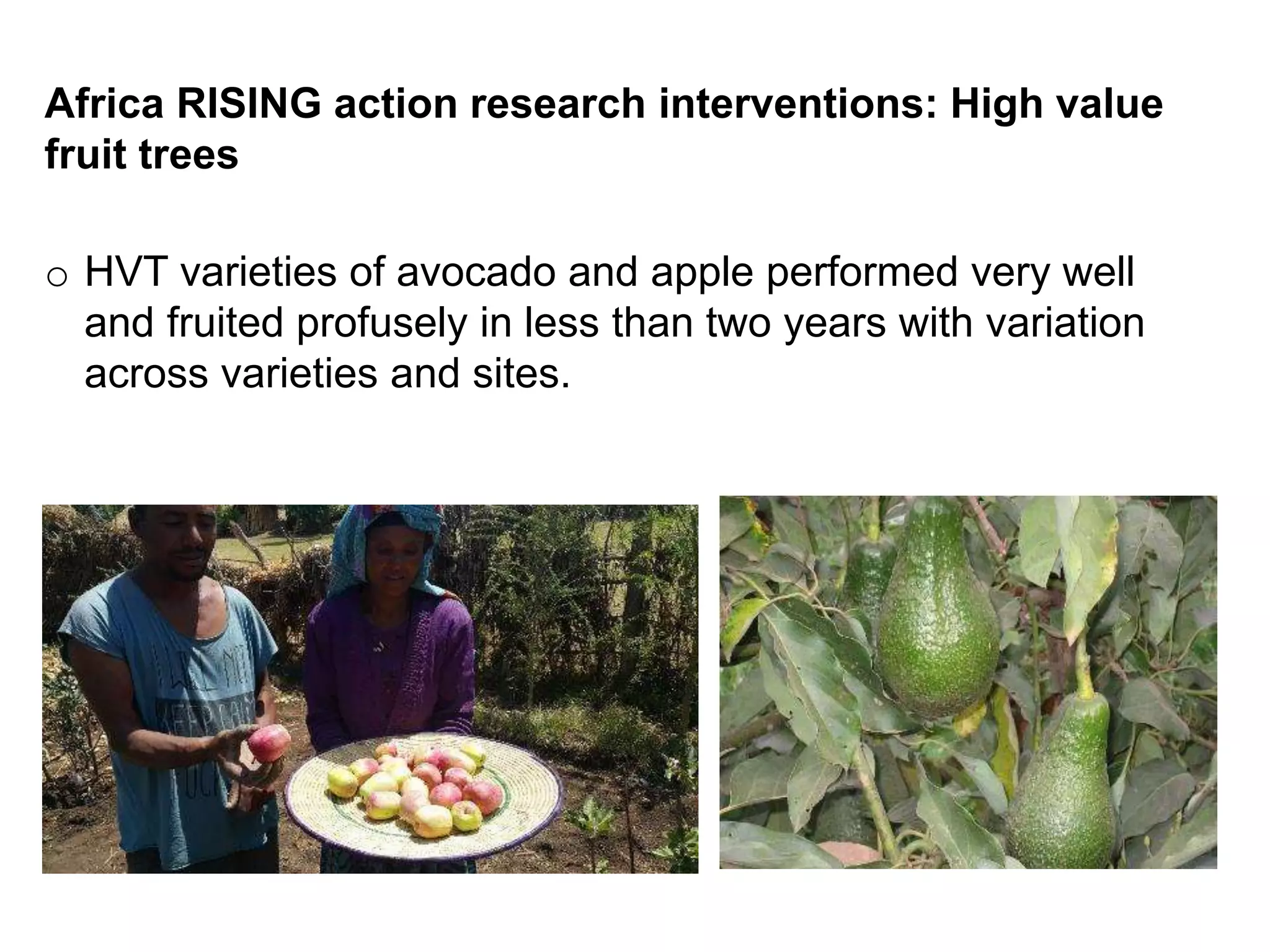
o HVT varieties of avocado and apple performed very well
and fruited profusely in less than two years with variation
across varieties and sites.
Africa RISING action research interventions: High value
fruit trees
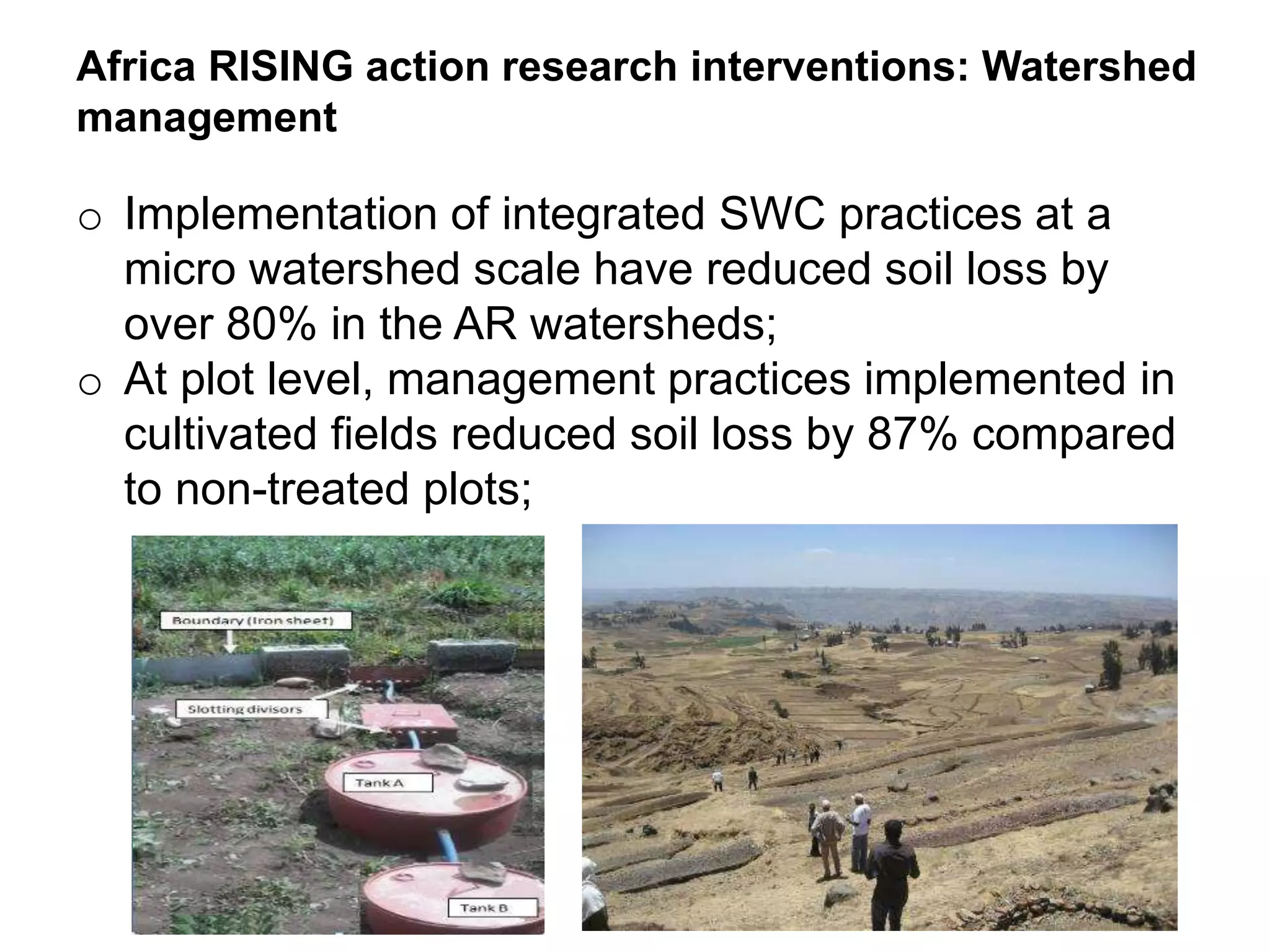
o Implementation of integrated SWC practices at a
micro watershed scale have reduced soil loss by
over 80% in the AR watersheds;
o At plot level, management practices implemented in
cultivated fields reduced soil loss by 87% compared
to non-treated plots;
Africa RISING action research interventions: Watershed
management
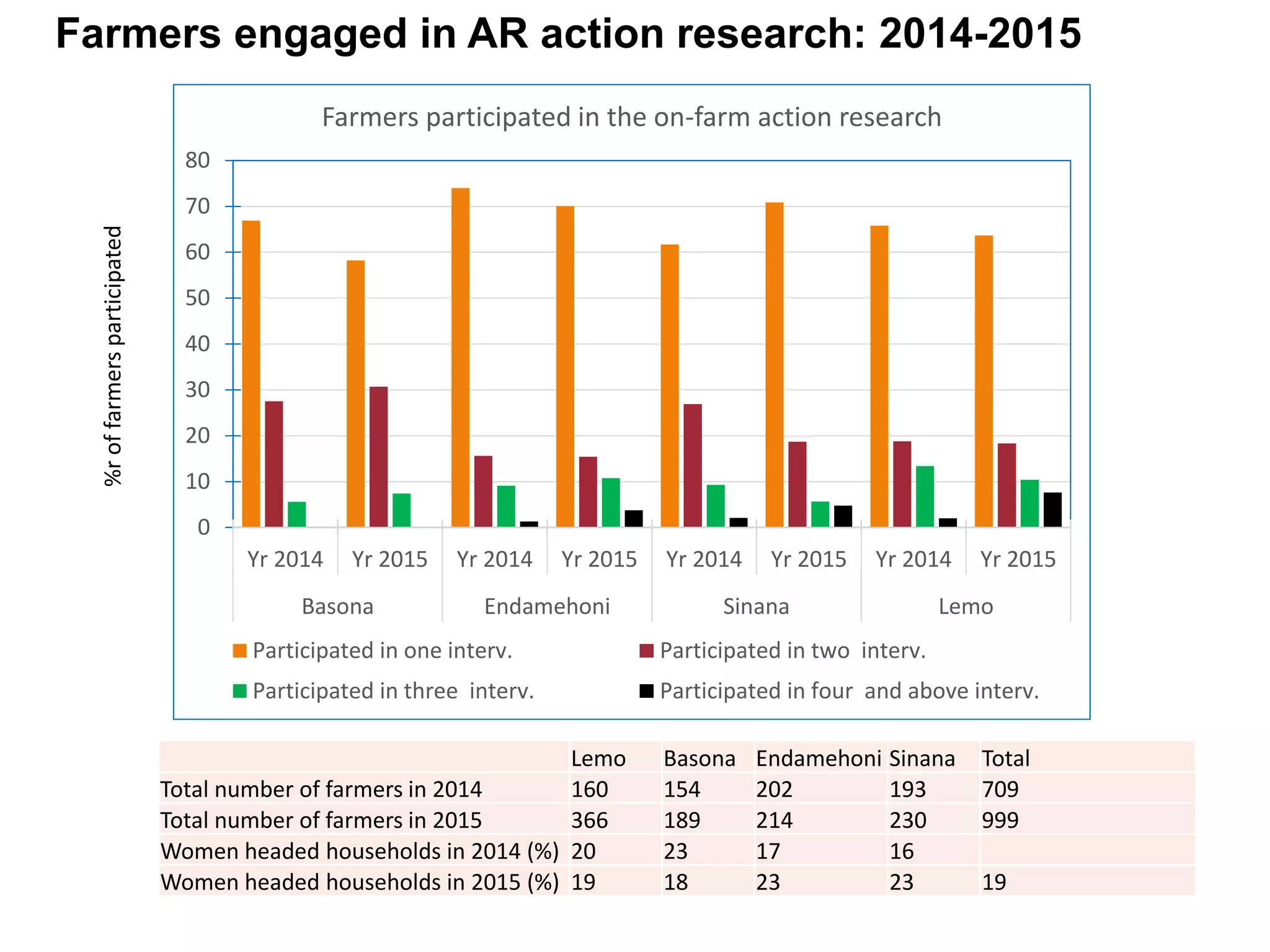
0
10
20
30
40
50
60
70
80
Yr 2014 Yr 2015 Yr 2014 Yr 2015 Yr 2014 Yr 2015 Yr 2014 Yr 2015
Basona Endamehoni Sinana Lemo
Farmers participated in the on-farm action research
Participated in one interv. Participated in two interv.
Participated in three interv. Participated in four and above interv.
%roffarmersparticipated
Lemo Basona Endamehoni Sinana Total
Total number of farmers in 2014 160 154 202 193 709
Total number of farmers in 2015 366 189 214 230 999
Women headed households in 2014 (%) 20 23 17 16
Women headed households in 2015 (%) 19 18 23 23 19
Farmers engaged in AR action research: 2014-2015
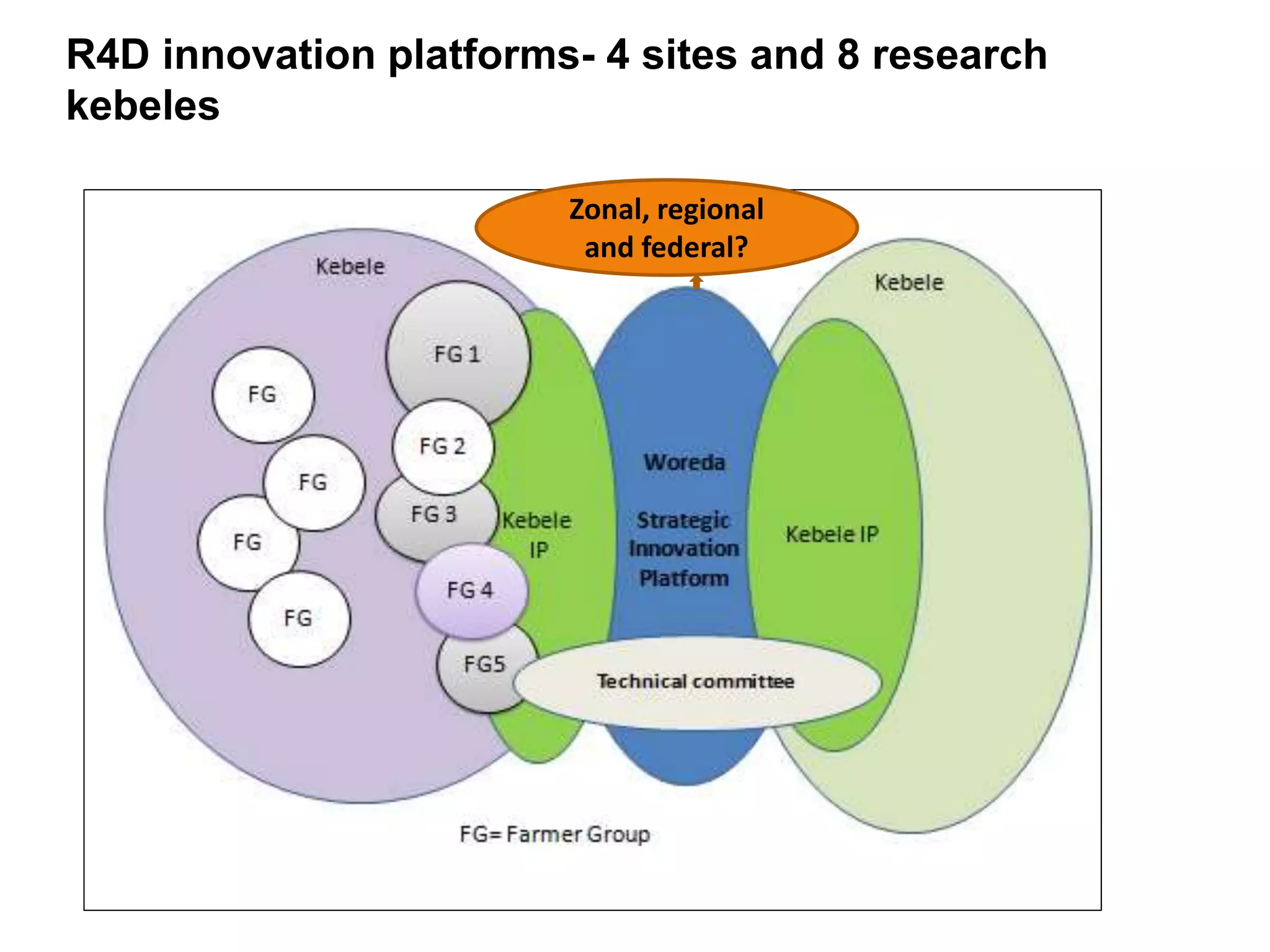
R4D innovation platforms- 4 sites and 8 research
kebeles
Zonal, regional
and federal?
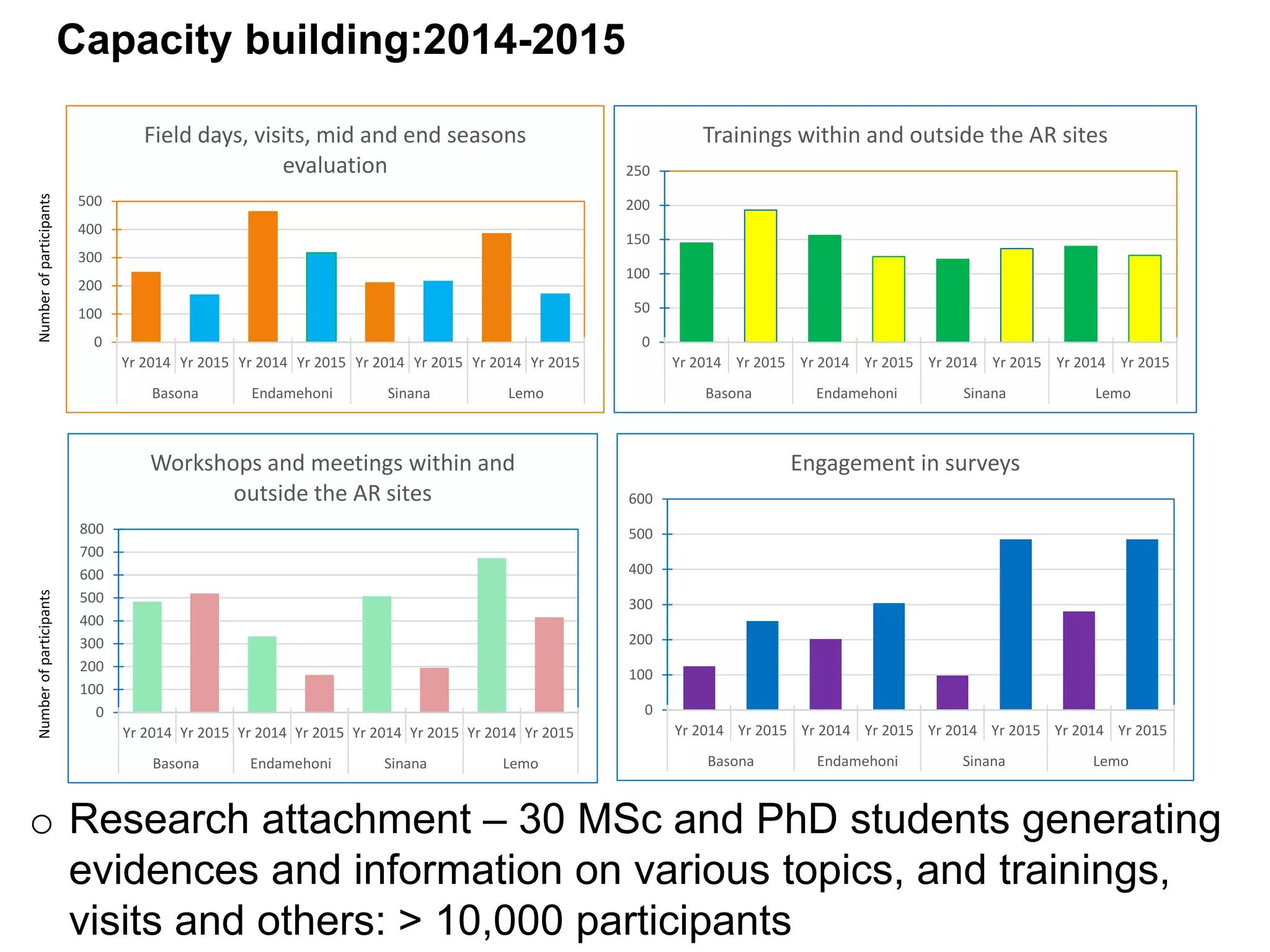
0
100
200
300
400
500
Yr 2014 Yr 2015 Yr 2014 Yr 2015 Yr 2014 Yr 2015 Yr 2014 Yr 2015
Basona Endamehoni Sinana Lemo
Field days, visits, mid and end seasons
evaluation
Numberofparticipants Capacity building:2014-2015
0
50
100
150
200
250
Yr 2014 Yr 2015 Yr 2014 Yr 2015 Yr 2014 Yr 2015 Yr 2014 Yr 2015
Basona Endamehoni Sinana Lemo
Trainings within and outside the AR sites
0
100
200
300
400
500
600
700
800
Yr 2014 Yr 2015 Yr 2014 Yr 2015 Yr 2014 Yr 2015 Yr 2014 Yr 2015
Basona Endamehoni Sinana Lemo
Workshops and meetings within and
outside the AR sites
Numberofparticipants
0
100
200
300
400
500
600
Yr 2014 Yr 2015 Yr 2014 Yr 2015 Yr 2014 Yr 2015 Yr 2014 Yr 2015
Basona Endamehoni Sinana Lemo
Engagement in surveys
o Research attachment – 30 MSc and PhD students generating
evidences and information on various topics, and trainings,
visits and others: > 10,000 participants
Communication and learning
 The AR team published 403 products (146 blog posts, 89
reports, 62 presentations, and numerous posters, reports,
briefs and brochures highlighting the project R4D activities.
 The AR team produced 16 manuscripts during a write-shop
and submitted to peer reviewed journals. Eight are already
published in peer reviewed international journals.
 AR in Ethiopian highlands won an award, sponsored by the
USAID Learning Laboratory in 2015, for its success in
collaborating, learning and adapting around its innovations.
 AR work in Ethiopia has generated significant media
coverage at international, national and regional levels
(http://www.businessinsider.com/ethiopia-is-experiencing-one-
of-the-worst-droughts-in-50-years-2016-5)
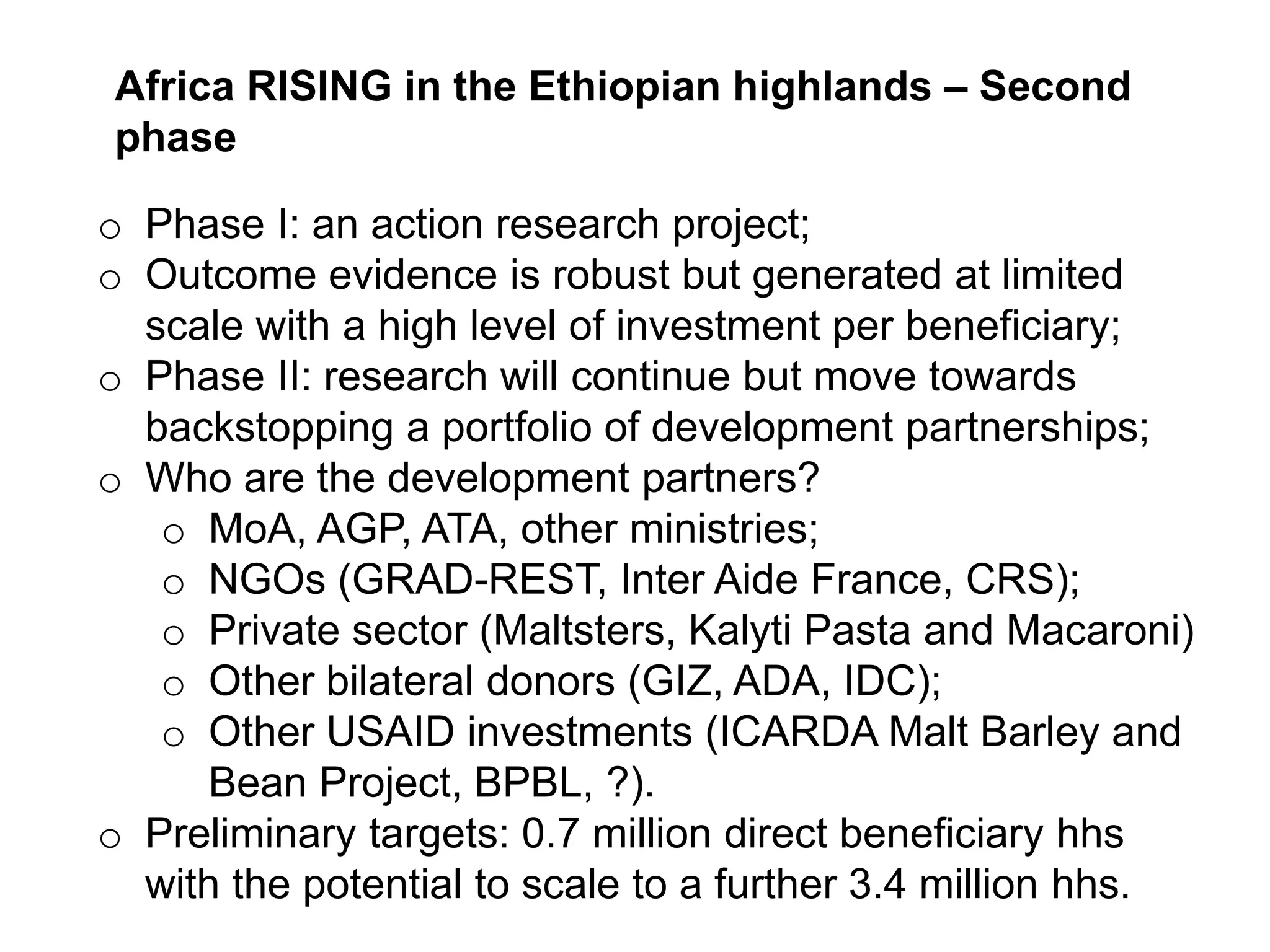
o Phase I: an action research project;
o Outcome evidence is robust but generated at limited
scale with a high level of investment per beneficiary;
o Phase II: research will continue but move towards
backstopping a portfolio of development partnerships;
o Who are the development partners?
o MoA, AGP, ATA, other ministries;
o NGOs (GRAD-REST, Inter Aide France, CRS);
o Private sector (Maltsters, Kalyti Pasta and Macaroni)
o Other bilateral donors (GIZ, ADA, IDC);
o Other USAID investments (ICARDA Malt Barley and
Bean Project, BPBL, ?).
o Preliminary targets: 0.7 million direct beneficiary hhs
with the potential to scale to a further 3.4 million hhs.
Africa RISING in the Ethiopian highlands – Second
phase
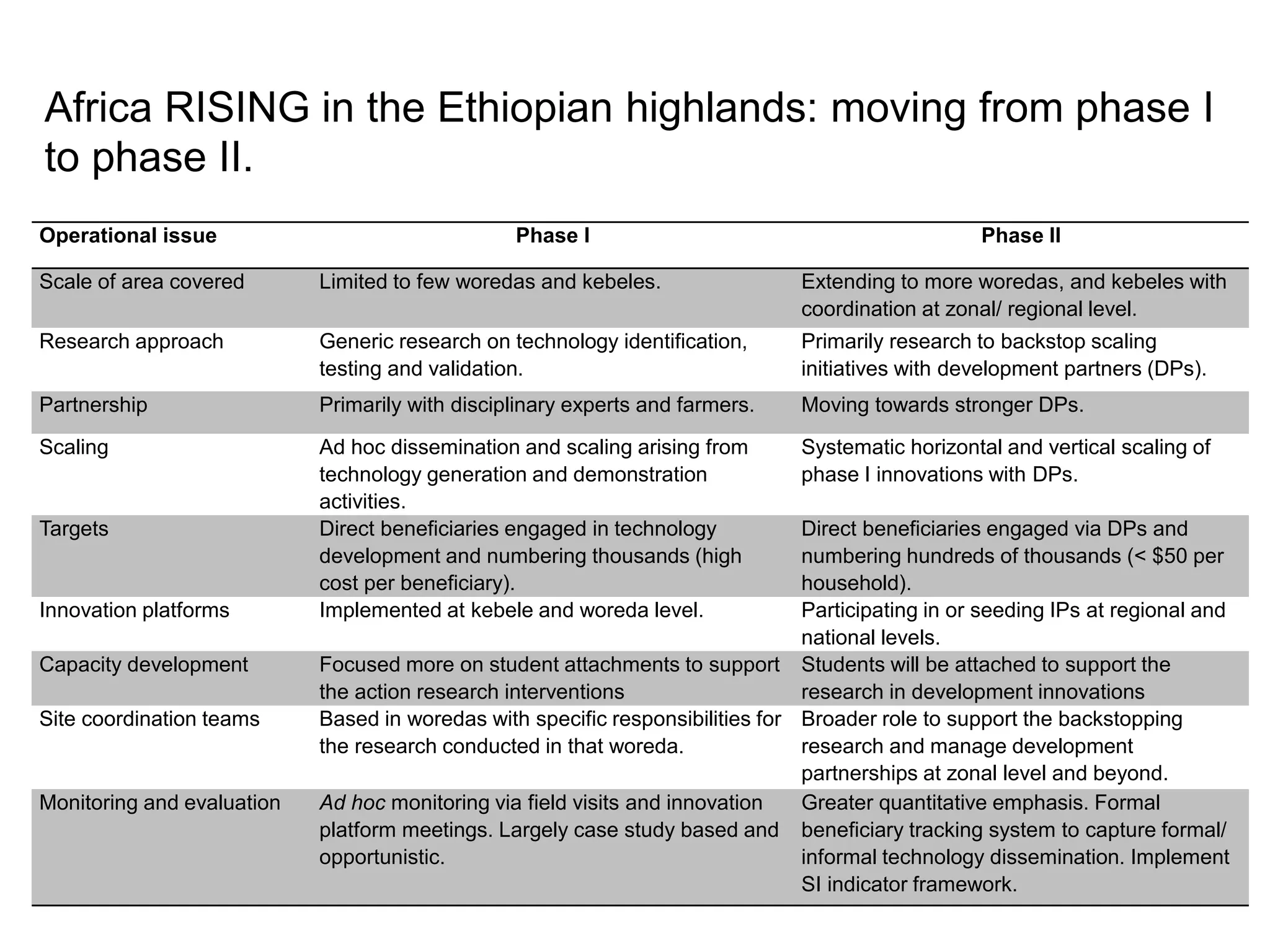
Operational issue Phase I Phase II
Scale of area covered Limited to few woredas and kebeles. Extending to more woredas, and kebeles with
coordination at zonal/ regional level.
Research approach Generic research on technology identification,
testing and validation.
Primarily research to backstop scaling
initiatives with development partners (DPs).
Partnership Primarily with disciplinary experts and farmers. Moving towards stronger DPs.
Scaling Ad hoc dissemination and scaling arising from
technology generation and demonstration
activities.
Systematic horizontal and vertical scaling of
phase I innovations with DPs.
Targets Direct beneficiaries engaged in technology
development and numbering thousands (high
cost per beneficiary).
Direct beneficiaries engaged via DPs and
numbering hundreds of thousands (< $50 per
household).
Innovation platforms Implemented at kebele and woreda level. Participating in or seeding IPs at regional and
national levels.
Capacity development Focused more on student attachments to support
the action research interventions
Students will be attached to support the
research in development innovations
Site coordination teams Based in woredas with specific responsibilities for
the research conducted in that woreda.
Broader role to support the backstopping
research and manage development
partnerships at zonal level and beyond.
Monitoring and evaluation Ad hoc monitoring via field visits and innovation
platform meetings. Largely case study based and
opportunistic.
Greater quantitative emphasis. Formal
beneficiary tracking system to capture formal/
informal technology dissemination. Implement
SI indicator framework.
Africa RISING in the Ethiopian highlands: moving from phase I
to phase II.
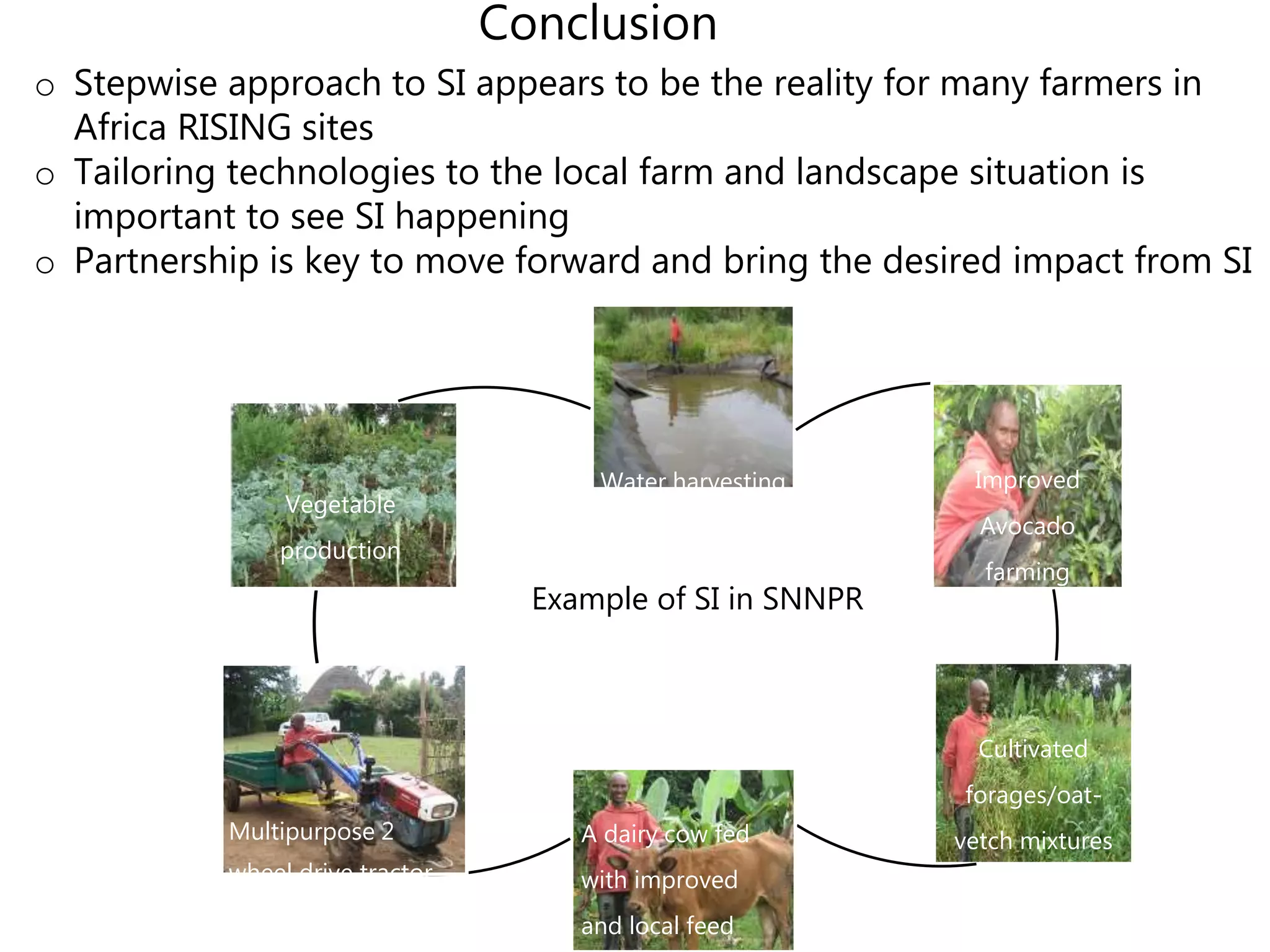
Water harvesting Improved
Avocado
farming
Cultivated
forages/oat-
vetch mixturesA dairy cow fed
with improved
and local feed
Multipurpose 2
wheel drive tractor
Vegetable
production
Example of SI in SNNPR
Conclusion
o Stepwise approach to SI appears to be the reality for many farmers in
Africa RISING sites
o Tailoring technologies to the local farm and landscape situation is
important to see SI happening
o Partnership is key to move forward and bring the desired impact from SI
Africa RISING CGIAR partners in Ethiopia
Africa RISING local partnersin Ethiopia
 Academic institutions:
 Wachemo, Mekelle, Madawolabu, Debre Berhan and Hawassa universities; Maichew
Agricultural College
 Regional research organizations:
 Amhara Regional Agricultrural Research Institute, Southern Agricultural Research
Institute, Tigray Agricultural Research Institute, Oromia Agricultural Research Institute
 Federal research organizations:
 Ethiopian Institute for Agricultural Research, Ethiopian Health and Nutrition Research
Institute
 Offices of Agriculture:
 Endamekoni (Tigray), Basona Worena (Amhara), Lemo (SNNRP) and Sinana (Oromia)
 Agricultural Transformation Agency
Africa Research in Sustainable Intensification for the Next Generation
africa-rising.net
The presentation has a Creative Commons licence. You are free to re-use or distribute this work, provided credit is given to ILRI.

Africa RISING in the Ethiopian highlands: Phase one R4D initiatives and Phase two priorities

  • 1.
    Africa RISING inthe Ethiopian highlands: Phase one R4D initiatives and Phase two priorities Training of Trainers (ToT) Workshop Michew, Tigray, 19-21 April 2017 Kindu Mekonnen and Peter Thorne, ILRI
  • 2.
    Africa Research inSustainable Intensification for the next Generation (Africa RISING) program o USAID funded – FtF initiative o Principal focus: SI of mixed farming systems o Duration- 2012- Sept 2016 and Oct 2016-2021 o Operation: three African regions
  • 3.
    o Implemented ineight research kebeles across the four, main highland regions (Amhara, Oromia, SNNPR, Tigray) o Partners: 9 CGIAR centers, 4 local universities, 4 regional and 2 federal research institutions, 4 woreda agriculture offices, NGOs, innovation laboratories (SIIL, ILSSI, PHIL, LSIL) … and farmers. Africa RISING in the Ethiopian highlands– First phase
  • 4.
    Systems understanding/diagnosis: Tools andmethods o Rapid Telephone Survey (RTS) o Livelihood survey using SLATE o Participatory Community Analysis (PCA) o IMPACTlite survey: hhs detailed characterization o Survey on Agro-ecological knowledge, community knowledge groups – AKT5 tool o FEAST and TECHfit o Market/ Value chain studies
  • 5.
    o Climate variability; oLow crop yields (< 1 t ha-1); o Soil fertility depletion, erosion and poor drainage; o High price and poor access to fertilizer; o Crop pests, weeds and diseases; o Post harvest losses (30-40%); o Lack of improved farm implements; o Acute shortage of animal feed; o Poor access to veterinary drugs and animal health services; o Seasonal water shortages; o Poor household nutrition; o Shortage of wood for fuel; o Weak links to markets. l Major constraints and challenges identified in Africa RISING sites
  • 6.
    1. Feed andforage development. 2. Field crop varietal selection and management. 3. Integration of high value products into mixed farming systems. 4. Improved land and water management for sustainability. 5. Improving the efficiency of mixed farming systems through more effective crop-livestock integration. 6. Cross-cutting problems and opportunities (markets, gender, nutrition). 7. Knowledge management, exchange and capacity development. Thematic areas formulated: seven broad areas Addressed through 17 action research protocols and implemented in collaboration with volunteer farmers.
  • 7.
    Irrigated/rain-fed fodder Cropresidue management and utilization Sweet lupin - Fodder and food crop Fodder and fertilizer trees/shrubs Africa RISING action research interventions: Livestock
  • 8.
    Community based seedmultiplication PVS on major crops Crop production and storage Africa RISING action research interventions: Crops and related
  • 9.
    o Crop responsesto various combinations of fertilizer blends (N, P, K, S, Zn, Bn) in wheat-based cropping systems quantified; o Soil-specific best fertilizer blends and rates for wheat have been identified in some of the research kebeles; Africa RISING action research interventions: Fertilizer recommendation fine tuning
  • 10.
    Water harvesting, liftingand saving - ponds, rope and washer, pulley system and solar pumps Africa RISING action research interventions: Water
  • 11.
    Multipurpose two wheeltractor Mechanized seeding Africa RISING action research interventions: Mechanization o Two wheel drive tractor for pumping water, transportation of produces from farms, cultivation and planting crops
  • 12.
    o HVT varietiesof avocado and apple performed very well and fruited profusely in less than two years with variation across varieties and sites. Africa RISING action research interventions: High value fruit trees
  • 13.
    o Implementation ofintegrated SWC practices at a micro watershed scale have reduced soil loss by over 80% in the AR watersheds; o At plot level, management practices implemented in cultivated fields reduced soil loss by 87% compared to non-treated plots; Africa RISING action research interventions: Watershed management
  • 14.
    0 10 20 30 40 50 60 70 80 Yr 2014 Yr2015 Yr 2014 Yr 2015 Yr 2014 Yr 2015 Yr 2014 Yr 2015 Basona Endamehoni Sinana Lemo Farmers participated in the on-farm action research Participated in one interv. Participated in two interv. Participated in three interv. Participated in four and above interv. %roffarmersparticipated Lemo Basona Endamehoni Sinana Total Total number of farmers in 2014 160 154 202 193 709 Total number of farmers in 2015 366 189 214 230 999 Women headed households in 2014 (%) 20 23 17 16 Women headed households in 2015 (%) 19 18 23 23 19 Farmers engaged in AR action research: 2014-2015
  • 15.
    R4D innovation platforms-4 sites and 8 research kebeles Zonal, regional and federal?
  • 16.
    0 100 200 300 400 500 Yr 2014 Yr2015 Yr 2014 Yr 2015 Yr 2014 Yr 2015 Yr 2014 Yr 2015 Basona Endamehoni Sinana Lemo Field days, visits, mid and end seasons evaluation Numberofparticipants Capacity building:2014-2015 0 50 100 150 200 250 Yr 2014 Yr 2015 Yr 2014 Yr 2015 Yr 2014 Yr 2015 Yr 2014 Yr 2015 Basona Endamehoni Sinana Lemo Trainings within and outside the AR sites 0 100 200 300 400 500 600 700 800 Yr 2014 Yr 2015 Yr 2014 Yr 2015 Yr 2014 Yr 2015 Yr 2014 Yr 2015 Basona Endamehoni Sinana Lemo Workshops and meetings within and outside the AR sites Numberofparticipants 0 100 200 300 400 500 600 Yr 2014 Yr 2015 Yr 2014 Yr 2015 Yr 2014 Yr 2015 Yr 2014 Yr 2015 Basona Endamehoni Sinana Lemo Engagement in surveys o Research attachment – 30 MSc and PhD students generating evidences and information on various topics, and trainings, visits and others: > 10,000 participants
  • 17.
    Communication and learning The AR team published 403 products (146 blog posts, 89 reports, 62 presentations, and numerous posters, reports, briefs and brochures highlighting the project R4D activities.  The AR team produced 16 manuscripts during a write-shop and submitted to peer reviewed journals. Eight are already published in peer reviewed international journals.  AR in Ethiopian highlands won an award, sponsored by the USAID Learning Laboratory in 2015, for its success in collaborating, learning and adapting around its innovations.  AR work in Ethiopia has generated significant media coverage at international, national and regional levels (http://www.businessinsider.com/ethiopia-is-experiencing-one- of-the-worst-droughts-in-50-years-2016-5)
  • 18.
    o Phase I:an action research project; o Outcome evidence is robust but generated at limited scale with a high level of investment per beneficiary; o Phase II: research will continue but move towards backstopping a portfolio of development partnerships; o Who are the development partners? o MoA, AGP, ATA, other ministries; o NGOs (GRAD-REST, Inter Aide France, CRS); o Private sector (Maltsters, Kalyti Pasta and Macaroni) o Other bilateral donors (GIZ, ADA, IDC); o Other USAID investments (ICARDA Malt Barley and Bean Project, BPBL, ?). o Preliminary targets: 0.7 million direct beneficiary hhs with the potential to scale to a further 3.4 million hhs. Africa RISING in the Ethiopian highlands – Second phase
  • 19.
    Operational issue PhaseI Phase II Scale of area covered Limited to few woredas and kebeles. Extending to more woredas, and kebeles with coordination at zonal/ regional level. Research approach Generic research on technology identification, testing and validation. Primarily research to backstop scaling initiatives with development partners (DPs). Partnership Primarily with disciplinary experts and farmers. Moving towards stronger DPs. Scaling Ad hoc dissemination and scaling arising from technology generation and demonstration activities. Systematic horizontal and vertical scaling of phase I innovations with DPs. Targets Direct beneficiaries engaged in technology development and numbering thousands (high cost per beneficiary). Direct beneficiaries engaged via DPs and numbering hundreds of thousands (< $50 per household). Innovation platforms Implemented at kebele and woreda level. Participating in or seeding IPs at regional and national levels. Capacity development Focused more on student attachments to support the action research interventions Students will be attached to support the research in development innovations Site coordination teams Based in woredas with specific responsibilities for the research conducted in that woreda. Broader role to support the backstopping research and manage development partnerships at zonal level and beyond. Monitoring and evaluation Ad hoc monitoring via field visits and innovation platform meetings. Largely case study based and opportunistic. Greater quantitative emphasis. Formal beneficiary tracking system to capture formal/ informal technology dissemination. Implement SI indicator framework. Africa RISING in the Ethiopian highlands: moving from phase I to phase II.
  • 20.
    Water harvesting Improved Avocado farming Cultivated forages/oat- vetchmixturesA dairy cow fed with improved and local feed Multipurpose 2 wheel drive tractor Vegetable production Example of SI in SNNPR Conclusion o Stepwise approach to SI appears to be the reality for many farmers in Africa RISING sites o Tailoring technologies to the local farm and landscape situation is important to see SI happening o Partnership is key to move forward and bring the desired impact from SI
  • 21.
    Africa RISING CGIARpartners in Ethiopia
  • 22.
    Africa RISING localpartnersin Ethiopia  Academic institutions:  Wachemo, Mekelle, Madawolabu, Debre Berhan and Hawassa universities; Maichew Agricultural College  Regional research organizations:  Amhara Regional Agricultrural Research Institute, Southern Agricultural Research Institute, Tigray Agricultural Research Institute, Oromia Agricultural Research Institute  Federal research organizations:  Ethiopian Institute for Agricultural Research, Ethiopian Health and Nutrition Research Institute  Offices of Agriculture:  Endamekoni (Tigray), Basona Worena (Amhara), Lemo (SNNRP) and Sinana (Oromia)  Agricultural Transformation Agency
  • 23.
    Africa Research inSustainable Intensification for the Next Generation africa-rising.net The presentation has a Creative Commons licence. You are free to re-use or distribute this work, provided credit is given to ILRI.

Editor's Notes