Proposals for Africa RISING
    Ethiopian Highlands Research
     Component 2 – Community
    level issues and interventions
                 Aster Gebrekristos (ICRAF)

Africa RISING Ethiopia project implementation meeting, Addis
                 Ababa, 13-14 February 2013
Introduction


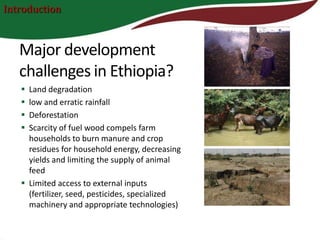
   Major development
   challenges in Ethiopia?
    Land degradation
    low and erratic rainfall
    Deforestation
    Scarcity of fuel wood compels farm
     households to burn manure and crop
     residues for household energy, decreasing
     yields and limiting the supply of animal
     feed
    Limited access to external inputs
     (fertilizer, seed, pesticides, specialized
     machinery and appropriate technologies)
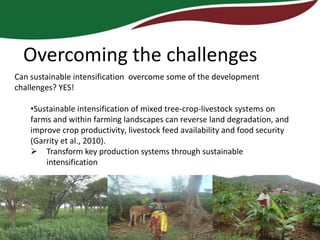
Overcoming the challenges
Can sustainable intensification overcome some of the development
challenges? YES!

    •Sustainable intensification of mixed tree-crop-livestock systems on
    farms and within farming landscapes can reverse land degradation, and
    improve crop productivity, livestock feed availability and food security
    (Garrity et al., 2010).
     Transform key production systems through sustainable
        intensification
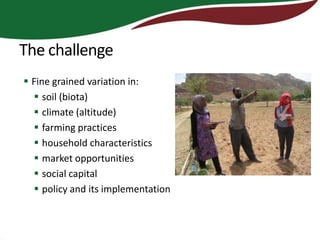
The challenge
 Fine grained variation in:
   soil (biota)
   climate (altitude)
   farming practices
   household characteristics
   market opportunities
   social capital
   policy and its implementation
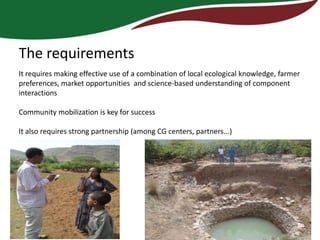
The requirements
It requires making effective use of a combination of local ecological knowledge, farmer
preferences, market opportunities and science-based understanding of component
interactions

Community mobilization is key for success

It also requires strong partnership (among CG centers, partners...)
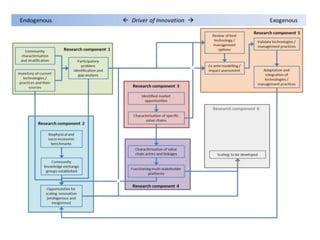
Main objectives of RC2
 RC2 will focus on exploiting the potential for peer-to-peer
 knowledge exchange within communities and on
 opportunities for strengthening and augmenting existing
 practises with external innovation.

 The three key deliverables are:
 • Bio-physical and socio-economic benchmarks
 • Community knowledge exchange groups (CKEGs)
 • Opportunities for scaling innovation (endogenous and
   exogenous)

       Based on the out come of RC1 exsisting functional
 CKEGs and/or establish new
Research Questions
• What benchmarks are appropriate for meeting the needs of
  monitoring progress towards AR-EH / FtF development outcomes at
  the household level?

• How can CKEGs be constituted to make the best use of knowledge
  that already exists within communities and to act as a platform for the
  acquisition and application of new knowledge (intervention options)?

• How can gender equity be properly ensured in the formation and
  operation of CKEGs.

• How can communities be organised to capitalise on a range of
  opportunities for scaling innovation in ways that are both equitably
  targeted and cost effective?
Hypotheses
 Based on proper characterisation and stratification (RC1), it is possible to
  constructs cost-effective suites of benchmarks that are effective sources of
  knowledge for communities, they can underpin meaningful M and E and
  do not require exhaustive and expensive household surveys.
 Effective sharing of existing knowledge within communities through CKEGs
  can be effective in generating development outcomes before exogenous
  innovation is brought into play.
 CKEGs can also form a strong platform for the introduction and integration
  of exogenous technologies.
 A balanced analysis of endogenous and exogenous opportunities that
  focus on bottom-up integration rather than top-down introduction is a
  more effective mechanism for implementing sustainable intensification at
  a household level.
Approach
Bio-physical and socio-economic benchmarks
 Collate all the benchmarking data gathered under RC1 and develop a
 suite of benchmarks that addresses the needs of monitoring progress
 towards AR-EH / FtF development outcomes.
 Develop and test approaches for actively using benchmarks to inform
 discussion in CKEGs.
 Establish monitoring processes based on the suite of benchmarks
 selected.
Approach
Community knowledge exchange groups
 Establish CKEGs based on equitable gender participation and the
 opportunities for knowledge transfer amongst strata.
 Develop and test participatory approaches for peer-to-peer
 benchmarking as a driver of knowledge transfer.
 Develop and test approaches that would allow CKEGs to participate in
 driving research priorities for AR-EH.
Approach
Opportunities for scaling innovation
 Identification of barriers to wider adoption of current practises within
 the community.
 Identification of solutions for lifting these barriers where feasible.
 Identification of entry points for exogenous technologies and
 management practices.
Approach: Local ecological knowledge
process
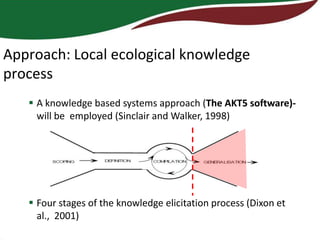
    A knowledge based systems approach (The AKT5 software)-
     will be employed (Sinclair and Walker, 1998)


    Four stages of the knowledge elicitation process (Dixon et
     al., 2001)
The process
    Stakeholder analysis (to establish system boundaries and determine the
     different strata of people who had an influence on the functioning of the
     system e.g farmers, Development Agents, Extension officers and village
     leaders etc)

    Scoping, ( different PRA methods will be used such as social mapping and
     modelling, seasonality maps, participatory linkage diagrams and focus group
     discussions.

    Definition(objectives will be redefined and then semi structured interviews
     will be prepared ) Stratified random sampling to select informants of equal
     number of male and female

    Compilation phase involved repeated interaction with key
     informants, Knowledge representation and evaluation of emerging knowledge
     base
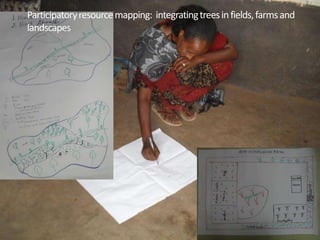
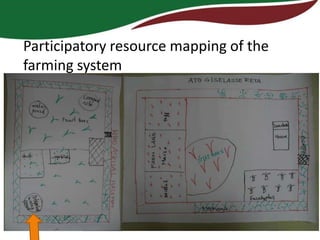
Participatory resource mapping: integrating trees in fields, farms and
landscapes
Participatory resource mapping of the
farming system
Compilation and generalisation
•    What do farmers know and explain well?
•    Drivers and challenges
•    Why do farmers do the way they do (e.g positioning of trees on farms)
•    Source of exsisting technologies (Endogenous and exogenous)
•    processes of change (what works well)- (strong community leader, existing
     CKEGs , Model farmers?)
•    Identify knowledge gaps and
    Demand driven Intervention options (build on what we have (entry point)
     and/or introduce new technologies)
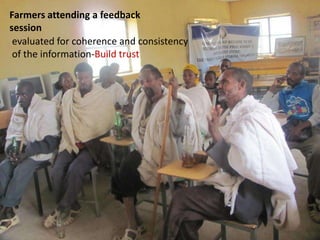
Farmers attending a feedback
session
 evaluated for coherence and consistency
 of the information-Build trust
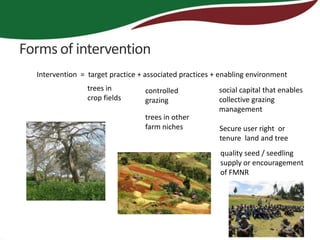
Forms of intervention
  Intervention = target practice + associated practices + enabling environment
                 trees in         controlled             social capital that enables
                 crop fields      grazing                collective grazing
                                                         management
                                  trees in other
                                  farm niches            Secure user right or
                                                         tenure land and tree
                                                         quality seed / seedling
                                                         supply or encouragement
                                                         of FMNR
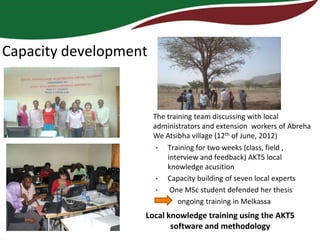
Capacity development


                       The training team discussing with local
                       administrators and extension workers of Abreha
                       We Atsibha village (12th of June, 2012)
                        •  Training for two weeks (class, field ,
                           interview and feedback) AKT5 local
                           knowledge acusition
                        •  Capacity building of seven local experts
                        •   One MSc student defended her thesis
                               ongoing training in Melkassa
                   Local knowledge training using the AKT5
                          software and methodology
The approach
  Characterize variation across scaling domain
       acquire local knowledge
       identify strengths and weaknesses (knowledge gaps)
 • Design scaling so that promising options are tested across sufficient
     range to refine our understanding of what works where and for
     whom
       measure performance of options
       Fit options to sites and farmer circumstances
  Establish participatory approach with farmers in which uncertainty and
  risk are understood, acknowledged and progressively reduced
       leave to farmers what they do best but
       learn collectively and systematically from experience
Contributors
                                  • ICRAF
                                  Dr Aster Gebrekirstos
                                  Dr. Kiros Hadgu
Thank you for your attention!!!   Dr Fergus Sinclair
Amesegenaleu!                     Dr Ermias Aynekulu
                                  Mrs Martha Cronin

                                  • ILRI
                                  • National partners
Africa Research in Sustainable Intensification for the Next Generation
                    africa-rising.net

Proposals for Africa RISING Ethiopian Highlands Research Component 2—Community level issues and interventions

  • 1.
    Proposals for AfricaRISING Ethiopian Highlands Research Component 2 – Community level issues and interventions Aster Gebrekristos (ICRAF) Africa RISING Ethiopia project implementation meeting, Addis Ababa, 13-14 February 2013
  • 2.
    Introduction Major development challenges in Ethiopia?  Land degradation  low and erratic rainfall  Deforestation  Scarcity of fuel wood compels farm households to burn manure and crop residues for household energy, decreasing yields and limiting the supply of animal feed  Limited access to external inputs (fertilizer, seed, pesticides, specialized machinery and appropriate technologies)
  • 3.
    Overcoming the challenges Cansustainable intensification overcome some of the development challenges? YES! •Sustainable intensification of mixed tree-crop-livestock systems on farms and within farming landscapes can reverse land degradation, and improve crop productivity, livestock feed availability and food security (Garrity et al., 2010).  Transform key production systems through sustainable intensification
  • 4.
    The challenge  Finegrained variation in:  soil (biota)  climate (altitude)  farming practices  household characteristics  market opportunities  social capital  policy and its implementation
  • 5.
    The requirements It requiresmaking effective use of a combination of local ecological knowledge, farmer preferences, market opportunities and science-based understanding of component interactions Community mobilization is key for success It also requires strong partnership (among CG centers, partners...)
  • 7.
    Main objectives ofRC2 RC2 will focus on exploiting the potential for peer-to-peer knowledge exchange within communities and on opportunities for strengthening and augmenting existing practises with external innovation. The three key deliverables are: • Bio-physical and socio-economic benchmarks • Community knowledge exchange groups (CKEGs) • Opportunities for scaling innovation (endogenous and exogenous) Based on the out come of RC1 exsisting functional CKEGs and/or establish new
  • 8.
    Research Questions • Whatbenchmarks are appropriate for meeting the needs of monitoring progress towards AR-EH / FtF development outcomes at the household level? • How can CKEGs be constituted to make the best use of knowledge that already exists within communities and to act as a platform for the acquisition and application of new knowledge (intervention options)? • How can gender equity be properly ensured in the formation and operation of CKEGs. • How can communities be organised to capitalise on a range of opportunities for scaling innovation in ways that are both equitably targeted and cost effective?
  • 9.
    Hypotheses  Based onproper characterisation and stratification (RC1), it is possible to constructs cost-effective suites of benchmarks that are effective sources of knowledge for communities, they can underpin meaningful M and E and do not require exhaustive and expensive household surveys.  Effective sharing of existing knowledge within communities through CKEGs can be effective in generating development outcomes before exogenous innovation is brought into play.  CKEGs can also form a strong platform for the introduction and integration of exogenous technologies.  A balanced analysis of endogenous and exogenous opportunities that focus on bottom-up integration rather than top-down introduction is a more effective mechanism for implementing sustainable intensification at a household level.
  • 10.
    Approach Bio-physical and socio-economicbenchmarks Collate all the benchmarking data gathered under RC1 and develop a suite of benchmarks that addresses the needs of monitoring progress towards AR-EH / FtF development outcomes. Develop and test approaches for actively using benchmarks to inform discussion in CKEGs. Establish monitoring processes based on the suite of benchmarks selected.
  • 11.
    Approach Community knowledge exchangegroups Establish CKEGs based on equitable gender participation and the opportunities for knowledge transfer amongst strata. Develop and test participatory approaches for peer-to-peer benchmarking as a driver of knowledge transfer. Develop and test approaches that would allow CKEGs to participate in driving research priorities for AR-EH.
  • 12.
    Approach Opportunities for scalinginnovation Identification of barriers to wider adoption of current practises within the community. Identification of solutions for lifting these barriers where feasible. Identification of entry points for exogenous technologies and management practices.
  • 13.
    Approach: Local ecologicalknowledge process  A knowledge based systems approach (The AKT5 software)- will be employed (Sinclair and Walker, 1998)  Four stages of the knowledge elicitation process (Dixon et al., 2001)
  • 14.
    The process  Stakeholder analysis (to establish system boundaries and determine the different strata of people who had an influence on the functioning of the system e.g farmers, Development Agents, Extension officers and village leaders etc)  Scoping, ( different PRA methods will be used such as social mapping and modelling, seasonality maps, participatory linkage diagrams and focus group discussions.  Definition(objectives will be redefined and then semi structured interviews will be prepared ) Stratified random sampling to select informants of equal number of male and female  Compilation phase involved repeated interaction with key informants, Knowledge representation and evaluation of emerging knowledge base
  • 15.
    Participatory resource mapping:integrating trees in fields, farms and landscapes
  • 16.
    Participatory resource mappingof the farming system
  • 17.
    Compilation and generalisation • What do farmers know and explain well? • Drivers and challenges • Why do farmers do the way they do (e.g positioning of trees on farms) • Source of exsisting technologies (Endogenous and exogenous) • processes of change (what works well)- (strong community leader, existing CKEGs , Model farmers?) • Identify knowledge gaps and  Demand driven Intervention options (build on what we have (entry point) and/or introduce new technologies)
  • 18.
    Farmers attending afeedback session evaluated for coherence and consistency of the information-Build trust
  • 19.
    Forms of intervention Intervention = target practice + associated practices + enabling environment trees in controlled social capital that enables crop fields grazing collective grazing management trees in other farm niches Secure user right or tenure land and tree quality seed / seedling supply or encouragement of FMNR
  • 20.
    Capacity development The training team discussing with local administrators and extension workers of Abreha We Atsibha village (12th of June, 2012) • Training for two weeks (class, field , interview and feedback) AKT5 local knowledge acusition • Capacity building of seven local experts • One MSc student defended her thesis ongoing training in Melkassa Local knowledge training using the AKT5 software and methodology
  • 21.
    The approach Characterize variation across scaling domain  acquire local knowledge  identify strengths and weaknesses (knowledge gaps) • Design scaling so that promising options are tested across sufficient range to refine our understanding of what works where and for whom  measure performance of options  Fit options to sites and farmer circumstances Establish participatory approach with farmers in which uncertainty and risk are understood, acknowledged and progressively reduced  leave to farmers what they do best but  learn collectively and systematically from experience
  • 22.
    Contributors • ICRAF Dr Aster Gebrekirstos Dr. Kiros Hadgu Thank you for your attention!!! Dr Fergus Sinclair Amesegenaleu! Dr Ermias Aynekulu Mrs Martha Cronin • ILRI • National partners
  • 23.
    Africa Research inSustainable Intensification for the Next Generation africa-rising.net

Editor's Notes

  • #14 During this reasearch only the three stages were done generalisation still needs to be done.
  • #15 Second sites