Contents
General Description
 History
 Fluids and Human Body
 Uses of IV Fluids
 Goals of IV Fluids
 Assessment of Fluid volume status
Specific Description
 Concept of Osmosis
 Osmolarity
 Tonicity
 Body Fluid compartments
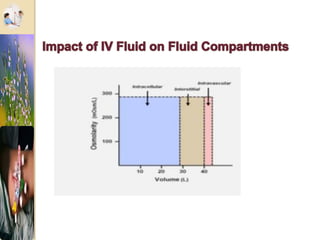
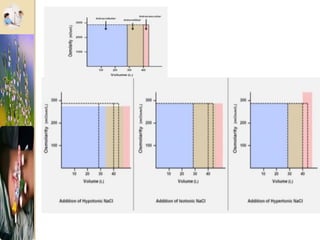
 Impact of IV Fluid on Fluid
Compartments

Something About Colloids
 Crystalloid
Categories of colloid & Crystalloid
Down sides
Rule of 4:2:1
Drip Rate
Pre, intra & post Operative Maintenance
Complications
Take home message
HISTORY
 The first record available that shows an understanding of
the need for fluid in injured patients was apparently from
Ambroise Paré (1510-1590), who urged the use of clysters
(enemas to administer fluid into the rectum) to prevent
“noxious vapors from mounting to the brain.”
 The term shock appears to have been first used in 1743 in
a translation of the French treatise of Henri Francois Le
Dran regarding battlefield wounds.
 In 1830, Herman provided one of the first clear
descriptions of intravenous (IV) fluid therapy. In response
to a cholera epidemic, he attempted to rehydrate patients
by injecting 6 ounces of water into the vein
 0.9% normal saline originated during the cholera pandemic
that afflicted Europe in 1831, but an examination of the
composition of the fluids used by physicians of that era
found no resemblance to normal saline. The origin of the
concept of normal saline remains unclear
 Sydney Ringer found three ingredients essential were
potassium, calcium, and bicarbonate. Ringer’s solution soon
became ubiquitous in physiologic laboratory experiments.
 In 1932, attempting to develop an alkalinizing solution to
administer to his acidotic patients, Hartmann modified Ringer’s
solution by adding sodium lactate. The result was lactated
Ringer’s (LR), or Hartmann’s solution.
 By world war II, shock was recognized as the single most
common cause of treatable morbidity and mortality. Out of
necessity, efforts to make blood transfusions available
heightened and led to the institution of blood banking for
transfusions.
 It maintains the shape and integrity of all cells in the body
 It maintains blood pressure/ volume
 A transport medium for ;
 Delivery of nutrients and oxygen to the tissues
 Removal of waste products from the body
 A medium for all the biochemical reactions necessary for life
 Approximately 60% of the body is water!
 Resuscitation
 Rehydration / Replacement
 Maintenance
 Special purpose
To maintain adequate oxygen delivery to the tissues
To maintain normal electrolytes concentration
To maintain normoglycemia
Look at the patient:
- Pulse
- Blood pressure
- Capillary refill
- Skin turgor
- Mucous membranes
- Peripheral circulation
“If the eyes are the windows to the soul,
then the kidneys are the windows to the
body”
Sandra Ouellette.
The principle of osmosis and tonicity.
The different fluid compartment of the body
Predict the effect that specific types of IV fluids
will have on the volume within different body fluid
compartments.
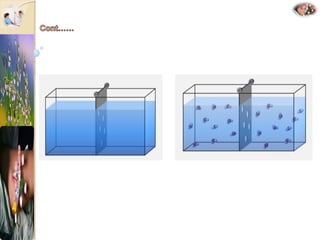
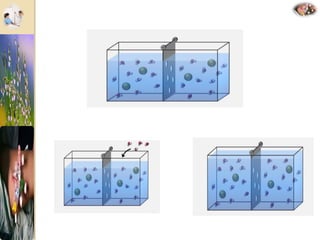
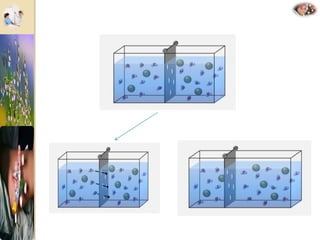
The Spontaneous movement of water across a
semipermeable membrane from a region of low
solute concentration to one of high solute
concentration , which tends to equalize the
solute concentrations on either side of the
membrane.
OSMOLALITY
Measure of a fluid’s capability to create osmotic pressure
is called osmolality or osmotic (osmolar) concentration of
a solution. In simple words, it is the concentration of
osmotically active substance in the solution. Osmolality is
expressed as the number of particles (osmoles) per
kilogram of solution (osmoles/kg H2O).
OSMOLARITY
Osmolarity is another term to express the osmotic
concentration. It is the number of particles (osmoles) per
liter of solution (osmoles/L).
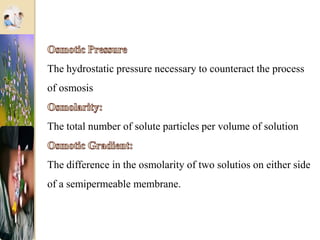
The hydrostatic pressure necessary to counteract the process
of osmosis
The total number of solute particles per volume of solution
The difference in the osmolarity of two solutios on either side
of a semipermeable membrane.
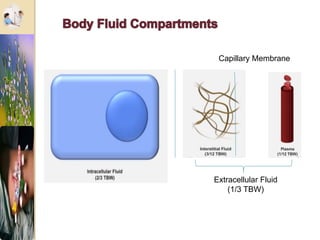
Extracellular Fluid
(1/3 TBW)
Capillary Membrane
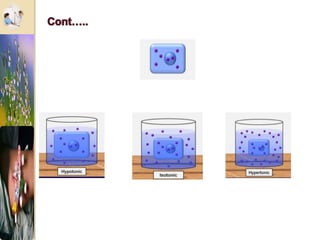
Tonicity #Osmolarity
Osmilarity is dependent upon all particles of solute
Tonicity is dependent just upon those particles when exert an
osmotic force (i.e. those which cannot permeate through cell
membrane
Example: Urea creates osmolarity but does not contribute to
tonicity since it freely moves through the cell membrane
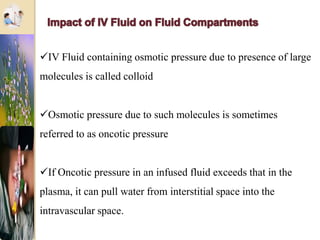
IV Fluid containing osmotic pressure due to presence of large
molecules is called colloid
Osmotic pressure due to such molecules is sometimes
referred to as oncotic pressure
If Oncotic pressure in an infused fluid exceeds that in the
plasma, it can pull water from interstitial space into the
intravascular space.
List the categories of IV fluids , and several examples of each (e.g.
NS, D5W, LR,albumin, hydroxyethyl starch, etc….)
Constitunts of common IV Fluids
Primary Indication, contraindications aside effects of common IV
fluids.
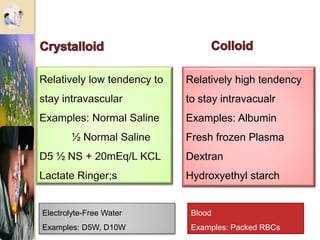
Relatively high tendency
to stay intravacualr
Examples: Albumin
Fresh frozen Plasma
Dextran
Hydroxyethyl starch
Electrolyte-Free Water
Examples: D5W, D10W
Blood
Examples: Packed RBCs
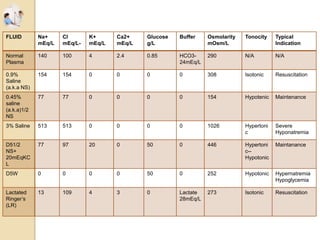
FLUID Na+
mEq/L
Cl
mEq/L-
K+
mEq/L
Ca2+
mEq/L
Glucose
g/L
Buffer Osmolarity
mOsm/L
Tonocity Typical
Indication
Normal
Plasma
140 100 4 2.4 0.85 HCO3-
24mEq/L
290 N/A N/A
0.9%
Saline
(a.k.a NS)
154 154 0 0 0 0 308 Isotonic Resuscitation
0.45%
saline
(a.k.a)1/2
NS
77 77 0 0 0 0 154 Hypotenic Maintenance
3% Saline 513 513 0 0 0 0 1026 Hypertoni
c
Severe
Hyponatremia
D51/2
NS+
20mEqKC
L
77 97 20 0 50 0 446 Hypertoni
c--
Hypotonic
Maintanance
D5W 0 0 0 0 50 0 252 Hypotonic Hypernatremia
Hypoglycemia
Lactated
Ringer’s
(LR)
13 109 4 3 0 Lactate
28mEq/L
273 Isotonic Resuscitation
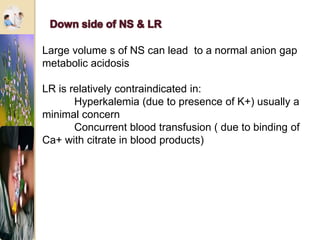
Large volume s of NS can lead to a normal anion gap
metabolic acidosis
LR is relatively contraindicated in:
Hyperkalemia (due to presence of K+) usually a
minimal concern
Concurrent blood transfusion ( due to binding of
Ca+ with citrate in blood products)
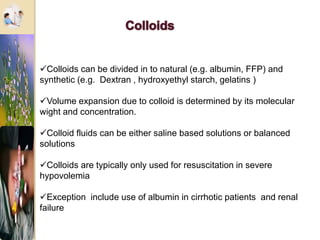
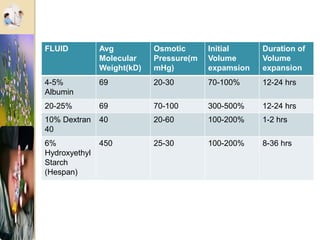
Colloids can be divided in to natural (e.g. albumin, FFP) and
synthetic (e.g. Dextran , hydroxyethyl starch, gelatins )
Volume expansion due to colloid is determined by its molecular
wight and concentration.
Colloid fluids can be either saline based solutions or balanced
solutions
Colloids are typically only used for resuscitation in severe
hypovolemia
Exception include use of albumin in cirrhotic patients and renal
failure
FLUID Avg
Molecular
Weight(kD)
Osmotic
Pressure(m
mHg)
Initial
Volume
expamsion
Duration of
Volume
expansion
4-5%
Albumin
69 20-30 70-100% 12-24 hrs
20-25% 69 70-100 300-500% 12-24 hrs
10% Dextran
40
40 20-60 100-200% 1-2 hrs
6%
Hydroxyethyl
Starch
(Hespan)
450 25-30 100-200% 8-36 hrs
To about the rule of maintenance fluid and rate of IV drip
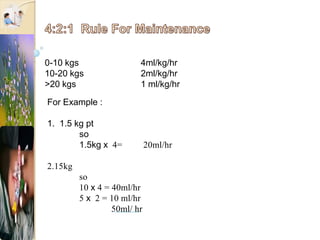
0-10 kgs 4ml/kg/hr
10-20 kgs 2ml/kg/hr
>20 kgs 1 ml/kg/hr
For Example :
1. 1.5 kg pt
so
1.5kg x 4= 20ml/hr
2.15kg
so
10 x 4 = 40ml/hr
5 x 2 = 10 ml/hr
50ml/ hr
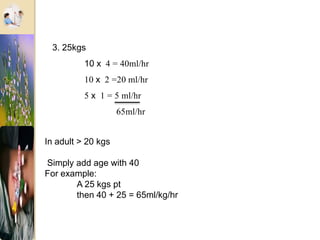
3. 25kgs
10 x 4 = 40ml/hr
10 x 2 =20 ml/hr
5 x 1 = 5 ml/hr
65ml/hr
In adult > 20 kgs
Simply add age with 40
For example:
A 25 kgs pt
then 40 + 25 = 65ml/kg/hr
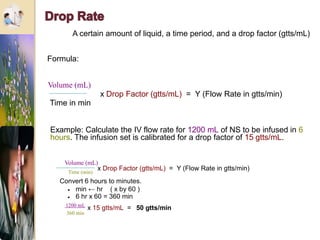
A certain amount of liquid, a time period, and a drop factor (gtts/mL)
x Drop Factor (gtts/mL) = Y (Flow Rate in gtts/min)
Volume (mL)
Time in min
Formula:
Example: Calculate the IV flow rate for 1200 mL of NS to be infused in 6
hours. The infusion set is calibrated for a drop factor of 15 gtts/mL.
Time (min)
x Drop Factor (gtts/mL) = Y (Flow Rate in gtts/min)
Convert 6 hours to minutes.
 min ← hr ( x by 60 )
 6 hr x 60 = 360 min
1200 mL
360 min
x 15 gtts/mL = 50 gtts/min
Volume (mL)
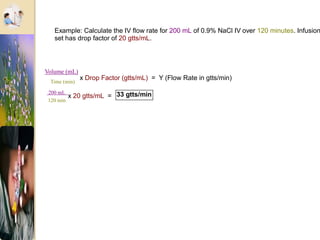
Example: Calculate the IV flow rate for 200 mL of 0.9% NaCl IV over 120 minutes. Infusion
set has drop factor of 20 gtts/mL.
Time (min)
x Drop Factor (gtts/mL) = Y (Flow Rate in gtts/min)
200 mL
120 min
x 20 gtts/mL = 33 gtts/min
Volume (mL)
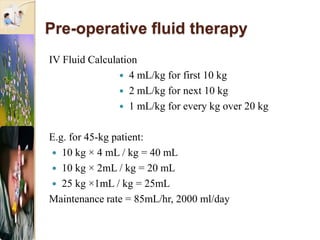
Pre-operative fluid therapy
IV Fluid Calculation
 4 mL/kg for first 10 kg
 2 mL/kg for next 10 kg
 1 mL/kg for every kg over 20 kg
E.g. for 45-kg patient:
 10 kg × 4 mL / kg = 40 mL
 10 kg × 2mL / kg = 20 mL
 25 kg ×1mL / kg = 25mL
Maintenance rate = 85mL/hr, 2000 ml/day
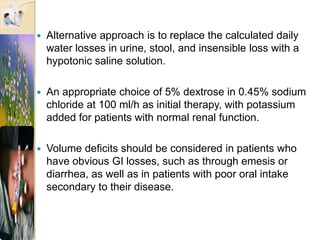
 Alternative approach is to replace the calculated daily
water losses in urine, stool, and insensible loss with a
hypotonic saline solution.
 An appropriate choice of 5% dextrose in 0.45% sodium
chloride at 100 ml/h as initial therapy, with potassium
added for patients with normal renal function.
 Volume deficits should be considered in patients who
have obvious GI losses, such as through emesis or
diarrhea, as well as in patients with poor oral intake
secondary to their disease.
Intra-operative fluid therapy
 With the induction of anesthesia, compensatory
mechanisms are lost, and hypotension will
develop if volume deficits are not appropriately
corrected.
 In addition to measured blood loss, major open
abdominal surgeries are associated with
continued extracellular losses in the form of
bowel wall edema, peritoneal fluid, and the
wound edema during surgery.
 Large soft tissue wounds, complex fractures with
associated soft tissue injury, and burns are all
associated with additional third-space losses that must
be considered in the operating room. These functional
losses have been referred to as parasitic losses,
sequestration, or third-space edema, because the lost
volume no longer participates in the normal functions of
the ECF.
 Replacement of ECF during surgery often requires 500
to 1000 ml/h of a balanced salt solution to support
homeostasis.
Post-operative fluid therapy
 Postoperative fluid therapy should be based on the
patient’s current estimated volume status and
projected ongoing fluid losses.
 Any deficits from either preoperative or intraoperative
losses, third-space losses should be included in fluid
replacement strategies.
 The adequacy of resuscitation should be guided by
the restoration of acceptable values for vital signs and
urine output.
 If uncertainty exists, particularly in patients with renal
or cardiac dysfunction, a central venous catheter may
be inserted to help guide fluid therapy.
 In the initial postoperative period, an isotonic solution
should be administered.
 After the initial 24 to 48 hours, fluids can be changed to
5% dextrose in 0.45% saline in patients unable to
tolerate enteral nutrition.
 If normal renal function and adequate urine output are
present, potassium may be added to the IV fluids.
 Daily fluid orders should begin with assessment of the
patient’s volume status and assessment of electrolyte
abnormalities. All measured losses, including losses
through vomiting, nasogastric suctioning, drains, and
urine output, as well as insensible losses, are replaced
with the appropriate parenteral solutions.
 Infiltration
 Extravasation
 Infection
 Thrombophlebitis
 Severed catheter
 Fluid overload
 Air embolism
 Fluid is like “prescription” so give it with caution.
 Children are more vulnerable for rapid fluid loss.
 Maintenance calculation by “4-2-1” rule or Holliday Segar’s
formula.
 Vigilant Monitoring of WEIGHT, URINE OUTPUT, SERUM
SODIUM CONCENTRATION while giving fluid is must.
 As far as possible try to give maintenance fluid requirement orally.
 0.45% DNS + 20 mEq/l KCl is ideal fluid in most of the children
requiring maintenance therapy.
 Replacement of fluids should be prompt & appropriate.
Iv Fluid Therapy by Faisal Azmi

Iv Fluid Therapy by Faisal Azmi

  • 4.
    Contents General Description  History Fluids and Human Body  Uses of IV Fluids  Goals of IV Fluids  Assessment of Fluid volume status Specific Description  Concept of Osmosis  Osmolarity  Tonicity  Body Fluid compartments  Impact of IV Fluid on Fluid Compartments  Something About Colloids  Crystalloid Categories of colloid & Crystalloid Down sides Rule of 4:2:1 Drip Rate Pre, intra & post Operative Maintenance Complications Take home message
  • 6.
    HISTORY  The firstrecord available that shows an understanding of the need for fluid in injured patients was apparently from Ambroise Paré (1510-1590), who urged the use of clysters (enemas to administer fluid into the rectum) to prevent “noxious vapors from mounting to the brain.”  The term shock appears to have been first used in 1743 in a translation of the French treatise of Henri Francois Le Dran regarding battlefield wounds.
  • 7.
     In 1830,Herman provided one of the first clear descriptions of intravenous (IV) fluid therapy. In response to a cholera epidemic, he attempted to rehydrate patients by injecting 6 ounces of water into the vein  0.9% normal saline originated during the cholera pandemic that afflicted Europe in 1831, but an examination of the composition of the fluids used by physicians of that era found no resemblance to normal saline. The origin of the concept of normal saline remains unclear
  • 8.
     Sydney Ringerfound three ingredients essential were potassium, calcium, and bicarbonate. Ringer’s solution soon became ubiquitous in physiologic laboratory experiments.  In 1932, attempting to develop an alkalinizing solution to administer to his acidotic patients, Hartmann modified Ringer’s solution by adding sodium lactate. The result was lactated Ringer’s (LR), or Hartmann’s solution.  By world war II, shock was recognized as the single most common cause of treatable morbidity and mortality. Out of necessity, efforts to make blood transfusions available heightened and led to the institution of blood banking for transfusions.
  • 9.
     It maintainsthe shape and integrity of all cells in the body  It maintains blood pressure/ volume  A transport medium for ;  Delivery of nutrients and oxygen to the tissues  Removal of waste products from the body  A medium for all the biochemical reactions necessary for life  Approximately 60% of the body is water!
  • 10.
     Resuscitation  Rehydration/ Replacement  Maintenance  Special purpose
  • 11.
    To maintain adequateoxygen delivery to the tissues To maintain normal electrolytes concentration To maintain normoglycemia
  • 12.
    Look at thepatient: - Pulse - Blood pressure - Capillary refill - Skin turgor - Mucous membranes - Peripheral circulation
  • 13.
    “If the eyesare the windows to the soul, then the kidneys are the windows to the body” Sandra Ouellette.
  • 14.
    The principle ofosmosis and tonicity. The different fluid compartment of the body Predict the effect that specific types of IV fluids will have on the volume within different body fluid compartments.
  • 15.
    The Spontaneous movementof water across a semipermeable membrane from a region of low solute concentration to one of high solute concentration , which tends to equalize the solute concentrations on either side of the membrane.
  • 16.
    OSMOLALITY Measure of afluid’s capability to create osmotic pressure is called osmolality or osmotic (osmolar) concentration of a solution. In simple words, it is the concentration of osmotically active substance in the solution. Osmolality is expressed as the number of particles (osmoles) per kilogram of solution (osmoles/kg H2O). OSMOLARITY Osmolarity is another term to express the osmotic concentration. It is the number of particles (osmoles) per liter of solution (osmoles/L).
  • 20.
    The hydrostatic pressurenecessary to counteract the process of osmosis The total number of solute particles per volume of solution The difference in the osmolarity of two solutios on either side of a semipermeable membrane.
  • 21.
  • 22.
    Tonicity #Osmolarity Osmilarity isdependent upon all particles of solute Tonicity is dependent just upon those particles when exert an osmotic force (i.e. those which cannot permeate through cell membrane Example: Urea creates osmolarity but does not contribute to tonicity since it freely moves through the cell membrane
  • 27.
    IV Fluid containingosmotic pressure due to presence of large molecules is called colloid Osmotic pressure due to such molecules is sometimes referred to as oncotic pressure If Oncotic pressure in an infused fluid exceeds that in the plasma, it can pull water from interstitial space into the intravascular space.
  • 28.
    List the categoriesof IV fluids , and several examples of each (e.g. NS, D5W, LR,albumin, hydroxyethyl starch, etc….) Constitunts of common IV Fluids Primary Indication, contraindications aside effects of common IV fluids.
  • 29.
    Relatively high tendency tostay intravacualr Examples: Albumin Fresh frozen Plasma Dextran Hydroxyethyl starch Electrolyte-Free Water Examples: D5W, D10W Blood Examples: Packed RBCs
  • 30.
    FLUID Na+ mEq/L Cl mEq/L- K+ mEq/L Ca2+ mEq/L Glucose g/L Buffer Osmolarity mOsm/L TonocityTypical Indication Normal Plasma 140 100 4 2.4 0.85 HCO3- 24mEq/L 290 N/A N/A 0.9% Saline (a.k.a NS) 154 154 0 0 0 0 308 Isotonic Resuscitation 0.45% saline (a.k.a)1/2 NS 77 77 0 0 0 0 154 Hypotenic Maintenance 3% Saline 513 513 0 0 0 0 1026 Hypertoni c Severe Hyponatremia D51/2 NS+ 20mEqKC L 77 97 20 0 50 0 446 Hypertoni c-- Hypotonic Maintanance D5W 0 0 0 0 50 0 252 Hypotonic Hypernatremia Hypoglycemia Lactated Ringer’s (LR) 13 109 4 3 0 Lactate 28mEq/L 273 Isotonic Resuscitation
  • 31.
    Large volume sof NS can lead to a normal anion gap metabolic acidosis LR is relatively contraindicated in: Hyperkalemia (due to presence of K+) usually a minimal concern Concurrent blood transfusion ( due to binding of Ca+ with citrate in blood products)
  • 32.
    Colloids can bedivided in to natural (e.g. albumin, FFP) and synthetic (e.g. Dextran , hydroxyethyl starch, gelatins ) Volume expansion due to colloid is determined by its molecular wight and concentration. Colloid fluids can be either saline based solutions or balanced solutions Colloids are typically only used for resuscitation in severe hypovolemia Exception include use of albumin in cirrhotic patients and renal failure
  • 33.
    FLUID Avg Molecular Weight(kD) Osmotic Pressure(m mHg) Initial Volume expamsion Duration of Volume expansion 4-5% Albumin 6920-30 70-100% 12-24 hrs 20-25% 69 70-100 300-500% 12-24 hrs 10% Dextran 40 40 20-60 100-200% 1-2 hrs 6% Hydroxyethyl Starch (Hespan) 450 25-30 100-200% 8-36 hrs
  • 34.
    To about therule of maintenance fluid and rate of IV drip
  • 35.
    0-10 kgs 4ml/kg/hr 10-20kgs 2ml/kg/hr >20 kgs 1 ml/kg/hr For Example : 1. 1.5 kg pt so 1.5kg x 4= 20ml/hr 2.15kg so 10 x 4 = 40ml/hr 5 x 2 = 10 ml/hr 50ml/ hr
  • 36.
    3. 25kgs 10 x4 = 40ml/hr 10 x 2 =20 ml/hr 5 x 1 = 5 ml/hr 65ml/hr In adult > 20 kgs Simply add age with 40 For example: A 25 kgs pt then 40 + 25 = 65ml/kg/hr
  • 37.
    A certain amountof liquid, a time period, and a drop factor (gtts/mL) x Drop Factor (gtts/mL) = Y (Flow Rate in gtts/min) Volume (mL) Time in min Formula: Example: Calculate the IV flow rate for 1200 mL of NS to be infused in 6 hours. The infusion set is calibrated for a drop factor of 15 gtts/mL. Time (min) x Drop Factor (gtts/mL) = Y (Flow Rate in gtts/min) Convert 6 hours to minutes.  min ← hr ( x by 60 )  6 hr x 60 = 360 min 1200 mL 360 min x 15 gtts/mL = 50 gtts/min Volume (mL)
  • 38.
    Example: Calculate theIV flow rate for 200 mL of 0.9% NaCl IV over 120 minutes. Infusion set has drop factor of 20 gtts/mL. Time (min) x Drop Factor (gtts/mL) = Y (Flow Rate in gtts/min) 200 mL 120 min x 20 gtts/mL = 33 gtts/min Volume (mL)
  • 39.
    Pre-operative fluid therapy IVFluid Calculation  4 mL/kg for first 10 kg  2 mL/kg for next 10 kg  1 mL/kg for every kg over 20 kg E.g. for 45-kg patient:  10 kg × 4 mL / kg = 40 mL  10 kg × 2mL / kg = 20 mL  25 kg ×1mL / kg = 25mL Maintenance rate = 85mL/hr, 2000 ml/day
  • 40.
     Alternative approachis to replace the calculated daily water losses in urine, stool, and insensible loss with a hypotonic saline solution.  An appropriate choice of 5% dextrose in 0.45% sodium chloride at 100 ml/h as initial therapy, with potassium added for patients with normal renal function.  Volume deficits should be considered in patients who have obvious GI losses, such as through emesis or diarrhea, as well as in patients with poor oral intake secondary to their disease.
  • 41.
    Intra-operative fluid therapy With the induction of anesthesia, compensatory mechanisms are lost, and hypotension will develop if volume deficits are not appropriately corrected.  In addition to measured blood loss, major open abdominal surgeries are associated with continued extracellular losses in the form of bowel wall edema, peritoneal fluid, and the wound edema during surgery.
  • 42.
     Large softtissue wounds, complex fractures with associated soft tissue injury, and burns are all associated with additional third-space losses that must be considered in the operating room. These functional losses have been referred to as parasitic losses, sequestration, or third-space edema, because the lost volume no longer participates in the normal functions of the ECF.  Replacement of ECF during surgery often requires 500 to 1000 ml/h of a balanced salt solution to support homeostasis.
  • 43.
    Post-operative fluid therapy Postoperative fluid therapy should be based on the patient’s current estimated volume status and projected ongoing fluid losses.  Any deficits from either preoperative or intraoperative losses, third-space losses should be included in fluid replacement strategies.  The adequacy of resuscitation should be guided by the restoration of acceptable values for vital signs and urine output.  If uncertainty exists, particularly in patients with renal or cardiac dysfunction, a central venous catheter may be inserted to help guide fluid therapy.
  • 44.
     In theinitial postoperative period, an isotonic solution should be administered.  After the initial 24 to 48 hours, fluids can be changed to 5% dextrose in 0.45% saline in patients unable to tolerate enteral nutrition.  If normal renal function and adequate urine output are present, potassium may be added to the IV fluids.  Daily fluid orders should begin with assessment of the patient’s volume status and assessment of electrolyte abnormalities. All measured losses, including losses through vomiting, nasogastric suctioning, drains, and urine output, as well as insensible losses, are replaced with the appropriate parenteral solutions.
  • 45.
     Infiltration  Extravasation Infection  Thrombophlebitis  Severed catheter  Fluid overload  Air embolism
  • 46.
     Fluid islike “prescription” so give it with caution.  Children are more vulnerable for rapid fluid loss.  Maintenance calculation by “4-2-1” rule or Holliday Segar’s formula.  Vigilant Monitoring of WEIGHT, URINE OUTPUT, SERUM SODIUM CONCENTRATION while giving fluid is must.  As far as possible try to give maintenance fluid requirement orally.  0.45% DNS + 20 mEq/l KCl is ideal fluid in most of the children requiring maintenance therapy.  Replacement of fluids should be prompt & appropriate.