IV FLUID THERAPY
FARWANIYA HEALTH REGION
STAFF DEVELOPMENT UNIT
Objective
At the end of this session the staff nurse will be able to
• Define IV therapy.
• Describe the indication and Places to avoid of IV therapy.
• Mention the type of IV fluids.
• Identify Sites for venous puncture For adult & pediatric.
• Explain the formula for medication administration.
• List out the steps of IV cannulation.
• Discuss the Nursing responsibilities during IV therapy
• Enumerate the complication of IV therapy.
INTRODUCTION
INTRODUCTION
 Total body fluid- for approximately 60% of total body weight
 TBW can be divided into
• 2/3 of the TBW
• Found inside the plasma
membrane of the body's cells
Intracellular
• Interstitial compartment
• Intravascular compartment
• 3rd space
Extracellular
DEFINITION
Intravenous therapy (abbreviated as IV therapy) is a
treatment technique that infuses intravenous solution,
medications, nutrients, blood and blood products
directly into the vein
 Fluid and Electrolyte Replacement.
 Emergency Care
 Administration of Medication.
 Blood or Blood Products Administration.
 Administration of Total Parental Nutrition.
 Chemotherapy Administration.
 Administration of Contrast agent for CT,MRI and Nuclear Imaging.
 Surgery
Indications
Places to avoid
 Veins of the fractured limbs
 Same arm as an AV fistula
 An area that is affected by burns, oedema or infection
 Bony prominences/ flexion area
 A limb affected by stroke
 A limb that has a deep venous thrombosis
 Same arm of post mastectomy or lymph node dissection.
 Avoid inserting a cannula into the lower limb if possible
Types of IV Fluids
Fluids can be classified into
a. Colloids,
b. Crystalloids
c. Blood products
1. Colloid
• Contain large molecules which remain in the
intravascular compartment to expand the
intravascular volume
• Used to increase the blood volume following
severe loss of blood or loss of plasma.
+ Examples: Albumin
Gelatine
Dextran
2. Crystalloid
+ Contain small molecules that flow easily across the cell
membranes
+ This will increase fluid volume in both the interstitial and
intravascular spaces (Extracellular)
+ Used as maintenance fluids to correct body fluids and
electrolyte deficit .
+ It is subdivided into:
* Isotonic * Hypotonic * Hypertonic
Isotonic fluids
 Same osmolarity as blood serum
 No change at the cellular level
 Example
• Dextrose 5% in water
• Sodium chloride 0.9%
• Lactate ringer
-
Cells are stable
Hypotonic fluids
+ Decrease osmotic pressure causing fluid into
invade cells
+ Danger of water intoxication
+ Example
• 0.45% NaCl
• 0.2%NaCl
-
• Water moves
into cells
Hypertonic fluids
+ This fluid can cause venous irritation
+ The osmotic pressure drawing fluid from
cell
+ Danger of cellular dehydration
+ Examples - 3% sodium chloride (3% NaCl):
10,20,50,70 % Dextrose
: TPN
-
• Water moves out of
cells
Sites for venous puncture For adult
Sites for
venous
puncture
for
pediatric
Layers of the Vein
Parts of cannula
IV Calculation
Formula
 Calculating Rate in Drops per Minute
Volume x drop factor = drop/min
No of hours x 60
 Rate in mL per Hour
IV Calculation example
Calculating Rate in Drops per Minute
Start 2pints of ½ strength Normal Saline in Dextrose 5% to be given over
10 hours. If the IV set used is a micro drip set, how many drops per
minute shall the IVF be regulated?
Volume x drop factor 2 pints = 1000 ml
No of hours x 60 micro drop = 60
1000ml x 60 = 1000 = 100 drops/mt
10 x 60 10
IV Calculation example
Calculating ML Per hour
How many ml per hour will be set in an infusion pump to deliver 1 litter
over 8 hours?
Total volume 1000 = 125 ml / hour
No of hours 8
IV Cannulation procedure
EQUIPMENTS
1-Trolly containing
• Prescribed infusion fluid
• IV infusion set
• IV needle /cannulas of different sizes
• Alcohol 70%
Equipment (Cont.)
• Cotton balls
• Sterile gauze
• Bed protector
• Gloves
• Tourniquet
• IV label
• Kidney basin
• Adhesive plaster
• Pairs of scissors
• Flush - 10mL 0.9% NaCl
in a syringe
Equipment (Cont.)
2- Infusion stand
3- Container for waste
4- Sharp disposable box
Optional
1- Splint and bandage.
2- Shaving set
Steps of IV Cannulation
+ Confirm doctor’s instructions
+ Wash and dry hand
+ Assemble equipment
+ Identify the patient and explain the procedure
+ Provide privacy
+ Prime the IV set with prescribed solution
• Open the IV set and Iv solution aseptically
• Clamp the tubing
• Hang the IV solution on the IV stand
• Open the clamp , expel the air
Steps of IV Cannulation (Cont.)
+ Place the patient in comfortable position
+ Apply tourniquet, the tourniquet should be applied at a
pressure which is high enough to impede venous distension
but not to restrict arterial flow
+ Identify vein
+ Clean the site over the vein with alcohol wipe, allow to dry
+ Hold the cannula in your dominant hand, stretch the skin over
the vein to anchor the vein with your non-dominant hand.
+ Insert the needle (bevel side up) at an angle of 10-30o
to
the skin (this will depend on vein depth.)
+ Observe the back flow of the blood and advance the
needle into the vein
+ Release the tourniquet
+ Flush the cannula using 10mL of 0.9%NaCl.
+ Connect iv tubing with needle ,release the clamp and
observe for swelling
Steps of IV Cannulation (Cont.)
+ Fix the needle with adhesive plaster and label with date
and time of insertion
+ Regulate the IV flow
+ Attach the infusion label with require information
+ Discard waste
+ Clean and replace reusable equipment
+ Wash and dry hands
+ Document the date, site, the cannula gauge and the number of attempts
Removing the Cannula
+ Wash your hands and don gloves.
+ Remove the dressing and any tape
surrounding the cannula.
+ Remove the cannula in a steady, fluid motion.
+ Apply pressure to the area using sterile gauze.
+ Place a small dressing (such as a cotton ball) to the area with tape.
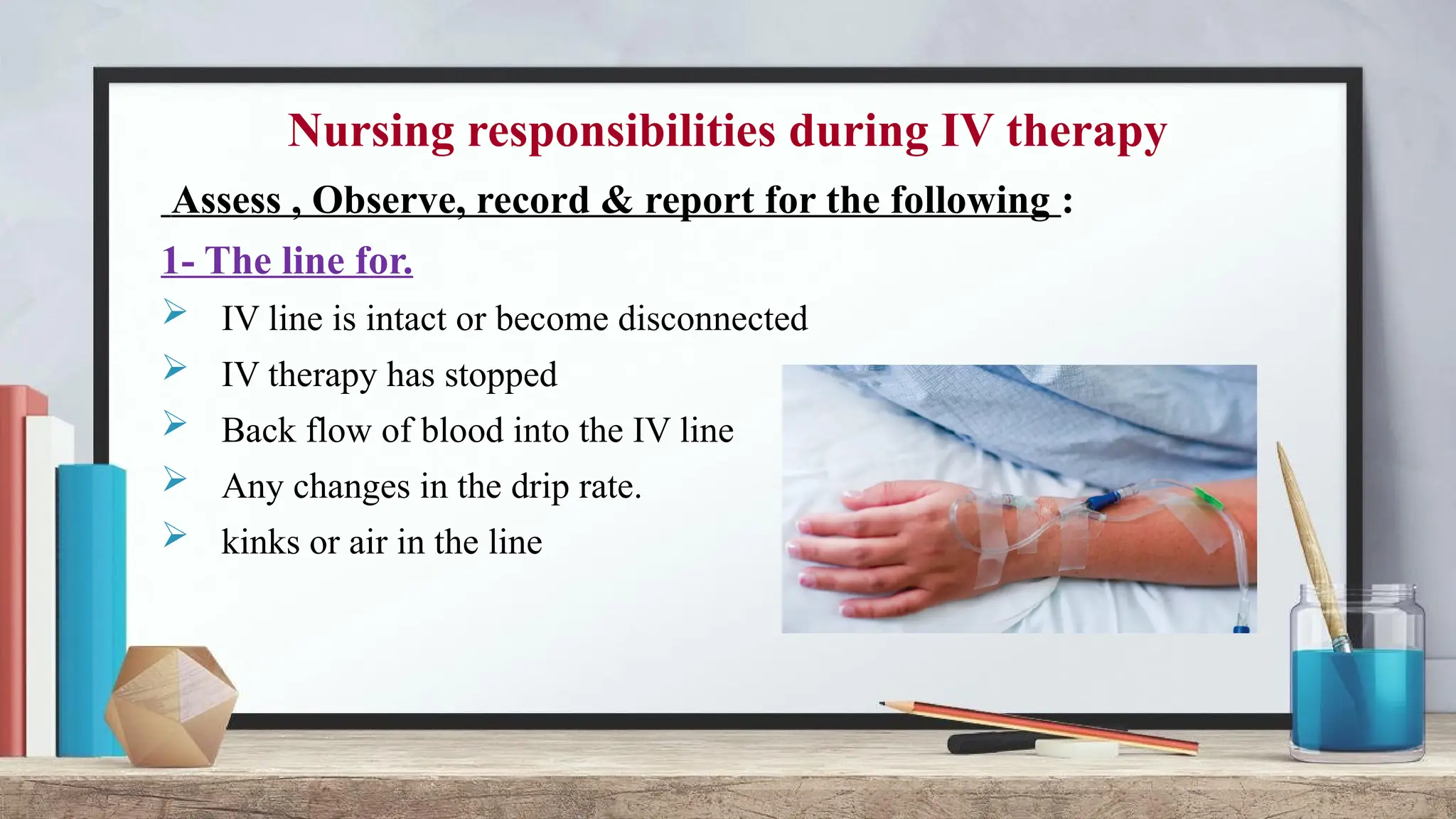
Assess , Observe, record & report for the following :
1- The line for.
 IV line is intact or become disconnected
 IV therapy has stopped
 Back flow of blood into the IV line
 Any changes in the drip rate.
 kinks or air in the line
Nursing responsibilities during IV therapy
2- The site of injection for :
 Proper positioning of IV
 Redness, any tissue swelling
 Pain or burning at IV site
 Any leakage, any coolness around IV site
 Any concerns verbalised by the patient
 Unusual changes in the patient e.g.: pallor / flushes / pain /
temperature
Nursing responsibilities during IV therapy(Cont.)
COMPLICATIONS
+ Infection: Redness, swelling and drainage at site;
chills, fever, malaise, headache
+ Tissue damage: Skin color change, sloughing of
skin, discomfort at site
+ Phlebitis: Heat, redness, tenderness, swollen
+ Thrombophlebitis:
Heat, redness, tenderness, hard
and cordlike vein
COMPLICATIONS (Cont.)
+ Air embolism: Tachycardia, dyspnea, hypotension,
cyanosis, decreased level of consciousness
+ Catheter embolism: Pain along vein, weak, rapid
pulse,
+ Hematoma: leakage of blood at the site, and hard painful
lumps at the site
+ Infiltration: Edema, pain, coolness at the site
+ Circulatory overload: Increased BP, distended
jugular veins, moist cough and crackles
Conclusion
Iv fluid therapy is very important for many medical conditions .
Fluid management for any particular medical condition has always been
an interesting but challenging field. Where, IV fluids can save the life of
an individual at the same time inappropriate administration can be a life
threatening.
Thanky
ou!
Any questions?

iv fluid therapy and types final-3.pptx

  • 1.
    IV FLUID THERAPY FARWANIYAHEALTH REGION STAFF DEVELOPMENT UNIT
  • 2.
    Objective At the endof this session the staff nurse will be able to • Define IV therapy. • Describe the indication and Places to avoid of IV therapy. • Mention the type of IV fluids. • Identify Sites for venous puncture For adult & pediatric. • Explain the formula for medication administration. • List out the steps of IV cannulation. • Discuss the Nursing responsibilities during IV therapy • Enumerate the complication of IV therapy.
  • 3.
  • 4.
    INTRODUCTION  Total bodyfluid- for approximately 60% of total body weight  TBW can be divided into • 2/3 of the TBW • Found inside the plasma membrane of the body's cells Intracellular • Interstitial compartment • Intravascular compartment • 3rd space Extracellular
  • 5.
    DEFINITION Intravenous therapy (abbreviatedas IV therapy) is a treatment technique that infuses intravenous solution, medications, nutrients, blood and blood products directly into the vein
  • 6.
     Fluid andElectrolyte Replacement.  Emergency Care  Administration of Medication.  Blood or Blood Products Administration.  Administration of Total Parental Nutrition.  Chemotherapy Administration.  Administration of Contrast agent for CT,MRI and Nuclear Imaging.  Surgery Indications
  • 7.
    Places to avoid Veins of the fractured limbs  Same arm as an AV fistula  An area that is affected by burns, oedema or infection  Bony prominences/ flexion area  A limb affected by stroke  A limb that has a deep venous thrombosis  Same arm of post mastectomy or lymph node dissection.  Avoid inserting a cannula into the lower limb if possible
  • 8.
    Types of IVFluids Fluids can be classified into a. Colloids, b. Crystalloids c. Blood products
  • 9.
    1. Colloid • Containlarge molecules which remain in the intravascular compartment to expand the intravascular volume • Used to increase the blood volume following severe loss of blood or loss of plasma. + Examples: Albumin Gelatine Dextran
  • 10.
    2. Crystalloid + Containsmall molecules that flow easily across the cell membranes + This will increase fluid volume in both the interstitial and intravascular spaces (Extracellular) + Used as maintenance fluids to correct body fluids and electrolyte deficit . + It is subdivided into: * Isotonic * Hypotonic * Hypertonic
  • 11.
    Isotonic fluids  Sameosmolarity as blood serum  No change at the cellular level  Example • Dextrose 5% in water • Sodium chloride 0.9% • Lactate ringer - Cells are stable
  • 12.
    Hypotonic fluids + Decreaseosmotic pressure causing fluid into invade cells + Danger of water intoxication + Example • 0.45% NaCl • 0.2%NaCl - • Water moves into cells
  • 13.
    Hypertonic fluids + Thisfluid can cause venous irritation + The osmotic pressure drawing fluid from cell + Danger of cellular dehydration + Examples - 3% sodium chloride (3% NaCl): 10,20,50,70 % Dextrose : TPN - • Water moves out of cells
  • 14.
    Sites for venouspuncture For adult
  • 15.
  • 16.
  • 17.
  • 19.
    IV Calculation Formula  CalculatingRate in Drops per Minute Volume x drop factor = drop/min No of hours x 60  Rate in mL per Hour
  • 20.
    IV Calculation example CalculatingRate in Drops per Minute Start 2pints of ½ strength Normal Saline in Dextrose 5% to be given over 10 hours. If the IV set used is a micro drip set, how many drops per minute shall the IVF be regulated? Volume x drop factor 2 pints = 1000 ml No of hours x 60 micro drop = 60 1000ml x 60 = 1000 = 100 drops/mt 10 x 60 10
  • 21.
    IV Calculation example CalculatingML Per hour How many ml per hour will be set in an infusion pump to deliver 1 litter over 8 hours? Total volume 1000 = 125 ml / hour No of hours 8
  • 22.
    IV Cannulation procedure EQUIPMENTS 1-Trollycontaining • Prescribed infusion fluid • IV infusion set • IV needle /cannulas of different sizes • Alcohol 70%
  • 23.
    Equipment (Cont.) • Cottonballs • Sterile gauze • Bed protector • Gloves • Tourniquet • IV label • Kidney basin • Adhesive plaster • Pairs of scissors • Flush - 10mL 0.9% NaCl in a syringe
  • 24.
    Equipment (Cont.) 2- Infusionstand 3- Container for waste 4- Sharp disposable box Optional 1- Splint and bandage. 2- Shaving set
  • 25.
    Steps of IVCannulation + Confirm doctor’s instructions + Wash and dry hand + Assemble equipment + Identify the patient and explain the procedure + Provide privacy + Prime the IV set with prescribed solution • Open the IV set and Iv solution aseptically • Clamp the tubing • Hang the IV solution on the IV stand • Open the clamp , expel the air
  • 26.
    Steps of IVCannulation (Cont.) + Place the patient in comfortable position + Apply tourniquet, the tourniquet should be applied at a pressure which is high enough to impede venous distension but not to restrict arterial flow + Identify vein + Clean the site over the vein with alcohol wipe, allow to dry + Hold the cannula in your dominant hand, stretch the skin over the vein to anchor the vein with your non-dominant hand.
  • 27.
    + Insert theneedle (bevel side up) at an angle of 10-30o to the skin (this will depend on vein depth.) + Observe the back flow of the blood and advance the needle into the vein + Release the tourniquet + Flush the cannula using 10mL of 0.9%NaCl. + Connect iv tubing with needle ,release the clamp and observe for swelling Steps of IV Cannulation (Cont.)
  • 28.
    Steps of IVCannulation (Cont.) + Fix the needle with adhesive plaster and label with date and time of insertion + Regulate the IV flow + Attach the infusion label with require information + Discard waste + Clean and replace reusable equipment + Wash and dry hands + Document the date, site, the cannula gauge and the number of attempts
  • 29.
    Removing the Cannula +Wash your hands and don gloves. + Remove the dressing and any tape surrounding the cannula. + Remove the cannula in a steady, fluid motion. + Apply pressure to the area using sterile gauze. + Place a small dressing (such as a cotton ball) to the area with tape.
  • 30.
    Assess , Observe,record & report for the following : 1- The line for.  IV line is intact or become disconnected  IV therapy has stopped  Back flow of blood into the IV line  Any changes in the drip rate.  kinks or air in the line Nursing responsibilities during IV therapy
  • 31.
    2- The siteof injection for :  Proper positioning of IV  Redness, any tissue swelling  Pain or burning at IV site  Any leakage, any coolness around IV site  Any concerns verbalised by the patient  Unusual changes in the patient e.g.: pallor / flushes / pain / temperature Nursing responsibilities during IV therapy(Cont.)
  • 32.
    COMPLICATIONS + Infection: Redness,swelling and drainage at site; chills, fever, malaise, headache + Tissue damage: Skin color change, sloughing of skin, discomfort at site + Phlebitis: Heat, redness, tenderness, swollen + Thrombophlebitis: Heat, redness, tenderness, hard and cordlike vein
  • 33.
    COMPLICATIONS (Cont.) + Airembolism: Tachycardia, dyspnea, hypotension, cyanosis, decreased level of consciousness + Catheter embolism: Pain along vein, weak, rapid pulse, + Hematoma: leakage of blood at the site, and hard painful lumps at the site + Infiltration: Edema, pain, coolness at the site + Circulatory overload: Increased BP, distended jugular veins, moist cough and crackles
  • 34.
    Conclusion Iv fluid therapyis very important for many medical conditions . Fluid management for any particular medical condition has always been an interesting but challenging field. Where, IV fluids can save the life of an individual at the same time inappropriate administration can be a life threatening.
  • 35.

Editor's Notes

  • #3 Of course not, because water is essential to sustain life. Likewise, body fluids are vital to maintain normal body functioning Essential for Cell life . Interfere in the Chemical and metabolic reactions . Nutrients absorption and transport . Regulate the Body temperature . Elimination of waste products through urine .
  • #4 intracellular compartment contains on average about 28 liters of fluid Interstitial compartment It the small, narrow spaces between tissues or parts of an organ. It is filled with what is called interstitial fluid 15% of the TBW 2-Intravascular compartment The main intravascular fluid in humans is blood; the average volume of blood in humans is approximately 70-75 ml/kg Third space The third space is space in the body where fluid does not normally collect in larger amounts. For examples the peritoneal cavity and pleural cavity are major examples of the third space
  • #8 .
  • #9 Are used to increase the blood volume following severe loss of blood (haemorrhage) or loss of plasma ( severe burns). –Expanders present in dextran, plasma, and albumin
  • #11 solutions that have the same osmolality as body fluids, When the concentration of the solutes are similar to that of plasma, it doesn't move into cells No change at the cellular level Increases circulating volumeTypes of isotonic solutions include: 0.9% sodium chloride (0.9% NaCl) lactated Ringer's solution 5% dextrose in water (D5W) Ringer's solution
  • #16 An understanding of vein wall anatomy and physiology is necessary in understanding the potential complications of IV therapy The vein wall consists of 3 layers and each has very specific characteristics and considerations involved in the introduction of IV catheters and the administration of IV fluids. The layers include the Tunica intima Tunica media Tunica adventitia
  • #19 .