NURSING CARE PLAN
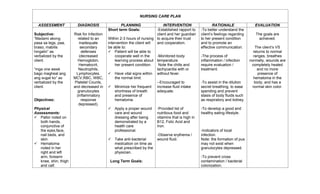
ASSESSMENT DIAGNOSIS PLANNING INTERVENTION RATIONALE EVALUATION
Subjective:
“Madami akong
pasa sa legs, paa,
braso, mabilis
hingalin” as
verbalized by the
client.
“mga one week
bago magheal ang
ang sugat ko” as
verbalized by the
client.
Objectives:
Physical
Assessments:
 Pallor noted on
both hands,
conjunctiva of
the eyes,face,
nail beds, and
skin.
 Hematoma
noted in her
right and left
arm, forearm
knee, shin, thigh
and calf.
Risk for Infection
related to an
inadequate
secondary
defenses
(decreased
Hemoglobin,
Hematocrit,
Neutrophils,
Lymphocytes,
MCV,RBC, WBC,
Platelet Counts,
and decreased in
granulocytes
(inflammatory
response
depressed).
Short term Goals:
Within 2-3 hours of nursing
intervention the client will
be able to:
 Patient will be able to
cooperate well in the
learning process about
her present condition.
 Have vital signs within
the normal limit.
 Minimize her frequent
shortness of breath
and presence of
hematoma.
 Apply a proper wound
care and wound
dressing after being
demonstrated by a
health care
professional.
 Take anti-bacterial
medication on time as
what prescribed by the
physician.
Long Term Goals:
-Established rapport to
client and her guardian
to acquire their trust
and cooperation.
-Monitored body
temperature.
Note the chills and
tachycardia with or
without fever.
--Encouraged to
increase fluid intake
adequate.
-Provided list of
nutritious food and
vitamins that is high in
B12, Folic Acid and
Iron.
-Observe erythema /
wound fluid.
-To better understand the
client’s feelings regarding
to her present condition
and to promote an
effective communication.
-The process of
inflammation / infection
require evaluation /
treatment.
-To assist in the dilution
secret breathing, to ease
spending and prevent
stasis of body fluids such
as respiratory and kidney.
-To develop a good and
healthy eating lifestyle.
-Indicators of local
infection.
Note: the formation of pus
may not exist when
granulocytes depressed.
-To prevent cross
contamination / bacterial
colonization.
The goals are
achieved.
The client’s VS
returns to normal
ranges, breathes
normally, wounds are
completely healed
and no more
presence of
hematoma in the
body, and has a
normal skin color.
Vital Signs:
 BP: 110/70 mm
Hg
 PR: 76 bpm
 Temp: 36.3 °C
 O2Sat: 96 %
 RR: 18 cpm
Clinical Laboratory
Values:
 RBC: 2.21 x
1012/L
(decreased)
 WBC: 2.44 x
109/L
(decreased)
 Platelets: 9 x
109/L
(decreased)
Risk Factor:
 Bone marrow
malfunction.
Within 3-4 consecutive
days of nursing
intervention, the client’s
vital signs is within the
normal ranges, wounds
are being take cared
independently and almost
healed, and only a few
light appearance of
hematoma presents in the
body of the client.
- Increased good hand
washing; by the care
givers and client.
-Provided a skin care,
perianal, and oral
carefully.
-Maintained strict
aseptic technique on
the procedure /
treatment of wounds.
- Monitored / limits
visitors. Give isolation
room whenever
possible.
- Provided a topical
antiseptic; systemic
Note: patients with severe
anemia / aplastic be at
risk due to the normal
flora of the skin.
-To reduce the risk of
damage to the skin /
tissue and infection.
-To reduce the risk of
colonization / infection of
bacteria.
-To limit exposure to
bacteria / infection.
Protection in isolation
required in aplastic
anemia, when the
immune response is very
disturbed.
-To be used to reduce
colonization or
prophylactic treatment for
localized infection
process.
- To reduce the risk of
infection and promotes
healing progress.
antibiotics
(collaboration).
NURSING CARE PLAN
Assessment Nursing
Diagnosis
Planning Implementation Rationale of every action Evaluation
Subjective:
“Nawawalan ako ng
gana kumain simula
siguro mga August
this year. Dati nga
mahilig ako sa
pansit,lalo na
maaasim na pagkain”
as verbalized by the
patient
Objective:
Weight: From 45kg
to 39kg
Vital Signs:
RR: 18 cpm
PR: 76 bpm
BP: 11/70
TEMP: 36.3 °C
O2Sat: 96%
Lab Values:
Risk for
imbalanced
Nutrition Less than
Body
Requirements
related to loss of
appetite as
evidenced by
weight loss
Short term:
After 4 hours of nursing
intervention, the patient
will:
 Verbalize
understanding of
causative factors
when known and
necessary
interventions
Long Term:
After 3 to 6 weeks of
nursing intervention the
patient will:
 Demonstrate
progressive weight
gain toward goal
 Display
normalization of
Laboratory value
Independent:
1. Monitor Vital Signs
2. Accurately and
procedurally take the
actual weight of the
patient.
3. Identify the patient’s
view towards feeding
and food.
4. Use flavoring agents
5. Determine patient’s
ability to chew,
swallow, and taste
food
6. Encourage proper
positioning.
1. For Baseline data
2. The anthropomorphic
assessments form the
basis for the
requirements for
nutrients and calories
3. There are different
factors that influence
the type and number of
foods taken.
4. To enhance food
satisfaction and
stimulate appetite
5. All factors that affect the
ingestion and digestion
of nutrients
6. A head that is 30
degrees elevation from
the bed makes
Short-term goals:
Goal was met.
After 4 hours of nursing
intervention, the patient
verbalized understanding of
causative factors and necessary
interventions
Long-term goals:
Goal was met.
After 3 to 6 weeks of nursing
intervention
 The patient demonstrated
progressive weight gain
toward goal
 The patient displayed
normalization of
Laboratory values and
was free of signs of
Malnutrition as reflected in
Defining Characteristics
 The patient demonstrated
behaviors, and lifestyle
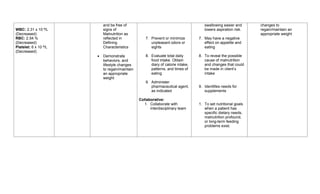
WBC: 2.31 x 10 ⁹/L
(Decreased)
RBC: 2.54 %
(Decreased)
Platelet: 6 x 10 ⁹/L
(Decreased)
and be free of
signs of
Malnutrition as
reflected in
Defining
Characteristics
 Demonstrate
behaviors, and
lifestyle changes
to regain/maintain
an appropriate
weight
7. Prevent or minimize
unpleasant odors or
sights
8. Evaluate total daily
food intake. Obtain
diary of calorie intake,
patterns, and times of
eating
9. Administer
pharmaceutical agent,
as indicated
Collaborative:
1. Collaborate with
interdisciplinary team
swallowing easier and
lowers aspiration risk.
7. May have a negative
effect on appetite and
eating
8. To reveal the possible
cause of malnutrition
and changes that could
be made in client’s
intake
9. Identifies needs for
supplements
1. To set nutritional goals
when a patient has
specific dietary needs,
malnutrition profound,
or long-term feeding
problems exist.
changes to
regain/maintain an
appropriate weight
ASSESSMENT
NURSING
DIAGNOSIS
PLANNING IMPLEMENTATION
EVALUATION
GOALS AND
DESIRED
OUTCOMES
INTERVENTION RATIONALE
Subjective:
“Dahil sa sakit ko ang
exercise ko nalang ay
paglalakad at minsan
ko nalang din
nagagawa dahil
nahihilo at mabilis
akong hingalin” as
verbalized by the
patient.
Objective:
Physical Assessment:
 Pale skin
 Dry skin
VS taken:
 RR: 18 cpm
 PR: 76 bpm
 BP: 110/70
mmHg
 Temp: 36.3 °C
 O2Sat: 96 %
Lab Values:
Activity Intolerance
r/t body weakness
as evidenced by
patient’s report of
dizziness and easy
fatigability when
walking a few
minutes.
Short term:
After 1 hour of
nursing
interventions, the
patient will:
 Maintain
normal vital
signs.
 Identify
potential
aggravating
factors of
activity
intolerance.
 Identify
strategies for
reducing
activity
intolerance.
Long term:
After 24 hours of
nursing
intervention, the
patient will:
Independent:
1. Recorded and
monitored vital
signs.
2. Encouraged the
verbalization of the
patient's feelings
regarding
constraints.
3. Assisted the patient
in progressive
increase of
activities to
gradually
strengthen the
muscles.
4. Encouraged the
patient to
progressively
1. This gives the nurse
a baseline and way
to gauge potential
changes and
fluctuations in vital
signs when active.
2. This enables the
patient to cope with
and to address the
underlying causes
of decreased
activity accordingly.
3. This avoids
problems brought
by prolonged bed
rest while building
endurance.
4. Progressively
increasing the
activity's intensity
minimizes
overexertion.
SHORT TERM GOALS:
After 1 hour of nursing intervention, the
patient obtained normal vital signs and was
able to identify potential aggravating factors
of activity intolerance along with identifying
strategies for reducing activity intolerance.
LONG TERM GOALS:
After 24 hours of nursing intervention:
 Patient was able to tolerate activities
of the daily living without assistance.
 Patient was able to maintain a
regular routine for rest and sleep
and has achieved an adequate
sleep.
 Patient was able to verbalize
understanding of the importance of
progressively increasing activity
level and was able to demonstrate
proper way on how to do so.
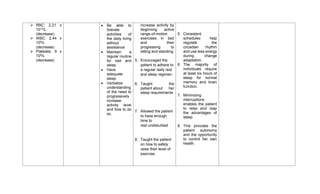
 RBC: 2.21 x
1012/L
(decrease)
 WBC: 2.44 x
109/L
(decrease)
 Platelets: 9 x
109/L
(decrease)
 Be able to
tolerate
activities of
the daily living
without
assistance
 Maintain a
regular routine
for rest and
sleep.
 Have
adequate
sleep.
 Verbalize
understanding
of the need to
progressively
increase
activity level
and how to do
so.
increase activity by
beginning active
range-of-motion
exercises in bed
and then
progressing to
sitting and standing.
5. Encouraged the
patient to adhere to
a regular daily rest
and sleep regimen.
6. Taught the
patient about her
sleep requirements.
7. Allowed the patient
to have enough
time to
rest undisturbed.
8. Taught the patient
on how to safely
raise their level of
exercise.
5. Consistent
schedules help
regulate the
circadian rhythm
and use less energy
during change
adaptation.
6. The majority of
individuals require
at least six hours of
sleep for normal
memory and brain
function.
7. Minimizing
interruptions
enables the patient
to relax and reap
the advantages of
sleep.
8. This provides the
patient autonomy
and the opportunity
to control her own
health.
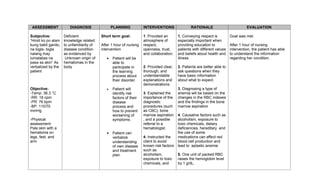
ASSESSMENT DIAGNOSIS PLANNING INTERVENTIONS RATIONALE EVALUATION
Subjective:
“Hindi ko po alam
kung bakit ganito,
na bigla- bigla
nalang may
lumalabas na
pasa sa akin” As
verbalized by the
patient
Objective:
-Temp: 36.3 °C
-RR: 18 cpm
-PR: 76 bpm
-BP: 110/70
mmHg
-Physical
assessment:
Pale skin with a
hematoma on
legs, feet, and
arm
Deficient
knowledge related
to unfamiliarity of
disease condition
as evidenced by
Unknown origin of
hematomas in the
body
Short term goal:
After 1 hour of nursing
intervention
 Patient will be
able to
participate in
the learning
process about
their disorder.
 Patient will
identify risk
factors of their
disease
process and
how to prevent
worsening of
symptoms.
 Patient can
verbalize
understanding
of own disease
and treatment
plan.
1. Provided an
atmosphere of
respect,
openness, trust,
and collaboration.
2. Provided clear,
thorough, and
understandable
explanations and
demonstrations.
3. Explained the
importance of the
diagnostic
procedures (such
as CBC), bone
marrow aspiration
, and a possible
referral to a
hematologist.
4. Instructed the
client to avoid
known risk factors
such as
alcoholism,
exposure to toxic
chemicals, and
1. Conveying respect is
especially important when
providing education to
patients with different values
and beliefs about health and
illness.
2. Patients are better able to
ask questions when they
have basic information
about what to expect.
3. Diagnosing a type of
anemia will be based on the
changes in the RBC indexes
and the findings in the bone
marrow aspiration
4. Causative factors such as
alcoholism, exposure to
toxic chemicals, dietary
deficiencies, hereditary and
the use of some
medications can affect red
blood cell production and
lead to aplastic anemia
5. One unit of packed RBC
raises the hemoglobin level
by 1 g/dL.
Goal was met.
After 1 hour of nursing
intervention, the patient has able
to understand the information
regarding her condition.
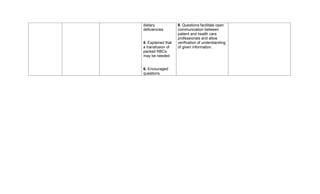
dietary
deficiencies.
5. Explained that
a transfusion of
packed RBCs
may be needed
6. Encouraged
questions
6. Questions facilitate open
communication between
patient and health care
professionals and allow
verification of understanding
of given information.

compiled NCP's.docx

  • 1.
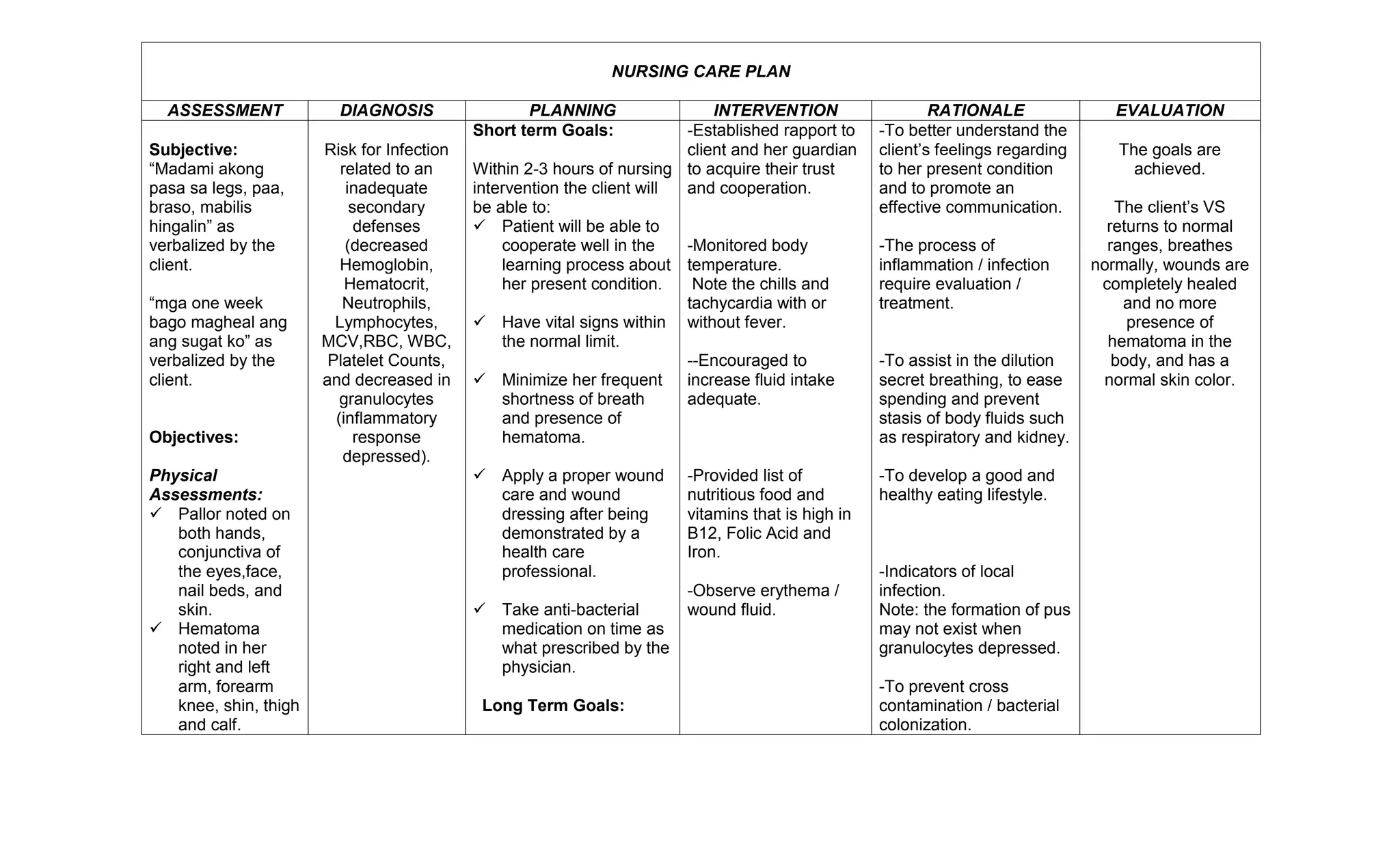
    NURSING CARE PLAN ASSESSMENTDIAGNOSIS PLANNING INTERVENTION RATIONALE EVALUATION Subjective: “Madami akong pasa sa legs, paa, braso, mabilis hingalin” as verbalized by the client. “mga one week bago magheal ang ang sugat ko” as verbalized by the client. Objectives: Physical Assessments:  Pallor noted on both hands, conjunctiva of the eyes,face, nail beds, and skin.  Hematoma noted in her right and left arm, forearm knee, shin, thigh and calf. Risk for Infection related to an inadequate secondary defenses (decreased Hemoglobin, Hematocrit, Neutrophils, Lymphocytes, MCV,RBC, WBC, Platelet Counts, and decreased in granulocytes (inflammatory response depressed). Short term Goals: Within 2-3 hours of nursing intervention the client will be able to:  Patient will be able to cooperate well in the learning process about her present condition.  Have vital signs within the normal limit.  Minimize her frequent shortness of breath and presence of hematoma.  Apply a proper wound care and wound dressing after being demonstrated by a health care professional.  Take anti-bacterial medication on time as what prescribed by the physician. Long Term Goals: -Established rapport to client and her guardian to acquire their trust and cooperation. -Monitored body temperature. Note the chills and tachycardia with or without fever. --Encouraged to increase fluid intake adequate. -Provided list of nutritious food and vitamins that is high in B12, Folic Acid and Iron. -Observe erythema / wound fluid. -To better understand the client’s feelings regarding to her present condition and to promote an effective communication. -The process of inflammation / infection require evaluation / treatment. -To assist in the dilution secret breathing, to ease spending and prevent stasis of body fluids such as respiratory and kidney. -To develop a good and healthy eating lifestyle. -Indicators of local infection. Note: the formation of pus may not exist when granulocytes depressed. -To prevent cross contamination / bacterial colonization. The goals are achieved. The client’s VS returns to normal ranges, breathes normally, wounds are completely healed and no more presence of hematoma in the body, and has a normal skin color.
  • 2.
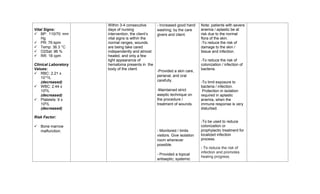
    Vital Signs:  BP:110/70 mm Hg  PR: 76 bpm  Temp: 36.3 °C  O2Sat: 96 %  RR: 18 cpm Clinical Laboratory Values:  RBC: 2.21 x 10¹²/L (decreased)  WBC: 2.44 x 10⁹/L (decreased)  Platelets: 9 x 10⁹/L (decreased) Risk Factor:  Bone marrow malfunction. Within 3-4 consecutive days of nursing intervention, the client’s vital signs is within the normal ranges, wounds are being take cared independently and almost healed, and only a few light appearance of hematoma presents in the body of the client. - Increased good hand washing; by the care givers and client. -Provided a skin care, perianal, and oral carefully. -Maintained strict aseptic technique on the procedure / treatment of wounds. - Monitored / limits visitors. Give isolation room whenever possible. - Provided a topical antiseptic; systemic Note: patients with severe anemia / aplastic be at risk due to the normal flora of the skin. -To reduce the risk of damage to the skin / tissue and infection. -To reduce the risk of colonization / infection of bacteria. -To limit exposure to bacteria / infection. Protection in isolation required in aplastic anemia, when the immune response is very disturbed. -To be used to reduce colonization or prophylactic treatment for localized infection process. - To reduce the risk of infection and promotes healing progress.
  • 3.
  • 4.
    NURSING CARE PLAN AssessmentNursing Diagnosis Planning Implementation Rationale of every action Evaluation Subjective: “Nawawalan ako ng gana kumain simula siguro mga August this year. Dati nga mahilig ako sa pansit,lalo na maaasim na pagkain” as verbalized by the patient Objective: Weight: From 45kg to 39kg Vital Signs: RR: 18 cpm PR: 76 bpm BP: 11/70 TEMP: 36.3 °C O2Sat: 96% Lab Values: Risk for imbalanced Nutrition Less than Body Requirements related to loss of appetite as evidenced by weight loss Short term: After 4 hours of nursing intervention, the patient will:  Verbalize understanding of causative factors when known and necessary interventions Long Term: After 3 to 6 weeks of nursing intervention the patient will:  Demonstrate progressive weight gain toward goal  Display normalization of Laboratory value Independent: 1. Monitor Vital Signs 2. Accurately and procedurally take the actual weight of the patient. 3. Identify the patient’s view towards feeding and food. 4. Use flavoring agents 5. Determine patient’s ability to chew, swallow, and taste food 6. Encourage proper positioning. 1. For Baseline data 2. The anthropomorphic assessments form the basis for the requirements for nutrients and calories 3. There are different factors that influence the type and number of foods taken. 4. To enhance food satisfaction and stimulate appetite 5. All factors that affect the ingestion and digestion of nutrients 6. A head that is 30 degrees elevation from the bed makes Short-term goals: Goal was met. After 4 hours of nursing intervention, the patient verbalized understanding of causative factors and necessary interventions Long-term goals: Goal was met. After 3 to 6 weeks of nursing intervention  The patient demonstrated progressive weight gain toward goal  The patient displayed normalization of Laboratory values and was free of signs of Malnutrition as reflected in Defining Characteristics  The patient demonstrated behaviors, and lifestyle
  • 5.
    WBC: 2.31 x10 ⁹/L (Decreased) RBC: 2.54 % (Decreased) Platelet: 6 x 10 ⁹/L (Decreased) and be free of signs of Malnutrition as reflected in Defining Characteristics  Demonstrate behaviors, and lifestyle changes to regain/maintain an appropriate weight 7. Prevent or minimize unpleasant odors or sights 8. Evaluate total daily food intake. Obtain diary of calorie intake, patterns, and times of eating 9. Administer pharmaceutical agent, as indicated Collaborative: 1. Collaborate with interdisciplinary team swallowing easier and lowers aspiration risk. 7. May have a negative effect on appetite and eating 8. To reveal the possible cause of malnutrition and changes that could be made in client’s intake 9. Identifies needs for supplements 1. To set nutritional goals when a patient has specific dietary needs, malnutrition profound, or long-term feeding problems exist. changes to regain/maintain an appropriate weight
  • 6.
    ASSESSMENT NURSING DIAGNOSIS PLANNING IMPLEMENTATION EVALUATION GOALS AND DESIRED OUTCOMES INTERVENTIONRATIONALE Subjective: “Dahil sa sakit ko ang exercise ko nalang ay paglalakad at minsan ko nalang din nagagawa dahil nahihilo at mabilis akong hingalin” as verbalized by the patient. Objective: Physical Assessment:  Pale skin  Dry skin VS taken:  RR: 18 cpm  PR: 76 bpm  BP: 110/70 mmHg  Temp: 36.3 °C  O2Sat: 96 % Lab Values: Activity Intolerance r/t body weakness as evidenced by patient’s report of dizziness and easy fatigability when walking a few minutes. Short term: After 1 hour of nursing interventions, the patient will:  Maintain normal vital signs.  Identify potential aggravating factors of activity intolerance.  Identify strategies for reducing activity intolerance. Long term: After 24 hours of nursing intervention, the patient will: Independent: 1. Recorded and monitored vital signs. 2. Encouraged the verbalization of the patient's feelings regarding constraints. 3. Assisted the patient in progressive increase of activities to gradually strengthen the muscles. 4. Encouraged the patient to progressively 1. This gives the nurse a baseline and way to gauge potential changes and fluctuations in vital signs when active. 2. This enables the patient to cope with and to address the underlying causes of decreased activity accordingly. 3. This avoids problems brought by prolonged bed rest while building endurance. 4. Progressively increasing the activity's intensity minimizes overexertion. SHORT TERM GOALS: After 1 hour of nursing intervention, the patient obtained normal vital signs and was able to identify potential aggravating factors of activity intolerance along with identifying strategies for reducing activity intolerance. LONG TERM GOALS: After 24 hours of nursing intervention:  Patient was able to tolerate activities of the daily living without assistance.  Patient was able to maintain a regular routine for rest and sleep and has achieved an adequate sleep.  Patient was able to verbalize understanding of the importance of progressively increasing activity level and was able to demonstrate proper way on how to do so.
  • 7.
     RBC: 2.21x 10¹²/L (decrease)  WBC: 2.44 x 10⁹/L (decrease)  Platelets: 9 x 10⁹/L (decrease)  Be able to tolerate activities of the daily living without assistance  Maintain a regular routine for rest and sleep.  Have adequate sleep.  Verbalize understanding of the need to progressively increase activity level and how to do so. increase activity by beginning active range-of-motion exercises in bed and then progressing to sitting and standing. 5. Encouraged the patient to adhere to a regular daily rest and sleep regimen. 6. Taught the patient about her sleep requirements. 7. Allowed the patient to have enough time to rest undisturbed. 8. Taught the patient on how to safely raise their level of exercise. 5. Consistent schedules help regulate the circadian rhythm and use less energy during change adaptation. 6. The majority of individuals require at least six hours of sleep for normal memory and brain function. 7. Minimizing interruptions enables the patient to relax and reap the advantages of sleep. 8. This provides the patient autonomy and the opportunity to control her own health.
  • 8.
    ASSESSMENT DIAGNOSIS PLANNINGINTERVENTIONS RATIONALE EVALUATION Subjective: “Hindi ko po alam kung bakit ganito, na bigla- bigla nalang may lumalabas na pasa sa akin” As verbalized by the patient Objective: -Temp: 36.3 °C -RR: 18 cpm -PR: 76 bpm -BP: 110/70 mmHg -Physical assessment: Pale skin with a hematoma on legs, feet, and arm Deficient knowledge related to unfamiliarity of disease condition as evidenced by Unknown origin of hematomas in the body Short term goal: After 1 hour of nursing intervention  Patient will be able to participate in the learning process about their disorder.  Patient will identify risk factors of their disease process and how to prevent worsening of symptoms.  Patient can verbalize understanding of own disease and treatment plan. 1. Provided an atmosphere of respect, openness, trust, and collaboration. 2. Provided clear, thorough, and understandable explanations and demonstrations. 3. Explained the importance of the diagnostic procedures (such as CBC), bone marrow aspiration , and a possible referral to a hematologist. 4. Instructed the client to avoid known risk factors such as alcoholism, exposure to toxic chemicals, and 1. Conveying respect is especially important when providing education to patients with different values and beliefs about health and illness. 2. Patients are better able to ask questions when they have basic information about what to expect. 3. Diagnosing a type of anemia will be based on the changes in the RBC indexes and the findings in the bone marrow aspiration 4. Causative factors such as alcoholism, exposure to toxic chemicals, dietary deficiencies, hereditary and the use of some medications can affect red blood cell production and lead to aplastic anemia 5. One unit of packed RBC raises the hemoglobin level by 1 g/dL. Goal was met. After 1 hour of nursing intervention, the patient has able to understand the information regarding her condition.
  • 9.
    dietary deficiencies. 5. Explained that atransfusion of packed RBCs may be needed 6. Encouraged questions 6. Questions facilitate open communication between patient and health care professionals and allow verification of understanding of given information.