PHARMACEUTICAL INCOMPATIBILITY
1
2
 DEFINITION: Incompatibility is the result of mixing two or
more antagonistic substances as a result of which undesirable
product or effect may be seen.
Ways of detecting Incompatibility
It may be detected by:
 Physical change.
 Chemical change.
 Therapeutic change.
Importance Of Determining Incompatibility:
3
Incompatible products may effect:
 Safety of medicament.
 Efficacy of product.
 Appearance of a medicine.
 Purpose of medication.
Types Of Incompatibilities:
4
 Physical incompatibility.
 Chemical incompatibility.
 Therapeutic incompatibility.
PHYSICAL INCOMPATIBILITY:
5
 When two or more substances are combined together a physical change
would takes place leading to an incompatible product.
causes
 Immiscibility
 Insolubility
 Liquefaction
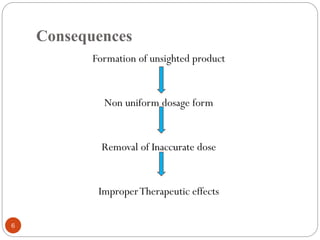
Consequences
6
Formation of unsighted product
Non uniform dosage form
Removal of Inaccurate dose
ImproperTherapeutic effects
Immiscibility
7
 What is a miscible solution?
 The components of an Ideal solution are miscible in all proportions
for e.g. water and ethanol, propylene glycol and water, propylene
glycol and acetone etc.
Examples:
 Oil and water .For e.g. Castor oil ,Olive oil.
 Concentrated Hydro alcoholic solutions of volatile oils (spirits and
concentrated water)
Methods Of Rectifying Immiscibility:
8
Immiscibility can be overcome by:
 Vigorous shaking / stirring.
 Emulsification or solubilization for e.g. Fats soluble Vitamins, Certain
antibiotics like Chloramphenicol, Amphotericin B, Analgesics like
Aspirin, Acetanilide & phenacetin many alkaloids and glycosides etc are
made soluble by the technique of solubilization.
Insolubility
9
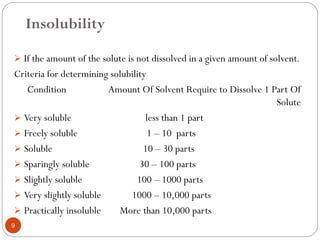
 If the amount of the solute is not dissolved in a given amount of solvent.
Criteria for determining solubility
Condition Amount Of Solvent Require to Dissolve 1 Part Of
Solute
 Very soluble less than 1 part
 Freely soluble 1 – 10 parts
 Soluble 10 – 30 parts
 Sparingly soluble 30 – 100 parts
 Slightly soluble 100 – 1000 parts
 Very slightly soluble 1000 – 10,000 parts
 Practically insoluble More than 10,000 parts
10
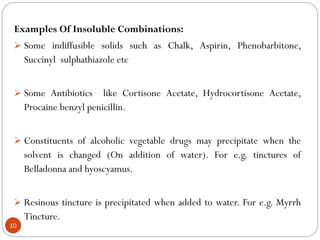
Examples Of Insoluble Combinations:
 Some indiffusible solids such as Chalk, Aspirin, Phenobarbitone,
Succinyl sulphathiazole etc
 Some Antibiotics like Cortisone Acetate, Hydrocortisone Acetate,
Procaine benzyl penicillin.
 Constituents of alcoholic vegetable drugs may precipitate when the
solvent is changed (On addition of water). For e.g. tinctures of
Belladonna and hyoscyamus.
 Resinous tincture is precipitated when added to water. For e.g. Myrrh
Tincture.
11
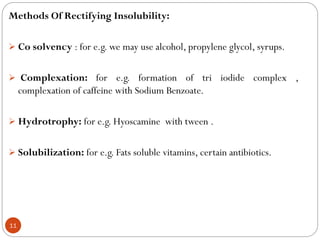
Methods Of Rectifying Insolubility:
 Co solvency : for e.g. we may use alcohol, propylene glycol, syrups.
 Complexation: for e.g. formation of tri iodide complex ,
complexation of caffeine with Sodium Benzoate.
 Hydrotrophy: for e.g. Hyoscamine with tween .
 Solubilization: for e.g. Fats soluble vitamins, certain antibiotics.
LIQUEFACTION
12
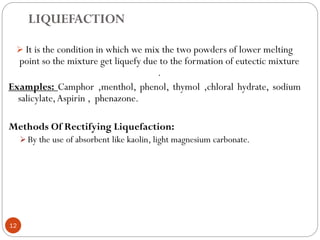
 It is the condition in which we mix the two powders of lower melting
point so the mixture get liquefy due to the formation of eutectic mixture
.
Examples: Camphor ,menthol, phenol, thymol ,chloral hydrate, sodium
salicylate,Aspirin , phenazone.
Methods Of Rectifying Liquefaction:
 By the use of absorbent like kaolin, light magnesium carbonate.
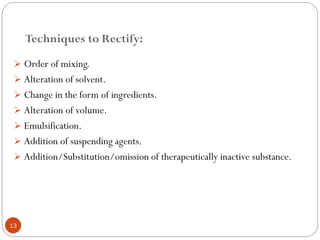
Techniques to Rectify:
13
 Order of mixing.
 Alteration of solvent.
 Change in the form of ingredients.
 Alteration of volume.
 Emulsification.
 Addition of suspending agents.
 Addition/Substitution/omission of therapeutically inactive substance.
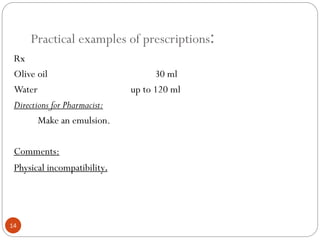
Practical examples of prescriptions:
14
Rx
Olive oil 30 ml
Water up to 120 ml
Directions for Pharmacist:
Make an emulsion.
Comments:
Physical incompatibility.
15
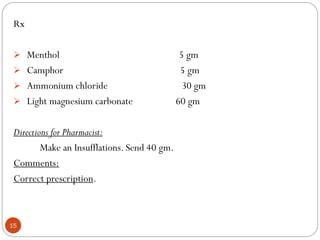
Rx
 Menthol 5 gm
 Camphor 5 gm
 Ammonium chloride 30 gm
 Light magnesium carbonate 60 gm
Directions for Pharmacist:
Make an Insufflations. Send 40 gm.
Comments:
Correct prescription.
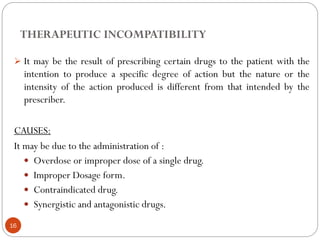
THERAPEUTIC INCOMPATIBILITY
16
 It may be the result of prescribing certain drugs to the patient with the
intention to produce a specific degree of action but the nature or the
intensity of the action produced is different from that intended by the
prescriber.
CAUSES:
It may be due to the administration of :
 Overdose or improper dose of a single drug.
 Improper Dosage form.
 Contraindicated drug.
 Synergistic and antagonistic drugs.
17
Mechanisms of therapeutic incompatibility
 They are divided into two groups:
 Pharmacokinetics:
 involve the effect of a drug on another from the point of view that
includes absorption ,distribution , metabolism and excretion.
 Pharmacodynamics:
are related to the pharmacological activity of the interacting drugs e.g.
synergism. antagonism, altered cellular transport, effect on the
receptor site.
18
Pharmacokinetic interactions:
 Altered GIT absorption
Altered pH
Altered bacterial flora
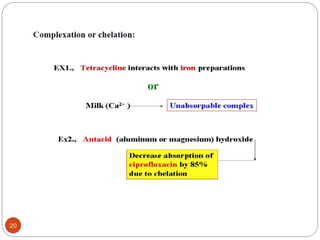
Formation of drug chelates or complexes
Drug induced mucosal damage and altered GIT motility
 Displaced protein binding
It depends on the affinity of the drug to plasma protein.The most
likely bound drugs is capable to displace others.The free drug is
increased by displacement by another drug with higher affinity
19
 Altered metabolism
 The effect of one drug on the metabolism of the other is well
documented.The liver is the major site of drug metabolism but other
organs can also do e.g.,WBC, skin, lung, and GIT.
 Altered renal execration:
 Inhibition of renal tubular secretion:
• It occurs in the proximal tubules (a portion of renal tubules).The drug
combines with a specific protein to pass through the proximal tubules.
•When a drug has a competitive reactivity to the protein that is
responsible for active transport of another drug .This will reduce such a
drug excretion increasing its concentration and hence its toxicity.
 E.g., Probenecid …..Decreases tubular secretion of methotrexate
20
21
Pharmacodynamic interactions
 It means alteration of the dug action without change in its serum
concentration by pharmacokinetic factors.
a.Additive effect-occurs when two or more drugs having the same effect
are combined and the result is the sum of the individual effects relative to
the doses used.This additive effect may be beneficial or harmful to the
client.
b. Synergistic effect- occurs when two or more drugs, with or without the
same overt effect, are used together to yield a combined effect that has an
outcome greater than the sum of the single drugs active components alone
22
c. Potentiation-describes a particular type of synergistic effect-a drug
interaction in which only one of two drugs exerts the action that is made
greater by the presence of the second drug.
d.Antagonistic-reactions have the opposite effect of synergism and result in
a combined effect that is less than either active component alone. (e.g.
Protamine administered as an antidote to anticoagulant action of heparin)
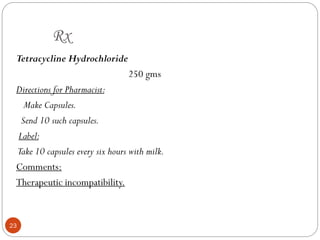
Rx
23
Tetracycline Hydrochloride
250 gms
Directions for Pharmacist:
Make Capsules.
Send 10 such capsules.
Label:
Take 10 capsules every six hours with milk.
Comments:
Therapeutic incompatibility.
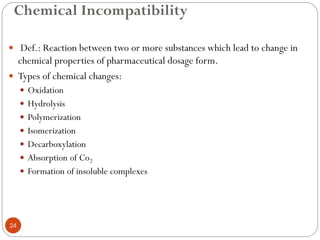
Chemical Incompatibility
24
 Def.: Reaction between two or more substances which lead to change in
chemical properties of pharmaceutical dosage form.
 Types of chemical changes:
 Oxidation
 Hydrolysis
 Polymerization
 Isomerization
 Decarboxylation
 Absorption of Co2
 Formation of insoluble complexes
25
 Oxidation:
Def.: Oxidation is defined as loss of electrons or gain of oxygen
Auto-oxidation: It is a reaction with oxygen of air which occur
spontaneously without other factors.
Pre-oxidants: are substances catalyze oxidation process i.e. metals,
some impurities.
 Hydrolysis:
A chemical reaction in which water is used to break down a
compound; this is achieved by breaking a covalent bond in the
compound by inserting a water molecule across the bond.
 Polymerization:
In polymerization, small repeating units called monomers are bonded
to form a long chain polymer.
26
 Isomerization:
 CO2 – absorption:
- When some pharmaceutical dosage forms contain CO2, precipitate is
formed:
- Ex: Ca(OH)2 + CO2 CaCO3
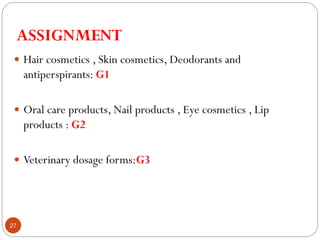
ASSIGNMENT
27
 Hair cosmetics , Skin cosmetics, Deodorants and
antiperspirants: G1
 Oral care products, Nail products , Eye cosmetics , Lip
products : G2
 Veterinary dosage forms:G3

Pharmaceutical incompatibility and classification

  • 1.
  • 2.
    2  DEFINITION: Incompatibilityis the result of mixing two or more antagonistic substances as a result of which undesirable product or effect may be seen. Ways of detecting Incompatibility It may be detected by:  Physical change.  Chemical change.  Therapeutic change.
  • 3.
    Importance Of DeterminingIncompatibility: 3 Incompatible products may effect:  Safety of medicament.  Efficacy of product.  Appearance of a medicine.  Purpose of medication.
  • 4.
    Types Of Incompatibilities: 4 Physical incompatibility.  Chemical incompatibility.  Therapeutic incompatibility.
  • 5.
    PHYSICAL INCOMPATIBILITY: 5  Whentwo or more substances are combined together a physical change would takes place leading to an incompatible product. causes  Immiscibility  Insolubility  Liquefaction
  • 6.
    Consequences 6 Formation of unsightedproduct Non uniform dosage form Removal of Inaccurate dose ImproperTherapeutic effects
  • 7.
    Immiscibility 7  What isa miscible solution?  The components of an Ideal solution are miscible in all proportions for e.g. water and ethanol, propylene glycol and water, propylene glycol and acetone etc. Examples:  Oil and water .For e.g. Castor oil ,Olive oil.  Concentrated Hydro alcoholic solutions of volatile oils (spirits and concentrated water)
  • 8.
    Methods Of RectifyingImmiscibility: 8 Immiscibility can be overcome by:  Vigorous shaking / stirring.  Emulsification or solubilization for e.g. Fats soluble Vitamins, Certain antibiotics like Chloramphenicol, Amphotericin B, Analgesics like Aspirin, Acetanilide & phenacetin many alkaloids and glycosides etc are made soluble by the technique of solubilization.
  • 9.
    Insolubility 9  If theamount of the solute is not dissolved in a given amount of solvent. Criteria for determining solubility Condition Amount Of Solvent Require to Dissolve 1 Part Of Solute  Very soluble less than 1 part  Freely soluble 1 – 10 parts  Soluble 10 – 30 parts  Sparingly soluble 30 – 100 parts  Slightly soluble 100 – 1000 parts  Very slightly soluble 1000 – 10,000 parts  Practically insoluble More than 10,000 parts
  • 10.
    10 Examples Of InsolubleCombinations:  Some indiffusible solids such as Chalk, Aspirin, Phenobarbitone, Succinyl sulphathiazole etc  Some Antibiotics like Cortisone Acetate, Hydrocortisone Acetate, Procaine benzyl penicillin.  Constituents of alcoholic vegetable drugs may precipitate when the solvent is changed (On addition of water). For e.g. tinctures of Belladonna and hyoscyamus.  Resinous tincture is precipitated when added to water. For e.g. Myrrh Tincture.
  • 11.
    11 Methods Of RectifyingInsolubility:  Co solvency : for e.g. we may use alcohol, propylene glycol, syrups.  Complexation: for e.g. formation of tri iodide complex , complexation of caffeine with Sodium Benzoate.  Hydrotrophy: for e.g. Hyoscamine with tween .  Solubilization: for e.g. Fats soluble vitamins, certain antibiotics.
  • 12.
    LIQUEFACTION 12  It isthe condition in which we mix the two powders of lower melting point so the mixture get liquefy due to the formation of eutectic mixture . Examples: Camphor ,menthol, phenol, thymol ,chloral hydrate, sodium salicylate,Aspirin , phenazone. Methods Of Rectifying Liquefaction:  By the use of absorbent like kaolin, light magnesium carbonate.
  • 13.
    Techniques to Rectify: 13 Order of mixing.  Alteration of solvent.  Change in the form of ingredients.  Alteration of volume.  Emulsification.  Addition of suspending agents.  Addition/Substitution/omission of therapeutically inactive substance.
  • 14.
    Practical examples ofprescriptions: 14 Rx Olive oil 30 ml Water up to 120 ml Directions for Pharmacist: Make an emulsion. Comments: Physical incompatibility.
  • 15.
    15 Rx  Menthol 5gm  Camphor 5 gm  Ammonium chloride 30 gm  Light magnesium carbonate 60 gm Directions for Pharmacist: Make an Insufflations. Send 40 gm. Comments: Correct prescription.
  • 16.
    THERAPEUTIC INCOMPATIBILITY 16  Itmay be the result of prescribing certain drugs to the patient with the intention to produce a specific degree of action but the nature or the intensity of the action produced is different from that intended by the prescriber. CAUSES: It may be due to the administration of :  Overdose or improper dose of a single drug.  Improper Dosage form.  Contraindicated drug.  Synergistic and antagonistic drugs.
  • 17.
    17 Mechanisms of therapeuticincompatibility  They are divided into two groups:  Pharmacokinetics:  involve the effect of a drug on another from the point of view that includes absorption ,distribution , metabolism and excretion.  Pharmacodynamics: are related to the pharmacological activity of the interacting drugs e.g. synergism. antagonism, altered cellular transport, effect on the receptor site.
  • 18.
    18 Pharmacokinetic interactions:  AlteredGIT absorption Altered pH Altered bacterial flora Formation of drug chelates or complexes Drug induced mucosal damage and altered GIT motility  Displaced protein binding It depends on the affinity of the drug to plasma protein.The most likely bound drugs is capable to displace others.The free drug is increased by displacement by another drug with higher affinity
  • 19.
    19  Altered metabolism The effect of one drug on the metabolism of the other is well documented.The liver is the major site of drug metabolism but other organs can also do e.g.,WBC, skin, lung, and GIT.  Altered renal execration:  Inhibition of renal tubular secretion: • It occurs in the proximal tubules (a portion of renal tubules).The drug combines with a specific protein to pass through the proximal tubules. •When a drug has a competitive reactivity to the protein that is responsible for active transport of another drug .This will reduce such a drug excretion increasing its concentration and hence its toxicity.  E.g., Probenecid …..Decreases tubular secretion of methotrexate
  • 20.
  • 21.
    21 Pharmacodynamic interactions  Itmeans alteration of the dug action without change in its serum concentration by pharmacokinetic factors. a.Additive effect-occurs when two or more drugs having the same effect are combined and the result is the sum of the individual effects relative to the doses used.This additive effect may be beneficial or harmful to the client. b. Synergistic effect- occurs when two or more drugs, with or without the same overt effect, are used together to yield a combined effect that has an outcome greater than the sum of the single drugs active components alone
  • 22.
    22 c. Potentiation-describes aparticular type of synergistic effect-a drug interaction in which only one of two drugs exerts the action that is made greater by the presence of the second drug. d.Antagonistic-reactions have the opposite effect of synergism and result in a combined effect that is less than either active component alone. (e.g. Protamine administered as an antidote to anticoagulant action of heparin)
  • 23.
    Rx 23 Tetracycline Hydrochloride 250 gms Directionsfor Pharmacist: Make Capsules. Send 10 such capsules. Label: Take 10 capsules every six hours with milk. Comments: Therapeutic incompatibility.
  • 24.
    Chemical Incompatibility 24  Def.:Reaction between two or more substances which lead to change in chemical properties of pharmaceutical dosage form.  Types of chemical changes:  Oxidation  Hydrolysis  Polymerization  Isomerization  Decarboxylation  Absorption of Co2  Formation of insoluble complexes
  • 25.
    25  Oxidation: Def.: Oxidationis defined as loss of electrons or gain of oxygen Auto-oxidation: It is a reaction with oxygen of air which occur spontaneously without other factors. Pre-oxidants: are substances catalyze oxidation process i.e. metals, some impurities.  Hydrolysis: A chemical reaction in which water is used to break down a compound; this is achieved by breaking a covalent bond in the compound by inserting a water molecule across the bond.  Polymerization: In polymerization, small repeating units called monomers are bonded to form a long chain polymer.
  • 26.
    26  Isomerization:  CO2– absorption: - When some pharmaceutical dosage forms contain CO2, precipitate is formed: - Ex: Ca(OH)2 + CO2 CaCO3
  • 27.
    ASSIGNMENT 27  Hair cosmetics, Skin cosmetics, Deodorants and antiperspirants: G1  Oral care products, Nail products , Eye cosmetics , Lip products : G2  Veterinary dosage forms:G3