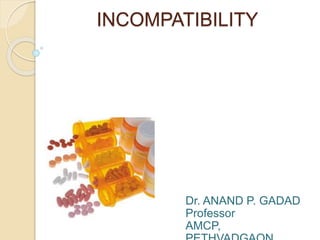
INCOMPATIBILITY
Dr. ANAND P. GADAD
Professor
AMCP,
Definition
 Incompatibility is the result of prescribing
two or more substances which are
antagonistic in nature and result in
undesirable products or results which
may affect the safety, efficacy and quality
of the products.
 Incompatibles are substances which have
opposite medicinal properties, or
substances when mixed together, react
chemically to produce other substances.
 An understanding of incompatibilities can
save the pharmacist valuable time in
compounding as well as ensure the
Incompatibilities- Types
Incompatibilities are divided into three
classes:
 Physical incompatibilities
 Chemical incompatibilities
 Therapeutic incompatibilities
Physical Incompatibilities
Physical incompatibilities are often called
Pharmaceutical incompatibilities and produce a
mixture which is unacceptable in appearance and
taste and may result in non-uniform dosage form.
1. Incomplete solution: Gums are insoluble in
alcohol, resins are insoluble in water
2. Precipitation: Resins are precipitated from
alcoholic solution when water is added
Camphor and volatile oils are salted out from
their aromatic water when soluble salts are
added
3. Immiscible liquids. Eg oil & Water
4. Eutexia: eg formation of Eutectic mixture
Chemical Incompatibilities
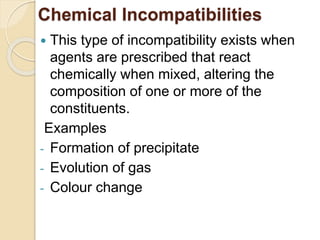
 This type of incompatibility exists when
agents are prescribed that react
chemically when mixed, altering the
composition of one or more of the
constituents.
Examples
- Formation of precipitate
- Evolution of gas
- Colour change
1. Alkaloidal Incompatibility
i. Alkaloidal salts with alkaline substances
ii. Alkaloidal salts with soluble iodides
iii. Alkaloidal salts with Tannins
iv. Alkaloidal salts with salicylates
v. Alkaloidal salts with soluble iodides &
bromides
Rx
Caffeine citrate
Sodium Salicylate
Water qs
Make a Mixture
Rx
Strychnine Hcl solution
Aromatic spirit of
Ammonia
Water qs
Make a Mixture
2. Soluble Salicylates
Incompatibilities
i. Soluble salicylates with ferric salt
ii. Soluble salicylates with alkali
bicarbonates
iii. Soluble salicylates and benzoates with
acids Rx
Sodium Salicylate
Lemon syrup
Water qs
Make a Mixture
Rx
Ferric chloride solution
Sodium salicylate
Water qs
Make a Mixture
3.Soluble Iodides Incompatibility
Rx
Quinine sulphate
Dilute sulphuric
acid
Potassium iodide
Water qs
i. Oxidation of iodides with ferric salts
ii. Oxidation of iodides with potassium
chlorates
iii. Oxidation of iodides with Quinine Sulphate
Rx
Ferric chloride
solution
Potassium iodide
Potassium citrate
Water qs
4. Evolution of CO2 Gas
Rx
Sodium bicarbonate
Borax
Phenol
Glycerine
Water qs
Make a Spray Solution
i. Sodium bicarbonate with soluble calcium
or magnesium salts
ii. Bismuth subnitrate with sodium
bicarbonate
iii.Borax with sodium bicarbonate and
glycerin
Miscellaneous
Eg.: Soluble Barbiturates with Ammonium
bromide
Rx
Phenobarbitone sodium 600mg
Ammonium bromide 8 gm
Water qs 100 ml
Make a Mixture
Label: Two teaspoonful to be taken at night
Therapeutic Incompatibility
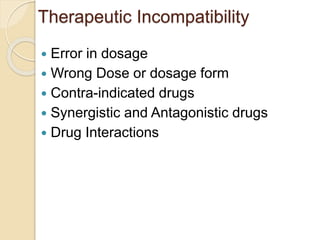
 Error in dosage
 Wrong Dose or dosage form
 Contra-indicated drugs
 Synergistic and Antagonistic drugs
 Drug Interactions
Error in dosage
Rx
Codeine phosphate 0.5 g
Prepare 10 dose
Direction: One dose to be taken at bed time
Note:
As Codeine phosphate is a potent drug hence the dose
shows in large quantity.
May be the intention of the physician is to prescribe 5mg
and by mistake prescribed as 0.5 g in the prescription. So
prescription may be referred back to the physician
informing with the dose to be corrected.
Wrong Medication or dosage
form
Eg. Prednisone & Prednisolone
Eg. Cyprowin & Ciprowin
Eg. Digoxin & Digitoxin
Eg. Allerin & Alergin
Contra-indicated drugs
Pregnancy & Lactation
Renal failure
Liver Cirrhosis
 The Penicillins and Sulpha drugs are
contra-indicated to the patients who are
allergic to it
 Corticosteroids are contra-indicated in
patients having an active peptic ulcer
 Barbiturates and morphine should not be
given to asthmatic patients
contd
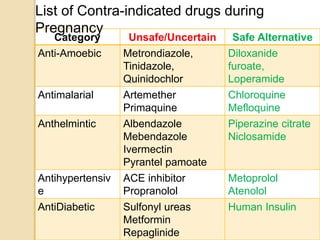
Category Unsafe/Uncertain Safe Alternative
Anti-Amoebic Metrondiazole,
Tinidazole,
Quinidochlor
Diloxanide
furoate,
Loperamide
Antimalarial Artemether
Primaquine
Chloroquine
Mefloquine
Anthelmintic Albendazole
Mebendazole
Ivermectin
Pyrantel pamoate
Piperazine citrate
Niclosamide
Antihypertensiv
e
ACE inhibitor
Propranolol
Metoprolol
Atenolol
AntiDiabetic Sulfonyl ureas
Metformin
Repaglinide
Human Insulin
List of Contra-indicated drugs during
Pregnancy
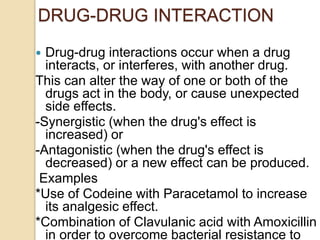
DRUG-DRUG INTERACTION
 Drug-drug interactions occur when a drug
interacts, or interferes, with another drug.
This can alter the way of one or both of the
drugs act in the body, or cause unexpected
side effects.
-Synergistic (when the drug's effect is
increased) or
-Antagonistic (when the drug's effect is
decreased) or a new effect can be produced.
Examples
*Use of Codeine with Paracetamol to increase
its analgesic effect.
*Combination of Clavulanic acid with Amoxicillin
in order to overcome bacterial resistance to
DRUG-FOOD INTERACTION
 A drug-food interaction happens when the food
we eat affects the ingredients in a medicine we
are taking so the medicine cannot work the way
it should.
Example
1. Consumers taking digoxin for heart failure or
ACE inhibitors for high blood pressure should be
careful with salt substitutes, which most often
replace sodium with potassium.
2. Blood-thinning drugs such as Coumadin®
(warfarin) interfere with vitamin K-dependent
clotting factors. Eating too much green leafy
vegetables, which are high in vitamin K, can
decrease the ability of blood-thinners to prevent
clotting.
3. Tetracycline should not be taken with milk
HOW TO PREVENT DRUG
INTERACTIONS?
We should tell our doctor about everything
we are taking, including prescription drugs,
OTC medications, vitamins and herbal
supplements.
We should read the consumer information
sheet with our prescriptions and read it
carefully.
We should read the labels on OTC
medications, paying special attention to the
“Warnings”section.
Before buying a new OTC medication,
vitamin or herbal supplement, we should ask
?
Incompatibility.pptx

Incompatibility.pptx

  • 1.
    INCOMPATIBILITY Dr. ANAND P.GADAD Professor AMCP,
  • 2.
    Definition  Incompatibility isthe result of prescribing two or more substances which are antagonistic in nature and result in undesirable products or results which may affect the safety, efficacy and quality of the products.  Incompatibles are substances which have opposite medicinal properties, or substances when mixed together, react chemically to produce other substances.  An understanding of incompatibilities can save the pharmacist valuable time in compounding as well as ensure the
  • 3.
    Incompatibilities- Types Incompatibilities aredivided into three classes:  Physical incompatibilities  Chemical incompatibilities  Therapeutic incompatibilities
  • 4.
    Physical Incompatibilities Physical incompatibilitiesare often called Pharmaceutical incompatibilities and produce a mixture which is unacceptable in appearance and taste and may result in non-uniform dosage form. 1. Incomplete solution: Gums are insoluble in alcohol, resins are insoluble in water 2. Precipitation: Resins are precipitated from alcoholic solution when water is added Camphor and volatile oils are salted out from their aromatic water when soluble salts are added 3. Immiscible liquids. Eg oil & Water 4. Eutexia: eg formation of Eutectic mixture
  • 5.
    Chemical Incompatibilities  Thistype of incompatibility exists when agents are prescribed that react chemically when mixed, altering the composition of one or more of the constituents. Examples - Formation of precipitate - Evolution of gas - Colour change
  • 6.
    1. Alkaloidal Incompatibility i.Alkaloidal salts with alkaline substances ii. Alkaloidal salts with soluble iodides iii. Alkaloidal salts with Tannins iv. Alkaloidal salts with salicylates v. Alkaloidal salts with soluble iodides & bromides Rx Caffeine citrate Sodium Salicylate Water qs Make a Mixture Rx Strychnine Hcl solution Aromatic spirit of Ammonia Water qs Make a Mixture
  • 7.
    2. Soluble Salicylates Incompatibilities i.Soluble salicylates with ferric salt ii. Soluble salicylates with alkali bicarbonates iii. Soluble salicylates and benzoates with acids Rx Sodium Salicylate Lemon syrup Water qs Make a Mixture Rx Ferric chloride solution Sodium salicylate Water qs Make a Mixture
  • 8.
    3.Soluble Iodides Incompatibility Rx Quininesulphate Dilute sulphuric acid Potassium iodide Water qs i. Oxidation of iodides with ferric salts ii. Oxidation of iodides with potassium chlorates iii. Oxidation of iodides with Quinine Sulphate Rx Ferric chloride solution Potassium iodide Potassium citrate Water qs
  • 9.
    4. Evolution ofCO2 Gas Rx Sodium bicarbonate Borax Phenol Glycerine Water qs Make a Spray Solution i. Sodium bicarbonate with soluble calcium or magnesium salts ii. Bismuth subnitrate with sodium bicarbonate iii.Borax with sodium bicarbonate and glycerin
  • 10.
    Miscellaneous Eg.: Soluble Barbiturateswith Ammonium bromide Rx Phenobarbitone sodium 600mg Ammonium bromide 8 gm Water qs 100 ml Make a Mixture Label: Two teaspoonful to be taken at night
  • 11.
    Therapeutic Incompatibility  Errorin dosage  Wrong Dose or dosage form  Contra-indicated drugs  Synergistic and Antagonistic drugs  Drug Interactions
  • 12.
    Error in dosage Rx Codeinephosphate 0.5 g Prepare 10 dose Direction: One dose to be taken at bed time Note: As Codeine phosphate is a potent drug hence the dose shows in large quantity. May be the intention of the physician is to prescribe 5mg and by mistake prescribed as 0.5 g in the prescription. So prescription may be referred back to the physician informing with the dose to be corrected.
  • 13.
    Wrong Medication ordosage form Eg. Prednisone & Prednisolone Eg. Cyprowin & Ciprowin Eg. Digoxin & Digitoxin Eg. Allerin & Alergin
  • 14.
    Contra-indicated drugs Pregnancy &Lactation Renal failure Liver Cirrhosis  The Penicillins and Sulpha drugs are contra-indicated to the patients who are allergic to it  Corticosteroids are contra-indicated in patients having an active peptic ulcer  Barbiturates and morphine should not be given to asthmatic patients contd
  • 15.
    Category Unsafe/Uncertain SafeAlternative Anti-Amoebic Metrondiazole, Tinidazole, Quinidochlor Diloxanide furoate, Loperamide Antimalarial Artemether Primaquine Chloroquine Mefloquine Anthelmintic Albendazole Mebendazole Ivermectin Pyrantel pamoate Piperazine citrate Niclosamide Antihypertensiv e ACE inhibitor Propranolol Metoprolol Atenolol AntiDiabetic Sulfonyl ureas Metformin Repaglinide Human Insulin List of Contra-indicated drugs during Pregnancy
  • 16.
    DRUG-DRUG INTERACTION  Drug-druginteractions occur when a drug interacts, or interferes, with another drug. This can alter the way of one or both of the drugs act in the body, or cause unexpected side effects. -Synergistic (when the drug's effect is increased) or -Antagonistic (when the drug's effect is decreased) or a new effect can be produced. Examples *Use of Codeine with Paracetamol to increase its analgesic effect. *Combination of Clavulanic acid with Amoxicillin in order to overcome bacterial resistance to
  • 17.
    DRUG-FOOD INTERACTION  Adrug-food interaction happens when the food we eat affects the ingredients in a medicine we are taking so the medicine cannot work the way it should. Example 1. Consumers taking digoxin for heart failure or ACE inhibitors for high blood pressure should be careful with salt substitutes, which most often replace sodium with potassium. 2. Blood-thinning drugs such as Coumadin® (warfarin) interfere with vitamin K-dependent clotting factors. Eating too much green leafy vegetables, which are high in vitamin K, can decrease the ability of blood-thinners to prevent clotting. 3. Tetracycline should not be taken with milk
  • 18.
    HOW TO PREVENTDRUG INTERACTIONS? We should tell our doctor about everything we are taking, including prescription drugs, OTC medications, vitamins and herbal supplements. We should read the consumer information sheet with our prescriptions and read it carefully. We should read the labels on OTC medications, paying special attention to the “Warnings”section. Before buying a new OTC medication, vitamin or herbal supplement, we should ask
  • 19.

Editor's Notes

  • #7 1.Note: 2. Note: Caffeine citrate is an equal mixture of caffeine and citric acid. The citric acid present in caffeine citrate reacts with sodium salicylate to liberate salicylic acid which get precipitated. If caffeine is used alone instead of caffeine citrate it forms a soluble cmplex with sodium salicylates. Hence substitute caffeine citrate with half as much caffeine to form a clear mixture.
  • #8 1.Note: Ferric salt reacts with sodium salicylate to liberate ferric salicylate which gets separated as indiffusible ppt, hence follow method B 3.Note: Lemon syrup contains citric acid which reacts with Sodium salicylate, separates salicylic acid as indiffusible ppt. The prescription can be dispensed in two methods, 1.follow method B or 2. Replace lemon syrup with Tincture of lemon & Simple syrup.
  • #10 * Boric acid from hydrolysis of the borax reacts with the glycerol producing monobasic glyceryl-boric acid which liberates carbon dioxide from the bicarbonate. Hasten the reaction with hot water
  • #11 Note: It forms indiffusible ppt. of Phenobarbitone, hence substituting Ammonium bromide with an equivalent amount of Sodium bromide the indiffusible ppt can be avoided and therapeutic effect can be achieved.