LITERARY DEVICES

Mr. Gregorio P. Ebron Jr.
       Instructor
FIGURES OF SPEECH


     a word or phrase which is used
for special effect, and which does not
have its usual or literal meaning.
SIMILE


-consists of comparing two unlike things using
the words as or like.

Ex.
      My love is like a red, red rose.
METAPHOR


-   -uses a direct comparison of two unlike things or
    ideas.
-   -the words as and like are not used


       Ex.
             She is phantom of delight.
PERSONIFICATION
-gives human traits to inanimate objects or ideas.

Ex.
           The wind whistled in my ears.

           Here rests his head upon the lap of earth
           A youth to Fortune and to Fame
           unknown:
           Fair science frowned not on his humble
                 birth,
           And Melancholy marked him for her own.
APOSTROPHE


-   A direct address to someone absent, dead
    or inanimate.
    -   Ex. Oh rose! Thou art sick.

           O, pardon me, thou bleeding piece of earth,
           That I am meek and gentle with these
           butchers!
           Thou art the ruins of the noblest man
           That ever lived in the tide of times.
           Woe to the hand that shed this costly blood!
METONYMY
- It substitute a word that closely relates to a
person or thing.

     Ex. The pen is mightier than a sword.
         Lend me your ear.
         The power of the crown was mortally
          weakened.
         I’m studying Shakespeare.
I would not give up freedom for a crown.
The captain abandoned the sword.
HYPERBOLE

-   Makes use of exaggeration

    Ex. There is a garden on her face.
    I am so hungry I could eat a horse.
    I have a million things to do.
    I had to walk 15 miles to school in the
snow,    uphill.
IRONY

-   Says the opposite of what is meant

    -   Ex. How nice of you to insult me.

        -   Water, water, every where,
            And all the boards did shrink ;
            Water, water, every where,
            Nor any drop to drink
ALLUSION
      refers to any
literary, biblical, historical, mythological, scientif
ic event, character or place.
Ex.
1. Oh, don’t wash your hands and give the
      kiss of Judas.
2. Be careful when accepting gift
      packages. They might turn out to be
            Trojan Horse.
3. Perhaps Poseidon was with them for the
sea was so calm when they had the cruise.
ANTITHESIS
      involves a contrast or words or ideas.
      opposition, or contrast of ideas or words
in a balanced or parallel construction.

Ex. They promised freedom and provided
    slavery.

    Not that I loved Caesar less, but that I
loved Rome more.
PARADOX
     uses a phrase or a statement that on surface
seems contradictory that make some kind of
emotional sense.

Ex. 1. Let us go to war of peace.
    2. The war was no bad after all.
     3. Parting is such a sweet sorrow.
         4. Stone walls do not a prison make, nor
              iron bar a cage.
OXYMORON
     puts together in one statement two
contradictory terms.

Why, then, O brawling love! O loving hate!
O any thing, of nothing first create!
O heavy lightness! serious vanity!
Mis-shapen chaos of well-seeming forms!
Feather of lead, bright smoke, cold fire, sick
health!
Still-waking sleep, that is not what it is!
This love feel I, that feel no love in this.
LITERARY SOUND DEVICES
ONOMATOPOEIA

 uses words having a sound that imitates what
it denotes.

    Ex. hiss, bang, buzz, hush, swoosh
ALLITERATION

    involves the repetition of initial consonant
sound.

     Ex. Wicked and wan, threatening and
throng.
ASSONANCE

     uses repetition of vowels without
repetition of consonants, also called a vowel
rhyme.

Ex. Ring and hild, calano and platano.
CONSONANCE

     repeats the final consonant sounds also
called consonant rhyme

    Ex. Dreary and weary, odds and ends.
RHYME

     employs identical sound from the vowel of
the accented syllables to the end.

    Ex. Hold, told, mold, gold
ANAPHORA

     repeats a word or words at the beginning
of two or more successive clauses or verses.

      Ex. Cannon to the right of them/ Cannon
to the left of them
Sonnet 116

Let me not to the marriage of two minds
Admit impediments. Love is not love
Which alters when it alteration finds,
Or bends with the remover to remove:

O no! it is an ever fixed mark
That looks on tempests and is never shaken;
It is the star to every wandering bark
Whose worth’s unknown, although his height
be taken.
Love’s not Time’s fool, though rosy lips and cheeks
Within his bending sickle’s compass come:
Love alters not with his brief hours and weeks,
But bears it out even to the edge of doom.

If this be error and upon me proved,
I never writ, nor no man ever loved.
Paradox Times
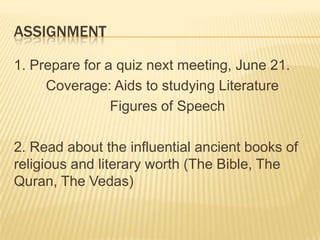
ASSIGNMENT

1. Prepare for a quiz next meeting, June 21.
     Coverage: Aids to studying Literature
                Figures of Speech

2. Read about the influential ancient books of
religious and literary worth (The Bible, The
Quran, The Vedas)

Literary devices

  • 1.
    LITERARY DEVICES Mr. GregorioP. Ebron Jr. Instructor
  • 3.
    FIGURES OF SPEECH a word or phrase which is used for special effect, and which does not have its usual or literal meaning.
  • 4.
    SIMILE -consists of comparingtwo unlike things using the words as or like. Ex. My love is like a red, red rose.
  • 5.
    METAPHOR - -uses a direct comparison of two unlike things or ideas. - -the words as and like are not used Ex. She is phantom of delight.
  • 6.
    PERSONIFICATION -gives human traitsto inanimate objects or ideas. Ex. The wind whistled in my ears. Here rests his head upon the lap of earth A youth to Fortune and to Fame unknown: Fair science frowned not on his humble birth, And Melancholy marked him for her own.
  • 7.
    APOSTROPHE - A direct address to someone absent, dead or inanimate. - Ex. Oh rose! Thou art sick. O, pardon me, thou bleeding piece of earth, That I am meek and gentle with these butchers! Thou art the ruins of the noblest man That ever lived in the tide of times. Woe to the hand that shed this costly blood!
  • 8.
    METONYMY - It substitutea word that closely relates to a person or thing. Ex. The pen is mightier than a sword. Lend me your ear. The power of the crown was mortally weakened. I’m studying Shakespeare.
  • 9.
    I would notgive up freedom for a crown. The captain abandoned the sword.
  • 10.
    HYPERBOLE - Makes use of exaggeration Ex. There is a garden on her face. I am so hungry I could eat a horse. I have a million things to do. I had to walk 15 miles to school in the snow, uphill.
  • 11.
    IRONY - Says the opposite of what is meant - Ex. How nice of you to insult me. - Water, water, every where, And all the boards did shrink ; Water, water, every where, Nor any drop to drink
  • 12.
    ALLUSION refers to any literary, biblical, historical, mythological, scientif ic event, character or place. Ex. 1. Oh, don’t wash your hands and give the kiss of Judas. 2. Be careful when accepting gift packages. They might turn out to be Trojan Horse. 3. Perhaps Poseidon was with them for the sea was so calm when they had the cruise.
  • 13.
    ANTITHESIS involves a contrast or words or ideas. opposition, or contrast of ideas or words in a balanced or parallel construction. Ex. They promised freedom and provided slavery. Not that I loved Caesar less, but that I loved Rome more.
  • 14.
    PARADOX uses a phrase or a statement that on surface seems contradictory that make some kind of emotional sense. Ex. 1. Let us go to war of peace. 2. The war was no bad after all. 3. Parting is such a sweet sorrow. 4. Stone walls do not a prison make, nor iron bar a cage.
  • 15.
    OXYMORON puts together in one statement two contradictory terms. Why, then, O brawling love! O loving hate! O any thing, of nothing first create! O heavy lightness! serious vanity! Mis-shapen chaos of well-seeming forms! Feather of lead, bright smoke, cold fire, sick health! Still-waking sleep, that is not what it is! This love feel I, that feel no love in this.
  • 16.
  • 17.
    ONOMATOPOEIA uses wordshaving a sound that imitates what it denotes. Ex. hiss, bang, buzz, hush, swoosh
  • 18.
    ALLITERATION involves the repetition of initial consonant sound. Ex. Wicked and wan, threatening and throng.
  • 19.
    ASSONANCE uses repetition of vowels without repetition of consonants, also called a vowel rhyme. Ex. Ring and hild, calano and platano.
  • 20.
    CONSONANCE repeats the final consonant sounds also called consonant rhyme Ex. Dreary and weary, odds and ends.
  • 21.
    RHYME employs identical sound from the vowel of the accented syllables to the end. Ex. Hold, told, mold, gold
  • 22.
    ANAPHORA repeats a word or words at the beginning of two or more successive clauses or verses. Ex. Cannon to the right of them/ Cannon to the left of them
  • 23.
    Sonnet 116 Let menot to the marriage of two minds Admit impediments. Love is not love Which alters when it alteration finds, Or bends with the remover to remove: O no! it is an ever fixed mark That looks on tempests and is never shaken; It is the star to every wandering bark Whose worth’s unknown, although his height be taken.
  • 24.
    Love’s not Time’sfool, though rosy lips and cheeks Within his bending sickle’s compass come: Love alters not with his brief hours and weeks, But bears it out even to the edge of doom. If this be error and upon me proved, I never writ, nor no man ever loved.
  • 25.
  • 26.
    ASSIGNMENT 1. Prepare fora quiz next meeting, June 21. Coverage: Aids to studying Literature Figures of Speech 2. Read about the influential ancient books of religious and literary worth (The Bible, The Quran, The Vedas)