Conservation Categories
    VCE Environmental Science
      Unit 3: Area of Study 2
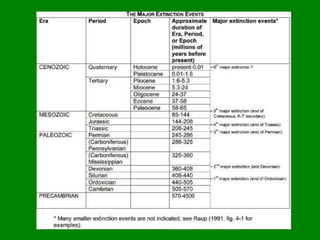
Scientists recognize FIVE episodes of mass extinction during the past 500
million years –

First Mass Extinction: It occurred around 438 million years ago in the
Ordovician Period during which more than 85 % of species on the earth
became extinct.
Second Mass Extinction occurred around 367 million years ago near the end
of the Devonian period when about 82 % of species became extinct.
Third Mass Extinction occurred around 245 million years ago at the end of
the Permian period when about 96 % of species became extinct. The
devastation was so great that Paleontologists use this event to mark the end
of ancient or the Paleozoic Era and the beginning of the middle or the
Mesozoic Era. During this era many new groups of animals and plants
evolved on the earth.
Fourth Mass Extinction occurred around 208 million years ago, near the end
of the Triassic Period during which about 76 percent species had become
extinct from the earth. The populations that had gone extinct during that
period mostly belonged to amphibians and reptiles.
Fifth Mass Extinction occurred around 65 million years ago at
the end of the Cretaceous Period when about 76 % of the
species of the earth including Dinosaurs had gone extinct. It is
supposed that this Mass Extinction occurred when one or
more big meteorite(s) had struck the earth during the
Mesozoic era. This era is also called as the era of reptiles.

Scientists are of the opinion that now the earth is facing the
most severe episode of extinction since the extinction of
dinosaurs. Biologists say that about 27,000 species are
becoming extinct each year, which means: three species per
year. The causes of the current mass extinction or the Sixth
Mass Extinction are changes in the world climate and
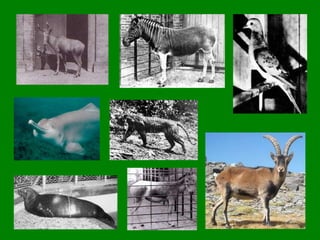
anthropogenic pressures. The penguin-like great auk, the
Passenger Pigeon, the Balinese tiger, the quagga, and the moa
are all victims of the 6th mass extinction.
Conservation Categories
• IUCN - International Union of Conservation of
  Nature - Red List of Threatened species
  http://www.iucnredlist.org/
• National EPBC Act - Environment Protection and
  Biodiversity Conservation Act
  http://www.environment.gov.au/epbc/index.html
• State FFG - Flora and Fauna Guarantee Act
  http://www.dse.vic.gov.au/plants-and-
  animals/native-plants-and-animals/threatened-
  species-and-communities/flora-and-fauna-
  guarantee-act
Conservation Status in Victoria
Extinct (EX)
A taxon is Extinct when there is no reasonable doubt that the last
individual has died. A taxon is presumed Extinct when exhaustive
surveys in known and/or expected habitat, at appropriate times
(diurnal, seasonal, annual), throughout its historic range have failed
to record an individual. Surveys should be over a time frame
appropriate to the taxon’s life cycle and life form.
Regionally Extinct (RX)
As for Extinct but within a defined region (in this case the State of
Victoria) that does not encompass the entire geographic range of
the taxon. A taxon is presumed Regionally Extinct when exhaustive
surveys in known and/or expected habitat, at appropriate times
(diurnal, seasonal, annual), throughout the region have failed to
record an individual. Surveys should be over a time frame
appropriate to the taxon’s life cycle and life form.
Extinct in the Wild (WX)
A taxon is Extinct in the Wild when it is known only to survive in
cultivation, in captivity or as a naturalized population (or
populations) well outside the past range. A taxon is presumed
Extinct in the Wild when exhaustive surveys in known and/or
expected habitat, at appropriate times (diurnal, seasonal, annual),
throughout its historic range have failed to record an individual.
Surveys should be over a time frame appropriate to the taxon’s life
cycle and life form.

Critically Endangered (CR)
A taxon is Critically Endangered when the best available evidence
indicates that it meets any of the criteria A to E for Critically
Endangered (see Species Survival Commission 2001), and it is
therefore mconsidered to be facing an extremely high risk of
extinction in the wild.
Endangered (EN)
A taxon is Endangered when the best available evidence indicates that it
meets any of the criteria A to E for Endangered (see Species Survival
Commission 2001), and it is therefore considered to be facing a very
high risk of extinction in the wild.

Vulnerable (VU)
A taxon is Vulnerable when the best available evidence indicates that it
meets any of the criteria A to E for Vulnerable (see Species Survival
Commission 2001), and it is therefore considered to be facing a high risk of
extinction in the wild.

Near Threatened (NT)
A taxon is Near Threatened when it has been evaluated against the criteria
but does not qualify for Critically Endangered, Endangered or Vulnerable
now, but is close to qualifying for or is likely to qualify for a threatened
category in the near future.
Data Deficient (DD)

A taxon is Data Deficient when there is
inadequate information to make a direct, or
indirect, assessment of its risk of extinction based
on its distribution and/or population status. A
taxon in this category may be well studied, and its
biology well known, but appropriate data on
abundance and/or distribution arelacking. Data
Deficient is therefore not a category of threat.
Listing of taxa in this category indicates that more
information is required and acknowledges the
possibility that future research will show that
threatened classification is appropriate.
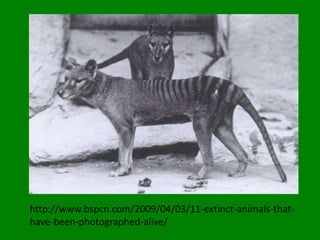
http://www.bspcn.com/2009/04/03/11-extinct-animals-that-
have-been-photographed-alive/
Extinct
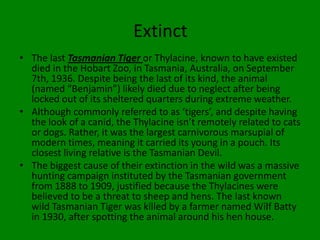
• The last Tasmanian Tiger or Thylacine, known to have existed
  died in the Hobart Zoo, in Tasmania, Australia, on September
  7th, 1936. Despite being the last of its kind, the animal
  (named “Benjamin”) likely died due to neglect after being
  locked out of its sheltered quarters during extreme weather.
• Although commonly referred to as ‘tigers’, and despite having
  the look of a canid, the Thylacine isn’t remotely related to cats
  or dogs. Rather, it was the largest carnivorous marsupial of
  modern times, meaning it carried its young in a pouch. Its
  closest living relative is the Tasmanian Devil.
• The biggest cause of their extinction in the wild was a massive
  hunting campaign instituted by the Tasmanian government
  from 1888 to 1909, justified because the Thylacines were
  believed to be a threat to sheep and hens. The last known
  wild Tasmanian Tiger was killed by a farmer named Wilf Batty
  in 1930, after spotting the animal around his hen house.
Extinct

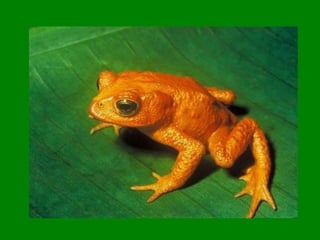
The first recorded account of the Golden Toad was by
herpetologist Jay Savage in 1966, and the last sighting of the
species was made in 1989. The toad, showcased by its brilliant
golden orange colorization, was native to the tropical cloud
forests which surround Monteverde, Costa Rica.
Their extinction symbolizes a large scale decline in amphibian
numbers worldwide over the last several decades, which has
likely been caused by global warming and climate change. In
fact, famed Australian biologist Tim Flannery has described the
extinction of the Golden Toad to be the first demise of a species
due primarily to global warming
EXTINCT (EX)
  “A taxon is Extinct when there is no reasonable
  doubt that the last individual has died. A taxon is
  presumed extinct when exhaustive surveys in
  known and/or expected habitat, at appropriate
  times (diurnal, seasonal, annual), throughout its
  historic range have failed to record an individual.
  Surveys should be over a time frame appropriate
  to the taxon’s life cycles and life form.”
EXTINCT IN THE WILD (EW)
“A taxon is Extinct in the Wild when it is known
only to survive in cultivation, in captivity or as a
naturalised population (or populations) well
outside the past range. A taxon is presumed
Extinct in the Wild when exhaustive surveys in
known and/or expected habitat, at appropriate
times (diurnal, seasonal, annual), throughout its
historic range have failed to record an individual.
Surveys should be over a time frame appropriate
to the taxon's life cycle and life form.”
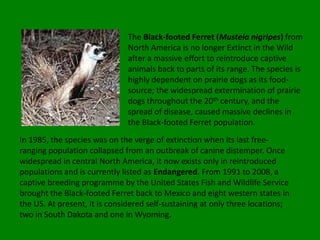
The Black-footed Ferret (Mustela nigripes) from
                              North America is no longer Extinct in the Wild
                              after a massive effort to reintroduce captive
                              animals back to parts of its range. The species is
                              highly dependent on prairie dogs as its food-
                              source; the widespread extermination of prairie
                              dogs throughout the 20th century, and the
                              spread of disease, caused massive declines in
                              the Black-footed Ferret population.
In 1985, the species was on the verge of extinction when its last free-
ranging population collapsed from an outbreak of canine distemper. Once
widespread in central North America, it now exists only in reintroduced
populations and is currently listed as Endangered. From 1991 to 2008, a
captive breeding programme by the United States Fish and Wildlife Service
brought the Black-footed Ferret back to Mexico and eight western states in
the US. At present, it is considered self-sustaining at only three locations;
two in South Dakota and one in Wyoming.
CRITICALLY ENDANGERED (CR)
“A taxon is Critically Endangered when the
best available evidence indicates that it meets
any of the criteria A to E for Critically
Endangered, and it is therefore considered to
be facing an extremely high risk of extinction
in the wild.”
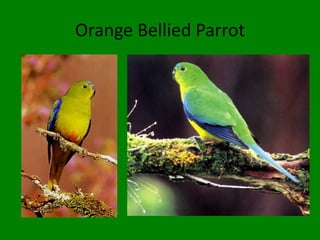
Orange Bellied Parrot
ENDANGERED (EN)
“A taxon is Endangered when the best
available evidence indicates that it meets any
of the criteria A to E for Endangered, and it is
therefore considered to be facing a very high
risk of extinction in the wild.”
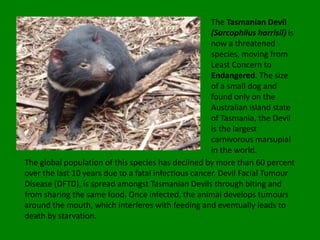
The Tasmanian Devil
                                                      (Sarcophilus harrisii) is
                                                      now a threatened
                                                      species, moving from
                                                      Least Concern to
                                                      Endangered. The size
                                                      of a small dog and
                                                      found only on the
                                                      Australian island state
                                                      of Tasmania, the Devil
                                                      is the largest
                                                      carnivorous marsupial
                                                      in the world.
The global population of this species has declined by more than 60 percent
over the last 10 years due to a fatal infectious cancer. Devil Facial Tumour
Disease (DFTD), is spread amongst Tasmanian Devils through biting and
from sharing the same food. Once infected, the animal develops tumours
around the mouth, which interferes with feeding and eventually leads to
death by starvation.
VULNERABLE (VU)
“A taxon is Vulnerable when the best available
evidence indicates that it meets any of the
criteria A to E for Vulnerable, and it is
therefore considered to be facing a high risk of
extinction in the wild.”
NEAR THREATENED (NT)
“A taxon is Near Threatened when it has been
evaluated against the criteria but does not
qualify for Critically Endangered, Endangered
or Vulnerable now, but is close to qualifying
for or is likely to qualify for a threatened
category in the near future.”
LEAST CONCERN (LC)
“A taxon is Least Concern when it has been
evaluated against the criteria and does not
qualify for Critically
Endangered, Endangered, Vulnerable or Near
Threatened. Widespread and abundant taxa
are included in this category.”

NOT EVALUATED (NE)
“A taxon is Not Evaluated when it is has not
yet been evaluated against the criteria.”
DATA DEFICIENT (DD)
“A taxon is Data Deficient when there is inadequate information
to make a direct, or indirect, assessment of its risk of extinction
based on its distribution and/or population status. A taxon in this
category may be well studied, and its biology well known, but
appropriate data on abundance and/or distribution are lacking.
Data Deficient is therefore not a category of threat. Listing of
taxa in this category indicates that more information is required
and acknowledges the possibility that future research will show
that threatened classification is appropriate. It is important to
make positive use of whatever data are available. In many cases
great care should be exercised in choosing between DD and a
threatened status. If the range of a taxon is suspected to be
relatively circumscribed, if a considerable period of time has
elapsed since the last record of the taxon, threatened status may
well be justified.”
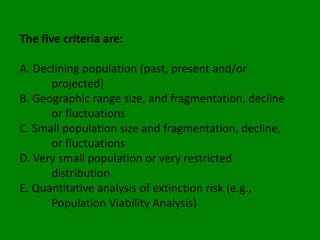
The five criteria are:

A. Declining population (past, present and/or
      projected)
B. Geographic range size, and fragmentation, decline
      or fluctuations
C. Small population size and fragmentation, decline,
      or fluctuations
D. Very small population or very restricted
      distribution
E. Quantitative analysis of extinction risk (e.g.,
      Population Viability Analysis)
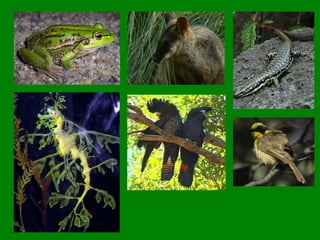
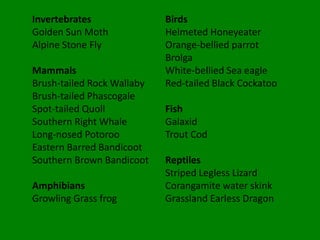
Invertebrates               Birds
Golden Sun Moth             Helmeted Honeyeater
Alpine Stone Fly            Orange-bellied parrot
                            Brolga
Mammals                     White-bellied Sea eagle
Brush-tailed Rock Wallaby   Red-tailed Black Cockatoo
Brush-tailed Phascogale
Spot-tailed Quoll           Fish
Southern Right Whale        Galaxid
Long-nosed Potoroo          Trout Cod
Eastern Barred Bandicoot
Southern Brown Bandicoot    Reptiles
                            Striped Legless Lizard
Amphibians                  Corangamite water skink
Growling Grass frog         Grassland Earless Dragon
References
• http://www.iucnredlist.org/
• http://www.ecosensorium.org/2010/12/mass
  -extinction-of-species-through-ages.html
• http://www.bspcn.com/2009/04/03/11-
  extinct-animals-that-have-been-
  photographed-alive/
• http://evolutionid.wordpress.com/tag/evoluti
  on/

3B.3 Conservation Categories

  • 1.
    Conservation Categories VCE Environmental Science Unit 3: Area of Study 2
  • 3.
    Scientists recognize FIVEepisodes of mass extinction during the past 500 million years – First Mass Extinction: It occurred around 438 million years ago in the Ordovician Period during which more than 85 % of species on the earth became extinct. Second Mass Extinction occurred around 367 million years ago near the end of the Devonian period when about 82 % of species became extinct. Third Mass Extinction occurred around 245 million years ago at the end of the Permian period when about 96 % of species became extinct. The devastation was so great that Paleontologists use this event to mark the end of ancient or the Paleozoic Era and the beginning of the middle or the Mesozoic Era. During this era many new groups of animals and plants evolved on the earth. Fourth Mass Extinction occurred around 208 million years ago, near the end of the Triassic Period during which about 76 percent species had become extinct from the earth. The populations that had gone extinct during that period mostly belonged to amphibians and reptiles.
  • 5.
    Fifth Mass Extinctionoccurred around 65 million years ago at the end of the Cretaceous Period when about 76 % of the species of the earth including Dinosaurs had gone extinct. It is supposed that this Mass Extinction occurred when one or more big meteorite(s) had struck the earth during the Mesozoic era. This era is also called as the era of reptiles. Scientists are of the opinion that now the earth is facing the most severe episode of extinction since the extinction of dinosaurs. Biologists say that about 27,000 species are becoming extinct each year, which means: three species per year. The causes of the current mass extinction or the Sixth Mass Extinction are changes in the world climate and anthropogenic pressures. The penguin-like great auk, the Passenger Pigeon, the Balinese tiger, the quagga, and the moa are all victims of the 6th mass extinction.
  • 6.
    Conservation Categories • IUCN- International Union of Conservation of Nature - Red List of Threatened species http://www.iucnredlist.org/ • National EPBC Act - Environment Protection and Biodiversity Conservation Act http://www.environment.gov.au/epbc/index.html • State FFG - Flora and Fauna Guarantee Act http://www.dse.vic.gov.au/plants-and- animals/native-plants-and-animals/threatened- species-and-communities/flora-and-fauna- guarantee-act
  • 7.
    Conservation Status inVictoria Extinct (EX) A taxon is Extinct when there is no reasonable doubt that the last individual has died. A taxon is presumed Extinct when exhaustive surveys in known and/or expected habitat, at appropriate times (diurnal, seasonal, annual), throughout its historic range have failed to record an individual. Surveys should be over a time frame appropriate to the taxon’s life cycle and life form. Regionally Extinct (RX) As for Extinct but within a defined region (in this case the State of Victoria) that does not encompass the entire geographic range of the taxon. A taxon is presumed Regionally Extinct when exhaustive surveys in known and/or expected habitat, at appropriate times (diurnal, seasonal, annual), throughout the region have failed to record an individual. Surveys should be over a time frame appropriate to the taxon’s life cycle and life form.
  • 8.
    Extinct in theWild (WX) A taxon is Extinct in the Wild when it is known only to survive in cultivation, in captivity or as a naturalized population (or populations) well outside the past range. A taxon is presumed Extinct in the Wild when exhaustive surveys in known and/or expected habitat, at appropriate times (diurnal, seasonal, annual), throughout its historic range have failed to record an individual. Surveys should be over a time frame appropriate to the taxon’s life cycle and life form. Critically Endangered (CR) A taxon is Critically Endangered when the best available evidence indicates that it meets any of the criteria A to E for Critically Endangered (see Species Survival Commission 2001), and it is therefore mconsidered to be facing an extremely high risk of extinction in the wild.
  • 9.
    Endangered (EN) A taxonis Endangered when the best available evidence indicates that it meets any of the criteria A to E for Endangered (see Species Survival Commission 2001), and it is therefore considered to be facing a very high risk of extinction in the wild. Vulnerable (VU) A taxon is Vulnerable when the best available evidence indicates that it meets any of the criteria A to E for Vulnerable (see Species Survival Commission 2001), and it is therefore considered to be facing a high risk of extinction in the wild. Near Threatened (NT) A taxon is Near Threatened when it has been evaluated against the criteria but does not qualify for Critically Endangered, Endangered or Vulnerable now, but is close to qualifying for or is likely to qualify for a threatened category in the near future.
  • 10.
    Data Deficient (DD) Ataxon is Data Deficient when there is inadequate information to make a direct, or indirect, assessment of its risk of extinction based on its distribution and/or population status. A taxon in this category may be well studied, and its biology well known, but appropriate data on abundance and/or distribution arelacking. Data Deficient is therefore not a category of threat. Listing of taxa in this category indicates that more information is required and acknowledges the possibility that future research will show that threatened classification is appropriate.
  • 11.
  • 12.
    Extinct • The lastTasmanian Tiger or Thylacine, known to have existed died in the Hobart Zoo, in Tasmania, Australia, on September 7th, 1936. Despite being the last of its kind, the animal (named “Benjamin”) likely died due to neglect after being locked out of its sheltered quarters during extreme weather. • Although commonly referred to as ‘tigers’, and despite having the look of a canid, the Thylacine isn’t remotely related to cats or dogs. Rather, it was the largest carnivorous marsupial of modern times, meaning it carried its young in a pouch. Its closest living relative is the Tasmanian Devil. • The biggest cause of their extinction in the wild was a massive hunting campaign instituted by the Tasmanian government from 1888 to 1909, justified because the Thylacines were believed to be a threat to sheep and hens. The last known wild Tasmanian Tiger was killed by a farmer named Wilf Batty in 1930, after spotting the animal around his hen house.
  • 14.
    Extinct The first recordedaccount of the Golden Toad was by herpetologist Jay Savage in 1966, and the last sighting of the species was made in 1989. The toad, showcased by its brilliant golden orange colorization, was native to the tropical cloud forests which surround Monteverde, Costa Rica. Their extinction symbolizes a large scale decline in amphibian numbers worldwide over the last several decades, which has likely been caused by global warming and climate change. In fact, famed Australian biologist Tim Flannery has described the extinction of the Golden Toad to be the first demise of a species due primarily to global warming
  • 15.
    EXTINCT (EX) “A taxon is Extinct when there is no reasonable doubt that the last individual has died. A taxon is presumed extinct when exhaustive surveys in known and/or expected habitat, at appropriate times (diurnal, seasonal, annual), throughout its historic range have failed to record an individual. Surveys should be over a time frame appropriate to the taxon’s life cycles and life form.”
  • 17.
    EXTINCT IN THEWILD (EW) “A taxon is Extinct in the Wild when it is known only to survive in cultivation, in captivity or as a naturalised population (or populations) well outside the past range. A taxon is presumed Extinct in the Wild when exhaustive surveys in known and/or expected habitat, at appropriate times (diurnal, seasonal, annual), throughout its historic range have failed to record an individual. Surveys should be over a time frame appropriate to the taxon's life cycle and life form.”
  • 18.
    The Black-footed Ferret(Mustela nigripes) from North America is no longer Extinct in the Wild after a massive effort to reintroduce captive animals back to parts of its range. The species is highly dependent on prairie dogs as its food- source; the widespread extermination of prairie dogs throughout the 20th century, and the spread of disease, caused massive declines in the Black-footed Ferret population. In 1985, the species was on the verge of extinction when its last free- ranging population collapsed from an outbreak of canine distemper. Once widespread in central North America, it now exists only in reintroduced populations and is currently listed as Endangered. From 1991 to 2008, a captive breeding programme by the United States Fish and Wildlife Service brought the Black-footed Ferret back to Mexico and eight western states in the US. At present, it is considered self-sustaining at only three locations; two in South Dakota and one in Wyoming.
  • 19.
    CRITICALLY ENDANGERED (CR) “Ataxon is Critically Endangered when the best available evidence indicates that it meets any of the criteria A to E for Critically Endangered, and it is therefore considered to be facing an extremely high risk of extinction in the wild.”
  • 20.
  • 21.
    ENDANGERED (EN) “A taxonis Endangered when the best available evidence indicates that it meets any of the criteria A to E for Endangered, and it is therefore considered to be facing a very high risk of extinction in the wild.”
  • 22.
    The Tasmanian Devil (Sarcophilus harrisii) is now a threatened species, moving from Least Concern to Endangered. The size of a small dog and found only on the Australian island state of Tasmania, the Devil is the largest carnivorous marsupial in the world. The global population of this species has declined by more than 60 percent over the last 10 years due to a fatal infectious cancer. Devil Facial Tumour Disease (DFTD), is spread amongst Tasmanian Devils through biting and from sharing the same food. Once infected, the animal develops tumours around the mouth, which interferes with feeding and eventually leads to death by starvation.
  • 23.
    VULNERABLE (VU) “A taxonis Vulnerable when the best available evidence indicates that it meets any of the criteria A to E for Vulnerable, and it is therefore considered to be facing a high risk of extinction in the wild.”
  • 25.
    NEAR THREATENED (NT) “Ataxon is Near Threatened when it has been evaluated against the criteria but does not qualify for Critically Endangered, Endangered or Vulnerable now, but is close to qualifying for or is likely to qualify for a threatened category in the near future.”
  • 26.
    LEAST CONCERN (LC) “Ataxon is Least Concern when it has been evaluated against the criteria and does not qualify for Critically Endangered, Endangered, Vulnerable or Near Threatened. Widespread and abundant taxa are included in this category.” NOT EVALUATED (NE) “A taxon is Not Evaluated when it is has not yet been evaluated against the criteria.”
  • 27.
    DATA DEFICIENT (DD) “Ataxon is Data Deficient when there is inadequate information to make a direct, or indirect, assessment of its risk of extinction based on its distribution and/or population status. A taxon in this category may be well studied, and its biology well known, but appropriate data on abundance and/or distribution are lacking. Data Deficient is therefore not a category of threat. Listing of taxa in this category indicates that more information is required and acknowledges the possibility that future research will show that threatened classification is appropriate. It is important to make positive use of whatever data are available. In many cases great care should be exercised in choosing between DD and a threatened status. If the range of a taxon is suspected to be relatively circumscribed, if a considerable period of time has elapsed since the last record of the taxon, threatened status may well be justified.”
  • 28.
    The five criteriaare: A. Declining population (past, present and/or projected) B. Geographic range size, and fragmentation, decline or fluctuations C. Small population size and fragmentation, decline, or fluctuations D. Very small population or very restricted distribution E. Quantitative analysis of extinction risk (e.g., Population Viability Analysis)
  • 29.
    Invertebrates Birds Golden Sun Moth Helmeted Honeyeater Alpine Stone Fly Orange-bellied parrot Brolga Mammals White-bellied Sea eagle Brush-tailed Rock Wallaby Red-tailed Black Cockatoo Brush-tailed Phascogale Spot-tailed Quoll Fish Southern Right Whale Galaxid Long-nosed Potoroo Trout Cod Eastern Barred Bandicoot Southern Brown Bandicoot Reptiles Striped Legless Lizard Amphibians Corangamite water skink Growling Grass frog Grassland Earless Dragon
  • 30.
    References • http://www.iucnredlist.org/ • http://www.ecosensorium.org/2010/12/mass -extinction-of-species-through-ages.html • http://www.bspcn.com/2009/04/03/11- extinct-animals-that-have-been- photographed-alive/ • http://evolutionid.wordpress.com/tag/evoluti on/

Editor's Notes

  • #17 http://www.bspcn.com/2009/04/03/11-extinct-animals-that-have-been-photographed-alive/