ITIL® Service Strategy
ITIL® is a registered trade mark of AXELOS Limited, used under permission of AXELOS Limited. All rights reserved.
The Swirl logo™ is a trade mark of AXELOS Limited, used under permission of AXELOS Limited. All rights reserved.
Course Name : ITIL Service Strategy
Version : INVL_ITILSS_CW_01_1.2
Course ID :ITSM - 111
2
About Invensis Learning
Invensis Learning is a pioneer in providing globally-recognized certification training courses for
individuals and enterprises worldwide. Our training methodology coupled with high-quality courseware
has enabled organizations to achieve high-impact learning with increased knowledge, competence, and
performance. We offer courses in various categories such as IT Service Management, Project
Management, IT Security and Governance, Quality Management, Agile Project Management, DevOps,
and Cloud Courses. Invensis Learning certification training programs adhere to global standards such as
PMI, TUV SUD, AXELOS, ISACA, DevOps Institute, and PEOPLECERT.
Chapter 1
Introduction to Service Strategy
4
Service Strategy - Introduction
Learning Objectives
This qualification provides a complete overview of service strategy including all its related activities: how
to design, develop, and implement service management not only as an organizational capability but also
as a strategic asset. Candidates can expect to gain competencies in the following upon successful
completion of the education and examination components related to this certification:
 Introduction to service strategy
 Service strategy principles
 Service strategy processes
 Governance
 Organizing for service strategy
 Technology considerations
 Implementing service strategy
 Challenges, critical success factors and risks
5
Service Strategy - Introduction
Processes
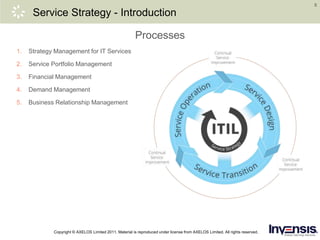
1. Strategy Management for IT Services
2. Service Portfolio Management
3. Financial Management
4. Demand Management
5. Business Relationship Management
Copyright © AXELOS Limited 2011. Material is reproduced under license from AXELOS Limited. All rights reserved.
6
Service Strategy - Introduction
Purpose
 Transform Service Management into a strategic asset and to then think and act in a strategic
manner
 Helps clarify the relationships between various services, systems or processes and the business
models, strategies or objectives they support
 Build Service Management as an organizational capability and as a strategic asset
 Establish the direction and guiding principles for Service Management activities across ITIL
Service lifecycle by setting goals, policies, guidelines, and processes and measures of performance
7
Service Strategy - Introduction
Objectives
 Define service quality for the organization.
 Identify services and target customers
 Create and capture value for customers and differentiate from competitors
 Strategic decision making and make a case for strategic investments by using financial
management to provide visibility and control over value-creation
 Efficient allocation of resources across a portfolio of services and resolve conflicting demands for
shared resources
8
Service Strategy - Introduction
Scope
Two aspects of strategy are covered in ITIL Service Strategy:
 Defining a strategy whereby a service provider will deliver services to meet a customer’s business
outcomes.
 Defining a strategy for how to manage those services.
9
Service Strategy - Introduction
Value to Business
 Provides guidance on how to design, and put in place service management as a strategic asset
 Support the ability to link activities performed by the service provider to outcomes that are critical to
internal or external customers
 Enable the service provider to have a clear understanding of what types and levels of service will
make its customers successful and then organize itself optimally to deliver and support those
services
 Enable the service provider to respond quickly and effectively to changes in the business
environment, ensuring increased competitive advantage over time
 Provide the means for the service provider to organize itself so that it can provide services in an
efficient and effective manner
10
Service Strategy - Introduction
Context of Service Strategy in relation to Service Design
Service design is the stage in the lifecycle that turns a service strategy into a plan for delivering the
business objectives
 Provides guidance for the design and development of services and service management practices.
 Guides organizations on how to develop design capabilities for service management
11
Service Strategy - Introduction
Context of Service Strategy in relation to Service Transition
Ensures that the value(s) identified in the service strategy, and encoded in service design, are effectively
transitioned so that they can be realized in service operation.
 Provides guidance for the development and improvement of capabilities for introducing new and
changed services into supported environments.
 Describes best practices in transition across all the processes in Transition.
 Introduces the service knowledge management system, which can support organizational learning
and help to improve the overall efficiency and effectiveness of all stages of the service lifecycle.
12
Service Strategy - Introduction
Context of Service Strategy in relation to Service Operation
 Service Operation describes best practice for managing services in supported environments.
 Guidance on achieving effectiveness and efficiency in the delivery and support of services to
ensure value for the customer, the users and the service provider.
 Provides guidance on how to maintain stability in service operation, allowing for changes in design,
scale, scope and service levels.
 Organizations are provided with detailed process guidelines, methods and tools for use in two
major control perspectives: reactive and proactive.
 Describes best practices in transition across all the processes in Service Operations
13
Service Strategy - Introduction
Context of Service Strategy in relation to Continual Service Improvement
 Provides guidance on creating and maintaining value for customers through better strategy, design,
transition and operation of services.
 Combines principles, practices and methods from quality management, change management and
capability improvement.
 Describes best practice for achieving incremental and large-scale improvements in service quality,
operational efficiency and business continuity, and for ensuring that the service portfolio continues to
be aligned to business needs.
 Guidance is provided for linking improvement efforts and outcomes with service strategy, design,
transition and operation.
Service Strategy Principles (SSP)
15
Service Strategy Principles
Fundamental aspects of Service Strategy
Basic approach of deciding a strategy
Carl von Clausewitz remarked, ‘Everything in strategy is very simple, but that does not mean that
everything is very easy’. Basic approach of deciding a strategy are…
 Acknowledge your competitors.
 Identify differentiators.
 Understanding trade-offs involved in its Strategic choices.
16
Service Strategy Principles
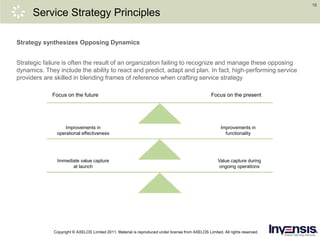
Strategy synthesizes Opposing Dynamics
Strategic failure is often the result of an organization failing to recognize and manage these opposing
dynamics. They include the ability to react and predict, adapt and plan. In fact, high-performing service
providers are skilled in blending frames of reference when crafting service strategy
Focus on the future
Improvements in
operational effectiveness
Immediate value capture
at launch
Focus on the present
Improvements in
functionality
Value capture during
ongoing operations
Copyright © AXELOS Limited 2011. Material is reproduced under license from AXELOS Limited. All rights reserved.
17
Service Strategy Principles
Fundamental aspects of Service Strategy
Outperforming Competitors
A high-performance service strategy, is one that enables a service provider to consistently outperform
competing alternatives over time, across business cycles, industry disruptions and changes in
leadership. It comprises both the ability to succeed today and positioning for the future by….
 Service Provider meeting business outcomes subject to constraints
 Trade-offs involved in strategic choices
 Superior performance versus competing alternatives
18
Service Strategy Principles
Fundamental aspects of Service Strategy
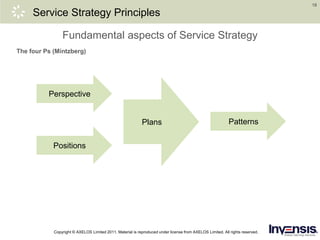
The four Ps (Mintzberg)
Perspective
Positions
Plans Patterns
Copyright © AXELOS Limited 2011. Material is reproduced under license from AXELOS Limited. All rights reserved.
19
Service Strategy Principles
Fundamental aspects of Service Strategy
Service
A service is a means of delivering value to
customers by facilitating outcomes
customers want to achieve without the
ownership of specific costs and risks.
Copyright © AXELOS Limited 2011. Material is reproduced under license from AXELOS Limited. All rights reserved.
20
Service Strategy Principles
Service-Outcomes
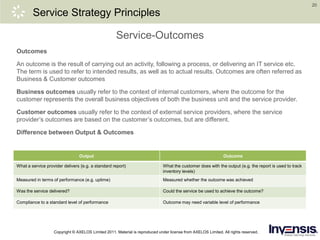
Outcomes
An outcome is the result of carrying out an activity, following a process, or delivering an IT service etc.
The term is used to refer to intended results, as well as to actual results. Outcomes are often referred as
Business & Customer outcomes
Business outcomes usually refer to the context of internal customers, where the outcome for the
customer represents the overall business objectives of both the business unit and the service provider.
Customer outcomes usually refer to the context of external service providers, where the service
provider’s outcomes are based on the customer’s outcomes, but are different.
Difference between Output & Outcomes
Output Outcome
What a service provider delivers {e.g. a standard report) What the customer does with the output (e.g. the report is used to track
inventory levels)
Measured in terms of performance (e.g. uptime) Measured whether the outcome was achieved
Was the service delivered? Could the service be used to achieve the outcome?
Compliance to a standard level of performance Outcome may need variable level of performance
Copyright © AXELOS Limited 2011. Material is reproduced under license from AXELOS Limited. All rights reserved.
21
Service Strategy Principles
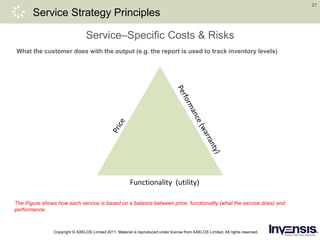
Service–Specific Costs & Risks
What the customer does with the output (e.g. the report is used to track inventory levels)
The Figure shows how each service is based on a balance between price, functionality (what the service does) and
performance.
Functionality (utility)
Copyright © AXELOS Limited 2011. Material is reproduced under license from AXELOS Limited. All rights reserved.
22
Service Strategy Principles
Fundamental aspects of Service Strategy
Value (Characteristics)
 Value is defined by customers
 Affordable mix of features
 Achievement of objectives
 Value changes over time and circumstance
Service contribute value to an organization only when their value is perceived to be higher than the cost
of obtaining the service. IT requires three pieces of information. They are…
1. What service(s) did IT provide?
2. What did the service(s) achieve?
3. How much did the service(s) cost – or what is the price of the service(s)?
23
Service Strategy Principles
Fundamental aspects of Service Strategy
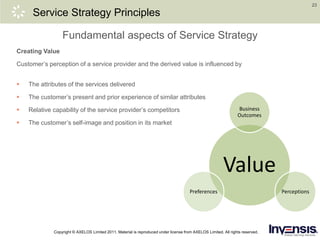
Creating Value
Customer’s perception of a service provider and the derived value is influenced by
 The attributes of the services delivered
 The customer’s present and prior experience of similar attributes
 Relative capability of the service provider’s competitors
 The customer’s self-image and position in its market
Value
Business
Outcomes
PerceptionsPreferences
Copyright © AXELOS Limited 2011. Material is reproduced under license from AXELOS Limited. All rights reserved.
24
Service Strategy Principles
Fundamental aspects of Service Strategy
Economic value of a service
Economic value of Service
Based on DIY Strategy
or existing arrangements
Gains from utilizing the
service
+ diff - diff
Net
difference
Losses from utilizing
the Service
Reference value
Copyright © AXELOS Limited 2011. Material is reproduced under license from AXELOS Limited. All rights reserved.
25
Service Strategy Principles
Fundamental aspects of Service Strategy
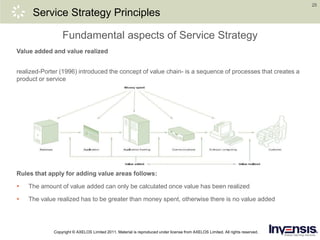
Value added and value realized
realized-Porter (1996) introduced the concept of value chain- is a sequence of processes that creates a
product or service
Rules that apply for adding value areas follows:
 The amount of value added can only be calculated once value has been realized
 The value realized has to be greater than money spent, otherwise there is no value added
Copyright © AXELOS Limited 2011. Material is reproduced under license from AXELOS Limited. All rights reserved.
26
Service Strategy Principles
Just as there are internal and external customers,
there are internal and external services. Internal
services are delivered between departments or
business units in the same organization. External
services are delivered to external customers.
The figure shows which of these services add or
realize value, and which are classified as ‘money
spent’.
Linking ‘value added’ to ‘value realized’
Copyright © AXELOS Limited 2011. Material is reproduced under license from AXELOS Limited. All rights reserved.
27
Service Strategy Principles
Value Capture
 Value capture is an important notion for all types of service providers, internal and external.
 It is the ability of a service provider to retain a portion of the value that has been created and
realized.
 Good business sense discourages stakeholders from making major investments in any
organizational capability unless it demonstrates value capture.
 Internal providers are encouraged to adopt this strategic perspective to continue as viable concerns
within a business.
 Cost recovery is necessary but not sufficient. Profits or surpluses allow continued investments in
service assets that have a direct impact on capabilities.
 Linking value creation to value capture is a difficult but worthwhile endeavor.
Fundamental aspects of Service Strategy
28
Service Strategy Principles
Utility and Warranty
Fundamental aspects of Service Strategy
UTILITY
WARRANTY
T/F
T/F
T/F
Fit for purpose?
Fit for use?
OR
AND
Performance supported?
Constraints removed?
Available enough?
Capacity enough?
Continuous enough?
Secure enough?
T: True
F: False
Value-createdAND
Increase Gains
Prevent loss
Copyright © AXELOS Limited 2011. Material is reproduced under license from AXELOS Limited. All rights reserved.
29
Service Strategy Principles
Effect of improved Utility of a service
Improving the utility of a service has the effect of increasing the functionality of a service or what it does
for the customer, thus increasing the type and range of outcomes that can be achieved.
Effect of improved warranty on a service
The effect of improving warranty of a service means that the service will continue to do the same things,
but more reliably. Therefore there is a higher probability that the desired outcomes will be achieved,
along with a decreased risk that the customer will suffer losses due to variations in service performance.
Improved warranty also results in an increase in the number of times a task can be performed within an
acceptable level of cost, time and activity.
Fundamental aspects of Service Strategy
Copyright © AXELOS Limited 2011. Material is reproduced under license from AXELOS Limited. All rights reserved.
30
Service Strategy Principles
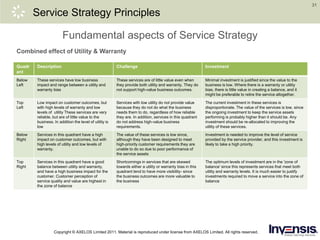
Combined effect of Utility & Warranty
Fundamental aspects of Service Strategy
Copyright © AXELOS Limited 2011. Material is reproduced under license from AXELOS Limited. All rights reserved.
31
Service Strategy Principles
Combined effect of Utility & Warranty
Fundamental aspects of Service Strategy
Quadr
ant
Description Challenge Investment
Below
Left
These services have low business
impact and range between a utility and
warranty bias
These services are of little value even when
they provide both utility and warranty. They do
not support high-value business outcomes.
Minimal investment is justified since the value to the
business is low. Where there is a warranty or utility
bias, there is little value in creating a balance, and it
might be preferable to retire the service altogether.
Top
Left
Low impact on customer outcomes, but
with high levels of warranty and low
levels of utility These services are very
reliable, but are of little value to the
business. In addition the level of utility is
low
Services with low utility do not provide value
because they do not do what the business
needs them to do, regardless of how reliable
they are. In addition, services in this quadrant
do not address high-value business
requirements.
The current investment in these services is
disproportionate. The value of the services is low, since
the ongoing investment to keep the service assets
performing is probably higher than it should be. Any
investment should be re-allocated to improving the
utility of these services.
Below
Right
Services in this quadrant have a high
impact on customer outcomes, but with
high levels of utility and low levels of
warranty.
The value of these services is low since,
although they have been designed to meet
high-priority customer requirements they are
unable to do so due to poor performance of
the service assets
Investment is needed to improve the level of service
provided by the service provider, and this investment is
likely to take a high priority.
Top
Right
Services in this quadrant have a good
balance between utility and warranty,
and have a high business impact for the
customer. Customer perception of
service quality and value are highest in
the zone of balance
Shortcomings in services that are skewed
towards either a utility or warranty bias in this
quadrant tend to have more visibility- since
the business outcomes are more valuable to
the business
The optimum levels of investment are in the 'zone of
balance' since this represents services that meet both
utility and warranty levels. It is much easier to justify
investments required to move a service into the zone of
balance
Copyright © AXELOS Limited 2011. Material is reproduced under license from AXELOS Limited. All rights reserved.
32
Service Strategy Principles
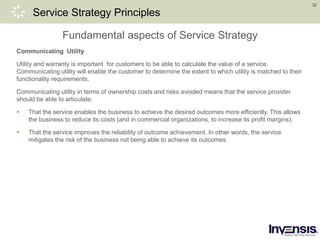
Communicating Utility
Utility and warranty is important for customers to be able to calculate the value of a service.
Communicating utility will enable the customer to determine the extent to which utility is matched to their
functionality requirements.
Communicating utility in terms of ownership costs and risks avoided means that the service provider
should be able to articulate:
 That the service enables the business to achieve the desired outcomes more efficiently. This allows
the business to reduce its costs (and in commercial organizations, to increase its profit margins).
 That the service improves the reliability of outcome achievement. In other words, the service
mitigates the risk of the business not being able to achieve its outcomes.
Fundamental aspects of Service Strategy
33
Service Strategy Principles
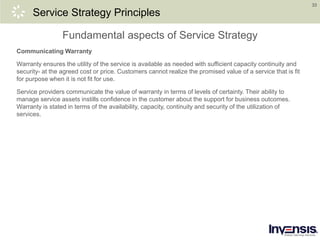
Communicating Warranty
Warranty ensures the utility of the service is available as needed with sufficient capacity continuity and
security- at the agreed cost or price. Customers cannot realize the promised value of a service that is fit
for purpose when it is not fit for use.
Service providers communicate the value of warranty in terms of levels of certainty. Their ability to
manage service assets instills confidence in the customer about the support for business outcomes.
Warranty is stated in terms of the availability, capacity, continuity and security of the utilization of
services.
Fundamental aspects of Service Strategy
34
Service Strategy Principles
Communicating Combined effect of Utility & Warranty
The ability to deliver a certain level of warranty to customers by itself is a basis of competitive advantage
for service providers. This is particularly true where services are commoditized or standardized. In such
cases, it is hard to differentiate value largely in terms of utility for customers. When customers have a
choice between service providers whose services provide more or less the same utility but different
levels of warranty, then they prefer the greater certainty in the support of business outcomes, provided it
is offered at a competitive price and by a service provider with a reputation for being able to deliver what
is promised.
Fundamental aspects of Service Strategy
35
Service Strategy Principles
Customer Assets, Service Assets & Strategic Assets
Asset, Resource & Capabilities
 Capabilities are developed over a period of time
 Distinctive capabilities is enhanced by breadth and depth of experience gained in
 Solving problems
 Handling situations
 Managing risks
 Analyzing failures
‘A basic code of good business behaviour is a bit like oxygen: We take an interest in its presence only
when it is absent.’ Amartya Sen, Nobel Laureate in Economics
Fundamental aspects of Service Strategy
36
Service Strategy Principles
Business Units & Service Providers
Fundamental aspects of Service Strategy
Fig 1 Fig 2
Copyright © AXELOS Limited 2011. Material is reproduced under license from AXELOS Limited. All rights reserved.

37
To know more about our ITIL Service Strategy
Certification Training, please visit
www.invensislearning.com
38
CONTACT INVENSIS LEARNING
Email Us:
© Copyright 2018 Invensis Learning. Invensis®
is a registered trademark of Invensis Technologies Pvt Ltd.
ITIL® is a registered trade mark of AXELOS Limited, used under permission of AXELOS Limited. All rights reserved.
The Swirl logo™ is a trade mark of AXELOS Limited, used under permission of AXELOS Limited. All rights reserved.
www.invensislearning.com
support@invensislearning.com
USA +1-910-726-3695 | IND +91-96-2020-0784
UK +44 2033-223-280 | Germany +49 2119-5987-989
Switzerland +41-22-518-2042 | Hong Kong +852-5803-9039

ITIL Intermediate Service Strategy Course Preview

  • 1.
    ITIL® Service Strategy ITIL®is a registered trade mark of AXELOS Limited, used under permission of AXELOS Limited. All rights reserved. The Swirl logo™ is a trade mark of AXELOS Limited, used under permission of AXELOS Limited. All rights reserved. Course Name : ITIL Service Strategy Version : INVL_ITILSS_CW_01_1.2 Course ID :ITSM - 111
  • 2.
    2 About Invensis Learning InvensisLearning is a pioneer in providing globally-recognized certification training courses for individuals and enterprises worldwide. Our training methodology coupled with high-quality courseware has enabled organizations to achieve high-impact learning with increased knowledge, competence, and performance. We offer courses in various categories such as IT Service Management, Project Management, IT Security and Governance, Quality Management, Agile Project Management, DevOps, and Cloud Courses. Invensis Learning certification training programs adhere to global standards such as PMI, TUV SUD, AXELOS, ISACA, DevOps Institute, and PEOPLECERT.
  • 3.
    Chapter 1 Introduction toService Strategy
  • 4.
    4 Service Strategy -Introduction Learning Objectives This qualification provides a complete overview of service strategy including all its related activities: how to design, develop, and implement service management not only as an organizational capability but also as a strategic asset. Candidates can expect to gain competencies in the following upon successful completion of the education and examination components related to this certification:  Introduction to service strategy  Service strategy principles  Service strategy processes  Governance  Organizing for service strategy  Technology considerations  Implementing service strategy  Challenges, critical success factors and risks
  • 5.
    5 Service Strategy -Introduction Processes 1. Strategy Management for IT Services 2. Service Portfolio Management 3. Financial Management 4. Demand Management 5. Business Relationship Management Copyright © AXELOS Limited 2011. Material is reproduced under license from AXELOS Limited. All rights reserved.
  • 6.
    6 Service Strategy -Introduction Purpose  Transform Service Management into a strategic asset and to then think and act in a strategic manner  Helps clarify the relationships between various services, systems or processes and the business models, strategies or objectives they support  Build Service Management as an organizational capability and as a strategic asset  Establish the direction and guiding principles for Service Management activities across ITIL Service lifecycle by setting goals, policies, guidelines, and processes and measures of performance
  • 7.
    7 Service Strategy -Introduction Objectives  Define service quality for the organization.  Identify services and target customers  Create and capture value for customers and differentiate from competitors  Strategic decision making and make a case for strategic investments by using financial management to provide visibility and control over value-creation  Efficient allocation of resources across a portfolio of services and resolve conflicting demands for shared resources
  • 8.
    8 Service Strategy -Introduction Scope Two aspects of strategy are covered in ITIL Service Strategy:  Defining a strategy whereby a service provider will deliver services to meet a customer’s business outcomes.  Defining a strategy for how to manage those services.
  • 9.
    9 Service Strategy -Introduction Value to Business  Provides guidance on how to design, and put in place service management as a strategic asset  Support the ability to link activities performed by the service provider to outcomes that are critical to internal or external customers  Enable the service provider to have a clear understanding of what types and levels of service will make its customers successful and then organize itself optimally to deliver and support those services  Enable the service provider to respond quickly and effectively to changes in the business environment, ensuring increased competitive advantage over time  Provide the means for the service provider to organize itself so that it can provide services in an efficient and effective manner
  • 10.
    10 Service Strategy -Introduction Context of Service Strategy in relation to Service Design Service design is the stage in the lifecycle that turns a service strategy into a plan for delivering the business objectives  Provides guidance for the design and development of services and service management practices.  Guides organizations on how to develop design capabilities for service management
  • 11.
    11 Service Strategy -Introduction Context of Service Strategy in relation to Service Transition Ensures that the value(s) identified in the service strategy, and encoded in service design, are effectively transitioned so that they can be realized in service operation.  Provides guidance for the development and improvement of capabilities for introducing new and changed services into supported environments.  Describes best practices in transition across all the processes in Transition.  Introduces the service knowledge management system, which can support organizational learning and help to improve the overall efficiency and effectiveness of all stages of the service lifecycle.
  • 12.
    12 Service Strategy -Introduction Context of Service Strategy in relation to Service Operation  Service Operation describes best practice for managing services in supported environments.  Guidance on achieving effectiveness and efficiency in the delivery and support of services to ensure value for the customer, the users and the service provider.  Provides guidance on how to maintain stability in service operation, allowing for changes in design, scale, scope and service levels.  Organizations are provided with detailed process guidelines, methods and tools for use in two major control perspectives: reactive and proactive.  Describes best practices in transition across all the processes in Service Operations
  • 13.
    13 Service Strategy -Introduction Context of Service Strategy in relation to Continual Service Improvement  Provides guidance on creating and maintaining value for customers through better strategy, design, transition and operation of services.  Combines principles, practices and methods from quality management, change management and capability improvement.  Describes best practice for achieving incremental and large-scale improvements in service quality, operational efficiency and business continuity, and for ensuring that the service portfolio continues to be aligned to business needs.  Guidance is provided for linking improvement efforts and outcomes with service strategy, design, transition and operation.
  • 14.
  • 15.
    15 Service Strategy Principles Fundamentalaspects of Service Strategy Basic approach of deciding a strategy Carl von Clausewitz remarked, ‘Everything in strategy is very simple, but that does not mean that everything is very easy’. Basic approach of deciding a strategy are…  Acknowledge your competitors.  Identify differentiators.  Understanding trade-offs involved in its Strategic choices.
  • 16.
    16 Service Strategy Principles Strategysynthesizes Opposing Dynamics Strategic failure is often the result of an organization failing to recognize and manage these opposing dynamics. They include the ability to react and predict, adapt and plan. In fact, high-performing service providers are skilled in blending frames of reference when crafting service strategy Focus on the future Improvements in operational effectiveness Immediate value capture at launch Focus on the present Improvements in functionality Value capture during ongoing operations Copyright © AXELOS Limited 2011. Material is reproduced under license from AXELOS Limited. All rights reserved.
  • 17.
    17 Service Strategy Principles Fundamentalaspects of Service Strategy Outperforming Competitors A high-performance service strategy, is one that enables a service provider to consistently outperform competing alternatives over time, across business cycles, industry disruptions and changes in leadership. It comprises both the ability to succeed today and positioning for the future by….  Service Provider meeting business outcomes subject to constraints  Trade-offs involved in strategic choices  Superior performance versus competing alternatives
  • 18.
    18 Service Strategy Principles Fundamentalaspects of Service Strategy The four Ps (Mintzberg) Perspective Positions Plans Patterns Copyright © AXELOS Limited 2011. Material is reproduced under license from AXELOS Limited. All rights reserved.
  • 19.
    19 Service Strategy Principles Fundamentalaspects of Service Strategy Service A service is a means of delivering value to customers by facilitating outcomes customers want to achieve without the ownership of specific costs and risks. Copyright © AXELOS Limited 2011. Material is reproduced under license from AXELOS Limited. All rights reserved.
  • 20.
    20 Service Strategy Principles Service-Outcomes Outcomes Anoutcome is the result of carrying out an activity, following a process, or delivering an IT service etc. The term is used to refer to intended results, as well as to actual results. Outcomes are often referred as Business & Customer outcomes Business outcomes usually refer to the context of internal customers, where the outcome for the customer represents the overall business objectives of both the business unit and the service provider. Customer outcomes usually refer to the context of external service providers, where the service provider’s outcomes are based on the customer’s outcomes, but are different. Difference between Output & Outcomes Output Outcome What a service provider delivers {e.g. a standard report) What the customer does with the output (e.g. the report is used to track inventory levels) Measured in terms of performance (e.g. uptime) Measured whether the outcome was achieved Was the service delivered? Could the service be used to achieve the outcome? Compliance to a standard level of performance Outcome may need variable level of performance Copyright © AXELOS Limited 2011. Material is reproduced under license from AXELOS Limited. All rights reserved.
  • 21.
    21 Service Strategy Principles Service–SpecificCosts & Risks What the customer does with the output (e.g. the report is used to track inventory levels) The Figure shows how each service is based on a balance between price, functionality (what the service does) and performance. Functionality (utility) Copyright © AXELOS Limited 2011. Material is reproduced under license from AXELOS Limited. All rights reserved.
  • 22.
    22 Service Strategy Principles Fundamentalaspects of Service Strategy Value (Characteristics)  Value is defined by customers  Affordable mix of features  Achievement of objectives  Value changes over time and circumstance Service contribute value to an organization only when their value is perceived to be higher than the cost of obtaining the service. IT requires three pieces of information. They are… 1. What service(s) did IT provide? 2. What did the service(s) achieve? 3. How much did the service(s) cost – or what is the price of the service(s)?
  • 23.
    23 Service Strategy Principles Fundamentalaspects of Service Strategy Creating Value Customer’s perception of a service provider and the derived value is influenced by  The attributes of the services delivered  The customer’s present and prior experience of similar attributes  Relative capability of the service provider’s competitors  The customer’s self-image and position in its market Value Business Outcomes PerceptionsPreferences Copyright © AXELOS Limited 2011. Material is reproduced under license from AXELOS Limited. All rights reserved.
  • 24.
    24 Service Strategy Principles Fundamentalaspects of Service Strategy Economic value of a service Economic value of Service Based on DIY Strategy or existing arrangements Gains from utilizing the service + diff - diff Net difference Losses from utilizing the Service Reference value Copyright © AXELOS Limited 2011. Material is reproduced under license from AXELOS Limited. All rights reserved.
  • 25.
    25 Service Strategy Principles Fundamentalaspects of Service Strategy Value added and value realized realized-Porter (1996) introduced the concept of value chain- is a sequence of processes that creates a product or service Rules that apply for adding value areas follows:  The amount of value added can only be calculated once value has been realized  The value realized has to be greater than money spent, otherwise there is no value added Copyright © AXELOS Limited 2011. Material is reproduced under license from AXELOS Limited. All rights reserved.
  • 26.
    26 Service Strategy Principles Justas there are internal and external customers, there are internal and external services. Internal services are delivered between departments or business units in the same organization. External services are delivered to external customers. The figure shows which of these services add or realize value, and which are classified as ‘money spent’. Linking ‘value added’ to ‘value realized’ Copyright © AXELOS Limited 2011. Material is reproduced under license from AXELOS Limited. All rights reserved.
  • 27.
    27 Service Strategy Principles ValueCapture  Value capture is an important notion for all types of service providers, internal and external.  It is the ability of a service provider to retain a portion of the value that has been created and realized.  Good business sense discourages stakeholders from making major investments in any organizational capability unless it demonstrates value capture.  Internal providers are encouraged to adopt this strategic perspective to continue as viable concerns within a business.  Cost recovery is necessary but not sufficient. Profits or surpluses allow continued investments in service assets that have a direct impact on capabilities.  Linking value creation to value capture is a difficult but worthwhile endeavor. Fundamental aspects of Service Strategy
  • 28.
    28 Service Strategy Principles Utilityand Warranty Fundamental aspects of Service Strategy UTILITY WARRANTY T/F T/F T/F Fit for purpose? Fit for use? OR AND Performance supported? Constraints removed? Available enough? Capacity enough? Continuous enough? Secure enough? T: True F: False Value-createdAND Increase Gains Prevent loss Copyright © AXELOS Limited 2011. Material is reproduced under license from AXELOS Limited. All rights reserved.
  • 29.
    29 Service Strategy Principles Effectof improved Utility of a service Improving the utility of a service has the effect of increasing the functionality of a service or what it does for the customer, thus increasing the type and range of outcomes that can be achieved. Effect of improved warranty on a service The effect of improving warranty of a service means that the service will continue to do the same things, but more reliably. Therefore there is a higher probability that the desired outcomes will be achieved, along with a decreased risk that the customer will suffer losses due to variations in service performance. Improved warranty also results in an increase in the number of times a task can be performed within an acceptable level of cost, time and activity. Fundamental aspects of Service Strategy Copyright © AXELOS Limited 2011. Material is reproduced under license from AXELOS Limited. All rights reserved.
  • 30.
    30 Service Strategy Principles Combinedeffect of Utility & Warranty Fundamental aspects of Service Strategy Copyright © AXELOS Limited 2011. Material is reproduced under license from AXELOS Limited. All rights reserved.
  • 31.
    31 Service Strategy Principles Combinedeffect of Utility & Warranty Fundamental aspects of Service Strategy Quadr ant Description Challenge Investment Below Left These services have low business impact and range between a utility and warranty bias These services are of little value even when they provide both utility and warranty. They do not support high-value business outcomes. Minimal investment is justified since the value to the business is low. Where there is a warranty or utility bias, there is little value in creating a balance, and it might be preferable to retire the service altogether. Top Left Low impact on customer outcomes, but with high levels of warranty and low levels of utility These services are very reliable, but are of little value to the business. In addition the level of utility is low Services with low utility do not provide value because they do not do what the business needs them to do, regardless of how reliable they are. In addition, services in this quadrant do not address high-value business requirements. The current investment in these services is disproportionate. The value of the services is low, since the ongoing investment to keep the service assets performing is probably higher than it should be. Any investment should be re-allocated to improving the utility of these services. Below Right Services in this quadrant have a high impact on customer outcomes, but with high levels of utility and low levels of warranty. The value of these services is low since, although they have been designed to meet high-priority customer requirements they are unable to do so due to poor performance of the service assets Investment is needed to improve the level of service provided by the service provider, and this investment is likely to take a high priority. Top Right Services in this quadrant have a good balance between utility and warranty, and have a high business impact for the customer. Customer perception of service quality and value are highest in the zone of balance Shortcomings in services that are skewed towards either a utility or warranty bias in this quadrant tend to have more visibility- since the business outcomes are more valuable to the business The optimum levels of investment are in the 'zone of balance' since this represents services that meet both utility and warranty levels. It is much easier to justify investments required to move a service into the zone of balance Copyright © AXELOS Limited 2011. Material is reproduced under license from AXELOS Limited. All rights reserved.
  • 32.
    32 Service Strategy Principles CommunicatingUtility Utility and warranty is important for customers to be able to calculate the value of a service. Communicating utility will enable the customer to determine the extent to which utility is matched to their functionality requirements. Communicating utility in terms of ownership costs and risks avoided means that the service provider should be able to articulate:  That the service enables the business to achieve the desired outcomes more efficiently. This allows the business to reduce its costs (and in commercial organizations, to increase its profit margins).  That the service improves the reliability of outcome achievement. In other words, the service mitigates the risk of the business not being able to achieve its outcomes. Fundamental aspects of Service Strategy
  • 33.
    33 Service Strategy Principles CommunicatingWarranty Warranty ensures the utility of the service is available as needed with sufficient capacity continuity and security- at the agreed cost or price. Customers cannot realize the promised value of a service that is fit for purpose when it is not fit for use. Service providers communicate the value of warranty in terms of levels of certainty. Their ability to manage service assets instills confidence in the customer about the support for business outcomes. Warranty is stated in terms of the availability, capacity, continuity and security of the utilization of services. Fundamental aspects of Service Strategy
  • 34.
    34 Service Strategy Principles CommunicatingCombined effect of Utility & Warranty The ability to deliver a certain level of warranty to customers by itself is a basis of competitive advantage for service providers. This is particularly true where services are commoditized or standardized. In such cases, it is hard to differentiate value largely in terms of utility for customers. When customers have a choice between service providers whose services provide more or less the same utility but different levels of warranty, then they prefer the greater certainty in the support of business outcomes, provided it is offered at a competitive price and by a service provider with a reputation for being able to deliver what is promised. Fundamental aspects of Service Strategy
  • 35.
    35 Service Strategy Principles CustomerAssets, Service Assets & Strategic Assets Asset, Resource & Capabilities  Capabilities are developed over a period of time  Distinctive capabilities is enhanced by breadth and depth of experience gained in  Solving problems  Handling situations  Managing risks  Analyzing failures ‘A basic code of good business behaviour is a bit like oxygen: We take an interest in its presence only when it is absent.’ Amartya Sen, Nobel Laureate in Economics Fundamental aspects of Service Strategy
  • 36.
    36 Service Strategy Principles BusinessUnits & Service Providers Fundamental aspects of Service Strategy Fig 1 Fig 2 Copyright © AXELOS Limited 2011. Material is reproduced under license from AXELOS Limited. All rights reserved.
  • 37.
    37 To know moreabout our ITIL Service Strategy Certification Training, please visit www.invensislearning.com
  • 38.
    38 CONTACT INVENSIS LEARNING EmailUs: © Copyright 2018 Invensis Learning. Invensis® is a registered trademark of Invensis Technologies Pvt Ltd. ITIL® is a registered trade mark of AXELOS Limited, used under permission of AXELOS Limited. All rights reserved. The Swirl logo™ is a trade mark of AXELOS Limited, used under permission of AXELOS Limited. All rights reserved. www.invensislearning.com support@invensislearning.com USA +1-910-726-3695 | IND +91-96-2020-0784 UK +44 2033-223-280 | Germany +49 2119-5987-989 Switzerland +41-22-518-2042 | Hong Kong +852-5803-9039