MOCHA Project
Management
Welcome to our presentation on MOCHA, a dynamic project
management methodology.
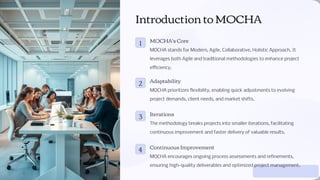
Introduction to MOCHA
1 MOCHA's Core
MOCHA stands for Modern, Agile, Collaborative, Holistic Approach. It
leverages both Agile and traditional methodologies to enhance project
efficiency.
2 Adaptability
MOCHA prioritizes flexibility, enabling quick adjustments to evolving
project demands, client needs, and market shifts.
3 Iterations
The methodology breaks projects into smaller iterations, facilitating
continuous improvement and faster delivery of valuable results.
4 Continuous Improvement
MOCHA encourages ongoing process assessments and refinements,
ensuring high-quality deliverables and optimized project management.
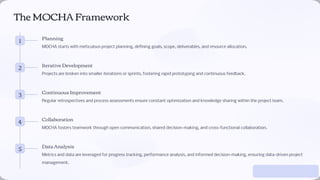
The MOCHA Framework
1 Planning
MOCHA starts with meticulous project planning, defining goals, scope, deliverables, and resource allocation.
2 Iterative Development
Projects are broken into smaller iterations or sprints, fostering rapid prototyping and continuous feedback.
3 Continuous Improvement
Regular retrospectives and process assessments ensure constant optimization and knowledge sharing within the project team.
4 Collaboration
MOCHA fosters teamwork through open communication, shared decision-making, and cross-functional collaboration.
5 Data Analysis
Metrics and data are leveraged for progress tracking, performance analysis, and informed decision-making, ensuring data-driven project
management.
Benefits of MOCHA
Enhanced Efficiency
MOCHA streamlines project execution, resulting in faster
delivery times and reduced costs, leading to improved ROI.
Increased Flexibility
The methodology's iterative nature enables quick adaptations
to changing project requirements, market shifts, and client
feedback.
Elevated Stakeholder Satisfaction
Open communication, regular updates, and active stakeholder
involvement foster transparency and trust, resulting in higher
satisfaction.
Enhanced Quality
Continuous improvement practices and rigorous testing ensure
high-quality deliverables, meeting client expectations and
industry standards.
MOCHA vs. Traditional
Project Management
Traditional Project
Management
MOCHA
Waterfall model, rigid planning,
upfront requirements
Iterative development, flexible
planning, continuous adaptation
Emphasis on documentation,
detailed plans
Focus on iterative development,
frequent feedback loops
Less adaptable to change Highly adaptable to evolving
project needs
Limited stakeholder
involvement
Active stakeholder
engagement and collaboration
Case Study: Successful MOCHA
Implementation
Project Overview
A software development company implemented MOCHA for a complex enterprise
application project, facing tight deadlines and evolving client requirements.
Iterative Development
The project was divided into smaller iterations, allowing for frequent feedback loops and
adjustments based on user testing and stakeholder input.
Benefits Realized
The MOCHA approach resulted in a successful launch, exceeding client expectations,
delivering high-quality software within the stipulated timeframe.
Lessons Learned
The project highlighted the importance of strong communication, data-driven
decision-making, and continuous improvement for effective project management.
Challenges and Considerations
Challenges
MOCHA implementation can face
challenges, including resistance
to change, lack of experience
with Agile methodologies, and
insufficient team
communication.
Mitigating Strategies
These challenges can be
mitigated through effective
communication, training,
coaching, and fostering a
collaborative team environment.
Key Considerations
Careful planning, clear
communication, and ongoing
adaptation are crucial for
successful MOCHA
implementation, ensuring
alignment and progress.
Conclusion
1 MOCHA's Value
MOCHA project management offers a robust, adaptable, and
collaborative approach, delivering value through increased
efficiency, flexibility, and stakeholder satisfaction.
2 Call to Action
Consider adopting MOCHA in your projects to streamline
processes, enhance collaboration, and achieve greater project
success.
3 Future Outlook
MOCHA continues to evolve, incorporating emerging
technologies and methodologies, ensuring its relevance and
effectiveness in the dynamic project landscape.

MOCHA Project Management: A Comprehensive Guide

  • 1.
    MOCHA Project Management Welcome toour presentation on MOCHA, a dynamic project management methodology.
  • 2.
    Introduction to MOCHA 1MOCHA's Core MOCHA stands for Modern, Agile, Collaborative, Holistic Approach. It leverages both Agile and traditional methodologies to enhance project efficiency. 2 Adaptability MOCHA prioritizes flexibility, enabling quick adjustments to evolving project demands, client needs, and market shifts. 3 Iterations The methodology breaks projects into smaller iterations, facilitating continuous improvement and faster delivery of valuable results. 4 Continuous Improvement MOCHA encourages ongoing process assessments and refinements, ensuring high-quality deliverables and optimized project management.
  • 3.
    The MOCHA Framework 1Planning MOCHA starts with meticulous project planning, defining goals, scope, deliverables, and resource allocation. 2 Iterative Development Projects are broken into smaller iterations or sprints, fostering rapid prototyping and continuous feedback. 3 Continuous Improvement Regular retrospectives and process assessments ensure constant optimization and knowledge sharing within the project team. 4 Collaboration MOCHA fosters teamwork through open communication, shared decision-making, and cross-functional collaboration. 5 Data Analysis Metrics and data are leveraged for progress tracking, performance analysis, and informed decision-making, ensuring data-driven project management.
  • 4.
    Benefits of MOCHA EnhancedEfficiency MOCHA streamlines project execution, resulting in faster delivery times and reduced costs, leading to improved ROI. Increased Flexibility The methodology's iterative nature enables quick adaptations to changing project requirements, market shifts, and client feedback. Elevated Stakeholder Satisfaction Open communication, regular updates, and active stakeholder involvement foster transparency and trust, resulting in higher satisfaction. Enhanced Quality Continuous improvement practices and rigorous testing ensure high-quality deliverables, meeting client expectations and industry standards.
  • 5.
    MOCHA vs. Traditional ProjectManagement Traditional Project Management MOCHA Waterfall model, rigid planning, upfront requirements Iterative development, flexible planning, continuous adaptation Emphasis on documentation, detailed plans Focus on iterative development, frequent feedback loops Less adaptable to change Highly adaptable to evolving project needs Limited stakeholder involvement Active stakeholder engagement and collaboration
  • 6.
    Case Study: SuccessfulMOCHA Implementation Project Overview A software development company implemented MOCHA for a complex enterprise application project, facing tight deadlines and evolving client requirements. Iterative Development The project was divided into smaller iterations, allowing for frequent feedback loops and adjustments based on user testing and stakeholder input. Benefits Realized The MOCHA approach resulted in a successful launch, exceeding client expectations, delivering high-quality software within the stipulated timeframe. Lessons Learned The project highlighted the importance of strong communication, data-driven decision-making, and continuous improvement for effective project management.
  • 7.
    Challenges and Considerations Challenges MOCHAimplementation can face challenges, including resistance to change, lack of experience with Agile methodologies, and insufficient team communication. Mitigating Strategies These challenges can be mitigated through effective communication, training, coaching, and fostering a collaborative team environment. Key Considerations Careful planning, clear communication, and ongoing adaptation are crucial for successful MOCHA implementation, ensuring alignment and progress.
  • 8.
    Conclusion 1 MOCHA's Value MOCHAproject management offers a robust, adaptable, and collaborative approach, delivering value through increased efficiency, flexibility, and stakeholder satisfaction. 2 Call to Action Consider adopting MOCHA in your projects to streamline processes, enhance collaboration, and achieve greater project success. 3 Future Outlook MOCHA continues to evolve, incorporating emerging technologies and methodologies, ensuring its relevance and effectiveness in the dynamic project landscape.