STRATEGIC MANAGEMENT
GROUP 2
Aarushi Narang-, Ajay Kumar,
Anuradha Gupta, Jayant Sharma, Megha Sharma, Vanshika Chauhan
ITC
ONE OF THE MOST VALUABLE CORPORATIONS
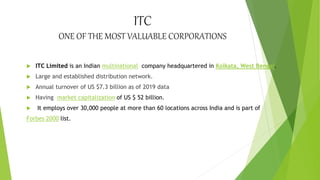
 ITC Limited is an Indian multinational company headquartered in Kolkata, West Bengal.
 Large and established distribution network.
 Annual turnover of US $7.3 billion as of 2019 data
 Having market capitalization of US $ 52 billion.
 It employs over 30,000 people at more than 60 locations across India and is part of
Forbes 2000 list.
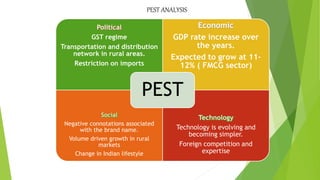
PEST ANALYSIS
Political
GST regime
Transportation and distribution
network in rural areas.
Restriction on imports
Economic
GDP rate increase over
the years.
Expected to grow at 11-
12% ( FMCG sector)
Negative connotations associated
with the brand name.
Volume driven growth in rural
markets
Change in Indian lifestyle
Technology is evolving and
becoming simpler.
Foreign competition and
expertise
PEST
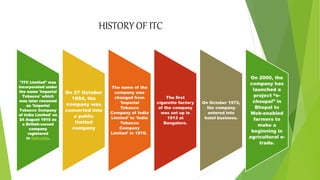
HISTORY OF ITC
"ITC Limited" was
incorporated under
the name 'Imperial
Tobacco' which
was later renamed
as 'Imperial
Tobacco Company
of India Limited' on
24 August 1910 as
a British-owned
company
registered
in Calcutta.
On 27 October
1954, the
company was
converted into
a public
limited
company
The name of the
company was
changed from
'Imperial
Tobacco
Company of India
Limited' to 'India
Tobacco
Company
Limited' in 1970.
The first
cigarette factory
of the company
was set up in
1913 at
Bangalore.
On October 1972,
the company
entered into
hotel business.
On 2000, the
company has
launched a
project “e-
choupal” in
Bhopal to
Web-enabled
farmers to
make a
beginning in
agricultural e-
trade.
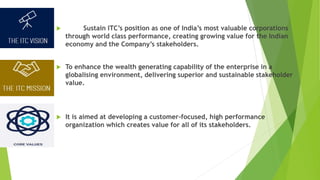
 Sustain ITC’s position as one of India’s most valuable corporations
through world class performance, creating growing value for the Indian
economy and the Company’s stakeholders.
 To enhance the wealth generating capability of the enterprise in a
globalising environment, delivering superior and sustainable stakeholder
value.
 It is aimed at developing a customer-focused, high performance
organization which creates value for all of its stakeholders.
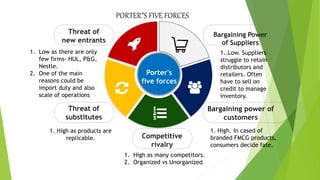
Porter's
five forces
Threat of
new entrants
Threat of
substitutes
Competitive
rivalry
1. Low as there are only
few firms- HUL, P&G,
Nestle.
2. One of the main
reasons could be
import duty and also
scale of operations
1. High as products are
replicable.
1..Low. Suppliers
struggle to retain
distributors and
retailers. Often
have to sell on
credit to manage
inventory.
1. High. In cased of
branded FMCG products,
consumers decide fate.
1. High as many competitors.
2. Organized vs Unorganized
PORTER”S FIVE FORCES
Bargaining Power
of Suppliers
Bargaining power of
customers
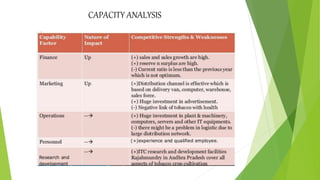
CAPACITY ANALYSIS
SWOT ANALYSIS
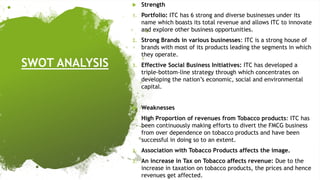
 Strength
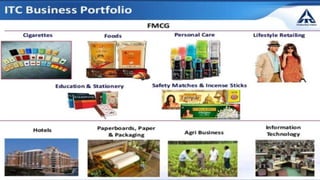
1. Portfolio: ITC has 6 strong and diverse businesses under its
name which boasts its total revenue and allows ITC to innovate
and explore other business opportunities.
2. Strong Brands in various businesses: ITC is a strong house of
brands with most of its products leading the segments in which
they operate.
3. Effective Social Business Initiatives: ITC has developed a
triple-bottom-line strategy through which concentrates on
developing the nation’s economic, social and environmental
capital.
 Weaknesses
1. High Proportion of revenues from Tobacco products: ITC has
been continuously making efforts to divert the FMCG business
from over dependence on tobacco products and have been
successful in doing so to an extent.
2. Association with Tobacco Products affects the image.
3. An increase in Tax on Tobacco affects revenue: Due to the
increase in taxation on tobacco products, the prices and hence
revenues get affected.
SWOT ANALYSIS
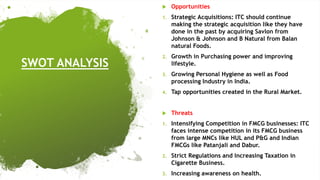
 Opportunities
1. Strategic Acquisitions: ITC should continue
making the strategic acquisition like they have
done in the past by acquiring Savlon from
Johnson & Johnson and B Natural from Balan
natural Foods.
2. Growth in Purchasing power and improving
lifestyle.
3. Growing Personal Hygiene as well as Food
processing Industry in India.
4. Tap opportunities created in the Rural Market.
 Threats
1. Intensifying Competition in FMCG businesses: ITC
faces intense competition in its FMCG business
from large MNCs like HUL and P&G and Indian
FMCGs like Patanjali and Dabur.
2. Strict Regulations and Increasing Taxation in
Cigarette Business.
3. Increasing awareness on health.
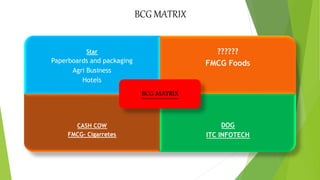
Star
Paperboards and packaging
Agri Business
Hotels
??????
FMCG Foods
CASH COW
FMCG- Cigarretes
DOG
ITC INFOTECH
BCG MATRIX
BCG MATRIX
REFERENCE: ET and ITC official website
 Initial years primarily devoted to growth of Cigarettes and Leaf Tobacco
business
 Packaging and printing business was set up in 1925 as a strategic backward
integration
 In 1973, ITC set up its integrated research center in Bangalore, aimed at
diversification and venturing into newer businesses with research and
development.
 ITC entered into the hospitality sector with hotel business in 1975 with the
acquisition renaming of ITC Welcomgroup Hotel Chola in Madras.
 ITC Sangeet Research Academy was set up at Calcutta in 1977.
 In 1979, ITC entered the paperboards business by promoting ITC
Bhadrachalam Paperboards Limited.
 J N Sapru took over as the company's chairman in 1983 and the international expansion started
with the acquisition of Surya Nepal Private Limited in 1985.
 ITC also entered into the edible oils industry with the launch of 'Sundrop' brand of cooking oils in
1988.
 Tribeni Tissues Limited was acquired in 1990.
 In the year 2000, an innovative initiative for farmers called 'e-Choupal' was started in Madhya
Pradesh.
 Launched range of notebooks under brand Paperkraft in 2002 and Classmate in 2003.
 ITC entered the personal care business in 2005.
 Ready to eat segment-”Kitchens of India”-2001
 2003 witnessed introduction of Sunfeast and Bingo! was launched in 2007.
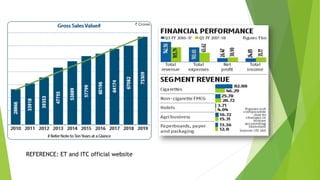
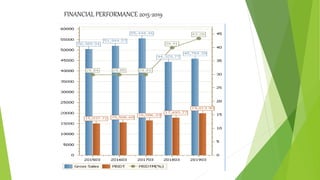
FINANCIAL PERFORMANCE 2015-2019
ITC has also been growing the FMCG portfolio through
acquisitions. In 2014, it acquired B Natural from south
Indian juice maker Balan Natural. It acquired Shower to
Shower in 2015 and Savlon brands from Johnson &
Johnson in 2017 .
ITC has also entered the coffee and chocolates markets at
the top-end luxury segments — via boutiques at ITC’s
hotels and a few select malls.
ITC will focus on health and wellness products within
the FMCG vertical. The company will attempt to
reinforce the existing categories in the FMCG segment.
STRATEGY FOR EXPANSION
• A whole range of products are being developed in
the health and wellness space.
 Developing alternate and emerging channels such as
modern trade, on-the-go food services, end-to-end cold
chain and e-commerce, among others.
 So far, it has been restricted to alternative investment
funds...Later, it would make direct investments in start-
ups in the FMCG space.
 The 20 Integrated Consumer Goods Manufacturing and
Logistics (ICML) facilities being progressively built will
provide formidable strength to the company's FMCG brands
by enhancing cost efficiency, economies of scale, freshness
and close-to-market distribution.
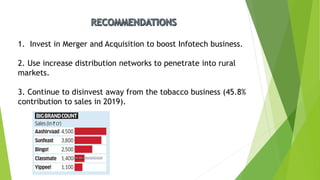
1. Invest in Merger and Acquisition to boost Infotech business.
2. Use increase distribution networks to penetrate into rural
markets.
3. Continue to disinvest away from the tobacco business (45.8%
contribution to sales in 2019).

Strategic management

  • 1.
    STRATEGIC MANAGEMENT GROUP 2 AarushiNarang-, Ajay Kumar, Anuradha Gupta, Jayant Sharma, Megha Sharma, Vanshika Chauhan
  • 2.
    ITC ONE OF THEMOST VALUABLE CORPORATIONS  ITC Limited is an Indian multinational company headquartered in Kolkata, West Bengal.  Large and established distribution network.  Annual turnover of US $7.3 billion as of 2019 data  Having market capitalization of US $ 52 billion.  It employs over 30,000 people at more than 60 locations across India and is part of Forbes 2000 list.
  • 3.
    PEST ANALYSIS Political GST regime Transportationand distribution network in rural areas. Restriction on imports Economic GDP rate increase over the years. Expected to grow at 11- 12% ( FMCG sector) Negative connotations associated with the brand name. Volume driven growth in rural markets Change in Indian lifestyle Technology is evolving and becoming simpler. Foreign competition and expertise PEST
  • 4.
    HISTORY OF ITC "ITCLimited" was incorporated under the name 'Imperial Tobacco' which was later renamed as 'Imperial Tobacco Company of India Limited' on 24 August 1910 as a British-owned company registered in Calcutta. On 27 October 1954, the company was converted into a public limited company The name of the company was changed from 'Imperial Tobacco Company of India Limited' to 'India Tobacco Company Limited' in 1970. The first cigarette factory of the company was set up in 1913 at Bangalore. On October 1972, the company entered into hotel business. On 2000, the company has launched a project “e- choupal” in Bhopal to Web-enabled farmers to make a beginning in agricultural e- trade.
  • 5.
     Sustain ITC’sposition as one of India’s most valuable corporations through world class performance, creating growing value for the Indian economy and the Company’s stakeholders.  To enhance the wealth generating capability of the enterprise in a globalising environment, delivering superior and sustainable stakeholder value.  It is aimed at developing a customer-focused, high performance organization which creates value for all of its stakeholders.
  • 7.
    Porter's five forces Threat of newentrants Threat of substitutes Competitive rivalry 1. Low as there are only few firms- HUL, P&G, Nestle. 2. One of the main reasons could be import duty and also scale of operations 1. High as products are replicable. 1..Low. Suppliers struggle to retain distributors and retailers. Often have to sell on credit to manage inventory. 1. High. In cased of branded FMCG products, consumers decide fate. 1. High as many competitors. 2. Organized vs Unorganized PORTER”S FIVE FORCES Bargaining Power of Suppliers Bargaining power of customers
  • 8.
  • 9.
    SWOT ANALYSIS  Strength 1.Portfolio: ITC has 6 strong and diverse businesses under its name which boasts its total revenue and allows ITC to innovate and explore other business opportunities. 2. Strong Brands in various businesses: ITC is a strong house of brands with most of its products leading the segments in which they operate. 3. Effective Social Business Initiatives: ITC has developed a triple-bottom-line strategy through which concentrates on developing the nation’s economic, social and environmental capital.  Weaknesses 1. High Proportion of revenues from Tobacco products: ITC has been continuously making efforts to divert the FMCG business from over dependence on tobacco products and have been successful in doing so to an extent. 2. Association with Tobacco Products affects the image. 3. An increase in Tax on Tobacco affects revenue: Due to the increase in taxation on tobacco products, the prices and hence revenues get affected.
  • 10.
    SWOT ANALYSIS  Opportunities 1.Strategic Acquisitions: ITC should continue making the strategic acquisition like they have done in the past by acquiring Savlon from Johnson & Johnson and B Natural from Balan natural Foods. 2. Growth in Purchasing power and improving lifestyle. 3. Growing Personal Hygiene as well as Food processing Industry in India. 4. Tap opportunities created in the Rural Market.  Threats 1. Intensifying Competition in FMCG businesses: ITC faces intense competition in its FMCG business from large MNCs like HUL and P&G and Indian FMCGs like Patanjali and Dabur. 2. Strict Regulations and Increasing Taxation in Cigarette Business. 3. Increasing awareness on health.
  • 11.
    Star Paperboards and packaging AgriBusiness Hotels ?????? FMCG Foods CASH COW FMCG- Cigarretes DOG ITC INFOTECH BCG MATRIX BCG MATRIX
  • 12.
    REFERENCE: ET andITC official website
  • 13.
     Initial yearsprimarily devoted to growth of Cigarettes and Leaf Tobacco business  Packaging and printing business was set up in 1925 as a strategic backward integration  In 1973, ITC set up its integrated research center in Bangalore, aimed at diversification and venturing into newer businesses with research and development.  ITC entered into the hospitality sector with hotel business in 1975 with the acquisition renaming of ITC Welcomgroup Hotel Chola in Madras.  ITC Sangeet Research Academy was set up at Calcutta in 1977.  In 1979, ITC entered the paperboards business by promoting ITC Bhadrachalam Paperboards Limited.
  • 14.
     J NSapru took over as the company's chairman in 1983 and the international expansion started with the acquisition of Surya Nepal Private Limited in 1985.  ITC also entered into the edible oils industry with the launch of 'Sundrop' brand of cooking oils in 1988.  Tribeni Tissues Limited was acquired in 1990.  In the year 2000, an innovative initiative for farmers called 'e-Choupal' was started in Madhya Pradesh.  Launched range of notebooks under brand Paperkraft in 2002 and Classmate in 2003.  ITC entered the personal care business in 2005.  Ready to eat segment-”Kitchens of India”-2001  2003 witnessed introduction of Sunfeast and Bingo! was launched in 2007.
  • 15.
  • 16.
    ITC has alsobeen growing the FMCG portfolio through acquisitions. In 2014, it acquired B Natural from south Indian juice maker Balan Natural. It acquired Shower to Shower in 2015 and Savlon brands from Johnson & Johnson in 2017 . ITC has also entered the coffee and chocolates markets at the top-end luxury segments — via boutiques at ITC’s hotels and a few select malls. ITC will focus on health and wellness products within the FMCG vertical. The company will attempt to reinforce the existing categories in the FMCG segment. STRATEGY FOR EXPANSION
  • 17.
    • A wholerange of products are being developed in the health and wellness space.  Developing alternate and emerging channels such as modern trade, on-the-go food services, end-to-end cold chain and e-commerce, among others.  So far, it has been restricted to alternative investment funds...Later, it would make direct investments in start- ups in the FMCG space.  The 20 Integrated Consumer Goods Manufacturing and Logistics (ICML) facilities being progressively built will provide formidable strength to the company's FMCG brands by enhancing cost efficiency, economies of scale, freshness and close-to-market distribution.
  • 18.
    1. Invest inMerger and Acquisition to boost Infotech business. 2. Use increase distribution networks to penetrate into rural markets. 3. Continue to disinvest away from the tobacco business (45.8% contribution to sales in 2019).