CASE STUDY ON
DIVERSIFICATION STRATEGIES BY MNC’S


                 PRESENTED BY:
                 AANCHAL NARANG
                 PARUL GUPTA
                 MONICA MAHALWAL
HIGHLIGHTS OF CASE STUDY
HIGHLIGHTS OF THE CASE
The main aspect of the case shows that the international business
environment has witnessed unprecedented changes over the past
decades and so MNC’s have been continously expanding


Focuses on the major reasons that has been leading these
companies to expand


Also main focus has been on the various strategies used by MNC’s
in order to diversify.
INTRODUCTION TO – MNC’S
      INTRODUCTION TO MNC’S
• Multinational corporations (MNCs) are huge industrial
  organizations having a wide network of branches and
  subsidiaries spread over a number of countries.

• MNCs practices production and provides services to
  countries other than the home country.

• The two main characteristics of MNCs are their large
  size and the fact that their worldwide activities are
  centrally controlled by the parent companies.
WHEN SHOULD A MNC DIVERSIFY?
 It is faced with diminishing growth prospects in present business


 It has opportunities to expand into industries whose technologies
  and products complement its present business.

 It has a powerful brand name it can transfer to products of other
  businesses to increase sales and profits of these businesses
Need for Diversification
 Growth and expansion.


 Risk involved in single business strategy.


 Contribute towards more profit margins.


 Powerful brand name.


 To meet the utmost competition in market.
DIVERSIFICATION STARTEGIES OF MNC’S

There are a number of diversification strategies and some of them are
here under:

Strategies for entering new industries


 Related diversification strategies


 Unrelated diversification strategies


 Multinational diversification
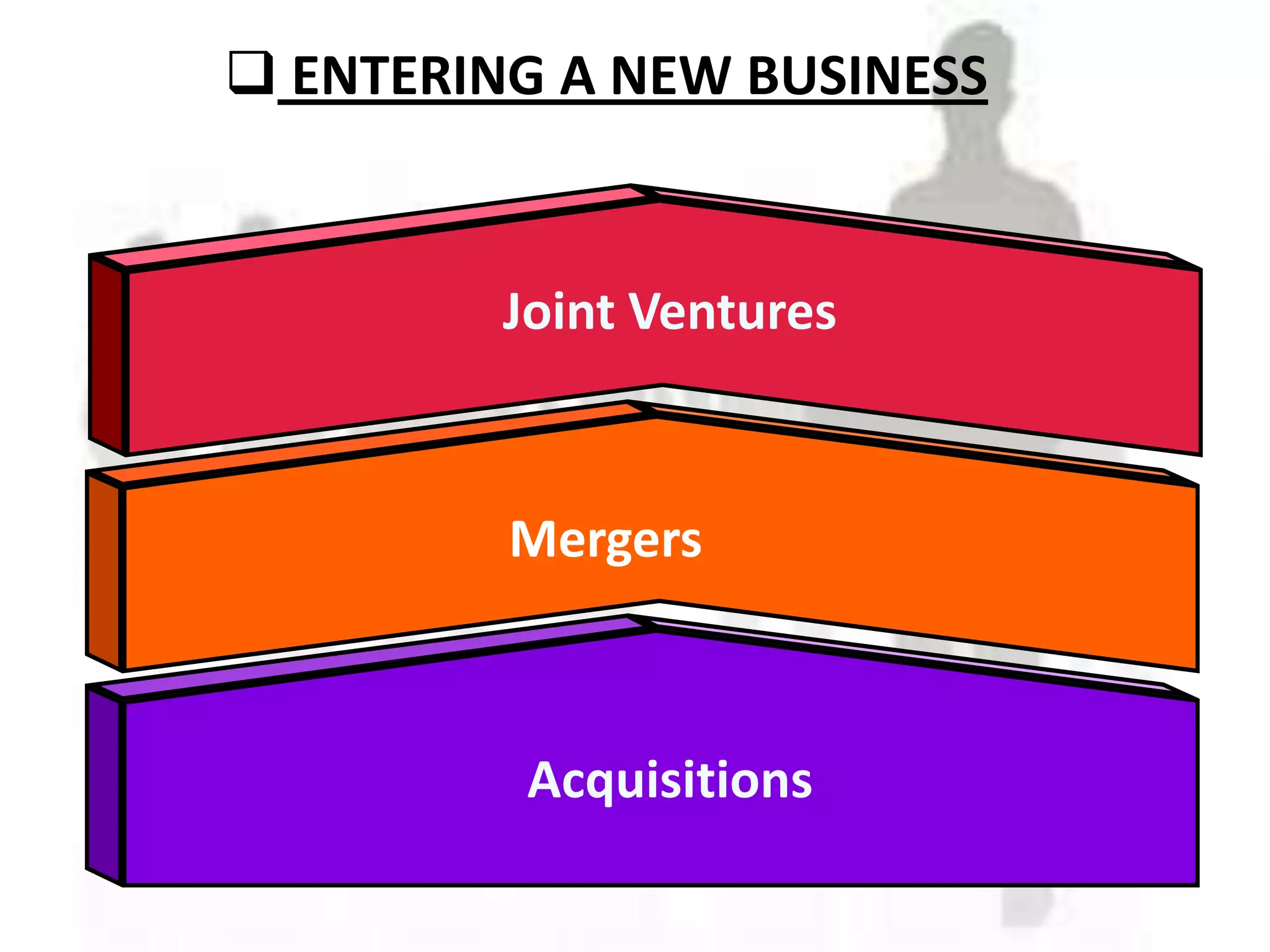
 ENTERING A NEW BUSINESS


         Joint Ventures


         Mergers


          Acquisitions
    Joint venture :

- involving two or more companies(domestic or international )
  joining temporarily.

Example:Nokia with Microsoft in 2011, coco cola with Mc Donalds


 Takeovers : Microsoft takeover Skype in 2011.

 Mergers :
-Companies unite together   to enhance their growth and eliminate
    competition .

Example: Samsung merged with Intel’s tizen.
Unrelated to businesss
-Taking of those activities which are unrelated to the existing
businesses.

Example – AMWAY (U.S based ) deals in jewllery as well as
beauty products
Diversification of the resource base. –
-Internationalization of production that substitutes for production at
   home.
              JHGVHG
Example - Tommy Hilfiger(American brand)- outsources its production
  to countries like India and China.


Unrelated technology
  -A similar type of product is offered with a help of unrelated
   technology.

Example: Nokia shifting its operating system from symbian to
  android.
 New product line
-new type of product or service is provided with the help of related
technology.

             JHGVHG
Example- Apple iphone and ipod touch.


 Similar product lines
-similar type of product is provided with the help of related technology.

 Example - L'Oreal total repair shampoo and L'Oreal Paris color protect
shampoo.
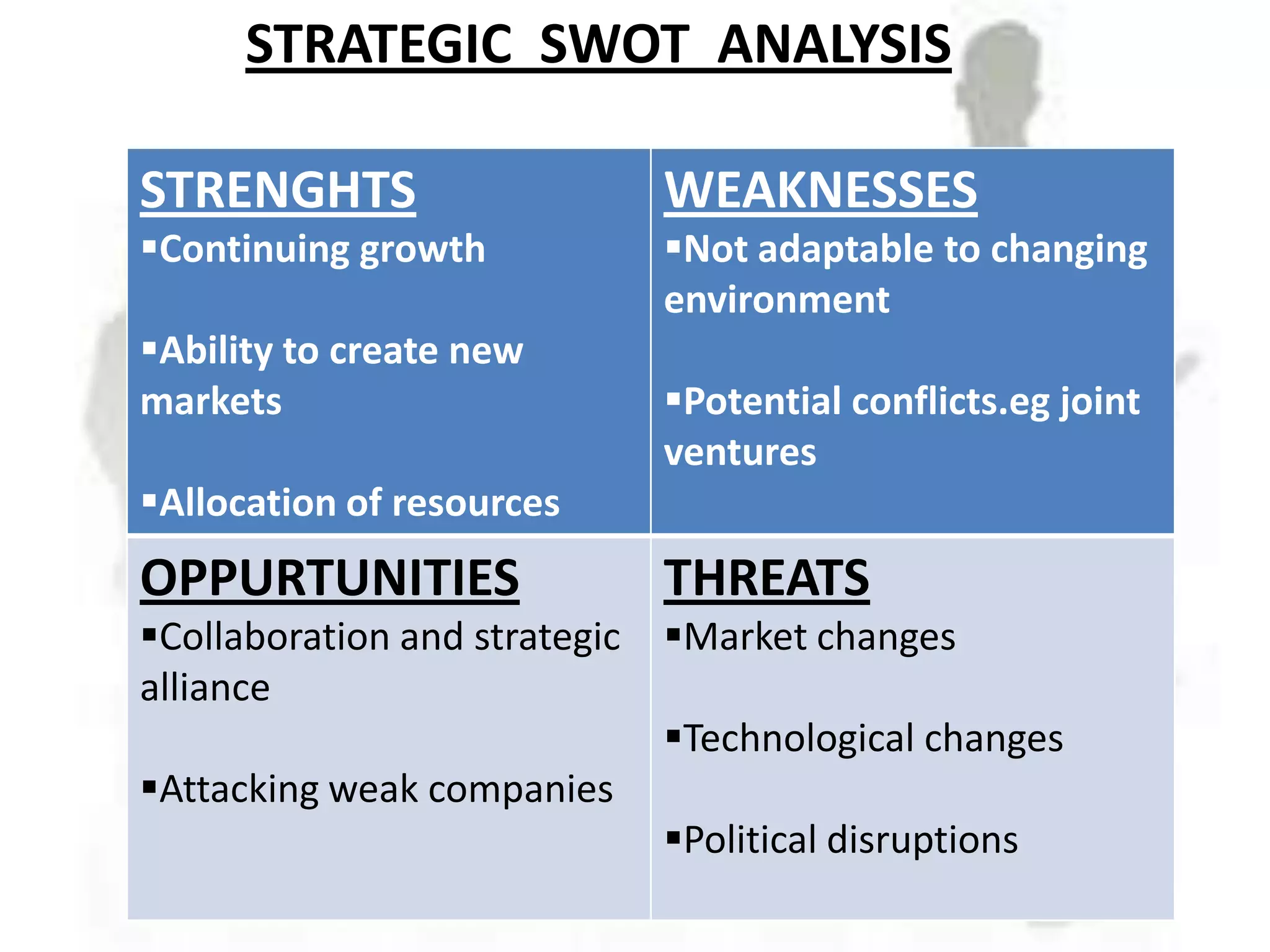
STRATEGIC SWOT ANALYSIS

STRENGHTS                      WEAKNESSES
Continuing growth             Not adaptable to changing
                               environment
Ability to create new
markets                        Potential conflicts.eg joint
                               ventures
Allocation of resources
OPPURTUNITIES                  THREATS
Collaboration and strategic   Market changes
alliance
                               Technological changes
Attacking weak companies
                               Political disruptions
FUTURE OF MNC’s

 Increasing international competition.
50
45

 Global consumer awareness.
40
35
30
 Technological advancement.
25                                                     Series 2
20                                                     Series 1
 Reduction in friction among nations.
15
10
 5
 Growing role of private sector inn developing
 0
countries. 1/6/2002
1/5/2002              1/7/2002   1/8/2002   1/9/2002
diversification strategies by MNCs

diversification strategies by MNCs

  • 1.
    CASE STUDY ON DIVERSIFICATIONSTRATEGIES BY MNC’S PRESENTED BY: AANCHAL NARANG PARUL GUPTA MONICA MAHALWAL
  • 2.
  • 3.
    HIGHLIGHTS OF THECASE The main aspect of the case shows that the international business environment has witnessed unprecedented changes over the past decades and so MNC’s have been continously expanding Focuses on the major reasons that has been leading these companies to expand Also main focus has been on the various strategies used by MNC’s in order to diversify.
  • 4.
    INTRODUCTION TO –MNC’S INTRODUCTION TO MNC’S • Multinational corporations (MNCs) are huge industrial organizations having a wide network of branches and subsidiaries spread over a number of countries. • MNCs practices production and provides services to countries other than the home country. • The two main characteristics of MNCs are their large size and the fact that their worldwide activities are centrally controlled by the parent companies.
  • 5.
    WHEN SHOULD AMNC DIVERSIFY?  It is faced with diminishing growth prospects in present business  It has opportunities to expand into industries whose technologies and products complement its present business.  It has a powerful brand name it can transfer to products of other businesses to increase sales and profits of these businesses
  • 6.
    Need for Diversification Growth and expansion.  Risk involved in single business strategy.  Contribute towards more profit margins.  Powerful brand name.  To meet the utmost competition in market.
  • 7.
    DIVERSIFICATION STARTEGIES OFMNC’S There are a number of diversification strategies and some of them are here under: Strategies for entering new industries  Related diversification strategies  Unrelated diversification strategies  Multinational diversification
  • 8.
     ENTERING ANEW BUSINESS Joint Ventures Mergers Acquisitions
  • 9.
    Joint venture : - involving two or more companies(domestic or international ) joining temporarily. Example:Nokia with Microsoft in 2011, coco cola with Mc Donalds  Takeovers : Microsoft takeover Skype in 2011.  Mergers : -Companies unite together to enhance their growth and eliminate competition . Example: Samsung merged with Intel’s tizen.
  • 10.
    Unrelated to businesss -Takingof those activities which are unrelated to the existing businesses. Example – AMWAY (U.S based ) deals in jewllery as well as beauty products
  • 11.
    Diversification of theresource base. – -Internationalization of production that substitutes for production at home. JHGVHG Example - Tommy Hilfiger(American brand)- outsources its production to countries like India and China. Unrelated technology -A similar type of product is offered with a help of unrelated technology. Example: Nokia shifting its operating system from symbian to android.
  • 12.
     New productline -new type of product or service is provided with the help of related technology. JHGVHG Example- Apple iphone and ipod touch.  Similar product lines -similar type of product is provided with the help of related technology. Example - L'Oreal total repair shampoo and L'Oreal Paris color protect shampoo.
  • 13.
    STRATEGIC SWOT ANALYSIS STRENGHTS WEAKNESSES Continuing growth Not adaptable to changing environment Ability to create new markets Potential conflicts.eg joint ventures Allocation of resources OPPURTUNITIES THREATS Collaboration and strategic Market changes alliance Technological changes Attacking weak companies Political disruptions
  • 14.
    FUTURE OF MNC’s Increasing international competition. 50 45  Global consumer awareness. 40 35 30  Technological advancement. 25 Series 2 20 Series 1  Reduction in friction among nations. 15 10 5  Growing role of private sector inn developing 0 countries. 1/6/2002 1/5/2002 1/7/2002 1/8/2002 1/9/2002