A Seminar Presntaion
On
Cyber Crime,IPC & IT Act 2008
Presented to:
Mr. Pankaj Dadheech
Reader, CSE
Presented by:
Dushyant Kr Marwal
11ESKCS047
Contents
 INTRODUCTION
 HISTORY OF CYBER CRIME
TYPES OF CYBER CRIME
 CYBER CRIMINALS
 CATEGORIES OF CYBER CRIME
CYBER SECURITY
An !dea about Cyber Crime
▪ Crime committed using the computer and the
internet to steal the person’s identity or illegal
imports or malicious programs.
▪ Cyber Crime is nothing but where the computer is
used as an object or a subject of crime.
History of Cyber Crime
▪ The first recorded cyber crime LOOM took place
in the year 1820.
▪ After that in 1978 a SPAM EMAIL is found when it
was sent out over the ARPANet (Advanced
Research Project Agency Network).
Types of Cyber Crime
 Virus/Worm Attacks
 Trojan Attacks
 Email Bombing
 Phishing
 Denial of Service Attack
 Web Jacking
Types of Cyber Crime(Contd…)
 Child Pornography
 Cyber Laundering
Cyber Stalking
 Cyber Theft
Botnet
Cyber Criminals
▪ Those who are doing crimes by using the computer
as an target or object.
o Children and adolescents between the age
group of 6-18 years .
o Dissatisfied employees.
o Professional hackers / crackers.
Categories of Cyber Crime
▪ Cyber crimes can be basically divided into three
categories:
o Cyber crimes against persons.
o Cyber crimes against property.
o Cyber crimes against government.
Against persons
 Harassment via E-mails: Harassment through e-mails is
not a new concept. It is very similar to harassing through
letters.
 Email Spoofing: A mail which misrepresents its origin. It
shows it’s origin to be different from which actually it
originates.

Against property
 Computer vandalism: Damaging or destroying data
rather than stealing or misusing them is called Computer
vandalism.
 Transmitting virus: These are programs that attach
themselves to a file and then circulate.They usually affect
the data on a computer, either by altering or deleting it.
Against Government
CyberTerrorism:
• Terrorist attacks on internet is by:
o Distributed denial of service attacks
o Fake websites and fake emails
o Attacks on sensitive computer networks , etc.
• In this terrorists are using 512 bit encryption, which is
impossible to decrypt.
How can we protect it?
▪ Keep Software up to Date: If the seller releases patches for the
software operating your device, install them as soon as possible.
▪ Use Good Passwords: Select passwords that are difficult to guess. Do
not options that allows your computer to remember the password.
▪ Disable Remote Connectivity: Some PDA’s & Phones are equipped
with wireless technologies, such as Bluetooth.You should disable
these features when they are not in use.
Intellectual Property Right
Contents
▪ Introduction
▪ Importance of IPR
▪ Forms of IPR
▪ Patent
▪ Copyright
▪ Trademark
▪ Laws in india
What is Intellectual Property ?
▪ Creation of human mind
▪ Idea or a concept or a thought at the
beginning
▪ Research and Development to lead the idea
▪ The outcome of these ideas may be
development of products, processes and
design etc.
Why IPR is important?
•Reward original efforts ?
•Prevent duplication of work?
•Commercial value in research?
•Technical information for research &
to prevent litigation?
Patent
Patent defined in Patents Act as “patent
granted for any invention under the Act”.
 Granted by the Government
 To inventor
 To prevent third parties not having his consent
from making, using, offering for sale. (Sec. 48)
 For a limited period of time (20 years)
 Qualified rights with duties
Copyright Act
▪ Objective:To ensure protection from unlawfully
exploitation of the work of owner(Author)
▪ Copyright act provides exclusive rights to authors
and other owners of original works.
▪ Exclusive privilege to authors to reproduce,
distribute, perform or display their creative works.
FilmsLiterary Dramatic Musical Artistic
What is covered by copyright ?
What is not covered by copyright ?
Ideas
Facts
Recipes
Names, titles or short phrases
Trademark
▪ Word or symbol used by manufacturers to
identify goods.
▪ Initial registration for 10 yrs and further
renewed by payment of fees for unlimited
period.
Types of trademark
▪ TM - a Trade Mark™ - used before registration
▪ SM - a Service Mark SM - used before registration
▪ Rights by Registration®
Trade Marks
Name
Logotype
Symbol
Slogan
Shape
Color
Duration of protection
YEARS RENEWABLE
Patents 20 No
Trade marks 6-10 Yes
Designs 6-10 Yes
Copyright 70 after death No
CYBER LAWS
(IT ACT 2000)
Content:
▪ Cyber law
▪ Need of Cyber law
▪ Cyber Laws in India
▪ Challenges facing law enforcement
▪ Positive Initiatives
Need of cyber law
▪ Tackling cyber crime
▪ Successful and smooth functioning of e-
commerce and virtual communication
▪ Cloud computing is proving to be a major
threat
Cyber Law
oCyber law is a term that encapsulates the legal
issues related to use of the Internet
oThe abuse of computers has also given birth to a new
age crimes that are addressed by the Information
Technology Act, 2000.
CYBER LAWS IN INDIA
▪ IT act 2000 passes
▪ Up gradation of IT act 2000-introducing IT act 2008
▪ IPC acts
▪ Copy right act
The IT ACT, 2000
o Legal Recognition of Electronic Documents
o Legal Recognition of Digital Signatures
o Offenses and Contraventions
o Justice Dispensation Systems for cybercrimes
Contd…..
oCivilWrongs under IT Act
oSection 46: IT Act
oSection 65: Source Code
oSection 66: Hacking
oSec. 67. Pornography
Contd….
o Sec 69: Decryption of information
oSec 70 : Protected System
oEmail spoofing
oCyber stalking
Information Technology Act 2008
o Information Security
o New sections on offences
o Data Protection.
o Section 69 empowers the C Gov/S Gov
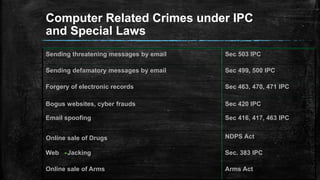
Computer Related Crimes under IPC
and Special Laws
Arms ActOnline sale of Arms
Sec. 383 IPCWeb -Jacking
NDPS ActOnline sale of Drugs
Sec 416, 417, 463 IPCEmail spoofing
Sec 420 IPCBogus websites, cyber frauds
Sec 463, 470, 471 IPCForgery of electronic records
Sec 499, 500 IPCSending defamatory messages by email
Sec 503 IPCSending threatening messages by email
Challenges facing law enforcement
oMost not trained in the technologies
o Multiple jurisdictions
o Retrofit new crimes to existing laws
POSITIVE INITIATIVES:
o More Cyber crime police cells set up across the country
o Websites aid in creating awareness and encouraging
reporting of cyber crime cases.
o Specialized Training
o Active coordination between police and other law
enforcement agencies
ASLU Survey published in March 2014-
Incidence of Cyber crime in India
UNAUTHORISED
ACCESS 19%
E-MAIL ABUSE 21%
DATA THEFT 33%
Conclusion
Cyber crime is indeed getting the recognition it deserves.
 It is highly likely that cyber crime and its hackers will
continue developing and upgrading to stay ahead of the
law.
 Create yourself, rather than using other’s
creations.
Technological advancement made the job of the
CREATOR easy
 Copyright Law of the USA, Chapter 1 Section 121
 Schechter, Roger E., and John R. Thomas. Intellectual Property: The Law of
Copyrights, Patents and Trademarks.
 Trend micro incorporated research paper
 ATO Z OF Cyber Crime By Aayushi shah.
 Computer Security Policy Guidebook(WILEY publication).
 Moore, R. (2005) "Cyber crime: Investigating High-Technology Computer Crime,"
Anderson Publishing
Refrences:
Thank you…

it act

  • 1.
    A Seminar Presntaion On CyberCrime,IPC & IT Act 2008 Presented to: Mr. Pankaj Dadheech Reader, CSE Presented by: Dushyant Kr Marwal 11ESKCS047
  • 2.
    Contents  INTRODUCTION  HISTORYOF CYBER CRIME TYPES OF CYBER CRIME  CYBER CRIMINALS  CATEGORIES OF CYBER CRIME CYBER SECURITY
  • 3.
    An !dea aboutCyber Crime ▪ Crime committed using the computer and the internet to steal the person’s identity or illegal imports or malicious programs. ▪ Cyber Crime is nothing but where the computer is used as an object or a subject of crime.
  • 4.
    History of CyberCrime ▪ The first recorded cyber crime LOOM took place in the year 1820. ▪ After that in 1978 a SPAM EMAIL is found when it was sent out over the ARPANet (Advanced Research Project Agency Network).
  • 5.
    Types of CyberCrime  Virus/Worm Attacks  Trojan Attacks  Email Bombing  Phishing  Denial of Service Attack  Web Jacking
  • 6.
    Types of CyberCrime(Contd…)  Child Pornography  Cyber Laundering Cyber Stalking  Cyber Theft Botnet
  • 7.
    Cyber Criminals ▪ Thosewho are doing crimes by using the computer as an target or object. o Children and adolescents between the age group of 6-18 years . o Dissatisfied employees. o Professional hackers / crackers.
  • 8.
    Categories of CyberCrime ▪ Cyber crimes can be basically divided into three categories: o Cyber crimes against persons. o Cyber crimes against property. o Cyber crimes against government.
  • 9.
    Against persons  Harassmentvia E-mails: Harassment through e-mails is not a new concept. It is very similar to harassing through letters.  Email Spoofing: A mail which misrepresents its origin. It shows it’s origin to be different from which actually it originates.
  • 10.
    Against property  Computervandalism: Damaging or destroying data rather than stealing or misusing them is called Computer vandalism.  Transmitting virus: These are programs that attach themselves to a file and then circulate.They usually affect the data on a computer, either by altering or deleting it.
  • 11.
    Against Government CyberTerrorism: • Terroristattacks on internet is by: o Distributed denial of service attacks o Fake websites and fake emails o Attacks on sensitive computer networks , etc. • In this terrorists are using 512 bit encryption, which is impossible to decrypt.
  • 12.
    How can weprotect it? ▪ Keep Software up to Date: If the seller releases patches for the software operating your device, install them as soon as possible. ▪ Use Good Passwords: Select passwords that are difficult to guess. Do not options that allows your computer to remember the password. ▪ Disable Remote Connectivity: Some PDA’s & Phones are equipped with wireless technologies, such as Bluetooth.You should disable these features when they are not in use.
  • 13.
  • 14.
    Contents ▪ Introduction ▪ Importanceof IPR ▪ Forms of IPR ▪ Patent ▪ Copyright ▪ Trademark ▪ Laws in india
  • 15.
    What is IntellectualProperty ? ▪ Creation of human mind ▪ Idea or a concept or a thought at the beginning ▪ Research and Development to lead the idea ▪ The outcome of these ideas may be development of products, processes and design etc.
  • 16.
    Why IPR isimportant? •Reward original efforts ? •Prevent duplication of work? •Commercial value in research? •Technical information for research & to prevent litigation?
  • 17.
    Patent Patent defined inPatents Act as “patent granted for any invention under the Act”.  Granted by the Government  To inventor  To prevent third parties not having his consent from making, using, offering for sale. (Sec. 48)  For a limited period of time (20 years)  Qualified rights with duties
  • 18.
    Copyright Act ▪ Objective:Toensure protection from unlawfully exploitation of the work of owner(Author) ▪ Copyright act provides exclusive rights to authors and other owners of original works. ▪ Exclusive privilege to authors to reproduce, distribute, perform or display their creative works.
  • 19.
    FilmsLiterary Dramatic MusicalArtistic What is covered by copyright ? What is not covered by copyright ? Ideas Facts Recipes Names, titles or short phrases
  • 20.
    Trademark ▪ Word orsymbol used by manufacturers to identify goods. ▪ Initial registration for 10 yrs and further renewed by payment of fees for unlimited period.
  • 21.
    Types of trademark ▪TM - a Trade Mark™ - used before registration ▪ SM - a Service Mark SM - used before registration ▪ Rights by Registration®
  • 22.
  • 23.
    Duration of protection YEARSRENEWABLE Patents 20 No Trade marks 6-10 Yes Designs 6-10 Yes Copyright 70 after death No
  • 24.
  • 25.
    Content: ▪ Cyber law ▪Need of Cyber law ▪ Cyber Laws in India ▪ Challenges facing law enforcement ▪ Positive Initiatives
  • 26.
    Need of cyberlaw ▪ Tackling cyber crime ▪ Successful and smooth functioning of e- commerce and virtual communication ▪ Cloud computing is proving to be a major threat
  • 27.
    Cyber Law oCyber lawis a term that encapsulates the legal issues related to use of the Internet oThe abuse of computers has also given birth to a new age crimes that are addressed by the Information Technology Act, 2000.
  • 28.
    CYBER LAWS ININDIA ▪ IT act 2000 passes ▪ Up gradation of IT act 2000-introducing IT act 2008 ▪ IPC acts ▪ Copy right act
  • 29.
    The IT ACT,2000 o Legal Recognition of Electronic Documents o Legal Recognition of Digital Signatures o Offenses and Contraventions o Justice Dispensation Systems for cybercrimes
  • 30.
    Contd….. oCivilWrongs under ITAct oSection 46: IT Act oSection 65: Source Code oSection 66: Hacking oSec. 67. Pornography
  • 31.
    Contd…. o Sec 69:Decryption of information oSec 70 : Protected System oEmail spoofing oCyber stalking
  • 32.
    Information Technology Act2008 o Information Security o New sections on offences o Data Protection. o Section 69 empowers the C Gov/S Gov
  • 33.
    Computer Related Crimesunder IPC and Special Laws Arms ActOnline sale of Arms Sec. 383 IPCWeb -Jacking NDPS ActOnline sale of Drugs Sec 416, 417, 463 IPCEmail spoofing Sec 420 IPCBogus websites, cyber frauds Sec 463, 470, 471 IPCForgery of electronic records Sec 499, 500 IPCSending defamatory messages by email Sec 503 IPCSending threatening messages by email
  • 34.
    Challenges facing lawenforcement oMost not trained in the technologies o Multiple jurisdictions o Retrofit new crimes to existing laws
  • 35.
    POSITIVE INITIATIVES: o MoreCyber crime police cells set up across the country o Websites aid in creating awareness and encouraging reporting of cyber crime cases. o Specialized Training o Active coordination between police and other law enforcement agencies
  • 36.
    ASLU Survey publishedin March 2014- Incidence of Cyber crime in India UNAUTHORISED ACCESS 19% E-MAIL ABUSE 21% DATA THEFT 33%
  • 37.
    Conclusion Cyber crime isindeed getting the recognition it deserves.  It is highly likely that cyber crime and its hackers will continue developing and upgrading to stay ahead of the law.  Create yourself, rather than using other’s creations. Technological advancement made the job of the CREATOR easy
  • 38.
     Copyright Lawof the USA, Chapter 1 Section 121  Schechter, Roger E., and John R. Thomas. Intellectual Property: The Law of Copyrights, Patents and Trademarks.  Trend micro incorporated research paper  ATO Z OF Cyber Crime By Aayushi shah.  Computer Security Policy Guidebook(WILEY publication).  Moore, R. (2005) "Cyber crime: Investigating High-Technology Computer Crime," Anderson Publishing Refrences:
  • 39.