SEMESTER: SEVENTH SEMESTER
BA LLB/ BBA LLB
NAME OF THE SUBJECT: LAW & EMERGING TECHNOLOGY
INDUSTRIAL REVOLUTION & NOTION OF TECHNOLOGY
Unit-3
Dr. Sonia Rajoria
Assistant Professor
Center for Legal Studies
Gitarattan International Business School
UNIT-3 (A)
CYBER CRIME UNDER INFORMATION
TECHNOLOGY ACT: NATIONAL
PERSPECTIVE
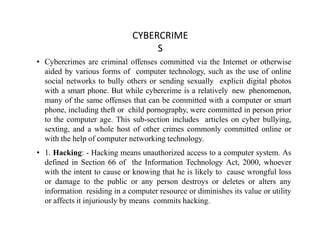
CYBERCRIME
S
• Cybercrimes are criminal offenses committed via the Internet or otherwise
aided by various forms of computer technology, such as the use of online
social networks to bully others or sending sexually explicit digital photos
with a smart phone. But while cybercrime is a relatively new phenomenon,
many of the same offenses that can be committed with a computer or smart
phone, including theft or child pornography, were committed in person prior
to the computer age. This sub-section includes articles on cyber bullying,
sexting, and a whole host of other crimes commonly committed online or
with the help of computer networking technology.
• 1. Hacking: - Hacking means unauthorized access to a computer system. As
defined in Section 66 of the Information Technology Act, 2000, whoever
with the intent to cause or knowing that he is likely to cause wrongful loss
or damage to the public or any person destroys or deletes or alters any
information residing in a computer resource or diminishes its value or utility
or affects it injuriously by means commits hacking.
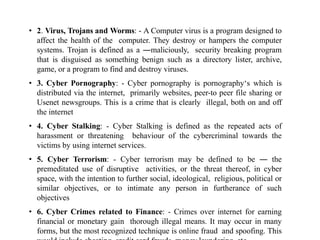
• 2. Virus, Trojans and Worms: - A Computer virus is a program designed to
affect the health of the computer. They destroy or hampers the computer
systems. Trojan is defined as a ―maliciously, security breaking program
that is disguised as something benign such as a directory lister, archive,
game, or a program to find and destroy viruses.
• 3. Cyber Pornography: - Cyber pornography is pornography‘s which is
distributed via the internet, primarily websites, peer-to peer file sharing or
Usenet newsgroups. This is a crime that is clearly illegal, both on and off
the internet
• 4. Cyber Stalking: - Cyber Stalking is defined as the repeated acts of
harassment or threatening behaviour of the cybercriminal towards the
victims by using internet services.
• 5. Cyber Terrorism: - Cyber terrorism may be defined to be ― the
premeditated use of disruptive activities, or the threat thereof, in cyber
space, with the intention to further social, ideological, religious, political or
similar objectives, or to intimate any person in furtherance of such
objectives
• 6. Cyber Crimes related to Finance: - Crimes over internet for earning
financial or monetary gain thorough illegal means. It may occur in many
forms, but the most recognized technique is online fraud and spoofing. This
Cyber Crime under Information Technology Act:
National Perspective
Statuary Provisions (Information Technology Act, 2000)
• The first step in the field of cyber law was the Model Law which was drafted
under the United Nations Commissions on International Trade law, 1986.
Then, the United Nations general assembly on 30th January, 1999 passed a
resolution to regulate e-commerce through uniform set of laws applicable to its
member‘s countries.
• Being a signatory to the resolution, Parliament of India has a passed the
Information Technology Act,
2000 on 17th may, 2000.
• The preamble of the Act states that the objectives of the act is to legalise e-
commerce and further amend the Indian penal Code, 1860, the India Evidence
Act,182, the Banker‘s Book Evidence Act, 1891and the Reserve Bank of
IndiaAct, 1934 to make compatible with thisAct.
• The Act consists of 13 Chapters and governs laws relating to Electronic
Contract, Electronic Record, Digital Signature and the use of the electronic
records and signature in Government records. It also regulates the activities
of the Network Service Providers, Internet Service Providers (ISPs).
PunishmentsAnd Offences
• The main aim of the act is to legalize the digital language so that people can
easily and without fear use the electronic devices for their own purposes like
doing business or for entertainment. It prescribes certain offences and
penalties to keep a check on the cyber crime, the main of them are:
• Section 65: Tampering with Computer Source Documents
• Section 66: Hacking with Computer System
• Section 67: Publishing of obscene information which is obscene in electronic
form.
• Section 72: Penalty breach of confidentially and privacy.
• In addition to above, Section 77 of the Act states that “No penalty imposed or
confiscation made under this Act shall prevent the imposition of any other
punishment to which the person affected thereby is liable under any other law
for the time being in force.” which means the civil crimes can also be made as
CriminalAct, as:
• Computer Network Breaking and Hacking: - S. 66(2) of I.T.Act and S. 441
of IPC
• Child Pornography: - S. 67 of I.T.Act and S. 294 of IPC
• Email- bombing: - S. 43(e) of I.T.Act and S. 425-441 read with S447 of IPC
• Password Sniffing: - S. 43(a), (g) of I.T.Act and S. 419 of IPC
• Credit Card Fraud: - S. 43(h) I.T.Act and S. 443 (a) and (g) read with 426,
427 and 447 of IPC.
UNIT-3 (B)
CYBER CRIME UNDER INFORMATION
TECHNOLOGY
ACT: INTERNATIONALPERSPECTIVE &
CONVENTIONS
USA
• The Computer Fraud and Abuse Act, deals with the issue of
unauthorized access in the U S legal
system. The legislation was first enacted in 1984, revised in 1994, and last
amended made in late 1996.
• Thus, USA has passed several enactments, which cover various aspect of
cyber crime. The States of USA also pass various federal laws for the
protection of cyber crime. These Federal Acts, however either are to
introduced or amend existing provisions in U.S. Federal Code.
• The major provisions of U.S. codes governing criminal activities can broadly
discussed in the following
heads:
 Federal Criminal Code Concerning computer crimes
 Federal Statutes Governing Intellectual property Rights:
• Copyright Offences
• Copyright Management offences
• Trademark offences.
• Bootlegging offences
• Trade Secret Offences
• Offences concerning the integrity of IP System
• Offences concerning the Misuse of Dissemination system
• Cyber Stalking
 Search and seizure of Computers
 Guidelines concerning sentences
• U.S.A. has successfully enacted provisions relating to offences, there
investigation and sentencing. The country is leading in the field of checking
cybercrime along through effective police forces, particularly F.B.I., and
people cooperation. The numbers of cyber criminals are also greater in the
country because of predominance of internet and cyber technology in day-to-
day life.
• The Counterfeit Access Device and Computer Fraud and Abuse Act of
1984 prohibits various attacks on federal computer systems and on those
used by banks and in interstate and foreign commerce.
• The Electronic Communications Privacy Act of 1986 (ECPA)
prohibits unauthorized electronic
eavesdropping.
• The Federal Information Security ManagementAct of 2002 (FISMA).
• United States has a specific CAN-Spam Act 2003, which came into
force in January 2004. Major provisions are:
 False and misleading header information is banned
 Deceptive subject lines are prohibited
 Opt-out methods must be provided
 Commercial email must be identified as an advertisement and it must include
the sender's valid physical
postal address
 Receivers must be warned of sexually explicit material. Penalties include fine
up to USD 11000 and also imprisonment in specific circumstances.
UK
• The Computer Misuse Act 1990, 'an Act to make provision for securing
computer material against unauthorized access or modification; and for
connected purposes', set out three computer misuse offences.
• Unauthorized access to computer material
• Unauthorized access with intent to commit or facilitate commission of
further offences.
• Unauthorized modification of computer material.
• The maximum prison sentences specified by the act for each offence
were six months and five years respectively.
• The Police and Justice Act 2006 : The British Police and Justice (2006) bill
was granted Royal Assent with some interesting changes being introduced to
the Computer Misuse Act (1990) under Part 5 (Miscellaneous) which could
have serious implications for those on the murkier side of computing. The
Computer Misuse Act obviously needed updating, as most of the threats in
existence today were not possible 16 years ago. Maximum sentencing for
unauthorized access to computer was also used.
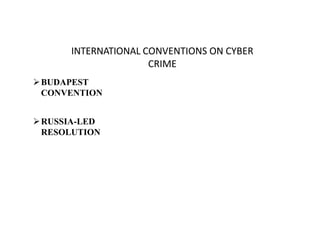
INTERNATIONAL CONVENTIONS ON CYBER
CRIME
BUDAPEST
CONVENTION
RUSSIA-LED
RESOLUTION
BUDAPEST
CONVENTION
• Budapest Convention on cybercrime provides for the criminalisation of
conduct, ranging from illegal access, data and systems interference to
computer-related fraud and child pornography; procedural law tools to make
the investigation of cybercrime and the securing of e-evidence in relation to
any crime more effective and international police and judicial
cooperation on cybercrime and e-evidence.
• The Budapest Convention is supplemented by a Protocol on Xenophobia and
Racism committed through computer systems.
• In 2014, the Council of Europe established a dedicated Programme Office on
Cybercrime (C-PROC) in Bucharest, Romania.
• This triangle of common standards (Budapest Convention), follow-up and
assessments (Cybercrime Convention Committee) and capacity building (C-
PROC) represents a dynamic framework under the convention.
• Members: 67 states — together with 10 international organisations (such as
the Commonwealth Secretariat, INTERPOL, International
Telecommunication Union and the UN Office on Drugs and Crime)
participate as members or observers in the Cybercrime Convention
Committee.
• Significance: Securing e-evidence for criminal justice purposes is particularly
challenging in the context of cloud computing where data is distributed over
different services, providers, locations and often jurisdictions, and where
mutual legal assistance is often not feasible.
• India and the Budapest Convention: While membership in the Budapest
Convention more than doubled since then, India is yet to join this treaty.
India's concern:
• As India did not participate in the negotiation of the Convention and thus
should not sign it. India can become a member but we cannot participate in
making or changing the law.
• The Budapest Convention allows for trans-border access to data and
thus infringes on national sovereignty.
• It is a criminal justice treaty and thus does not cover state actors or that
some of the states from which
most attacks affecting India emanate have not signed the Convention.
• India should promote a treaty at the UN level: India wants a treaty to focus
on terrorism, or to address state-to-state relations and matters of international
security.
• The Budapest Convention has been validly criticized for its lack of human
rights and legal safeguards.
RUSSIA-LED
RESOLUTION
• The Russian proposal entitled “Countering the use of information and
communications technologies for criminal purposes” was recently put forth in
the United Nations GeneralAssembly (UNGA).
• The proposal, which India voted in favour of, creates a committee to convene
in August 2020 in New York to establish a new treaty through which nation-
states can coordinate and share data to prevent cybercrime.
• India maintained its status as a non-member of the Europe-led Budapest
Convention, even as it voted in favour of a Russian-led UN resolution to set
up a separate convention
• This recent UN proposal follows previous Russian initiatives, including the
“Draft United Nations Convention on Cooperation in Combating Cybercrime”
in 2017 to develop a UN convention on cybercrime.
• India’s Stand
• India maintained its status as a non-member of the Europe-led Budapest
Convention. Although, India voted in favour of a Russian-led UN resolution
to set up a separate convention.
SUMMARY
• The United Nations has approved a Russian-led bid that aims to
create a new convention on cybercrime, alarming rights
groups and Western powers that fear a bid to restrict online freedom.
• The General Assembly approved the resolution sponsored by Russia and
backed by China, which would set up a committee of international experts in
2020.
• Why the US is worried about this?
• A new UN treaty on cybercrime could render the Budapest Convention
obsolete, further alarming rights
groups.
• The Budapest Convention was drafted by the Council of Europe, but other
countries have joined, including the United States and Japan.
• Russia has opposed the Budapest Convention, arguing that giving
investigators access to computer data across borders violates national
sovereignty.
• What is Budapest convention?
• Also known as the Convention on Cybercrime, it is the first international
treaty seeking to address Internet and computer crime by harmonizing
national laws, improving investigative techniques, and increasing
cooperation among nations.
• It was drawn up by the Council of Europe in Strasbourg, France, with the
active participation of the Council of Europe’s observer states Canada, Japan,
SouthAfrica and the United States.
• It is open for ratification even to states that are not members of the Council
of Europe.
• As of September 2019, 64 states have ratified the convention.
• It was drawn up by the Council of Europe in Strasbourg, France, with the
active participation of the Council of Europe’s observer states Canada, Japan,
Philippines, SouthAfrica and the US.
• It was opened for signature in Budapest, on 23 November 2001 and it entered
into force on 1 July 2004.
• The convention is the sole legally binding multilateral treaty that
coordinates cybercrime investigations between nation-states and criminalizes
certain cybercrime conduct.
• What it does?
• The Budapest Convention provides for the criminalisation of conduct, ranging
from illegal access, data and systems interference to computer-related fraud and
child pornography, procedural law tools to make investigation of cybercrime and
securing of e-evidence in relation to any crime more effective, and international
police and judicial cooperation on cybercrime and e-evidence.
• India’s concerns over signing of this agreement:
• India did not participate in the negotiation of the Convention and thus is worried
about it.
• The Convention — through its Article 32b — allows for transborder access to
data and thus infringes on national sovereignty.
• The regime of the Convention is not effective, “the promise of cooperation not
firm enough,” or that there
are grounds for refusal to cooperate.
• Why dint India ratify?
• Since it entered into force, important countries like Brazil and India have declined
to adopt the Convention on
the grounds that they did not participate in its drafting.
• India’s is concerned due to data sharing with foreign law enforcement
agencies as it infringes on national sovereignty.
The Russian proposal
• It entitled “Countering the use of information and communications technologies
for criminal purposes” was
passed in the UNGA.
• It allows for regarding cross-border access to data, including by limiting the
ability of a signatory to refuse to provide access to requested data.
• The proposal creates a committee to convene in August 2020 in New York to
establish a new treaty through
which nation-states can coordinate and share data to prevent cybercrime.
UNIT-3 (C)
CYBER JURISDICTION
CYBER
JURISDICTION
• The internet can be seen as a multi jurisdictional because of the ease which a
user can access of website anywhere in the world. It can be even viewed as a
jurisdictional issue in the sense that from the user‘s perspective that the state
and national borders are essentially transparent. For courts determining
jurisdiction situation is more problematic.
• The whole trouble with internet jurisdiction is the presence of multiple parties
in various parts of the world who have only a virtual nexus with each other.
Then, if one party wants to sue the other, where can he sue?
• Traditional requirement generally encompass two areas:-
• 1. Firstly, the Place where the defendant reside, or
• 2. Secondly, where the cause of action arises.
• However, in the context of the internet or cyberspace (Cyberspace is the
electronic medium of computer networks, in which online communication
takes place), both these are difficult to establish with any certainty. Issues of
this nature have contributed to the complete confusion and contradictions
that plague judicial decisions in the area of internet jurisdiction.
• Because cyberspace has no geographical boundaries, it establishes immediate
long-distance communications with anyone who can have access to any
website. Usually an internet user has no way of knowing exactly where the
information on a site is being accessed from. Here, i.e., in cyberspace,
jurisdiction issues are of primary importance. As Internet does not tend to
make geographical and jurisdictional boundaries clear, Internet users remain
in physical jurisdictions and are subject to laws independent of their
presence on the Internet.
• In each case, a determination should be made as to where an online presence
will subject the user to jurisdiction in a distant state or a foreign company. As
such, a single transaction may involve the laws of at least three jurisdictions:
• 1. The laws of the state/nation in which the user resides,
• 2. The laws of the state/nation that apply where the server hosting the
transaction is located, and
• 3. The laws of the state/nation which apply to the person or business with
whom the transaction takes place.
• So a user in one of the Indian States conducting a transaction with another
user in Britain through a server in Canada could theoretically be subject to
the laws of all three countries as they relate to the transaction at hand. The
laws of a nation may have extra-territorial impact extending the jurisdiction
beyond the sovereign and territorial limits of that nation. This is particularly
problematic, as the medium of the Internet does not explicitly territorial
limitations.
• There is no uniform, international jurisdictional law of universal application,
and such questions are generally a matter of conflict of law, particularly
private international law.
• An example would be where the contents of a web site are legal in one
country and illegal in another. In the absence of a uniform jurisdictional
code, legal practitioners are generally left with a conflict of law issue.
• Jurisdiction in case of Cyber crime
• In order for a national court to adjudicate criminal and regulatory sanctions
internationally, there must be some connection, or nexus, between the
regulating nation (the forum) and the crime or criminal. Four nexuses have
been invoked by courts to justify their exercise of jurisdiction.
• 1. The territoriality nexus holds that the place where an offense is
committed-in whole or in part
determines jurisdiction.
• 2. The nationality nexus looks to the nationality or national character of the
person committing the offense to establish jurisdiction.
• 3. The protective nexus provides for jurisdiction when a national or
international interest of the forum is injured by the offender.
• 4. The universality nexus holds that a court has jurisdiction over certain
offenses that are recognized by the community of nations as being of
universal concern, including piracy, the slave trade, attacks on or the
hijacking of aircraft, genocide, war crimes, and crimes against humanity.
It is not enough that these nexuses exist; the connection between the
forum and the person or activity also must be “reasonable.”
Extra territorial jurisdiction
• The main problem arises when a citizen of some other country causes harm to
citizens of a native country, let’s take for an example in India, though
Information Technology Act, 2000 does have extra territorial jurisdiction but
it’s very difficult to enforce it and exercise it.
• If a crime is committed in Delhi by a citizen of US by hacking the systems of
an Indian Company, that maximum the court can do is pass an order in favour
of the plaintiff but the problem arises that how to punish the US citizen, the
only thing which the hacker has to do is avoid coming to India, moreover as
it’s an international matter collection of evidence will also be a trouble for
all.
• Hacking is still a crime of greater degree but it creates problem in case of
crimes like publishing obscene materials on websites, if a citizen of U.K posts
obscene material. Are the international Extradition laws strict enough enforce
an arrest? What if theAct is an offence in India but not in his native country?
• Prosecuting and trying a person also raises difficult problem in the field of
jurisdiction. These problems relate to determination of place where the
offence was committed (locus delicti- The place where a crime was
committed) and where several jurisdictions are equally competent.
• Under the Information Technology Act, 2000, India claims “long arm”
jurisdiction over foreign parties committing criminal acts outside of India
which have an effect on a computer information system located within India.
A court may order law enforcement authorities to seize computer equipment
that is suspected of having been used in the commission of a computer
crime. It is possible for more than one punishment to be administered for
commission of the same unlawful acts if more than one criminal law has
been violated. Section 75 of the Information Technology Act, 2000 deals with
extraterritorial application of the law, the section states that the provisions of
theAct will apply to
• (a)Any person irrespective of nationality
• (b)An offence or contravention committed outside India
• (c)The said offence or contravention must have been committed against a
computer, computer system or computer network located in India.
UNIT-3 (D)
MOBILE PHONES CRIMES
MOBILE PHONES
CRIMES
• Telecommunications in India have evolved up to a great extent starting from
its introduction in 1882 to the introduction of mobile technology in 1995
and then to the emerging trend of Smartphone’s post 2005 period. Similarly,
with the advancement of technology, crimes over technological grounds have
also evolved.
• Mobile technology over the years has evolved upto a large extent be it on
grounds of flexibility or portability. Security measures too have improved,
but not at the desired expected rate to absolutely curb crime rates. The fact
that tops the list is that people fail to believe that they can be victims to such
crimes.
• Crime committed using modern technological tools are generally known as
cyber crimes. The broadest way to deliver the true meaning of cyber crime
is “any crime wherein computer is either used as a tool or a weapon.” On
general lines, computers are considered to be of laptop or desktop in form.
Kinds of Mobile
Crimes
Mobile Hacking
• Hacking in simple terms means an illegal intrusion into a computer system
and/or network. There is an equivalent term to hacking i.e. cracking. Every
act committed towards breaking into a mobile, communication devices,
computer and/or network is hacking. Hackers write or use ready-made
computer programs to attack the target computer, mobile and/or
communication devices.
Mobile Cyber Defamation
• This kind of crime has become widely prevalent across the world today.
Criminals send derogatory, humiliative and obscene SMS or email by using
their mobiles, cell phones and communication devices, so as to defame others
and lower their reputation in the eyes of those who hold them in high esteem.
Mobile Pornography
• The Internet is being highly used by its abusers to reach and abuse children
sexually, worldwide. The internet is very fast becoming a household
commodity. As more homes have access to internet, more children would be
using the mobiles, communications devices, internet and more are the chances
of falling victim to the aggression of pedophiles.
• Mobile Pornography using mobile phone could be brought specifically within
the ambit of section 67B of the amended Indian Information Technology Act
2000. The said act is a crime, punishable with imprisonment of either
description for a term which may extend to 5 years and with fine which may
extend to 10 lakh rupees.
Identity Theft:
• Mobile phone is used for the identity theft and criminals commit the crimes
such as subscription fraud etc. using various communication devices.
Cloning or re-chapping of mobile:
• A clone is an analogue mobile phone which has been programmed to
impersonate one owned by a legitimate subscriber by using its ESN and
telephone number (these numbers are usually obtained by interception with
a ‘scanner’ radio, theft of a dealer’s or service provider’s records or directly
from the impersonated phone). New types of cloned phones are coming to
the UK from the USA and Hong Kong: ‘tumbling’ phones automatically
seek an identity from a pre-programmed list, and the most recent ‘magic’
phones act as their own scanners copying identities from nearby phones in
use.
Mobile Cyber Stalking
• Cyber Stalking can be defined as the repeated acts harassment or threatening
behaviour of the cyber- criminal towards the victim by using mobiles
internet services. Stalking in General terms can be referred to as the
repeated acts of harassment targeting the victim such as following the victim,
making harassing phone calls, killing the victims pet, vandalizing victims
property, leaving written messages or objects. Stalking may be followed by
serious violent acts such as physical harm to the victim and the same has to
be treated and viewed seriously. It all depends on the course of conduct of
the stalker.
• Denial of serviceAttack
• This is an act by the criminal, who floods the bandwidth of the victim’s
network or fills his e-mail box with spam mail depriving him of the services
he is entitled to access or provide.
• Mobiles Virus Dissemination
• A mobile virus is an electronic virus that targets mobile phones or other
communication devices. In
typical mobile virus dissemination malicious software attaches itself to other
software.
• Mobile Software Piracy
• Theft of mobile software through the illegal copying of genuine programs
or the counterfeiting and distribution of products intended to pass for the
original.
Mobile Credit Card Fraud
• The unauthorized and illegal use of a credit card through mobile to purchase
products and /or services.
Mobile Phishing
• This refers to the act of targeting mobile phone users by phishing emails that
appear to come from mobile service providers. This further includes the act
of sending an e-mail to a user falsely claiming to be an established legitimate
enterprise in an attempt to scam the user into surrendering private
information that will be used for identity theft.

Unit-3 Cyber Crime PPT.pptx

  • 1.
    SEMESTER: SEVENTH SEMESTER BALLB/ BBA LLB NAME OF THE SUBJECT: LAW & EMERGING TECHNOLOGY INDUSTRIAL REVOLUTION & NOTION OF TECHNOLOGY Unit-3 Dr. Sonia Rajoria Assistant Professor Center for Legal Studies Gitarattan International Business School
  • 2.
    UNIT-3 (A) CYBER CRIMEUNDER INFORMATION TECHNOLOGY ACT: NATIONAL PERSPECTIVE
  • 3.
    CYBERCRIME S • Cybercrimes arecriminal offenses committed via the Internet or otherwise aided by various forms of computer technology, such as the use of online social networks to bully others or sending sexually explicit digital photos with a smart phone. But while cybercrime is a relatively new phenomenon, many of the same offenses that can be committed with a computer or smart phone, including theft or child pornography, were committed in person prior to the computer age. This sub-section includes articles on cyber bullying, sexting, and a whole host of other crimes commonly committed online or with the help of computer networking technology. • 1. Hacking: - Hacking means unauthorized access to a computer system. As defined in Section 66 of the Information Technology Act, 2000, whoever with the intent to cause or knowing that he is likely to cause wrongful loss or damage to the public or any person destroys or deletes or alters any information residing in a computer resource or diminishes its value or utility or affects it injuriously by means commits hacking.
  • 4.
    • 2. Virus,Trojans and Worms: - A Computer virus is a program designed to affect the health of the computer. They destroy or hampers the computer systems. Trojan is defined as a ―maliciously, security breaking program that is disguised as something benign such as a directory lister, archive, game, or a program to find and destroy viruses. • 3. Cyber Pornography: - Cyber pornography is pornography‘s which is distributed via the internet, primarily websites, peer-to peer file sharing or Usenet newsgroups. This is a crime that is clearly illegal, both on and off the internet • 4. Cyber Stalking: - Cyber Stalking is defined as the repeated acts of harassment or threatening behaviour of the cybercriminal towards the victims by using internet services. • 5. Cyber Terrorism: - Cyber terrorism may be defined to be ― the premeditated use of disruptive activities, or the threat thereof, in cyber space, with the intention to further social, ideological, religious, political or similar objectives, or to intimate any person in furtherance of such objectives • 6. Cyber Crimes related to Finance: - Crimes over internet for earning financial or monetary gain thorough illegal means. It may occur in many forms, but the most recognized technique is online fraud and spoofing. This
  • 5.
    Cyber Crime underInformation Technology Act: National Perspective Statuary Provisions (Information Technology Act, 2000) • The first step in the field of cyber law was the Model Law which was drafted under the United Nations Commissions on International Trade law, 1986. Then, the United Nations general assembly on 30th January, 1999 passed a resolution to regulate e-commerce through uniform set of laws applicable to its member‘s countries. • Being a signatory to the resolution, Parliament of India has a passed the Information Technology Act, 2000 on 17th may, 2000. • The preamble of the Act states that the objectives of the act is to legalise e- commerce and further amend the Indian penal Code, 1860, the India Evidence Act,182, the Banker‘s Book Evidence Act, 1891and the Reserve Bank of IndiaAct, 1934 to make compatible with thisAct.
  • 6.
    • The Actconsists of 13 Chapters and governs laws relating to Electronic Contract, Electronic Record, Digital Signature and the use of the electronic records and signature in Government records. It also regulates the activities of the Network Service Providers, Internet Service Providers (ISPs). PunishmentsAnd Offences • The main aim of the act is to legalize the digital language so that people can easily and without fear use the electronic devices for their own purposes like doing business or for entertainment. It prescribes certain offences and penalties to keep a check on the cyber crime, the main of them are: • Section 65: Tampering with Computer Source Documents • Section 66: Hacking with Computer System • Section 67: Publishing of obscene information which is obscene in electronic form. • Section 72: Penalty breach of confidentially and privacy.
  • 7.
    • In additionto above, Section 77 of the Act states that “No penalty imposed or confiscation made under this Act shall prevent the imposition of any other punishment to which the person affected thereby is liable under any other law for the time being in force.” which means the civil crimes can also be made as CriminalAct, as: • Computer Network Breaking and Hacking: - S. 66(2) of I.T.Act and S. 441 of IPC • Child Pornography: - S. 67 of I.T.Act and S. 294 of IPC • Email- bombing: - S. 43(e) of I.T.Act and S. 425-441 read with S447 of IPC • Password Sniffing: - S. 43(a), (g) of I.T.Act and S. 419 of IPC • Credit Card Fraud: - S. 43(h) I.T.Act and S. 443 (a) and (g) read with 426, 427 and 447 of IPC.
  • 8.
    UNIT-3 (B) CYBER CRIMEUNDER INFORMATION TECHNOLOGY ACT: INTERNATIONALPERSPECTIVE & CONVENTIONS
  • 9.
    USA • The ComputerFraud and Abuse Act, deals with the issue of unauthorized access in the U S legal system. The legislation was first enacted in 1984, revised in 1994, and last amended made in late 1996. • Thus, USA has passed several enactments, which cover various aspect of cyber crime. The States of USA also pass various federal laws for the protection of cyber crime. These Federal Acts, however either are to introduced or amend existing provisions in U.S. Federal Code. • The major provisions of U.S. codes governing criminal activities can broadly discussed in the following heads:  Federal Criminal Code Concerning computer crimes  Federal Statutes Governing Intellectual property Rights: • Copyright Offences • Copyright Management offences • Trademark offences.
  • 10.
    • Bootlegging offences •Trade Secret Offences • Offences concerning the integrity of IP System • Offences concerning the Misuse of Dissemination system • Cyber Stalking  Search and seizure of Computers  Guidelines concerning sentences • U.S.A. has successfully enacted provisions relating to offences, there investigation and sentencing. The country is leading in the field of checking cybercrime along through effective police forces, particularly F.B.I., and people cooperation. The numbers of cyber criminals are also greater in the country because of predominance of internet and cyber technology in day-to- day life. • The Counterfeit Access Device and Computer Fraud and Abuse Act of 1984 prohibits various attacks on federal computer systems and on those used by banks and in interstate and foreign commerce.
  • 11.
    • The ElectronicCommunications Privacy Act of 1986 (ECPA) prohibits unauthorized electronic eavesdropping. • The Federal Information Security ManagementAct of 2002 (FISMA). • United States has a specific CAN-Spam Act 2003, which came into force in January 2004. Major provisions are:  False and misleading header information is banned  Deceptive subject lines are prohibited  Opt-out methods must be provided  Commercial email must be identified as an advertisement and it must include the sender's valid physical postal address  Receivers must be warned of sexually explicit material. Penalties include fine up to USD 11000 and also imprisonment in specific circumstances.
  • 12.
    UK • The ComputerMisuse Act 1990, 'an Act to make provision for securing computer material against unauthorized access or modification; and for connected purposes', set out three computer misuse offences. • Unauthorized access to computer material • Unauthorized access with intent to commit or facilitate commission of further offences. • Unauthorized modification of computer material. • The maximum prison sentences specified by the act for each offence were six months and five years respectively. • The Police and Justice Act 2006 : The British Police and Justice (2006) bill was granted Royal Assent with some interesting changes being introduced to the Computer Misuse Act (1990) under Part 5 (Miscellaneous) which could have serious implications for those on the murkier side of computing. The Computer Misuse Act obviously needed updating, as most of the threats in existence today were not possible 16 years ago. Maximum sentencing for unauthorized access to computer was also used.
  • 13.
    INTERNATIONAL CONVENTIONS ONCYBER CRIME BUDAPEST CONVENTION RUSSIA-LED RESOLUTION
  • 14.
    BUDAPEST CONVENTION • Budapest Conventionon cybercrime provides for the criminalisation of conduct, ranging from illegal access, data and systems interference to computer-related fraud and child pornography; procedural law tools to make the investigation of cybercrime and the securing of e-evidence in relation to any crime more effective and international police and judicial cooperation on cybercrime and e-evidence. • The Budapest Convention is supplemented by a Protocol on Xenophobia and Racism committed through computer systems. • In 2014, the Council of Europe established a dedicated Programme Office on Cybercrime (C-PROC) in Bucharest, Romania. • This triangle of common standards (Budapest Convention), follow-up and assessments (Cybercrime Convention Committee) and capacity building (C- PROC) represents a dynamic framework under the convention.
  • 15.
    • Members: 67states — together with 10 international organisations (such as the Commonwealth Secretariat, INTERPOL, International Telecommunication Union and the UN Office on Drugs and Crime) participate as members or observers in the Cybercrime Convention Committee. • Significance: Securing e-evidence for criminal justice purposes is particularly challenging in the context of cloud computing where data is distributed over different services, providers, locations and often jurisdictions, and where mutual legal assistance is often not feasible. • India and the Budapest Convention: While membership in the Budapest Convention more than doubled since then, India is yet to join this treaty.
  • 16.
    India's concern: • AsIndia did not participate in the negotiation of the Convention and thus should not sign it. India can become a member but we cannot participate in making or changing the law. • The Budapest Convention allows for trans-border access to data and thus infringes on national sovereignty. • It is a criminal justice treaty and thus does not cover state actors or that some of the states from which most attacks affecting India emanate have not signed the Convention. • India should promote a treaty at the UN level: India wants a treaty to focus on terrorism, or to address state-to-state relations and matters of international security. • The Budapest Convention has been validly criticized for its lack of human rights and legal safeguards.
  • 17.
    RUSSIA-LED RESOLUTION • The Russianproposal entitled “Countering the use of information and communications technologies for criminal purposes” was recently put forth in the United Nations GeneralAssembly (UNGA). • The proposal, which India voted in favour of, creates a committee to convene in August 2020 in New York to establish a new treaty through which nation- states can coordinate and share data to prevent cybercrime. • India maintained its status as a non-member of the Europe-led Budapest Convention, even as it voted in favour of a Russian-led UN resolution to set up a separate convention • This recent UN proposal follows previous Russian initiatives, including the “Draft United Nations Convention on Cooperation in Combating Cybercrime” in 2017 to develop a UN convention on cybercrime. • India’s Stand • India maintained its status as a non-member of the Europe-led Budapest Convention. Although, India voted in favour of a Russian-led UN resolution to set up a separate convention.
  • 18.
    SUMMARY • The UnitedNations has approved a Russian-led bid that aims to create a new convention on cybercrime, alarming rights groups and Western powers that fear a bid to restrict online freedom. • The General Assembly approved the resolution sponsored by Russia and backed by China, which would set up a committee of international experts in 2020. • Why the US is worried about this? • A new UN treaty on cybercrime could render the Budapest Convention obsolete, further alarming rights groups. • The Budapest Convention was drafted by the Council of Europe, but other countries have joined, including the United States and Japan. • Russia has opposed the Budapest Convention, arguing that giving investigators access to computer data across borders violates national sovereignty.
  • 19.
    • What isBudapest convention? • Also known as the Convention on Cybercrime, it is the first international treaty seeking to address Internet and computer crime by harmonizing national laws, improving investigative techniques, and increasing cooperation among nations. • It was drawn up by the Council of Europe in Strasbourg, France, with the active participation of the Council of Europe’s observer states Canada, Japan, SouthAfrica and the United States. • It is open for ratification even to states that are not members of the Council of Europe. • As of September 2019, 64 states have ratified the convention. • It was drawn up by the Council of Europe in Strasbourg, France, with the active participation of the Council of Europe’s observer states Canada, Japan, Philippines, SouthAfrica and the US. • It was opened for signature in Budapest, on 23 November 2001 and it entered into force on 1 July 2004. • The convention is the sole legally binding multilateral treaty that coordinates cybercrime investigations between nation-states and criminalizes certain cybercrime conduct.
  • 20.
    • What itdoes? • The Budapest Convention provides for the criminalisation of conduct, ranging from illegal access, data and systems interference to computer-related fraud and child pornography, procedural law tools to make investigation of cybercrime and securing of e-evidence in relation to any crime more effective, and international police and judicial cooperation on cybercrime and e-evidence. • India’s concerns over signing of this agreement: • India did not participate in the negotiation of the Convention and thus is worried about it. • The Convention — through its Article 32b — allows for transborder access to data and thus infringes on national sovereignty. • The regime of the Convention is not effective, “the promise of cooperation not firm enough,” or that there are grounds for refusal to cooperate.
  • 21.
    • Why dintIndia ratify? • Since it entered into force, important countries like Brazil and India have declined to adopt the Convention on the grounds that they did not participate in its drafting. • India’s is concerned due to data sharing with foreign law enforcement agencies as it infringes on national sovereignty. The Russian proposal • It entitled “Countering the use of information and communications technologies for criminal purposes” was passed in the UNGA. • It allows for regarding cross-border access to data, including by limiting the ability of a signatory to refuse to provide access to requested data. • The proposal creates a committee to convene in August 2020 in New York to establish a new treaty through which nation-states can coordinate and share data to prevent cybercrime.
  • 22.
  • 23.
    CYBER JURISDICTION • The internetcan be seen as a multi jurisdictional because of the ease which a user can access of website anywhere in the world. It can be even viewed as a jurisdictional issue in the sense that from the user‘s perspective that the state and national borders are essentially transparent. For courts determining jurisdiction situation is more problematic. • The whole trouble with internet jurisdiction is the presence of multiple parties in various parts of the world who have only a virtual nexus with each other. Then, if one party wants to sue the other, where can he sue? • Traditional requirement generally encompass two areas:- • 1. Firstly, the Place where the defendant reside, or • 2. Secondly, where the cause of action arises.
  • 24.
    • However, inthe context of the internet or cyberspace (Cyberspace is the electronic medium of computer networks, in which online communication takes place), both these are difficult to establish with any certainty. Issues of this nature have contributed to the complete confusion and contradictions that plague judicial decisions in the area of internet jurisdiction. • Because cyberspace has no geographical boundaries, it establishes immediate long-distance communications with anyone who can have access to any website. Usually an internet user has no way of knowing exactly where the information on a site is being accessed from. Here, i.e., in cyberspace, jurisdiction issues are of primary importance. As Internet does not tend to make geographical and jurisdictional boundaries clear, Internet users remain in physical jurisdictions and are subject to laws independent of their presence on the Internet.
  • 25.
    • In eachcase, a determination should be made as to where an online presence will subject the user to jurisdiction in a distant state or a foreign company. As such, a single transaction may involve the laws of at least three jurisdictions: • 1. The laws of the state/nation in which the user resides, • 2. The laws of the state/nation that apply where the server hosting the transaction is located, and • 3. The laws of the state/nation which apply to the person or business with whom the transaction takes place. • So a user in one of the Indian States conducting a transaction with another user in Britain through a server in Canada could theoretically be subject to the laws of all three countries as they relate to the transaction at hand. The laws of a nation may have extra-territorial impact extending the jurisdiction beyond the sovereign and territorial limits of that nation. This is particularly problematic, as the medium of the Internet does not explicitly territorial limitations.
  • 26.
    • There isno uniform, international jurisdictional law of universal application, and such questions are generally a matter of conflict of law, particularly private international law. • An example would be where the contents of a web site are legal in one country and illegal in another. In the absence of a uniform jurisdictional code, legal practitioners are generally left with a conflict of law issue. • Jurisdiction in case of Cyber crime • In order for a national court to adjudicate criminal and regulatory sanctions internationally, there must be some connection, or nexus, between the regulating nation (the forum) and the crime or criminal. Four nexuses have been invoked by courts to justify their exercise of jurisdiction.
  • 27.
    • 1. Theterritoriality nexus holds that the place where an offense is committed-in whole or in part determines jurisdiction. • 2. The nationality nexus looks to the nationality or national character of the person committing the offense to establish jurisdiction. • 3. The protective nexus provides for jurisdiction when a national or international interest of the forum is injured by the offender. • 4. The universality nexus holds that a court has jurisdiction over certain offenses that are recognized by the community of nations as being of universal concern, including piracy, the slave trade, attacks on or the hijacking of aircraft, genocide, war crimes, and crimes against humanity. It is not enough that these nexuses exist; the connection between the forum and the person or activity also must be “reasonable.”
  • 28.
    Extra territorial jurisdiction •The main problem arises when a citizen of some other country causes harm to citizens of a native country, let’s take for an example in India, though Information Technology Act, 2000 does have extra territorial jurisdiction but it’s very difficult to enforce it and exercise it. • If a crime is committed in Delhi by a citizen of US by hacking the systems of an Indian Company, that maximum the court can do is pass an order in favour of the plaintiff but the problem arises that how to punish the US citizen, the only thing which the hacker has to do is avoid coming to India, moreover as it’s an international matter collection of evidence will also be a trouble for all. • Hacking is still a crime of greater degree but it creates problem in case of crimes like publishing obscene materials on websites, if a citizen of U.K posts obscene material. Are the international Extradition laws strict enough enforce an arrest? What if theAct is an offence in India but not in his native country? • Prosecuting and trying a person also raises difficult problem in the field of jurisdiction. These problems relate to determination of place where the offence was committed (locus delicti- The place where a crime was committed) and where several jurisdictions are equally competent.
  • 29.
    • Under theInformation Technology Act, 2000, India claims “long arm” jurisdiction over foreign parties committing criminal acts outside of India which have an effect on a computer information system located within India. A court may order law enforcement authorities to seize computer equipment that is suspected of having been used in the commission of a computer crime. It is possible for more than one punishment to be administered for commission of the same unlawful acts if more than one criminal law has been violated. Section 75 of the Information Technology Act, 2000 deals with extraterritorial application of the law, the section states that the provisions of theAct will apply to • (a)Any person irrespective of nationality • (b)An offence or contravention committed outside India • (c)The said offence or contravention must have been committed against a computer, computer system or computer network located in India.
  • 30.
  • 31.
    MOBILE PHONES CRIMES • Telecommunicationsin India have evolved up to a great extent starting from its introduction in 1882 to the introduction of mobile technology in 1995 and then to the emerging trend of Smartphone’s post 2005 period. Similarly, with the advancement of technology, crimes over technological grounds have also evolved. • Mobile technology over the years has evolved upto a large extent be it on grounds of flexibility or portability. Security measures too have improved, but not at the desired expected rate to absolutely curb crime rates. The fact that tops the list is that people fail to believe that they can be victims to such crimes. • Crime committed using modern technological tools are generally known as cyber crimes. The broadest way to deliver the true meaning of cyber crime is “any crime wherein computer is either used as a tool or a weapon.” On general lines, computers are considered to be of laptop or desktop in form.
  • 32.
    Kinds of Mobile Crimes MobileHacking • Hacking in simple terms means an illegal intrusion into a computer system and/or network. There is an equivalent term to hacking i.e. cracking. Every act committed towards breaking into a mobile, communication devices, computer and/or network is hacking. Hackers write or use ready-made computer programs to attack the target computer, mobile and/or communication devices. Mobile Cyber Defamation • This kind of crime has become widely prevalent across the world today. Criminals send derogatory, humiliative and obscene SMS or email by using their mobiles, cell phones and communication devices, so as to defame others and lower their reputation in the eyes of those who hold them in high esteem.
  • 33.
    Mobile Pornography • TheInternet is being highly used by its abusers to reach and abuse children sexually, worldwide. The internet is very fast becoming a household commodity. As more homes have access to internet, more children would be using the mobiles, communications devices, internet and more are the chances of falling victim to the aggression of pedophiles. • Mobile Pornography using mobile phone could be brought specifically within the ambit of section 67B of the amended Indian Information Technology Act 2000. The said act is a crime, punishable with imprisonment of either description for a term which may extend to 5 years and with fine which may extend to 10 lakh rupees. Identity Theft: • Mobile phone is used for the identity theft and criminals commit the crimes such as subscription fraud etc. using various communication devices.
  • 34.
    Cloning or re-chappingof mobile: • A clone is an analogue mobile phone which has been programmed to impersonate one owned by a legitimate subscriber by using its ESN and telephone number (these numbers are usually obtained by interception with a ‘scanner’ radio, theft of a dealer’s or service provider’s records or directly from the impersonated phone). New types of cloned phones are coming to the UK from the USA and Hong Kong: ‘tumbling’ phones automatically seek an identity from a pre-programmed list, and the most recent ‘magic’ phones act as their own scanners copying identities from nearby phones in use. Mobile Cyber Stalking • Cyber Stalking can be defined as the repeated acts harassment or threatening behaviour of the cyber- criminal towards the victim by using mobiles internet services. Stalking in General terms can be referred to as the repeated acts of harassment targeting the victim such as following the victim, making harassing phone calls, killing the victims pet, vandalizing victims property, leaving written messages or objects. Stalking may be followed by serious violent acts such as physical harm to the victim and the same has to be treated and viewed seriously. It all depends on the course of conduct of the stalker.
  • 35.
    • Denial ofserviceAttack • This is an act by the criminal, who floods the bandwidth of the victim’s network or fills his e-mail box with spam mail depriving him of the services he is entitled to access or provide. • Mobiles Virus Dissemination • A mobile virus is an electronic virus that targets mobile phones or other communication devices. In typical mobile virus dissemination malicious software attaches itself to other software. • Mobile Software Piracy • Theft of mobile software through the illegal copying of genuine programs or the counterfeiting and distribution of products intended to pass for the original.
  • 36.
    Mobile Credit CardFraud • The unauthorized and illegal use of a credit card through mobile to purchase products and /or services. Mobile Phishing • This refers to the act of targeting mobile phone users by phishing emails that appear to come from mobile service providers. This further includes the act of sending an e-mail to a user falsely claiming to be an established legitimate enterprise in an attempt to scam the user into surrendering private information that will be used for identity theft.