NAVODAYA DENTAL COLLEGE
DEPARTMENT OF PEDODONTICS
STAFF NAME – Dr VINOD KUMAR
Professor and Head of department
TOPIC NAME – ISOLATION AND MATRICES
ISOLATION
Isolating the working area:
I) Isolation from moisture (saliva, blood &
gingival crevicular fluid)
II) Isolation from soft tissues ( lips, cheeks,
gingiva & tongue)
RUBBER DAM
One of the most effective way of isolation
Usually made of latex rubber
Developed by S. C. Barnum(1864), a New York City
dentist.
ARMAMENTARIUM
1. Rubber dam sheet
2. Rubber dam frame
3. Rubber dam punch
4. Rubber dam forceps
5. Clamps
6. Waxed dental floss
7. Scissors
8. Rubber dam napkin
9. Lubricants
RUBBER DAM SHEET
Grade Thickness [mm]
• Thin 0.15
• Medium 0.20
•Heavy 0.25
•Extra Heavy 0.30
•Special extra heavy 0.35
•Available as rolls or prefabricated *Size 5’’x5” or 6”x6”
• Available in various colours
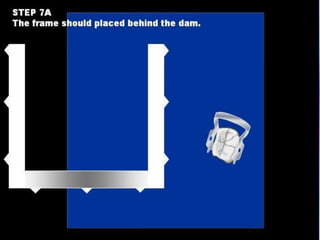
RUBBER DAM FRAME
Frames support the edges of the rubber dam sheets –retract
soft tissues & improve access to isolated teeth
These are of two types
Metallic
Plastic
RUBBER DAM PUNCH
•Is a precision instrument having
a rotating metal table (disk) with
5 or 6 holes of varying sizes and a sharp pointed plunger
• Used to produce the clean-cut holes in the rubber sheet
through which teeth can be isolated.
RUBBER DAM FORCEPS
Forceps needed to stretch the jaws of the clamp open in a controlled manner
during placement and removal.
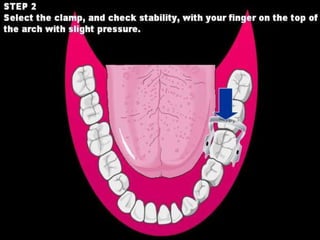
CLAMPS
• Clamps retain the rubber dam on teeth;
also retract gingival tissue
•Usually one or two clamps are used.
• Clamps -consist of four prongs & two jaws
connected by a bow.
• Bow or spring holds the jaws of the clamp
together and provides the force required
to grip the neck of the tooth
RUBBER DAM NAPKIN
•Absorbent material placed
between the rubber sheet and
the soft tissues.
•Used where chemicals are
used
Placement of rubber dam
3 methods
1. Dam first technique
2. Clamp first technique
3. Clamp and dam together technique
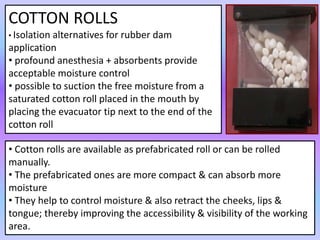
COTTON ROLLS
• Isolation alternatives for rubber dam
application
• profound anesthesia + absorbents provide
acceptable moisture control
• possible to suction the free moisture from a
saturated cotton roll placed in the mouth by
placing the evacuator tip next to the end of the
cotton roll
• Cotton rolls are available as prefabricated roll or can be rolled
manually.
• The prefabricated ones are more compact & can absorb more
moisture
• They help to control moisture & also retract the cheeks, lips &
tongue; thereby improving the accessibility & visibility of the working
area.
GAUZE PIECES
Used to prevent accidental ingestion or aspiration of small instruments
• Indicated when there is danger of
aspirating or swallowing small
objects.
•Important when treating teeth in the
maxillary arch.
•Gauze sponge (2 X 2 inch [5 X 5 cm]),
unfolded & spread over the tongue &
the posterior part of the mouth
EVACUATION SYSTEMS
•High-Volume Evacuators
•Low-Volume Evacuators
Tips are made of metal or plastic
*metallic ones should possess a rubber tip to avoid irritation to the
tissues sterilized after each patient plastic tips-disposable &
preferred.
No chance of cross contamination
High-Volume Evacuators are preferred for suctioning water & debris
from the mouth, & other shavings of tooth & restorative materials
Saliva ejectors remove water slowly & have little capacity for picking
up solids.
GINGIVAL RETRACTION CORDS
•Readymade cotton or synthetic fibers woven in form of cords.
• provide improved access & visibility.
• protects gingiva from abrasions
• inserted into the sulcus to keep moisture & gingiva away from tooth surface for
cavity preparation.
•Retraction cords having vasoconstrictors or styptics (local haemostatic) are used
to control sulcular seepage.
• May help restrict excess restorative material from entering the gingival sulcus
•Retraction cords may be
Braided Non-braided
Plain Impregnated
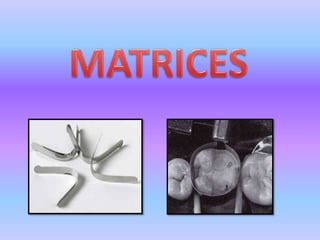
MATRICING
MATRICING is a procedure, whereby a temporary wall is created
opposite to axial wall & surrounding areas of the tooth structure that
were lost during preparation.
The matrix should posses the exact three-dimensional contour
(including the contact area) of the future restoration. Not only should it
be immobile while the material sets but also it should be easily
removable after hardening of the restorative material without
compromising the created contact & contour of the characteristics of
the restorative material.
Isolation and Matrices.pptx

Isolation and Matrices.pptx

  • 1.
    NAVODAYA DENTAL COLLEGE DEPARTMENTOF PEDODONTICS STAFF NAME – Dr VINOD KUMAR Professor and Head of department TOPIC NAME – ISOLATION AND MATRICES
  • 2.
    ISOLATION Isolating the workingarea: I) Isolation from moisture (saliva, blood & gingival crevicular fluid) II) Isolation from soft tissues ( lips, cheeks, gingiva & tongue)
  • 3.
    RUBBER DAM One ofthe most effective way of isolation Usually made of latex rubber Developed by S. C. Barnum(1864), a New York City dentist.
  • 4.
    ARMAMENTARIUM 1. Rubber damsheet 2. Rubber dam frame 3. Rubber dam punch 4. Rubber dam forceps 5. Clamps 6. Waxed dental floss 7. Scissors 8. Rubber dam napkin 9. Lubricants
  • 5.
    RUBBER DAM SHEET GradeThickness [mm] • Thin 0.15 • Medium 0.20 •Heavy 0.25 •Extra Heavy 0.30 •Special extra heavy 0.35 •Available as rolls or prefabricated *Size 5’’x5” or 6”x6” • Available in various colours
  • 6.
    RUBBER DAM FRAME Framessupport the edges of the rubber dam sheets –retract soft tissues & improve access to isolated teeth These are of two types Metallic Plastic
  • 7.
    RUBBER DAM PUNCH •Isa precision instrument having a rotating metal table (disk) with 5 or 6 holes of varying sizes and a sharp pointed plunger • Used to produce the clean-cut holes in the rubber sheet through which teeth can be isolated.
  • 8.
    RUBBER DAM FORCEPS Forcepsneeded to stretch the jaws of the clamp open in a controlled manner during placement and removal.
  • 9.
    CLAMPS • Clamps retainthe rubber dam on teeth; also retract gingival tissue •Usually one or two clamps are used. • Clamps -consist of four prongs & two jaws connected by a bow. • Bow or spring holds the jaws of the clamp together and provides the force required to grip the neck of the tooth
  • 10.
    RUBBER DAM NAPKIN •Absorbentmaterial placed between the rubber sheet and the soft tissues. •Used where chemicals are used
  • 11.
    Placement of rubberdam 3 methods 1. Dam first technique 2. Clamp first technique 3. Clamp and dam together technique
  • 22.
    COTTON ROLLS • Isolationalternatives for rubber dam application • profound anesthesia + absorbents provide acceptable moisture control • possible to suction the free moisture from a saturated cotton roll placed in the mouth by placing the evacuator tip next to the end of the cotton roll • Cotton rolls are available as prefabricated roll or can be rolled manually. • The prefabricated ones are more compact & can absorb more moisture • They help to control moisture & also retract the cheeks, lips & tongue; thereby improving the accessibility & visibility of the working area.
  • 23.
    GAUZE PIECES Used toprevent accidental ingestion or aspiration of small instruments • Indicated when there is danger of aspirating or swallowing small objects. •Important when treating teeth in the maxillary arch. •Gauze sponge (2 X 2 inch [5 X 5 cm]), unfolded & spread over the tongue & the posterior part of the mouth
  • 24.
    EVACUATION SYSTEMS •High-Volume Evacuators •Low-VolumeEvacuators Tips are made of metal or plastic *metallic ones should possess a rubber tip to avoid irritation to the tissues sterilized after each patient plastic tips-disposable & preferred. No chance of cross contamination High-Volume Evacuators are preferred for suctioning water & debris from the mouth, & other shavings of tooth & restorative materials Saliva ejectors remove water slowly & have little capacity for picking up solids.
  • 25.
    GINGIVAL RETRACTION CORDS •Readymadecotton or synthetic fibers woven in form of cords. • provide improved access & visibility. • protects gingiva from abrasions • inserted into the sulcus to keep moisture & gingiva away from tooth surface for cavity preparation. •Retraction cords having vasoconstrictors or styptics (local haemostatic) are used to control sulcular seepage. • May help restrict excess restorative material from entering the gingival sulcus •Retraction cords may be Braided Non-braided Plain Impregnated
  • 27.
    MATRICING MATRICING is aprocedure, whereby a temporary wall is created opposite to axial wall & surrounding areas of the tooth structure that were lost during preparation. The matrix should posses the exact three-dimensional contour (including the contact area) of the future restoration. Not only should it be immobile while the material sets but also it should be easily removable after hardening of the restorative material without compromising the created contact & contour of the characteristics of the restorative material.