

21 September 2014 
1
Group Member 
Khubaib Ur Rahman BSET-01113030 
Usman Lateef BSET 01113109 
Presented To 
Sir Yasir Dawood 
21 September 2014 
2
Table Of contents 
 ISO 
History 
Standards 
Organization Block Diagram 
 ISO 9000 Series 
21 September 2014 
3
21 September 2014 
4 
Topic:
ISO HISTORY DEFINITIONS 
 ISO is a network of the national standards institutes of 163 
countries, on the basis of one member per country, with a 
Central Secretariat in Geneva, Switzerland, that 
coordinates the system. 
 ISO is a non-governmental organization 
 ISO (International Organization for Standardization) is 
the world's largest developer and publisher 
of International Standards. 
 Member countries generate some 98 % of world gross 
national income (GNI). 
21 September 2014 
5
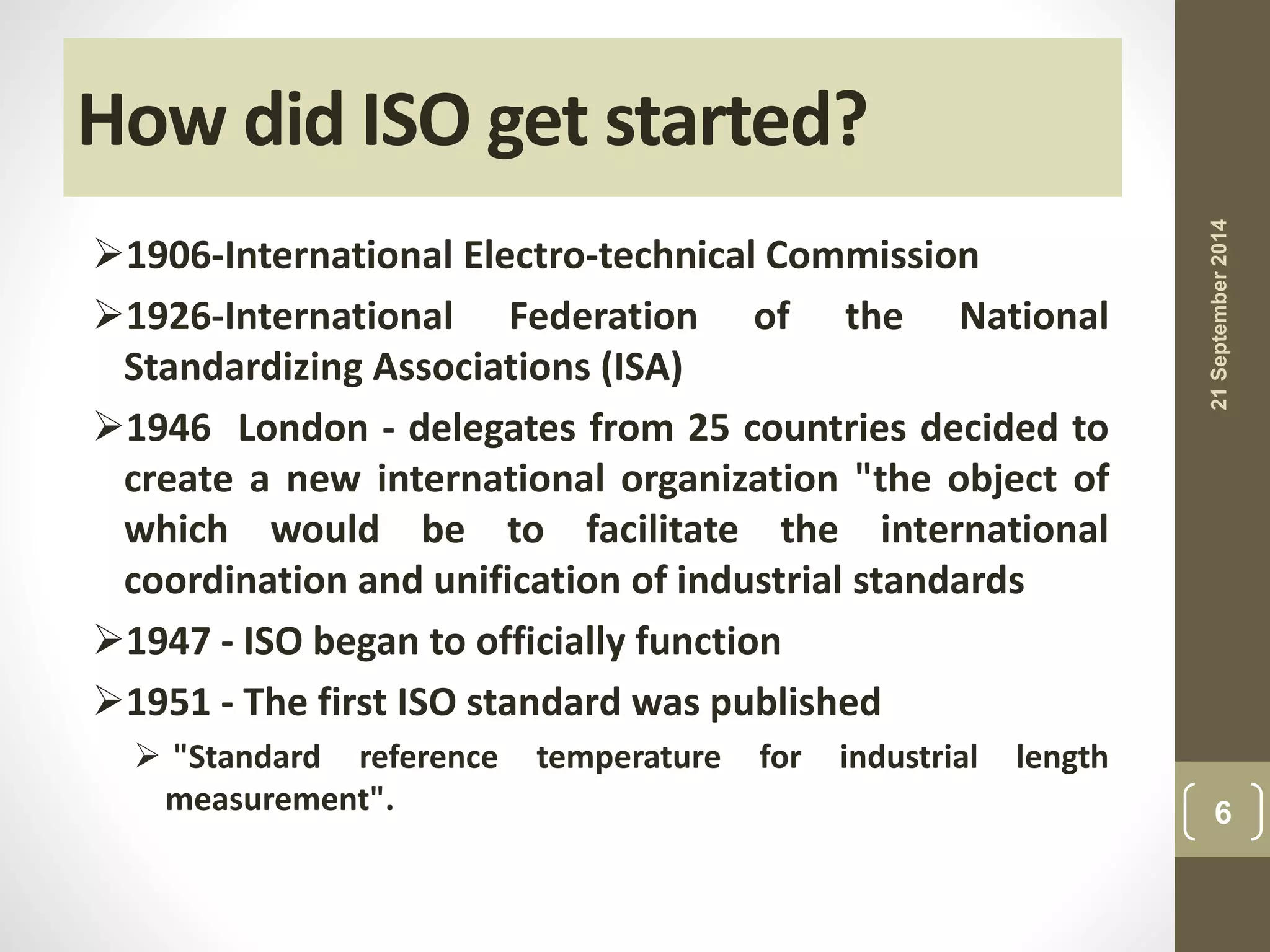
How did ISO get started? 
1906-International Electro-technical Commission 
1926-International Federation of the National 
Standardizing Associations (ISA) 
1946 London - delegates from 25 countries decided to 
create a new international organization "the object of 
which would be to facilitate the international 
coordination and unification of industrial standards 
1947 - ISO began to officially function 
1951 - The first ISO standard was published 
 "Standard reference temperature for industrial length 
measurement". 
21 September 2014 
6
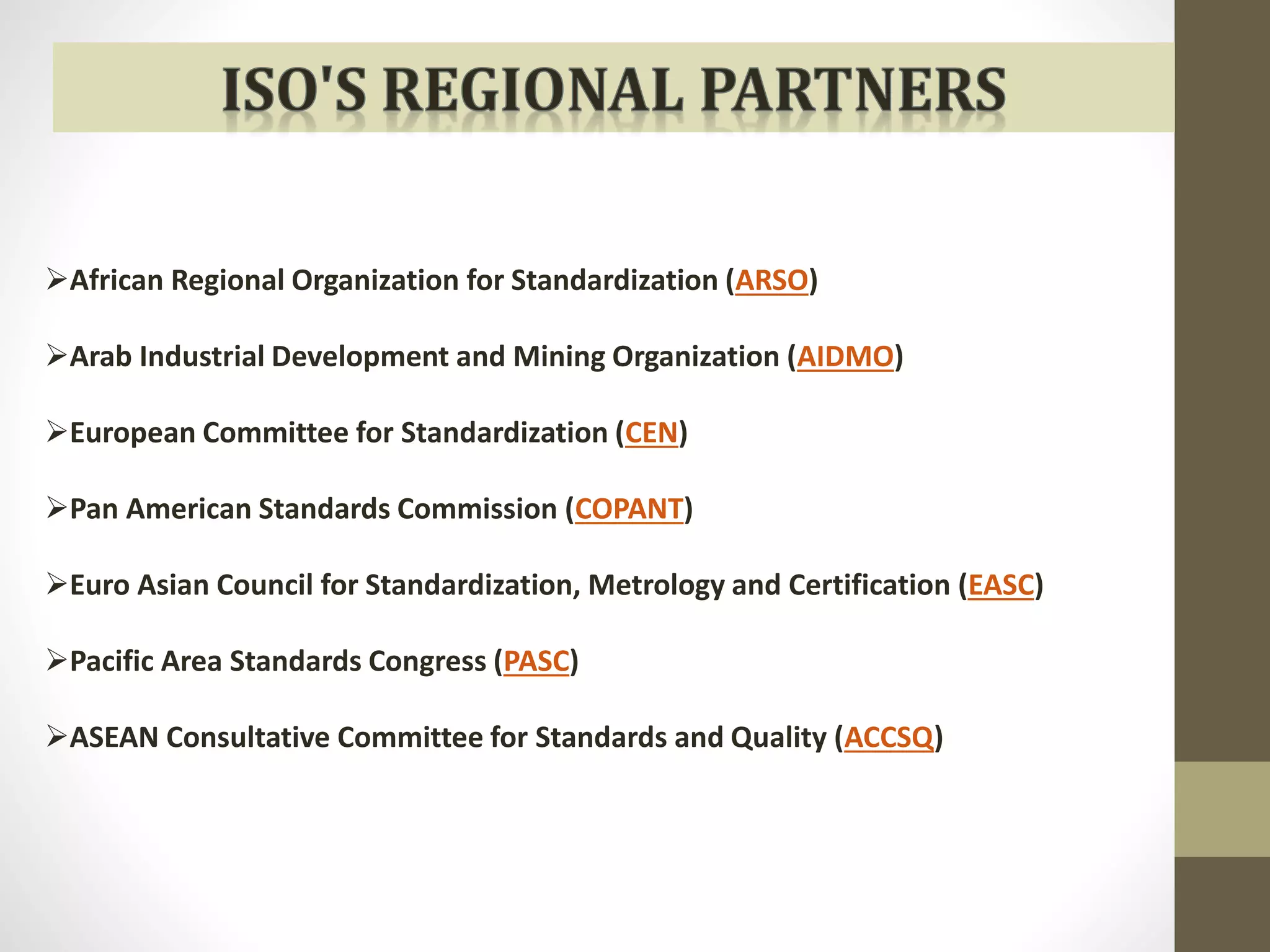
African Regional Organization for Standardization (ARSO) 
Arab Industrial Development and Mining Organization (AIDMO) 
European Committee for Standardization (CEN) 
Pan American Standards Commission (COPANT) 
Euro Asian Council for Standardization, Metrology and Certification (EASC) 
Pacific Area Standards Congress (PASC) 
ASEAN Consultative Committee for Standards and Quality (ACCSQ)
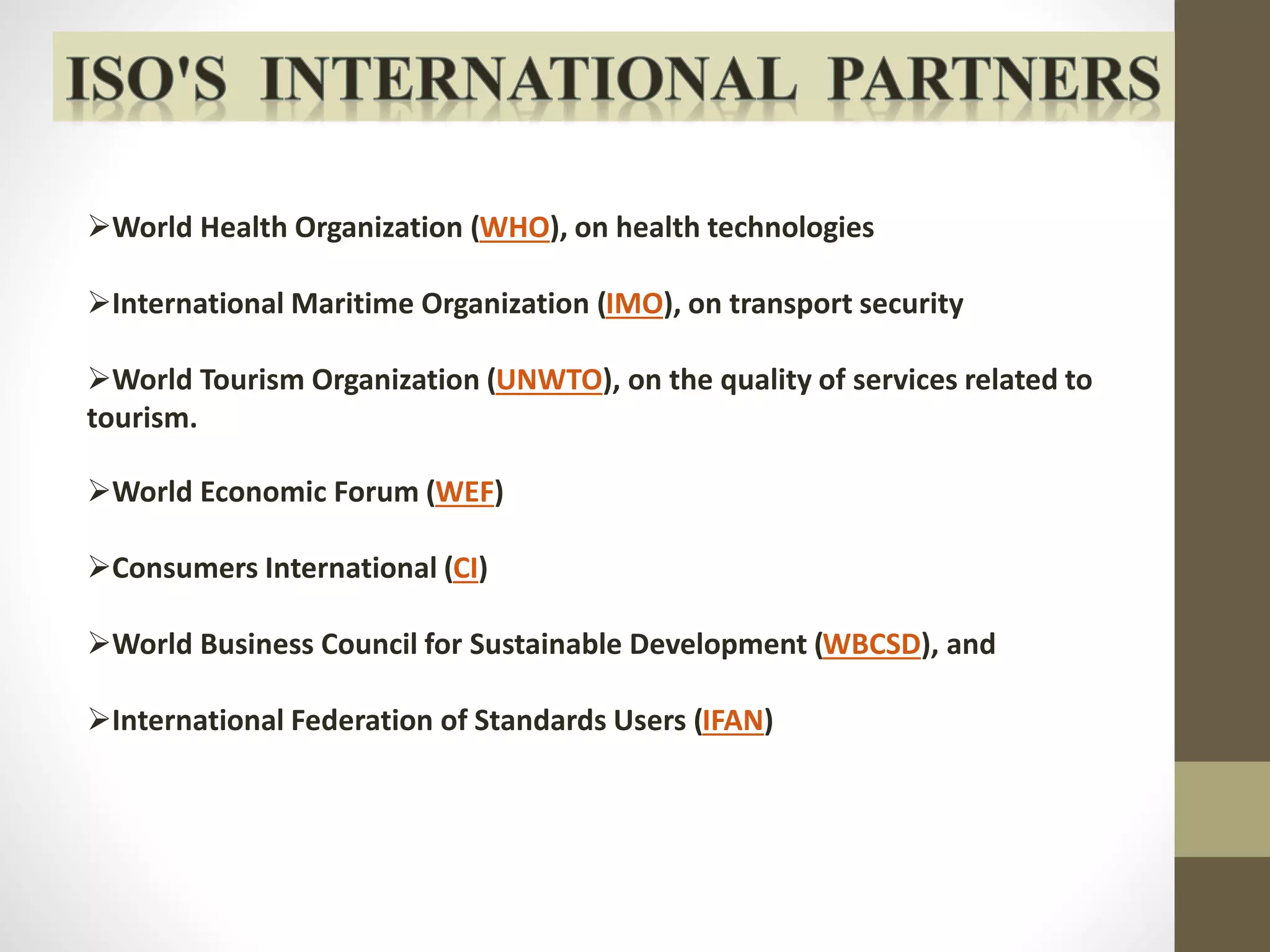
World Health Organization (WHO), on health technologies 
International Maritime Organization (IMO), on transport security 
World Tourism Organization (UNWTO), on the quality of services related to 
tourism. 
World Economic Forum (WEF) 
Consumers International (CI) 
World Business Council for Sustainable Development (WBCSD), and 
International Federation of Standards Users (IFAN)
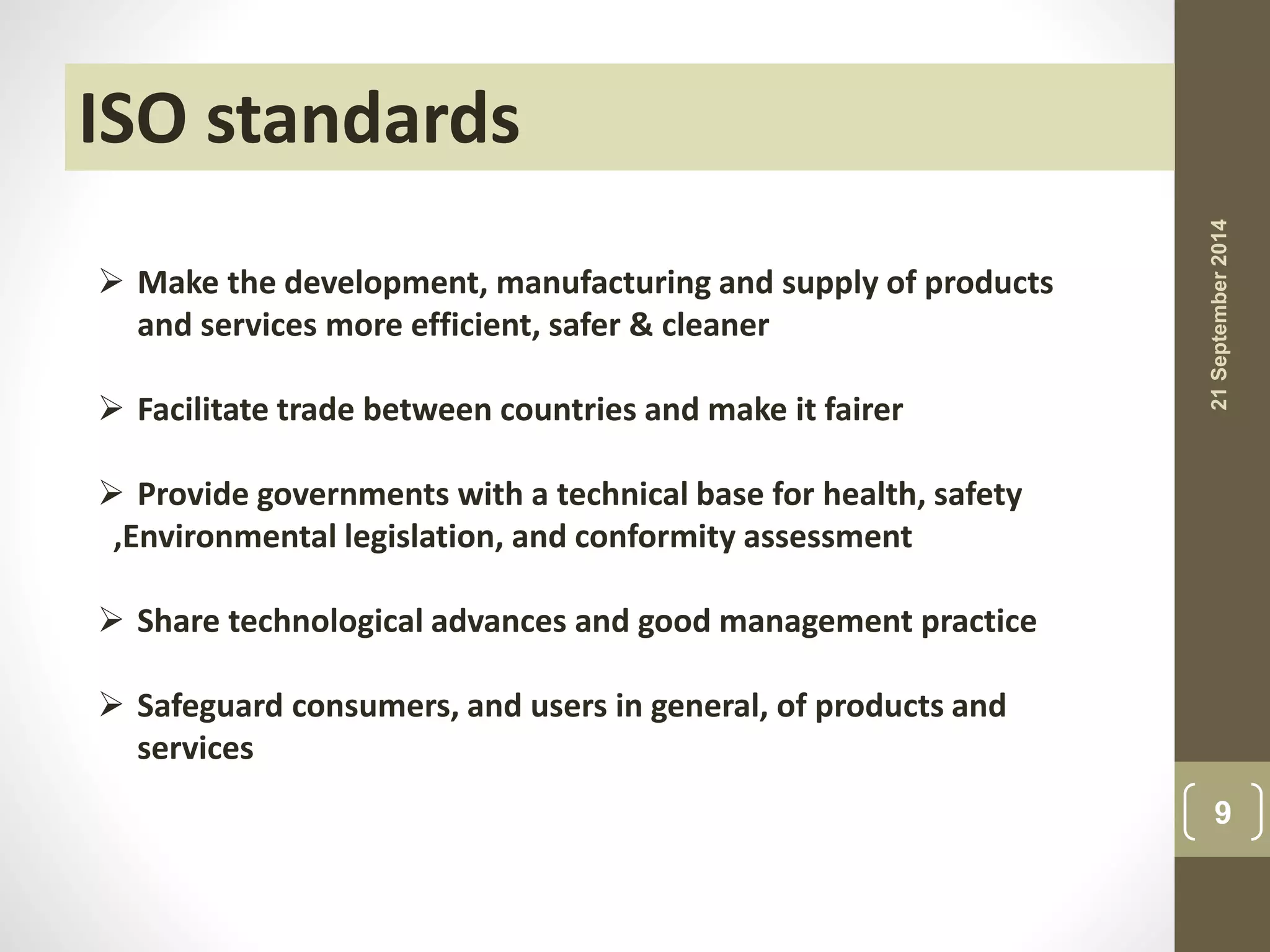
ISO standards 
 Make the development, manufacturing and supply of products 
and services more efficient, safer & cleaner 
 Facilitate trade between countries and make it fairer 
 Provide governments with a technical base for health, safety 
,Environmental legislation, and conformity assessment 
 Share technological advances and good management practice 
 Safeguard consumers, and users in general, of products and 
services 
21 September 2014 
9
 Make life simpler by providing solutions to common problems 
 ISO occupies a special position between the public & private sectors. 
 And the broader needs of society, such as the needs of stakeholder 
groups like consumers and users. 
 ISO is able to act as a bridging organization in which a consensus can 
be reached on solutions that meet both the requirements of business. 
21 September 2014 
10 
ISO standards
Popular standards 
• ISO 9000 Quality management 
• ISO 14000 Environmental management 
• ISO 3166 Country codes 
• ISO 26000 Social responsibility 
• ISO 50001 Energy management 
• ISO 31000 Risk management 
• ISO 22000 Food safety management 
• ISO 27001 Information security management 
• ISO 20121 Sustainable events 
21 September 2014 
11
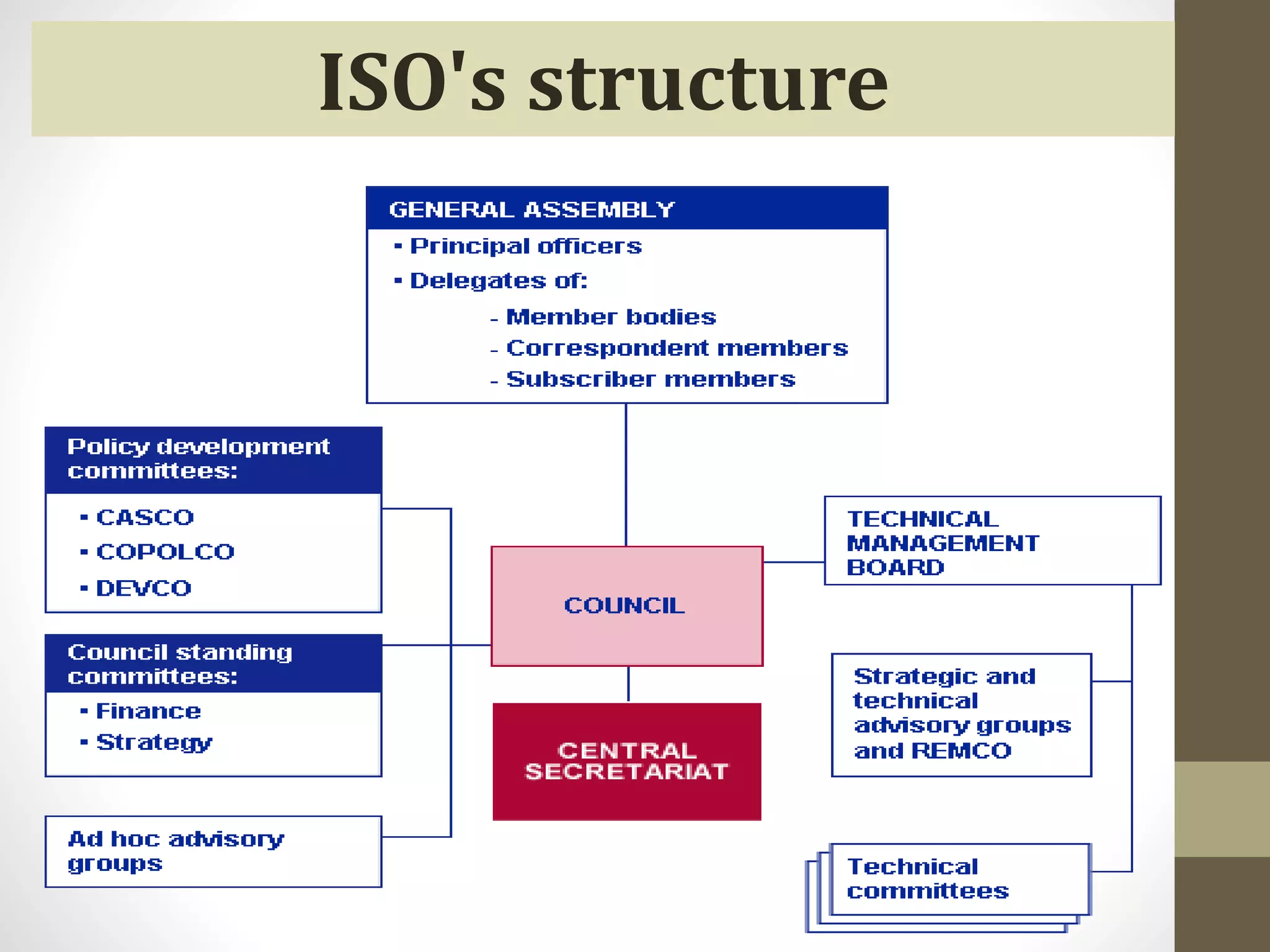
ISO's structure
What has ISO Accomplished? 
ISO film speed code 
Standard format for telephone and banking cards 
ISO 9000 which provides a framework for quality 
management and quality assurance 
ISO 14000 series provides a similar framework for 
environmental management 
Internationally standardized freight containers 
Standardized paper sizes. 
Automobile control symbols 
ISO international codes for country names, currencies 
and languages 
21 September 2014 
13
ISO 9000 
What You Need To Know 
21 September 2014 
14
ISO 9000 
What do you need to know about ISO 
9000? 
What are the ISO 9000 Series Standards? 
What are the elements of the Standards? 
Why is ISO 9000 so important? 
What is quality system registration? 
Ten steps to ISO 9000 registration 
21 September 2014 
15
Qualitymanagement 
Quality management also means what the organization 
does to 
i. Enhance customer satisfaction, and 
ii. Achieve continual improvement of its 
performance. 
21 September 2014 
16
Management system 
Management system means what the organization does 
to manage its processes, or activities in order that 
its products or services meet the organization’s 
objectives, such as 
i. Satisfying the customer's quality requirements, 
ii. Complying to regulations, or 
iii. Meeting environmental objectives 
21 September 2014 
17
21 September 2014 
18 
What is ISO 9000? 
ISO 9000 is a standard in which to conduct business 
It is a set of rules which should be followed in order to 
meet the needs and understand the wants of customers 
The standard is generic
What are ISO 9000 Standards? 
ISO 9000 Standards 
Define the required elements of an effective quality 
management system 
Can be applied to any company 
Adopted by the United States as the ANSI/ASQC Q90 
series. 
Revised 2000 – wider applicability 
21 September 2014 
19
What is a Quality Management System? 
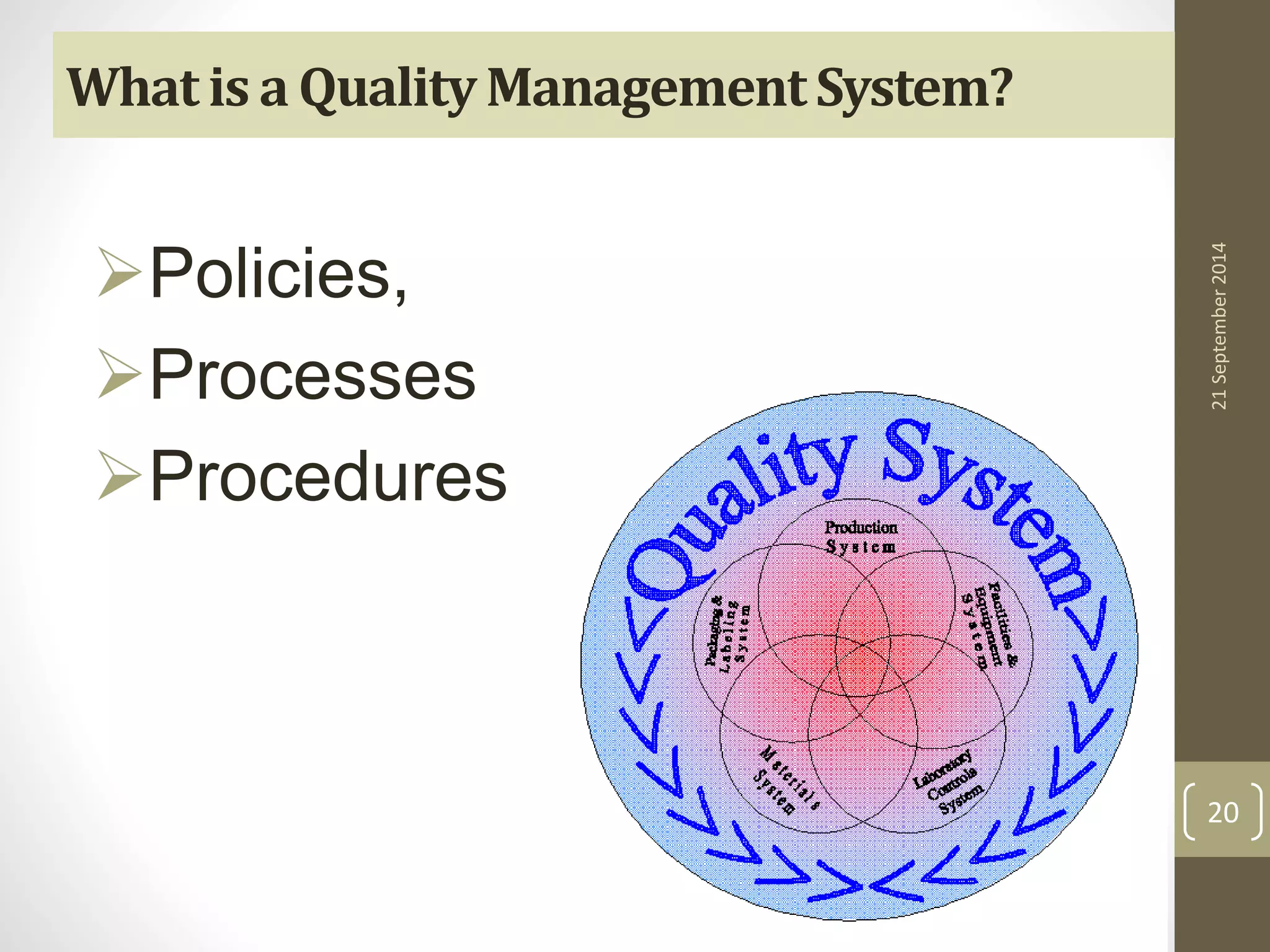
Policies, 
Processes 
Procedures 
21 September 2014 
20
What is a Quality Management System? 
Required for planning and executing 
business processes 
To meet customer requirements 
Accredited to International Standards 
by a Registrar 
ISO 9001:2008 is an example 
21 September 2014 
21
21 September 2014 
22
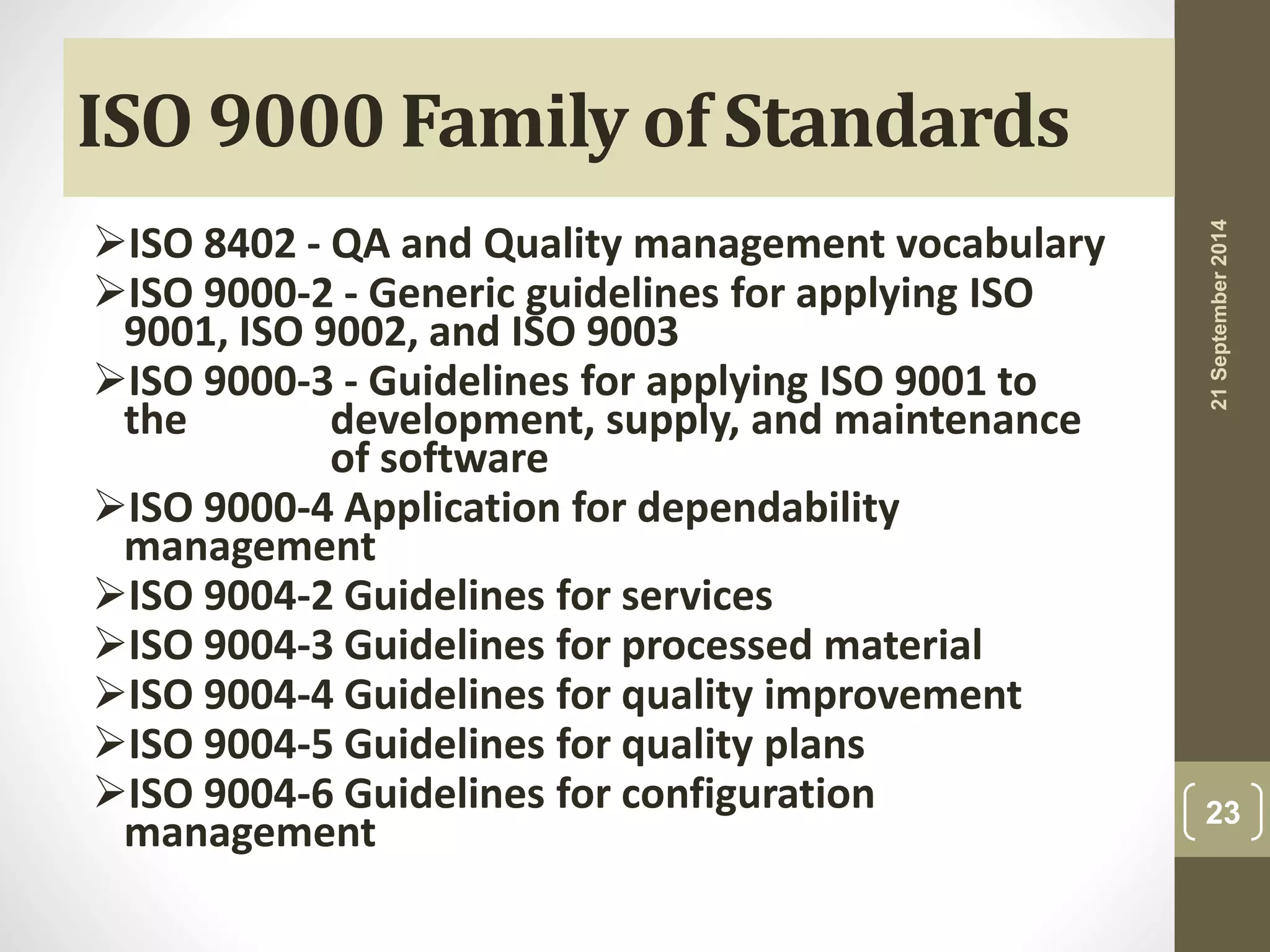
ISO 9000 Family of Standards 
ISO 8402 - QA and Quality management vocabulary 
ISO 9000-2 - Generic guidelines for applying ISO 
9001, ISO 9002, and ISO 9003 
ISO 9000-3 - Guidelines for applying ISO 9001 to 
the development, supply, and maintenance 
of software 
ISO 9000-4 Application for dependability 
management 
ISO 9004-2 Guidelines for services 
ISO 9004-3 Guidelines for processed material 
ISO 9004-4 Guidelines for quality improvement 
ISO 9004-5 Guidelines for quality plans 
ISO 9004-6 Guidelines for configuration 
management 
21 September 2014 
23
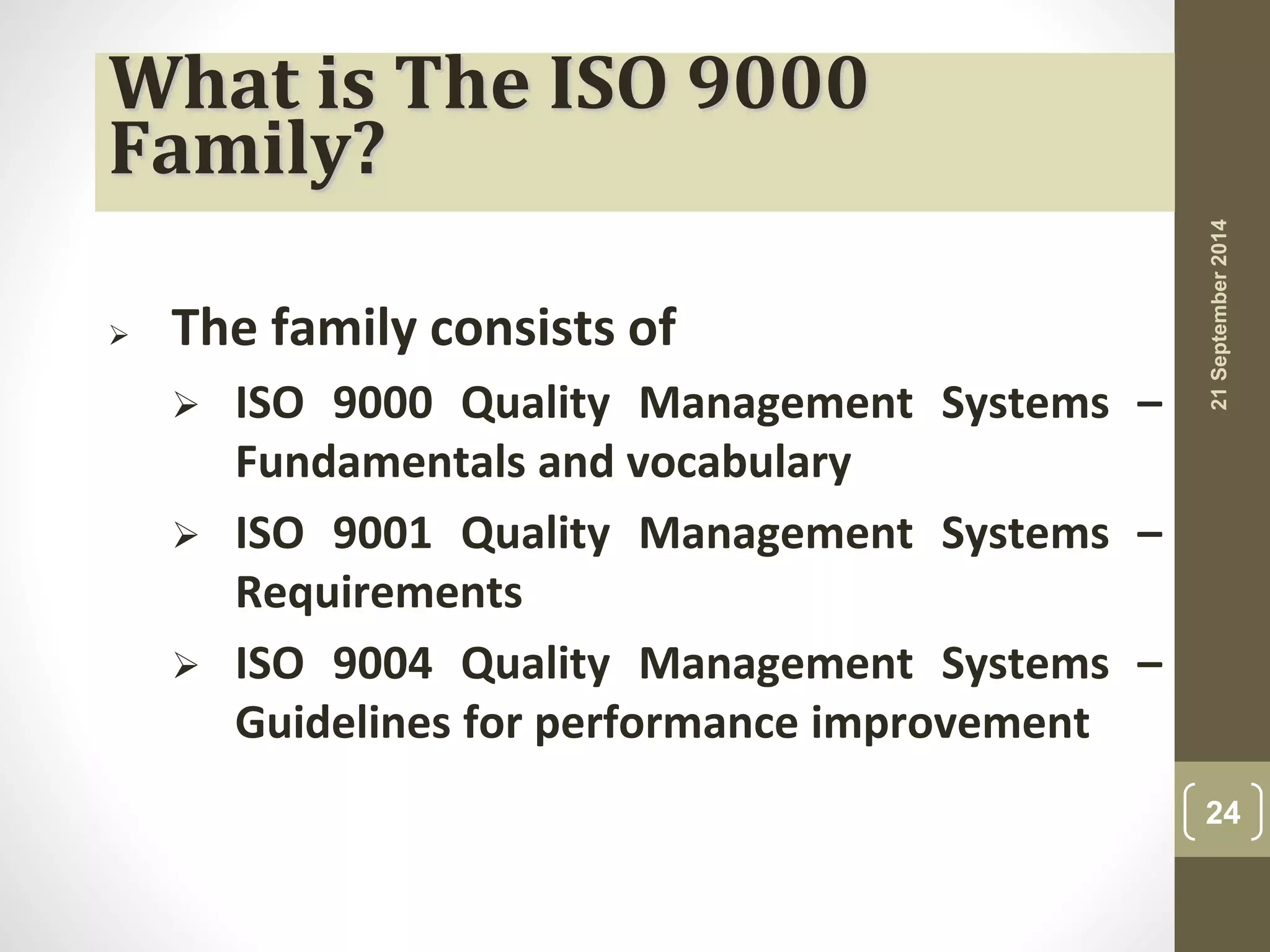
What is The ISO 9000 
Family? 
 The family consists of 
 ISO 9000 Quality Management Systems – 
Fundamentals and vocabulary 
 ISO 9001 Quality Management Systems – 
Requirements 
 ISO 9004 Quality Management Systems – 
Guidelines for performance improvement 
21 September 2014 
24
21 September 2014 
25 
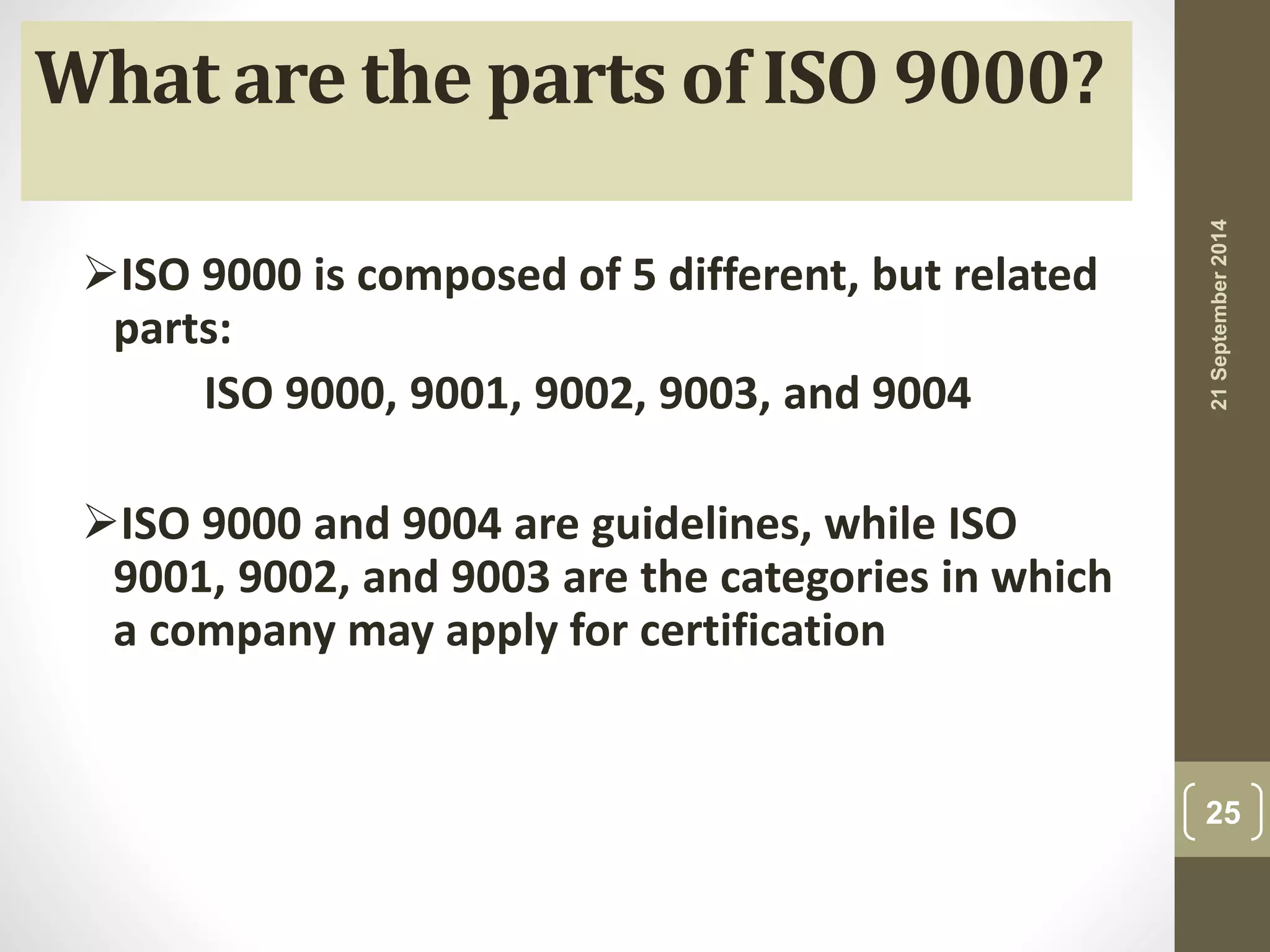
What are the parts of ISO 9000? 
ISO 9000 is composed of 5 different, but related 
parts: 
ISO 9000, 9001, 9002, 9003, and 9004 
ISO 9000 and 9004 are guidelines, while ISO 
9001, 9002, and 9003 are the categories in which 
a company may apply for certification
21 September 2014 
26 
Part 1: ISO 9000 
 ISO 9000: “Quality Management and 
Quality Assurance Standards – 
Guidelines for Selection and Use” 
Written in order to determine which 
category your organization should apply 
for
21 September 2014 
27 
Part 2: ISO 9001 
ISO 9001: “Quality Systems – Model for 
Quality Assurance in Design/Development, 
Production, Installation, and Servicing” 
This is the category for companies which are 
involved in manufacturing or the creation 
and delivery of a service.
21 September 2014 
28 
Part 3: ISO 9002 
ISO 9002: “Quality Systems – Model for Quality 
Assurance in Production and Installation” 
Companies who perform many functions, with 
the exception of design and development, may 
apply to this category
21 September 2014 
29 
Part 4: ISO 9003 
ISO 9003: “Quality Systems – Model for Quality 
Assurance in Final Inspection and Test” 
This category is useful for outside of the 
manufacturing sector, such as in distributors 
ISO 9003 is being used less and may be dropped 
in the future
21 September 2014 
30 
Part 5: ISO 9004 
ISO 9004: “Quality Management 
and Quality System Elements – 
Guidelines” 
Used in order to help interpret 
the categories included in ISO 
9000 certification
21 September 2014 
31 
ISO Implementation 
Implementing ISO 9000 in an organization can be very 
beneficial 
The goal of this implementation is to achieve customer 
satisfaction at its highest level
21 September 2014 
32 
How is ISO 9000 Being 
Implemented Today? 
ISO 9000 is being used in many organizations with 
mixed results 
If an organization implements ISO 9000 in order to 
simply remain competitive and without mutually 
beneficial goals in mind, it will most likely fail in 
the long term
21 September 2014 
33 
How can ISO 9000 be used in 
a business? 
 ISO 9000 can benefit many industries, such 
as: Banking 
Health Care 
Manufacturing, etc. 
 ISO 9000 is generic, so it can be applied 
virtually anywhere! 
 Remember, ISO 9000 is just one part of an 
entire system needed to create value for 
customers
21 September 2014 
34 
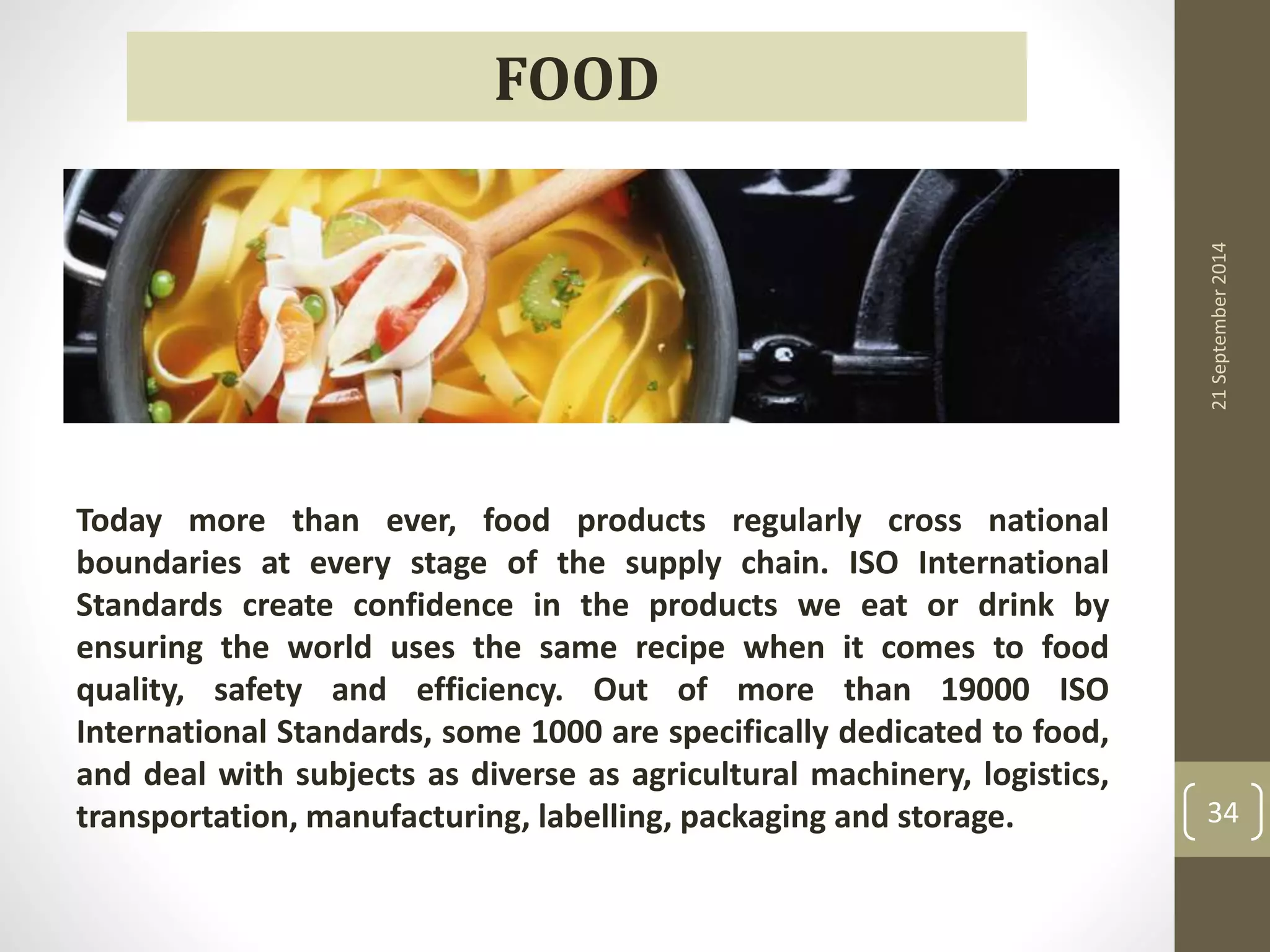
FOOD 
Today more than ever, food products regularly cross national 
boundaries at every stage of the supply chain. ISO International 
Standards create confidence in the products we eat or drink by 
ensuring the world uses the same recipe when it comes to food 
quality, safety and efficiency. Out of more than 19000 ISO 
International Standards, some 1000 are specifically dedicated to food, 
and deal with subjects as diverse as agricultural machinery, logistics, 
transportation, manufacturing, labelling, packaging and storage.
21 September 2014 
35 
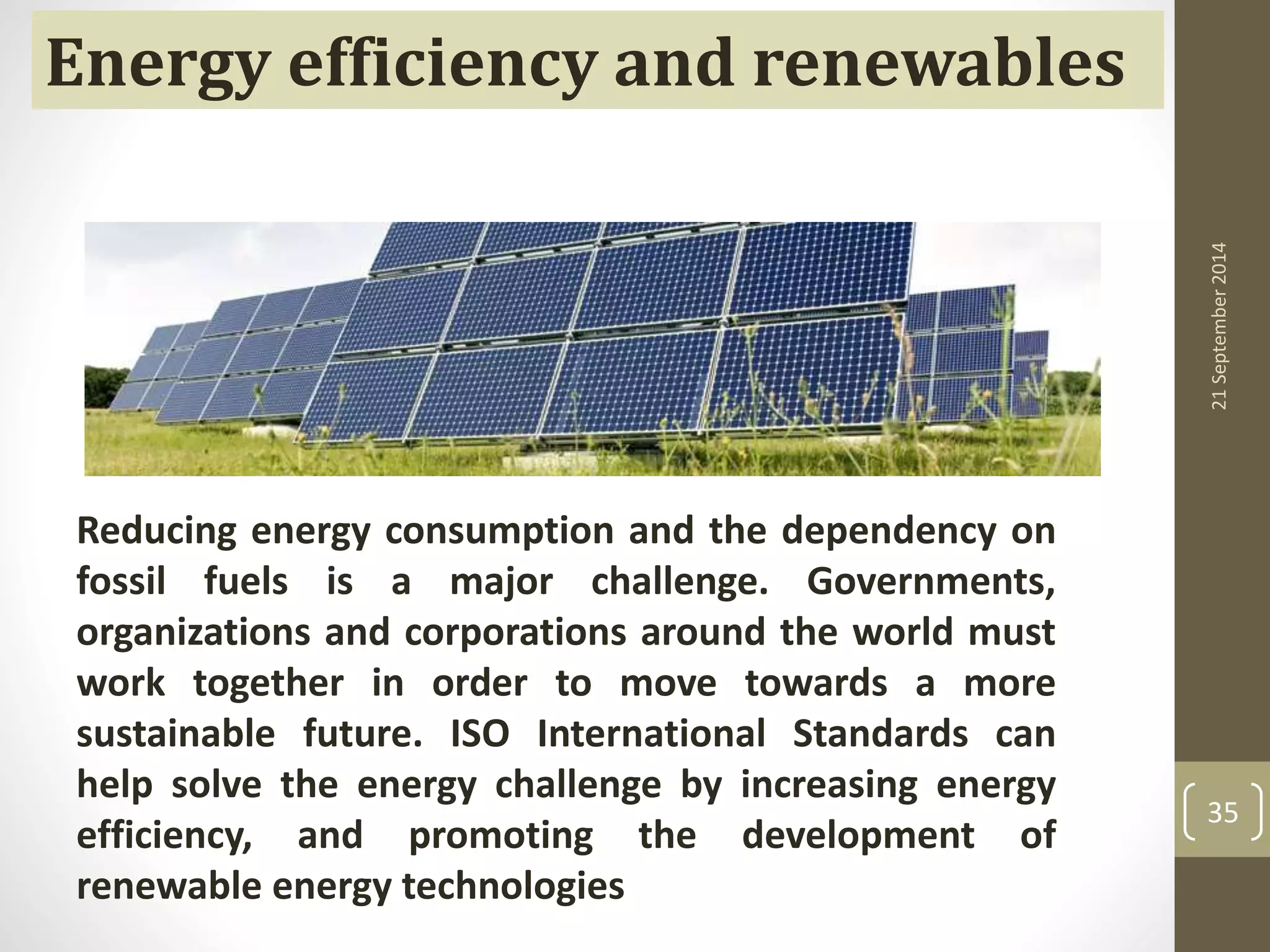
Energy efficiency and renewables 
Reducing energy consumption and the dependency on 
fossil fuels is a major challenge. Governments, 
organizations and corporations around the world must 
work together in order to move towards a more 
sustainable future. ISO International Standards can 
help solve the energy challenge by increasing energy 
efficiency, and promoting the development of 
renewable energy technologies
21 September 2014 
36 
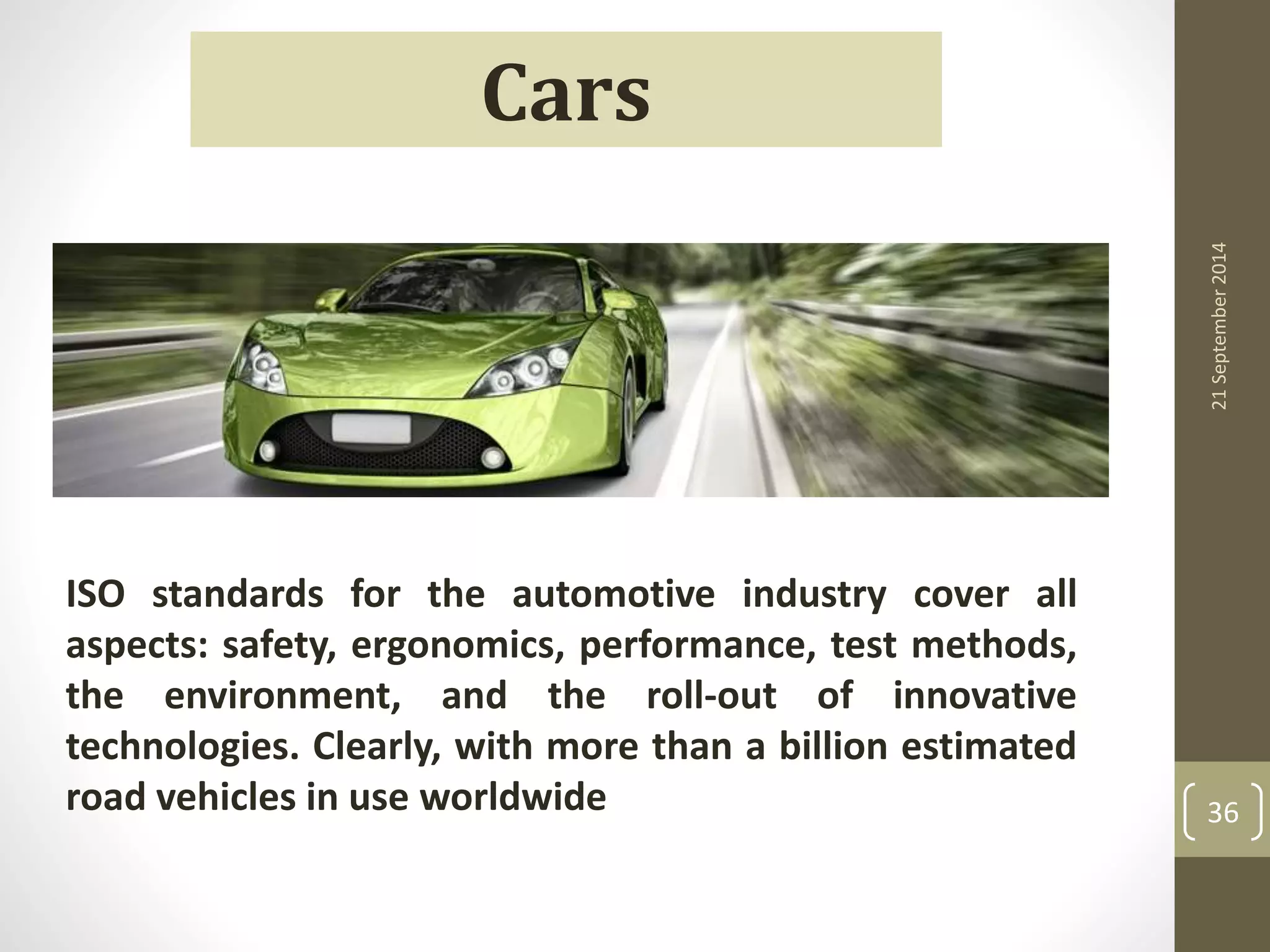
Cars 
ISO standards for the automotive industry cover all 
aspects: safety, ergonomics, performance, test methods, 
the environment, and the roll-out of innovative 
technologies. Clearly, with more than a billion estimated 
road vehicles in use worldwide
21 September 2014 
37 
The Impact of ISO 9000 Certification on 
Sales 
 ISO 9000 certification has been applied around the world and in all 
sectors of industry. 
 Nowadays for a company, receiving ISO 9000 certification is not only a 
fashion or trend, but also a general requirement for running a good 
business (Yann, 1998). 
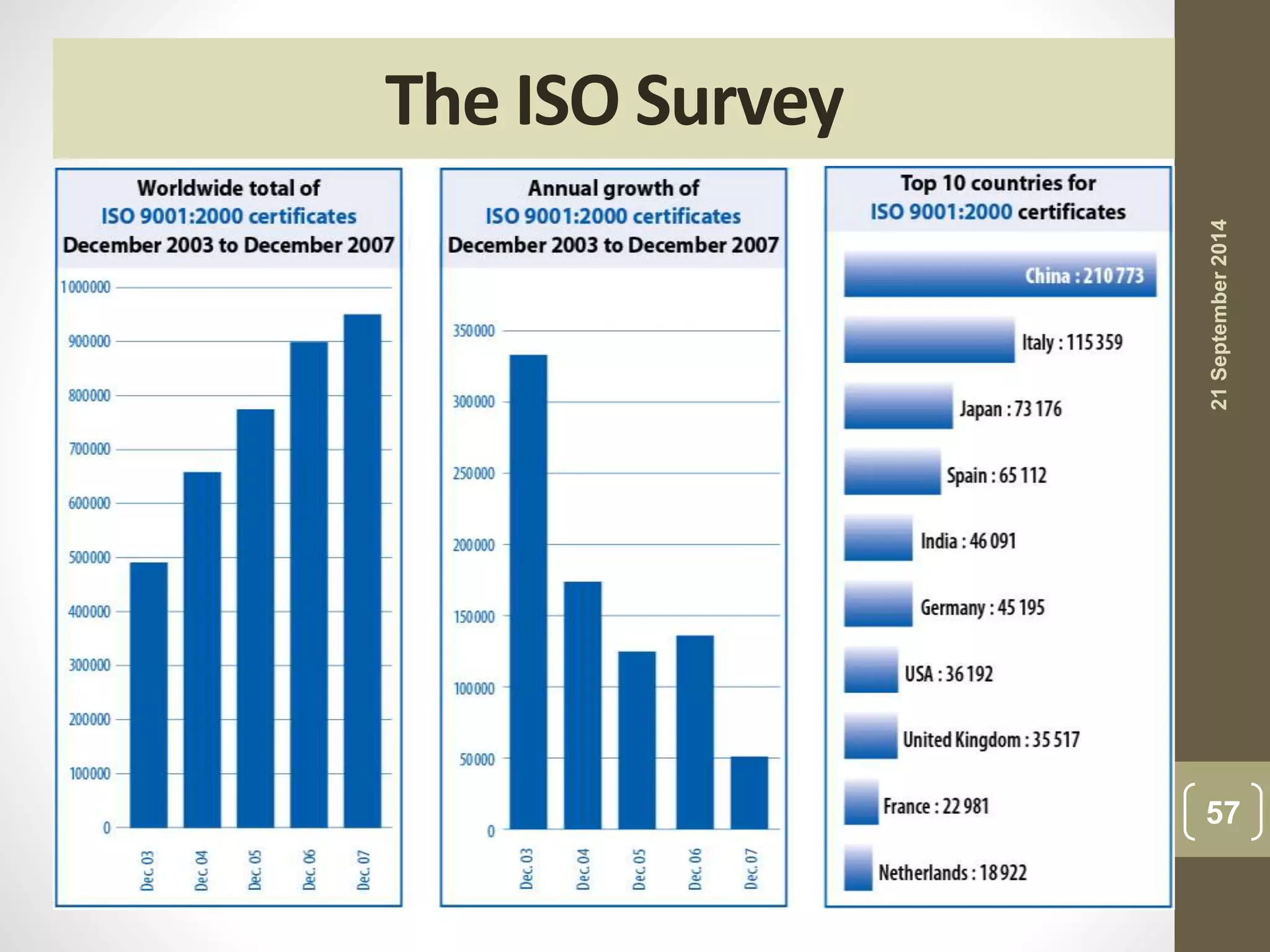
 The top 10 countries for ISO 9001 certificates as at 2009 are China , 
Italy, Japan, Spain, Russian Federation, Germany, U.K., India, U.S.A 
and Korea.
21 September 2014 
38 
ISO 9000 in Spanish industry 
 The impact of the ISO 9000 in Spain has been spectacular. 
At present, there are more than 9,000 certified Spanish companies, 
according to the latest report of the International Standardization 
Organization (2000). 
 In addition, the mean growth of ISO 9000 certification in Spain is 
markedly higher than the European . 
 It is also clear that certified companies show greater export capacity 
than other companies, with a greater average percentage of turnover 
devoted to major exports (Casadesu´ s and Heras, 1999).
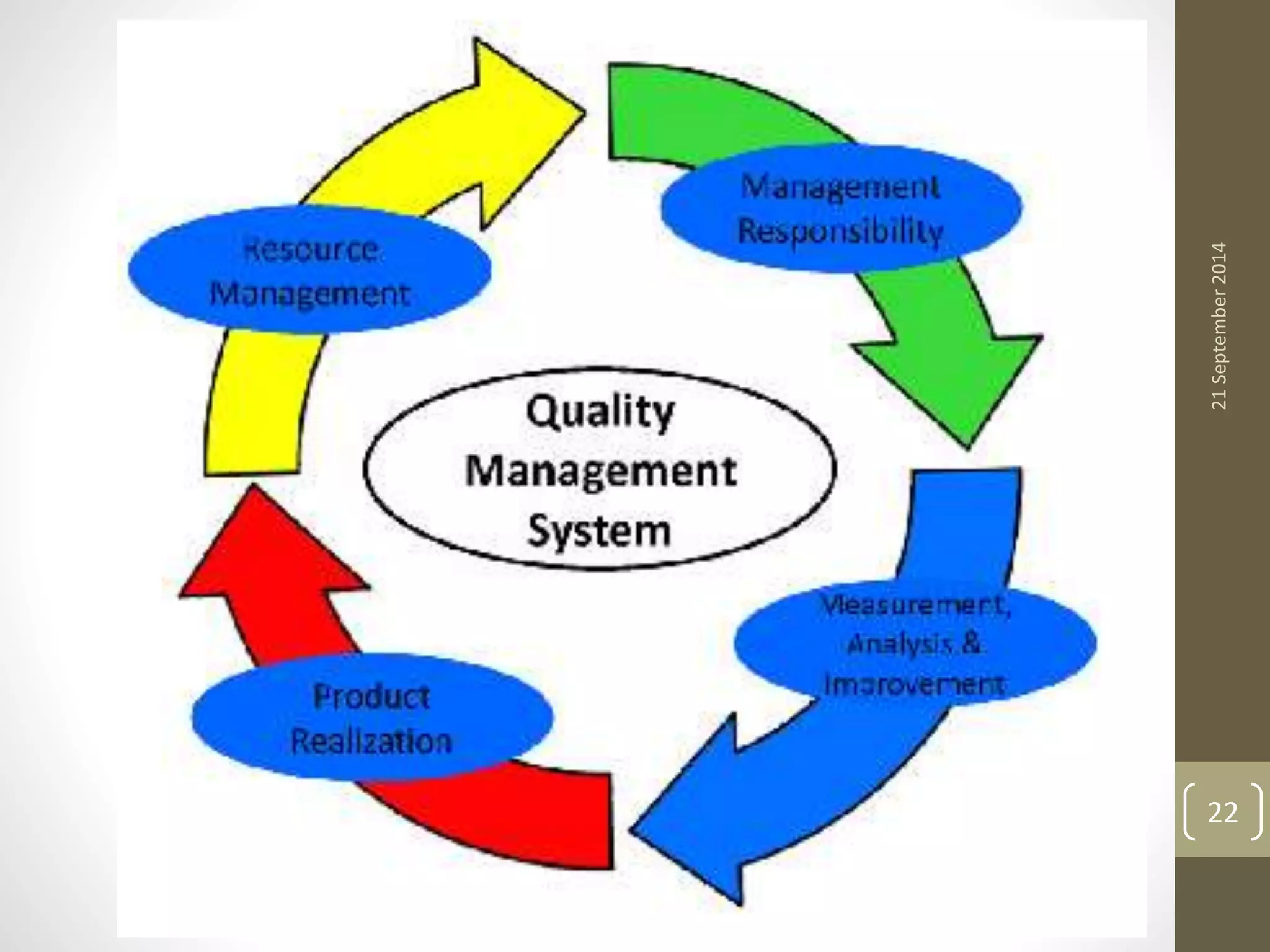
ISO 9000:2000 Consists of 3 
Areas 
ISO 9000:2000 Quality Management Systems: 
fundamentals and vocabulary 
ISO 9001:2000 Quality Management Systems – 
Requirements (required for certification) 
Management responsibility 
Resource management 
Product/service realization 
Measurement, analysis, improvement 
ISO 9004-2000 Quality Management Systems – 
Guidelines for performance improvement 
21 September 2014 
39
ISO 9000 
 Quality Management Fundamentals 
 Role of top management 
 Checking the quality management system 
 Role of statistical techniques 
 Vocabulary 
 Quality planning 
 Customer satisfaction 
 Continual improvement 
21 September 2014 
40
Who created the standards? 
International Organization for 
Standardization - Geneva 
ISO tech committee - TC 176 started in 
1979 
Standards created in 1987 
To eliminate country to country 
differences 
To eliminate terminology confusion 
To increase quality awareness 
21 September 2014 
41
What are the elements of the 
standards? 
Management 
responsibility 
Resource management 
Quality System 
Contract Review 
Design Control 
Document Control 
Purchasing 
Purchaser-Supplied 
Product 
Product Identification and 
Traceability 
Process Control 
Inspection and Testing 
Inspection, Measuring and 
Test Equipment 
Inspection and Test Status 
Control of Non-conforming 
product 
Corrective Action 
Quality Records 
Internal Quality Audit 
Training 
Servicing 
Statistical Techniques 
21 September 2014 
42
Element Standard: Management 
Responsibility 
Management must have a written policy statement 
of their commitment to quality. This policy must be 
communicated to and understood by all 
employees. 
Management must clearly define quality-related 
organizational responsibilities and 
interrelationships. 
A management representative must be assigned to 
oversee the implementation and continuous 
improvement of the quality system. 
Senior management must continually review the 
system. 
21 September 2014 
43
Element Standard: Process Control 
The company must identify all processes that 
directly affect the quality of the product or 
service and ensure that these processes are 
carried out under controlled conditions, 
including: 
Formal approval of process design and equipment. 
Documented work instructions. 
Development of quality plans describing how the 
process is to be monitored. 
A suitable working environment. 
Documented quality criteria. 
21 September 2014 
44
Why is ISO 9000 important? 
European Union directive 
 ISO 9000 certification required by suppliers 
of “Regulated Products” 
health, safety, and the environment 
EC has strict corporate liability legislation 
protecting consumers 
Globalization impact 
21 September 2014 
45
Why adopt ISO 9000? 
To comply with customers who require ISO 
9000 
To sell in the European Union market 
To compete in domestic markets 
To improve the quality system 
To minimize repetitive auditing by similar and 
different customers 
To improve subcontractors’ performance 
21 September 2014 
46
What the ISO 9000 Family is not 
 A family of product standards 
 A guarantee of product quality 
 A method to rescue a troubled company 
21 September 2014 
47
Why Companies Implement ISO 9000 
 Meet customer requirements 
 Meet regulatory requirements 
 Improve quality 
 Increase profitability 
21 September 2014 
48
The Engineers Role in ISO 
9000 
 Engineers working in quality management may 
be responsible for implementation of the entire 
standard 
 Project management task 
 ISO 9001 Processes operated / managed by 
technical personnel may include 
 Design and development 
 Planning of product realization 
 Infrastructure 
 Work environment 
 Monitoring and measurement of product and 
processes 
21 September 2014 
49
Processus, not Product 
Both ISO 9001 concern the way an organization goes about 
its work. 
It is not product standards. 
It is not service standards. 
It’s process standards. 
It can be used by Product manufacturers and service 
providers. 
21 September 2014 
50
ISO 9001 
 Organized by key business processes 
 Quality management system 
 Management 
 Resources 
 Product realization 
 Measurement, analysis and improvement 
21 September 2014 
51
What are the benefits of ISO 9001 certification? 
ISO 9001 certification is an ideal way for an organisation to 
improve the way it operates and manages, irrespective of its 
size or industry. Most organisations want ISO 9001 
certification to qualify for a tender or to achieve preferred 
supplier status: typically for public sector work. However, 
there are many other benefits that can be added to these, 
including: 
 Improved internal working leading to less errors and re-work. 
 Improved customer satisfaction and loyalty. 
 Improved consistency with traceability. 
 Improved morale and motivation. 
 Preferential insurance premiums. 
 Competitive advantage. 
 Increased profitability. 
 Enhanced status. 
51
Impact on Business Results 
 ISO 9001 promotes 
 Not entering into commitments that the 
organization cannot meet 
 Identification and management of resources 
needed to meet organizational objectives 
 Processes designed to meet organizational 
objectives 
 Reduction in waste 
 Continual improvement of the quality 
management system 
 Satisfied customers 
21 September 2014 
53
Impact on Business Results 
 ISO 9001 promotes 
 Not entering into commitments that the 
organization cannot meet 
 Identification and management of resources 
needed to meet organizational objectives 
 Processes designed to meet organizational 
objectives 
 Reduction in waste 
 Continual improvement of the quality 
management system 
 Satisfied customers 
21 September 2014 
54
21 September 2014 
55 
ISO 9000 in Spanish industry 
 The impact of the ISO 9000 in Spain has been 
impressive. 
At present, there are more than 9,000 certified 
Spanish companies, according to the latest report of 
the International Standardization Organization (2000). 
 In addition, the mean growth of ISO 9000 certification 
in Spain is markedly higher than the European . 
 It is also clear that certified companies show greater 
export capacity than other companies, with a greater 
average percentage of turnover devoted to major 
exports (Casadesu´ s and Heras, 1999).
The ISO:9000 Survey 
The worldwide total of certificates to ISO 9001:2001 at the 
end of 2007 was 9,51,486. 
This was increase of 6 % over 2006 when the total was 
8,96,929 certificates. 
Certificates had been issued in 175 countries compared to 170 
the previous year.
The ISO Survey 
21 September 2014 
57
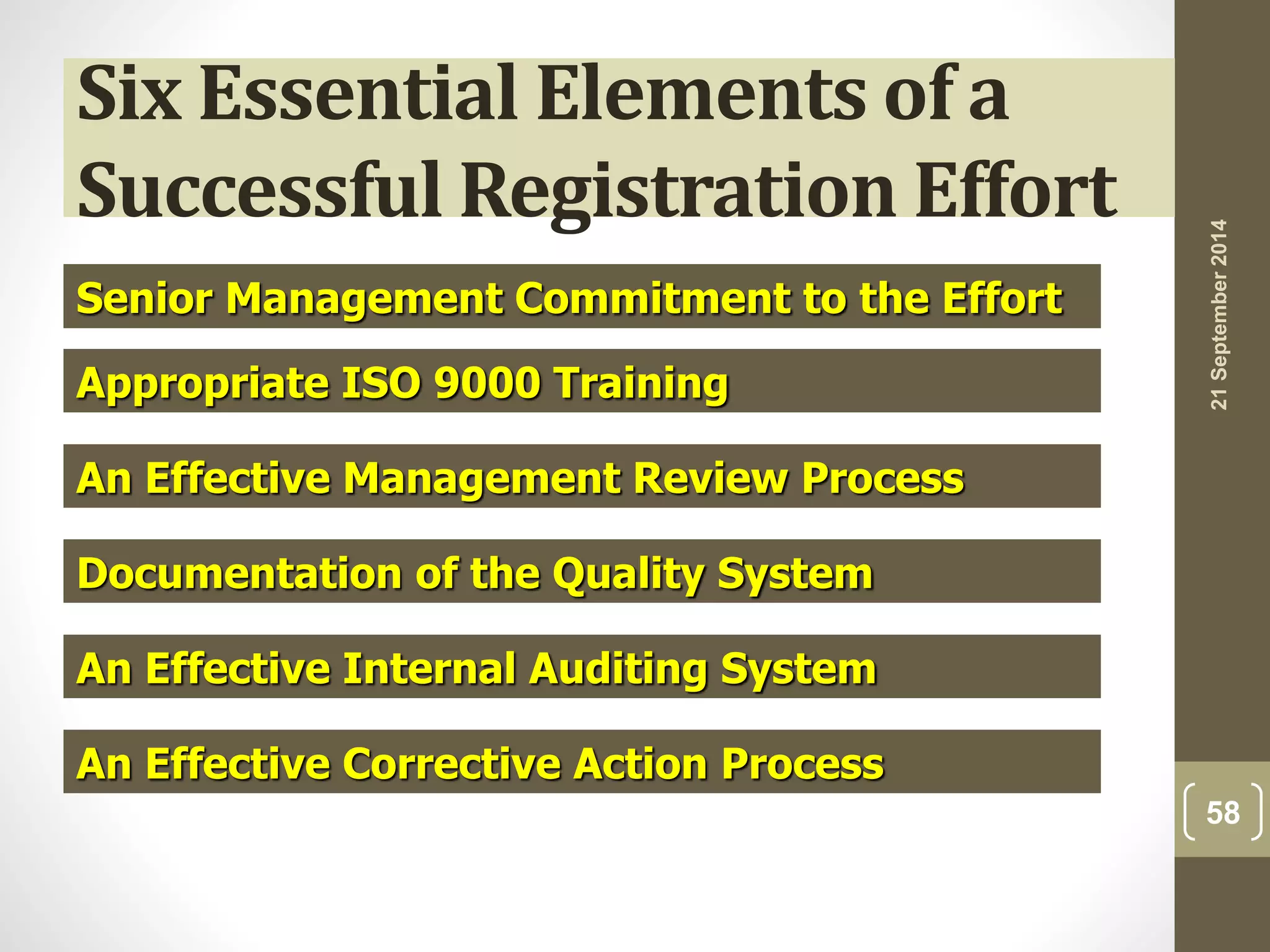
Six Essential Elements of a 
Successful Registration Effort 
Senior Management Commitment to the Effort 
Appropriate ISO 9000 Training 
An Effective Management Review Process 
Documentation of the Quality System 
An Effective Internal Auditing System 
An Effective Corrective Action Process 
21 September 2014 
58
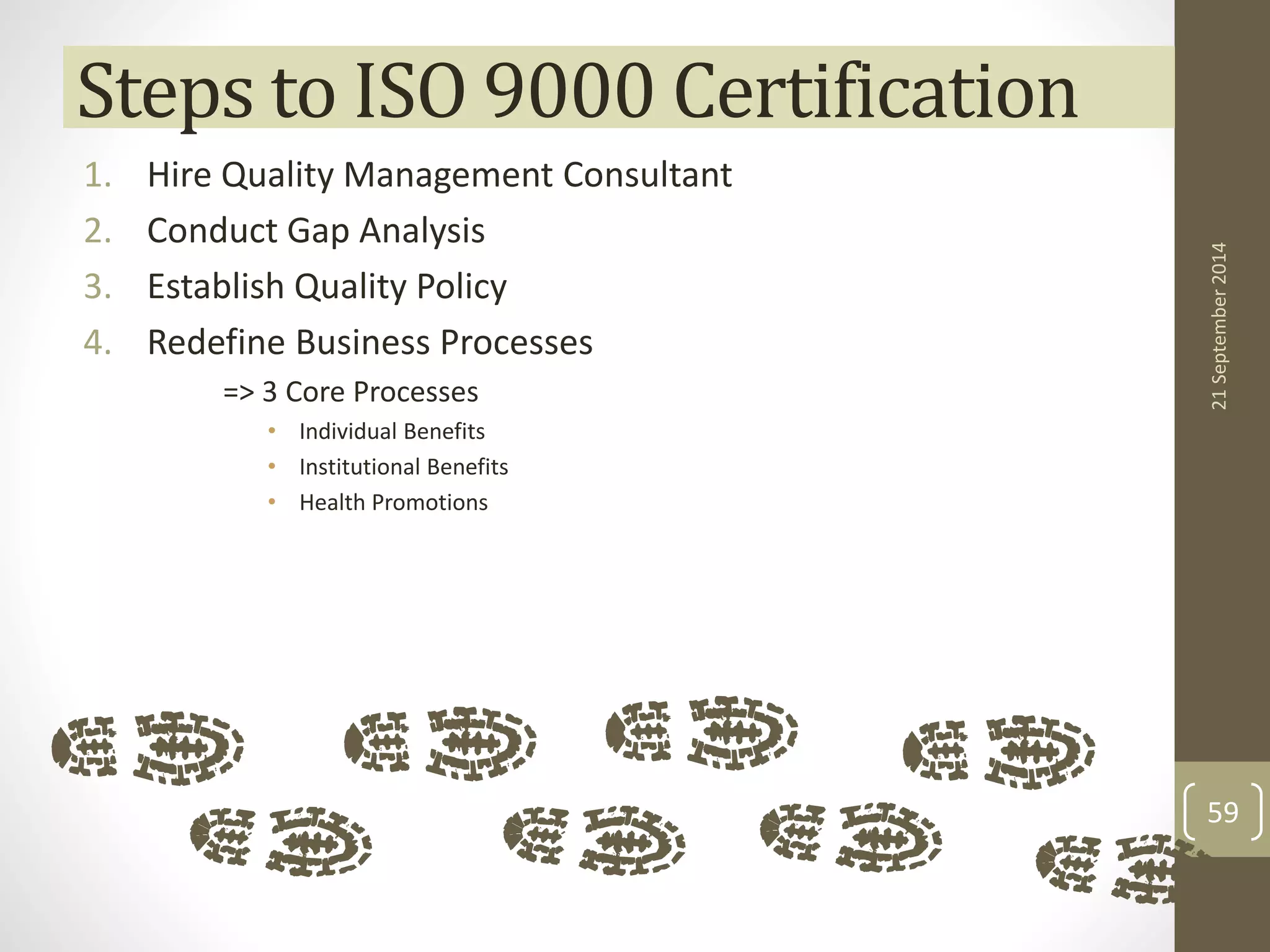
Steps to ISO 9000 Certification 
1. Hire Quality Management Consultant 
2. Conduct Gap Analysis 
3. Establish Quality Policy 
4. Redefine Business Processes 
=> 3 Core Processes 
• Individual Benefits 
• Institutional Benefits 
• Health Promotions 
21 September 2014 
59
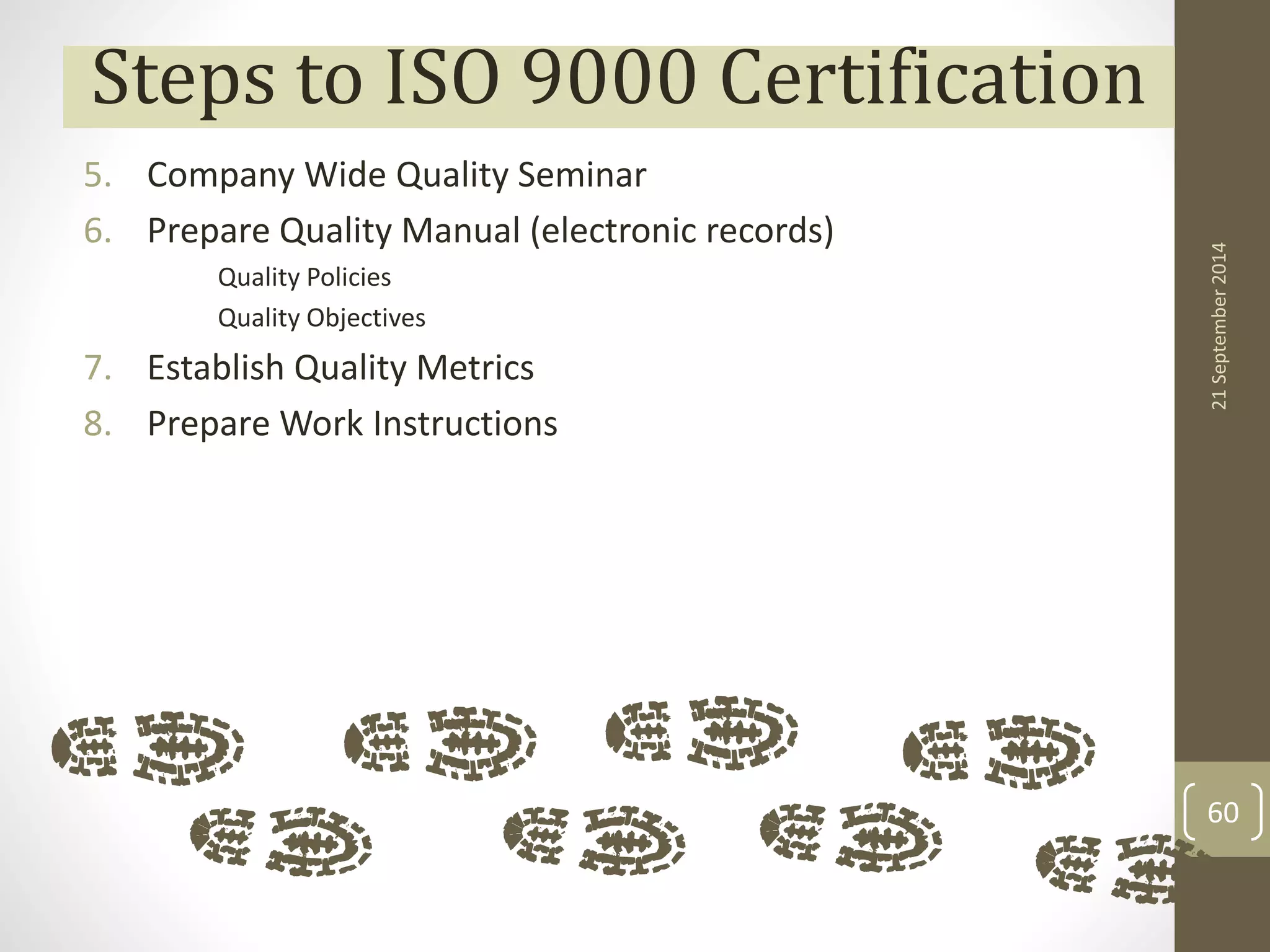
Steps to ISO 9000 Certification 
5. Company Wide Quality Seminar 
6. Prepare Quality Manual (electronic records) 
Quality Policies 
Quality Objectives 
7. Establish Quality Metrics 
8. Prepare Work Instructions 
21 September 2014 
60
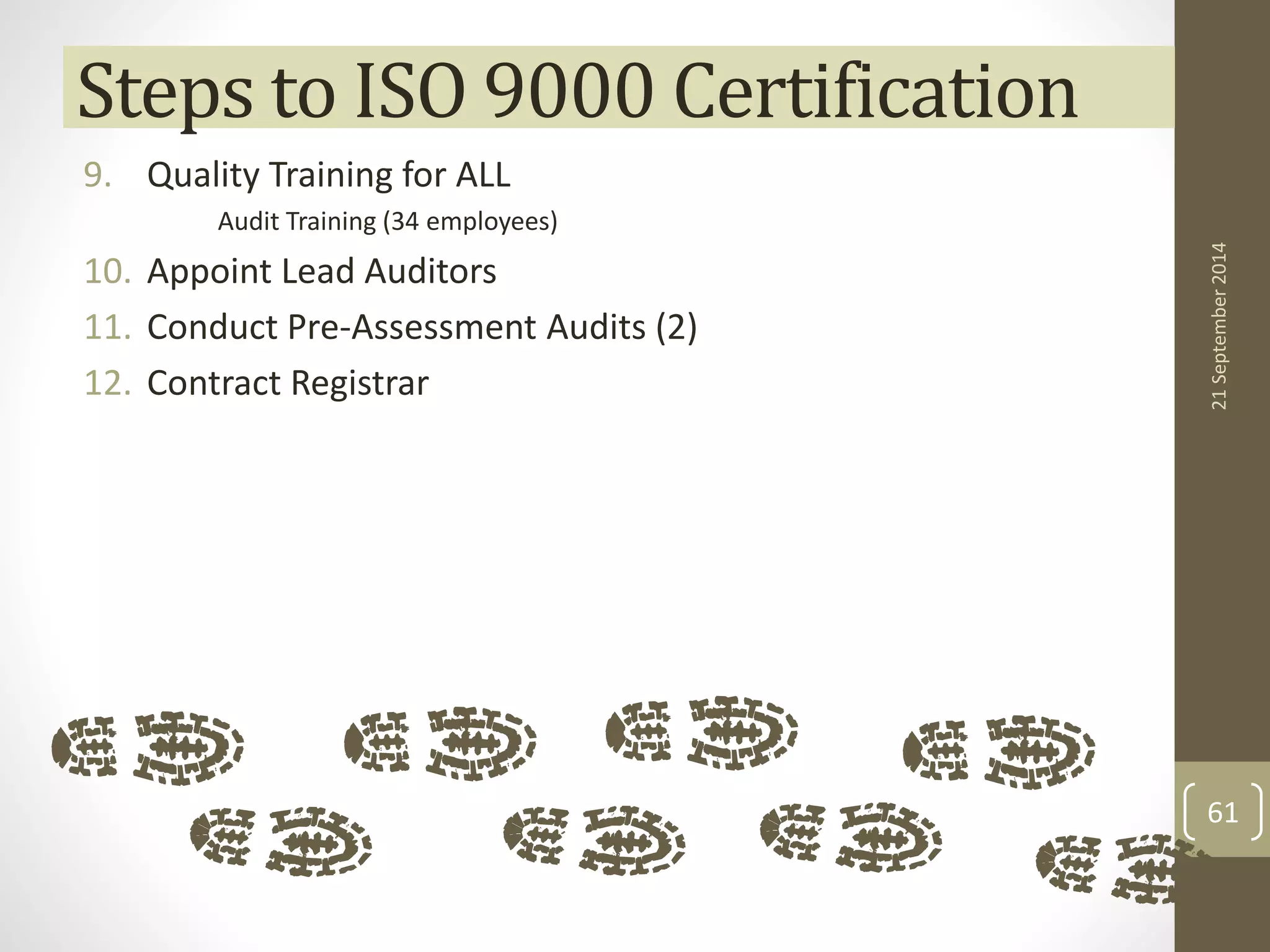
Steps to ISO 9000 Certification 
9. Quality Training for ALL 
Audit Training (34 employees) 
10. Appoint Lead Auditors 
11. Conduct Pre-Assessment Audits (2) 
12. Contract Registrar 
21 September 2014 
61
Steps to ISO 9000 Certification 
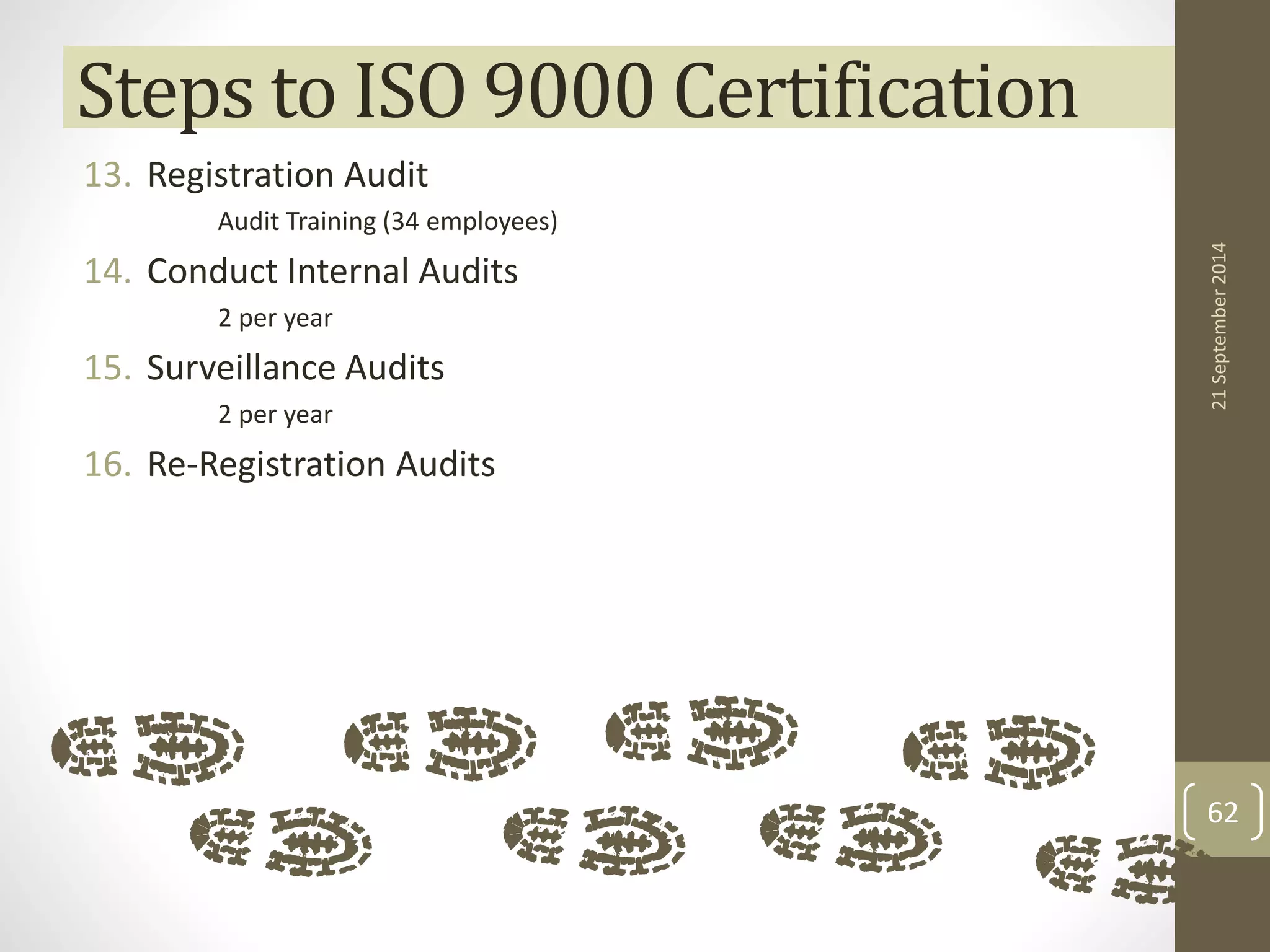
13. Registration Audit 
Audit Training (34 employees) 
14. Conduct Internal Audits 
2 per year 
15. Surveillance Audits 
2 per year 
16. Re-Registration Audits 
21 September 2014 
62
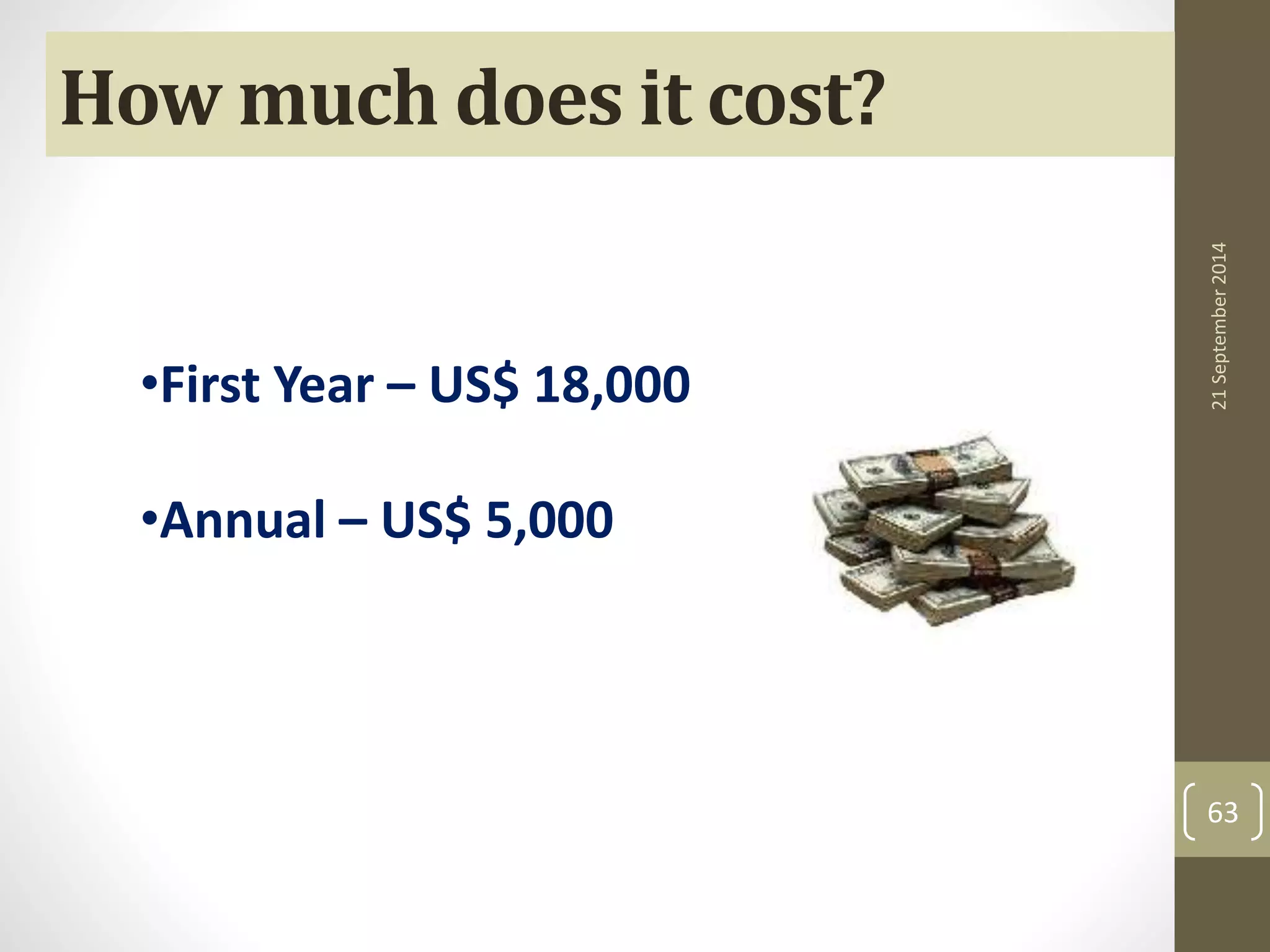
How much does it cost? 
•First Year – US$ 18,000 
•Annual – US$ 5,000 
21 September 2014 
63
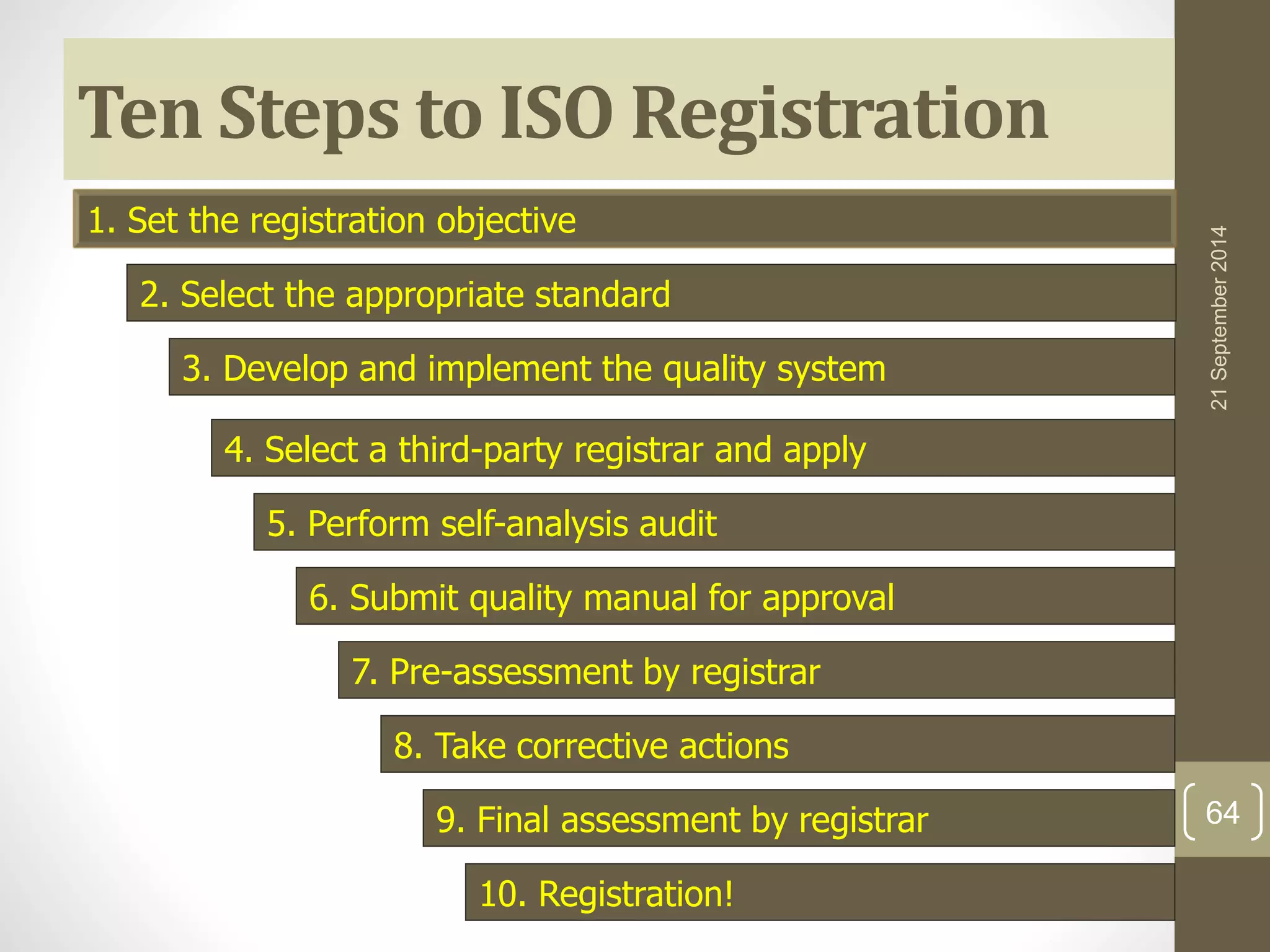
Ten Steps to ISO Registration 
1. Set the registration objective 
2. Select the appropriate standard 
3. Develop and implement the quality system 
4. Select a third-party registrar and apply 
5. Perform self-analysis audit 
6. Submit quality manual for approval 
7. Pre-assessment by registrar 
8. Take corrective actions 
9. Final assessment by registrar 
10. Registration! 
21 September 2014 
64
65 
21 September 2014

Iso prsntation final on Quality

  • 1.
  • 2.
    Group Member KhubaibUr Rahman BSET-01113030 Usman Lateef BSET 01113109 Presented To Sir Yasir Dawood 21 September 2014 2
  • 3.
    Table Of contents  ISO History Standards Organization Block Diagram  ISO 9000 Series 21 September 2014 3
  • 4.
  • 5.
    ISO HISTORY DEFINITIONS  ISO is a network of the national standards institutes of 163 countries, on the basis of one member per country, with a Central Secretariat in Geneva, Switzerland, that coordinates the system.  ISO is a non-governmental organization  ISO (International Organization for Standardization) is the world's largest developer and publisher of International Standards.  Member countries generate some 98 % of world gross national income (GNI). 21 September 2014 5
  • 6.
    How did ISOget started? 1906-International Electro-technical Commission 1926-International Federation of the National Standardizing Associations (ISA) 1946 London - delegates from 25 countries decided to create a new international organization "the object of which would be to facilitate the international coordination and unification of industrial standards 1947 - ISO began to officially function 1951 - The first ISO standard was published  "Standard reference temperature for industrial length measurement". 21 September 2014 6
  • 7.
    African Regional Organizationfor Standardization (ARSO) Arab Industrial Development and Mining Organization (AIDMO) European Committee for Standardization (CEN) Pan American Standards Commission (COPANT) Euro Asian Council for Standardization, Metrology and Certification (EASC) Pacific Area Standards Congress (PASC) ASEAN Consultative Committee for Standards and Quality (ACCSQ)
  • 8.
    World Health Organization(WHO), on health technologies International Maritime Organization (IMO), on transport security World Tourism Organization (UNWTO), on the quality of services related to tourism. World Economic Forum (WEF) Consumers International (CI) World Business Council for Sustainable Development (WBCSD), and International Federation of Standards Users (IFAN)
  • 9.
    ISO standards Make the development, manufacturing and supply of products and services more efficient, safer & cleaner  Facilitate trade between countries and make it fairer  Provide governments with a technical base for health, safety ,Environmental legislation, and conformity assessment  Share technological advances and good management practice  Safeguard consumers, and users in general, of products and services 21 September 2014 9
  • 10.
     Make lifesimpler by providing solutions to common problems  ISO occupies a special position between the public & private sectors.  And the broader needs of society, such as the needs of stakeholder groups like consumers and users.  ISO is able to act as a bridging organization in which a consensus can be reached on solutions that meet both the requirements of business. 21 September 2014 10 ISO standards
  • 11.
    Popular standards •ISO 9000 Quality management • ISO 14000 Environmental management • ISO 3166 Country codes • ISO 26000 Social responsibility • ISO 50001 Energy management • ISO 31000 Risk management • ISO 22000 Food safety management • ISO 27001 Information security management • ISO 20121 Sustainable events 21 September 2014 11
  • 12.
  • 13.
    What has ISOAccomplished? ISO film speed code Standard format for telephone and banking cards ISO 9000 which provides a framework for quality management and quality assurance ISO 14000 series provides a similar framework for environmental management Internationally standardized freight containers Standardized paper sizes. Automobile control symbols ISO international codes for country names, currencies and languages 21 September 2014 13
  • 14.
    ISO 9000 WhatYou Need To Know 21 September 2014 14
  • 15.
    ISO 9000 Whatdo you need to know about ISO 9000? What are the ISO 9000 Series Standards? What are the elements of the Standards? Why is ISO 9000 so important? What is quality system registration? Ten steps to ISO 9000 registration 21 September 2014 15
  • 16.
    Qualitymanagement Quality managementalso means what the organization does to i. Enhance customer satisfaction, and ii. Achieve continual improvement of its performance. 21 September 2014 16
  • 17.
    Management system Managementsystem means what the organization does to manage its processes, or activities in order that its products or services meet the organization’s objectives, such as i. Satisfying the customer's quality requirements, ii. Complying to regulations, or iii. Meeting environmental objectives 21 September 2014 17
  • 18.
    21 September 2014 18 What is ISO 9000? ISO 9000 is a standard in which to conduct business It is a set of rules which should be followed in order to meet the needs and understand the wants of customers The standard is generic
  • 19.
    What are ISO9000 Standards? ISO 9000 Standards Define the required elements of an effective quality management system Can be applied to any company Adopted by the United States as the ANSI/ASQC Q90 series. Revised 2000 – wider applicability 21 September 2014 19
  • 20.
    What is aQuality Management System? Policies, Processes Procedures 21 September 2014 20
  • 21.
    What is aQuality Management System? Required for planning and executing business processes To meet customer requirements Accredited to International Standards by a Registrar ISO 9001:2008 is an example 21 September 2014 21
  • 22.
  • 23.
    ISO 9000 Familyof Standards ISO 8402 - QA and Quality management vocabulary ISO 9000-2 - Generic guidelines for applying ISO 9001, ISO 9002, and ISO 9003 ISO 9000-3 - Guidelines for applying ISO 9001 to the development, supply, and maintenance of software ISO 9000-4 Application for dependability management ISO 9004-2 Guidelines for services ISO 9004-3 Guidelines for processed material ISO 9004-4 Guidelines for quality improvement ISO 9004-5 Guidelines for quality plans ISO 9004-6 Guidelines for configuration management 21 September 2014 23
  • 24.
    What is TheISO 9000 Family?  The family consists of  ISO 9000 Quality Management Systems – Fundamentals and vocabulary  ISO 9001 Quality Management Systems – Requirements  ISO 9004 Quality Management Systems – Guidelines for performance improvement 21 September 2014 24
  • 25.
    21 September 2014 25 What are the parts of ISO 9000? ISO 9000 is composed of 5 different, but related parts: ISO 9000, 9001, 9002, 9003, and 9004 ISO 9000 and 9004 are guidelines, while ISO 9001, 9002, and 9003 are the categories in which a company may apply for certification
  • 26.
    21 September 2014 26 Part 1: ISO 9000  ISO 9000: “Quality Management and Quality Assurance Standards – Guidelines for Selection and Use” Written in order to determine which category your organization should apply for
  • 27.
    21 September 2014 27 Part 2: ISO 9001 ISO 9001: “Quality Systems – Model for Quality Assurance in Design/Development, Production, Installation, and Servicing” This is the category for companies which are involved in manufacturing or the creation and delivery of a service.
  • 28.
    21 September 2014 28 Part 3: ISO 9002 ISO 9002: “Quality Systems – Model for Quality Assurance in Production and Installation” Companies who perform many functions, with the exception of design and development, may apply to this category
  • 29.
    21 September 2014 29 Part 4: ISO 9003 ISO 9003: “Quality Systems – Model for Quality Assurance in Final Inspection and Test” This category is useful for outside of the manufacturing sector, such as in distributors ISO 9003 is being used less and may be dropped in the future
  • 30.
    21 September 2014 30 Part 5: ISO 9004 ISO 9004: “Quality Management and Quality System Elements – Guidelines” Used in order to help interpret the categories included in ISO 9000 certification
  • 31.
    21 September 2014 31 ISO Implementation Implementing ISO 9000 in an organization can be very beneficial The goal of this implementation is to achieve customer satisfaction at its highest level
  • 32.
    21 September 2014 32 How is ISO 9000 Being Implemented Today? ISO 9000 is being used in many organizations with mixed results If an organization implements ISO 9000 in order to simply remain competitive and without mutually beneficial goals in mind, it will most likely fail in the long term
  • 33.
    21 September 2014 33 How can ISO 9000 be used in a business?  ISO 9000 can benefit many industries, such as: Banking Health Care Manufacturing, etc.  ISO 9000 is generic, so it can be applied virtually anywhere!  Remember, ISO 9000 is just one part of an entire system needed to create value for customers
  • 34.
    21 September 2014 34 FOOD Today more than ever, food products regularly cross national boundaries at every stage of the supply chain. ISO International Standards create confidence in the products we eat or drink by ensuring the world uses the same recipe when it comes to food quality, safety and efficiency. Out of more than 19000 ISO International Standards, some 1000 are specifically dedicated to food, and deal with subjects as diverse as agricultural machinery, logistics, transportation, manufacturing, labelling, packaging and storage.
  • 35.
    21 September 2014 35 Energy efficiency and renewables Reducing energy consumption and the dependency on fossil fuels is a major challenge. Governments, organizations and corporations around the world must work together in order to move towards a more sustainable future. ISO International Standards can help solve the energy challenge by increasing energy efficiency, and promoting the development of renewable energy technologies
  • 36.
    21 September 2014 36 Cars ISO standards for the automotive industry cover all aspects: safety, ergonomics, performance, test methods, the environment, and the roll-out of innovative technologies. Clearly, with more than a billion estimated road vehicles in use worldwide
  • 37.
    21 September 2014 37 The Impact of ISO 9000 Certification on Sales  ISO 9000 certification has been applied around the world and in all sectors of industry.  Nowadays for a company, receiving ISO 9000 certification is not only a fashion or trend, but also a general requirement for running a good business (Yann, 1998).  The top 10 countries for ISO 9001 certificates as at 2009 are China , Italy, Japan, Spain, Russian Federation, Germany, U.K., India, U.S.A and Korea.
  • 38.
    21 September 2014 38 ISO 9000 in Spanish industry  The impact of the ISO 9000 in Spain has been spectacular. At present, there are more than 9,000 certified Spanish companies, according to the latest report of the International Standardization Organization (2000).  In addition, the mean growth of ISO 9000 certification in Spain is markedly higher than the European .  It is also clear that certified companies show greater export capacity than other companies, with a greater average percentage of turnover devoted to major exports (Casadesu´ s and Heras, 1999).
  • 39.
    ISO 9000:2000 Consistsof 3 Areas ISO 9000:2000 Quality Management Systems: fundamentals and vocabulary ISO 9001:2000 Quality Management Systems – Requirements (required for certification) Management responsibility Resource management Product/service realization Measurement, analysis, improvement ISO 9004-2000 Quality Management Systems – Guidelines for performance improvement 21 September 2014 39
  • 40.
    ISO 9000 Quality Management Fundamentals  Role of top management  Checking the quality management system  Role of statistical techniques  Vocabulary  Quality planning  Customer satisfaction  Continual improvement 21 September 2014 40
  • 41.
    Who created thestandards? International Organization for Standardization - Geneva ISO tech committee - TC 176 started in 1979 Standards created in 1987 To eliminate country to country differences To eliminate terminology confusion To increase quality awareness 21 September 2014 41
  • 42.
    What are theelements of the standards? Management responsibility Resource management Quality System Contract Review Design Control Document Control Purchasing Purchaser-Supplied Product Product Identification and Traceability Process Control Inspection and Testing Inspection, Measuring and Test Equipment Inspection and Test Status Control of Non-conforming product Corrective Action Quality Records Internal Quality Audit Training Servicing Statistical Techniques 21 September 2014 42
  • 43.
    Element Standard: Management Responsibility Management must have a written policy statement of their commitment to quality. This policy must be communicated to and understood by all employees. Management must clearly define quality-related organizational responsibilities and interrelationships. A management representative must be assigned to oversee the implementation and continuous improvement of the quality system. Senior management must continually review the system. 21 September 2014 43
  • 44.
    Element Standard: ProcessControl The company must identify all processes that directly affect the quality of the product or service and ensure that these processes are carried out under controlled conditions, including: Formal approval of process design and equipment. Documented work instructions. Development of quality plans describing how the process is to be monitored. A suitable working environment. Documented quality criteria. 21 September 2014 44
  • 45.
    Why is ISO9000 important? European Union directive  ISO 9000 certification required by suppliers of “Regulated Products” health, safety, and the environment EC has strict corporate liability legislation protecting consumers Globalization impact 21 September 2014 45
  • 46.
    Why adopt ISO9000? To comply with customers who require ISO 9000 To sell in the European Union market To compete in domestic markets To improve the quality system To minimize repetitive auditing by similar and different customers To improve subcontractors’ performance 21 September 2014 46
  • 47.
    What the ISO9000 Family is not  A family of product standards  A guarantee of product quality  A method to rescue a troubled company 21 September 2014 47
  • 48.
    Why Companies ImplementISO 9000  Meet customer requirements  Meet regulatory requirements  Improve quality  Increase profitability 21 September 2014 48
  • 49.
    The Engineers Rolein ISO 9000  Engineers working in quality management may be responsible for implementation of the entire standard  Project management task  ISO 9001 Processes operated / managed by technical personnel may include  Design and development  Planning of product realization  Infrastructure  Work environment  Monitoring and measurement of product and processes 21 September 2014 49
  • 50.
    Processus, not Product Both ISO 9001 concern the way an organization goes about its work. It is not product standards. It is not service standards. It’s process standards. It can be used by Product manufacturers and service providers. 21 September 2014 50
  • 51.
    ISO 9001 Organized by key business processes  Quality management system  Management  Resources  Product realization  Measurement, analysis and improvement 21 September 2014 51
  • 52.
    What are thebenefits of ISO 9001 certification? ISO 9001 certification is an ideal way for an organisation to improve the way it operates and manages, irrespective of its size or industry. Most organisations want ISO 9001 certification to qualify for a tender or to achieve preferred supplier status: typically for public sector work. However, there are many other benefits that can be added to these, including:  Improved internal working leading to less errors and re-work.  Improved customer satisfaction and loyalty.  Improved consistency with traceability.  Improved morale and motivation.  Preferential insurance premiums.  Competitive advantage.  Increased profitability.  Enhanced status. 51
  • 53.
    Impact on BusinessResults  ISO 9001 promotes  Not entering into commitments that the organization cannot meet  Identification and management of resources needed to meet organizational objectives  Processes designed to meet organizational objectives  Reduction in waste  Continual improvement of the quality management system  Satisfied customers 21 September 2014 53
  • 54.
    Impact on BusinessResults  ISO 9001 promotes  Not entering into commitments that the organization cannot meet  Identification and management of resources needed to meet organizational objectives  Processes designed to meet organizational objectives  Reduction in waste  Continual improvement of the quality management system  Satisfied customers 21 September 2014 54
  • 55.
    21 September 2014 55 ISO 9000 in Spanish industry  The impact of the ISO 9000 in Spain has been impressive. At present, there are more than 9,000 certified Spanish companies, according to the latest report of the International Standardization Organization (2000).  In addition, the mean growth of ISO 9000 certification in Spain is markedly higher than the European .  It is also clear that certified companies show greater export capacity than other companies, with a greater average percentage of turnover devoted to major exports (Casadesu´ s and Heras, 1999).
  • 56.
    The ISO:9000 Survey The worldwide total of certificates to ISO 9001:2001 at the end of 2007 was 9,51,486. This was increase of 6 % over 2006 when the total was 8,96,929 certificates. Certificates had been issued in 175 countries compared to 170 the previous year.
  • 57.
    The ISO Survey 21 September 2014 57
  • 58.
    Six Essential Elementsof a Successful Registration Effort Senior Management Commitment to the Effort Appropriate ISO 9000 Training An Effective Management Review Process Documentation of the Quality System An Effective Internal Auditing System An Effective Corrective Action Process 21 September 2014 58
  • 59.
    Steps to ISO9000 Certification 1. Hire Quality Management Consultant 2. Conduct Gap Analysis 3. Establish Quality Policy 4. Redefine Business Processes => 3 Core Processes • Individual Benefits • Institutional Benefits • Health Promotions 21 September 2014 59
  • 60.
    Steps to ISO9000 Certification 5. Company Wide Quality Seminar 6. Prepare Quality Manual (electronic records) Quality Policies Quality Objectives 7. Establish Quality Metrics 8. Prepare Work Instructions 21 September 2014 60
  • 61.
    Steps to ISO9000 Certification 9. Quality Training for ALL Audit Training (34 employees) 10. Appoint Lead Auditors 11. Conduct Pre-Assessment Audits (2) 12. Contract Registrar 21 September 2014 61
  • 62.
    Steps to ISO9000 Certification 13. Registration Audit Audit Training (34 employees) 14. Conduct Internal Audits 2 per year 15. Surveillance Audits 2 per year 16. Re-Registration Audits 21 September 2014 62
  • 63.
    How much doesit cost? •First Year – US$ 18,000 •Annual – US$ 5,000 21 September 2014 63
  • 64.
    Ten Steps toISO Registration 1. Set the registration objective 2. Select the appropriate standard 3. Develop and implement the quality system 4. Select a third-party registrar and apply 5. Perform self-analysis audit 6. Submit quality manual for approval 7. Pre-assessment by registrar 8. Take corrective actions 9. Final assessment by registrar 10. Registration! 21 September 2014 64
  • 65.