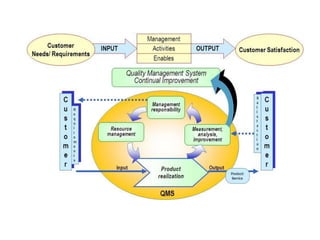
Quality Management System
Presented by
KHURRAM SHAHID 183801 AFTAB
AHMED 183809
JIBRAN 18380
WHAT IS “ISO”
• ISO is an independent, non-governmental
international organization with a membership
of 164 national standard bodies.
• Its central secretariat is at Switzerland
• This organization develop and publish
International Standards
ISO STORY
In London, in 1946, 65 delegates from 25
countries meet to discuss the future of
International Standardization.
In 1947, ISO officially comes into existence with
67 technical committees (groups of experts
focusing on a specific subject).
SCOPE
• Requirements for a quality management system when an organization:
• a) needs to demonstrate its ability to consistently provide products and
services that fulfill customer, statutory and regulatory requirements
• b) aims to enhance customer satisfaction through the effective
application of the system including processes for improvement of the
system
• All the requirements of ISO 9001:2015 are generic and are intended to be
applicable to any organization, regardless of its type or size, or the
products and services it provides.
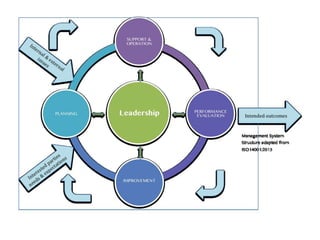
CONTEXT OF ORGANIZATION
• Organization finds Internal and external issues
that are relevant to its purpose
• interested parties and their needs and
expectations
• Determine boundaries and applicability of
QMS in documented form
• Processes needed and improvement in
processes
Leadership
 Taking accountability for the effectiveness QMS
 Ensuring integration
 Ensuring resources needed QMS processes
 Requirements
 Intended results
 Engaging , directing and supporting persons
 Promoting improvement
 Supporting relevant management roles
 Leadership and commitment
• General
• Customer focus
Leadership
 Taking accountability for the effectiveness QMS
 Ensuring integration
 Ensuring resources needed QMS processes
 Requirements
 Intended results
 Engaging , directing and supporting persons
 Promoting improvement
 Supporting relevant management roles
 Customer requirements
 Risks and opportunities
 Enhancing customer satisfaction
 Leadership and commitment
• General
• Customer focus
Leadership
 Leadership and commitment
• General
• Customer focus
 Policy
• Establishing the quality policy
• Communicating the quality policy
• Organizational roles,
responsibilities and authorities
Leadership
• Strategic direction
• Provides framework
• Commitment to safety
• Continual improvement
 Leadership and commitment
• General
• Customer focus
 Policy
• Establishing the quality policy
• Communicating the quality policy
• Organizational roles,
responsibilities and authorities
Leadership
• Strategic direction
• Provides framework
• Commitment to safety
• Continual improvement
• Documented information
• Communicate and apply
 Leadership and commitment
• General
• Customer focus
 Policy
• Establishing the quality policy
• Communicating the quality policy
• Organizational roles,
responsibilities and authorities
Leadership
• Strategic direction
• Provides framework
• Commitment to safety
• Continual improvement
• Documented information
• Communicate and apply
• Ensuring QMS international standard
• Reporting on the performance
• Ensuring promotion of customer focus
• Ensuring integrity
 Leadership and commitment
• General
• Customer focus
 Policy
• Establishing the quality policy
• Communicating the quality policy
• Organizational roles,
responsibilities and authorities
Planning
 Action to address risk and
opportunities
 Quality objectives and planning to
achieve them
 Planning of charges
Planning
• Assurance QMS achieve results
• Enhance desirable effects
• Reduce undesirable effects
• Achieve improvement
 Actions to address risk and
opportunities
 Quality objectives and planning to
achieve them
 Planning of charges
Planning
• Assurance QMS achieve results
• Enhance desirable effects
• Reduce undesirable effects
• Achieve improvement
• Be measurable
• Be monitored
• Be communicated
• Be updated
 Actions to address risk and
opportunities
 Quality objectives and planning to
achieve them
 Planning of charges
Planning
• Assurance QMS achieve results
• Enhance desirable effects
• Reduce undesirable effects
• Achieve improvement
• Be measurable
• Be monitored
• Be communicated
• Be updated
• Availability of resources
• Allocation responsibilities and authorities
 Actions to address risk and
opportunities
 Quality objectives and planning to
achieve them
 Planning of charges
Support
• People
• Infrastructure
• Environment for the operation of processes
• Monitoring and measuring resources
• Measurement traceability
• Organizational knowledge
 Resources
 Competence
 Awareness
 Communication
 Documented information
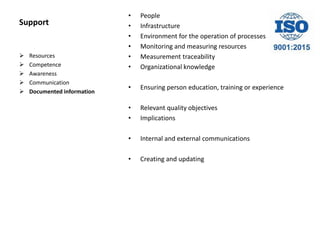
Support
• People
• Infrastructure
• Environment for the operation of processes
• Monitoring and measuring resources
• Measurement traceability
• Organizational knowledge
• Ensuring person education, training or experience
 Resources
 Competence
 Awareness
 Communication
 Documented information
Support
• People
• Infrastructure
• Environment for the operation of processes
• Monitoring and measuring resources
• Measurement traceability
• Organizational knowledge
• Ensuring person education, training or experience
• Relevant quality objectives
• Implications
 Resources
 Competence
 Awareness
 Communication
 Documented information
Support
• People
• Infrastructure
• Environment for the operation of processes
• Monitoring and measuring resources
• Measurement traceability
• Organizational knowledge
• Ensuring person education, training or experience
• Relevant quality objectives
• Implications
• Internal and external communications
 Resources
 Competence
 Awareness
 Communication
 Documented information
Support
• People
• Infrastructure
• Environment for the operation of processes
• Monitoring and measuring resources
• Measurement traceability
• Organizational knowledge
• Ensuring person education, training or experience
• Relevant quality objectives
• Implications
• Internal and external communications
• Creating and updating
 Resources
 Competence
 Awareness
 Communication
 Documented information
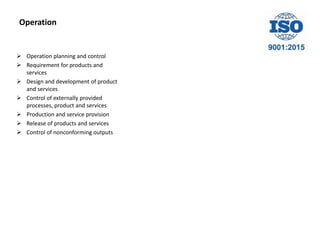
Operation
 Operation planning and control
 Requirement for products and
services
 Design and development of product
and services
 Control of externally provided
processes, product and services
 Production and service provision
 Release of products and services
 Control of nonconforming outputs
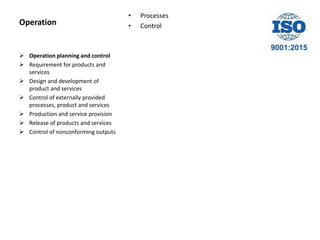
Operation
• Processes
• Control
 Operation planning and control
 Requirement for products and
services
 Design and development of
product and services
 Control of externally provided
processes, product and services
 Production and service provision
 Release of products and services
 Control of nonconforming outputs
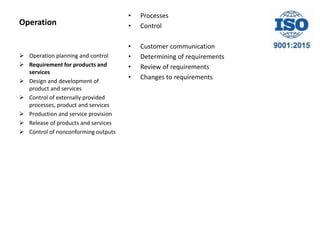
Operation
• Processes
• Control
• Customer communication
• Determining of requirements
• Review of requirements
• Changes to requirements
 Operation planning and control
 Requirement for products and
services
 Design and development of
product and services
 Control of externally provided
processes, product and services
 Production and service provision
 Release of products and services
 Control of nonconforming outputs
Operation
• Processes
• Control
• Customer communication
• Determining of requirements
• Review of requirements
• Changes to requirements
• Design and development planning
• Design and development inputs
• Design and development controls
• Design and development outputs
• Design and development changes
 Operation planning and control
 Requirement for products and
services
 Design and development of
product and services
 Control of externally provided
processes, product and services
 Production and service provision
 Release of products and services
 Control of nonconforming outputs
Operation
• Processes
• Control
• Customer communication
• Determining of requirements
• Review of requirements
• Changes to requirements
• Design and development planning
• Design and development inputs
• Design and development controls
• Design and development outputs
• Design and development changes
• Type and extent of control
• Information for external providers
 Operation planning and control
 Requirement for products and
services
 Design and development of
product and services
 Control of externally provided
processes, product and services
 Production and service provision
 Release of products and services
 Control of nonconforming outputs
Operation
• Control of production
• Identification and traceability
• Preservation
• Post delivery activities
• Control of changes Operation planning and control
 Requirement for products and
services
 Design and development of
product and services
 Control of externally provided
processes, product and services
 Production and service provision
 Release of products and services
 Control of nonconforming outputs
Operation
• Control of production
• Identification and traceability
• Preservation
• Post delivery activities
• Control of changes
• Release product relevant authority
 Operation planning and control
 Requirement for products and
services
 Design and development of
product and services
 Control of externally provided
processes, product and services
 Production and service provision
 Release of products and services
 Control of nonconforming outputs
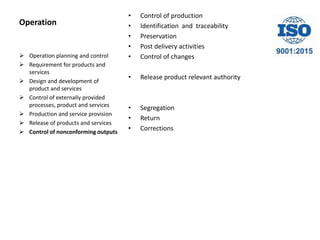
Operation
• Control of production
• Identification and traceability
• Preservation
• Post delivery activities
• Control of changes
• Release product relevant authority
• Segregation
• Return
• Corrections
 Operation planning and control
 Requirement for products and
services
 Design and development of
product and services
 Control of externally provided
processes, product and services
 Production and service provision
 Release of products and services
 Control of nonconforming outputs
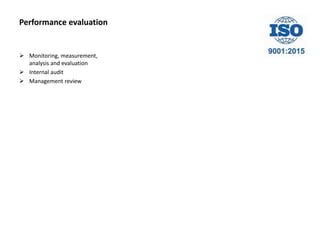
Performance evaluation
 Monitoring, measurement,
analysis and evaluation
 Internal audit
 Management review
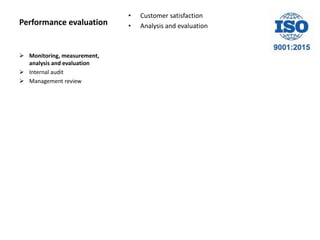
Performance evaluation
• Customer satisfaction
• Analysis and evaluation
 Monitoring, measurement,
analysis and evaluation
 Internal audit
 Management review
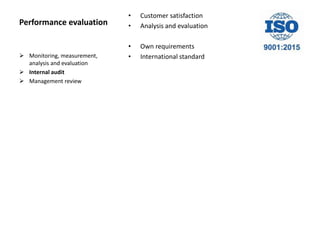
Performance evaluation
• Customer satisfaction
• Analysis and evaluation
• Own requirements
• International standard Monitoring, measurement,
analysis and evaluation
 Internal audit
 Management review
Performance evaluation
• Customer satisfaction
• Analysis and evaluation
• Own requirements
• International standard
• Management review inputs
• Management review outputs
 Monitoring, measurement,
analysis and evaluation
 Internal audit
 Management review
Improvement
• Take action for correction
• Reviewing and analyzing
• Update risks and opportunities
 Nonconformity and corrective
action
 Continual improvement
Improvement
• Take action for correction
• Reviewing and analyzing
• Update risks and opportunities
• Continually improvement suitability Nonconformity and corrective
action
 Continual improvement

Quality Management System

  • 1.
    Quality Management System Presentedby KHURRAM SHAHID 183801 AFTAB AHMED 183809 JIBRAN 18380
  • 3.
    WHAT IS “ISO” •ISO is an independent, non-governmental international organization with a membership of 164 national standard bodies. • Its central secretariat is at Switzerland • This organization develop and publish International Standards
  • 4.
    ISO STORY In London,in 1946, 65 delegates from 25 countries meet to discuss the future of International Standardization. In 1947, ISO officially comes into existence with 67 technical committees (groups of experts focusing on a specific subject).
  • 7.
    SCOPE • Requirements fora quality management system when an organization: • a) needs to demonstrate its ability to consistently provide products and services that fulfill customer, statutory and regulatory requirements • b) aims to enhance customer satisfaction through the effective application of the system including processes for improvement of the system • All the requirements of ISO 9001:2015 are generic and are intended to be applicable to any organization, regardless of its type or size, or the products and services it provides.
  • 9.
    CONTEXT OF ORGANIZATION •Organization finds Internal and external issues that are relevant to its purpose • interested parties and their needs and expectations • Determine boundaries and applicability of QMS in documented form • Processes needed and improvement in processes
  • 12.
    Leadership  Taking accountabilityfor the effectiveness QMS  Ensuring integration  Ensuring resources needed QMS processes  Requirements  Intended results  Engaging , directing and supporting persons  Promoting improvement  Supporting relevant management roles  Leadership and commitment • General • Customer focus
  • 13.
    Leadership  Taking accountabilityfor the effectiveness QMS  Ensuring integration  Ensuring resources needed QMS processes  Requirements  Intended results  Engaging , directing and supporting persons  Promoting improvement  Supporting relevant management roles  Customer requirements  Risks and opportunities  Enhancing customer satisfaction  Leadership and commitment • General • Customer focus
  • 14.
    Leadership  Leadership andcommitment • General • Customer focus  Policy • Establishing the quality policy • Communicating the quality policy • Organizational roles, responsibilities and authorities
  • 15.
    Leadership • Strategic direction •Provides framework • Commitment to safety • Continual improvement  Leadership and commitment • General • Customer focus  Policy • Establishing the quality policy • Communicating the quality policy • Organizational roles, responsibilities and authorities
  • 16.
    Leadership • Strategic direction •Provides framework • Commitment to safety • Continual improvement • Documented information • Communicate and apply  Leadership and commitment • General • Customer focus  Policy • Establishing the quality policy • Communicating the quality policy • Organizational roles, responsibilities and authorities
  • 17.
    Leadership • Strategic direction •Provides framework • Commitment to safety • Continual improvement • Documented information • Communicate and apply • Ensuring QMS international standard • Reporting on the performance • Ensuring promotion of customer focus • Ensuring integrity  Leadership and commitment • General • Customer focus  Policy • Establishing the quality policy • Communicating the quality policy • Organizational roles, responsibilities and authorities
  • 18.
    Planning  Action toaddress risk and opportunities  Quality objectives and planning to achieve them  Planning of charges
  • 19.
    Planning • Assurance QMSachieve results • Enhance desirable effects • Reduce undesirable effects • Achieve improvement  Actions to address risk and opportunities  Quality objectives and planning to achieve them  Planning of charges
  • 20.
    Planning • Assurance QMSachieve results • Enhance desirable effects • Reduce undesirable effects • Achieve improvement • Be measurable • Be monitored • Be communicated • Be updated  Actions to address risk and opportunities  Quality objectives and planning to achieve them  Planning of charges
  • 21.
    Planning • Assurance QMSachieve results • Enhance desirable effects • Reduce undesirable effects • Achieve improvement • Be measurable • Be monitored • Be communicated • Be updated • Availability of resources • Allocation responsibilities and authorities  Actions to address risk and opportunities  Quality objectives and planning to achieve them  Planning of charges
  • 22.
    Support • People • Infrastructure •Environment for the operation of processes • Monitoring and measuring resources • Measurement traceability • Organizational knowledge  Resources  Competence  Awareness  Communication  Documented information
  • 23.
    Support • People • Infrastructure •Environment for the operation of processes • Monitoring and measuring resources • Measurement traceability • Organizational knowledge • Ensuring person education, training or experience  Resources  Competence  Awareness  Communication  Documented information
  • 24.
    Support • People • Infrastructure •Environment for the operation of processes • Monitoring and measuring resources • Measurement traceability • Organizational knowledge • Ensuring person education, training or experience • Relevant quality objectives • Implications  Resources  Competence  Awareness  Communication  Documented information
  • 25.
    Support • People • Infrastructure •Environment for the operation of processes • Monitoring and measuring resources • Measurement traceability • Organizational knowledge • Ensuring person education, training or experience • Relevant quality objectives • Implications • Internal and external communications  Resources  Competence  Awareness  Communication  Documented information
  • 26.
    Support • People • Infrastructure •Environment for the operation of processes • Monitoring and measuring resources • Measurement traceability • Organizational knowledge • Ensuring person education, training or experience • Relevant quality objectives • Implications • Internal and external communications • Creating and updating  Resources  Competence  Awareness  Communication  Documented information
  • 27.
    Operation  Operation planningand control  Requirement for products and services  Design and development of product and services  Control of externally provided processes, product and services  Production and service provision  Release of products and services  Control of nonconforming outputs
  • 28.
    Operation • Processes • Control Operation planning and control  Requirement for products and services  Design and development of product and services  Control of externally provided processes, product and services  Production and service provision  Release of products and services  Control of nonconforming outputs
  • 29.
    Operation • Processes • Control •Customer communication • Determining of requirements • Review of requirements • Changes to requirements  Operation planning and control  Requirement for products and services  Design and development of product and services  Control of externally provided processes, product and services  Production and service provision  Release of products and services  Control of nonconforming outputs
  • 30.
    Operation • Processes • Control •Customer communication • Determining of requirements • Review of requirements • Changes to requirements • Design and development planning • Design and development inputs • Design and development controls • Design and development outputs • Design and development changes  Operation planning and control  Requirement for products and services  Design and development of product and services  Control of externally provided processes, product and services  Production and service provision  Release of products and services  Control of nonconforming outputs
  • 31.
    Operation • Processes • Control •Customer communication • Determining of requirements • Review of requirements • Changes to requirements • Design and development planning • Design and development inputs • Design and development controls • Design and development outputs • Design and development changes • Type and extent of control • Information for external providers  Operation planning and control  Requirement for products and services  Design and development of product and services  Control of externally provided processes, product and services  Production and service provision  Release of products and services  Control of nonconforming outputs
  • 32.
    Operation • Control ofproduction • Identification and traceability • Preservation • Post delivery activities • Control of changes Operation planning and control  Requirement for products and services  Design and development of product and services  Control of externally provided processes, product and services  Production and service provision  Release of products and services  Control of nonconforming outputs
  • 33.
    Operation • Control ofproduction • Identification and traceability • Preservation • Post delivery activities • Control of changes • Release product relevant authority  Operation planning and control  Requirement for products and services  Design and development of product and services  Control of externally provided processes, product and services  Production and service provision  Release of products and services  Control of nonconforming outputs
  • 34.
    Operation • Control ofproduction • Identification and traceability • Preservation • Post delivery activities • Control of changes • Release product relevant authority • Segregation • Return • Corrections  Operation planning and control  Requirement for products and services  Design and development of product and services  Control of externally provided processes, product and services  Production and service provision  Release of products and services  Control of nonconforming outputs
  • 35.
    Performance evaluation  Monitoring,measurement, analysis and evaluation  Internal audit  Management review
  • 36.
    Performance evaluation • Customersatisfaction • Analysis and evaluation  Monitoring, measurement, analysis and evaluation  Internal audit  Management review
  • 37.
    Performance evaluation • Customersatisfaction • Analysis and evaluation • Own requirements • International standard Monitoring, measurement, analysis and evaluation  Internal audit  Management review
  • 38.
    Performance evaluation • Customersatisfaction • Analysis and evaluation • Own requirements • International standard • Management review inputs • Management review outputs  Monitoring, measurement, analysis and evaluation  Internal audit  Management review
  • 39.
    Improvement • Take actionfor correction • Reviewing and analyzing • Update risks and opportunities  Nonconformity and corrective action  Continual improvement
  • 40.
    Improvement • Take actionfor correction • Reviewing and analyzing • Update risks and opportunities • Continually improvement suitability Nonconformity and corrective action  Continual improvement