QUALITY MANAGEMENT SYSTEM
        ISO 9001: 2000
      Prepared & Presented by :

          Sharjeel A.Khan
            Dubai-UAE


                                  1
Defining Quality – What is quality?


What are some common definitions of quality,
which will be helpful in this discussion.


                                               2
THE QUALITY CYCLE

                                  Inspection


                  Production

                                               Marketing


          Purchasing

Vendors                                             Service   Customers


                Manufact.
               Engineering                     Market
                                               Studies

                                 Product
                               Development


                                                                          3
QUALITY IN RELATION WITH
 MANAGEMENT SYSTEM -
         ISO 9000


                           4
Quality Definition: ISO 8406


The totality of features and
characteristics of a product or service
that bear on its ability to satisfy stated
or implied needs


                                             5
WHAT IS ISO 9000


                   6
WHAT IS ISO 9000


•   ISO is a ‘nickname’ to “International
    Organization for Standardization”.
•   An international standard more than
    100 countries
•   ISO is a non-governmental
    organization established in 1947 by
    International Standard Agency
    headquartered in Geneva.
•   Principles are applicable to all
    organizations
                                            7
WHAT IS ISO 9000


ISO 9000 is a written set of standard which
describe and define the basic
elements/clauses of the quality system
needed to ensure that an organization’s
products/or services meet or exceed
customer needs and expectations


                                              8
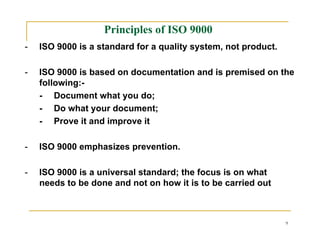
Principles of ISO 9000
-   ISO 9000 is a standard for a quality system, not product.

-   ISO 9000 is based on documentation and is premised on the
    following:-
    - Document what you do;
    - Do what your document;
    - Prove it and improve it

-   ISO 9000 emphasizes prevention.

-   ISO 9000 is a universal standard; the focus is on what
    needs to be done and not on how it is to be carried out


                                                                9
WHY QUALITY SYSTEM - ISO 9000

•     To satisfy customers through a quality
      product
•     To gain self confidence – we get what
      we planned
•     To achieve competitiveness in both
      the local and overseas markets.
•     As a blueprint for efforts to improve
      the quality system of the organization.


                                                10
QUALITY SYSTEM     =   VEHICLE


QUALITY MANAGEMENT =   DRIVER


QUALITY POLICY     =   ROAD MAP


                                  11
ADVANTAGES OF ISO 9000
   IMPLEMENTATION


                         12
WHAT IS IT INTENDED FOR?

This International Standard specifies quality
system requirements for use where
organization’s capability to design and supply
conforming product needs to be
demonstrated.

The requirements specified are aimed
primarily at achieving customer satisfaction
by preventing nonconformity at all stages
from design through to servicing


                                               13
BENEFITS OF ISO 9000 IMPLEMENTATION

For the company:-

- Well defined organization and
  responsibilities,
  i.e., minimize grey areas and possible
  resources wastage.

- Standardize practice and establishment
  of proper communication channel, i.e.
  maximize productivity and
  communication efficiency.


                                           14
BENEFITS OF ISO 9000 IMPLEMENTATION

For the company:-

- A greater degree of internal control.

- Ultimately, increase profitability and
  market share, improve competitive position.

For the customer:-

- Increase satisfaction and growth in
  confidence.

                                            15
QUALITY MANAGEMENT SYSTEM –
         ISO 9001:2000
      IT’S A NEW REVISION STANDARD


                                     16
ISO 9001 Revision 2000 been developed by TC 176, after
a great deal of research on Eight Quality Management
Principles
        Eight Quality Management Principles
       • Customer - focused organization
       • Leadership
       • Involvement of people
       • Process approach
       • System approach to management
       • Continual improvement
       • Factual approach to decision making
       • Mutually beneficial supplier relationship


                                                     17
Structure of the ISO 9001:2000 standard
• 20 elements of ISO 9001:1994 still there but in
  the context of a model based on organizational
  processes

Core organizational processes covered under:
Clause 5.   MANAGEMENT RESPONSIBILITY
Clause 6.   RESOURCE MANAGEMENT
Clause 7.   PRODUCT REALISATION
Clause 8.   MEASUREMENT, ANALYSIS AND
            IMPROVEMENT
supported by:
Clause 4: Quality Management System


                                                    18
Structure of the new ISO 9001:2000
                  standard

-    Process-oriented structure and a more logical
     sequence of contents

-    Allows for more flexibility on amount of
     documentation

-    Changes in terminology for easier
     interpretation by all sectors.


                                                     19
QUALITY MANAGEMENT SYSTEM
                           Continual improvement of the
                           Quality management system


                                       Management
                                       responsibility                       Customers
Customers


                                                  Measurement,
                          Resource
                                                  analysis and
                         management                                         Satisfaction
                                                  improvement

Requirements

               Input                                               Output
                                    Product              Product
                                    realization


           Information flow
          Value-adding activities
                                                                                   20
                                                                 Reference: ISO 9001:2000
The ISO 9001:2000 standard has new more
  clearly defined requirements relating to :
  Continual improvement;
  Increased emphasis on the role of top
  management;
  Consideration of legal and regulatory
  requirements;
  Establishment of measurable objectives at
  relevant functions and levels;
  Monitoring of information of customer
  satisfaction as a measure of system
  performance;

                                               21
The ISO 9001:2000 standard has new more
clearly defined requirements relating to :
(contd.)

   Increased attention to resource
   availability;

   Determination of training effectiveness;

   Measurements extended to systems, process and
   product;
   Analysis of collected data on the performance of
   the QMS;

   Control of outsourced processes .

                                                      22
Correspondence between ISO 9001:1994 and ISO 9001:2000
         Correspondence between ISO 9001:1994 and ISO 9001:2000


              Table 11 – Correspondence between ISO 9001: 1994 and ISO 9001: 2000
               Table – Correspondence between ISO 9001: 1994 and ISO 9001: 2000

                           ISO 9001: 1994                                 ISO 9001: 2000
1. Scope                                                          1
2. Normative reference                                            2
3. Definitions                                                    3
4. Quality system requirements (title only)
4.1 Management responsibility (title only)
4.1.1 Quality policy                                              5.1 + 5.3 + 5.4.1
4.1.2 Organization (title only)
4.1.2.1 Organization (title only)                                 5.5.1
4.1.2.2 Resources                                                 6.1 + 6.2.1
4.1.2.3 Management Representative                                 5.5.2
4.1.3 Management Review                                           5.6.1 + 8.5.1


                                                                                           23
ISO 9001: 1994                ISO 9001: 2000
4.2 Quality system (title only)
4.2.1 General                                   4.1 + 4.2.2
4.2.2 Quality system procedures                 4.2.1
4.2.3 Quality planning                          5.4.2 + 7.1
4.3 Contract review (title only)
4.3.1   General
4.3.2   Review                                  5.2. + 7.2.1 + 7.2.2 + 7.2.3
4.3.3   Amendment to a contract                 7.2.2
4.3.4   Records                                 7.2.2
4.4 Design control (title only)
4.4.1 General
4.4.2 Design and development planning           7.3.1
4.4.3 Organizational and technical interfaces   7.3.1
4.4.4 Design input                              7.2.1 + 7.3.2
4.4.5 Design output                             7.3.3
4.4.6 Design review                             7.3.4
4.4.7 Design verification                       7.3.5
4.4.8 Design validation                         7.3.6
4.4.9 Design changes                            7.3.7


                                                                               24
ISO 9001: 1994               ISO 9001: 2000
4.5 Document and data control (title only)
4.5.1 General                                 4.2.3
4.5.2 Document and data approval and issue    4.2.3
4.5.3 Document and data changes               4.2.3
4.6 Purchasing (title only)
4.6.1 General
4.6.2 Evaluation of subcontractors            7.4.1
4.6.3 Purchasing data                         7.4.2
4.6.4 Verification of purchased product       7.4.3
4.7 Control of customer-supplied product      7.5.4
4.8 Product identification and traceability   7.5.3
4.9 Process control                           6.3 + 6.4 + 7.5.1 + 7.5.2
4.10 Inspection and testing (title only )
4.10.1 General                                7.1 + 8.1
4.10.2 Receiving inspection and testing       7.4.3 + 8.2.4
4.10.3 In-process inspection and testing      8.2.4
4.10.4 Final inspection and testing           8.2.4
4.10.5 Inspection and test records            7.5.3 + 8.2.4


                                                                          25
ISO 9001: 1994                                    ISO 9001: 2000
4.11 Control of inspection, measuring and test equipment (title
only)                                                               7.6
4.11.1 General                                                      7.6
4.11.2 Control procedure
4.12 Inspection and test status                                     7.5.3
4.13 Control of nonconforming product (title only)
4.13.1 General                                                      8.3
4.13.2 Review and disposition of nonconforming product              8.3
4.14 Corrective and preventive action (title only)
4.14.1 General                                                      8.5.2 + 8.5.3
4.14.2 Corrective action                                            8.5.2
4.14.3 Preventive action                                            8.5.3
4.15 Handling, storage, packaging, preservation & delivery (title
only)
4.15.1 General                                                      7.5.5
4.15.2 Handling                                                     7.5.5
4.15.3 Storage                                                      7.5.5
4.15.4 Packaging                                                    7.5.5
4.15.5 Preservation                                                 7.5.1
4.15.6 Delivery


                                                                                             26
ISO 9001: 1994            ISO 9001: 2000
4.16 Control of quality records            4.2.4
4.17 Internal quality audits               8.2.2 + 8.2.3
4.18 Training                              6.2.2
4.19 Servicing                             7.5.1
4.20 Statistical techniques (title only)
4.20.1 Identification of need              8.1 + 8.2.3 + 8.2.4 + 8.4
4.20.2 Procedures                          8.1 + 8.2.3. + 8.2.4 + 8.4


                                                                        27
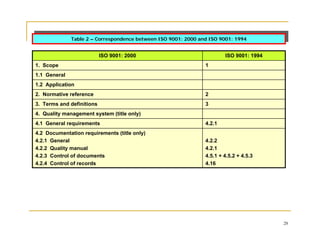
Table 22 – Correspondence between ISO 9001: 2000 and ISO 9001: 1994
               Table – Correspondence between ISO 9001: 2000 and ISO 9001: 1994


                           ISO 9001: 2000                               ISO 9001: 1994
1. Scope                                                        1
1.1 General
1.2 Application
2. Normative reference                                          2
3. Terms and definitions                                        3
4. Quality management system (title only)
4.1 General requirements                                        4.2.1
4.2 Documentation requirements (title only)
4.2.1 General                                                   4.2.2
4.2.2 Quality manual                                            4.2.1
4.2.3 Control of documents                                      4.5.1 + 4.5.2 + 4.5.3
4.2.4 Control of records                                        4.16


                                                                                         28
ISO 9001: 2000                                  ISO 9001: 1994
5. Management responsibility (title only)
5.1 Management commitment                                      4.1.1
5.2 Customer focus                                             4.3.2
5.3 Quality policy                                             4.1.1
5.4 Planning (title only)
5.4.1 Quality objectives                                       4.1.1
5.4.2 Quality management system planning                       4.2.3
5.5 Responsibility, authority and communication (title only)
5.5.1 Responsibility and authority                             4.1.2.1
5.5.2 Management representative                                4.1.2.3
5.5.3 Internal communication
5.6 Management review (title only)
5.6.1 General                                                  4.1.3
5.6.2 Review input
5.6.3 Review output


                                                                                          29
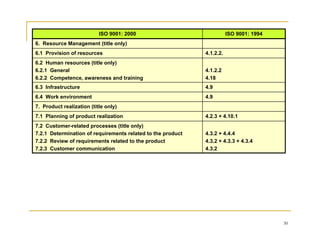
ISO 9001: 2000                               ISO 9001: 1994
6. Resource Management (title only)
6.1 Provision of resources                                   4.1.2.2.
6.2 Human resources (title only)
6.2.1 General                                                4.1.2.2
6.2.2 Competence, awareness and training                     4.18
6.3 Infrastructure                                           4.9
6.4 Work environment                                         4.9
7. Product realization (title only)
7.1 Planning of product realization                          4.2.3 + 4.10.1
7.2 Customer-related processes (title only)
7.2.1 Determination of requirements related to the product   4.3.2 + 4.4.4
7.2.2 Review of requirements related to the product          4.3.2 + 4.3.3 + 4.3.4
7.2.3 Customer communication                                 4.3.2


                                                                                         30
ISO 9001: 2000                            ISO 9001: 1994
7.3 Design and development (title only)
7.3.1 Design and development planning                      4.4.2 + 4.4.3
7.3.2 Design and development inputs                        4.4.4
7.3.3 Design and development outputs                       4.4.5
7.3.4 Design and development                               4.4.6
7.3.5 Design and development verification                  4.4.7
7.3.6 Design and development validation                    4.4.8
7.3.7 Control of design and development changes            4.4.9
7.4 Purchasing (title only)
7.4.1 Purchasing process                                   4.6.2
7.4.2 Purchasing information                               4.6.3
7.4.3 Verification of purchased product                    4.6.4 + 4.10.2
7.5 Production and service provision (title only)
7.5.1 Control of production and service provision          4.9 + 4.15.6 + 4.19
7.5.2 Validation of processes for production and service   4.9
provision                                                  4.8 + 4.10.5 + 4.12
7.5.3 Identification and traceability                      4.7
7.5.4 Customer property                                    4.15.2 + 4.15.3 + 4.15.4 + 4.15.5
7.5.5 Preservation of product


                                                                                           31
ISO 9001: 2000                                    ISO 9001: 1994
7.6 Control of monitoring and measuring devices   4.11.1 + 4.11.2

8. Measurement, analysis and improvement (title
only)
8.1 General                                       4.10.1 + 4.20.1 + 4.20.2
8.2 Monitoring and measurement (title only)
8.2.1 Customer satisfaction
8.2.2 Internal audit                              4.17
8.2.3 Monitoring and measurement of processes     4.17 + 4.20.1 + 4.20.2
8.2.4 Monitoring and measurement of product       4.10.2 + 4.10.3 + 4.10.4 + 4.10.5 + 4.20.1 +
                                                  4.20.2
8.3 Control of nonconforming product              4.13.1 + 4.13.2
8.4 Analysis of data                              4.20.1 + 4.20.2

8.5 Improvement (title only)
8.5.1 Continual improvement                       4.1.3
8.5.2 Corrective action                           4.14.1 + 4.14.2
8.5.3 Preventive action                           4.14.1 + 4.14.3


                                                                                                 32
DOCUMENTING THE SYSTEM BASED
  ON ISO 9001:2000 STANDARD


                               33
Quality Management System
                  Documentation
 The organization shall establish, document,
 implement and maintain a quality management
 system and continually improve its effectiveness in
 accordance with the requirements of this
 International Standard.
 (Clause 4.1, ISO 9001:2000)

• Documentation is a set of documents, for example specifications
  and records.
• Document is information (meaningful data) and its supporting
  medium.
• Quality management system is a management system to direct and
  control an organization with regard to quality.
• Quality manual is the document specifying the quality
  management system of an organization.


                                                             34
DOCUMENTATION PYRAMID
                                                                         LOW
   QUALITY/ POLICY                                             LEVEL 1
   MANUAL

  OPERATION
  PROCEDURES                                                   LEVEL 2

                                                                         DETAIL
 WORK
 INSTRUCTIONS                                                  LEVEL 3


FORMS,
LABEL,                                                         LEVEL 4
RECORDS,
                                                                         HIGH
ETC.           A            B          C          D         E
           Purchasing   Production Personnel    Quality   Stores
           Department   Department Department   Control


                                                                           35
LEVEL 1: QUALITY MANUAL

        The quality manual as a highest level
        document at the peak of a pyramid
        outlining the quality system and acting as
        a directory for the documents and
        procedures below. It will outline the
        company’s policy and commitment to
        quality.


                                                     36
WHY NEED QUALITY MANUAL?
1. Communicating the organization’s quality policy,
   procedures and requirements;
2. Describing and implementing an effective quality
   system;
3. Providing improved control of practices and facilitating
   assurance activities;
4. Providing the documented bases for auditing the
   quality system;
5. Providing continuity of the quality system and its
   requirements during changing circumstances;
6. Training personnel;
7. Presenting quality system for external purposes;
8. Demonstrating compliance of the quality system with
   quality requirements


                                                         37
Quality Policy
                Clause 5.3


  The overall quality intentions and
direction of an organization related to
quality, as formally expressed by top
             management


                                          38
LEVEL 2: OPERATION PROCEDURE

        A second tier set of departmental
        procedures detail how that commitment is
        applied to the company operations and lay
        down procedures for the management to
        control the system


                                                39
PROCEDURES DEVELOPMENT

1. Review current practice
2. Analyze current practice
3. Develop a draft procedure
4. Release draft for comment
5. Review comments
6. Revise and issue procedure for acceptance
7. Obtain approval
8. Issue for use
9. Implement
10. Monitor and Review


                                               40
SUGGESTED FORMAT

1.   PURPOSE
2.   APPLICATION/SCOPE
3.   REFERENCE DOCUMENT
4.   DEFINITION
5.   RESPONSIBILITY
6.   QUALIFICATION OR TRAINING
7.   PROCEDURE
8.   RECORD
9.   ATTACHMENT


                                 41
LEVEL 3:   WORK INSTRUCTIONS

           This third tier of work
           instructions details the day-to-
           day operating instructions to
           provide control of quality and
           being applied in the manner laid
           down in operation procedures.


                                              42
Work Instructions
The written and /or spoken direction given with regard to
what is to be done, including the information given in
training.

      What is to be done?
      How it should be done?
      Who should do it?
      When it should be done?
      Supplies, services & equipment to be used
      Criteria to be satisfied
      Balance between instructions & training
      Usually departmental, or specific to product
      Frequently changed
      In details

                                                       43
LEVEL 4: SUPPORTING DOCUMENTS

       Relates to all the forms, documents,
       records, labels, tickets, job cards, purchase
       orders, goods inwards notes, registers,
       logs, etc. that are used to support the levels
       above.


                                                    44
SUPPORT DOCUMENTATION


1.   QUALITY PLAN

3.   CODES OF PRACTICE

4.   USER MANUAL

5.   TECHNICAL DOCUMENTATION


                               45
46

Iso 9000 2000 Prs

  • 1.
    QUALITY MANAGEMENT SYSTEM ISO 9001: 2000 Prepared & Presented by : Sharjeel A.Khan Dubai-UAE 1
  • 2.
    Defining Quality –What is quality? What are some common definitions of quality, which will be helpful in this discussion. 2
  • 3.
    THE QUALITY CYCLE Inspection Production Marketing Purchasing Vendors Service Customers Manufact. Engineering Market Studies Product Development 3
  • 4.
    QUALITY IN RELATIONWITH MANAGEMENT SYSTEM - ISO 9000 4
  • 5.
    Quality Definition: ISO8406 The totality of features and characteristics of a product or service that bear on its ability to satisfy stated or implied needs 5
  • 6.
  • 7.
    WHAT IS ISO9000 • ISO is a ‘nickname’ to “International Organization for Standardization”. • An international standard more than 100 countries • ISO is a non-governmental organization established in 1947 by International Standard Agency headquartered in Geneva. • Principles are applicable to all organizations 7
  • 8.
    WHAT IS ISO9000 ISO 9000 is a written set of standard which describe and define the basic elements/clauses of the quality system needed to ensure that an organization’s products/or services meet or exceed customer needs and expectations 8
  • 9.
    Principles of ISO9000 - ISO 9000 is a standard for a quality system, not product. - ISO 9000 is based on documentation and is premised on the following:- - Document what you do; - Do what your document; - Prove it and improve it - ISO 9000 emphasizes prevention. - ISO 9000 is a universal standard; the focus is on what needs to be done and not on how it is to be carried out 9
  • 10.
    WHY QUALITY SYSTEM- ISO 9000 • To satisfy customers through a quality product • To gain self confidence – we get what we planned • To achieve competitiveness in both the local and overseas markets. • As a blueprint for efforts to improve the quality system of the organization. 10
  • 11.
    QUALITY SYSTEM = VEHICLE QUALITY MANAGEMENT = DRIVER QUALITY POLICY = ROAD MAP 11
  • 12.
    ADVANTAGES OF ISO9000 IMPLEMENTATION 12
  • 13.
    WHAT IS ITINTENDED FOR? This International Standard specifies quality system requirements for use where organization’s capability to design and supply conforming product needs to be demonstrated. The requirements specified are aimed primarily at achieving customer satisfaction by preventing nonconformity at all stages from design through to servicing 13
  • 14.
    BENEFITS OF ISO9000 IMPLEMENTATION For the company:- - Well defined organization and responsibilities, i.e., minimize grey areas and possible resources wastage. - Standardize practice and establishment of proper communication channel, i.e. maximize productivity and communication efficiency. 14
  • 15.
    BENEFITS OF ISO9000 IMPLEMENTATION For the company:- - A greater degree of internal control. - Ultimately, increase profitability and market share, improve competitive position. For the customer:- - Increase satisfaction and growth in confidence. 15
  • 16.
    QUALITY MANAGEMENT SYSTEM– ISO 9001:2000 IT’S A NEW REVISION STANDARD 16
  • 17.
    ISO 9001 Revision2000 been developed by TC 176, after a great deal of research on Eight Quality Management Principles Eight Quality Management Principles • Customer - focused organization • Leadership • Involvement of people • Process approach • System approach to management • Continual improvement • Factual approach to decision making • Mutually beneficial supplier relationship 17
  • 18.
    Structure of theISO 9001:2000 standard • 20 elements of ISO 9001:1994 still there but in the context of a model based on organizational processes Core organizational processes covered under: Clause 5. MANAGEMENT RESPONSIBILITY Clause 6. RESOURCE MANAGEMENT Clause 7. PRODUCT REALISATION Clause 8. MEASUREMENT, ANALYSIS AND IMPROVEMENT supported by: Clause 4: Quality Management System 18
  • 19.
    Structure of thenew ISO 9001:2000 standard - Process-oriented structure and a more logical sequence of contents - Allows for more flexibility on amount of documentation - Changes in terminology for easier interpretation by all sectors. 19
  • 20.
    QUALITY MANAGEMENT SYSTEM Continual improvement of the Quality management system Management responsibility Customers Customers Measurement, Resource analysis and management Satisfaction improvement Requirements Input Output Product Product realization Information flow Value-adding activities 20 Reference: ISO 9001:2000
  • 21.
    The ISO 9001:2000standard has new more clearly defined requirements relating to : Continual improvement; Increased emphasis on the role of top management; Consideration of legal and regulatory requirements; Establishment of measurable objectives at relevant functions and levels; Monitoring of information of customer satisfaction as a measure of system performance; 21
  • 22.
    The ISO 9001:2000standard has new more clearly defined requirements relating to : (contd.) Increased attention to resource availability; Determination of training effectiveness; Measurements extended to systems, process and product; Analysis of collected data on the performance of the QMS; Control of outsourced processes . 22
  • 23.
    Correspondence between ISO9001:1994 and ISO 9001:2000 Correspondence between ISO 9001:1994 and ISO 9001:2000 Table 11 – Correspondence between ISO 9001: 1994 and ISO 9001: 2000 Table – Correspondence between ISO 9001: 1994 and ISO 9001: 2000 ISO 9001: 1994 ISO 9001: 2000 1. Scope 1 2. Normative reference 2 3. Definitions 3 4. Quality system requirements (title only) 4.1 Management responsibility (title only) 4.1.1 Quality policy 5.1 + 5.3 + 5.4.1 4.1.2 Organization (title only) 4.1.2.1 Organization (title only) 5.5.1 4.1.2.2 Resources 6.1 + 6.2.1 4.1.2.3 Management Representative 5.5.2 4.1.3 Management Review 5.6.1 + 8.5.1 23
  • 24.
    ISO 9001: 1994 ISO 9001: 2000 4.2 Quality system (title only) 4.2.1 General 4.1 + 4.2.2 4.2.2 Quality system procedures 4.2.1 4.2.3 Quality planning 5.4.2 + 7.1 4.3 Contract review (title only) 4.3.1 General 4.3.2 Review 5.2. + 7.2.1 + 7.2.2 + 7.2.3 4.3.3 Amendment to a contract 7.2.2 4.3.4 Records 7.2.2 4.4 Design control (title only) 4.4.1 General 4.4.2 Design and development planning 7.3.1 4.4.3 Organizational and technical interfaces 7.3.1 4.4.4 Design input 7.2.1 + 7.3.2 4.4.5 Design output 7.3.3 4.4.6 Design review 7.3.4 4.4.7 Design verification 7.3.5 4.4.8 Design validation 7.3.6 4.4.9 Design changes 7.3.7 24
  • 25.
    ISO 9001: 1994 ISO 9001: 2000 4.5 Document and data control (title only) 4.5.1 General 4.2.3 4.5.2 Document and data approval and issue 4.2.3 4.5.3 Document and data changes 4.2.3 4.6 Purchasing (title only) 4.6.1 General 4.6.2 Evaluation of subcontractors 7.4.1 4.6.3 Purchasing data 7.4.2 4.6.4 Verification of purchased product 7.4.3 4.7 Control of customer-supplied product 7.5.4 4.8 Product identification and traceability 7.5.3 4.9 Process control 6.3 + 6.4 + 7.5.1 + 7.5.2 4.10 Inspection and testing (title only ) 4.10.1 General 7.1 + 8.1 4.10.2 Receiving inspection and testing 7.4.3 + 8.2.4 4.10.3 In-process inspection and testing 8.2.4 4.10.4 Final inspection and testing 8.2.4 4.10.5 Inspection and test records 7.5.3 + 8.2.4 25
  • 26.
    ISO 9001: 1994 ISO 9001: 2000 4.11 Control of inspection, measuring and test equipment (title only) 7.6 4.11.1 General 7.6 4.11.2 Control procedure 4.12 Inspection and test status 7.5.3 4.13 Control of nonconforming product (title only) 4.13.1 General 8.3 4.13.2 Review and disposition of nonconforming product 8.3 4.14 Corrective and preventive action (title only) 4.14.1 General 8.5.2 + 8.5.3 4.14.2 Corrective action 8.5.2 4.14.3 Preventive action 8.5.3 4.15 Handling, storage, packaging, preservation & delivery (title only) 4.15.1 General 7.5.5 4.15.2 Handling 7.5.5 4.15.3 Storage 7.5.5 4.15.4 Packaging 7.5.5 4.15.5 Preservation 7.5.1 4.15.6 Delivery 26
  • 27.
    ISO 9001: 1994 ISO 9001: 2000 4.16 Control of quality records 4.2.4 4.17 Internal quality audits 8.2.2 + 8.2.3 4.18 Training 6.2.2 4.19 Servicing 7.5.1 4.20 Statistical techniques (title only) 4.20.1 Identification of need 8.1 + 8.2.3 + 8.2.4 + 8.4 4.20.2 Procedures 8.1 + 8.2.3. + 8.2.4 + 8.4 27
  • 28.
    Table 22 –Correspondence between ISO 9001: 2000 and ISO 9001: 1994 Table – Correspondence between ISO 9001: 2000 and ISO 9001: 1994 ISO 9001: 2000 ISO 9001: 1994 1. Scope 1 1.1 General 1.2 Application 2. Normative reference 2 3. Terms and definitions 3 4. Quality management system (title only) 4.1 General requirements 4.2.1 4.2 Documentation requirements (title only) 4.2.1 General 4.2.2 4.2.2 Quality manual 4.2.1 4.2.3 Control of documents 4.5.1 + 4.5.2 + 4.5.3 4.2.4 Control of records 4.16 28
  • 29.
    ISO 9001: 2000 ISO 9001: 1994 5. Management responsibility (title only) 5.1 Management commitment 4.1.1 5.2 Customer focus 4.3.2 5.3 Quality policy 4.1.1 5.4 Planning (title only) 5.4.1 Quality objectives 4.1.1 5.4.2 Quality management system planning 4.2.3 5.5 Responsibility, authority and communication (title only) 5.5.1 Responsibility and authority 4.1.2.1 5.5.2 Management representative 4.1.2.3 5.5.3 Internal communication 5.6 Management review (title only) 5.6.1 General 4.1.3 5.6.2 Review input 5.6.3 Review output 29
  • 30.
    ISO 9001: 2000 ISO 9001: 1994 6. Resource Management (title only) 6.1 Provision of resources 4.1.2.2. 6.2 Human resources (title only) 6.2.1 General 4.1.2.2 6.2.2 Competence, awareness and training 4.18 6.3 Infrastructure 4.9 6.4 Work environment 4.9 7. Product realization (title only) 7.1 Planning of product realization 4.2.3 + 4.10.1 7.2 Customer-related processes (title only) 7.2.1 Determination of requirements related to the product 4.3.2 + 4.4.4 7.2.2 Review of requirements related to the product 4.3.2 + 4.3.3 + 4.3.4 7.2.3 Customer communication 4.3.2 30
  • 31.
    ISO 9001: 2000 ISO 9001: 1994 7.3 Design and development (title only) 7.3.1 Design and development planning 4.4.2 + 4.4.3 7.3.2 Design and development inputs 4.4.4 7.3.3 Design and development outputs 4.4.5 7.3.4 Design and development 4.4.6 7.3.5 Design and development verification 4.4.7 7.3.6 Design and development validation 4.4.8 7.3.7 Control of design and development changes 4.4.9 7.4 Purchasing (title only) 7.4.1 Purchasing process 4.6.2 7.4.2 Purchasing information 4.6.3 7.4.3 Verification of purchased product 4.6.4 + 4.10.2 7.5 Production and service provision (title only) 7.5.1 Control of production and service provision 4.9 + 4.15.6 + 4.19 7.5.2 Validation of processes for production and service 4.9 provision 4.8 + 4.10.5 + 4.12 7.5.3 Identification and traceability 4.7 7.5.4 Customer property 4.15.2 + 4.15.3 + 4.15.4 + 4.15.5 7.5.5 Preservation of product 31
  • 32.
    ISO 9001: 2000 ISO 9001: 1994 7.6 Control of monitoring and measuring devices 4.11.1 + 4.11.2 8. Measurement, analysis and improvement (title only) 8.1 General 4.10.1 + 4.20.1 + 4.20.2 8.2 Monitoring and measurement (title only) 8.2.1 Customer satisfaction 8.2.2 Internal audit 4.17 8.2.3 Monitoring and measurement of processes 4.17 + 4.20.1 + 4.20.2 8.2.4 Monitoring and measurement of product 4.10.2 + 4.10.3 + 4.10.4 + 4.10.5 + 4.20.1 + 4.20.2 8.3 Control of nonconforming product 4.13.1 + 4.13.2 8.4 Analysis of data 4.20.1 + 4.20.2 8.5 Improvement (title only) 8.5.1 Continual improvement 4.1.3 8.5.2 Corrective action 4.14.1 + 4.14.2 8.5.3 Preventive action 4.14.1 + 4.14.3 32
  • 33.
    DOCUMENTING THE SYSTEMBASED ON ISO 9001:2000 STANDARD 33
  • 34.
    Quality Management System Documentation The organization shall establish, document, implement and maintain a quality management system and continually improve its effectiveness in accordance with the requirements of this International Standard. (Clause 4.1, ISO 9001:2000) • Documentation is a set of documents, for example specifications and records. • Document is information (meaningful data) and its supporting medium. • Quality management system is a management system to direct and control an organization with regard to quality. • Quality manual is the document specifying the quality management system of an organization. 34
  • 35.
    DOCUMENTATION PYRAMID LOW QUALITY/ POLICY LEVEL 1 MANUAL OPERATION PROCEDURES LEVEL 2 DETAIL WORK INSTRUCTIONS LEVEL 3 FORMS, LABEL, LEVEL 4 RECORDS, HIGH ETC. A B C D E Purchasing Production Personnel Quality Stores Department Department Department Control 35
  • 36.
    LEVEL 1: QUALITYMANUAL The quality manual as a highest level document at the peak of a pyramid outlining the quality system and acting as a directory for the documents and procedures below. It will outline the company’s policy and commitment to quality. 36
  • 37.
    WHY NEED QUALITYMANUAL? 1. Communicating the organization’s quality policy, procedures and requirements; 2. Describing and implementing an effective quality system; 3. Providing improved control of practices and facilitating assurance activities; 4. Providing the documented bases for auditing the quality system; 5. Providing continuity of the quality system and its requirements during changing circumstances; 6. Training personnel; 7. Presenting quality system for external purposes; 8. Demonstrating compliance of the quality system with quality requirements 37
  • 38.
    Quality Policy Clause 5.3 The overall quality intentions and direction of an organization related to quality, as formally expressed by top management 38
  • 39.
    LEVEL 2: OPERATIONPROCEDURE A second tier set of departmental procedures detail how that commitment is applied to the company operations and lay down procedures for the management to control the system 39
  • 40.
    PROCEDURES DEVELOPMENT 1. Reviewcurrent practice 2. Analyze current practice 3. Develop a draft procedure 4. Release draft for comment 5. Review comments 6. Revise and issue procedure for acceptance 7. Obtain approval 8. Issue for use 9. Implement 10. Monitor and Review 40
  • 41.
    SUGGESTED FORMAT 1. PURPOSE 2. APPLICATION/SCOPE 3. REFERENCE DOCUMENT 4. DEFINITION 5. RESPONSIBILITY 6. QUALIFICATION OR TRAINING 7. PROCEDURE 8. RECORD 9. ATTACHMENT 41
  • 42.
    LEVEL 3: WORK INSTRUCTIONS This third tier of work instructions details the day-to- day operating instructions to provide control of quality and being applied in the manner laid down in operation procedures. 42
  • 43.
    Work Instructions The writtenand /or spoken direction given with regard to what is to be done, including the information given in training. What is to be done? How it should be done? Who should do it? When it should be done? Supplies, services & equipment to be used Criteria to be satisfied Balance between instructions & training Usually departmental, or specific to product Frequently changed In details 43
  • 44.
    LEVEL 4: SUPPORTINGDOCUMENTS Relates to all the forms, documents, records, labels, tickets, job cards, purchase orders, goods inwards notes, registers, logs, etc. that are used to support the levels above. 44
  • 45.
    SUPPORT DOCUMENTATION 1. QUALITY PLAN 3. CODES OF PRACTICE 4. USER MANUAL 5. TECHNICAL DOCUMENTATION 45
  • 46.