Sandrine Le Bail AP Art History 
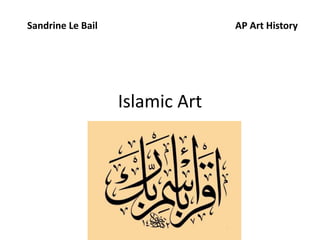
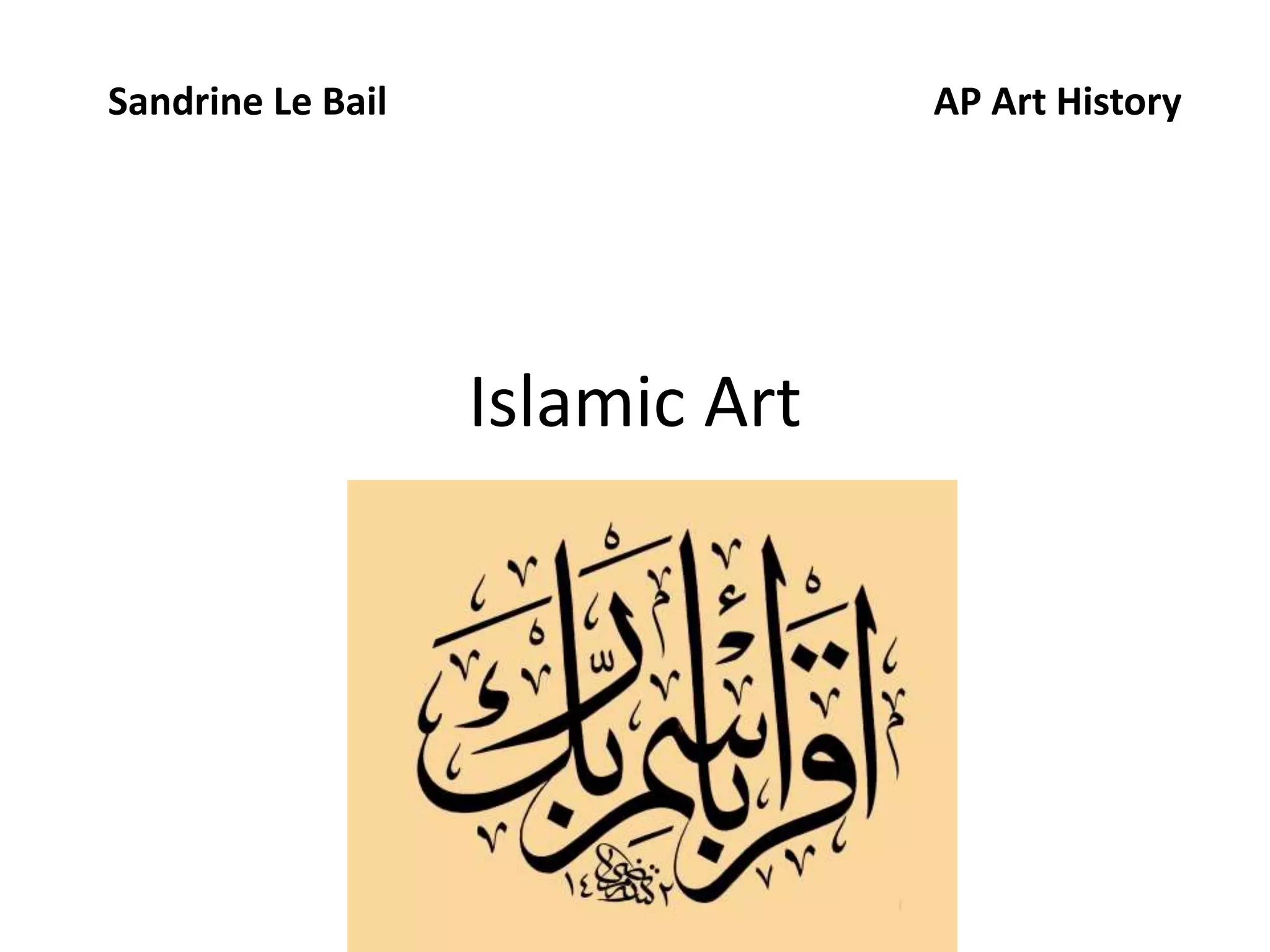
Islamic Art
Islamic Art 
Refers to art and architecture created: 
• By Muslims artists 
• For a Muslim patron 
• For use in Islamic faith 
It is not an art specific to a religion but to a culture. 
Common elements but great diversity in Islamic 
practices.
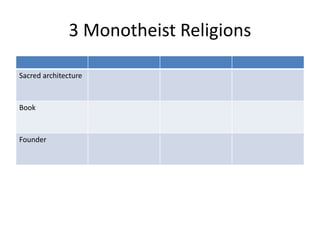
3 Monotheist Religions 
Sacred architecture 
Book 
Founder
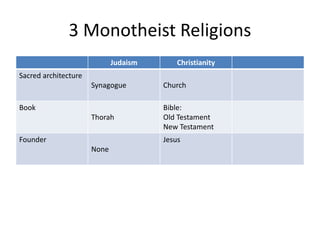
3 Monotheist Religions 
Judaism 
Sacred architecture 
Synagogue 
Book 
Thorah 
Founder 
None
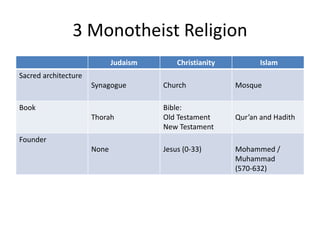
3 Monotheist Religions 
Judaism Christianity 
Sacred architecture 
Synagogue Church 
Book 
Thorah 
Bible: 
Old Testament 
New Testament 
Founder 
None 
Jesus
3 Monotheist Religion 
Judaism Christianity Islam 
Sacred architecture 
Synagogue Church Mosque 
Book 
Thorah 
Bible: 
Old Testament 
New Testament 
Qur’an and Hadith 
Founder 
None Jesus (0-33) Mohammed / 
Muhammad 
(570-632)
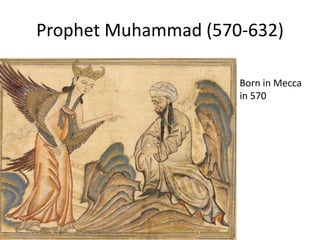
Prophet Muhammad (570-632) 
Born in Mecca 
in 570
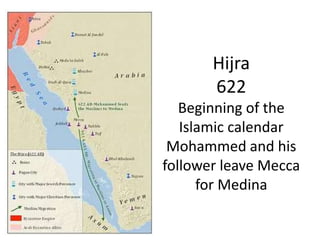
Hijra 
622 
Beginning of the 
Islamic calendar 
Mohammed and his 
follower leave Mecca 
for Medina
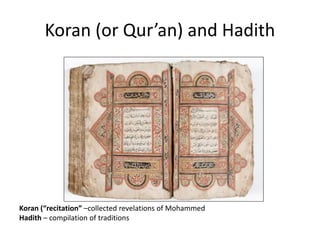
Koran (or Qur’an) and Hadith 
Koran (“recitation” –collected revelations of Mohammed 
Hadith – compilation of traditions
Aniconism 
• No mentionned in Koran or Hadith 
• Fear of idolatry 
• Suspicion against the creation of images of 
living beings 
• Absolute proscription against image of Gods, 
depictions of Mohammed, Islamic prophets, 
relatives of Mohammed 
• Consequence: use of geometric or vegetal-inspired 
patterns and calligraphy
Importance of decoration
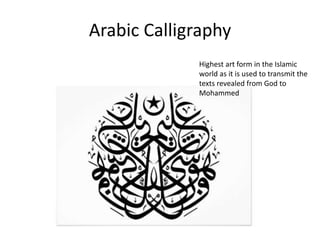
Arabic Calligraphy 
Highest art form in the Islamic 
world as it is used to transmit the 
texts revealed from God to 
Mohammed
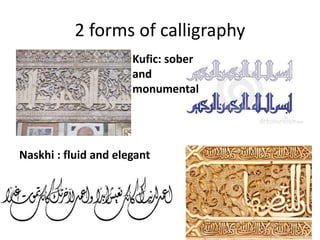
2 forms of calligraphy 
Kufic: sober 
and 
monumental 
Naskhi : fluid and elegant
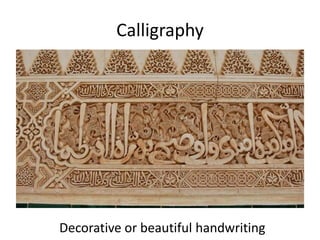
Calligraphy 
Decorative or beautiful handwriting
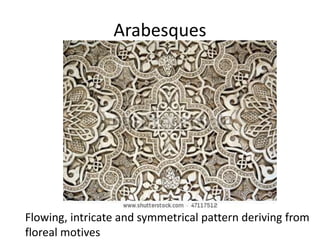
Arabesques 
Flowing, intricate and symmetrical pattern deriving from 
floreal motives
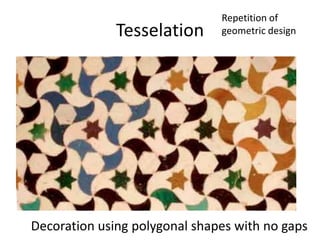
Tesselation 
Repetition of 
geometric design 
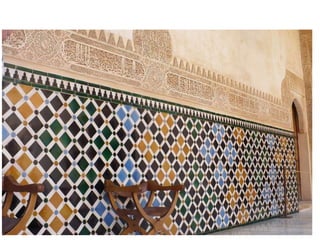
Decoration using polygonal shapes with no gaps
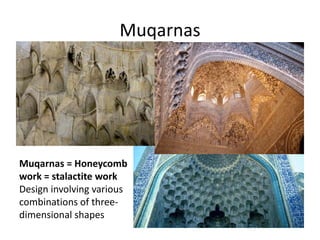
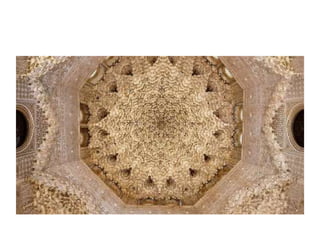
Muqarnas 
Muqarnas = Honeycomb 
work = stalactite work 
Design involving various 
combinations of three-dimensional 
shapes
Architecture 
Mosque
Mosque 
Always oriented towards Mecca 
Not only for religious purpose. 
No congregational worship 
Used for politic or social gatherings
Elements of the Mosque 
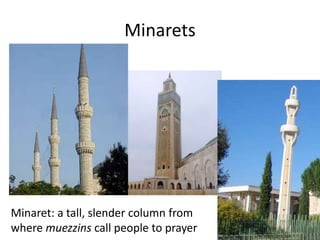
• Minaret 
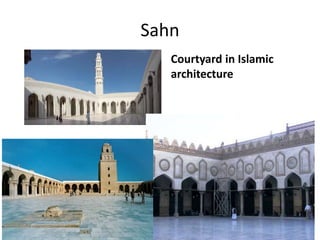
• Sahn 
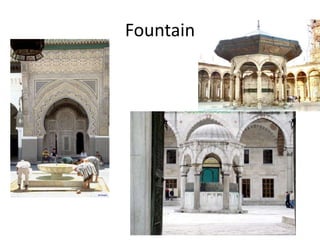
• Fountain 
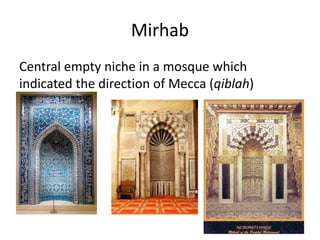
• Mirhab 
• Minbar
Minarets 
Minaret: a tall, slender column from 
where muezzins call people to prayer
Sahn 
Courtyard in Islamic 
architecture
Fountain
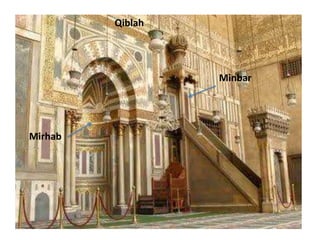
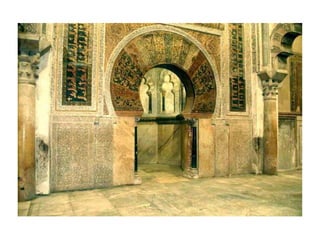
Mirhab 
Central empty niche in a mosque which 
indicated the direction of Mecca (qiblah)
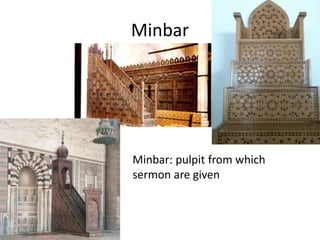
Minbar 
Minbar: pulpit from which 
sermon are given
Qiblah 
Mirhab 
Minbar
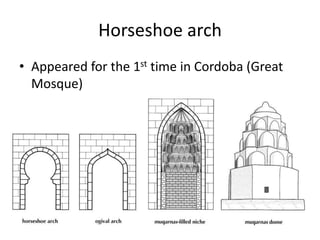
Horseshoe arch 
• Appeared for the 1st time in Cordoba (Great 
Mosque)
Main architectural features for 
Mosques 
• 1st great Islamic building : Dome of the rock 
• Hypostyle mosques (Kerouan and Còrdoba) 
• Unified central core (Mosque of Suleyman I or 
Selim II)
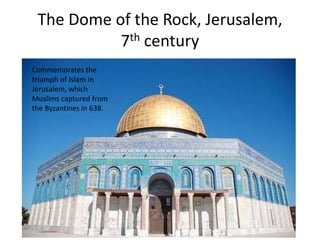
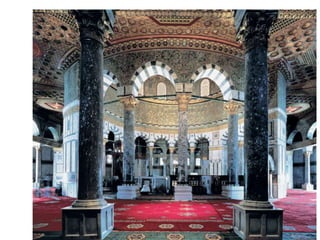
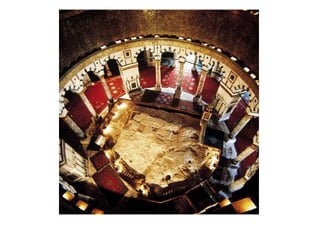
The Dome of the Rock, Jerusalem, 
7th century 
Commemorates the 
triumph of Islam in 
Jerusalem, which 
Muslims captured from 
the Byzantines in 638.
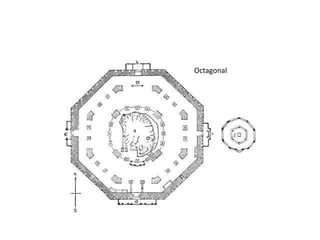
Octagonal
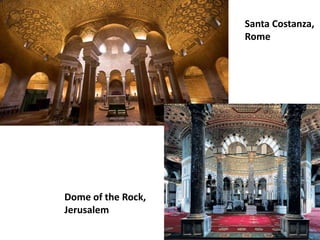
Santa Costanza, 
Rome 
Dome of the Rock, 
Jerusalem
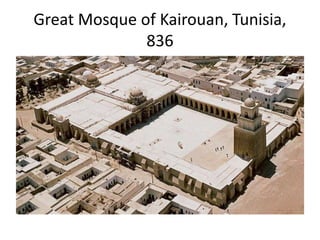
Great Mosque of Kairouan, Tunisia, 
836
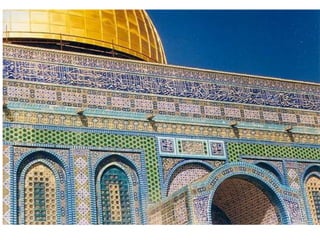
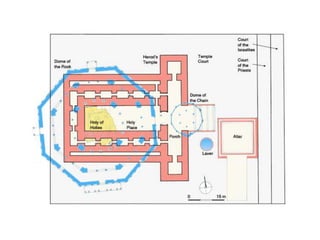
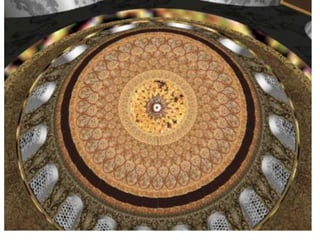
Dome of the Rock 
• 1st Mosque 
• Built on a Jewish Mount sacred to Jewish and 
Muslims (rock where Mohammed ascended to 
heaven) 
• Mosaics by Byzantine artists 
• Influenced by centrally planned buildings (as 
Santa Costanza) 
• Dome is of gilded wood
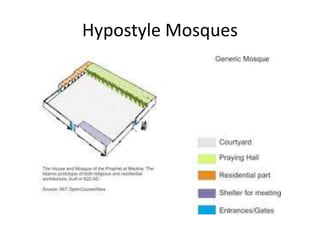
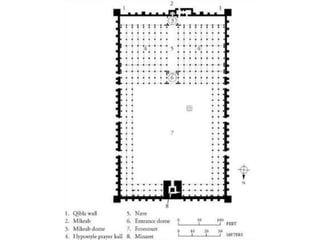
Hypostyle Mosques
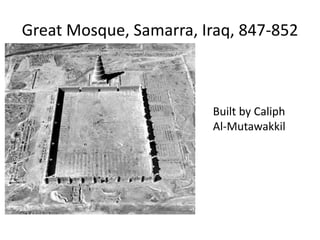
Great Mosque, Samarra, Iraq, 847-852 
Built by Caliph 
Al-Mutawakkil
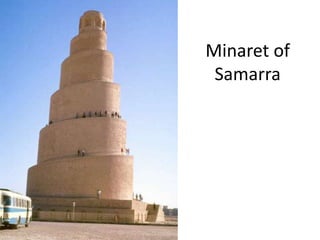
Minaret of 
Samarra
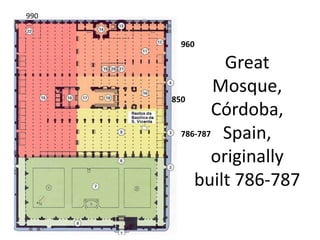
960 
Great 
Mosque, 
Córdoba, 
Spain, 
originally 
built 786-787 
850 
786-787 
990
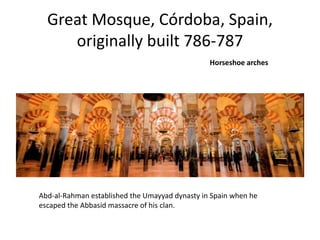
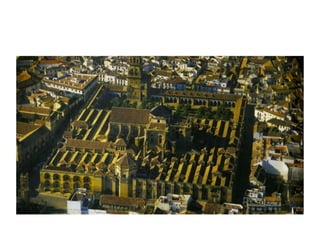
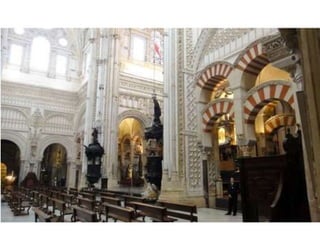
Great Mosque, Córdoba, Spain, 
originally built 786-787 
Horseshoe arches 
Abd-al-Rahman established the Umayyad dynasty in Spain when he 
escaped the Abbasid massacre of his clan.
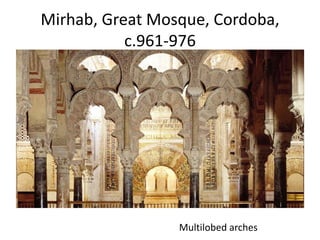
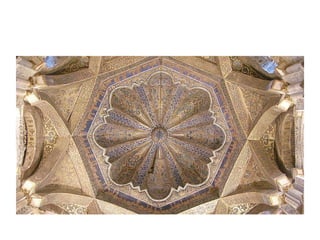
Mirhab, Great Mosque, Cordoba, 
c.961-976 
Multilobed arches
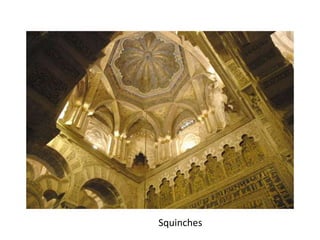
Squinches
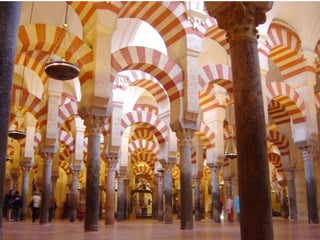
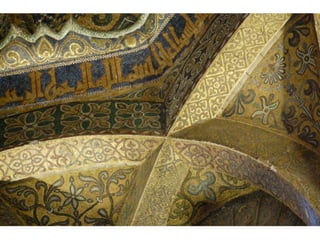
Great Mosque, Córdoba, Spain, 8th- 
10th century 
• Double-arched columns 
• Interior light and airy 
• Horseshoe-shaped arches 
• No central focus 
• Complex dome over mirhab with elaborate 
squinches 
• Columns recycled from ancient Roman 
structures
Istanbul 
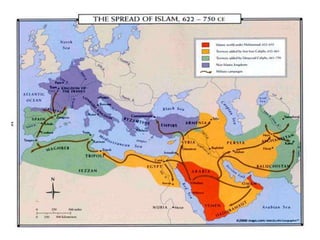
1453 – conquested by Ottoman Turks
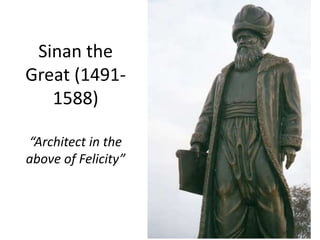
Sinan the 
Great (1491- 
1588) 
“Architect in the 
above of Felicity”
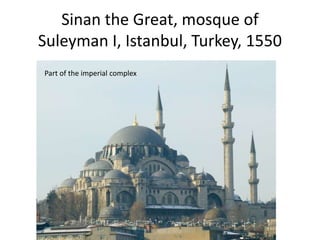
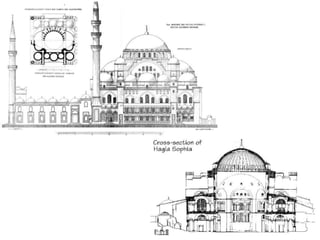
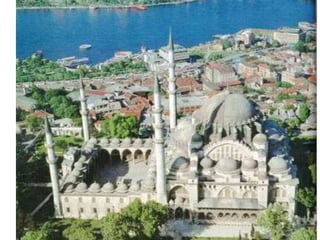
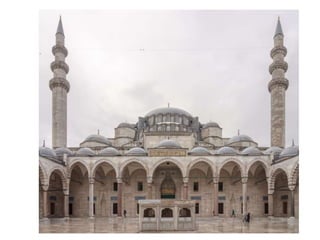
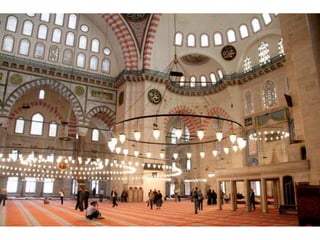
Sinan the Great, mosque of 
Suleyman I, Istanbul, Turkey, 1550 
Part of the imperial complex
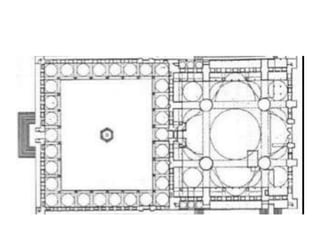
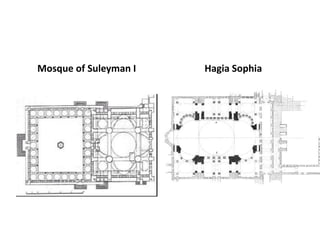
Mosque of Suleyman I Hagia Sophia
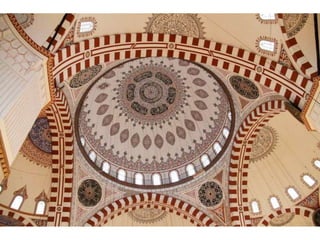
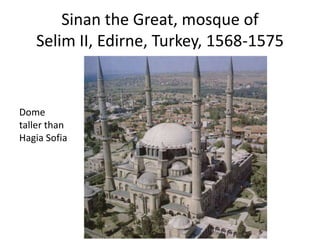
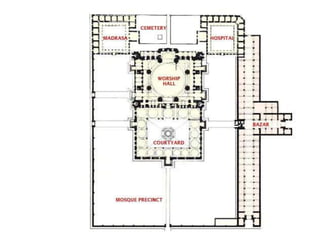
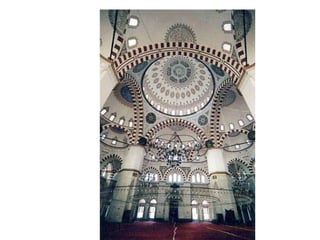
Sinan the Great, mosque of 
Selim II, Edirne, Turkey, 1568-1575 
Dome 
taller than 
Hagia Sofia
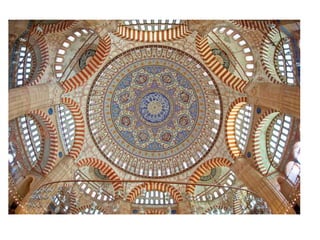
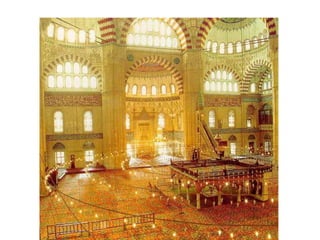
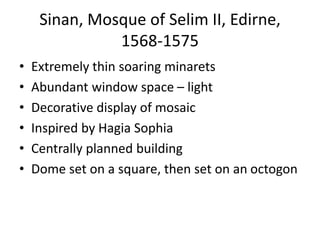
Sinan, Mosque of Selim II, Edirne, 
1568-1575 
• Extremely thin soaring minarets 
• Abundant window space – light 
• Decorative display of mosaic 
• Inspired by Hagia Sophia 
• Centrally planned building 
• Dome set on a square, then set on an octogon
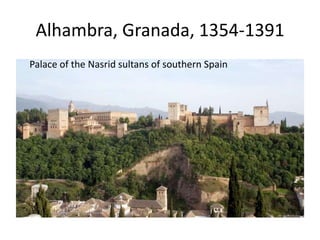
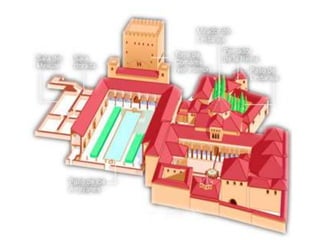
Alhambra, Granada, 1354-1391 
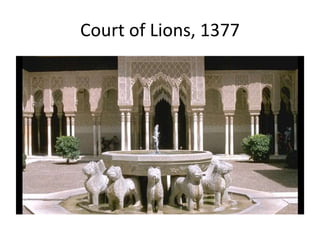
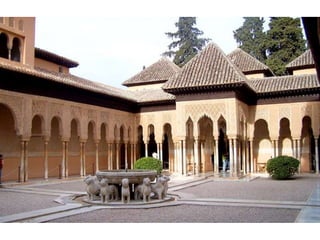
Palace of the Nasrid sultans of southern Spain
Court of Lions, 1377
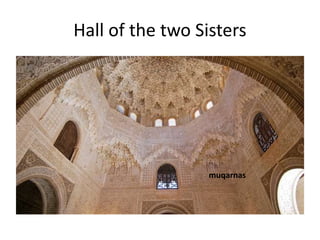
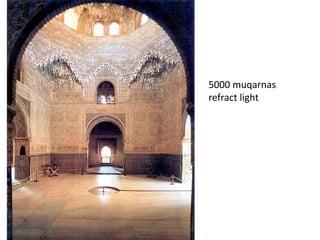
Hall of the two Sisters 
muqarnas
5000 muqarnas 
refract light
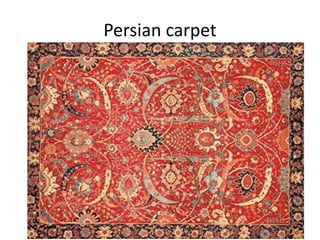
Persian carpet
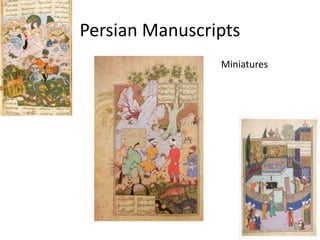
Persian Manuscripts 
Miniatures
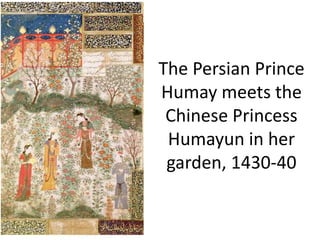
The Persian Prince 
Humay meets the 
Chinese Princess 
Humayun in her 
garden, 1430-40
Characteristic of Persian Manuscript 
• Persian tradition: representation of Human 
beings 
• Shadowless world 
• Richly decorated environment 
• Intricate details and multicolored geometric 
patterns 
• Space divided into a series of flat planes 
• Marriage of text and calligraphy 
• Manipulation of perspective
Characteristics of Islamic Art 
• Intellectual and refined art 
• Decorative 
• No strong emotions / No pathos 
• Try to avoid images (but the Koran doesn’t 
ban images)
Questions 
Explain how the designs of the mosque varies 
across the Islamic world with reference to two 
examples. Despite the difference, what features 
do mosques typically have in common?
Questions 
Images of People are not allowed in Islamic 
religious contexts, but mosque and other 
religious building are lavishly decorated. 
What artistic motifs and techniques are used 
and why?
Questions 
Select an Islamic structure that is influenced by 
Roman or Byzantine architecture. Which forms 
are borrowed? 
Why and how, in their Islamic context, are they 
transformed?

sdfsjefbib

  • 1.
    Sandrine Le BailAP Art History Islamic Art
  • 2.
    Islamic Art Refersto art and architecture created: • By Muslims artists • For a Muslim patron • For use in Islamic faith It is not an art specific to a religion but to a culture. Common elements but great diversity in Islamic practices.
  • 3.
    3 Monotheist Religions Sacred architecture Book Founder
  • 4.
    3 Monotheist Religions Judaism Sacred architecture Synagogue Book Thorah Founder None
  • 5.
    3 Monotheist Religions Judaism Christianity Sacred architecture Synagogue Church Book Thorah Bible: Old Testament New Testament Founder None Jesus
  • 6.
    3 Monotheist Religion Judaism Christianity Islam Sacred architecture Synagogue Church Mosque Book Thorah Bible: Old Testament New Testament Qur’an and Hadith Founder None Jesus (0-33) Mohammed / Muhammad (570-632)
  • 7.
    Prophet Muhammad (570-632) Born in Mecca in 570
  • 8.
    Hijra 622 Beginningof the Islamic calendar Mohammed and his follower leave Mecca for Medina
  • 10.
    Koran (or Qur’an)and Hadith Koran (“recitation” –collected revelations of Mohammed Hadith – compilation of traditions
  • 12.
    Aniconism • Nomentionned in Koran or Hadith • Fear of idolatry • Suspicion against the creation of images of living beings • Absolute proscription against image of Gods, depictions of Mohammed, Islamic prophets, relatives of Mohammed • Consequence: use of geometric or vegetal-inspired patterns and calligraphy
  • 13.
  • 14.
    Arabic Calligraphy Highestart form in the Islamic world as it is used to transmit the texts revealed from God to Mohammed
  • 15.
    2 forms ofcalligraphy Kufic: sober and monumental Naskhi : fluid and elegant
  • 16.
    Calligraphy Decorative orbeautiful handwriting
  • 17.
    Arabesques Flowing, intricateand symmetrical pattern deriving from floreal motives
  • 18.
    Tesselation Repetition of geometric design Decoration using polygonal shapes with no gaps
  • 20.
    Muqarnas Muqarnas =Honeycomb work = stalactite work Design involving various combinations of three-dimensional shapes
  • 21.
  • 22.
    Mosque Always orientedtowards Mecca Not only for religious purpose. No congregational worship Used for politic or social gatherings
  • 23.
    Elements of theMosque • Minaret • Sahn • Fountain • Mirhab • Minbar
  • 24.
    Minarets Minaret: atall, slender column from where muezzins call people to prayer
  • 25.
    Sahn Courtyard inIslamic architecture
  • 26.
  • 27.
    Mirhab Central emptyniche in a mosque which indicated the direction of Mecca (qiblah)
  • 28.
    Minbar Minbar: pulpitfrom which sermon are given
  • 29.
  • 30.
    Horseshoe arch •Appeared for the 1st time in Cordoba (Great Mosque)
  • 31.
    Main architectural featuresfor Mosques • 1st great Islamic building : Dome of the rock • Hypostyle mosques (Kerouan and Còrdoba) • Unified central core (Mosque of Suleyman I or Selim II)
  • 32.
    The Dome ofthe Rock, Jerusalem, 7th century Commemorates the triumph of Islam in Jerusalem, which Muslims captured from the Byzantines in 638.
  • 35.
  • 37.
    Santa Costanza, Rome Dome of the Rock, Jerusalem
  • 40.
    Great Mosque ofKairouan, Tunisia, 836
  • 41.
    Dome of theRock • 1st Mosque • Built on a Jewish Mount sacred to Jewish and Muslims (rock where Mohammed ascended to heaven) • Mosaics by Byzantine artists • Influenced by centrally planned buildings (as Santa Costanza) • Dome is of gilded wood
  • 42.
  • 44.
    Great Mosque, Samarra,Iraq, 847-852 Built by Caliph Al-Mutawakkil
  • 45.
  • 46.
    960 Great Mosque, Córdoba, Spain, originally built 786-787 850 786-787 990
  • 47.
    Great Mosque, Córdoba,Spain, originally built 786-787 Horseshoe arches Abd-al-Rahman established the Umayyad dynasty in Spain when he escaped the Abbasid massacre of his clan.
  • 51.
    Mirhab, Great Mosque,Cordoba, c.961-976 Multilobed arches
  • 53.
  • 56.
    Great Mosque, Córdoba,Spain, 8th- 10th century • Double-arched columns • Interior light and airy • Horseshoe-shaped arches • No central focus • Complex dome over mirhab with elaborate squinches • Columns recycled from ancient Roman structures
  • 57.
    Istanbul 1453 –conquested by Ottoman Turks
  • 58.
    Sinan the Great(1491- 1588) “Architect in the above of Felicity”
  • 59.
    Sinan the Great,mosque of Suleyman I, Istanbul, Turkey, 1550 Part of the imperial complex
  • 61.
    Mosque of SuleymanI Hagia Sophia
  • 67.
    Sinan the Great,mosque of Selim II, Edirne, Turkey, 1568-1575 Dome taller than Hagia Sofia
  • 72.
    Sinan, Mosque ofSelim II, Edirne, 1568-1575 • Extremely thin soaring minarets • Abundant window space – light • Decorative display of mosaic • Inspired by Hagia Sophia • Centrally planned building • Dome set on a square, then set on an octogon
  • 73.
    Alhambra, Granada, 1354-1391 Palace of the Nasrid sultans of southern Spain
  • 75.
  • 77.
    Hall of thetwo Sisters muqarnas
  • 78.
  • 80.
  • 81.
  • 82.
    The Persian Prince Humay meets the Chinese Princess Humayun in her garden, 1430-40
  • 83.
    Characteristic of PersianManuscript • Persian tradition: representation of Human beings • Shadowless world • Richly decorated environment • Intricate details and multicolored geometric patterns • Space divided into a series of flat planes • Marriage of text and calligraphy • Manipulation of perspective
  • 84.
    Characteristics of IslamicArt • Intellectual and refined art • Decorative • No strong emotions / No pathos • Try to avoid images (but the Koran doesn’t ban images)
  • 85.
    Questions Explain howthe designs of the mosque varies across the Islamic world with reference to two examples. Despite the difference, what features do mosques typically have in common?
  • 86.
    Questions Images ofPeople are not allowed in Islamic religious contexts, but mosque and other religious building are lavishly decorated. What artistic motifs and techniques are used and why?
  • 87.
    Questions Select anIslamic structure that is influenced by Roman or Byzantine architecture. Which forms are borrowed? Why and how, in their Islamic context, are they transformed?

Editor's Notes

  • #8 Born in Mecca Messenger and prophet of God
  • #9 622 – Mohammed and his follower have to leave Mecca fro Medina Beginning of the Islamic calendar At his Death, the caliph become the main ruler
  • #10 Army conquested a large territory Used to major conquests: Byzantine Empire and Persian
  • #11 Koran –revealed word of gods Hadith – compilation of tradition Both – base of the Islamic law Doesn’t ban images but strong tradition to not represent Sometimes floreal and animal decoration
  • #12 Declaration of Faith : there is no God but Allah and Muhammed is his messenger 5 times a day facing Mecca Division Sunni and Shiite
  • #13 Competition with God
  • #15 Double function: decorative and iconographic Even noblemen had to have a good calligraphy. Important artists All media
  • #18 Specific islamic Continuity and repetition In the entire Muslim word All material
  • #19 Unity is in multiplicity Patterns seem to radiate from a central point although any point can be thought of as start Importance of mathematicians Complexity , taste for math and symmetry / Filosophy Star / circles
  • #21 From Stalictics or Typical for Islamic art From squinches then only ornemental Stom or plaster
  • #23 Don’t need a mosque to pray 5 prayers / day
  • #25 Square – Syria and Magreb Polygonal in Egypt Cylindrical in Turkey
  • #27 Fes / Cairo / Istanbul
  • #29 Often in wood Sometimes stone or marble // throne in ebony
  • #30 Sultan Mosque in Cairo
  • #33 Earliest mosque Sacred stone for the 3 religions Mosaics and marble Dazzling/ Influence from Byzantine and Persian
  • #34 Repeated motive tesselation in multiplicty there is unity Calligraphy
  • #36 Like Christian martyria Domed wooden octagon
  • #37 Column from Roman monuments Mosaics by Byzantine artists
  • #39 Adam was buried Abraham nearly sacrificed Issac Muhammad ascended to heaven Temple of Jerusalem was located
  • #41 Kairouan, Tunisia Sud – Mecca – Prayer room
  • #43 Model: Mohammed’s house Muslims can pray everywhere For Friday prayer Lot of different typology according to the region
  • #45 Built by caliph al-Mutawakkil Ruins Bigger mosque Bricks -
  • #47 Abd Al Rahman – 1st muslim ruler Cordoba capital Flexibility of the mosque
  • #48 No centrality / no main axis
  • #49 Reuse of roman column – short so double heights of horseshoe-shaped arches Brick and stone Double arches Origininally wooden roof Impression of movement Sense of mystery Dimly lit
  • #54 Squinches Intrigated geometric patterns 8 stone arches crisscrossed Mozaic inspired mosaics with golden background
  • #55 Calligraphy and arabesques
  • #56 Arabesques (acanthus and split leaves)
  • #59 Architect of the caliph // Michelangelo
  • #60 Centrally planned mosques / on a hill – Visual effect 1453 – Istanbul conquested by Ottoman Turks / Hagia Sofia – mosque Ottoman Empire (until 1922) Sinan, great architect Influence of Hagia Sofia
  • #64 Lot of domes but unity thanks to a square shape Geometry and symmetry Circle in square Very thin and high minaret
  • #66 Unity Clear influence of Hagia Sofia and Byzantine architecture
  • #67 Decoration / Light Pendentive Abundant window
  • #68 Master piece
  • #74 Last muslim city in Spain 1492 reconquested by the Catholic King Nasrids sultans
  • #75 Organic / Many courtyards / fountains…
  • #76 Importance of water and courtyard for Islam All around main rooms for guests Water on the floor (4 river of paradise) Fountain with colour Lions represent
  • #77 Incredible variety of patterns
  • #78 Lot of light / open air Honeycomb of stalactites that dangles from the ceiling Abstracts pattern Squinches
  • #79 Higly sophisticated
  • #80 Light is refracted Highly sophisticated Same motive reapeted / We don’t know the beginning nor the end
  • #81 Importance for prayer
  • #82 Rich heritage from Persia Visual image of a litteray plot, rendering the reading more enjoyable Influence of China
  • #83 Importance of Persian manuscripts / miniature Influence of China Used as an illustration to the text Look like a carpet Fairy-tale world No foreshortening / no shade / no light No relation between the figures and the background Beautiful dresses Lot of details Flat planes Marriage of text and images Crowded composition No Perspective