
Conventional Banking Vs Islamic Banking
The distinguishing features of the conventional banking and lslamic banking may be shown in
terms of a box diagram as under
Conventional Banking Islamic Banking
1. The functions and operating modes of
conventional banks are based on man-
made principles
1. The functions and operating modes of
Islmaic banks are based on the principles
of Islamic Shariah
2. The investor is assured of a predetermined
rate of interest
2. In contrast, it promotes risk sharing
between provider of capital (investor) and
the use of funds (entrepreneur)
3. It aims at maximizing profit without any
restrictions
3. It also aims at maximizing profit but
subject to Shariah restrictions
4. It does not deal with zakah 4. In the modern Islamic banking system, it
has become one of the service-oriented
functions of the Islamic banks to collect
and distribute zakah.
5. Lending money and getting it back with
interest is the fundamental function of the
conventional banks
5. Participation in partnership business is the
fundamental function of the Islamic banks
6. Its scope of activities is narrower when
compared with an Islamic bank.
6. Its scope of activities is wider when
compared with a conventional bank. It is,
in effect, a multipurpose institution.
7. It can charge additional money
(compound rate of interest) in case of
defaults
7. The Islamic banks have no provision to
charge any extra money from the
defaulters.
8. In it very often, banks own interest
becomes prominent. It makes no effort to
ensure growth with equity
8. It gives due importance to the public
interest. Its ultimate aim is to ensure
growth with equity.
9. For interest-based commercial banks,
borrowing from the money market is
relatively easier.
9. For Islamic banks, it is comparatively
difficult to borrow money from the money
market.
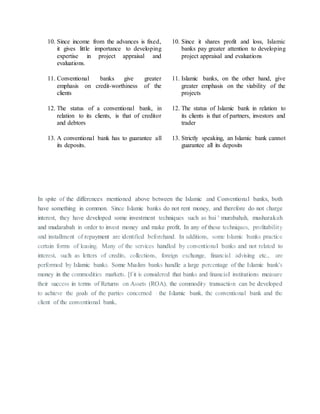
10. Since income from the advances is fixed,
it gives little importance to developing
expertise in project appraisal and
evaluations.
10. Since it shares profit and loss, Islamic
banks pay greater attention to developing
project appraisal and evaluations
11. Conventional banks give greater
emphasis on credit-worthiness of the
clients
11. Islamic banks, on the other hand, give
greater emphasis on the viability of the
projects
12. The status of a conventional bank, in
relation to its clients, is that of creditor
and debtors
12. The status of Islamic bank in relation to
its clients is that of partners, investors and
trader
13. A conventional bank has to guarantee all
its deposits.
13. Strictly speaking, an Islamic bank cannot
guarantee all its deposits
In spite of the differences mentioned above between the Islamic and Conventional banks, both
have something in common. Since Islamic banks do not rent money, and therefore do not charge
interest, they have developed some investment techniques such as bai ' murabahah, musharakah
and mudarabah in order to invest money and make profit. In any of these techniques, profitability
and installment of repayment are identified beforehand. In additions, some Islamic banks practice
certain forms of leasing. Many of the services handled by conventional banks and not related to
interest. such as letters of credits, collections, foreign exchange, financial advising etc., are
performed by Islamic banks. Some Muslim banks handle a large percentage of the Islamic bank's
money in the commodities markets. [f it is considered that banks and financial institutions measure
their success in terms of Returns on Assets (ROA), the commodity transaction can be developed
to achieve the goals of the parties concerned - the Islamic bank, the conventional bank and the
client of the conventional bank.

Conventional banking vs islamic banking

  • 1.
    Conventional Banking VsIslamic Banking The distinguishing features of the conventional banking and lslamic banking may be shown in terms of a box diagram as under Conventional Banking Islamic Banking 1. The functions and operating modes of conventional banks are based on man- made principles 1. The functions and operating modes of Islmaic banks are based on the principles of Islamic Shariah 2. The investor is assured of a predetermined rate of interest 2. In contrast, it promotes risk sharing between provider of capital (investor) and the use of funds (entrepreneur) 3. It aims at maximizing profit without any restrictions 3. It also aims at maximizing profit but subject to Shariah restrictions 4. It does not deal with zakah 4. In the modern Islamic banking system, it has become one of the service-oriented functions of the Islamic banks to collect and distribute zakah. 5. Lending money and getting it back with interest is the fundamental function of the conventional banks 5. Participation in partnership business is the fundamental function of the Islamic banks 6. Its scope of activities is narrower when compared with an Islamic bank. 6. Its scope of activities is wider when compared with a conventional bank. It is, in effect, a multipurpose institution. 7. It can charge additional money (compound rate of interest) in case of defaults 7. The Islamic banks have no provision to charge any extra money from the defaulters. 8. In it very often, banks own interest becomes prominent. It makes no effort to ensure growth with equity 8. It gives due importance to the public interest. Its ultimate aim is to ensure growth with equity. 9. For interest-based commercial banks, borrowing from the money market is relatively easier. 9. For Islamic banks, it is comparatively difficult to borrow money from the money market.
  • 2.
    10. Since incomefrom the advances is fixed, it gives little importance to developing expertise in project appraisal and evaluations. 10. Since it shares profit and loss, Islamic banks pay greater attention to developing project appraisal and evaluations 11. Conventional banks give greater emphasis on credit-worthiness of the clients 11. Islamic banks, on the other hand, give greater emphasis on the viability of the projects 12. The status of a conventional bank, in relation to its clients, is that of creditor and debtors 12. The status of Islamic bank in relation to its clients is that of partners, investors and trader 13. A conventional bank has to guarantee all its deposits. 13. Strictly speaking, an Islamic bank cannot guarantee all its deposits In spite of the differences mentioned above between the Islamic and Conventional banks, both have something in common. Since Islamic banks do not rent money, and therefore do not charge interest, they have developed some investment techniques such as bai ' murabahah, musharakah and mudarabah in order to invest money and make profit. In any of these techniques, profitability and installment of repayment are identified beforehand. In additions, some Islamic banks practice certain forms of leasing. Many of the services handled by conventional banks and not related to interest. such as letters of credits, collections, foreign exchange, financial advising etc., are performed by Islamic banks. Some Muslim banks handle a large percentage of the Islamic bank's money in the commodities markets. [f it is considered that banks and financial institutions measure their success in terms of Returns on Assets (ROA), the commodity transaction can be developed to achieve the goals of the parties concerned - the Islamic bank, the conventional bank and the client of the conventional bank.