Australian Council for Educational Research
ISA
International Schools’Assessment
Writing
Sample Materials
Grades 3 – 10
ISA Writing
Sample Materials
Grades 3 – 10
Notes on Writing Samples
There are two Writing tasks in the ISA. Writing Task A is a narrative/reflective task and
Writing Task B is an exposition/argument task. For each task, students are provided with
a short prompt and lined pages for their writing. Both writing tasks are introduced with a
short class discussion or orientation. The prompts are the same for all grade levels.
Students are encouraged to spend the last five minutes of the assessment session
proofreading and editing their writing. Time is not allocated for detailed planning or
substantial redrafting of the writing. It is expected that students’ work will be first-draft
writing, and there will be no penalty for drafting techniques such as crossing out.
Student responses to the narrative/reflective prompt are rated on Content – the kinds of
ideas generated and the quality of thinking and reflection; Language – expressiveness
and accuracy in technical aspects such as punctuation and grammar; and Spelling –
taking account of both accuracy and range.
Student responses to the exposition/argument prompt are rated on Content – the kinds
of ideas generated and the quality of thinking demonstrated about the issue; Structure
and Organisation – the way the writing is structured at both global and local levels; and
Language – with an emphasis on features such as grammar and syntax.
In many schools, students are not often asked to sit and write for an extended
period without preparation. They typically have time to plan and discuss their piece,
and perhaps to write several drafts. As far as possible – given that standardised
administration is required in order to make meaningful judgments of student performance
– the way the ISA writing tasks are presented to students aims to emulate these features
of good practice in writing pedagogy.
Presented here are extracts from the ISA Administration Handbook – the introductions to
the narrative/reflective and exposition/ argument writing tasks.
Instructions in the following samples labelled READ are to be read exactly as shown.
Instructions labelled SAY may be paraphrased to make the language more natural for
your classroom setting.
Annotated writing samples, illustrating different levels of the ISA narrative and expository
writing scales, can be accessed by existing ISA schools through their online account, or
obtained by contacting the ISA at isa@acer.edu.au
Writing Sample Materials 3
WRITING TASK A:
NARRATIVE/REFLECTIVE
SAMPLE 1
Introducing the Writing Task
SAY
On the page you can see some sentences to tell you what to write about.
Follow while I read these sentences.
READ
“Just in time!”
Create a piece of writing with these words in it.
You may use these words at the beginning, in the middle, or at the end of
your writing.
Or you could use “Just in time” as the title.
SAY
This is what you are going to do now.
You are going to write a story or a reflective piece that includes the words,
“Just in time!”You must write a story or reflective piece. Do not write a
piece giving your opinion.
You need to show how well you can write a story or a reflective piece.
Make your piece interesting for someone else to read. If you are writing a
story, your piece needs a plot, a setting and characters.
You can choose to write about something that really happened or
something that is made up.You might like to write about something that
happened to you just in time, or about something you hope will happen
just in time.You might write about something strange, or about an
everyday thing that happens just in time. It might be something you see, or
something no-one has ever seen before.
Who are the characters in your piece? You and your friends might be in the
piece, or you might have a completely different group of characters.
Does anyone have a suggestion for a good piece of writing?
Conduct a short discussion (no more than 5 minutes) to focus students on writing a
narrative/reflective piece using “Just in time!” as an idea. Encourage students to suggest
a range of different ideas. Encourage students to think of interesting, individual stories
or reflective pieces. Make sure students understand that they must not write an opinion
piece. Avoid making notes on a board.
Writing Sample Materials 4
SAY
You should write the best first draft that you can. If you make a mistake,
just correct it neatly. If youdon’t know how to spell a word, you should write
it using the best spelling you can.
Your piece will be judged on how well you develop your ideas, the way you
use language, and your spelling.
There is some space on the first page for you to do a plan or make some
notes if you wish.
Start your piece on the next page. There are more lined pages for you to
write on.You may only write on the lined pages and must keep your writing
inside the margins.You cannot have extra paper.You do not have to use all
the pages.
You have 30 minutes to write your piece, and I will tell you when you have
ten minutes left. Are there any questions?
Check that everyone understands what is required.
Starting the test
SAY
Remember that you must write a story or a reflective piece. Somewhere in
your piece you need to use the phrase, “Just in time!”
You may start now.
Ending the session
After 20 minutes:
SAY
You have ten minutes more to finish your writing.
After five minutes:
SAY
Now you have five minutes more to finish your piece. Don’t forget to
proofread and edit your writing.
Check your work carefully for spelling and punctuation.
Allow a further five minutes. Students may use this time for proofing, but they may
choose to continue writing.
At the end of this time, if more than two or three of the students have not finished, you
may allow five minutes extra.
SAY
Put down your pens.
Writing Sample Materials 5
Just in time!
Create a piece of writing with these words in it.
You may use these words at the beginning, in the middle or at the end of
your writing.
Or you could use ‘Just in time’ as the title.
Use the space below to plan your writing.
Writing Sample Materials 6
WRITING TASK A:
NARRATIVE/REFLECTIVE
SAMPLE 2
Introducing the Writing Task
SAY
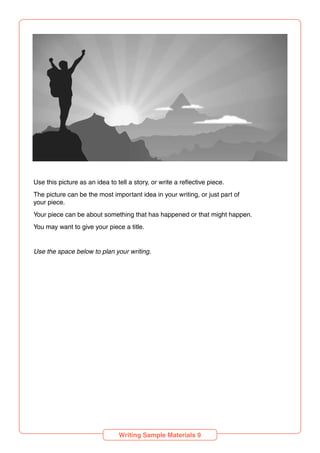
On the page you can see a picture of someone standing on top of a mountain.
There are some sentences underneath. Follow while I read these sentences.
READ
Use this picture as an idea to tell a story, or write a reflective piece.
The picture can be the most important idea in your writing, or just part of
your piece.
Your piece can be about something that has happened or that might happen.
You may want to give your piece a title.
SAY
This is what you are going to do now.
You are going to write a story or a reflective piece that uses this picture
as an idea.You must write a story or reflective piece. Do not write a piece
giving your opinion.
You need to show how well you can write a story or a reflective piece.
Make your piece interesting for someone else to read. If you are writing a
story, your piece needs a plot, a setting and characters.
Think about the picture of someone standing on top of a mountain. What
do you think is happening? How can you use this idea? You might start
with this idea, or use this idea in the middle or at the end of your piece.
This picture shows a place. What do you think this place is like? Your piece
can take place here or the picture might give you ideas for a piece that
takes place somewhere else.
Who are the characters in your piece? Your writing might be about you and
your friends, or about a completely different group of characters.
Does anyone have a suggestion for a good piece of writing?
Conduct a short discussion (no more than 5 minutes) to focus students on writing a
narrative/reflective piece using this picture as an idea. Encourage students to suggest
a range of different ideas. Encourage students to think of interesting, individual stories
or reflective pieces. Make sure students understand that they must not write an opinion
piece. Avoid making notes on a board.
Writing Sample Materials 7
SAY
You should write the best first draft that you can. If you make a mistake,
just correct it neatly. If youdon’t know how to spell a word, you should write
it using the best spelling you can.
Your piece will be judged on how well you develop your ideas, the way you
use language, and your spelling.
There is some space on the first page for you to do a plan or make some
notes if you wish.
Start your piece on the next page. There are more lined pages for you to
write on.You may only write on the lined pages and must keep your writing
inside the margins.You cannot have extra paper.You do not have to use all
the pages.
You have 30 minutes to complete your writing, and I will tell you when you
have ten minutes left.
Are there any questions?
Check that everyone understands what is required.
Starting the test
SAY
Remember that you must write a story or a reflective piece. Somewhere in
your piece you need toshow how you have used the picture of someone
standing on top of a mountain as an idea.
You may start now.
As the students work, ensure that their pages are always open at the Writing Task A
section of the student booklet.
Ending the session
After 20 minutes,
SAY
You have ten minutes more to finish your writing.
After five minutes,
SAY
Now you have five minutes more to finish your piece of writing. Don’t forget
to proofread and edit your writing.
Check your work carefully for spelling and punctuation.
Allow a further five minutes. Students may use this time for proofing, but they may
choose to continue writing.
At the end of this time, if more than two or three of the students have not finished, you
may allow five minutes extra.
SAY
Put down your pens.
Writing Sample Materials 8
Use this picture as an idea to tell a story, or write a reflective piece.
The picture can be the most important idea in your writing, or just part of
your piece.
Your piece can be about something that has happened or that might happen.
You may want to give your piece a title.
Use the space below to plan your writing.
Writing Sample Materials 9
WRITING TASK A:
NARRATIVE/REFLECTIVE
SAMPLE 3
Introducing the Writing Task
SAY
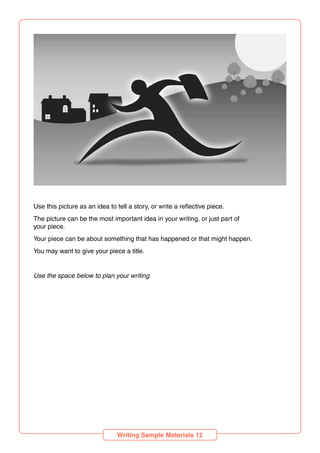
On the page you can see a picture of someone running. There are some
sentences underneath. Follow while I read these sentences.
READ
Use this picture as an idea to tell a story, or write a reflective piece.
The picture can be the most important idea in your writing, or just part of
your piece.
Your piece can be about something that has happened or that might
happen.
You may want to give your piece a title.
SAY
This is what you are going to do now.
You are going to write a story or a reflective piece that uses this picture
as an idea.You must write a story or reflective piece. Do not write a piece
giving your opinion.
You need to show how well you can write a story or a reflective piece.
Make your piece interesting for someone else to read. If you are writing a
story, your piece needs a plot, a setting and characters.
Think about the picture of someone running. What do you think is
happening? How can you use this idea? You might start with this idea, or
use this idea in the middle or at the end of your piece.
This picture shows a place. What do you think this place is like? Your piece
can take place here or the picture might give you ideas for a piece that
takes place somewhere else.
Who are the characters in your piece? You and your friends might be in the
piece, or you might have a completely different group of characters.
Does anyone have a suggestion for a good piece of writing?
Conduct a short discussion (no more than 5 minutes) to focus students on writing a
narrative/reflective piece using this picture as an idea. Encourage students to suggest
a range of different ideas. Encourage students to think of interesting, individual stories
or reflective pieces. Make sure students understand that they must not write an opinion
piece. Avoid making notes on a board.
Writing Sample Materials 10
SAY
You should write the best first draft that you can. If you make a mistake,
just correct it neatly. If you don’t know how to spell a word, you should write
it using the best spelling you can.
Your piece will be judged on how well you develop your ideas, the way you
use language, and your spelling.
There is some space on the first page for you to do a plan or make some
notes if you wish.
Start your piece on the next page. There are more lined pages for you to
write on.You may only write on the lined pages and must keep your writing
inside the margins.You cannot have extra paper.You do not have to use all
the pages.
You have 30 minutes to write your piece, and I will tell you when you have
ten minutes left. Are there any questions?
Check that everyone understands what is required.
Starting the test
SAY
Remember that you must write a story or a reflective piece. Somewhere in
your piece you need to show how you have used the picture of someone
running as an idea.
You may start now.
As the students work, ensure that their pages are always open at the Writing Task A
section of the student booklet.
Ending the session
After 20 minutes,
SAY
You have ten minutes more to finish your writing.
After five minutes,
SAY
Now you have five minutes more to finish your piece of writing. Don’t forget
to proofread and edit your writing.
Check your work carefully for spelling and punctuation.
Allow a further five minutes. Students may use this time for proofing, but they may
choose to continue writing.
At the end of this time, if more than two or three of the students have not finished, you
may allow five minutes extra. Then,
SAY
Put down your pens.
Writing Sample Materials 11
Use this picture as an idea to tell a story, or write a reflective piece.
The picture can be the most important idea in your writing, or just part of
your piece.
Your piece can be about something that has happened or that might happen.
You may want to give your piece a title.
Use the space below to plan your writing.
Writing Sample Materials 12
WRITING B:
EXPOSITION/ARGUMENT
SAMPLE 1
Introducing the Writing Task
SAY
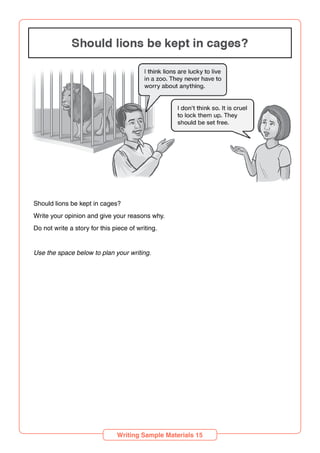
On the page you can see the topic for writing about your opinion. The
topic is ‘should lions be kept in cages’. There are some sentences
underneath. Follow while I read these sentences.
READ
Should lions be kept in cages?
[The boy says]
I think lions are lucky to live in a zoo.They never have to worry about anything.
[The girl says]
I don’t think so. It is cruel to lock them up. They should be free.
[Then underneath it says]
Should lions be kept in cages?
Write your opinion and give your reasons why.
Do not write a story for this piece of writing.
SAY
This is what you are going to do now.You are going to write on the topic,
“Should lions be kept in cages?” What is your opinion about this? Do you
think lions should be kept in cages or not? You need to write what you
think and give good reasons to show why you think this way.You can think
whatever you want about whether lions should be kept in cages but you
must give good reasons to support what you think.
Conduct a short discussion (no more than 5 minutes) to focus students on the reasons for
their opinions about keeping lions in cages. Encourage students to think of some different
reasons to support different opinions. Ensure students know that interesting and unusual
thoughts are welcome, and encourage them to develop an individual position. Ensure
students understand that they can have any opinion they like about the topic as long as they
support it with good reasons. Do not make any notes for the students (e.g. on a chalkboard).
Discussion could be prompted with questions such as:
• Why do you think that?
• Do you have a different opinion?
• What reasons do you have for thinking that?
• Do you agree with what (student name) said?
Writing Sample Materials 13
After a brief discussion:
SAY
You should write the best first draft that you can. If you make a mistake,
just correct it neatly. If you don’t know how to spell a word, you should write
it using the best spelling you can.
You need to write what you think about the question, “Should lions be kept
in cages”. Make sure that you include reasons for your opinion.You can
answer by arguing just on one side or just on the other side, or by giving
arguments for both sides.
Your writing will be judged on your interesting ideas and how well you
explain them and on the way you use language.
There is some space on the first page for you to do a plan or make some
notes if you wish to.
Start writing what you think on the next page. There are more lined pages
for you to write on.You may only write on the lined pages and must keep
your writing inside the margins.You cannot have extra paper.You do not
have to use all the pages.
You have 30 minutes to write what you think, and I will tell you when you
have ten minutes left.
Check that everyone understands what is required.
Starting the test
SAY
Remember you need to write about your opinions and to give reasons to
support what you think.
You may start now.
Ending the session
After 20 minutes:
SAY
You have ten minutes more to finish your piece of writing.
After five minutes:
SAY
Now you have five minutes more to finish your writing. Don’t forget to
proofread and edit your writing.
Check your work carefully for spelling and punctuation.
Allow a further five minutes. Students may use this time for proofing, but they may
choose to continue writing. At the end of this time, if more than two or three of the
students have not finished, you may allow five minutes extra.
SAY
Put down your pens.
Writing Sample Materials 14
Should lions be kept in cages?
Write your opinion and give your reasons why.
Do not write a story for this piece of writing.
Use the space below to plan your writing.
Writing Sample Materials 15
WRITING B:
EXPOSITION/ARGUMENT
SAMPLE 2
Introducing the Writing Task
SAY
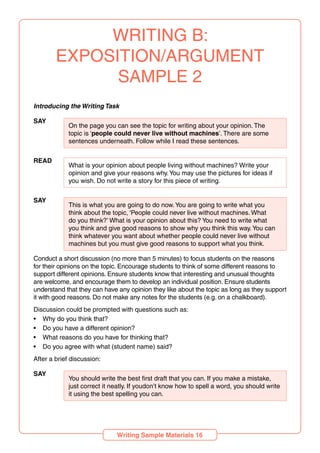
On the page you can see the topic for writing about your opinion. The
topic is ‘people could never live without machines’. There are some
sentences underneath. Follow while I read these sentences.
READ
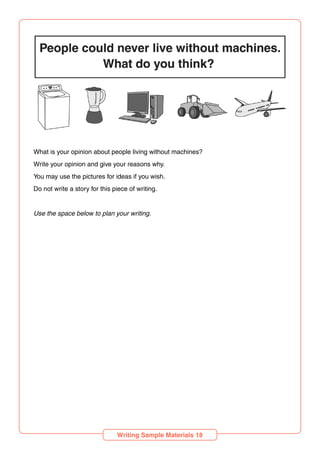
What is your opinion about people living without machines? Write your
opinion and give your reasons why.You may use the pictures for ideas if
you wish. Do not write a story for this piece of writing.
SAY
This is what you are going to do now.You are going to write what you
think about the topic, ‘People could never live without machines. What
do you think?’ What is your opinion about this? You need to write what
you think and give good reasons to show why you think this way.You can
think whatever you want about whether people could never live without
machines but you must give good reasons to support what you think.
Conduct a short discussion (no more than 5 minutes) to focus students on the reasons
for their opinions on the topic. Encourage students to think of some different reasons to
support different opinions. Ensure students know that interesting and unusual thoughts
are welcome, and encourage them to develop an individual position. Ensure students
understand that they can have any opinion they like about the topic as long as they support
it with good reasons. Do not make any notes for the students (e.g. on a chalkboard).
Discussion could be prompted with questions such as:
• Why do you think that?
• Do you have a different opinion?
• What reasons do you have for thinking that?
• Do you agree with what (student name) said?
After a brief discussion:
SAY
You should write the best first draft that you can. If you make a mistake,
just correct it neatly. If youdon’t know how to spell a word, you should write
it using the best spelling you can.
Writing Sample Materials 16
You need to write what you think about the topic, ‘People could never live
without machines. What do you think?’ Make sure that you include reasons
for your opinion.You can answer by arguing just on one side or just on the
other side, or by giving arguments for both sides.
Your writing will be judged on your interesting ideas and how well you
explain them and on the way you use language.
There is some space on the first page for you to do a plan or make some
notes if you wish to.
Start writing what you think on the next page. There are more lined pages
for you to write on.You may only write on the lined pages and must keep
your writing inside the margins.You cannot have extra paper.You do not
have to use all the pages.
You have 30 minutes to write what you think, and I will tell you when you
have ten minutes left.
Check that everyone understands what is required.
Starting the test
SAY
Remember you need to write about your opinions and to give reasons to
support what you think.
You may start now.
Ending the session
After 20 minutes:
SAY
You have ten minutes more to finish your piece of writing.
After five minutes:
SAY
Now you have five minutes more to finish your writing. Don’t forget to
proofread and edit your writing.
Check your work carefully for spelling and punctuation.
Allow a further five minutes. Students may use this time for proofing, but they may
choose to continue writing. At the end of this time, if more than two or three of the
students have not finished, you may allow five minutes extra.
SAY
Put down your pens.
Writing Sample Materials 17
What is your opinion about people living without machines?
Write your opinion and give your reasons why.
You may use the pictures for ideas if you wish.
Do not write a story for this piece of writing.
Use the space below to plan your writing.
Writing Sample Materials 18
WRITING B:
EXPOSITION/ARGUMENT
SAMPLE 3
Introducing the Writing Task
SAY
On the page you can see the topic for writing about your opinion. The topic
is ‘different languages’. There are some sentences underneath. Follow
while I read these sentences.
READ
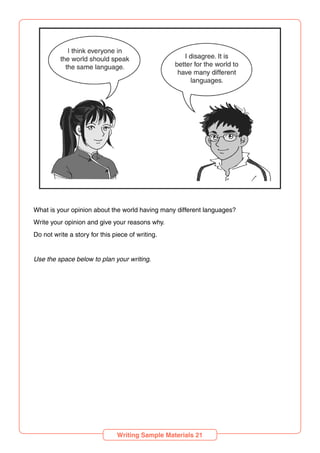
[The girl says]
I think everyone in the world should speak the same language.
[The boy says]
I disagree. It is better for the world to have many different languages.
[Then underneath it says]
What is your opinion about the world having many different languages?
Write your opinion and give your reasons why. Do not write a story for this
piece of writing.
SAY
This is what you are going to do now.You are going to write what you think
about the world having many different languages. What is your opinion
about this? You need to write what you think and give good reasons to
show why you think this way.You can think whatever you want about the
world having many different languages but you must give good reasons to
support what you think.
Conduct a short discussion (no more than 5 minutes) to focus students on the reasons
for their opinions on the topic. Encourage students to think of some different reasons
to support different opinions. Ensure students know that interesting and unusual
thoughts are welcome, and encourage them to develop an individual position. Ensure
students understand that they can have any opinion they like about the topic as long
as they support it with good reasons. Do not make any notes for the students (e.g. on a
chalkboard).
Discussion could be prompted with questions such as:
• Why do you think that?
• Do you have a different opinion?
• What reasons do you have for thinking that?
• Do you agree with what (student name) said?
Writing Sample Materials 19
After a brief discussion:
SAY
You should write the best first draft that you can. If you make a mistake,
just correct it neatly. If you don’t know how to spell a word, you should write
it using the best spelling you can.
You need to write what you think about the world having many different
languages. Make sure thatyou include reasons for your opinion.You can
answer by arguing just on one side or just on theother side, or by giving
arguments for both sides.
Your writing will be judged on your interesting ideas and how well you
explain them and on the way you use language.
There is some space on the first page for you to do a plan or make some
notes if you wish to.
Start writing what you think on the next page. There are more lined pages
for you to write on.You may only write on the lined pages and must keep
your writing inside the margins.You cannot have extra paper.You do not
have to use all the pages.
You have 30 minutes to write what you think, and I will tell you when you
have ten minutes left.
Check that everyone understands what is required.
Starting the test
SAY
Remember you need to write about your opinions and to give reasons to
support what you think.
You may start now.
Ending the session
After 20 minutes:
SAY
You have ten minutes more to finish your piece of writing.
After five minutes:
SAY
Now you have five minutes more to finish your writing. Don’t forget to
proofread and edit your writing.
Check your work carefully for spelling and punctuation.
Allow a further five minutes. Students may use this time for proofing, but they may
choose to continue writing. At the end of this time, if more than two or three of the
students have not finished, you may allow five minutes extra.
SAY
Put down your pens.
Writing Sample Materials 20
What is your opinion about the world having many different languages?
Write your opinion and give your reasons why.
Do not write a story for this piece of writing.
Use the space below to plan your writing.
Writing Sample Materials 21
WRITING B:
EXPOSITION/ARGUMENT
SAMPLE 4
Introducing the Writing Task
SAY
On the page you can see the topic for writing about your opinion. The topic
is ‘a single tablet you can take when it is time to eat a meal’. There are
some sentences underneath. Follow while I read these sentences.
READ
Imagine that there is a new invention which is a single tablet that you can
take when it is time to eat a meal. The tablet gives you all the vitamins and
minerals you need to be healthy.
Is this invention a good idea?
Write your opinion about the new invention and give your reasons why.
Do not write a story for this piece of writing.
Use the space below to plan your writing.
SAY
This is what you are going to do now.You are going to write what you think
about the world having many different languages. What is your opinion
about this? You need to write what you think and give good reasons to
show why you think this way.You can think whatever you want about the
world having many different languages but you must give good reasons to
support what you think.
Conduct a short discussion (no more than 5 minutes) to focus students on the reasons
for their opinions on the topic. Encourage students to think of some different reasons
to support different opinions. Ensure students know that interesting and unusual
thoughts are welcome, and encourage them to develop an individual position. Ensure
students understand that they can have any opinion they like about the topic as long
as they support it with good reasons. Do not make any notes for the students (e.g. on a
chalkboard).
Discussion could be prompted with questions such as:
• Why do you think that?
• Do you have a different opinion?
• What reasons do you have for thinking that?
• Do you agree with what (student name) said?
Writing Sample Materials 22
After a brief discussion:
SAY
You should write the best first draft that you can. If you make a mistake,
just correct it neatly. If you don’t know how to spell a word, you should write
it using the best spelling you can.
You need to write what you think about the world having many different
languages. Make sure thatyou include reasons for your opinion.You can
answer by arguing just on one side or just on theother side, or by giving
arguments for both sides.
Your writing will be judged on your interesting ideas and how well you
explain them and on the way you use language.
There is some space on the first page for you to do a plan or make some
notes if you wish to.
Start writing what you think on the next page. There are more lined pages
for you to write on.You may only write on the lined pages and must keep
your writing inside the margins.You cannot have extra paper.You do not
have to use all the pages.
You have 30 minutes to write what you think, and I will tell you when you
have ten minutes left.
Check that everyone understands what is required.
Starting the test
SAY
Remember you need to write about your opinions and to give reasons to
support what you think.
You may start now.
Ending the session
After 20 minutes:
SAY
You have ten minutes more to finish your piece of writing.
After five minutes:
SAY
Now you have five minutes more to finish your writing. Don’t forget to
proofread and edit your writing.
Check your work carefully for spelling and punctuation.
Allow a further five minutes. Students may use this time for proofing, but they may
choose to continue writing. At the end of this time, if more than two or three of the
students have not finished, you may allow five minutes extra.
SAY
Put down your pens.
Writing Sample Materials 23
Imagine that there is a new invention which is a single tablet that you can take when it
is time to eat a meal. The tablet gives you all the vitamins and minerals you need to be
healthy.
Is this invention a good idea?
Write your opinion about the new invention and give your reasons why.
Do not write a story for this piece of writing.
Use the space below to plan your writing.
Writing Sample Materials 24
Start your writing here.
Writing Sample Materials 25
Writing Sample Materials 26
Writing Sample Materials 27
Writing Sample Materials 28

ISA-Writing-G3-10-Sample-Material-2016.pdf

  • 1.
    Australian Council forEducational Research ISA International Schools’Assessment Writing Sample Materials Grades 3 – 10
  • 3.
    ISA Writing Sample Materials Grades3 – 10 Notes on Writing Samples There are two Writing tasks in the ISA. Writing Task A is a narrative/reflective task and Writing Task B is an exposition/argument task. For each task, students are provided with a short prompt and lined pages for their writing. Both writing tasks are introduced with a short class discussion or orientation. The prompts are the same for all grade levels. Students are encouraged to spend the last five minutes of the assessment session proofreading and editing their writing. Time is not allocated for detailed planning or substantial redrafting of the writing. It is expected that students’ work will be first-draft writing, and there will be no penalty for drafting techniques such as crossing out. Student responses to the narrative/reflective prompt are rated on Content – the kinds of ideas generated and the quality of thinking and reflection; Language – expressiveness and accuracy in technical aspects such as punctuation and grammar; and Spelling – taking account of both accuracy and range. Student responses to the exposition/argument prompt are rated on Content – the kinds of ideas generated and the quality of thinking demonstrated about the issue; Structure and Organisation – the way the writing is structured at both global and local levels; and Language – with an emphasis on features such as grammar and syntax. In many schools, students are not often asked to sit and write for an extended period without preparation. They typically have time to plan and discuss their piece, and perhaps to write several drafts. As far as possible – given that standardised administration is required in order to make meaningful judgments of student performance – the way the ISA writing tasks are presented to students aims to emulate these features of good practice in writing pedagogy. Presented here are extracts from the ISA Administration Handbook – the introductions to the narrative/reflective and exposition/ argument writing tasks. Instructions in the following samples labelled READ are to be read exactly as shown. Instructions labelled SAY may be paraphrased to make the language more natural for your classroom setting. Annotated writing samples, illustrating different levels of the ISA narrative and expository writing scales, can be accessed by existing ISA schools through their online account, or obtained by contacting the ISA at isa@acer.edu.au Writing Sample Materials 3
  • 4.
    WRITING TASK A: NARRATIVE/REFLECTIVE SAMPLE1 Introducing the Writing Task SAY On the page you can see some sentences to tell you what to write about. Follow while I read these sentences. READ “Just in time!” Create a piece of writing with these words in it. You may use these words at the beginning, in the middle, or at the end of your writing. Or you could use “Just in time” as the title. SAY This is what you are going to do now. You are going to write a story or a reflective piece that includes the words, “Just in time!”You must write a story or reflective piece. Do not write a piece giving your opinion. You need to show how well you can write a story or a reflective piece. Make your piece interesting for someone else to read. If you are writing a story, your piece needs a plot, a setting and characters. You can choose to write about something that really happened or something that is made up.You might like to write about something that happened to you just in time, or about something you hope will happen just in time.You might write about something strange, or about an everyday thing that happens just in time. It might be something you see, or something no-one has ever seen before. Who are the characters in your piece? You and your friends might be in the piece, or you might have a completely different group of characters. Does anyone have a suggestion for a good piece of writing? Conduct a short discussion (no more than 5 minutes) to focus students on writing a narrative/reflective piece using “Just in time!” as an idea. Encourage students to suggest a range of different ideas. Encourage students to think of interesting, individual stories or reflective pieces. Make sure students understand that they must not write an opinion piece. Avoid making notes on a board. Writing Sample Materials 4
  • 5.
    SAY You should writethe best first draft that you can. If you make a mistake, just correct it neatly. If youdon’t know how to spell a word, you should write it using the best spelling you can. Your piece will be judged on how well you develop your ideas, the way you use language, and your spelling. There is some space on the first page for you to do a plan or make some notes if you wish. Start your piece on the next page. There are more lined pages for you to write on.You may only write on the lined pages and must keep your writing inside the margins.You cannot have extra paper.You do not have to use all the pages. You have 30 minutes to write your piece, and I will tell you when you have ten minutes left. Are there any questions? Check that everyone understands what is required. Starting the test SAY Remember that you must write a story or a reflective piece. Somewhere in your piece you need to use the phrase, “Just in time!” You may start now. Ending the session After 20 minutes: SAY You have ten minutes more to finish your writing. After five minutes: SAY Now you have five minutes more to finish your piece. Don’t forget to proofread and edit your writing. Check your work carefully for spelling and punctuation. Allow a further five minutes. Students may use this time for proofing, but they may choose to continue writing. At the end of this time, if more than two or three of the students have not finished, you may allow five minutes extra. SAY Put down your pens. Writing Sample Materials 5
  • 6.
    Just in time! Createa piece of writing with these words in it. You may use these words at the beginning, in the middle or at the end of your writing. Or you could use ‘Just in time’ as the title. Use the space below to plan your writing. Writing Sample Materials 6
  • 7.
    WRITING TASK A: NARRATIVE/REFLECTIVE SAMPLE2 Introducing the Writing Task SAY On the page you can see a picture of someone standing on top of a mountain. There are some sentences underneath. Follow while I read these sentences. READ Use this picture as an idea to tell a story, or write a reflective piece. The picture can be the most important idea in your writing, or just part of your piece. Your piece can be about something that has happened or that might happen. You may want to give your piece a title. SAY This is what you are going to do now. You are going to write a story or a reflective piece that uses this picture as an idea.You must write a story or reflective piece. Do not write a piece giving your opinion. You need to show how well you can write a story or a reflective piece. Make your piece interesting for someone else to read. If you are writing a story, your piece needs a plot, a setting and characters. Think about the picture of someone standing on top of a mountain. What do you think is happening? How can you use this idea? You might start with this idea, or use this idea in the middle or at the end of your piece. This picture shows a place. What do you think this place is like? Your piece can take place here or the picture might give you ideas for a piece that takes place somewhere else. Who are the characters in your piece? Your writing might be about you and your friends, or about a completely different group of characters. Does anyone have a suggestion for a good piece of writing? Conduct a short discussion (no more than 5 minutes) to focus students on writing a narrative/reflective piece using this picture as an idea. Encourage students to suggest a range of different ideas. Encourage students to think of interesting, individual stories or reflective pieces. Make sure students understand that they must not write an opinion piece. Avoid making notes on a board. Writing Sample Materials 7
  • 8.
    SAY You should writethe best first draft that you can. If you make a mistake, just correct it neatly. If youdon’t know how to spell a word, you should write it using the best spelling you can. Your piece will be judged on how well you develop your ideas, the way you use language, and your spelling. There is some space on the first page for you to do a plan or make some notes if you wish. Start your piece on the next page. There are more lined pages for you to write on.You may only write on the lined pages and must keep your writing inside the margins.You cannot have extra paper.You do not have to use all the pages. You have 30 minutes to complete your writing, and I will tell you when you have ten minutes left. Are there any questions? Check that everyone understands what is required. Starting the test SAY Remember that you must write a story or a reflective piece. Somewhere in your piece you need toshow how you have used the picture of someone standing on top of a mountain as an idea. You may start now. As the students work, ensure that their pages are always open at the Writing Task A section of the student booklet. Ending the session After 20 minutes, SAY You have ten minutes more to finish your writing. After five minutes, SAY Now you have five minutes more to finish your piece of writing. Don’t forget to proofread and edit your writing. Check your work carefully for spelling and punctuation. Allow a further five minutes. Students may use this time for proofing, but they may choose to continue writing. At the end of this time, if more than two or three of the students have not finished, you may allow five minutes extra. SAY Put down your pens. Writing Sample Materials 8
  • 9.
    Use this pictureas an idea to tell a story, or write a reflective piece. The picture can be the most important idea in your writing, or just part of your piece. Your piece can be about something that has happened or that might happen. You may want to give your piece a title. Use the space below to plan your writing. Writing Sample Materials 9
  • 10.
    WRITING TASK A: NARRATIVE/REFLECTIVE SAMPLE3 Introducing the Writing Task SAY On the page you can see a picture of someone running. There are some sentences underneath. Follow while I read these sentences. READ Use this picture as an idea to tell a story, or write a reflective piece. The picture can be the most important idea in your writing, or just part of your piece. Your piece can be about something that has happened or that might happen. You may want to give your piece a title. SAY This is what you are going to do now. You are going to write a story or a reflective piece that uses this picture as an idea.You must write a story or reflective piece. Do not write a piece giving your opinion. You need to show how well you can write a story or a reflective piece. Make your piece interesting for someone else to read. If you are writing a story, your piece needs a plot, a setting and characters. Think about the picture of someone running. What do you think is happening? How can you use this idea? You might start with this idea, or use this idea in the middle or at the end of your piece. This picture shows a place. What do you think this place is like? Your piece can take place here or the picture might give you ideas for a piece that takes place somewhere else. Who are the characters in your piece? You and your friends might be in the piece, or you might have a completely different group of characters. Does anyone have a suggestion for a good piece of writing? Conduct a short discussion (no more than 5 minutes) to focus students on writing a narrative/reflective piece using this picture as an idea. Encourage students to suggest a range of different ideas. Encourage students to think of interesting, individual stories or reflective pieces. Make sure students understand that they must not write an opinion piece. Avoid making notes on a board. Writing Sample Materials 10
  • 11.
    SAY You should writethe best first draft that you can. If you make a mistake, just correct it neatly. If you don’t know how to spell a word, you should write it using the best spelling you can. Your piece will be judged on how well you develop your ideas, the way you use language, and your spelling. There is some space on the first page for you to do a plan or make some notes if you wish. Start your piece on the next page. There are more lined pages for you to write on.You may only write on the lined pages and must keep your writing inside the margins.You cannot have extra paper.You do not have to use all the pages. You have 30 minutes to write your piece, and I will tell you when you have ten minutes left. Are there any questions? Check that everyone understands what is required. Starting the test SAY Remember that you must write a story or a reflective piece. Somewhere in your piece you need to show how you have used the picture of someone running as an idea. You may start now. As the students work, ensure that their pages are always open at the Writing Task A section of the student booklet. Ending the session After 20 minutes, SAY You have ten minutes more to finish your writing. After five minutes, SAY Now you have five minutes more to finish your piece of writing. Don’t forget to proofread and edit your writing. Check your work carefully for spelling and punctuation. Allow a further five minutes. Students may use this time for proofing, but they may choose to continue writing. At the end of this time, if more than two or three of the students have not finished, you may allow five minutes extra. Then, SAY Put down your pens. Writing Sample Materials 11
  • 12.
    Use this pictureas an idea to tell a story, or write a reflective piece. The picture can be the most important idea in your writing, or just part of your piece. Your piece can be about something that has happened or that might happen. You may want to give your piece a title. Use the space below to plan your writing. Writing Sample Materials 12
  • 13.
    WRITING B: EXPOSITION/ARGUMENT SAMPLE 1 Introducingthe Writing Task SAY On the page you can see the topic for writing about your opinion. The topic is ‘should lions be kept in cages’. There are some sentences underneath. Follow while I read these sentences. READ Should lions be kept in cages? [The boy says] I think lions are lucky to live in a zoo.They never have to worry about anything. [The girl says] I don’t think so. It is cruel to lock them up. They should be free. [Then underneath it says] Should lions be kept in cages? Write your opinion and give your reasons why. Do not write a story for this piece of writing. SAY This is what you are going to do now.You are going to write on the topic, “Should lions be kept in cages?” What is your opinion about this? Do you think lions should be kept in cages or not? You need to write what you think and give good reasons to show why you think this way.You can think whatever you want about whether lions should be kept in cages but you must give good reasons to support what you think. Conduct a short discussion (no more than 5 minutes) to focus students on the reasons for their opinions about keeping lions in cages. Encourage students to think of some different reasons to support different opinions. Ensure students know that interesting and unusual thoughts are welcome, and encourage them to develop an individual position. Ensure students understand that they can have any opinion they like about the topic as long as they support it with good reasons. Do not make any notes for the students (e.g. on a chalkboard). Discussion could be prompted with questions such as: • Why do you think that? • Do you have a different opinion? • What reasons do you have for thinking that? • Do you agree with what (student name) said? Writing Sample Materials 13
  • 14.
    After a briefdiscussion: SAY You should write the best first draft that you can. If you make a mistake, just correct it neatly. If you don’t know how to spell a word, you should write it using the best spelling you can. You need to write what you think about the question, “Should lions be kept in cages”. Make sure that you include reasons for your opinion.You can answer by arguing just on one side or just on the other side, or by giving arguments for both sides. Your writing will be judged on your interesting ideas and how well you explain them and on the way you use language. There is some space on the first page for you to do a plan or make some notes if you wish to. Start writing what you think on the next page. There are more lined pages for you to write on.You may only write on the lined pages and must keep your writing inside the margins.You cannot have extra paper.You do not have to use all the pages. You have 30 minutes to write what you think, and I will tell you when you have ten minutes left. Check that everyone understands what is required. Starting the test SAY Remember you need to write about your opinions and to give reasons to support what you think. You may start now. Ending the session After 20 minutes: SAY You have ten minutes more to finish your piece of writing. After five minutes: SAY Now you have five minutes more to finish your writing. Don’t forget to proofread and edit your writing. Check your work carefully for spelling and punctuation. Allow a further five minutes. Students may use this time for proofing, but they may choose to continue writing. At the end of this time, if more than two or three of the students have not finished, you may allow five minutes extra. SAY Put down your pens. Writing Sample Materials 14
  • 15.
    Should lions bekept in cages? Write your opinion and give your reasons why. Do not write a story for this piece of writing. Use the space below to plan your writing. Writing Sample Materials 15
  • 16.
    WRITING B: EXPOSITION/ARGUMENT SAMPLE 2 Introducingthe Writing Task SAY On the page you can see the topic for writing about your opinion. The topic is ‘people could never live without machines’. There are some sentences underneath. Follow while I read these sentences. READ What is your opinion about people living without machines? Write your opinion and give your reasons why.You may use the pictures for ideas if you wish. Do not write a story for this piece of writing. SAY This is what you are going to do now.You are going to write what you think about the topic, ‘People could never live without machines. What do you think?’ What is your opinion about this? You need to write what you think and give good reasons to show why you think this way.You can think whatever you want about whether people could never live without machines but you must give good reasons to support what you think. Conduct a short discussion (no more than 5 minutes) to focus students on the reasons for their opinions on the topic. Encourage students to think of some different reasons to support different opinions. Ensure students know that interesting and unusual thoughts are welcome, and encourage them to develop an individual position. Ensure students understand that they can have any opinion they like about the topic as long as they support it with good reasons. Do not make any notes for the students (e.g. on a chalkboard). Discussion could be prompted with questions such as: • Why do you think that? • Do you have a different opinion? • What reasons do you have for thinking that? • Do you agree with what (student name) said? After a brief discussion: SAY You should write the best first draft that you can. If you make a mistake, just correct it neatly. If youdon’t know how to spell a word, you should write it using the best spelling you can. Writing Sample Materials 16
  • 17.
    You need towrite what you think about the topic, ‘People could never live without machines. What do you think?’ Make sure that you include reasons for your opinion.You can answer by arguing just on one side or just on the other side, or by giving arguments for both sides. Your writing will be judged on your interesting ideas and how well you explain them and on the way you use language. There is some space on the first page for you to do a plan or make some notes if you wish to. Start writing what you think on the next page. There are more lined pages for you to write on.You may only write on the lined pages and must keep your writing inside the margins.You cannot have extra paper.You do not have to use all the pages. You have 30 minutes to write what you think, and I will tell you when you have ten minutes left. Check that everyone understands what is required. Starting the test SAY Remember you need to write about your opinions and to give reasons to support what you think. You may start now. Ending the session After 20 minutes: SAY You have ten minutes more to finish your piece of writing. After five minutes: SAY Now you have five minutes more to finish your writing. Don’t forget to proofread and edit your writing. Check your work carefully for spelling and punctuation. Allow a further five minutes. Students may use this time for proofing, but they may choose to continue writing. At the end of this time, if more than two or three of the students have not finished, you may allow five minutes extra. SAY Put down your pens. Writing Sample Materials 17
  • 18.
    What is youropinion about people living without machines? Write your opinion and give your reasons why. You may use the pictures for ideas if you wish. Do not write a story for this piece of writing. Use the space below to plan your writing. Writing Sample Materials 18
  • 19.
    WRITING B: EXPOSITION/ARGUMENT SAMPLE 3 Introducingthe Writing Task SAY On the page you can see the topic for writing about your opinion. The topic is ‘different languages’. There are some sentences underneath. Follow while I read these sentences. READ [The girl says] I think everyone in the world should speak the same language. [The boy says] I disagree. It is better for the world to have many different languages. [Then underneath it says] What is your opinion about the world having many different languages? Write your opinion and give your reasons why. Do not write a story for this piece of writing. SAY This is what you are going to do now.You are going to write what you think about the world having many different languages. What is your opinion about this? You need to write what you think and give good reasons to show why you think this way.You can think whatever you want about the world having many different languages but you must give good reasons to support what you think. Conduct a short discussion (no more than 5 minutes) to focus students on the reasons for their opinions on the topic. Encourage students to think of some different reasons to support different opinions. Ensure students know that interesting and unusual thoughts are welcome, and encourage them to develop an individual position. Ensure students understand that they can have any opinion they like about the topic as long as they support it with good reasons. Do not make any notes for the students (e.g. on a chalkboard). Discussion could be prompted with questions such as: • Why do you think that? • Do you have a different opinion? • What reasons do you have for thinking that? • Do you agree with what (student name) said? Writing Sample Materials 19
  • 20.
    After a briefdiscussion: SAY You should write the best first draft that you can. If you make a mistake, just correct it neatly. If you don’t know how to spell a word, you should write it using the best spelling you can. You need to write what you think about the world having many different languages. Make sure thatyou include reasons for your opinion.You can answer by arguing just on one side or just on theother side, or by giving arguments for both sides. Your writing will be judged on your interesting ideas and how well you explain them and on the way you use language. There is some space on the first page for you to do a plan or make some notes if you wish to. Start writing what you think on the next page. There are more lined pages for you to write on.You may only write on the lined pages and must keep your writing inside the margins.You cannot have extra paper.You do not have to use all the pages. You have 30 minutes to write what you think, and I will tell you when you have ten minutes left. Check that everyone understands what is required. Starting the test SAY Remember you need to write about your opinions and to give reasons to support what you think. You may start now. Ending the session After 20 minutes: SAY You have ten minutes more to finish your piece of writing. After five minutes: SAY Now you have five minutes more to finish your writing. Don’t forget to proofread and edit your writing. Check your work carefully for spelling and punctuation. Allow a further five minutes. Students may use this time for proofing, but they may choose to continue writing. At the end of this time, if more than two or three of the students have not finished, you may allow five minutes extra. SAY Put down your pens. Writing Sample Materials 20
  • 21.
    What is youropinion about the world having many different languages? Write your opinion and give your reasons why. Do not write a story for this piece of writing. Use the space below to plan your writing. Writing Sample Materials 21
  • 22.
    WRITING B: EXPOSITION/ARGUMENT SAMPLE 4 Introducingthe Writing Task SAY On the page you can see the topic for writing about your opinion. The topic is ‘a single tablet you can take when it is time to eat a meal’. There are some sentences underneath. Follow while I read these sentences. READ Imagine that there is a new invention which is a single tablet that you can take when it is time to eat a meal. The tablet gives you all the vitamins and minerals you need to be healthy. Is this invention a good idea? Write your opinion about the new invention and give your reasons why. Do not write a story for this piece of writing. Use the space below to plan your writing. SAY This is what you are going to do now.You are going to write what you think about the world having many different languages. What is your opinion about this? You need to write what you think and give good reasons to show why you think this way.You can think whatever you want about the world having many different languages but you must give good reasons to support what you think. Conduct a short discussion (no more than 5 minutes) to focus students on the reasons for their opinions on the topic. Encourage students to think of some different reasons to support different opinions. Ensure students know that interesting and unusual thoughts are welcome, and encourage them to develop an individual position. Ensure students understand that they can have any opinion they like about the topic as long as they support it with good reasons. Do not make any notes for the students (e.g. on a chalkboard). Discussion could be prompted with questions such as: • Why do you think that? • Do you have a different opinion? • What reasons do you have for thinking that? • Do you agree with what (student name) said? Writing Sample Materials 22
  • 23.
    After a briefdiscussion: SAY You should write the best first draft that you can. If you make a mistake, just correct it neatly. If you don’t know how to spell a word, you should write it using the best spelling you can. You need to write what you think about the world having many different languages. Make sure thatyou include reasons for your opinion.You can answer by arguing just on one side or just on theother side, or by giving arguments for both sides. Your writing will be judged on your interesting ideas and how well you explain them and on the way you use language. There is some space on the first page for you to do a plan or make some notes if you wish to. Start writing what you think on the next page. There are more lined pages for you to write on.You may only write on the lined pages and must keep your writing inside the margins.You cannot have extra paper.You do not have to use all the pages. You have 30 minutes to write what you think, and I will tell you when you have ten minutes left. Check that everyone understands what is required. Starting the test SAY Remember you need to write about your opinions and to give reasons to support what you think. You may start now. Ending the session After 20 minutes: SAY You have ten minutes more to finish your piece of writing. After five minutes: SAY Now you have five minutes more to finish your writing. Don’t forget to proofread and edit your writing. Check your work carefully for spelling and punctuation. Allow a further five minutes. Students may use this time for proofing, but they may choose to continue writing. At the end of this time, if more than two or three of the students have not finished, you may allow five minutes extra. SAY Put down your pens. Writing Sample Materials 23
  • 24.
    Imagine that thereis a new invention which is a single tablet that you can take when it is time to eat a meal. The tablet gives you all the vitamins and minerals you need to be healthy. Is this invention a good idea? Write your opinion about the new invention and give your reasons why. Do not write a story for this piece of writing. Use the space below to plan your writing. Writing Sample Materials 24
  • 25.
    Start your writinghere. Writing Sample Materials 25
  • 26.
  • 27.
  • 28.