We use recount writing
to retell events and
describe things that
have happened.
www.teachingpacks.co.uk
Images: © ThinkStock
©
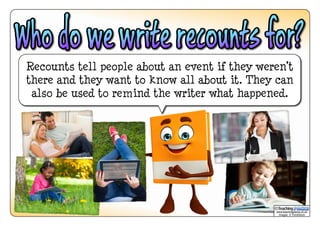
Recounts tell people about an event if they weren’t
there and they want to know all about it. They can
also be used to remind the writer what happened.
www.teachingpacks.co.uk
Images: © ThinkStock
©
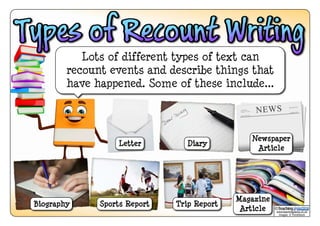
Lots of different types of text can
recount events and describe things that
have happened. Some of these include...
www.teachingpacks.co.uk
Images: © ThinkStock
©
Diary
Newspaper
Article
Magazine
Article
Trip ReportSports ReportBiography
Letter
Recount texts are
usually organised
like this.
Introduction
Set the scene by telling your audience...
• when and where the event(s) took place,
• who was involved and how they got there,
• what happened and why.
Events
Using lots of detail, tell your audience...
• about the sequence of events that took place,
in the order that they happened. You could use
paragraphs to separate each event.
As well as describing the facts, you could mention the
feelings of the people involved (and use quotes from them).
Conclusion
Tell your audience...
• what happened in the end.
You could also add your own comment about the events.
www.teachingpacks.co.uk
Images: © ThinkStock
©
www.teachingpacks.co.uk
Images: © ThinkStock
©
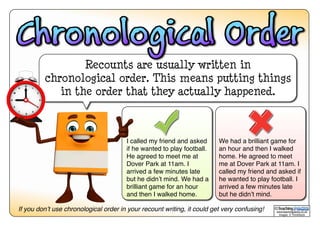
Recounts are usually written in
chronological order. This means putting things
in the order that they actually happened.
I called my friend and asked
if he wanted to play football.
He agreed to meet me at
Dover Park at 11am. I
arrived a few minutes late
but he didn’t mind. We had a
brilliant game for an hour
and then I walked home.
We had a brilliant game for
an hour and then I walked
home. He agreed to meet
me at Dover Park at 11am. I
called my friend and asked if
he wanted to play football. I
arrived a few minutes late
but he didn’t mind.
If you don’t use chronological order in your recount writing, it could get very confusing!
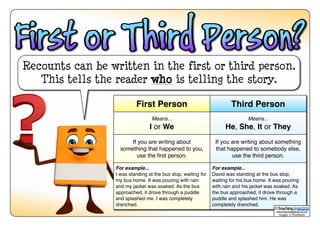
Recounts can be written in the first or third person.
This tells the reader who is telling the story.
First Person Third Person
Means...
I or We
Means...
He, She, It or They
If you are writing about
something that happened to you,
use the first person.
If you are writing about something
that happened to somebody else,
use the third person.
For example...
I was standing at the bus stop, waiting for
my bus home. It was pouring with rain
and my jacket was soaked. As the bus
approached, it drove through a puddle
and splashed me. I was completely
drenched.
For example...
David was standing at the bus stop,
waiting for his bus home. It was pouring
with rain and his jacket was soaked. As
the bus approached, it drove through a
puddle and splashed him. He was
completely drenched.
www.teachingpacks.co.uk
Images: © ThinkStock
©
Recounts describe things that have happened in the
past, so use the past tense when you are writing.
I ran to the shops with my dad.
I am running to the shops with my dad.
David smiled when he saw his
birthday cake.
David will smile when he sees his
birthday cake.
www.teachingpacks.co.uk
Images: © ThinkStock
©
www.teachingpacks.co.uk
Images: © ThinkStock
©
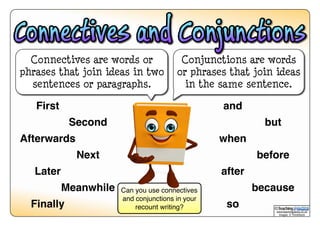
Connectives are words or
phrases that join ideas in two
sentences or paragraphs.
Conjunctions are words
or phrases that join ideas
in the same sentence.
First
Second
Afterwards
Next
Later
Meanwhile
Finally
and
but
when
before
after
because
so
Can you use connectives
and conjunctions in your
recount writing?
www.teachingpacks.co.uk
Images: © ThinkStock
©
Diary
Newspaper
Article
Magazine
Article
Sports Report
Biography
Letter
Personal recounts are usually
written to tell people who you
know, or remind yourself, about
things that have happened.
Trip Report
Impersonal recounts may be
written to tell a more general
audience (who the author
doesn’t know) about an event.
www.teachingpacks.co.uk
Images: © ThinkStock
©
Choose your verbs carefully
Writing about actions using
descriptive verbs can help your
readers to imagine what happened,
e.g. jogged, whispered, leapt.
Names, Names, Names
Be specific and tell people the names of
people, places and things in your recount.
Instead of writing...
‘I walked down the road with my friend’,
try...
‘I walked down Gladstone Road with Keira.’
Different sentences
Can you vary...
• the type of sentence?
(use questions and exclamations too!)
• the length of your sentences?
• how your sentences start?
Add quotations
Quotations show what
other people have said.
Can you add quotations
from people who were
involved in your event (or
who saw what happened)?

Recount Writing

  • 1.
    We use recountwriting to retell events and describe things that have happened. www.teachingpacks.co.uk Images: © ThinkStock ©
  • 2.
    Recounts tell peopleabout an event if they weren’t there and they want to know all about it. They can also be used to remind the writer what happened. www.teachingpacks.co.uk Images: © ThinkStock ©
  • 3.
    Lots of differenttypes of text can recount events and describe things that have happened. Some of these include... www.teachingpacks.co.uk Images: © ThinkStock © Diary Newspaper Article Magazine Article Trip ReportSports ReportBiography Letter
  • 4.
    Recount texts are usuallyorganised like this. Introduction Set the scene by telling your audience... • when and where the event(s) took place, • who was involved and how they got there, • what happened and why. Events Using lots of detail, tell your audience... • about the sequence of events that took place, in the order that they happened. You could use paragraphs to separate each event. As well as describing the facts, you could mention the feelings of the people involved (and use quotes from them). Conclusion Tell your audience... • what happened in the end. You could also add your own comment about the events. www.teachingpacks.co.uk Images: © ThinkStock ©
  • 5.
    www.teachingpacks.co.uk Images: © ThinkStock © Recountsare usually written in chronological order. This means putting things in the order that they actually happened. I called my friend and asked if he wanted to play football. He agreed to meet me at Dover Park at 11am. I arrived a few minutes late but he didn’t mind. We had a brilliant game for an hour and then I walked home. We had a brilliant game for an hour and then I walked home. He agreed to meet me at Dover Park at 11am. I called my friend and asked if he wanted to play football. I arrived a few minutes late but he didn’t mind. If you don’t use chronological order in your recount writing, it could get very confusing!
  • 6.
    Recounts can bewritten in the first or third person. This tells the reader who is telling the story. First Person Third Person Means... I or We Means... He, She, It or They If you are writing about something that happened to you, use the first person. If you are writing about something that happened to somebody else, use the third person. For example... I was standing at the bus stop, waiting for my bus home. It was pouring with rain and my jacket was soaked. As the bus approached, it drove through a puddle and splashed me. I was completely drenched. For example... David was standing at the bus stop, waiting for his bus home. It was pouring with rain and his jacket was soaked. As the bus approached, it drove through a puddle and splashed him. He was completely drenched. www.teachingpacks.co.uk Images: © ThinkStock ©
  • 7.
    Recounts describe thingsthat have happened in the past, so use the past tense when you are writing. I ran to the shops with my dad. I am running to the shops with my dad. David smiled when he saw his birthday cake. David will smile when he sees his birthday cake. www.teachingpacks.co.uk Images: © ThinkStock ©
  • 8.
    www.teachingpacks.co.uk Images: © ThinkStock © Connectivesare words or phrases that join ideas in two sentences or paragraphs. Conjunctions are words or phrases that join ideas in the same sentence. First Second Afterwards Next Later Meanwhile Finally and but when before after because so Can you use connectives and conjunctions in your recount writing?
  • 9.
    www.teachingpacks.co.uk Images: © ThinkStock © Diary Newspaper Article Magazine Article SportsReport Biography Letter Personal recounts are usually written to tell people who you know, or remind yourself, about things that have happened. Trip Report Impersonal recounts may be written to tell a more general audience (who the author doesn’t know) about an event.
  • 10.
    www.teachingpacks.co.uk Images: © ThinkStock © Chooseyour verbs carefully Writing about actions using descriptive verbs can help your readers to imagine what happened, e.g. jogged, whispered, leapt. Names, Names, Names Be specific and tell people the names of people, places and things in your recount. Instead of writing... ‘I walked down the road with my friend’, try... ‘I walked down Gladstone Road with Keira.’ Different sentences Can you vary... • the type of sentence? (use questions and exclamations too!) • the length of your sentences? • how your sentences start? Add quotations Quotations show what other people have said. Can you add quotations from people who were involved in your event (or who saw what happened)?