Students…are you ready?!


• You are going to dive deep into a
  nonfiction study and learn about a
  variety of text structures…
• Enjoy and get your thinking caps on!
NONFICTION:
TEXT STRUCTURES
 A lesson incorporating
        •Reading
        •Writing
        •Science
Five Text Structures
          Go ahead and count them
                on your hand:
•   1.   Description
•   2.   Sequence
•   3.   Compare and Contrast
•   4.   Cause and Effect
•   5.   Problem and Solution
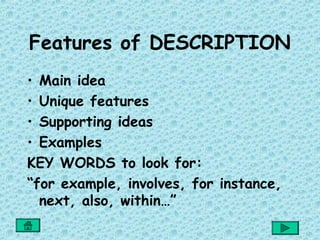
Features of DESCRIPTION
• Main idea
• Unique features
• Supporting ideas
• Examples
KEY WORDS to look for:
“for example, involves, for instance,
  next, also, within…”
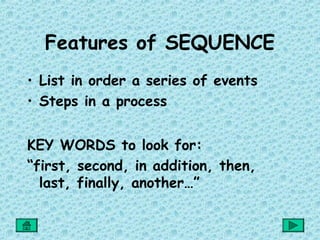
Features of SEQUENCE
• List in order a series of events
• Steps in a process


KEY WORDS to look for:
“first, second, in addition, then,
  last, finally, another…”
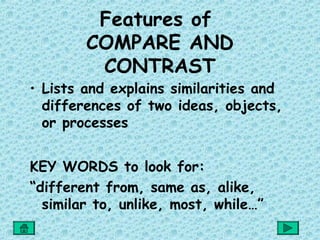
Features of
        COMPARE AND
         CONTRAST
• Lists and explains similarities and
  differences of two ideas, objects,
  or processes


KEY WORDS to look for:
“different from, same as, alike,
  similar to, unlike, most, while…”
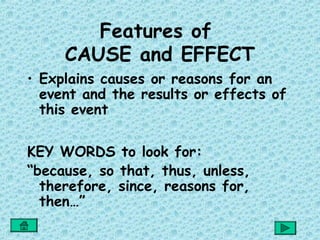
Features of
     CAUSE and EFFECT
• Explains causes or reasons for an
  event and the results or effects of
  this event

KEY WORDS to look for:
“because, so that, thus, unless,
  therefore, since, reasons for,
  then…”
Features of
 PROBLEM and SOLUTION
• States a problem and possible
  solutions, or ways the problem can
  be solved


KEY WORDS to look for:
“problem is, a solution is, solved by,
  possible answer, in conclusion…”
Now let’s see what you
      have learned…
• Sample Sentence:
“Golden Eagles are powerful raptors
   with large brown bodies and small
   heads with golden crowns.”
What type of sentence is this?
a. Description
b. Problem and Solution
c. Sequence
When reading
    INFORMATIONAL TEXT:
•   Reading and writing are
    important skills in all subject
    areas, including science

•   Understanding and using
    these different text
    structures will help enhance
    your reading and writing in
    nonfiction

•   Think about how knowing
    these different text
    structures will help you read
    and write a nonfiction
    science report for our next
    unit on the Solar System
• Make sure to pay close attention to
  the key words in the sentence
• The correct answer is “description”
  text structure because the
  sentence is describing the Golden
  Eagle in detail.
How can I apply this in my
      own learning?
• Reading expository   • Higher level
  or informational       thinking:
  texts                • Describe
• Reader’s responses   • Compare
• Writing nonfiction   • Explain
  report on _____      • Connect
• Science
• Social Studies
Now it’s your turn to apply
 what you have learned:
• Look at the sample sentence strip
  on the board
• What text structure does this
  sentence fit best?
(description, sequence, compare and
  contrast, cause and effect, problem
  and solution)
Sentence Strip Activity
• One student will read   • One student will
  the sentence at your      share WHY the
  table aloud               sentence fits that
• Determine what type       text structure
  of text structure it    • One student will
  is as a team              match it correctly on
• One student will          the board
  share what type of
  text it is with the     EVERYONE
  rest of the class         PARTICIPATES

Nonfiction Text Structures

  • 1.
    Students…are you ready?! •You are going to dive deep into a nonfiction study and learn about a variety of text structures… • Enjoy and get your thinking caps on!
  • 2.
    NONFICTION: TEXT STRUCTURES Alesson incorporating •Reading •Writing •Science
  • 3.
    Five Text Structures Go ahead and count them on your hand: • 1. Description • 2. Sequence • 3. Compare and Contrast • 4. Cause and Effect • 5. Problem and Solution
  • 4.
    Features of DESCRIPTION •Main idea • Unique features • Supporting ideas • Examples KEY WORDS to look for: “for example, involves, for instance, next, also, within…”
  • 5.
    Features of SEQUENCE •List in order a series of events • Steps in a process KEY WORDS to look for: “first, second, in addition, then, last, finally, another…”
  • 6.
    Features of COMPARE AND CONTRAST • Lists and explains similarities and differences of two ideas, objects, or processes KEY WORDS to look for: “different from, same as, alike, similar to, unlike, most, while…”
  • 7.
    Features of CAUSE and EFFECT • Explains causes or reasons for an event and the results or effects of this event KEY WORDS to look for: “because, so that, thus, unless, therefore, since, reasons for, then…”
  • 8.
    Features of PROBLEMand SOLUTION • States a problem and possible solutions, or ways the problem can be solved KEY WORDS to look for: “problem is, a solution is, solved by, possible answer, in conclusion…”
  • 9.
    Now let’s seewhat you have learned… • Sample Sentence: “Golden Eagles are powerful raptors with large brown bodies and small heads with golden crowns.” What type of sentence is this? a. Description b. Problem and Solution c. Sequence
  • 10.
    When reading INFORMATIONAL TEXT: • Reading and writing are important skills in all subject areas, including science • Understanding and using these different text structures will help enhance your reading and writing in nonfiction • Think about how knowing these different text structures will help you read and write a nonfiction science report for our next unit on the Solar System
  • 11.
    • Make sureto pay close attention to the key words in the sentence
  • 12.
    • The correctanswer is “description” text structure because the sentence is describing the Golden Eagle in detail.
  • 13.
    How can Iapply this in my own learning? • Reading expository • Higher level or informational thinking: texts • Describe • Reader’s responses • Compare • Writing nonfiction • Explain report on _____ • Connect • Science • Social Studies
  • 14.
    Now it’s yourturn to apply what you have learned: • Look at the sample sentence strip on the board • What text structure does this sentence fit best? (description, sequence, compare and contrast, cause and effect, problem and solution)
  • 15.
    Sentence Strip Activity •One student will read • One student will the sentence at your share WHY the table aloud sentence fits that • Determine what type text structure of text structure it • One student will is as a team match it correctly on • One student will the board share what type of text it is with the EVERYONE rest of the class PARTICIPATES