1
Introduction to Decision
Making
Dr. Mohamed Ezzeldin 1
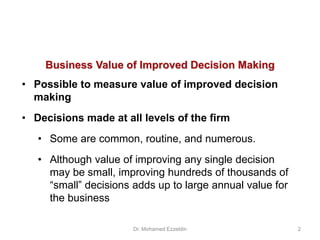
Business Value of Improved Decision Making
• Possible to measure value of improved decision
making
• Decisions made at all levels of the firm
• Some are common, routine, and numerous.
• Although value of improving any single decision
may be small, improving hundreds of thousands of
“small” decisions adds up to large annual value for
the business
Dr. Mohamed Ezzeldin 2
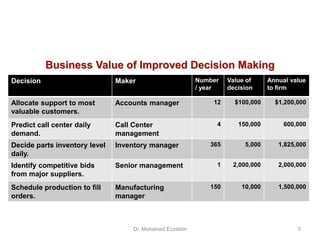
Business Value of Improved Decision Making
Decision Maker Number
/ year
Value of
decision
Annual value
to firm
Allocate support to most
valuable customers.
Accounts manager 12 $100,000 $1,200,000
Predict call center daily
demand.
Call Center
management
4 150,000 600,000
Decide parts inventory level
daily.
Inventory manager 365 5,000 1,825,000
Identify competitive bids
from major suppliers.
Senior management 1 2,000,000 2,000,000
Schedule production to fill
orders.
Manufacturing
manager
150 10,000 1,500,000
Dr. Mohamed Ezzeldin 3
Types of Decisions
• Unstructured
• Decision maker must provide judgment to solve problem
• Novel, important, nonroutine
• No well-understood or agreed-upon procedure for making
them
• Structured
• Repetitive and routine
• Involve definite procedure for handling them so do not have to
be treated as new
• Semistructured
• Only part of problem has clear-cut answer provided by
accepted procedure
Dr. Mohamed Ezzeldin 4
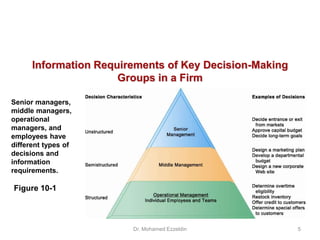
Figure 10-1
Senior managers,
middle managers,
operational
managers, and
employees have
different types of
decisions and
information
requirements.
Information Requirements of Key Decision-Making
Groups in a Firm
Dr. Mohamed Ezzeldin 5
The Decision-Making Process
1. Intelligence
• Discovering, identifying, and understanding the problems
occurring in the organization—why is there a problem, where,
what effects it is having on the firm
2. Design
• Identifying and exploring various solutions
3. Choice
• Choosing among solution alternatives
4. Implementation
• Making chosen alternative work and monitoring how well
solution is working
Dr. Mohamed Ezzeldin 6
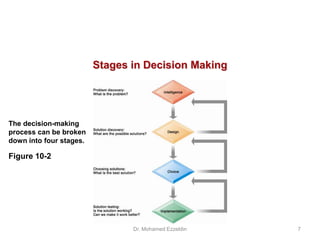
Figure 10-2
The decision-making
process can be broken
down into four stages.
Stages in Decision Making
Dr. Mohamed Ezzeldin 7
• High velocity decision-making
• Humans eliminated
• Trading programs at electronic stock exchanges
• Quality of decisions, decision making
• Accuracy
• Comprehensiveness
• Fairness
• Speed (efficiency)
• Coherence
• Due process
Dr. Mohamed Ezzeldin 8
The Business Intelligence Environment
• Six elements in business intelligence
environment
1. Data from business environment
2. Business intelligence infrastructure
3. Business analytics toolset
4. Managerial users and methods
5. Delivery platform
• MSS, DSS, ESS
6. User interface
Dr. Mohamed Ezzeldin 9
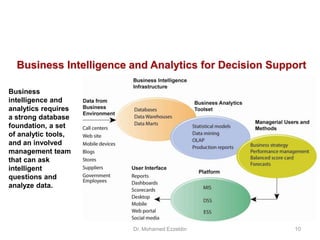
Business
intelligence and
analytics requires
a strong database
foundation, a set
of analytic tools,
and an involved
management team
that can ask
intelligent
questions and
analyze data.
Business Intelligence and Analytics for Decision Support
Dr. Mohamed Ezzeldin 10
Business Intelligence and Analytics Capabilities
• Production reports
• Predefined, based on industry standards
• Parameterized reports
• E.g. pivot tables
• Dashboards/scorecards
• Ad-hoc query/search/report creation
• Drill-down
• Forecasts, scenarios, models
• “What-if” scenario analysis, statistical analysis
Dr. Mohamed Ezzeldin 11
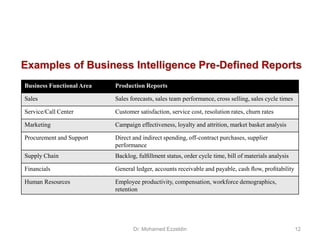
Examples of Business Intelligence Pre-Defined Reports
Business Functional Area Production Reports
Sales Sales forecasts, sales team performance, cross selling, sales cycle times
Service/Call Center Customer satisfaction, service cost, resolution rates, churn rates
Marketing Campaign effectiveness, loyalty and attrition, market basket analysis
Procurement and Support Direct and indirect spending, off-contract purchases, supplier
performance
Supply Chain Backlog, fulfillment status, order cycle time, bill of materials analysis
Financials General ledger, accounts receivable and payable, cash flow, profitability
Human Resources Employee productivity, compensation, workforce demographics,
retention
Dr. Mohamed Ezzeldin 12
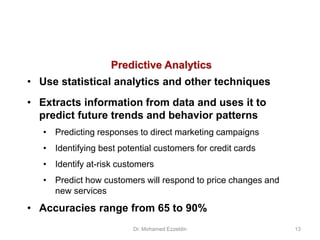
Predictive Analytics
• Use statistical analytics and other techniques
• Extracts information from data and uses it to
predict future trends and behavior patterns
• Predicting responses to direct marketing campaigns
• Identifying best potential customers for credit cards
• Identify at-risk customers
• Predict how customers will respond to price changes and
new services
• Accuracies range from 65 to 90%
Dr. Mohamed Ezzeldin 13
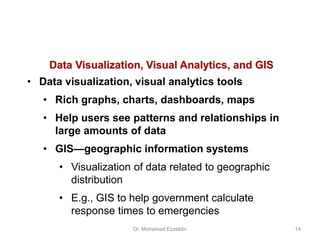
Data Visualization, Visual Analytics, and GIS
• Data visualization, visual analytics tools
• Rich graphs, charts, dashboards, maps
• Help users see patterns and relationships in
large amounts of data
• GIS—geographic information systems
• Visualization of data related to geographic
distribution
• E.g., GIS to help government calculate
response times to emergencies
Dr. Mohamed Ezzeldin 14
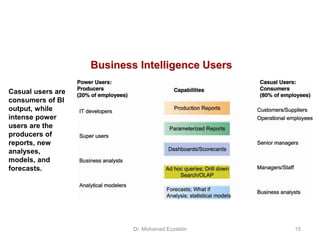
Casual users are
consumers of BI
output, while
intense power
users are the
producers of
reports, new
analyses,
models, and
forecasts.
Business Intelligence Users
Dr. Mohamed Ezzeldin 15
Support for Semi-Structured Decisions
• Decision-support systems (DSS)
• BI delivery platform for “super-users” who want to create own
reports, use more sophisticated analytics and models
• What-if analysis
• Sensitivity analysis
• Backward sensitivity analysis
• Pivot tables: spreadsheet function for multidimensional
analysis
• Intensive modeling techniques
Dr. Mohamed Ezzeldin 16
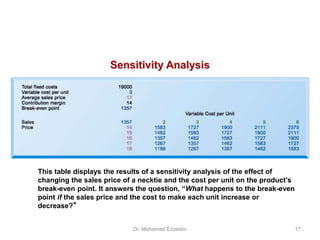
This table displays the results of a sensitivity analysis of the effect of
changing the sales price of a necktie and the cost per unit on the product’s
break-even point. It answers the question, “What happens to the break-even
point if the sales price and the cost to make each unit increase or
decrease?”
Sensitivity Analysis
Dr. Mohamed Ezzeldin 17
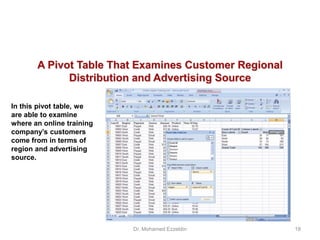
In this pivot table, we
are able to examine
where an online training
company’s customers
come from in terms of
region and advertising
source.
A Pivot Table That Examines Customer Regional
Distribution and Advertising Source
Dr. Mohamed Ezzeldin 18
Decision Support for Senior Management
• Executive support systems
• Balanced scorecard method
• Leading methodology for understanding information
most needed by executives
• Focuses on measurable outcomes
• Measures four dimensions of firm performance
• Financial
• Business process
• Customer
• Learning and growth
Dr. Mohamed Ezzeldin 19
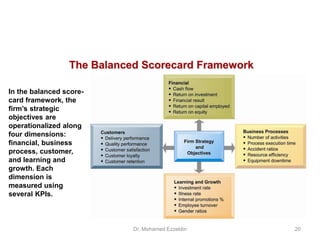
The Balanced Scorecard Framework
In the balanced score-
card framework, the
firm’s strategic
objectives are
operationalized along
four dimensions:
financial, business
process, customer,
and learning and
growth. Each
dimension is
measured using
several KPIs.
Dr. Mohamed Ezzeldin 20
• Business performance management (BPM)
• Management methodology
• Based on firm’s strategies
• E.g., differentiation, low-cost producer, market share
growth, scope of operation
• Translates strategies into operational targets
• Uses set of KPI (key performance indicators) to measure
progress toward targets
• ESS combine internal data with external
• Financial data, news, etc.
• Drill-down capabilities
Dr. Mohamed Ezzeldin 21
Group Decision-Support Systems (GDSS)
• Interactive, computer-based systems that facilitate solving
of unstructured problems by set of decision makers
• Used in conference rooms with special hardware and
software for collecting, ranking, storing ideas and
decisions
• Promotes a collaborative atmosphere by guaranteeing
contributors’ anonymity
• Supports increased meeting sizes with increased
productivity
• Software follows structured methods for organizing and
evaluating ideas
Dr. Mohamed Ezzeldin 22
• Intelligent techniques for enhancing decision making
• Many based on artificial intelligence (AI)
• Computer-based systems (hardware and software) that
attempt to emulate human behavior and thought
patterns
• Include:
• Expert systems
• Case-based reasoning
• Fuzzy logic
• Neural networks
• Genetic algorithms
• Intelligent agents
Dr. Mohamed Ezzeldin 23
• Expert systems
• Model human knowledge as a set of rules that are
collectively called the knowledge base
• From 200 to 10,000 rules, depending on complexity
• The system’s inference engine searches through the rules
and “fires” those rules that are triggered by facts gathered
and entered by the user
• Useful for dealing with problems of classification in which
there are relatively few alternative outcomes and in which
these possible outcomes are all known in advance
Dr. Mohamed Ezzeldin 24
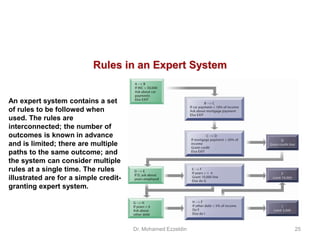
An expert system contains a set
of rules to be followed when
used. The rules are
interconnected; the number of
outcomes is known in advance
and is limited; there are multiple
paths to the same outcome; and
the system can consider multiple
rules at a single time. The rules
illustrated are for a simple credit-
granting expert system.
Rules in an Expert System
Dr. Mohamed Ezzeldin 25
• Case-based reasoning
• Knowledge and past experiences of human specialists
are represented as cases and stored in a database for
later retrieval
• System searches for stored cases with problem
characteristics similar to new one, finds closest fit, and
applies solutions of old case to new case
• Successful and unsuccessful applications are tagged and
linked in database
• Used in medical diagnostic systems, customer support
Dr. Mohamed Ezzeldin 26
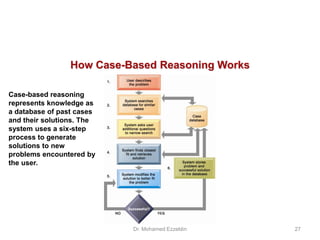
Case-based reasoning
represents knowledge as
a database of past cases
and their solutions. The
system uses a six-step
process to generate
solutions to new
problems encountered by
the user.
How Case-Based Reasoning Works
Dr. Mohamed Ezzeldin 27
• Fuzzy logic
• Rule-based technology that represents imprecision in
categories (e.g., “cold” versus “cool”) by creating rules
that use approximate or subjective values
• Describes a particular phenomenon or process
linguistically and then represents that description in a
small number of flexible rules
• Provides solutions to problems requiring expertise that is
difficult to represent in the form of IF-THEN rules
• E.g., Sendai, Japan subway system uses fuzzy logic
controls to accelerate so smoothly that standing
passengers need not hold on
Dr. Mohamed Ezzeldin 28
• Neural networks
• Use hardware and software that parallel the processing
patterns of a biological brain.
• “Learn” patterns from large quantities of data by searching
for relationships, building models, and correcting over and
over again the model’s own mistakes
• Humans “train” the network by feeding it data for which the
inputs produce a known set of outputs or conclusions
• Machine learning
• Useful for solving complex, poorly understood problems for
which large amounts of data have been collected
Dr. Mohamed Ezzeldin 29
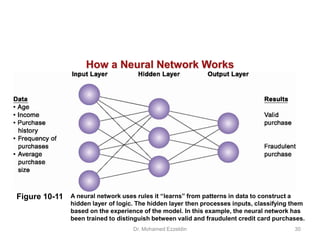
Figure 10-11 A neural network uses rules it “learns” from patterns in data to construct a
hidden layer of logic. The hidden layer then processes inputs, classifying them
based on the experience of the model. In this example, the neural network has
been trained to distinguish between valid and fraudulent credit card purchases.
How a Neural Network Works
Dr. Mohamed Ezzeldin 30
• Genetic algorithms
• Find the optimal solution for a specific problem by
examining very large number of alternative solutions for
that problem
• Based on techniques inspired by evolutionary biology:
inheritance, mutation, selection, and so on
• Work by representing a solution as a string of 0s and 1s,
then searching randomly generated strings of binary
digits to identify best possible solution
• Used to solve complex problems that are very dynamic
and complex, involving hundreds or thousands of
variables or formulas
Dr. Mohamed Ezzeldin 31
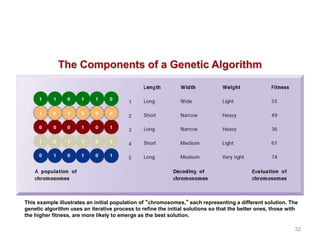
This example illustrates an initial population of “chromosomes,” each representing a different solution. The
genetic algorithm uses an iterative process to refine the initial solutions so that the better ones, those with
the higher fitness, are more likely to emerge as the best solution.
The Components of a Genetic Algorithm
32
• Intelligent agents
• Programs that work in the background without direct
human intervention to carry out specific, repetitive, and
predictable tasks for user, business process, or
software application
• Shopping bots
• Procter & Gamble (P&G) programmed group of
semiautonomous agents to emulate behavior of
supply-chain components, such as trucks, production
facilities, distributors, and retail stores and created
simulations to determine how to make supply chain
more efficient
Dr. Mohamed Ezzeldin 33
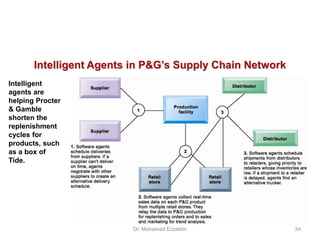
Intelligent
agents are
helping Procter
& Gamble
shorten the
replenishment
cycles for
products, such
as a box of
Tide.
Intelligent Agents in P&G’s Supply Chain Network
Dr. Mohamed Ezzeldin 34
• Knowledge management
• Business processes developed for creating,
storing, transferring, and applying knowledge
• Increases the ability of organization to learn
from environment and to incorporate knowledge
into business processes and decision making
• Knowing how to do things effectively and
efficiently in ways that other organizations
cannot duplicate is major source of profit and
competitive advantage
Dr. Mohamed Ezzeldin 35
• Three kinds of knowledge
• Structured: structured text documents
• Semistructured: e-mail, voice mail, digital pictures, etc.
• Tacit knowledge (unstructured): knowledge residing in heads
of employees, rarely written down
• Enterprise-wide knowledge management systems
• Deal with all three types of knowledge
• General-purpose, firm-wide systems that collect, store,
distribute, and apply digital content and knowledge
Enterprise-Wide Knowledge Management Systems
Dr. Mohamed Ezzeldin 36
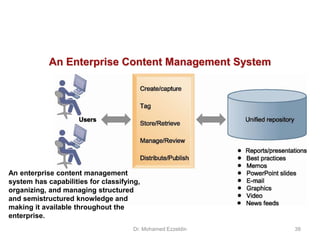
• Enterprise content management systems
• Capabilities for knowledge capture, storage
• Repositories for documents and best practices
• Capabilities for collecting and organizing
semistructured knowledge such as e-mail
• Classification schemes
• Key problem in managing knowledge
• Each knowledge object must be tagged for retrieval
Dr. Mohamed Ezzeldin 37
An enterprise content management
system has capabilities for classifying,
organizing, and managing structured
and semistructured knowledge and
making it available throughout the
enterprise.
An Enterprise Content Management System
Dr. Mohamed Ezzeldin 38
• Digital asset management systems
• Manage unstructured digital data like photographs,
graphic images, video, audio
• Knowledge network systems (expertise location
and management systems)
• Provide online directory of corporate experts in well-
defined knowledge domains
• Use communication technologies to make it easy for
employees to find appropriate expert in firm
Dr. Mohamed Ezzeldin 39
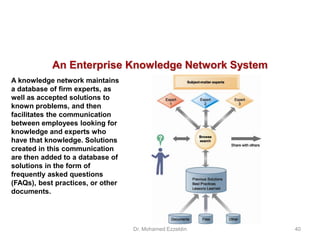
A knowledge network maintains
a database of firm experts, as
well as accepted solutions to
known problems, and then
facilitates the communication
between employees looking for
knowledge and experts who
have that knowledge. Solutions
created in this communication
are then added to a database of
solutions in the form of
frequently asked questions
(FAQs), best practices, or other
documents.
An Enterprise Knowledge Network System
Dr. Mohamed Ezzeldin 40
• Collaboration tools
• Social bookmarking: allow users to save their
bookmarks publicly and tag with keywords
• Folksonomies
• Learning management systems (LMS)
• Provide tools for management, delivery,
tracking, and assessment of various types of
employee learning and training
Dr. Mohamed Ezzeldin 41
Knowledge Work Systems (KWS)
• Specialized systems for knowledge workers
• Requirements of knowledge work systems:
• Specialized tools
• Powerful graphics, analytical tools, and
communications and document management
• Computing power to handle sophisticated
graphics or complex calculations
• Access to external databases
• User-friendly interfaces
Dr. Mohamed Ezzeldin 42
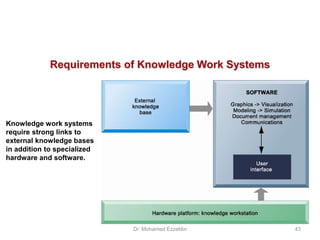
Knowledge work systems
require strong links to
external knowledge bases
in addition to specialized
hardware and software.
Requirements of Knowledge Work Systems
Dr. Mohamed Ezzeldin 43
Knowledge Work Systems (KWS)
• Examples of knowledge work
systems:
• Computer-aided design (CAD) systems
• Virtual reality (VR) systems
• Virtual Reality Modeling Language (VRML)
• Augmented reality (AR) systems
• Investment workstations
Dr. Mohamed Ezzeldin 44

Chapter 1

  • 1.
  • 2.
    Business Value ofImproved Decision Making • Possible to measure value of improved decision making • Decisions made at all levels of the firm • Some are common, routine, and numerous. • Although value of improving any single decision may be small, improving hundreds of thousands of “small” decisions adds up to large annual value for the business Dr. Mohamed Ezzeldin 2
  • 3.
    Business Value ofImproved Decision Making Decision Maker Number / year Value of decision Annual value to firm Allocate support to most valuable customers. Accounts manager 12 $100,000 $1,200,000 Predict call center daily demand. Call Center management 4 150,000 600,000 Decide parts inventory level daily. Inventory manager 365 5,000 1,825,000 Identify competitive bids from major suppliers. Senior management 1 2,000,000 2,000,000 Schedule production to fill orders. Manufacturing manager 150 10,000 1,500,000 Dr. Mohamed Ezzeldin 3
  • 4.
    Types of Decisions •Unstructured • Decision maker must provide judgment to solve problem • Novel, important, nonroutine • No well-understood or agreed-upon procedure for making them • Structured • Repetitive and routine • Involve definite procedure for handling them so do not have to be treated as new • Semistructured • Only part of problem has clear-cut answer provided by accepted procedure Dr. Mohamed Ezzeldin 4
  • 5.
    Figure 10-1 Senior managers, middlemanagers, operational managers, and employees have different types of decisions and information requirements. Information Requirements of Key Decision-Making Groups in a Firm Dr. Mohamed Ezzeldin 5
  • 6.
    The Decision-Making Process 1.Intelligence • Discovering, identifying, and understanding the problems occurring in the organization—why is there a problem, where, what effects it is having on the firm 2. Design • Identifying and exploring various solutions 3. Choice • Choosing among solution alternatives 4. Implementation • Making chosen alternative work and monitoring how well solution is working Dr. Mohamed Ezzeldin 6
  • 7.
    Figure 10-2 The decision-making processcan be broken down into four stages. Stages in Decision Making Dr. Mohamed Ezzeldin 7
  • 8.
    • High velocitydecision-making • Humans eliminated • Trading programs at electronic stock exchanges • Quality of decisions, decision making • Accuracy • Comprehensiveness • Fairness • Speed (efficiency) • Coherence • Due process Dr. Mohamed Ezzeldin 8
  • 9.
    The Business IntelligenceEnvironment • Six elements in business intelligence environment 1. Data from business environment 2. Business intelligence infrastructure 3. Business analytics toolset 4. Managerial users and methods 5. Delivery platform • MSS, DSS, ESS 6. User interface Dr. Mohamed Ezzeldin 9
  • 10.
    Business intelligence and analytics requires astrong database foundation, a set of analytic tools, and an involved management team that can ask intelligent questions and analyze data. Business Intelligence and Analytics for Decision Support Dr. Mohamed Ezzeldin 10
  • 11.
    Business Intelligence andAnalytics Capabilities • Production reports • Predefined, based on industry standards • Parameterized reports • E.g. pivot tables • Dashboards/scorecards • Ad-hoc query/search/report creation • Drill-down • Forecasts, scenarios, models • “What-if” scenario analysis, statistical analysis Dr. Mohamed Ezzeldin 11
  • 12.
    Examples of BusinessIntelligence Pre-Defined Reports Business Functional Area Production Reports Sales Sales forecasts, sales team performance, cross selling, sales cycle times Service/Call Center Customer satisfaction, service cost, resolution rates, churn rates Marketing Campaign effectiveness, loyalty and attrition, market basket analysis Procurement and Support Direct and indirect spending, off-contract purchases, supplier performance Supply Chain Backlog, fulfillment status, order cycle time, bill of materials analysis Financials General ledger, accounts receivable and payable, cash flow, profitability Human Resources Employee productivity, compensation, workforce demographics, retention Dr. Mohamed Ezzeldin 12
  • 13.
    Predictive Analytics • Usestatistical analytics and other techniques • Extracts information from data and uses it to predict future trends and behavior patterns • Predicting responses to direct marketing campaigns • Identifying best potential customers for credit cards • Identify at-risk customers • Predict how customers will respond to price changes and new services • Accuracies range from 65 to 90% Dr. Mohamed Ezzeldin 13
  • 14.
    Data Visualization, VisualAnalytics, and GIS • Data visualization, visual analytics tools • Rich graphs, charts, dashboards, maps • Help users see patterns and relationships in large amounts of data • GIS—geographic information systems • Visualization of data related to geographic distribution • E.g., GIS to help government calculate response times to emergencies Dr. Mohamed Ezzeldin 14
  • 15.
    Casual users are consumersof BI output, while intense power users are the producers of reports, new analyses, models, and forecasts. Business Intelligence Users Dr. Mohamed Ezzeldin 15
  • 16.
    Support for Semi-StructuredDecisions • Decision-support systems (DSS) • BI delivery platform for “super-users” who want to create own reports, use more sophisticated analytics and models • What-if analysis • Sensitivity analysis • Backward sensitivity analysis • Pivot tables: spreadsheet function for multidimensional analysis • Intensive modeling techniques Dr. Mohamed Ezzeldin 16
  • 17.
    This table displaysthe results of a sensitivity analysis of the effect of changing the sales price of a necktie and the cost per unit on the product’s break-even point. It answers the question, “What happens to the break-even point if the sales price and the cost to make each unit increase or decrease?” Sensitivity Analysis Dr. Mohamed Ezzeldin 17
  • 18.
    In this pivottable, we are able to examine where an online training company’s customers come from in terms of region and advertising source. A Pivot Table That Examines Customer Regional Distribution and Advertising Source Dr. Mohamed Ezzeldin 18
  • 19.
    Decision Support forSenior Management • Executive support systems • Balanced scorecard method • Leading methodology for understanding information most needed by executives • Focuses on measurable outcomes • Measures four dimensions of firm performance • Financial • Business process • Customer • Learning and growth Dr. Mohamed Ezzeldin 19
  • 20.
    The Balanced ScorecardFramework In the balanced score- card framework, the firm’s strategic objectives are operationalized along four dimensions: financial, business process, customer, and learning and growth. Each dimension is measured using several KPIs. Dr. Mohamed Ezzeldin 20
  • 21.
    • Business performancemanagement (BPM) • Management methodology • Based on firm’s strategies • E.g., differentiation, low-cost producer, market share growth, scope of operation • Translates strategies into operational targets • Uses set of KPI (key performance indicators) to measure progress toward targets • ESS combine internal data with external • Financial data, news, etc. • Drill-down capabilities Dr. Mohamed Ezzeldin 21
  • 22.
    Group Decision-Support Systems(GDSS) • Interactive, computer-based systems that facilitate solving of unstructured problems by set of decision makers • Used in conference rooms with special hardware and software for collecting, ranking, storing ideas and decisions • Promotes a collaborative atmosphere by guaranteeing contributors’ anonymity • Supports increased meeting sizes with increased productivity • Software follows structured methods for organizing and evaluating ideas Dr. Mohamed Ezzeldin 22
  • 23.
    • Intelligent techniquesfor enhancing decision making • Many based on artificial intelligence (AI) • Computer-based systems (hardware and software) that attempt to emulate human behavior and thought patterns • Include: • Expert systems • Case-based reasoning • Fuzzy logic • Neural networks • Genetic algorithms • Intelligent agents Dr. Mohamed Ezzeldin 23
  • 24.
    • Expert systems •Model human knowledge as a set of rules that are collectively called the knowledge base • From 200 to 10,000 rules, depending on complexity • The system’s inference engine searches through the rules and “fires” those rules that are triggered by facts gathered and entered by the user • Useful for dealing with problems of classification in which there are relatively few alternative outcomes and in which these possible outcomes are all known in advance Dr. Mohamed Ezzeldin 24
  • 25.
    An expert systemcontains a set of rules to be followed when used. The rules are interconnected; the number of outcomes is known in advance and is limited; there are multiple paths to the same outcome; and the system can consider multiple rules at a single time. The rules illustrated are for a simple credit- granting expert system. Rules in an Expert System Dr. Mohamed Ezzeldin 25
  • 26.
    • Case-based reasoning •Knowledge and past experiences of human specialists are represented as cases and stored in a database for later retrieval • System searches for stored cases with problem characteristics similar to new one, finds closest fit, and applies solutions of old case to new case • Successful and unsuccessful applications are tagged and linked in database • Used in medical diagnostic systems, customer support Dr. Mohamed Ezzeldin 26
  • 27.
    Case-based reasoning represents knowledgeas a database of past cases and their solutions. The system uses a six-step process to generate solutions to new problems encountered by the user. How Case-Based Reasoning Works Dr. Mohamed Ezzeldin 27
  • 28.
    • Fuzzy logic •Rule-based technology that represents imprecision in categories (e.g., “cold” versus “cool”) by creating rules that use approximate or subjective values • Describes a particular phenomenon or process linguistically and then represents that description in a small number of flexible rules • Provides solutions to problems requiring expertise that is difficult to represent in the form of IF-THEN rules • E.g., Sendai, Japan subway system uses fuzzy logic controls to accelerate so smoothly that standing passengers need not hold on Dr. Mohamed Ezzeldin 28
  • 29.
    • Neural networks •Use hardware and software that parallel the processing patterns of a biological brain. • “Learn” patterns from large quantities of data by searching for relationships, building models, and correcting over and over again the model’s own mistakes • Humans “train” the network by feeding it data for which the inputs produce a known set of outputs or conclusions • Machine learning • Useful for solving complex, poorly understood problems for which large amounts of data have been collected Dr. Mohamed Ezzeldin 29
  • 30.
    Figure 10-11 Aneural network uses rules it “learns” from patterns in data to construct a hidden layer of logic. The hidden layer then processes inputs, classifying them based on the experience of the model. In this example, the neural network has been trained to distinguish between valid and fraudulent credit card purchases. How a Neural Network Works Dr. Mohamed Ezzeldin 30
  • 31.
    • Genetic algorithms •Find the optimal solution for a specific problem by examining very large number of alternative solutions for that problem • Based on techniques inspired by evolutionary biology: inheritance, mutation, selection, and so on • Work by representing a solution as a string of 0s and 1s, then searching randomly generated strings of binary digits to identify best possible solution • Used to solve complex problems that are very dynamic and complex, involving hundreds or thousands of variables or formulas Dr. Mohamed Ezzeldin 31
  • 32.
    This example illustratesan initial population of “chromosomes,” each representing a different solution. The genetic algorithm uses an iterative process to refine the initial solutions so that the better ones, those with the higher fitness, are more likely to emerge as the best solution. The Components of a Genetic Algorithm 32
  • 33.
    • Intelligent agents •Programs that work in the background without direct human intervention to carry out specific, repetitive, and predictable tasks for user, business process, or software application • Shopping bots • Procter & Gamble (P&G) programmed group of semiautonomous agents to emulate behavior of supply-chain components, such as trucks, production facilities, distributors, and retail stores and created simulations to determine how to make supply chain more efficient Dr. Mohamed Ezzeldin 33
  • 34.
    Intelligent agents are helping Procter &Gamble shorten the replenishment cycles for products, such as a box of Tide. Intelligent Agents in P&G’s Supply Chain Network Dr. Mohamed Ezzeldin 34
  • 35.
    • Knowledge management •Business processes developed for creating, storing, transferring, and applying knowledge • Increases the ability of organization to learn from environment and to incorporate knowledge into business processes and decision making • Knowing how to do things effectively and efficiently in ways that other organizations cannot duplicate is major source of profit and competitive advantage Dr. Mohamed Ezzeldin 35
  • 36.
    • Three kindsof knowledge • Structured: structured text documents • Semistructured: e-mail, voice mail, digital pictures, etc. • Tacit knowledge (unstructured): knowledge residing in heads of employees, rarely written down • Enterprise-wide knowledge management systems • Deal with all three types of knowledge • General-purpose, firm-wide systems that collect, store, distribute, and apply digital content and knowledge Enterprise-Wide Knowledge Management Systems Dr. Mohamed Ezzeldin 36
  • 37.
    • Enterprise contentmanagement systems • Capabilities for knowledge capture, storage • Repositories for documents and best practices • Capabilities for collecting and organizing semistructured knowledge such as e-mail • Classification schemes • Key problem in managing knowledge • Each knowledge object must be tagged for retrieval Dr. Mohamed Ezzeldin 37
  • 38.
    An enterprise contentmanagement system has capabilities for classifying, organizing, and managing structured and semistructured knowledge and making it available throughout the enterprise. An Enterprise Content Management System Dr. Mohamed Ezzeldin 38
  • 39.
    • Digital assetmanagement systems • Manage unstructured digital data like photographs, graphic images, video, audio • Knowledge network systems (expertise location and management systems) • Provide online directory of corporate experts in well- defined knowledge domains • Use communication technologies to make it easy for employees to find appropriate expert in firm Dr. Mohamed Ezzeldin 39
  • 40.
    A knowledge networkmaintains a database of firm experts, as well as accepted solutions to known problems, and then facilitates the communication between employees looking for knowledge and experts who have that knowledge. Solutions created in this communication are then added to a database of solutions in the form of frequently asked questions (FAQs), best practices, or other documents. An Enterprise Knowledge Network System Dr. Mohamed Ezzeldin 40
  • 41.
    • Collaboration tools •Social bookmarking: allow users to save their bookmarks publicly and tag with keywords • Folksonomies • Learning management systems (LMS) • Provide tools for management, delivery, tracking, and assessment of various types of employee learning and training Dr. Mohamed Ezzeldin 41
  • 42.
    Knowledge Work Systems(KWS) • Specialized systems for knowledge workers • Requirements of knowledge work systems: • Specialized tools • Powerful graphics, analytical tools, and communications and document management • Computing power to handle sophisticated graphics or complex calculations • Access to external databases • User-friendly interfaces Dr. Mohamed Ezzeldin 42
  • 43.
    Knowledge work systems requirestrong links to external knowledge bases in addition to specialized hardware and software. Requirements of Knowledge Work Systems Dr. Mohamed Ezzeldin 43
  • 44.
    Knowledge Work Systems(KWS) • Examples of knowledge work systems: • Computer-aided design (CAD) systems • Virtual reality (VR) systems • Virtual Reality Modeling Language (VRML) • Augmented reality (AR) systems • Investment workstations Dr. Mohamed Ezzeldin 44