Management Support
Systems
 Managers and Decision Making
 Decisions and Information Systems
 Computerized Support
 Decision Support
 Expert Systems
 Intelligent Agents
 Neural Nets
 Knowledge Management
 Enterprise level support
 Hybrid Support
 Evolution of Computerized DSS
Managers & Decision Making
  Opening vignette – read & have answers to
  questions
  Roles of the manager
     Interpersonal
        Leader, Industry Liason
     Informational
        Monitor, Disseminate, Represent
     Decisional
        Exploit opportunity, handle disturbance,
        allocate resources, negotiate
Decisions & Information Systems
  Goals (outputs)
     Resources – application (inputs) – focus
     Productivity
  Focus
     Planning, Organizing, Directing, Controlling
  Management – Art or Technology?
     Speed, Competition
     Increasing alternatives from which to choose
     Cost of Errors
     Changing Environment
        Technology, multinational, politics, consumers
Computerized Support
  Vital to Business
  Data Collection (traditional)
     Accounting, operations, manufacturing
     Transactions
     Monitoring
  Decision support
     Analytical
     Proactive
Decision Support
  Speed - Timeliness
  Productivity – More decisions/manager
  Technical Facility – Bringing resources
  together
  Quality & Consistency
  Competitive Advantage
  Cognitive Limits
Decision Support Technologies
Management Support Systems (MSS)

  Group Support Systems (GSS)
  Decision Support Systems (DSS) Enterprise (Executive)
  Information Systems (EIS)
  Enterprise Resource Planning (ERP) and Supply-
  Chain Management (SCM)
  Knowledge Management Systems
  Expert Systems (ES) (KBS)
  Artificial Neural Networks (ANN)
  Hybrid Support Systems
  Intelligent DSS (IDSS)
Framework for Decision Support
  Decision making continuum
  Unstructured --------------------- Structured
  Nonprogrammed ---------------- Programmed
  ------------- semistrucutured-----------------
  Structured – steps to solution are known
  Unstructured – intuition, chaos, R&D,
  feasibility
  Semistructured – a range of alternatives with
  some uncertainty
Framework for Decision Support (2)
  Managerial Activities
  Strategic Planning
      What goals?
  Management Control
      What resources?
  Operational Control
      What tasks and efficiency?
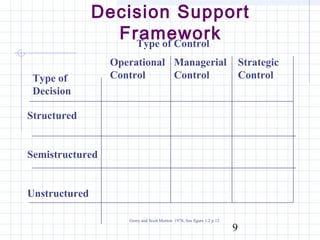
Decision Support
                 Framework
                   Type of Control
                 Operational Managerial                                    Strategic
 Type of         Control     Control                                       Control
 Decision

Structured


Semistructured


Unstructured

                    Gorry and Scott Morton 1978, See figure 1.2 p 12
                                                                       9
Support for Structured Decisions

  Management Science
     Define the problem
     Classify the problem (standard categories)
     Model (math or otherwise)
     Find potential solutions
     Choose the best
Three Phase Decision-
making Process (Simon)

 Intelligence--searching for conditions that call for
 decisions

 Design--inventing, developing, and analyzing possible
 courses of action

 Choice--selecting a course of action from those
 available

      Decision Support Systems and Intelligent Systems, Efraim Turban and Jay E. Aronson, 6th edition.
                          Copyright 2001, Prentice Hall, Upper Saddle River, NJ
                                                                                      11
Decision Support Systems
         Concept
   DSS are interactive computer-based systems, which help
   decision makers utilize data and models to solve unstructured
   problems (Scott Morton, 1971).

   Decision support systems couple the intellectual resources of
   individuals with the capabilities of the computer to improve
   the quality of decisions. It is a computer-based support system
   for management decision makers who deal with semi-
   structured problems (Keen and Scott Morton, 1978).

  Content-free expression
  There is no universally accepted definition of DSS
Umbrella term vs. narrow definition (specific technology)


         Decision Support Systems and Intelligent Systems, Efraim Turban and Jay E. Aronson, 6th edition.
                             Copyright 2001, Prentice Hall, Upper Saddle River, NJ
                                                                                         12
Major DSS Characteristics

     (DSS In Action 1.5: Houston Minerals Case)

Initial risk analysis (management science)
Model scrutiny using experience, judgment, and intuition
Initial model mathematically correct, but incomplete
DSS provided very quick analysis
DSS: flexible and responsive. Allows managerial intuition
and judgment


         Decision Support Systems and Intelligent Systems, Efraim Turban and Jay E. Aronson, 6th edition.
                             Copyright 2001, Prentice Hall, Upper Saddle River, NJ
                                                                                         13
Why Use DSS?
Perceived benefits
        decision quality
        improved communication
        cost reduction
        increased productivity
        time savings
        improved customer and employee satisfaction


       Decision Support Systems and Intelligent Systems, Efraim Turban and Jay E. Aronson, 6th edition.
                           Copyright 2001, Prentice Hall, Upper Saddle River, NJ
                                                                                       14
Major Reasons
Unstable economy
Difficulty in tracking numerous business objectives
Increased competition
Electronic commerce
Existing systems did not support decision making
IS Department is too busy
Special analysis
Need accurate information
Organizational winner
New or timely information needed
Mandated by management
Cost reductions
End-user computing
      Decision Support Systems and Intelligent Systems, Efraim Turban and Jay E. Aronson, 6th edition.
                          Copyright 2001, Prentice Hall, Upper Saddle River, NJ
                                                                                      15
Other support systems

  Group Support (GSS)
  Executive (EIS)
  Enterprise
Expert Systems (ES)
Knowledge Based Systems
         (KBS)
Experts solve complex problems
Experts have specific knowledge and experience
“The more unstructured the situation the more specialized the
advice”

Expert systems mimic human experts
ES performance comparable to or better than experts in a
specialized and usually narrow problem area
Expertise transferred from Computer to Human


     Decision Support Systems and Intelligent Systems, Efraim Turban and Jay E. Aronson, 6th edition.
                         Copyright 2001, Prentice Hall, Upper Saddle River, NJ
                                                                                     17
Intelligent Agents
Help automate various tasks
Increase productivity and quality
Learn how you work


      Decision Support Systems and Intelligent Systems, Efraim Turban and Jay E. Aronson, 6th edition.
                          Copyright 2001, Prentice Hall, Upper Saddle River, NJ
                                                                                      18
Artificial Neural
               Systems
Artificial Neural Networks (ANN):

Mathematical models of the human brain

ANN learn patterns in data

ANN can work with partial, incomplete, or inexact
information


       Decision Support Systems and Intelligent Systems, Efraim Turban and Jay E. Aronson, 6th edition.
                           Copyright 2001, Prentice Hall, Upper Saddle River, NJ
                                                                                       19
Knowledge Management
   Systems (KMS)
Capture and reuse knowledge at the
organizational level
Knowledge repository for storage
Organizational impacts can be dramatic


      Decision Support Systems and Intelligent Systems, Efraim Turban and Jay E. Aronson, 6th edition.
                          Copyright 2001, Prentice Hall, Upper Saddle River, NJ
                                                                                      20
Cutting Edge Intelligent
         Systems
Genetic Algorithms
Work in an evolutionary fashion

Fuzzy Logic
Continuous logic (NOT just True / False)

Intelligent Agents
In search engines, e-mail, electronic commerce


  Decision Support Systems and Intelligent Systems, Efraim Turban and Jay E. Aronson, 6th edition.
                      Copyright 2001, Prentice Hall, Upper Saddle River, NJ
                                                                                  21
Hybrid Support Systems
Combines MSS technologies
Use strengths of each
Goal: successful solution of the
managerial problem

Tools support each other

Tools can add intelligence to traditional
MSS


                                   22
Computerized Decision Aids
 Evolution and Attributes

Computerized procedures development
aids decision making (Table 1.2)

DSS supports specific questions (Table 1.3)


                                23
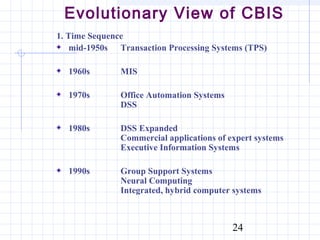
Evolutionary View of CBIS
1. Time Sequence
    mid-1950s Transaction Processing Systems (TPS)

  1960s        MIS

  1970s        Office Automation Systems
               DSS

  1980s        DSS Expanded
               Commercial applications of expert systems
               Executive Information Systems

  1990s        Group Support Systems
               Neural Computing
               Integrated, hybrid computer systems


                                           24
2. Computer evolved over time

3. Systemic linkages in how each system processes
   data into information


  Relationship among these and other technologies
  (Figure 1.3)


                                       25
Relationship Among
         Technologies
Each technology unique
Technologies interrelated
Each supports some aspects of managerial decision
making
Ever expanding role of information technology
improving management
Interrelationship and coordination evolving


                                     26
Summary

DSS has many definitions

Complexity of managerial decision making is
increasing

Computer support for managerial decision
making

Several MSS technologies including hybrids


                                  27

Turban01

  • 1.
    Management Support Systems Managersand Decision Making Decisions and Information Systems Computerized Support Decision Support Expert Systems Intelligent Agents Neural Nets Knowledge Management Enterprise level support Hybrid Support Evolution of Computerized DSS
  • 2.
    Managers & DecisionMaking Opening vignette – read & have answers to questions Roles of the manager  Interpersonal  Leader, Industry Liason  Informational  Monitor, Disseminate, Represent  Decisional  Exploit opportunity, handle disturbance, allocate resources, negotiate
  • 3.
    Decisions & InformationSystems Goals (outputs)  Resources – application (inputs) – focus  Productivity Focus  Planning, Organizing, Directing, Controlling Management – Art or Technology?  Speed, Competition  Increasing alternatives from which to choose  Cost of Errors  Changing Environment  Technology, multinational, politics, consumers
  • 4.
    Computerized Support Vital to Business Data Collection (traditional)  Accounting, operations, manufacturing  Transactions  Monitoring Decision support  Analytical  Proactive
  • 5.
    Decision Support Speed - Timeliness Productivity – More decisions/manager Technical Facility – Bringing resources together Quality & Consistency Competitive Advantage Cognitive Limits
  • 6.
    Decision Support Technologies ManagementSupport Systems (MSS) Group Support Systems (GSS) Decision Support Systems (DSS) Enterprise (Executive) Information Systems (EIS) Enterprise Resource Planning (ERP) and Supply- Chain Management (SCM) Knowledge Management Systems Expert Systems (ES) (KBS) Artificial Neural Networks (ANN) Hybrid Support Systems Intelligent DSS (IDSS)
  • 7.
    Framework for DecisionSupport Decision making continuum Unstructured --------------------- Structured Nonprogrammed ---------------- Programmed ------------- semistrucutured----------------- Structured – steps to solution are known Unstructured – intuition, chaos, R&D, feasibility Semistructured – a range of alternatives with some uncertainty
  • 8.
    Framework for DecisionSupport (2) Managerial Activities Strategic Planning  What goals? Management Control  What resources? Operational Control  What tasks and efficiency?
  • 9.
    Decision Support Framework Type of Control Operational Managerial Strategic Type of Control Control Control Decision Structured Semistructured Unstructured Gorry and Scott Morton 1978, See figure 1.2 p 12 9
  • 10.
    Support for StructuredDecisions Management Science  Define the problem  Classify the problem (standard categories)  Model (math or otherwise)  Find potential solutions  Choose the best
  • 11.
    Three Phase Decision- makingProcess (Simon) Intelligence--searching for conditions that call for decisions Design--inventing, developing, and analyzing possible courses of action Choice--selecting a course of action from those available Decision Support Systems and Intelligent Systems, Efraim Turban and Jay E. Aronson, 6th edition. Copyright 2001, Prentice Hall, Upper Saddle River, NJ 11
  • 12.
    Decision Support Systems Concept DSS are interactive computer-based systems, which help decision makers utilize data and models to solve unstructured problems (Scott Morton, 1971). Decision support systems couple the intellectual resources of individuals with the capabilities of the computer to improve the quality of decisions. It is a computer-based support system for management decision makers who deal with semi- structured problems (Keen and Scott Morton, 1978). Content-free expression There is no universally accepted definition of DSS Umbrella term vs. narrow definition (specific technology) Decision Support Systems and Intelligent Systems, Efraim Turban and Jay E. Aronson, 6th edition. Copyright 2001, Prentice Hall, Upper Saddle River, NJ 12
  • 13.
    Major DSS Characteristics (DSS In Action 1.5: Houston Minerals Case) Initial risk analysis (management science) Model scrutiny using experience, judgment, and intuition Initial model mathematically correct, but incomplete DSS provided very quick analysis DSS: flexible and responsive. Allows managerial intuition and judgment Decision Support Systems and Intelligent Systems, Efraim Turban and Jay E. Aronson, 6th edition. Copyright 2001, Prentice Hall, Upper Saddle River, NJ 13
  • 14.
    Why Use DSS? Perceivedbenefits  decision quality  improved communication  cost reduction  increased productivity  time savings  improved customer and employee satisfaction Decision Support Systems and Intelligent Systems, Efraim Turban and Jay E. Aronson, 6th edition. Copyright 2001, Prentice Hall, Upper Saddle River, NJ 14
  • 15.
    Major Reasons Unstable economy Difficultyin tracking numerous business objectives Increased competition Electronic commerce Existing systems did not support decision making IS Department is too busy Special analysis Need accurate information Organizational winner New or timely information needed Mandated by management Cost reductions End-user computing Decision Support Systems and Intelligent Systems, Efraim Turban and Jay E. Aronson, 6th edition. Copyright 2001, Prentice Hall, Upper Saddle River, NJ 15
  • 16.
    Other support systems Group Support (GSS) Executive (EIS) Enterprise
  • 17.
    Expert Systems (ES) KnowledgeBased Systems (KBS) Experts solve complex problems Experts have specific knowledge and experience “The more unstructured the situation the more specialized the advice” Expert systems mimic human experts ES performance comparable to or better than experts in a specialized and usually narrow problem area Expertise transferred from Computer to Human Decision Support Systems and Intelligent Systems, Efraim Turban and Jay E. Aronson, 6th edition. Copyright 2001, Prentice Hall, Upper Saddle River, NJ 17
  • 18.
    Intelligent Agents Help automatevarious tasks Increase productivity and quality Learn how you work Decision Support Systems and Intelligent Systems, Efraim Turban and Jay E. Aronson, 6th edition. Copyright 2001, Prentice Hall, Upper Saddle River, NJ 18
  • 19.
    Artificial Neural Systems Artificial Neural Networks (ANN): Mathematical models of the human brain ANN learn patterns in data ANN can work with partial, incomplete, or inexact information Decision Support Systems and Intelligent Systems, Efraim Turban and Jay E. Aronson, 6th edition. Copyright 2001, Prentice Hall, Upper Saddle River, NJ 19
  • 20.
    Knowledge Management Systems (KMS) Capture and reuse knowledge at the organizational level Knowledge repository for storage Organizational impacts can be dramatic Decision Support Systems and Intelligent Systems, Efraim Turban and Jay E. Aronson, 6th edition. Copyright 2001, Prentice Hall, Upper Saddle River, NJ 20
  • 21.
    Cutting Edge Intelligent Systems Genetic Algorithms Work in an evolutionary fashion Fuzzy Logic Continuous logic (NOT just True / False) Intelligent Agents In search engines, e-mail, electronic commerce Decision Support Systems and Intelligent Systems, Efraim Turban and Jay E. Aronson, 6th edition. Copyright 2001, Prentice Hall, Upper Saddle River, NJ 21
  • 22.
    Hybrid Support Systems CombinesMSS technologies Use strengths of each Goal: successful solution of the managerial problem Tools support each other Tools can add intelligence to traditional MSS 22
  • 23.
    Computerized Decision Aids Evolution and Attributes Computerized procedures development aids decision making (Table 1.2) DSS supports specific questions (Table 1.3) 23
  • 24.
    Evolutionary View ofCBIS 1. Time Sequence mid-1950s Transaction Processing Systems (TPS) 1960s MIS 1970s Office Automation Systems DSS 1980s DSS Expanded Commercial applications of expert systems Executive Information Systems 1990s Group Support Systems Neural Computing Integrated, hybrid computer systems 24
  • 25.
    2. Computer evolvedover time 3. Systemic linkages in how each system processes data into information Relationship among these and other technologies (Figure 1.3) 25
  • 26.
    Relationship Among Technologies Each technology unique Technologies interrelated Each supports some aspects of managerial decision making Ever expanding role of information technology improving management Interrelationship and coordination evolving 26
  • 27.
    Summary DSS has manydefinitions Complexity of managerial decision making is increasing Computer support for managerial decision making Several MSS technologies including hybrids 27