International Research Journal of Engineering and Technology (IRJET) e-ISSN: 2395-0056
Volume: 06 Issue: 11 | Nov 2019 www.irjet.net p-ISSN: 2395-0072
© 2019, IRJET | Impact Factor value: 7.34 | ISO 9001:2008 Certified Journal | Page 3574
STOCK MARKET PREDICTION USING MACHINE LEARNING TECHNIQUES
Prof. Ketaki Bhoyar1, Rutuja Mehetre2, Arati Patil3, Jagruti Kale4, Pratiksha Barve5
1Professor, Dept. of Computer Engineering, DYPIEMR, Maharashtra, India
2,3,4,5Student,Dept. of Computer Engineering, DYPIEMR, Maharashtra, India
---------------------------------------------------------------------***----------------------------------------------------------------------
Abstract - The objective of Stock market prediction is to
determine the future value of a company stock or other
financial instrument traded on a financial exchange. The
successful prediction of a stock's future price will maximize
investor's gains. This paper proposes a machine learning
model to predict stock market price. Forecasting accuracy is
the most important factor in selecting any forecasting
methods. The appropriate stock selections those are suitable
for investment is a very difficult task. The key factor for each
investor is to earn maximum profits on their investments. By
using dataset of stock market we are going to use
preprocessing, processing and regression analysis. We will
review the use of machine learning and deep learning
algorithm on dataset and the result it generates. Predicting
how the stock market will perform is one of the most difficult
things to do.
Key Words: Machine Learning, Deep Learning, Time
Series, Regression Analysis, Data Analysis.
1. INTRODUCTION
The stock market refers to the collection of markets and
exchanges where regular activities of buying, selling, and
issuance of shares of publicly-held companies take place.
While today it is possible to purchase almost everything
online, there is usually a designated market for every
commodity. A stock market is a similar designated market
for trading various kinds of securities in a controlled, secure
and managed the environment. Since the stock market
brings together hundreds of thousands of market
participants who wish to buy and sell shares, it ensures fair
pricing practices and transparency in transactions. Stock
market prediction is the act of trying to determinethefuture
value of a company stock or other financial instrument
traded on an exchange. The successful predictionofa stock's
future price could yield significant profit. In Fundamental
analysis, Stock Market price movements are believed to
derive from a security’s relative data. Fundamentalists use
numeric information such as earnings, ratios, and
management effectiveness to determine future forecasts. In
Technical analysis, it is believed that market timing is key.
Technicians utilize charts and modeling techniques to
identify trends in price and volume. These later individuals
rely on historical data in order to predict future outcomes.
Stock Market prediction has always had a certain appeal for
researchers.
1.1 Problem Statement:
Investors investing in stock market usually are not aware of
the stock market behavior. They are facing the problem of
trading as they do not properly understand which stocks to
buy or which stocks to sell in order to get more profits the
input to our system will be historical data from Google.
Appropriate data would be applied to find the stock price
trends. Hence the prediction model will notify the up or
down of the stock price movement for the next trading day
and investors can act upon it so as to maximizetheirchances
of gaining a profit. The entire system would be implemented
in python. Hence it will effectively be a zero cost system.
1.2 Literature Survey:
 The first is Efficient Market Hypothesis (EMH). In
EMH, it is assumed that the price of a security
reflects all of the information available and that
everyone has some degree of access to the
information.
 A different perspective on prediction comes from
Random Walk Theory. In this theory, Stock Market
prediction is believed to be impossible where prices
are determined randomly and outperforming the
market is infeasible.
 In one model that tested trading philosophies;
LeBaron et. al. posited that much can be learned
from a simulated stock market with simulated
traders. In their work, simulated traders mimicked
human trading activity.
 Within this period of time, Gidofalvi demonstrated
that there exists a weak ability to predict the
direction of a security before the market corrects
itself.
2. EXISTING SYSTEM:
The existing system use data miningtechniques.Data mining
techniques are less accurate and time consuming to analyze
big data. The system does not allow the import of raw data
directly. The existing system cannot be used to analyze
multi-variate time series. Lastly, the system does not have a
user-interface which can be distributed asa GUIapptousers
for personal use Stock Market Prediction. The dataframe
features were date and the closing price for a particular day.
We used all these features to train the machine on random
forest model and predicted the object variable, which is the
International Research Journal of Engineering and Technology (IRJET) e-ISSN: 2395-0056
Volume: 06 Issue: 11 | Nov 2019 www.irjet.net p-ISSN: 2395-0072
© 2019, IRJET | Impact Factor value: 7.34 | ISO 9001:2008 Certified Journal | Page 3575
price for a given day. We also quantified the accuracy by
using the predictions for the test set and the actual values.
3. PROPOSED SYSTEM:
Stock Market price movements are believed to derivefroma
security’s relative data. Fundamentalists use numeric
information such as earnings, ratios, and management
effectiveness to determine future forecasts. In Technical
analysis, it is believed that market timing is key. Technicians
utilize charts and modeling techniques to identify trends in
price and volume. These later individuals rely on historical
data in order to predict future outcome.
Stock Market price movements are believed to derivefroma
security’s relative data. Fundamentalists use numeric
information such as earnings, ratios, and management
effectiveness to determine future forecasts. In Technical
analysis, it is believed that market timing is key. Technicians
utilize charts and modeling techniques to identify trends in
price and volume. These later individuals rely on historical
data in order to predict future outcome.
Software project estimation is form of problem solving. The
complex software is hard to estimate henceitisdividedinto
smaller of piceses. The estimation of project will be correct
only when the estimation of size of the project is correct. In
the context of project planning size refers to qualifiable
outcome of project. Here,the direct approch is chooesn and
hence , the size is estimated in Line of Codes.
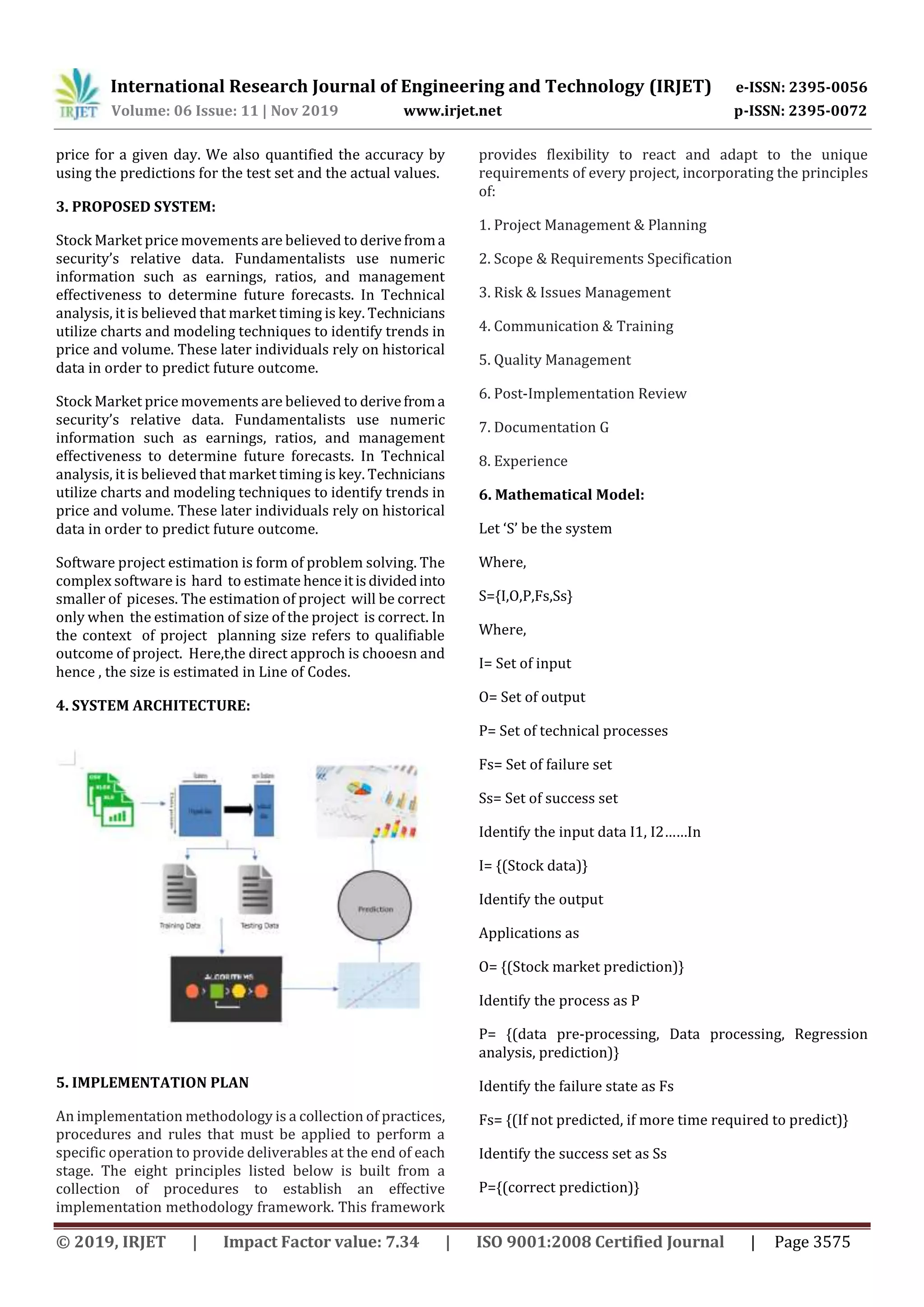
4. SYSTEM ARCHITECTURE:
5. IMPLEMENTATION PLAN
An implementation methodology is a collection of practices,
procedures and rules that must be applied to perform a
specific operation to provide deliverables at the end of each
stage. The eight principles listed below is built from a
collection of procedures to establish an effective
implementation methodology framework. This framework
provides flexibility to react and adapt to the unique
requirements of every project, incorporating the principles
of:
1. Project Management & Planning
2. Scope & Requirements Specification
3. Risk & Issues Management
4. Communication & Training
5. Quality Management
6. Post-Implementation Review
7. Documentation G
8. Experience
6. Mathematical Model:
Let ‘S’ be the system
Where,
S={I,O,P,Fs,Ss}
Where,
I= Set of input
O= Set of output
P= Set of technical processes
Fs= Set of failure set
Ss= Set of success set
Identify the input data I1, I2……In
I= {(Stock data)}
Identify the output
Applications as
O= {(Stock market prediction)}
Identify the process as P
P= {(data pre-processing, Data processing, Regression
analysis, prediction)}
Identify the failure state as Fs
Fs= {(If not predicted, if more time required to predict)}
Identify the success set as Ss
P={(correct prediction)}
International Research Journal of Engineering and Technology (IRJET) e-ISSN: 2395-0056
Volume: 06 Issue: 11 | Nov 2019 www.irjet.net p-ISSN: 2395-0072
© 2019, IRJET | Impact Factor value: 7.34 | ISO 9001:2008 Certified Journal | Page 3576
7. FUTURE SCOPE:
Financial analysts, investors canusethispredictionmodel to
take trading decision by observing market behavior. More
work on refining key phrases extraction will definitely
produce better results. Enhancements in the preprocessor
unit of this system will help in improving more accurate
predictability in stock market. Future research includes
using other machine learning techniques such as Relevance
Vector Regression, which promises to have better accuracy
and fewer vectors in classification. Another worthwhile
approach would be to 27 test a model based on article terms
and percentage of stock price change. While our models
relied on fixed stock prices that traded within a consistent
range, penny stocks with wild fluctuations may prove
worthy of further research.
CONCLUSION
Thus, as we can see above in our proposed method, we train
the data using existing stock dataset that is available.We use
this data to predict and forecast the stock price of n-days
into the future. The average performance of the model
decreases with increase in number of days, due to
unpredictable changes in trend. The current system can
update its training set as each day passes so as to detect
newer trends and behave like an online-learningsystemthat
predicts stock in real-time.
REFERENCES
[1] ASM Shakil Haider, “ Forecasting Dhaka Stock Exchange
(DSE) return: An Autoregressive IntegratedMovingAverage
(ARIMA) approach”, 2009, North South Business Review,
Volume 3, Number 1, ISSN 1991- 4938.
[2] Tarun Kanti Bose , Md. Reaz Uddin, and Md. Wahidul
Islam, “Measuring and Comparing the Efficiency of Dhaka
Stock Exchange and Chittagong Stock Exchange”, 2014,
International Journal of Scientific andResearchPublications,
Volume 4, Issue 3,1 ISSN 2250-3153
[3] Md. Kamruzzaman, Md. Mohsan Khudri, and Md. Matiar
Rahman, “Modeling and predicting stock market returns: A
case study on Dhaka stock exchange of Bangladesh”, 2017,
Dhaka Univ. J. Sci. 65(2): 97-101
[4] Ayodele A. Adebiyi, Aderemi O. Adewumi, and Charles K.
Ayo, “Stock Price Prediction Using the ARIMA Model”, 2014,
UKSim-AMSS 16th International Conference on Computer
Modelling and Simulation.
[5] Ashish Sharma, Dashish Sharma, Dinesh Bhuriya and
Upendra Singh, “Survey of Stock Market Prediction Using
Machine Learning Approach”, 2017, International
Conference on Electronics, Communication 2017,
doi:10.1109/iceca.2017.8212715
[6] Poonam Somani, Shreyas Talele, and Suraj Sawant
“Stock Market Prediction Using Hidden Markov Model”,
2014, IEEE 7th Joint International Information Technology
and Artificial Intelligence Conference.
doi:10.1109/itaic.2014.7065011
[7] Md. Rafiul Hassan and Baikunth Nath, “Stock Market
Forecasting Using Hidden Markov Model: A New
Approach”,2005, 5th International ConferenceonIntelligent
Systems Design and Applications (ISDA’05)”.
[8] Kumar abhishek, Anshul Khairwa, Tej Pratap, and Surya
Prakash “A stock market prediction model using Artificial
Neural Network”, 2012, Third International Conference on
Computing, Communication and Networking Technologies
(ICCCNT’12). doi:10.1109/icccnt.2012.6396089

IRJET- Stock Market Prediction using Machine Learning Techniques

  • 1.
    International Research Journalof Engineering and Technology (IRJET) e-ISSN: 2395-0056 Volume: 06 Issue: 11 | Nov 2019 www.irjet.net p-ISSN: 2395-0072 © 2019, IRJET | Impact Factor value: 7.34 | ISO 9001:2008 Certified Journal | Page 3574 STOCK MARKET PREDICTION USING MACHINE LEARNING TECHNIQUES Prof. Ketaki Bhoyar1, Rutuja Mehetre2, Arati Patil3, Jagruti Kale4, Pratiksha Barve5 1Professor, Dept. of Computer Engineering, DYPIEMR, Maharashtra, India 2,3,4,5Student,Dept. of Computer Engineering, DYPIEMR, Maharashtra, India ---------------------------------------------------------------------***---------------------------------------------------------------------- Abstract - The objective of Stock market prediction is to determine the future value of a company stock or other financial instrument traded on a financial exchange. The successful prediction of a stock's future price will maximize investor's gains. This paper proposes a machine learning model to predict stock market price. Forecasting accuracy is the most important factor in selecting any forecasting methods. The appropriate stock selections those are suitable for investment is a very difficult task. The key factor for each investor is to earn maximum profits on their investments. By using dataset of stock market we are going to use preprocessing, processing and regression analysis. We will review the use of machine learning and deep learning algorithm on dataset and the result it generates. Predicting how the stock market will perform is one of the most difficult things to do. Key Words: Machine Learning, Deep Learning, Time Series, Regression Analysis, Data Analysis. 1. INTRODUCTION The stock market refers to the collection of markets and exchanges where regular activities of buying, selling, and issuance of shares of publicly-held companies take place. While today it is possible to purchase almost everything online, there is usually a designated market for every commodity. A stock market is a similar designated market for trading various kinds of securities in a controlled, secure and managed the environment. Since the stock market brings together hundreds of thousands of market participants who wish to buy and sell shares, it ensures fair pricing practices and transparency in transactions. Stock market prediction is the act of trying to determinethefuture value of a company stock or other financial instrument traded on an exchange. The successful predictionofa stock's future price could yield significant profit. In Fundamental analysis, Stock Market price movements are believed to derive from a security’s relative data. Fundamentalists use numeric information such as earnings, ratios, and management effectiveness to determine future forecasts. In Technical analysis, it is believed that market timing is key. Technicians utilize charts and modeling techniques to identify trends in price and volume. These later individuals rely on historical data in order to predict future outcomes. Stock Market prediction has always had a certain appeal for researchers. 1.1 Problem Statement: Investors investing in stock market usually are not aware of the stock market behavior. They are facing the problem of trading as they do not properly understand which stocks to buy or which stocks to sell in order to get more profits the input to our system will be historical data from Google. Appropriate data would be applied to find the stock price trends. Hence the prediction model will notify the up or down of the stock price movement for the next trading day and investors can act upon it so as to maximizetheirchances of gaining a profit. The entire system would be implemented in python. Hence it will effectively be a zero cost system. 1.2 Literature Survey:  The first is Efficient Market Hypothesis (EMH). In EMH, it is assumed that the price of a security reflects all of the information available and that everyone has some degree of access to the information.  A different perspective on prediction comes from Random Walk Theory. In this theory, Stock Market prediction is believed to be impossible where prices are determined randomly and outperforming the market is infeasible.  In one model that tested trading philosophies; LeBaron et. al. posited that much can be learned from a simulated stock market with simulated traders. In their work, simulated traders mimicked human trading activity.  Within this period of time, Gidofalvi demonstrated that there exists a weak ability to predict the direction of a security before the market corrects itself. 2. EXISTING SYSTEM: The existing system use data miningtechniques.Data mining techniques are less accurate and time consuming to analyze big data. The system does not allow the import of raw data directly. The existing system cannot be used to analyze multi-variate time series. Lastly, the system does not have a user-interface which can be distributed asa GUIapptousers for personal use Stock Market Prediction. The dataframe features were date and the closing price for a particular day. We used all these features to train the machine on random forest model and predicted the object variable, which is the
  • 2.
    International Research Journalof Engineering and Technology (IRJET) e-ISSN: 2395-0056 Volume: 06 Issue: 11 | Nov 2019 www.irjet.net p-ISSN: 2395-0072 © 2019, IRJET | Impact Factor value: 7.34 | ISO 9001:2008 Certified Journal | Page 3575 price for a given day. We also quantified the accuracy by using the predictions for the test set and the actual values. 3. PROPOSED SYSTEM: Stock Market price movements are believed to derivefroma security’s relative data. Fundamentalists use numeric information such as earnings, ratios, and management effectiveness to determine future forecasts. In Technical analysis, it is believed that market timing is key. Technicians utilize charts and modeling techniques to identify trends in price and volume. These later individuals rely on historical data in order to predict future outcome. Stock Market price movements are believed to derivefroma security’s relative data. Fundamentalists use numeric information such as earnings, ratios, and management effectiveness to determine future forecasts. In Technical analysis, it is believed that market timing is key. Technicians utilize charts and modeling techniques to identify trends in price and volume. These later individuals rely on historical data in order to predict future outcome. Software project estimation is form of problem solving. The complex software is hard to estimate henceitisdividedinto smaller of piceses. The estimation of project will be correct only when the estimation of size of the project is correct. In the context of project planning size refers to qualifiable outcome of project. Here,the direct approch is chooesn and hence , the size is estimated in Line of Codes. 4. SYSTEM ARCHITECTURE: 5. IMPLEMENTATION PLAN An implementation methodology is a collection of practices, procedures and rules that must be applied to perform a specific operation to provide deliverables at the end of each stage. The eight principles listed below is built from a collection of procedures to establish an effective implementation methodology framework. This framework provides flexibility to react and adapt to the unique requirements of every project, incorporating the principles of: 1. Project Management & Planning 2. Scope & Requirements Specification 3. Risk & Issues Management 4. Communication & Training 5. Quality Management 6. Post-Implementation Review 7. Documentation G 8. Experience 6. Mathematical Model: Let ‘S’ be the system Where, S={I,O,P,Fs,Ss} Where, I= Set of input O= Set of output P= Set of technical processes Fs= Set of failure set Ss= Set of success set Identify the input data I1, I2……In I= {(Stock data)} Identify the output Applications as O= {(Stock market prediction)} Identify the process as P P= {(data pre-processing, Data processing, Regression analysis, prediction)} Identify the failure state as Fs Fs= {(If not predicted, if more time required to predict)} Identify the success set as Ss P={(correct prediction)}
  • 3.
    International Research Journalof Engineering and Technology (IRJET) e-ISSN: 2395-0056 Volume: 06 Issue: 11 | Nov 2019 www.irjet.net p-ISSN: 2395-0072 © 2019, IRJET | Impact Factor value: 7.34 | ISO 9001:2008 Certified Journal | Page 3576 7. FUTURE SCOPE: Financial analysts, investors canusethispredictionmodel to take trading decision by observing market behavior. More work on refining key phrases extraction will definitely produce better results. Enhancements in the preprocessor unit of this system will help in improving more accurate predictability in stock market. Future research includes using other machine learning techniques such as Relevance Vector Regression, which promises to have better accuracy and fewer vectors in classification. Another worthwhile approach would be to 27 test a model based on article terms and percentage of stock price change. While our models relied on fixed stock prices that traded within a consistent range, penny stocks with wild fluctuations may prove worthy of further research. CONCLUSION Thus, as we can see above in our proposed method, we train the data using existing stock dataset that is available.We use this data to predict and forecast the stock price of n-days into the future. The average performance of the model decreases with increase in number of days, due to unpredictable changes in trend. The current system can update its training set as each day passes so as to detect newer trends and behave like an online-learningsystemthat predicts stock in real-time. REFERENCES [1] ASM Shakil Haider, “ Forecasting Dhaka Stock Exchange (DSE) return: An Autoregressive IntegratedMovingAverage (ARIMA) approach”, 2009, North South Business Review, Volume 3, Number 1, ISSN 1991- 4938. [2] Tarun Kanti Bose , Md. Reaz Uddin, and Md. Wahidul Islam, “Measuring and Comparing the Efficiency of Dhaka Stock Exchange and Chittagong Stock Exchange”, 2014, International Journal of Scientific andResearchPublications, Volume 4, Issue 3,1 ISSN 2250-3153 [3] Md. Kamruzzaman, Md. Mohsan Khudri, and Md. Matiar Rahman, “Modeling and predicting stock market returns: A case study on Dhaka stock exchange of Bangladesh”, 2017, Dhaka Univ. J. Sci. 65(2): 97-101 [4] Ayodele A. Adebiyi, Aderemi O. Adewumi, and Charles K. Ayo, “Stock Price Prediction Using the ARIMA Model”, 2014, UKSim-AMSS 16th International Conference on Computer Modelling and Simulation. [5] Ashish Sharma, Dashish Sharma, Dinesh Bhuriya and Upendra Singh, “Survey of Stock Market Prediction Using Machine Learning Approach”, 2017, International Conference on Electronics, Communication 2017, doi:10.1109/iceca.2017.8212715 [6] Poonam Somani, Shreyas Talele, and Suraj Sawant “Stock Market Prediction Using Hidden Markov Model”, 2014, IEEE 7th Joint International Information Technology and Artificial Intelligence Conference. doi:10.1109/itaic.2014.7065011 [7] Md. Rafiul Hassan and Baikunth Nath, “Stock Market Forecasting Using Hidden Markov Model: A New Approach”,2005, 5th International ConferenceonIntelligent Systems Design and Applications (ISDA’05)”. [8] Kumar abhishek, Anshul Khairwa, Tej Pratap, and Surya Prakash “A stock market prediction model using Artificial Neural Network”, 2012, Third International Conference on Computing, Communication and Networking Technologies (ICCCNT’12). doi:10.1109/icccnt.2012.6396089