Tutorial Paper
Proc. of Int. Conf. on Control, Communication and Power Engineering 2013

A Comparison of Stock Trend Prediction Using
Accuracy Driven Neural Network Variants
M.P. Rajakumar1 and Dr. V. Shanthi2

1 Research Scholar, Sathyabama University, Chennai-600119, Tamil Nadu, India.
Associate professor, St. Joseph’s College of Engineering, Chennai-600119, Tamil Nadu, India
Email: rajakumar_mp@yahoo.com
2 Professor, St. Joseph’s College of Engineering, Chennai-600119, Tamil Nadu, India
Email: drvshanthi@yahoo.co.in
frequency, higher order linear data, fast convergence, need
only few data, providing more parsimonious interpolation in
high dimension spaces when modeling sample are sparse.
These additional advantages of neural network variants
provide fast forecasting of stock market prices with high
quality prediction accuracy compared to standalone neural
network.
This work focuses on the applications of available neural
networks variants to predict stock market indexes. A stock
index is a method of measuring the value of a section of the
stock market. It is computed from the prices of selected stocks
in the forecasting process and the main firm characteristics
are not taken into consideration. Authors developed models
to overcome this limitation. Neural network variants may be
applied to diverse markets to forecast the stock market
indexes.
The purpose of this work is to review and classify the
neural network variants to stock market prediction. Results
are presented in three tables. The first table lists the neural
network variants, descriptions, enhanced features and scope
for future work. The second table presents the stock markets
modeled by different authors, independent variables to the
stock market, performance measurement & data preprocessing
techniques used. The final table summarizes some useful
modeling information like sample size of the work, validation
set, training process, network structure and the membership
function used.
The classification of neural network variants techniques
used in analyzing and evaluating stock market is presented.
The major applications of this technique include obtaining
supplementary information related to market behavior,
relationship among factor influencing performance, input data
compassion among other things.

Abstract—In the recent scenario, nevertheless to say, modern
finance is facing many hurdles to find effective ways to gather
information about stock market data at one shot. At the same
time it is inevitable for both individuals & institutions to
visualize, summarize & enhance their knowledge about the
market behavior for making wise decisions. This paper surveys
recent literature in the domain of neural network variants to
forecast the stock market trends. Classification is made in
terms of dependant variables, data preprocessing techniques
used, network structure, performance analysis and other
useful modeling information. Through the surveyed papers it
is shown that the neural network variants are widely accepted
to study and evaluate stock market behavior compared to
standalone neural network.
Index Terms—neural network variants, standalone neural
network, classification, stock market forecasting.

I. INTRODUCTION
A stock market is a primarily a virtual exchange of
securities that is, shares and debentures, which companies
use as a means of raising finance and derivatives. Forecasting
the stock trend is highly challenging since the stock market
data are highly time variant data and non linear pattern. To
introspect challenges in stock market we need to overcome
the impediments and strive for further improving our focus
on prediction of share market.
Neural networks play an important role in predicting the
stock market prices accurately. Numerous researches on the
application of neural network in forecasting problem have
proven their advantages over statistical methods. The neural
network has the advantages like analyzing complex pattern,
process qualitative data, no restrictive assumption, overcome
autocorrelation and can handle noisy data. But it has some
limitations like need of high quality data, variables must be
carefully selected a priori, knowledge of its internal working
is never known, risk of over fitting, required definition of
architecture, long processing time, possibilities of illogical
network behavior, large training sample, need lot of
computational resources and limited to specific problems
when applied. The above limitation of neural network can
be overcome neural network variants in predicting the stock
market behavior.
The variants of neural network provides enhanced
features such as rapid training, reducing extra effort on
scrutinizing training data, shorter computational time, higher
© 2013 ACEEE
DOI: 03.LSCS.2013.2.531

II. COMPARISON OF NEURAL NETWORK TYPES
Table I presents description of neural network variants
for stock market forecasting, comparative performance, enhanced features and the scope for future work. The description provides information on the author’s proposed work,
objectives and methodology. The comparisons made by different authors against different model are listed. These networks showed comparable results. The enhanced features of
neural network variants include high speed learning for large
volume of data, less computation time, fast convergence,
73
Tutorial Paper
Proc. of Int. Conf. on Control, Communication and Power Engineering 2013
combining the strengths of different fields like fuzzy system,
genetic algorithm, wavelet theory, spatial and temporal information and regarded as open box rather than black box. The
possible extension to enhance the different types of neural
networks for predicting the share price is presented in future
work section.
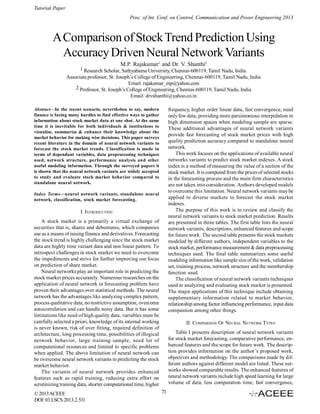
Table II lists stock market, input variables, performance
measurement and data preprocessing techniques used. The
stock markets modeled by different authors are listed. The
number of independent variables used in each work differs.
Some authors used 40 input variables .The most commonly
used inputs are stock market daily low price, high price,
maximum price and minimum price. Most authors predict the
stock market price and buy/sell behavior of the stock as
output. The performance measures can be classified as
statistical & non-statistical measures. Statistical measures
include AMAPE, ARV, CC, FPE, MAD, MAPE, MSE, NMSE,
R2 and POCID. Non- statistical performance includes hit
rate(time-first),hit rate(space-first),rate of return, annualized
return, cumulative return, annualized volatility, information
ratio, maximum drawdown, liquidity cash, portfolio value,
number of computational steps and speed up ratio. In most
researches the input data consists large amount of historical
data. This reduces the effectiveness of the training. This

may be overcome by preprocessing the data such as data
normalization, scaling of data between ranges of 0 and 1,
reduction in dimensionality, principal component analysis,
EDA optimization and some statistical procedures.
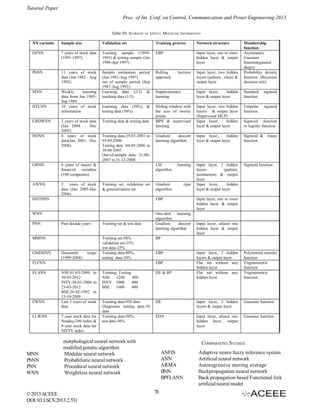
Table III lists sample size, validation set, training process,
network structure and its membership function. The proper
sample size enhances the accuracy of stock market prediction.
To predict established stock index large amount of data is
required due to changes of stock market in long run. Sample
size chosen by author is daily stock data with few cases of
missing data. It ranges from 2 years of stock data to 11 years
of stock data. Most authors divide the input series into
training set and validation set. But the percentage of the
sample size used for validating the result of the model varies
from 20 % to 50%. The training process used for variant
neural network types are EBP and Gradient descent learning
algorithms. Some authors proposed new training algorithm
like supplementary training process which has the features
of high speed learning with a large volume of data rate and
less calculation load. The average number of hidden layer
used in the network is one or two. Only FFNN uses 5 hidden
layers which measures the complexity of training algorithm.
The most common membership functions employed are
sigmoid function and Gaussian function.

Table I. COMPARISON OF NEURAL NETWORK VARIANTS
NN
variants
GFNN [9]

Descriptions
An intelligent decision support
system which measures all the
qualitative events in addition to
quantitative factors that may
influence the stock market were
developed. This novel method
consists of 3 parts namely factors
identification, qualitative model
and decision integration. The
fuzzy Delphi method was
employed to capture the stock
expert’s
knowledge
and
transformed to the acceptable
format of GFNN.

Comparative performance
analysis
The ANN which considers only
quantitative
factors
is
outperformed by the proposed
system in the learning accuracy,
buy-sell clarity and buy-sell
performance

Enhanced features

Future work

Capture the stock expert’s
knowledge, decrease the
training time and avoids
local minima

Real-number
coding
approach can be applied
in addition to binary
coding approach. It can
replace FFNN with EBP
learning algorithm

PbNN [3]

A set of trading strategies to
translate the forecasts into
monetary returns using PbNN
was developped. The significant
impact of the investment horizon
was also investigated. PNN was
built on the Bayesian classifier
which was capable of classifying
a sample with the maximum
probability of success

Comparison
is
based
on
performance statistics & trading
profits. PbNN has stronger
predictive power than both GMM
& RW

Training is rapid, reduces
extra effort on scrutinizing
training data, provides the
Bayesian probability of
the class affiliation to
make periodic decision on
asset allocation, inherently
parallel structure

Include a set of adaptive
thresholds
which
changes dynamically in
accordance with some
opportunity cost

MNN [16]

An attempt was made to model
and predict buying and selling
timing prediction system for
stocks and analysis of internal
representation.
MNN
was
characterized by a series of
independent NN moderated by
some intermediary.

The MNN produces a much
higher Correlation Coefficient
than MRA

High speed learning with
a large volume of data,
eliminate the need for
changing
parameters
depending on the amount
of learning data, reduce
the calculation load

Adaptation of network
model
that
has
regressive
connection
and
self-looping,
a
system in combination
with statistical method
must be developed

© 2013 ACEEE
DOI: 03.LSCS.2013.2.531

74
Tutorial Paper
Proc. of Int. Conf. on Control, Communication and Power Engineering 2013
HTLNN [5]

CBDWNN
[10]

HONN [2]

GRNN [13]

AWNN [8]

HSTDNN
[4]

WNN [1]

PNN [6]

The HTLNN which integrated the
supervised
MLP
with
unsupervised Kohonen network
for predicting the chaotic stock
series was presented. HTLNN
which contains short term
memory at the input processing
unit to provide the tap delay filter
to hybrid network
An integrated system CBDWNN
by combining dynamic time
windows, CBR & ANN for stock
trading prediction was developed.
This hybrid system consisted of
screening out the outstanding
stocks and use BPN to predict the
wave peak and wave trough of
stock price
A method of forecasting which
was capable of identifying and
dealing with discontinuities nonlinearties and high frequency
multi-polynomial
components
were proposed. HONN reduced
the need to establish the
relationship between inputs when
training
The future stock price companies
acting in Tehran stock exchange
used the most effective variables
related to the stock with the help
of GRNN was estimated.This
novel model could approximate
any arbitary function from
historical data.
one-period
continuously
compounded return series as
AWNN model for the day ahead
electricity market clearing price
forecast was presented. AWNN
introduced wavelets as activation
function of hidden neurons in
traditional FFNN with a linear
output neuron
A new approach which performs
testing process in the frequency
domain instead of the time
domain was proposed for fast
forecasting of stock prices. The
operation of HSTDNN relied on
performing cross correlation in
the frequency domain between
the input data and input weights
of the NN
Forecasting stock prices in
Nigeria stock market industry
using WNN was proposed.
Learning of WNN consisted of
changing the contents of the lookup table entries
A spatio temporal model for stock
price prediction was performed.
Both spatial and temporal
information
synchronously
without slide time window was
presented. Multidimensional time
series was also modeled. The two
models of PNN could handle
various
time-space
series
problems especially for large
scale of data

© 2013 ACEEE
DOI: 03.LSCS.2013.2.531

The HTLNN outperforms the
TLFN and HGUTLN in the
quality and accuracy of the
prediction

Combine the strengths of
both
supervised
and
unsupervised networks

HTLNN
is
being
investigated
for
integration with other AI
techniques
such
as
GA,FS

CBDWNN makes good trading
decision compared to CBR, BPN
even when the trend is downward

Combine the strengths of
dynamic windows, CBR
& ANN.

Time
window
CBDWNN
can
dynamically

GP model does well and
outperforms HONN, RNN, MLP,
ARMA, MACD and NAIVE
trading strategy

Fast learning network
with increased learning
capabilities,
shorter
computation
time.,
regarded as open box
rather than black box, able
to
simulate
higher
frequency, higher order
non-linear data
Internal structure is not
problem
dependent,
suitable for scattered data,
network model can be
taught immediately, solve
any
problems
in
monotonous function

Leverage factors can be
set
dynamically
in
reality. Leverage costs
also apply non trading
days

The proposed hybrid model
outperforms the literatures and
considering the extreme volatility
of spike signal, the price spike
forecast accuracy level of the
proposed system is good as
compared with literature

Universal
&
L2
approximation properties,
Consistent
function
estimator

Using
modern
SCADA/EMS systems
we can evaluate the
system
status
and
perform very short term
price forecasts which
improve the forecasting
of spikes

The
author
proved
mathematically and practically
that the number of computational
steps required for the HSTDNN is
less than TTDNN

Number of computation
step is less, less memory
capacity

The complexity of the
cross correlation in the
frequency domain can
be reduced

When compared with SES model,
the WNN forecasting tool proved
to be more accurate

Training takes only one
epoch , highly flexible,
fast learning algorithms

The other statistical
forecasting tools in
comparison with WNN
may be used

Time first & Space-first structures
of PNN performs higher hit rate
than BNN, HMM and SVM in
prediction of daily stock price

Combine the spatial and
temporal
information
together, simulate the
biological
neuron
physiologically
better,
decrease the time for
aggregating information
from
different
time
segments

The
generalization
ability of PNN for new
coming data may be
addressed in future

GRNN method is better than
linear regression method in
estimation & more descriptive

75

of
set

The number of input
variables
may
be
reduced
for
better
accuracy
Tutorial Paper
Proc. of Int. Conf. on Control, Communication and Power Engineering 2013
MMNN
[14]

TIMTAEF
method,
which
performs an evolutionary search
for the minimum dimension in
determining the characteristic
phase space that generates the
financial
time
series
was
presented. This novel model
searched for the particular time
lag capable of a fine tuned
charactererization of the time
series and estimates the initial
parameters of the MMNN.

The prediction of the proposed
model obtained a performance
much better in terms of evaluation
function than the TAEF &
MRLTAEF model

Overcome the random
walk dilemma for stock
market prediction

GMDHNN
[15]

A GMDH type Neural Network
and genetic algorithm was
developed for stock prediction of
cement sector in Tehran stock
exchange. A model could be
represented as a set of neurons in
which different pairs of them in
each layer were connected
through a quadratic polynomial
and therefore produce new
neurons in the next layer

GMDHNN
outperforms
traditional time series method and
regression based models in
prediction accuracy

Best optimal simplified
model for inaccurate,
noisy or small data sets,
simple structure than
traditional neural network
models, higher accuracy

FLFNN [7]

The proposed hybrid FLFNN
used non linear combination of
input variables to predict the
future stock close price. FLFNN
is a flat net without a hidden
layer. The hyperplanes generated
by the FLFNN produced greater
discrimination capability in the
input pattern

The proposed hybrid model
forecasts the stock close price
accurately with minimum error
rate than FLANN

Large
reduction
in
computation requirement,
learning algorithm is
simple, provides greater
discrimination capability
in the input pattern space,
fast convergence

Fuzzy sets can be filled
with suitable relations
that will be capable of
detecting
various
attributes
of
stock
market

FLANN
[11]

A simple FLANN network was
proposed whose randomly chosen
weights were optimized with BP
and DE algorithm respectively to
predict the stock price indices one
day, one week, two weeks and
one month in advance. It had the
capability to form complex
decision regions by creating non
linear decision boundaries
To increase prediction accuracy
and reduce search space and time
for achieving the optimal
solution, the combination of
WNN with fuzzy knowledge was
used. FWNN which integrated
wavelet functions with the TSK
fuzzy model. The proposed
network was constructed on the
base of a set of TSK fuzzy rules
that included a wavelet function
in the consequent part of each
rule
The seemingly chaotic behavior
of stock markets can be
represented using EDA based
LLWNN technique.Local linear
models should provide a more
parsimonious interpolation in
high-dimension spaces when
modeling samples are sparse.

The DE optimized FLANN a
proving it’s superiority compared
to BP optimized FLANN

Efficient global optimizer
in the continuous search
domain,
fast
convergence,
requires
only few parameters

The
performance
comparison
can
be
extended
with
DE
optimized PSO

Result, demonstrates that FWNN
with DE has better performance
than FWNN with BP, FFNN and
ANFIS

Combine the strengths of
wavelet theory, fuzzy
logic and neural networks,
fast training speed, ability
to analyze non-stationary
signals to discover their
local details, self learning
characteristic
that
increases the accuracy of
the prediction

The complexity of the
network
can
be
minimized

LLWNN outperform
prediction accuracy

Learning
efficiency,
structure
efficiency,
provides
more
parsimonious
interpolation
in
high
dimension spaces when
modeling samples are
sparse

It can be extended to
long term trends also

FWNN
[12]

LLWNN
[17]

focused on input data, data preprocessing methods, network
structure, membership function used, comparative studies,
performance measures and other useful modeling information.
The observation is that the neural network variants are

CONCLUSIONS
This study has surveyed articles of neural network
variants to predict stock market values. This study has
© 2013 ACEEE
DOI: 03.LSCS.2013.2.531

WNN in

Future
works
can
consider
the
development of further
studies, in terms of risk
and financial return, in
order to determine the
additional economical
benefits.
Also
investigate
the
performance
of
proposed method with
other financial time
series with components
seasonality,
impulses
steps
More price indices that
effect on stock price can
be used for accurate
stock price prediction,
proposed model can be
applied for the firms in
other sectors

76
Tutorial Paper
Proc. of Int. Conf. on Control, Communication and Power Engineering 2013
Table II. LIST
NN
variants
GFNN

Stock market

OF

SURVEYED STOCK MARKETS, I NPUT, OUTPUT & DATA PREPROCESSIN
Input variables

Performance measures

Data preprocessing

Taiwan
exchange

stock

Quantitative & Qualitative input
variables

MSE

Normalized to [0, 1]

PbNN

Taiwan
exchange

stock

FPE

Statistical testing procedure

MNN

Tokyo Stock exchange

CC

HTLNN

Kuala Lumpur stock
exchange

CBDWNN

Taiwan stock market

HONN

Greek stock market

TS,TB,DS3,DS6,DS12,GC3,GC6,G
C12,PC3,PC6,PC12,GNP3,GNP6,G
NP12,GDP3,GDP6,GDP12,CPI3,CP
I6,CPI12,IP3,IP6,IP12
Technical and economical indexes(
curve, turn over, interest rate, foreign
exchange rate, New-York DowJones average and historical share
prices)
Inter day stock data that is intraday
high, intraday low, close prices &
volume of the stock ticker
Highest stock price, lowest stock
price
Closing stock price

Teaching data are often irregular.
Such data is preprocessed by log
or error functions to make them
regular. It is then
normalized
into [0, 1] section.
All the data in the input series is
normalized to a value between 0
&1
Normalized to a value between
zero and one
Confirmation filters

GRNN

Tehran (Iran)
exchange
PJM market

AWNN

stock

HSTDNN

financial
variables
&
macroeconomic variables
Historic price data upto day (D-1) &
explanatory data upto day (D-1)
stock market price

Liquidity
value

cash,

Portfolio

RR
Annualized
Return,
Cumulative
Return,
Annualized Volatility,
Information
Ratio,
Maximum Drawdown
R2, MAPE, MSE, AMAPE
AMAPE, Variance, MSE

Nigeria
stock
exchange
Yahoo finance stock
market

Daily stock closing prices.

Hit-rate (Time-First), Hitratio (Space-First)

Stock market price

MSE, MAPE, NMSE or
THEIL, POCID, ARV,
Fitness Function

GMDHNN

Alliance
Financial
Corporation
,
BancFirst Corporation
,First
Citizens
Bancshares
Inc
,
Westamericaa Bancorp
Iranian stock market

EPS, PEPS, DPS, PE, E/P

R2, RMSE, MAD

FLFNN

SENSEX & NSE

RMSE, MAPE

FLANN

NSE, BSE and INFY

Non-linear combination of input
variables
The Indian stock prices with few
technical indicators like SMA, EMA
Stock price (low, high, open, close)

Opening price, closing price and
maximum price

CC, MAP, MAPE

Reduction in dimensionality

Number of Computation
Steps, Speed up ratio
MSE

Open price, highest price, lowest
price, closing price & stock volume.

Independent component analysis

WNN
PNN

MMNN

FWNN

LLWNN

NASDAQ
stock
market and
S& P
CNX NIFTY stock
index

suitable for stock market forecasting. Analysis demonstrates
that neural network variants outperform standalone neural
network and conventional models. They return better results
and higher prediction accuracy. However, difficulties arise
when defining the generalization structure of the network
like number of hidden layer, number of hidden neurons, etc.

AWNN
CBDWNN
FLANN

GMDHNN
GRNN
HONN
HSTDNN
HTLNN
LLWNN
MMNN

Adaptive wavelet neural network
Case based dynamic window neural
network
Functional link artificial neural network

© 2013 ACEEE
DOI: 03.LSCS.2013.2.531

RMSE

FWNN
GFNN

APPENDIX A NEURAL NETWORK VARIANTS

77

Data preprocessed to the range
[0,1]
All the inputs are normalized
within a range of [0, 1]
All the input and output data are
scaled in the interval [0, 1]

MAPE, RMSE

FLFNN

All time series were normalized to
lie within the range [0,1]

Input parameters are optimized by
EDA

Functional link fuzzy logic neural
network
Fuzzy wavelet neural network
Genetic algorithm based fuzzy neural
network
Group method of data handling
neural network
General regression neural network
Hybrid higher order neural network
High speed time delay neural network
Hybrid time lagged neural network
Local linear wavelet neural network
Hybrid model composed of modular
Tutorial Paper
Proc. of Int. Conf. on Control, Communication and Power Engineering 2013
Table III. SUMMARY OF USEFUL MODELING INFORMATION
NN variants

Sample size

Validation set

Training process

Network structure

GFNN

7 years of stock data
(1991-1997)

Training sample (19941995) & testing sample (Jan
1996-Apr 1997)

EBP

Input layer, one or more
hidden layer & output
layer

PbNN

11 years of stock
data (Jan 1982 - Aug
1992)

Rolling
approach

MNN

Weekly
learning
data from Jan 1985Sep 1989
10 years of stock
information

Sample estimation period
(Jan 1982-Aug 1987)
out of sample period (Sep
1987-Aug 1992)
Learning data (2/3) &
teaching data (1/3)
Learning data (50%)
testing data (50%)

HTLNN

CBDWNN

HONN

2 years of stock data
(Jan 2004 – Dec
2005)
8 years of stock
data(Jan 2001- Dec
2008)

GRNN

2 years of stock
data (Jan 2005-Dec
2006)

Training data:29-01-2001 to
03-05-2006
Testing data :04-05-2006 to
30-08-2007
Out-of-sample data: 31-082007 to 31-12-2008

6 years of macro &
financial variables
(100 companies)

AWNN

Training data & testing data

Training set, validation set
& generalization set

Supplementary
learning

Input layer,
hidden
layer & output layer

Standard
function

sigmoid

Sliding window with
the size of twenty
points
BPN & supervised
learning

Input layer, two hidden
layers & output layer
(Supervised MLP)
Input layer,
hidden
layer & output layer

Unipolar
function

sigmoid

Gradient
descent
learning algorithm

Input layer,
hidden
layer & output layer

Sigmoid &
function

LM
algorithm

&

Input layer, two hidden
layers (pattern , class) &
output layer

Membership
function
Asymmetric
Gaussian
function(general
shape)
Probability density
function (Bayesian
decision rule)

learning

Sigmoid function

Gradient
algorithm

type

Input layer, 2 hidden
layers
(pattern,
summation) & output
layer
Input layer,
hidden
layer & output layer

horizon

HSTDNN

EBP

WNN

One-shot
learning
algorithm
Gradient
descent
learning algorithm

PNN

Past decade years

Training set & test data

Decennial
(1999-2008)

Training set-50%
validation set-25%
test data-25%
Training data-80%,
testing data-20%

MMNN

GMDHNN

range

FLFNN
FLANN

FWNN

LLWNN

MNN
PbNN
PNN
WNN

7 year stock data for
Nasdaq-100 index &
4 year stock data for
NIFTY index

EBP

Input layer, one or more
hidden layer & output
layer

Input layer, atleast one
hidden layer & output
layer

Input layer, 2 hidden
layers & output layer
Flat net without any
hidden layer
Flat net without any
hidden layer

Polynomial transfer
function
Trigonometric
function
Trigonometric
function

Training Testing
NSE
1200
400
INFY 2000
400
BSE
1600
400

DE & BP

Training data-950 data
Diagnostic testing data-50
data
Training data-50%,
test data-50%

DE

Input layer, 5 hidden
layers & output layer

Gaussian function

EDA

Input layer, atleast one
hidden layer, output
layer

Gaussian function

morphological neural network with
modified genetic algorithm
Modular neural network
Probabilistic neural network
Procedural neural network
Weightless neural network

© 2013 ACEEE
DOI: 03.LSCS.2013.2.531

linear

BP

EBP
NSE:01-03-2000 to
30-03-2012
INFY:30-03-2000 to
23-03-2012
BSE:26-02-1992 to
15-10-2008
Last 3 years of stock
data

Sigmoid function
or logistic function

COMPARATIVE STUDIES
ANFIS
ANN
ARMA
BNN
BPFLANN
78

Adaptive neuro fuzzy inference system
Artificial neural network
Autoregressive moving average
Backpropogation neural network
Back propagation based Functional link
artificial neural model
Tutorial Paper
Proc. of Int. Conf. on Control, Communication and Power Engineering 2013
BPN
CBR
DEFLANN
DEFWNN
FLANN
FNN
GAFWNN
GMM
GPA
HGUTLN
HMM
MACD
MLP
MRA
MRLTAEF
RNN
SES
SVM
TAFE
TIMTAFE
TLFN
TTDNN
WaNN

Back propagation network
Case based reasoning
Differential evolution based Functional
link artificial neural model
Differential evolution using fuzzy
wavelet neural network
Functional link artificial neural model
Feed-forward neural network
Genetic algorithm using fuzzy wavelet
neural network
Generalized methods of moments with
kalman filter
Genetic programming algorithm
Highly granular unsupervised time
lagged network
Hidden markov model
Moving average convergence /
divergence model
Multi layer perceptron
Multiple regression analysis
Morphological-rank linear time-delay
added evolutionary forecasting
Hybrid, mixed recurrent network
Single exponential smoothing
Support vector machine
Time-delay added evolutionary
forecasting
Translation invariant morphological
time-lag added evolutionary forecasting
Time lagged feed-forward network
Traditional time delay neural network
Wavelet neural network

neural networks. The European Journal of Finance. (2012) 1-26
[3]An-Sing Chen, Mark T. Leung, Hazem Daouk.: Application of
Neural Networks to an Emerging Financial Market: Forecasting
and Trading the Taiwan Stock Index. Computers & Operations
Research. 30 (2003) 901-923
[4]Hazem M. El-Bakry, Nikos Mastorakis.: Fast Forecasting of
Stock Market Prices by using New High Speed Time Delay
Neural Network. International Journal of Computer and
Information Engineering. 4(2) (2010) 138-144
[5]Hui, S.C., Yap, M.T., Prakash, P.: A Hybrid Time Lagged Network
for Predicting Stock Prices. International Journal of the
Computer, the Internet and Management. 8(3) (2000) 26-40
[6]Jiuzhen Liang, Wei Song, Mei Wang.: Stock Price Prediction
Based on Procedural Neural Network. Hindawi Publishing
Corporation. Advances in Artificial Neural Systems. Article
ID : 814769 (2011) 1-11
[7]Kumaran Kumar, J., Kailas, A.: Prediction of Future Stock Price
using Proposed Hybrid ANN model of Functional Link Fuzzy
Logic Neural Model (FLFNM). International Journal of
Computer Applications in Engineering Sciences. 2(1) (2012)
38-42
[8]Lei Wu, Mohammad Shahidehpour.: A Hybrid Model for DayAhead Price Forecasting. IEEE Transactions on Power
Systems. 25(3) (2010) 1519-1530
[9]Kuo, R.J., Chen, C.H., Hwang, Y.C.: An Intelligent Stock Trading
Decision Support System Through Integration of Genetic
Algorithm Based Fuzzy Neural Network and Artificial Neural
Network. Fuzzy Sets and Systems. 118 (2001) 21-45
[10]Pei-Chann Chang, Chen-Hao Liu, Jun-Lin Lin, Chin-Yuan Fan,
Celeste S.P.Ng.: A Neural Network with a Case Based Dynamic
Window for Stock Trading Prediction. Expert Systems with
Applications. 36 (2009) 6889-6898
[11]Puspanjali Mohapatra, Alok Raj, Tapas Kumar Patra.: Indian
Stock Market Prediction Using Differential Evolutionary
Neural Network Model. International Journal of Electronics
Communication and Computer Technology. 2(4) (2012) 159166
[12]Rahib H. Abiyev, Vasif Hidayat Abiyev.: Differential Evaluation
Learning of Fuzzy Wavelet Neural Networks for Stock Price
Prediction. Journal of Information and Computing Science.
7(2) (2012) 121-130
[13]Reza Gharoie Ahangar, Mahmood Yahyazadehfar, Hassan
Pournaghshband.: The Comparison of Methods Artificial
Neural Network with Linear Regression Using Specific
Variables for Prediction Stock Price in Tehran Stock Exchange.
International Journal of Computer Science and Information
Security. 7(2) (2010)
[14]Ricardo de A. Araujo.: Translation Invariant Morphological
Time-Lag Added Evolutionary Forecasting Method for Stock
Market Prediction. Expert Systems with Applications. 38
(2011) 2835-2848
[15]Saeed Fallahi, Meysam Shaverdi, Vahab Bashiri.: Applying
GMDH-Type Neural Network and Genetic Algorithm for
Stock Price Prediction of Iranian Cement Factor. Applications
and Applied Mathematics: An International Journal. 6(2)
(2011) 572-591
[16]Takashi Kimoto, Kazuo Asakawa, Morio Yoda, Masakazu
Takeoka.: Stock Market Prediction System with Modular
Neural Networks. International Joint Conference on Neural
Networks. (1990) 1-6
[17]Yuehui Chen, Xiaohui Dong, Yaou Zhao.: Stock Index Modeling
using EDA based Local Linear Wavelet Neural Network. IEEE
(2005)

PERFORMANCE MEASUREMENT
AMAPE
ARV
CC
FPE
MAD
MAP
MAPE
MSE
NMSE
POCID
RMSE
R2
RR
TIC

Average mean absolute percentage
error
Average relative variance
Correlation coefficient
Final prediction error
Mean absolute deviation
Maximum absolute percentage error
Mean absolute percentage error
Mean squared error
Normalized mean squared error
Percentage of change in direction
Root mean squared error
Squared correlation
Rate of return
Theil inequality coefficient
REFERENCES

[1]Alhassan, J.K., Sanjay Misra.: Using a weightless neural network
to forecast stock prices: A case study of Nigerian stock
exchange. Scientific Research and Essays. 6(14) (2011) 29342940
[2]Andreas karathanasopoulos.: GP algorithm versus hybrid mixed

© 2013 ACEEE
DOI: 03.LSCS.2013.2.531

79

A Comparison of Stock Trend Prediction Using Accuracy Driven Neural Network Variants

  • 1.
    Tutorial Paper Proc. ofInt. Conf. on Control, Communication and Power Engineering 2013 A Comparison of Stock Trend Prediction Using Accuracy Driven Neural Network Variants M.P. Rajakumar1 and Dr. V. Shanthi2 1 Research Scholar, Sathyabama University, Chennai-600119, Tamil Nadu, India. Associate professor, St. Joseph’s College of Engineering, Chennai-600119, Tamil Nadu, India Email: rajakumar_mp@yahoo.com 2 Professor, St. Joseph’s College of Engineering, Chennai-600119, Tamil Nadu, India Email: drvshanthi@yahoo.co.in frequency, higher order linear data, fast convergence, need only few data, providing more parsimonious interpolation in high dimension spaces when modeling sample are sparse. These additional advantages of neural network variants provide fast forecasting of stock market prices with high quality prediction accuracy compared to standalone neural network. This work focuses on the applications of available neural networks variants to predict stock market indexes. A stock index is a method of measuring the value of a section of the stock market. It is computed from the prices of selected stocks in the forecasting process and the main firm characteristics are not taken into consideration. Authors developed models to overcome this limitation. Neural network variants may be applied to diverse markets to forecast the stock market indexes. The purpose of this work is to review and classify the neural network variants to stock market prediction. Results are presented in three tables. The first table lists the neural network variants, descriptions, enhanced features and scope for future work. The second table presents the stock markets modeled by different authors, independent variables to the stock market, performance measurement & data preprocessing techniques used. The final table summarizes some useful modeling information like sample size of the work, validation set, training process, network structure and the membership function used. The classification of neural network variants techniques used in analyzing and evaluating stock market is presented. The major applications of this technique include obtaining supplementary information related to market behavior, relationship among factor influencing performance, input data compassion among other things. Abstract—In the recent scenario, nevertheless to say, modern finance is facing many hurdles to find effective ways to gather information about stock market data at one shot. At the same time it is inevitable for both individuals & institutions to visualize, summarize & enhance their knowledge about the market behavior for making wise decisions. This paper surveys recent literature in the domain of neural network variants to forecast the stock market trends. Classification is made in terms of dependant variables, data preprocessing techniques used, network structure, performance analysis and other useful modeling information. Through the surveyed papers it is shown that the neural network variants are widely accepted to study and evaluate stock market behavior compared to standalone neural network. Index Terms—neural network variants, standalone neural network, classification, stock market forecasting. I. INTRODUCTION A stock market is a primarily a virtual exchange of securities that is, shares and debentures, which companies use as a means of raising finance and derivatives. Forecasting the stock trend is highly challenging since the stock market data are highly time variant data and non linear pattern. To introspect challenges in stock market we need to overcome the impediments and strive for further improving our focus on prediction of share market. Neural networks play an important role in predicting the stock market prices accurately. Numerous researches on the application of neural network in forecasting problem have proven their advantages over statistical methods. The neural network has the advantages like analyzing complex pattern, process qualitative data, no restrictive assumption, overcome autocorrelation and can handle noisy data. But it has some limitations like need of high quality data, variables must be carefully selected a priori, knowledge of its internal working is never known, risk of over fitting, required definition of architecture, long processing time, possibilities of illogical network behavior, large training sample, need lot of computational resources and limited to specific problems when applied. The above limitation of neural network can be overcome neural network variants in predicting the stock market behavior. The variants of neural network provides enhanced features such as rapid training, reducing extra effort on scrutinizing training data, shorter computational time, higher © 2013 ACEEE DOI: 03.LSCS.2013.2.531 II. COMPARISON OF NEURAL NETWORK TYPES Table I presents description of neural network variants for stock market forecasting, comparative performance, enhanced features and the scope for future work. The description provides information on the author’s proposed work, objectives and methodology. The comparisons made by different authors against different model are listed. These networks showed comparable results. The enhanced features of neural network variants include high speed learning for large volume of data, less computation time, fast convergence, 73
  • 2.
    Tutorial Paper Proc. ofInt. Conf. on Control, Communication and Power Engineering 2013 combining the strengths of different fields like fuzzy system, genetic algorithm, wavelet theory, spatial and temporal information and regarded as open box rather than black box. The possible extension to enhance the different types of neural networks for predicting the share price is presented in future work section. Table II lists stock market, input variables, performance measurement and data preprocessing techniques used. The stock markets modeled by different authors are listed. The number of independent variables used in each work differs. Some authors used 40 input variables .The most commonly used inputs are stock market daily low price, high price, maximum price and minimum price. Most authors predict the stock market price and buy/sell behavior of the stock as output. The performance measures can be classified as statistical & non-statistical measures. Statistical measures include AMAPE, ARV, CC, FPE, MAD, MAPE, MSE, NMSE, R2 and POCID. Non- statistical performance includes hit rate(time-first),hit rate(space-first),rate of return, annualized return, cumulative return, annualized volatility, information ratio, maximum drawdown, liquidity cash, portfolio value, number of computational steps and speed up ratio. In most researches the input data consists large amount of historical data. This reduces the effectiveness of the training. This may be overcome by preprocessing the data such as data normalization, scaling of data between ranges of 0 and 1, reduction in dimensionality, principal component analysis, EDA optimization and some statistical procedures. Table III lists sample size, validation set, training process, network structure and its membership function. The proper sample size enhances the accuracy of stock market prediction. To predict established stock index large amount of data is required due to changes of stock market in long run. Sample size chosen by author is daily stock data with few cases of missing data. It ranges from 2 years of stock data to 11 years of stock data. Most authors divide the input series into training set and validation set. But the percentage of the sample size used for validating the result of the model varies from 20 % to 50%. The training process used for variant neural network types are EBP and Gradient descent learning algorithms. Some authors proposed new training algorithm like supplementary training process which has the features of high speed learning with a large volume of data rate and less calculation load. The average number of hidden layer used in the network is one or two. Only FFNN uses 5 hidden layers which measures the complexity of training algorithm. The most common membership functions employed are sigmoid function and Gaussian function. Table I. COMPARISON OF NEURAL NETWORK VARIANTS NN variants GFNN [9] Descriptions An intelligent decision support system which measures all the qualitative events in addition to quantitative factors that may influence the stock market were developed. This novel method consists of 3 parts namely factors identification, qualitative model and decision integration. The fuzzy Delphi method was employed to capture the stock expert’s knowledge and transformed to the acceptable format of GFNN. Comparative performance analysis The ANN which considers only quantitative factors is outperformed by the proposed system in the learning accuracy, buy-sell clarity and buy-sell performance Enhanced features Future work Capture the stock expert’s knowledge, decrease the training time and avoids local minima Real-number coding approach can be applied in addition to binary coding approach. It can replace FFNN with EBP learning algorithm PbNN [3] A set of trading strategies to translate the forecasts into monetary returns using PbNN was developped. The significant impact of the investment horizon was also investigated. PNN was built on the Bayesian classifier which was capable of classifying a sample with the maximum probability of success Comparison is based on performance statistics & trading profits. PbNN has stronger predictive power than both GMM & RW Training is rapid, reduces extra effort on scrutinizing training data, provides the Bayesian probability of the class affiliation to make periodic decision on asset allocation, inherently parallel structure Include a set of adaptive thresholds which changes dynamically in accordance with some opportunity cost MNN [16] An attempt was made to model and predict buying and selling timing prediction system for stocks and analysis of internal representation. MNN was characterized by a series of independent NN moderated by some intermediary. The MNN produces a much higher Correlation Coefficient than MRA High speed learning with a large volume of data, eliminate the need for changing parameters depending on the amount of learning data, reduce the calculation load Adaptation of network model that has regressive connection and self-looping, a system in combination with statistical method must be developed © 2013 ACEEE DOI: 03.LSCS.2013.2.531 74
  • 3.
    Tutorial Paper Proc. ofInt. Conf. on Control, Communication and Power Engineering 2013 HTLNN [5] CBDWNN [10] HONN [2] GRNN [13] AWNN [8] HSTDNN [4] WNN [1] PNN [6] The HTLNN which integrated the supervised MLP with unsupervised Kohonen network for predicting the chaotic stock series was presented. HTLNN which contains short term memory at the input processing unit to provide the tap delay filter to hybrid network An integrated system CBDWNN by combining dynamic time windows, CBR & ANN for stock trading prediction was developed. This hybrid system consisted of screening out the outstanding stocks and use BPN to predict the wave peak and wave trough of stock price A method of forecasting which was capable of identifying and dealing with discontinuities nonlinearties and high frequency multi-polynomial components were proposed. HONN reduced the need to establish the relationship between inputs when training The future stock price companies acting in Tehran stock exchange used the most effective variables related to the stock with the help of GRNN was estimated.This novel model could approximate any arbitary function from historical data. one-period continuously compounded return series as AWNN model for the day ahead electricity market clearing price forecast was presented. AWNN introduced wavelets as activation function of hidden neurons in traditional FFNN with a linear output neuron A new approach which performs testing process in the frequency domain instead of the time domain was proposed for fast forecasting of stock prices. The operation of HSTDNN relied on performing cross correlation in the frequency domain between the input data and input weights of the NN Forecasting stock prices in Nigeria stock market industry using WNN was proposed. Learning of WNN consisted of changing the contents of the lookup table entries A spatio temporal model for stock price prediction was performed. Both spatial and temporal information synchronously without slide time window was presented. Multidimensional time series was also modeled. The two models of PNN could handle various time-space series problems especially for large scale of data © 2013 ACEEE DOI: 03.LSCS.2013.2.531 The HTLNN outperforms the TLFN and HGUTLN in the quality and accuracy of the prediction Combine the strengths of both supervised and unsupervised networks HTLNN is being investigated for integration with other AI techniques such as GA,FS CBDWNN makes good trading decision compared to CBR, BPN even when the trend is downward Combine the strengths of dynamic windows, CBR & ANN. Time window CBDWNN can dynamically GP model does well and outperforms HONN, RNN, MLP, ARMA, MACD and NAIVE trading strategy Fast learning network with increased learning capabilities, shorter computation time., regarded as open box rather than black box, able to simulate higher frequency, higher order non-linear data Internal structure is not problem dependent, suitable for scattered data, network model can be taught immediately, solve any problems in monotonous function Leverage factors can be set dynamically in reality. Leverage costs also apply non trading days The proposed hybrid model outperforms the literatures and considering the extreme volatility of spike signal, the price spike forecast accuracy level of the proposed system is good as compared with literature Universal & L2 approximation properties, Consistent function estimator Using modern SCADA/EMS systems we can evaluate the system status and perform very short term price forecasts which improve the forecasting of spikes The author proved mathematically and practically that the number of computational steps required for the HSTDNN is less than TTDNN Number of computation step is less, less memory capacity The complexity of the cross correlation in the frequency domain can be reduced When compared with SES model, the WNN forecasting tool proved to be more accurate Training takes only one epoch , highly flexible, fast learning algorithms The other statistical forecasting tools in comparison with WNN may be used Time first & Space-first structures of PNN performs higher hit rate than BNN, HMM and SVM in prediction of daily stock price Combine the spatial and temporal information together, simulate the biological neuron physiologically better, decrease the time for aggregating information from different time segments The generalization ability of PNN for new coming data may be addressed in future GRNN method is better than linear regression method in estimation & more descriptive 75 of set The number of input variables may be reduced for better accuracy
  • 4.
    Tutorial Paper Proc. ofInt. Conf. on Control, Communication and Power Engineering 2013 MMNN [14] TIMTAEF method, which performs an evolutionary search for the minimum dimension in determining the characteristic phase space that generates the financial time series was presented. This novel model searched for the particular time lag capable of a fine tuned charactererization of the time series and estimates the initial parameters of the MMNN. The prediction of the proposed model obtained a performance much better in terms of evaluation function than the TAEF & MRLTAEF model Overcome the random walk dilemma for stock market prediction GMDHNN [15] A GMDH type Neural Network and genetic algorithm was developed for stock prediction of cement sector in Tehran stock exchange. A model could be represented as a set of neurons in which different pairs of them in each layer were connected through a quadratic polynomial and therefore produce new neurons in the next layer GMDHNN outperforms traditional time series method and regression based models in prediction accuracy Best optimal simplified model for inaccurate, noisy or small data sets, simple structure than traditional neural network models, higher accuracy FLFNN [7] The proposed hybrid FLFNN used non linear combination of input variables to predict the future stock close price. FLFNN is a flat net without a hidden layer. The hyperplanes generated by the FLFNN produced greater discrimination capability in the input pattern The proposed hybrid model forecasts the stock close price accurately with minimum error rate than FLANN Large reduction in computation requirement, learning algorithm is simple, provides greater discrimination capability in the input pattern space, fast convergence Fuzzy sets can be filled with suitable relations that will be capable of detecting various attributes of stock market FLANN [11] A simple FLANN network was proposed whose randomly chosen weights were optimized with BP and DE algorithm respectively to predict the stock price indices one day, one week, two weeks and one month in advance. It had the capability to form complex decision regions by creating non linear decision boundaries To increase prediction accuracy and reduce search space and time for achieving the optimal solution, the combination of WNN with fuzzy knowledge was used. FWNN which integrated wavelet functions with the TSK fuzzy model. The proposed network was constructed on the base of a set of TSK fuzzy rules that included a wavelet function in the consequent part of each rule The seemingly chaotic behavior of stock markets can be represented using EDA based LLWNN technique.Local linear models should provide a more parsimonious interpolation in high-dimension spaces when modeling samples are sparse. The DE optimized FLANN a proving it’s superiority compared to BP optimized FLANN Efficient global optimizer in the continuous search domain, fast convergence, requires only few parameters The performance comparison can be extended with DE optimized PSO Result, demonstrates that FWNN with DE has better performance than FWNN with BP, FFNN and ANFIS Combine the strengths of wavelet theory, fuzzy logic and neural networks, fast training speed, ability to analyze non-stationary signals to discover their local details, self learning characteristic that increases the accuracy of the prediction The complexity of the network can be minimized LLWNN outperform prediction accuracy Learning efficiency, structure efficiency, provides more parsimonious interpolation in high dimension spaces when modeling samples are sparse It can be extended to long term trends also FWNN [12] LLWNN [17] focused on input data, data preprocessing methods, network structure, membership function used, comparative studies, performance measures and other useful modeling information. The observation is that the neural network variants are CONCLUSIONS This study has surveyed articles of neural network variants to predict stock market values. This study has © 2013 ACEEE DOI: 03.LSCS.2013.2.531 WNN in Future works can consider the development of further studies, in terms of risk and financial return, in order to determine the additional economical benefits. Also investigate the performance of proposed method with other financial time series with components seasonality, impulses steps More price indices that effect on stock price can be used for accurate stock price prediction, proposed model can be applied for the firms in other sectors 76
  • 5.
    Tutorial Paper Proc. ofInt. Conf. on Control, Communication and Power Engineering 2013 Table II. LIST NN variants GFNN Stock market OF SURVEYED STOCK MARKETS, I NPUT, OUTPUT & DATA PREPROCESSIN Input variables Performance measures Data preprocessing Taiwan exchange stock Quantitative & Qualitative input variables MSE Normalized to [0, 1] PbNN Taiwan exchange stock FPE Statistical testing procedure MNN Tokyo Stock exchange CC HTLNN Kuala Lumpur stock exchange CBDWNN Taiwan stock market HONN Greek stock market TS,TB,DS3,DS6,DS12,GC3,GC6,G C12,PC3,PC6,PC12,GNP3,GNP6,G NP12,GDP3,GDP6,GDP12,CPI3,CP I6,CPI12,IP3,IP6,IP12 Technical and economical indexes( curve, turn over, interest rate, foreign exchange rate, New-York DowJones average and historical share prices) Inter day stock data that is intraday high, intraday low, close prices & volume of the stock ticker Highest stock price, lowest stock price Closing stock price Teaching data are often irregular. Such data is preprocessed by log or error functions to make them regular. It is then normalized into [0, 1] section. All the data in the input series is normalized to a value between 0 &1 Normalized to a value between zero and one Confirmation filters GRNN Tehran (Iran) exchange PJM market AWNN stock HSTDNN financial variables & macroeconomic variables Historic price data upto day (D-1) & explanatory data upto day (D-1) stock market price Liquidity value cash, Portfolio RR Annualized Return, Cumulative Return, Annualized Volatility, Information Ratio, Maximum Drawdown R2, MAPE, MSE, AMAPE AMAPE, Variance, MSE Nigeria stock exchange Yahoo finance stock market Daily stock closing prices. Hit-rate (Time-First), Hitratio (Space-First) Stock market price MSE, MAPE, NMSE or THEIL, POCID, ARV, Fitness Function GMDHNN Alliance Financial Corporation , BancFirst Corporation ,First Citizens Bancshares Inc , Westamericaa Bancorp Iranian stock market EPS, PEPS, DPS, PE, E/P R2, RMSE, MAD FLFNN SENSEX & NSE RMSE, MAPE FLANN NSE, BSE and INFY Non-linear combination of input variables The Indian stock prices with few technical indicators like SMA, EMA Stock price (low, high, open, close) Opening price, closing price and maximum price CC, MAP, MAPE Reduction in dimensionality Number of Computation Steps, Speed up ratio MSE Open price, highest price, lowest price, closing price & stock volume. Independent component analysis WNN PNN MMNN FWNN LLWNN NASDAQ stock market and S& P CNX NIFTY stock index suitable for stock market forecasting. Analysis demonstrates that neural network variants outperform standalone neural network and conventional models. They return better results and higher prediction accuracy. However, difficulties arise when defining the generalization structure of the network like number of hidden layer, number of hidden neurons, etc. AWNN CBDWNN FLANN GMDHNN GRNN HONN HSTDNN HTLNN LLWNN MMNN Adaptive wavelet neural network Case based dynamic window neural network Functional link artificial neural network © 2013 ACEEE DOI: 03.LSCS.2013.2.531 RMSE FWNN GFNN APPENDIX A NEURAL NETWORK VARIANTS 77 Data preprocessed to the range [0,1] All the inputs are normalized within a range of [0, 1] All the input and output data are scaled in the interval [0, 1] MAPE, RMSE FLFNN All time series were normalized to lie within the range [0,1] Input parameters are optimized by EDA Functional link fuzzy logic neural network Fuzzy wavelet neural network Genetic algorithm based fuzzy neural network Group method of data handling neural network General regression neural network Hybrid higher order neural network High speed time delay neural network Hybrid time lagged neural network Local linear wavelet neural network Hybrid model composed of modular
  • 6.
    Tutorial Paper Proc. ofInt. Conf. on Control, Communication and Power Engineering 2013 Table III. SUMMARY OF USEFUL MODELING INFORMATION NN variants Sample size Validation set Training process Network structure GFNN 7 years of stock data (1991-1997) Training sample (19941995) & testing sample (Jan 1996-Apr 1997) EBP Input layer, one or more hidden layer & output layer PbNN 11 years of stock data (Jan 1982 - Aug 1992) Rolling approach MNN Weekly learning data from Jan 1985Sep 1989 10 years of stock information Sample estimation period (Jan 1982-Aug 1987) out of sample period (Sep 1987-Aug 1992) Learning data (2/3) & teaching data (1/3) Learning data (50%) testing data (50%) HTLNN CBDWNN HONN 2 years of stock data (Jan 2004 – Dec 2005) 8 years of stock data(Jan 2001- Dec 2008) GRNN 2 years of stock data (Jan 2005-Dec 2006) Training data:29-01-2001 to 03-05-2006 Testing data :04-05-2006 to 30-08-2007 Out-of-sample data: 31-082007 to 31-12-2008 6 years of macro & financial variables (100 companies) AWNN Training data & testing data Training set, validation set & generalization set Supplementary learning Input layer, hidden layer & output layer Standard function sigmoid Sliding window with the size of twenty points BPN & supervised learning Input layer, two hidden layers & output layer (Supervised MLP) Input layer, hidden layer & output layer Unipolar function sigmoid Gradient descent learning algorithm Input layer, hidden layer & output layer Sigmoid & function LM algorithm & Input layer, two hidden layers (pattern , class) & output layer Membership function Asymmetric Gaussian function(general shape) Probability density function (Bayesian decision rule) learning Sigmoid function Gradient algorithm type Input layer, 2 hidden layers (pattern, summation) & output layer Input layer, hidden layer & output layer horizon HSTDNN EBP WNN One-shot learning algorithm Gradient descent learning algorithm PNN Past decade years Training set & test data Decennial (1999-2008) Training set-50% validation set-25% test data-25% Training data-80%, testing data-20% MMNN GMDHNN range FLFNN FLANN FWNN LLWNN MNN PbNN PNN WNN 7 year stock data for Nasdaq-100 index & 4 year stock data for NIFTY index EBP Input layer, one or more hidden layer & output layer Input layer, atleast one hidden layer & output layer Input layer, 2 hidden layers & output layer Flat net without any hidden layer Flat net without any hidden layer Polynomial transfer function Trigonometric function Trigonometric function Training Testing NSE 1200 400 INFY 2000 400 BSE 1600 400 DE & BP Training data-950 data Diagnostic testing data-50 data Training data-50%, test data-50% DE Input layer, 5 hidden layers & output layer Gaussian function EDA Input layer, atleast one hidden layer, output layer Gaussian function morphological neural network with modified genetic algorithm Modular neural network Probabilistic neural network Procedural neural network Weightless neural network © 2013 ACEEE DOI: 03.LSCS.2013.2.531 linear BP EBP NSE:01-03-2000 to 30-03-2012 INFY:30-03-2000 to 23-03-2012 BSE:26-02-1992 to 15-10-2008 Last 3 years of stock data Sigmoid function or logistic function COMPARATIVE STUDIES ANFIS ANN ARMA BNN BPFLANN 78 Adaptive neuro fuzzy inference system Artificial neural network Autoregressive moving average Backpropogation neural network Back propagation based Functional link artificial neural model
  • 7.
    Tutorial Paper Proc. ofInt. Conf. on Control, Communication and Power Engineering 2013 BPN CBR DEFLANN DEFWNN FLANN FNN GAFWNN GMM GPA HGUTLN HMM MACD MLP MRA MRLTAEF RNN SES SVM TAFE TIMTAFE TLFN TTDNN WaNN Back propagation network Case based reasoning Differential evolution based Functional link artificial neural model Differential evolution using fuzzy wavelet neural network Functional link artificial neural model Feed-forward neural network Genetic algorithm using fuzzy wavelet neural network Generalized methods of moments with kalman filter Genetic programming algorithm Highly granular unsupervised time lagged network Hidden markov model Moving average convergence / divergence model Multi layer perceptron Multiple regression analysis Morphological-rank linear time-delay added evolutionary forecasting Hybrid, mixed recurrent network Single exponential smoothing Support vector machine Time-delay added evolutionary forecasting Translation invariant morphological time-lag added evolutionary forecasting Time lagged feed-forward network Traditional time delay neural network Wavelet neural network neural networks. The European Journal of Finance. (2012) 1-26 [3]An-Sing Chen, Mark T. Leung, Hazem Daouk.: Application of Neural Networks to an Emerging Financial Market: Forecasting and Trading the Taiwan Stock Index. Computers & Operations Research. 30 (2003) 901-923 [4]Hazem M. El-Bakry, Nikos Mastorakis.: Fast Forecasting of Stock Market Prices by using New High Speed Time Delay Neural Network. International Journal of Computer and Information Engineering. 4(2) (2010) 138-144 [5]Hui, S.C., Yap, M.T., Prakash, P.: A Hybrid Time Lagged Network for Predicting Stock Prices. International Journal of the Computer, the Internet and Management. 8(3) (2000) 26-40 [6]Jiuzhen Liang, Wei Song, Mei Wang.: Stock Price Prediction Based on Procedural Neural Network. Hindawi Publishing Corporation. Advances in Artificial Neural Systems. Article ID : 814769 (2011) 1-11 [7]Kumaran Kumar, J., Kailas, A.: Prediction of Future Stock Price using Proposed Hybrid ANN model of Functional Link Fuzzy Logic Neural Model (FLFNM). International Journal of Computer Applications in Engineering Sciences. 2(1) (2012) 38-42 [8]Lei Wu, Mohammad Shahidehpour.: A Hybrid Model for DayAhead Price Forecasting. IEEE Transactions on Power Systems. 25(3) (2010) 1519-1530 [9]Kuo, R.J., Chen, C.H., Hwang, Y.C.: An Intelligent Stock Trading Decision Support System Through Integration of Genetic Algorithm Based Fuzzy Neural Network and Artificial Neural Network. Fuzzy Sets and Systems. 118 (2001) 21-45 [10]Pei-Chann Chang, Chen-Hao Liu, Jun-Lin Lin, Chin-Yuan Fan, Celeste S.P.Ng.: A Neural Network with a Case Based Dynamic Window for Stock Trading Prediction. Expert Systems with Applications. 36 (2009) 6889-6898 [11]Puspanjali Mohapatra, Alok Raj, Tapas Kumar Patra.: Indian Stock Market Prediction Using Differential Evolutionary Neural Network Model. International Journal of Electronics Communication and Computer Technology. 2(4) (2012) 159166 [12]Rahib H. Abiyev, Vasif Hidayat Abiyev.: Differential Evaluation Learning of Fuzzy Wavelet Neural Networks for Stock Price Prediction. Journal of Information and Computing Science. 7(2) (2012) 121-130 [13]Reza Gharoie Ahangar, Mahmood Yahyazadehfar, Hassan Pournaghshband.: The Comparison of Methods Artificial Neural Network with Linear Regression Using Specific Variables for Prediction Stock Price in Tehran Stock Exchange. International Journal of Computer Science and Information Security. 7(2) (2010) [14]Ricardo de A. Araujo.: Translation Invariant Morphological Time-Lag Added Evolutionary Forecasting Method for Stock Market Prediction. Expert Systems with Applications. 38 (2011) 2835-2848 [15]Saeed Fallahi, Meysam Shaverdi, Vahab Bashiri.: Applying GMDH-Type Neural Network and Genetic Algorithm for Stock Price Prediction of Iranian Cement Factor. Applications and Applied Mathematics: An International Journal. 6(2) (2011) 572-591 [16]Takashi Kimoto, Kazuo Asakawa, Morio Yoda, Masakazu Takeoka.: Stock Market Prediction System with Modular Neural Networks. International Joint Conference on Neural Networks. (1990) 1-6 [17]Yuehui Chen, Xiaohui Dong, Yaou Zhao.: Stock Index Modeling using EDA based Local Linear Wavelet Neural Network. IEEE (2005) PERFORMANCE MEASUREMENT AMAPE ARV CC FPE MAD MAP MAPE MSE NMSE POCID RMSE R2 RR TIC Average mean absolute percentage error Average relative variance Correlation coefficient Final prediction error Mean absolute deviation Maximum absolute percentage error Mean absolute percentage error Mean squared error Normalized mean squared error Percentage of change in direction Root mean squared error Squared correlation Rate of return Theil inequality coefficient REFERENCES [1]Alhassan, J.K., Sanjay Misra.: Using a weightless neural network to forecast stock prices: A case study of Nigerian stock exchange. Scientific Research and Essays. 6(14) (2011) 29342940 [2]Andreas karathanasopoulos.: GP algorithm versus hybrid mixed © 2013 ACEEE DOI: 03.LSCS.2013.2.531 79