International Research Journal of Engineering and Technology (IRJET) e-ISSN: 2395-0056
Volume: 09 Issue: 04 | Apr 2022 www.irjet.net p-ISSN: 2395-0072
© 2022, IRJET | Impact Factor value: 7.529 | ISO 9001:2008 Certified Journal | Page 2475
Stock Market Prediction Analysis
Riya Sudam Bote1, Shikha Virender Chandel2, Mital Krushna Donadkar3,Prof. Narendra Gawai4
1,2,3 Students, Dept of Computer Science and Technology, Usha Mittal Institute of Technology, Mumbai, India
4 Professor, Dept of Computer Science and Technology, Usha Mittal Institute of Technology, Mumbai, India
---------------------------------------------------------------------***---------------------------------------------------------------------
Abstract - Stock market has been playing a vital role in
financial market. Even a small commodity has some or the
other effects due to change in stock market. One needs
investors for the growth of the company who are attracted
by the stock price or market value of the company. So, the
precise prediction of a stock price can help one to gain
noteworthy benefits. Hence, this topic has been taken by
researchers and many models and studies have been made
through many years. In this paper, a new stock price
prediction framework is proposed utilizing various models
and making a hybrid model from the same; Long Short Term
Memory (LSTM) model, Support Vector Regression (SVR)
model, Linear Regression model along with Sentimental
Analysis. From the simulation results, it can be noted that
using this hybrid model with proper hyperparameter tuning,
our proposed scheme can forecast future stock trends with
high accuracy. The assessments are conducted by utilizing
online datasets for stock markets having open, high, low,
and closing prices.
Key Words: LSTM, SVR, Linear Regression, Sentimental
Analysis, Stock Market Prediction.
I. INTRODUCTION
Stock investments prove to be an alternate source of
income in today’s time. Some invests as a retirement
source while some as a primary source. Even companies
bond their workers by keeping their shares in their
vicinity in the name of the company. Even though stocks
are volatile in nature, visualizing share prices on different
parameters can help the keen investors to carefully decide
on which company they want to spend their earnings on.
Data visualization is one of the prominent fields in today’s
technology. The stock market analysis and forecasting has
been an important and emerging trend since
developments in the field of machine learning. The
financial institutions, brokerage firms, banking sectors and
other sections use such analysis methods in order to gain
knowledge about stock scores. The companies uses this to
protect their companies from the risk of drop of their
shares due to their investments. Even government bodies
whether it is developed countries or developing countries
use stock analysis for their growth as it effects the market
price of other things also. The necessary factor involved in
the monitoring has been providing security assurances to
the volatile firms. The basic objective of stock market
forecasting has been, in aiding to make the buy, sell or
hold decision. This application using the Streamlit, we can
create dynamic plots of the financial data of a specific
company by using the tabular data. On top of it, we can use
a machine learning algorithm to predict the upcoming
stock prices. This web application can be applied to any
company (whose stock code is known) of one’s choice.
II. PROPOSED SYSTEM
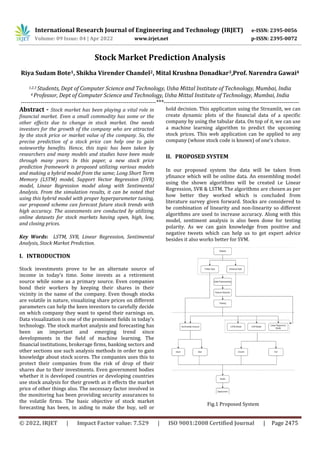
In our proposed system the data will be taken from
yfinance which will be online data. An ensembling model
using the shown algorithms will be created i.e Linear
Regression, SVR & LSTM. The algorithms are chosen as per
how better they worked which is concluded from
literature survey given forward. Stocks are considered to
be combination of linearity and non-linearity so different
algorithms are used to increase accuracy. Along with this
model, sentiment analysis is also been done for testing
polarity. As we can gain knowledge from positive and
negative tweets which can help us to get expert advice
besides it also works better for SVM.
Fig.1 Proposed System
International Research Journal of Engineering and Technology (IRJET) e-ISSN: 2395-0056
Volume: 09 Issue: 04 | Apr 2022 www.irjet.net p-ISSN: 2395-0072
© 2022, IRJET | Impact Factor value: 7.529 | ISO 9001:2008 Certified Journal | Page 2476
II. RELATED WORK
Sonawane Nikita, Sonawane Abhijit, Sharma Aayush,
Shinde Sagar, Prof A.S Bodhe[1] introduced an LSTM (long
short time memory) algorithm for training a stock
prediction model. The paper gave an outstanding result
inspite of the huge dataset. It recommended that stock
advertisement classifying its classification depends on a
particular company. The results obtained were better than
other algorithms. The result can be considered
uncommonly promising since it has illustrated able to
predict well compared to other approaches.
Rahul Mangalampalli, Pawankumar Khetre , Vaibhav
Malviya , Vivek Pandey[2] presented a different method
containing Hybrid model of ARIMA and GRU. In this paper
the author provided two approaches. The first approach
was build on the news content, while the second approach
was build on market data such as stock price at the time of
news release, close price and change in indicator values
were included in the classifier input. If we analyzed the
market around the publication of the news it may lead to
more precise labels.
Azadeh Nikfarjam, Ehsan Emadzadeh, Saravanan
Muthaiyah[3]presented different methods to show the
impact of financial news and tweets on prediction of stock
market. They offered two approaches in which the first
approach was based on news content, And the second
approach was based on market data with parameters
opening of stock price, closing of stock price and change
indicator values were included in the classifier. The stock
prices were recorded in a time interval around the
broadcasting of the news.
Eunsuk Chonga, Chulwoo Hanb, and Frank C. Park[4]
offered a structured analysis of the usage of deep learning
networks for analyzing and predicting the stock market.
The main characteristics such as extracting features from
a large data set without depending on any external factors
makes deep learning potentially attractive for prediction
of stock market, they used intraday stock returns of high
frequency as their input data, they also examined the
effects of unsupervised feature extraction methods which
were principal component analysis, autoencoder, and the
restricted Boltzmann ma- chine. Their study presented
practical insights on how deep learning networks can be
productively used for prediction and analysis of stock
market.
Venkata Sasank Pagolu, Kamal Nayan Reddy Challa
,Ganapati Panda[5] presented a paper where they have
employed two different textual representation that are
word2vec and Ngram for evaluating the sentiments of
public in tweets. They have used sentiment analysis and
supervised machine learning algorithms to the tweets
which were extracted from twitter and calculating the
connection between stock market, sentiments and
movement of a particular company. As we all know
positive tweets and news in social media of a respective
company will inspire people to invest in that company.
Atlast, the conclusion of the paper states that there is an
strong relation between the rise and fall of the stock price
and the public sentiment.
Ashwini Pathak, Sakshi Pathak[6] presented a paper which
focused on applying various machine learning algorithms
such as Support Vector Machine(SVM), KNN, Logistic
Regression and Random Forest algorithm on the dataset.
They calculated the performance metrics like recall rate,
precision, accuracy and fscore. Their main purpose was to
identify the best algorithm for stock market prediction.
G) Wu, M.C., Lin, S.Y., and Lin, C.H researched about stock
market prediction using decision tree algorithm. The main
approach was to modify the filter rule which was done
combining three decision variables which were linked
with fundamental analysis. The empirical test, which used
the stocks of an electronic company of Taiwan, showed
that the approach used outperformed the filter rule. In this
work they only considered the past information; the future
information was not taken into consideration at all. Their
research had aimed to upgrade the filter rule by
considering both future as well as past information.
IV. IMPLEMENTATION
Irjet Template sample paragraph .Define abbreviations and
acronyms the first time they are used in the text, even after
they have been defined in the abstract. Abbreviations such
as IEEE, SI, MKS, CGS, sc, dc, and rms do not have to be
defined. Do not use abbreviations in the title or heads
unless they are unavoidable.
As it is said that stock market prediction is a complex
problem since it has many factors. By using previous data
and relating it to the current data with help of proper ML
techniques one can easily predict the stock. For prediction
of stock the techniques we used are SVR, LSTM and Linear
Regression paired with sentimental analysis
The implementation of the project is divided into
following steps:
A. Data Pre-processing
The dataset which we used for training and testing the
model was picked up from yfinance(Yahoo Finance). It
contained around 9 lakh record of a particular company
stock. The variable which we considered for pre-processing
date, closing price and opening price.
International Research Journal of Engineering and Technology (IRJET) e-ISSN: 2395-0056
Volume: 09 Issue: 04 | Apr 2022 www.irjet.net p-ISSN: 2395-0072
© 2022, IRJET | Impact Factor value: 7.529 | ISO 9001:2008 Certified Journal | Page 2477
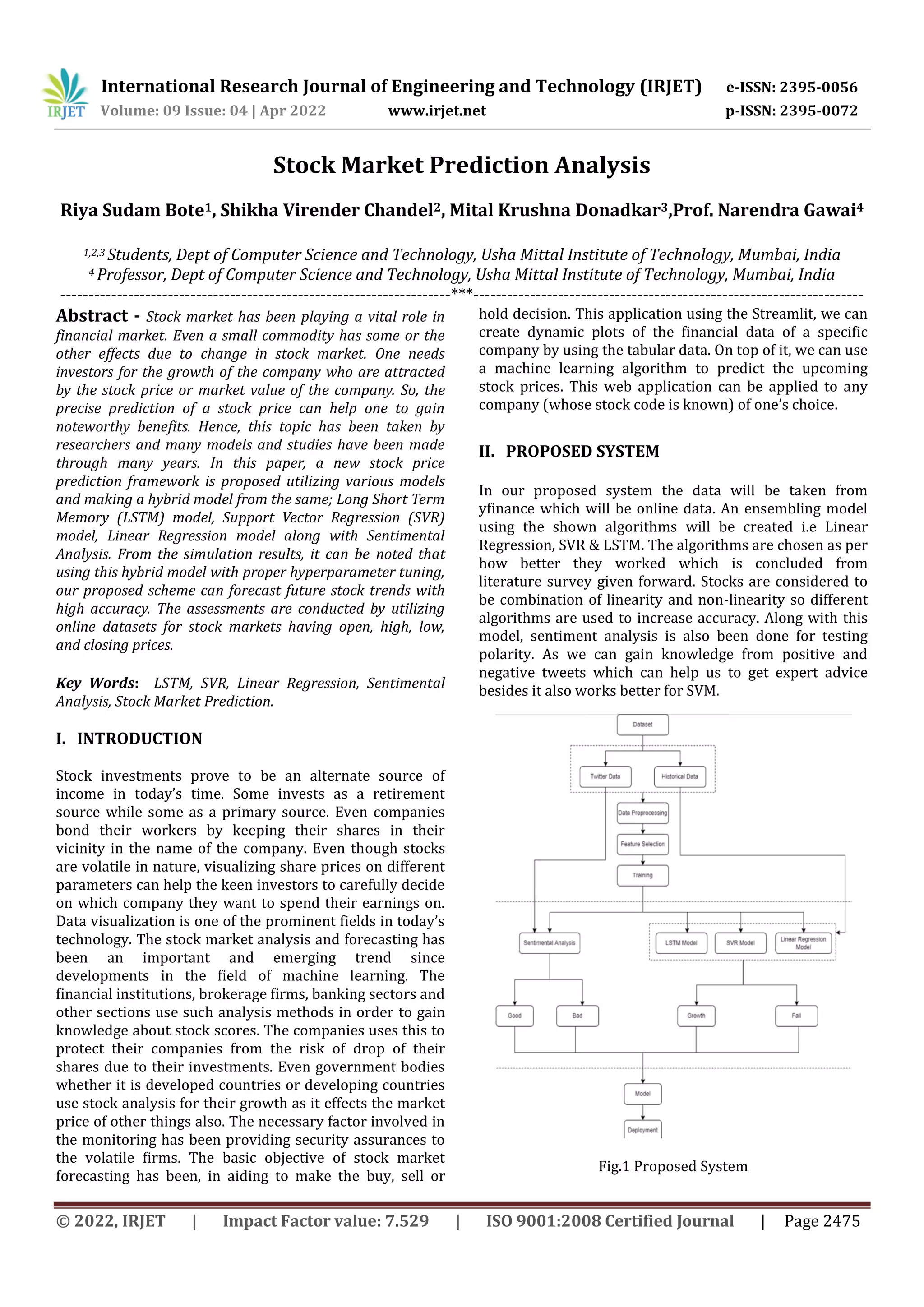
Fig.2 Company Description
The data of yfinance which was used was accessible in csv
format, which was then converted into a dataframe with
the help of pandas library. The data was sorted and the null
values were removed.
Fig.3 Data Preprocessing
Fig.4 Data Description
B. Building and Training Model
For prediction of stock we selected characteristics such as
RSI, Volume and the Closing price which will be used for
selection of features.
The dataset has been divided into two modules training
dataset and testing dataset. The model is trained with three
different techniques that are Linear Regression, Simple
Vector Regression and LSTM.
With the help of feature selection and combining the three
algorithms the trend in the stock of a particular company
will be predicted.
The accuracy we obtained by training the model are as
following:
Linear Regression:
Fig.5 Accuracy of Linear Regression
SVR:
Fig.6 Accuracy of SVR model
LSTM:
Fig.7 Accuracy of LSTM model
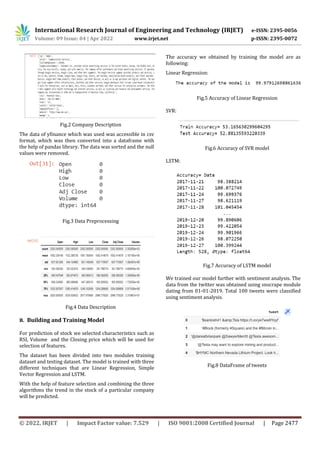
We trained our model further with sentiment analysis. The
data from the twitter was obtained using snscrape module
dating from 01-01-2019. Total 100 tweets were classified
using sentiment analysis.
Fig.8 DataFrame of tweets
International Research Journal of Engineering and Technology (IRJET) e-ISSN: 2395-0056
Volume: 09 Issue: 04 | Apr 2022 www.irjet.net p-ISSN: 2395-0072
© 2022, IRJET | Impact Factor value: 7.529 | ISO 9001:2008 Certified Journal | Page 2478
Fig.9 Probability of Sentiment Analysis
C. Prediction
For prediction of the future stock price model is trained
using hybrid algorithms. Predictions will be obtained by
comparing previous stock prices with current stock prices
of a particular company. The accuracy is obtained using
accuracy_score.
The prediction of stock trend i.e the stock value will be
displayed in our model as follows:-
Prediction by LSTM:
Fig.10 Prediction by LSTM
Prediction by SVR:
Fig.11 Prediction by SVR
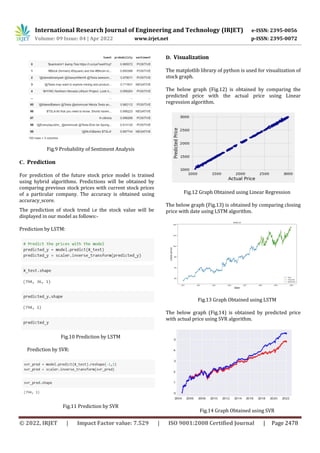
D. Visualization
The matplotlib library of python is used for visualization of
stock graph.
The below graph (Fig.12) is obtained by comparing the
predicted price with the actual price using Linear
regression algorithm.
Fig.12 Graph Obtained using Linear Regression
The below graph (Fig.13) is obtained by comparing closing
price with date using LSTM algorithm.
Fig.13 Graph Obtained using LSTM
The below graph (Fig.14) is obtained by predicted price
with actual price using SVR algorithm.
Fig.14 Graph Obtained using SVR
International Research Journal of Engineering and Technology (IRJET) e-ISSN: 2395-0056
Volume: 09 Issue: 04 | Apr 2022 www.irjet.net p-ISSN: 2395-0072
© 2022, IRJET | Impact Factor value: 7.529 | ISO 9001:2008 Certified Journal | Page 2479
The final output of our model is visualized as follows:
Prediction by LSTM in hybrid model:
Fig.15 Prediction in hybrid model LSTM
Prediction by SVR in hybrid model:
Fig.16 Prediction in hybrid model SVR
Prediction by hybrid model:-
Fig.17 Prediction by hybrid model
V. CONCLUSION
Through this research we can see that deep learning
algorithms have great impact on the technologies for
developing time series based prediction models. The
accuracy level obtained by these algorithms are highest
compared by any other different regression model for
stock prediction. This model can help keen investors to
obtain financial benefit while maintaining a viable
environment in stock market. We faced difficulty in
assembling sentiment analysis with our hybrid model and
converting it into an API. In future we plan to overcome
these difficulties by analyzing the data from different
market of different categories by using and combining
different algorithms.
REFERENCES
[1] Nikita, S., Abhijit, S. and Aayush, S., 2021. STOCK
MARKET PREDICTION USING LSTM. [online] Irjet.net.
Available at:
<https://www.irjet.net/archives/V6/i3/IRJET-
V6I3219.pdf> [Accessed 30 November 2021].
[2] Mangalampalli, R., Khetre, P. and Malviya, V., 2021.
STOCK PREDICTION USING HYBRID ARIMA AND GRU
MODELS. [online] Ijert.org. Available at:
<https://www.ijert.org/research/stock-prediction-using-
hybrid-arima-and-gru-models-IJERTV9IS050550.pdf>
[Accessed 30 November 2021].
[3] Nikfarjam, A., Emadzadeh, E. and Muthaiyah, S., 2021.
Text mining approaches for stock market prediction.
[online] https://www.academia.edu. Available at:
<https://www.academia.edu/10400600/Text_mining_app
roaches_for_stock_market_prediction> [Accessed 30
November 2021].
[4] Chonga, E., Hanb, C. and Park, F., 2021. Deep Learning
Networks for Stock Market Analysis and Prediction:
Methodology, Data Representations, and Case Studies.
[online] durham-research-online. Available at:
<https://vdocument.in/durham-research-online-
droduracukdroduracuk21533121533pdf-deep-
learning.html> [Accessed 30 November 2021].
[5] arxiv.org. 2021. Sentiment Analysis of Twitter Data for
predicting stock market moments. [online] Available at:
<https://arxiv.org/pdf/1610.09225.pdf> [Accessed 30
November 2021].
[6] www.ijert.org. 2021. Study of Machine learning
Algorithms for Stock Market Prediction. [online] Available
at: <https://www.ijert.org/study-of-machine-learning-
algorithms-for-stock-market-prediction> [Accessed 30
November 2021].
[7] Academia.edu. 2021. STOCK MARKET PREDICTION
LITERATURE REVIEW AND ANALYSIS. [online] Available
at: [Accessed 18 September 2021]

Stock Market Prediction Analysis

  • 1.
    International Research Journalof Engineering and Technology (IRJET) e-ISSN: 2395-0056 Volume: 09 Issue: 04 | Apr 2022 www.irjet.net p-ISSN: 2395-0072 © 2022, IRJET | Impact Factor value: 7.529 | ISO 9001:2008 Certified Journal | Page 2475 Stock Market Prediction Analysis Riya Sudam Bote1, Shikha Virender Chandel2, Mital Krushna Donadkar3,Prof. Narendra Gawai4 1,2,3 Students, Dept of Computer Science and Technology, Usha Mittal Institute of Technology, Mumbai, India 4 Professor, Dept of Computer Science and Technology, Usha Mittal Institute of Technology, Mumbai, India ---------------------------------------------------------------------***--------------------------------------------------------------------- Abstract - Stock market has been playing a vital role in financial market. Even a small commodity has some or the other effects due to change in stock market. One needs investors for the growth of the company who are attracted by the stock price or market value of the company. So, the precise prediction of a stock price can help one to gain noteworthy benefits. Hence, this topic has been taken by researchers and many models and studies have been made through many years. In this paper, a new stock price prediction framework is proposed utilizing various models and making a hybrid model from the same; Long Short Term Memory (LSTM) model, Support Vector Regression (SVR) model, Linear Regression model along with Sentimental Analysis. From the simulation results, it can be noted that using this hybrid model with proper hyperparameter tuning, our proposed scheme can forecast future stock trends with high accuracy. The assessments are conducted by utilizing online datasets for stock markets having open, high, low, and closing prices. Key Words: LSTM, SVR, Linear Regression, Sentimental Analysis, Stock Market Prediction. I. INTRODUCTION Stock investments prove to be an alternate source of income in today’s time. Some invests as a retirement source while some as a primary source. Even companies bond their workers by keeping their shares in their vicinity in the name of the company. Even though stocks are volatile in nature, visualizing share prices on different parameters can help the keen investors to carefully decide on which company they want to spend their earnings on. Data visualization is one of the prominent fields in today’s technology. The stock market analysis and forecasting has been an important and emerging trend since developments in the field of machine learning. The financial institutions, brokerage firms, banking sectors and other sections use such analysis methods in order to gain knowledge about stock scores. The companies uses this to protect their companies from the risk of drop of their shares due to their investments. Even government bodies whether it is developed countries or developing countries use stock analysis for their growth as it effects the market price of other things also. The necessary factor involved in the monitoring has been providing security assurances to the volatile firms. The basic objective of stock market forecasting has been, in aiding to make the buy, sell or hold decision. This application using the Streamlit, we can create dynamic plots of the financial data of a specific company by using the tabular data. On top of it, we can use a machine learning algorithm to predict the upcoming stock prices. This web application can be applied to any company (whose stock code is known) of one’s choice. II. PROPOSED SYSTEM In our proposed system the data will be taken from yfinance which will be online data. An ensembling model using the shown algorithms will be created i.e Linear Regression, SVR & LSTM. The algorithms are chosen as per how better they worked which is concluded from literature survey given forward. Stocks are considered to be combination of linearity and non-linearity so different algorithms are used to increase accuracy. Along with this model, sentiment analysis is also been done for testing polarity. As we can gain knowledge from positive and negative tweets which can help us to get expert advice besides it also works better for SVM. Fig.1 Proposed System
  • 2.
    International Research Journalof Engineering and Technology (IRJET) e-ISSN: 2395-0056 Volume: 09 Issue: 04 | Apr 2022 www.irjet.net p-ISSN: 2395-0072 © 2022, IRJET | Impact Factor value: 7.529 | ISO 9001:2008 Certified Journal | Page 2476 II. RELATED WORK Sonawane Nikita, Sonawane Abhijit, Sharma Aayush, Shinde Sagar, Prof A.S Bodhe[1] introduced an LSTM (long short time memory) algorithm for training a stock prediction model. The paper gave an outstanding result inspite of the huge dataset. It recommended that stock advertisement classifying its classification depends on a particular company. The results obtained were better than other algorithms. The result can be considered uncommonly promising since it has illustrated able to predict well compared to other approaches. Rahul Mangalampalli, Pawankumar Khetre , Vaibhav Malviya , Vivek Pandey[2] presented a different method containing Hybrid model of ARIMA and GRU. In this paper the author provided two approaches. The first approach was build on the news content, while the second approach was build on market data such as stock price at the time of news release, close price and change in indicator values were included in the classifier input. If we analyzed the market around the publication of the news it may lead to more precise labels. Azadeh Nikfarjam, Ehsan Emadzadeh, Saravanan Muthaiyah[3]presented different methods to show the impact of financial news and tweets on prediction of stock market. They offered two approaches in which the first approach was based on news content, And the second approach was based on market data with parameters opening of stock price, closing of stock price and change indicator values were included in the classifier. The stock prices were recorded in a time interval around the broadcasting of the news. Eunsuk Chonga, Chulwoo Hanb, and Frank C. Park[4] offered a structured analysis of the usage of deep learning networks for analyzing and predicting the stock market. The main characteristics such as extracting features from a large data set without depending on any external factors makes deep learning potentially attractive for prediction of stock market, they used intraday stock returns of high frequency as their input data, they also examined the effects of unsupervised feature extraction methods which were principal component analysis, autoencoder, and the restricted Boltzmann ma- chine. Their study presented practical insights on how deep learning networks can be productively used for prediction and analysis of stock market. Venkata Sasank Pagolu, Kamal Nayan Reddy Challa ,Ganapati Panda[5] presented a paper where they have employed two different textual representation that are word2vec and Ngram for evaluating the sentiments of public in tweets. They have used sentiment analysis and supervised machine learning algorithms to the tweets which were extracted from twitter and calculating the connection between stock market, sentiments and movement of a particular company. As we all know positive tweets and news in social media of a respective company will inspire people to invest in that company. Atlast, the conclusion of the paper states that there is an strong relation between the rise and fall of the stock price and the public sentiment. Ashwini Pathak, Sakshi Pathak[6] presented a paper which focused on applying various machine learning algorithms such as Support Vector Machine(SVM), KNN, Logistic Regression and Random Forest algorithm on the dataset. They calculated the performance metrics like recall rate, precision, accuracy and fscore. Their main purpose was to identify the best algorithm for stock market prediction. G) Wu, M.C., Lin, S.Y., and Lin, C.H researched about stock market prediction using decision tree algorithm. The main approach was to modify the filter rule which was done combining three decision variables which were linked with fundamental analysis. The empirical test, which used the stocks of an electronic company of Taiwan, showed that the approach used outperformed the filter rule. In this work they only considered the past information; the future information was not taken into consideration at all. Their research had aimed to upgrade the filter rule by considering both future as well as past information. IV. IMPLEMENTATION Irjet Template sample paragraph .Define abbreviations and acronyms the first time they are used in the text, even after they have been defined in the abstract. Abbreviations such as IEEE, SI, MKS, CGS, sc, dc, and rms do not have to be defined. Do not use abbreviations in the title or heads unless they are unavoidable. As it is said that stock market prediction is a complex problem since it has many factors. By using previous data and relating it to the current data with help of proper ML techniques one can easily predict the stock. For prediction of stock the techniques we used are SVR, LSTM and Linear Regression paired with sentimental analysis The implementation of the project is divided into following steps: A. Data Pre-processing The dataset which we used for training and testing the model was picked up from yfinance(Yahoo Finance). It contained around 9 lakh record of a particular company stock. The variable which we considered for pre-processing date, closing price and opening price.
  • 3.
    International Research Journalof Engineering and Technology (IRJET) e-ISSN: 2395-0056 Volume: 09 Issue: 04 | Apr 2022 www.irjet.net p-ISSN: 2395-0072 © 2022, IRJET | Impact Factor value: 7.529 | ISO 9001:2008 Certified Journal | Page 2477 Fig.2 Company Description The data of yfinance which was used was accessible in csv format, which was then converted into a dataframe with the help of pandas library. The data was sorted and the null values were removed. Fig.3 Data Preprocessing Fig.4 Data Description B. Building and Training Model For prediction of stock we selected characteristics such as RSI, Volume and the Closing price which will be used for selection of features. The dataset has been divided into two modules training dataset and testing dataset. The model is trained with three different techniques that are Linear Regression, Simple Vector Regression and LSTM. With the help of feature selection and combining the three algorithms the trend in the stock of a particular company will be predicted. The accuracy we obtained by training the model are as following: Linear Regression: Fig.5 Accuracy of Linear Regression SVR: Fig.6 Accuracy of SVR model LSTM: Fig.7 Accuracy of LSTM model We trained our model further with sentiment analysis. The data from the twitter was obtained using snscrape module dating from 01-01-2019. Total 100 tweets were classified using sentiment analysis. Fig.8 DataFrame of tweets
  • 4.
    International Research Journalof Engineering and Technology (IRJET) e-ISSN: 2395-0056 Volume: 09 Issue: 04 | Apr 2022 www.irjet.net p-ISSN: 2395-0072 © 2022, IRJET | Impact Factor value: 7.529 | ISO 9001:2008 Certified Journal | Page 2478 Fig.9 Probability of Sentiment Analysis C. Prediction For prediction of the future stock price model is trained using hybrid algorithms. Predictions will be obtained by comparing previous stock prices with current stock prices of a particular company. The accuracy is obtained using accuracy_score. The prediction of stock trend i.e the stock value will be displayed in our model as follows:- Prediction by LSTM: Fig.10 Prediction by LSTM Prediction by SVR: Fig.11 Prediction by SVR D. Visualization The matplotlib library of python is used for visualization of stock graph. The below graph (Fig.12) is obtained by comparing the predicted price with the actual price using Linear regression algorithm. Fig.12 Graph Obtained using Linear Regression The below graph (Fig.13) is obtained by comparing closing price with date using LSTM algorithm. Fig.13 Graph Obtained using LSTM The below graph (Fig.14) is obtained by predicted price with actual price using SVR algorithm. Fig.14 Graph Obtained using SVR
  • 5.
    International Research Journalof Engineering and Technology (IRJET) e-ISSN: 2395-0056 Volume: 09 Issue: 04 | Apr 2022 www.irjet.net p-ISSN: 2395-0072 © 2022, IRJET | Impact Factor value: 7.529 | ISO 9001:2008 Certified Journal | Page 2479 The final output of our model is visualized as follows: Prediction by LSTM in hybrid model: Fig.15 Prediction in hybrid model LSTM Prediction by SVR in hybrid model: Fig.16 Prediction in hybrid model SVR Prediction by hybrid model:- Fig.17 Prediction by hybrid model V. CONCLUSION Through this research we can see that deep learning algorithms have great impact on the technologies for developing time series based prediction models. The accuracy level obtained by these algorithms are highest compared by any other different regression model for stock prediction. This model can help keen investors to obtain financial benefit while maintaining a viable environment in stock market. We faced difficulty in assembling sentiment analysis with our hybrid model and converting it into an API. In future we plan to overcome these difficulties by analyzing the data from different market of different categories by using and combining different algorithms. REFERENCES [1] Nikita, S., Abhijit, S. and Aayush, S., 2021. STOCK MARKET PREDICTION USING LSTM. [online] Irjet.net. Available at: <https://www.irjet.net/archives/V6/i3/IRJET- V6I3219.pdf> [Accessed 30 November 2021]. [2] Mangalampalli, R., Khetre, P. and Malviya, V., 2021. STOCK PREDICTION USING HYBRID ARIMA AND GRU MODELS. [online] Ijert.org. Available at: <https://www.ijert.org/research/stock-prediction-using- hybrid-arima-and-gru-models-IJERTV9IS050550.pdf> [Accessed 30 November 2021]. [3] Nikfarjam, A., Emadzadeh, E. and Muthaiyah, S., 2021. Text mining approaches for stock market prediction. [online] https://www.academia.edu. Available at: <https://www.academia.edu/10400600/Text_mining_app roaches_for_stock_market_prediction> [Accessed 30 November 2021]. [4] Chonga, E., Hanb, C. and Park, F., 2021. Deep Learning Networks for Stock Market Analysis and Prediction: Methodology, Data Representations, and Case Studies. [online] durham-research-online. Available at: <https://vdocument.in/durham-research-online- droduracukdroduracuk21533121533pdf-deep- learning.html> [Accessed 30 November 2021]. [5] arxiv.org. 2021. Sentiment Analysis of Twitter Data for predicting stock market moments. [online] Available at: <https://arxiv.org/pdf/1610.09225.pdf> [Accessed 30 November 2021]. [6] www.ijert.org. 2021. Study of Machine learning Algorithms for Stock Market Prediction. [online] Available at: <https://www.ijert.org/study-of-machine-learning- algorithms-for-stock-market-prediction> [Accessed 30 November 2021]. [7] Academia.edu. 2021. STOCK MARKET PREDICTION LITERATURE REVIEW AND ANALYSIS. [online] Available at: [Accessed 18 September 2021]