International Research Journal of Engineering and Technology (IRJET) e-ISSN: 2395-0056
Volume: 06 Issue: 05 | May 2019 www.irjet.net p-ISSN: 2395-0072
© 2019, IRJET | Impact Factor value: 7.211 | ISO 9001:2008 Certified Journal | Page 5994
Prediction of Stock Market using Machine Learning Algorithms
Neha Bhardwaj1, MD Akil Ansari1
1School of Computer Science and Engineering, VIT University, Vellore, Tamil Nadu, India.
---------------------------------------------------------------------***---------------------------------------------------------------------
Abstract - In modern financial market, the most crucial problem is to find essential approach to outline and visualizing the
predictions in stock-markets to be made by individuals in order to attain maximum profit by investments. The stock market is a
transformative, non-straight dynamical and complex system. Long term investment is one of the major investment decisions.
Though, evaluating shares and calculating elementary values for companies for long term investment is difficult. In thispaperwe
are going to present comparison of machine learning aided algorithms to evaluate the stock prices in the future to analyze
market behaviour. Our method is able to correctly analyze supervised algorithms and compare which algorithm performs
the best to predict the future stock market prices in the market.
Keywords: Stock market, machine learning, Supervisedlearningalgorithms,Random forest,Logisticregression, K-NN,ARIMA.
1. INTRODUCTION
Exchanging the stocks on money markets is one of the significant speculation exercises.Already,scientistsdevelopeddifferent
stock examination system that could empower them to envision the bearings of stock esteem development. Predicting and
foreseeing of significant worth future cost, in perspective of the present cash relatedinformationand news,isofcolossal useto
the financial pros. Financial masters need to know whether some stock will gethigher orloweroverparticulartime-period. To
obtain the accurate output, the approach used is to implemented is machine learning along with supervised learning
algorithms. Results are tested using different types of supervised learning algorithms with a different set of a features.
The prologue to algorithms in exchanging unquestionably changed the share trading system. Calculations made it simple
to respond quick to specific occasions on the share trading system. Machine learning algorithms additionally empowered
examiners to make models at anticipating costs of stocks significantly simpler. Implementationof machine learning caused
that new models can be created in light of the past information. In this paper we will analyse the method for predicting stock
market direction using several machine learning algorithms.
The paper is composed in mentioned accompanying ways: In Section 2, we will be reviewing the literature survey of several
papers done in past few years for this topic . In Section 3, we will describe problem statement, methodology and algorithms
we are using for prediction . Section 4 describes the results of our methodology on datasets of five different company . In
the last section we will conclude the paper with its results.
2. LITERATURE SURVEY:
1) M.Suresh Babu et al., 2012, this paper investigates the significant clustering calculations: K-Means, Hierarchical
grouping calculation and turn around K-Means and look at the execution of these noteworthy clustering
calculations on part of effectivelyclasssavvygroupbuildingcapacityofcalculation.Theproposedstrategycomprisesof
three stages. To start with, they change over each money related report into an element vector and utilize the
various levelled agglomerative grouping strategy to isolate the changed over element vectors into bunches. They
consider both subjective and quantitative highlights in monetary reports.Second,theyjointheupsidesoftwogrouping
techniques to propose a compelling clustering strategy. Third, picking a fitting number of parts in HAC can limit
the bunches produced and in this way enhance the nature of the grouping created by the K-means clustering.
2) Mahajan Shubhrata D et al., 2016, this paper is to anticipate future stock value utilizing forecast idea. In that Parse
Records at that point figure anticipated esteem and send to client. Also, consequently perform activities like
buy and deal shares utilizing Automation idea. For that utilization Naïve Bayes Algorithm. There isRealtimeAccess
by Download log shapes hurray back site and Store in dataset. The investigations uncover a high capability of Naïve
Bayes Algorithm in foreseeing the arrival on interest in the offer market.
3) Xiao Ding et al., 2015, recommended that a deep learning technique for occasion driven securities exchange
expectation. Initially, occasions are removed from news message, and spoke to as thick vectors, prepared utilizinga
International Research Journal of Engineering and Technology (IRJET) e-ISSN: 2395-0056
Volume: 06 Issue: 05 | May 2019 www.irjet.net p-ISSN: 2395-0072
© 2019, IRJET | Impact Factor value: 7.211 | ISO 9001:2008 Certified Journal | Page 5995
novel neural tensor system. Second, a deep convolutional neural system is utilized to demonstrate both here and now
and long haul impacts of occasions on stock value developments. They exhibited that deep learning is helpful for
occasion driven stock value development forecast by proposing a novel neural tensor system for learning occasion
embeddings, and utilizing a deep convolutionalneuralsystemtodemonstratethejoinedimpactoflonghauloccasions
and here and now occasions on stock value developments.
4) Adebiyi Ayodele et al., 2012, proposed investigation work to enhance the exactness of every day stock value
forecast of securities exchange records utilizing artificial neural networks. The examination utilized three-layer,
multilayer perceptron models (a feedforward neural system demonstrate) prepared with backpropagation
calculation. This paper displays that hybridized approach can possibly upgrade the nature of basic leadership of
financial specialists in money markets by offering more precise stock forecast contrasted with existing specialized
investigation based approach.
5) Ayodele A. Adebiyi et al., 2012 , presents comprehensive |technique of building stock price predictive model using
the ARIMA model. Published stock data obtained from New You are able to Stock Exchange (NYSE) and Nigeria Stock
Exchange (NSE) {are being used} with stock price predictive model developed. Outcomes or Benefits obtained
revealed that the ARIMA model has a strong potential for immediate prediction and can remain competitive favorably
with existing {processes tactics for stock price prediction.
6) Peihao Li, Chaoqun Jing, et al., 2015 , through this paper they proposed a modelling process and present the
estimateSSE (Shanghai Stock Exchange)CompositeIndex to see the model's estimation performance, which testifies
to be feasible and effective. The forecast condition is essentially a direct condition that alludes to past
estimations of unique timeseries and past estimations ofthe blunders.Asshouldbeobviousinthelastexpectation,the
pattern can be accurately anticipated by the model implying that both themodelandfreefactorsareaccuratelychosen.
7) C.Narendra Babu and B.Eswara Reddy et al., 2014, proposed a direct half and half model utilizing ARIMA and GRACH
is created which protects the information pattern and renders great forecast exactness. Appropriately, the given
TSD is deteriorated into two distinctive arrangement utilizing a basic moving normal (MA) filter. One of them is
displayed utilizing ARIMA and the other is demonstrated utilizing GARCH relevantly.Theforecastsgotfromboththe
models are then melded to acquire the final demonstrateexpectations. Indian Stock market information is considered
keeping in mind the end goalto assess the exactness of the proposed display. The execution of this model iscontrasted
and conventional models, which uncovers that for multi-venture ahead expectation, theproposed display beats the
others as far as both forecast precision and safeguarding information drift.
8) Abdulsalam Sulaiman Olaniyi et al., 2011, proposed in this paper, the serial development of stock costs over some
stretch of time extricated from the everyday official rundown of Stock Exchange, are utilized as a part of building a
database and estimations of factors were separatedfromthedatabasetoanticipatethefutureestimationsofdifferent
factors using time arrangement information that utilized moving normal technique. They exhibited regression
investigation as an information mining strategy and created instrument for abusing particularly time
arrangement information in money related organization. An expectation framework has been constructed that
utilizations information mining method to create intermittently estimates about securities exchange costs and
ready to utilize regression investigation as an information mining system to portray the patterns of stock exchange
costs and foresee the future securities exchange costs.
9) Jatinder N.D. Gupta et al., 2000, gives a review to the tasks research reader of the fundamental neural network
methods, and in addition their verifiableand ebb and flow use in business. Neural networksand information mining
are not enchantment answers for issues, in spite of the message indicated by merchants of programming items.
They explored neural network strategiesinbusinessfromtheviewpointofthetasksresearcher.Thethree fundamental
neural network ways to deal with taking care of business issues have been presented: multi-layered feedforward
neural networks, Hopfield neural networks, and self-sorting out neural networks. Every one of these methods
discovers regular similaritywith more customary factualand tasks research strategies,and these analogies have been
talked about.
10) Dinesh Bhuria et al., 2017, surveyed about stock market prediction using regression techniques and proposed
productive regression way todeal with foresee the stock marketcost from stock market information based. In future
the consequences of multiple regression approach could be enhanced utilizing more number of factors. This
examination ponder is to helpthestockmerchantsandspeculatorsforputtingcashinthestockmarket.Theexpectation
International Research Journal of Engineering and Technology (IRJET) e-ISSN: 2395-0056
Volume: 06 Issue: 05 | May 2019 www.irjet.net p-ISSN: 2395-0072
© 2019, IRJET | Impact Factor value: 7.211 | ISO 9001:2008 Certified Journal | Page 5996
plays an imperative part in stock market business which is exceptionally confused and testing process due to dynamic
nature of the stock market.
11) Md Jan Nordin et al., 2012 , looks at the hypothesis and routine with regards to regression methods for
expectation of stock value slant by utilizing a changed informational collection in ordinal information
format. In this examination, all information in numerical esteems are changed into ordinal or counted qualities to
frame the dataset. Regression based classifiers from WEKA are then utilized as prescient examination to test the
ordinal information. The results were thought about and assessed.
12) Bhagyashree Nigade et al., 2017 , surveyed that the stock market does not have an effective programming
where the best possible proposals of accessible stocks and the correct speculation investigationaredisplayedinan
effective way. The paper clarifies the advancement and execution of a stock value prediction application utilizing
machine learning algorithm and protest situated approach of programming framework improvement. The
algorithm was utilized as a part of preparing an arrangement of market information gathered for the time of one
thousand, two hundred and three days. And a prediction framework has been manufactured that utilizations
information mining procedure to deliver intermittently gauges about stock market costs. The utilization of back
engendering in neural system empowers us to decrease blunders and enhance exactness of the framework.
13) Hemangi Karchalkar et al., 2017, explained a stock value prediction technique in this undertaking and for this
reason regression algorithm and question arranged approach of programming advancement is used. The winning
strategies demonstrate a pattern on futuredevelopment of stocks and not the conceivable cost forany stock lateron.
It is in this manner desirable over have an instrument that does point a bearing towards value development, as
well as demonstrates the doubtlessly cost of the stock itself
14) Luckyson Khaidem et al., 2016, proposed a novel method to limit the danger of interest in stock advertise by
foreseeing the profits of a stock utilizing a class of intense machine learning calculations known as ensemble
learning. They have utilized four administered learning calculations, i.e “Logistic Regression, Gaussian Discriminant
Analysis, Quadratic Discriminant Analysis, and SVM”.
15) T. Manojlović et al., 2015, utilized the ‘Random-forest’ calculation to construct the model used to anticipate 5-
days-ahead and 10-daysahead bearings of the CROBEX record andchose stocks. Their outcomes demonstrate that
random forests can be effectively used for building predictive models foranticipatingthecourseofsecuritiesexchange
patterns.
16) Mohammad Bolandraftar et al., 2014, attempted to create three models and looked at their exhibitions in
anticipating the heading of development in every day Tehran Stock Exchange (TSE) file. The models depend on
three order procedures, Decision Tree, Random Forest and Naïve Bayesian Classifier. What's more, reasoned that
principal investigation assumes less vital part than specialized examination during the time spent basic leadership of
brokers and partners.
17) Khalid Alkhatib et al., 2013, applied “K-nearest Neighbour” algorithm and indirect relapse approach so as to
anticipate stock costs for an example of six noteworthy organizations recorded on the Jordanian stock exchange
to help financial specialists, administration, chiefs, and clients in making right and educated ventures choices. As
indicated by the outcomes, the k-NN algorithm is vigorous with little mistake proportion; subsequently the outcomes
were sound and furthermore sensible.
18) San- hing Liul et al., 2010, build up a fundamental anticipating model in view of KNN and BP Neural Network. They
attempted it in anticipating the stock cost of China stock and test comes about demonstrate that the normal
blunders happening in KNN-ANN algorithm are littler than those in KNN algorithm, showing that the anticipating
model in light of KNN-ANN algorithm can do better in the stock forecast.
19) Tian Ye et al., 2017 , showed a stock estimating model in light of waveletexaminationand ARIMA-SVR.Thestockcostis
disintegrated into remade part and blunder part by wavelet deterioration and wavelet remaking. At that point, the
ARIMA show and the SVR display are utilized to gauge the recreated part and the blunder part separately,andthelast
forecast outcomes are joined to get the last expectation comes about. The day by day shutting cost of Shanghai
Pudong Development Bank from January 5, 2015 to January 29, 2016, was chosen as the trial information, with a
sum of 250, of which the initial 220 were the preparation set and the last 30 were the test set to do recreation try. The
International Research Journal of Engineering and Technology (IRJET) e-ISSN: 2395-0056
Volume: 06 Issue: 05 | May 2019 www.irjet.net p-ISSN: 2395-0072
© 2019, IRJET | Impact Factor value: 7.211 | ISO 9001:2008 Certified Journal | Page 5997
test comes about demonstrate that contrasted and the single determining model, theproposed display is a powerful
technique for anticipating stock value, which extraordinarily enhances the precision of estimating.
20) Robert P. Schumaker et al., 2008, discovered that two speculations have significantly affected statistical
surveying: Efficient Market Hypothesis (EMH) and Random Walk Theory. In EMH, the cost of a security is an
impression of finish showcase data. At whatever pointa change in money related viewpointhappens,themarketwill
in a flash alter the security cost to mirror the new data (Fama, 1964). EMH contained three unique levels of data
sharing: the powerless frame, the semi-solid and the solid shape. Insidepowerless EMH, justrecordedinformation
is implanted inside the present cost. The semi- solid frame goes more remote by joining chronicled and current open
data into its costs. The solid shape incorporates verifiable and current open data and additionally private data.
From these three structures, it was trusted that business sectors acted proficiently and that immediate value
amendments would forestall expectation models.
3. PROBLEM STATEMENT:
In order to predict the stock prices in future markets, we have analyzed papers and has given an overview on how these
algorithms give precise and accurate future predictions.In thispaper, weusedseveral algorithmsfromwhich weobservedthat
not all the algorithms implemented can predict data we need. There has been a basic requirement for computerized and
automized ways to deal with powerful and proficient usage of huge measure of money related information to help
organizations and people in vital arranging and decision making on investments.
4. METHODOLOGY:
We are using R statistical programming language to study and perform this experiment. -R is an extremely flexible
statistics programming language that is Open Source and unreservedly accessible for all standard working frameworks. R
has as of late encountered a "“explosive growth in use and in user contributed software". The "user-contributedsoftware"is
one of the most exceptional and gainful parts of R, as a huge number of clients have contributed code for actualizing probably
the most avant-garde measurable strategies, notwithstanding R executing basically all standard measurable
investigations. As a result of R's Open Source structure and a group of clients devoted to making R of the most noteworthy
quality, the PC code on which the techniques are based is straight forwardly scrutinized and improved.
By using R and implementing following Machine learning algorithms on the datasets we are predicting the stock price
movement:
LOGISTICS-REGRESSION
In statistical studies, “Logistic-regression”, is a regression exhibit where the dependent variable(DV) is straight out. Logistic-
regression uses the trademark logarithm ability to find the association between variables and utilizes test data to find the
coefficients. The limit would then have the capacity to suspect the future results using these coefficients in the logistic
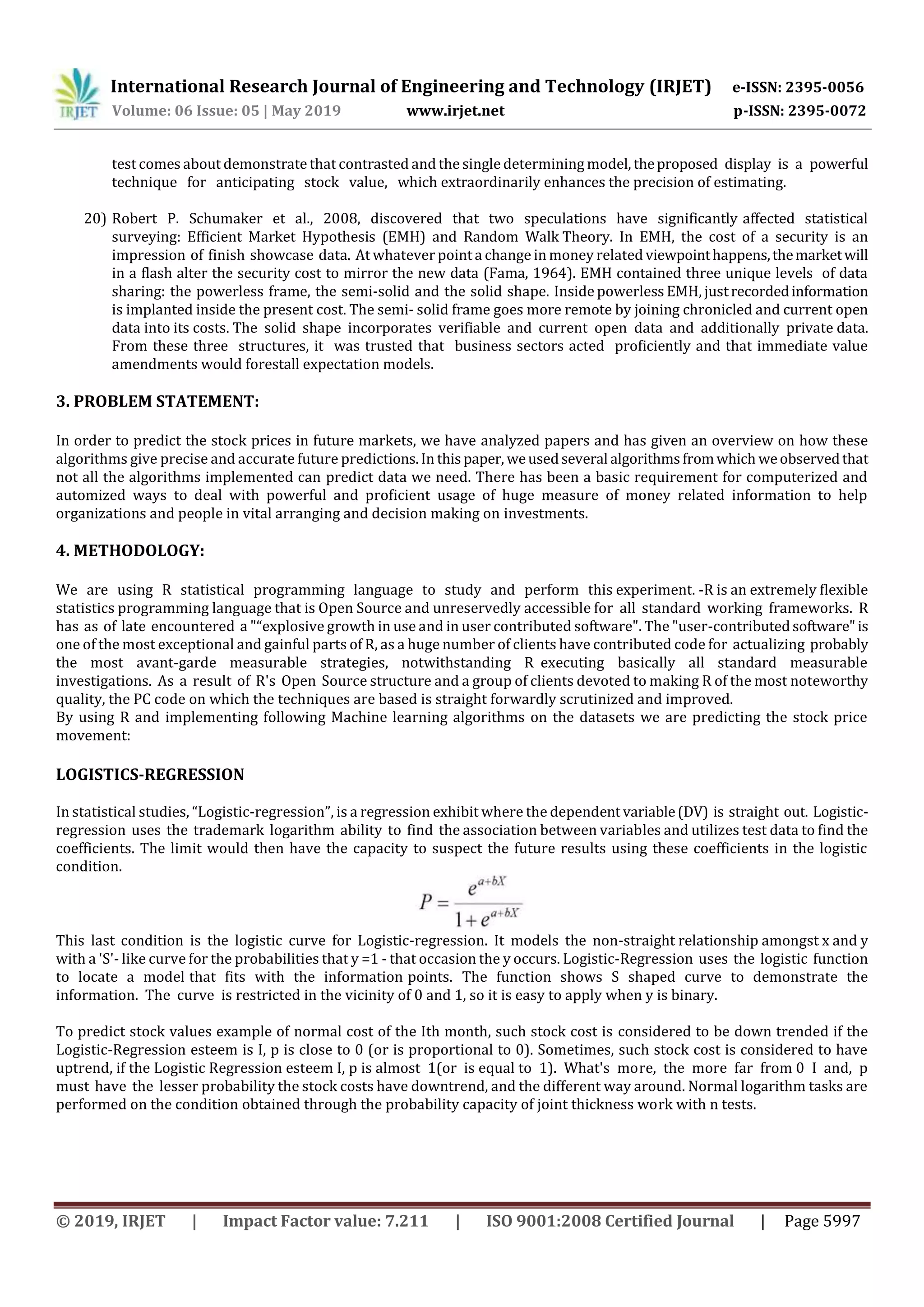
condition.
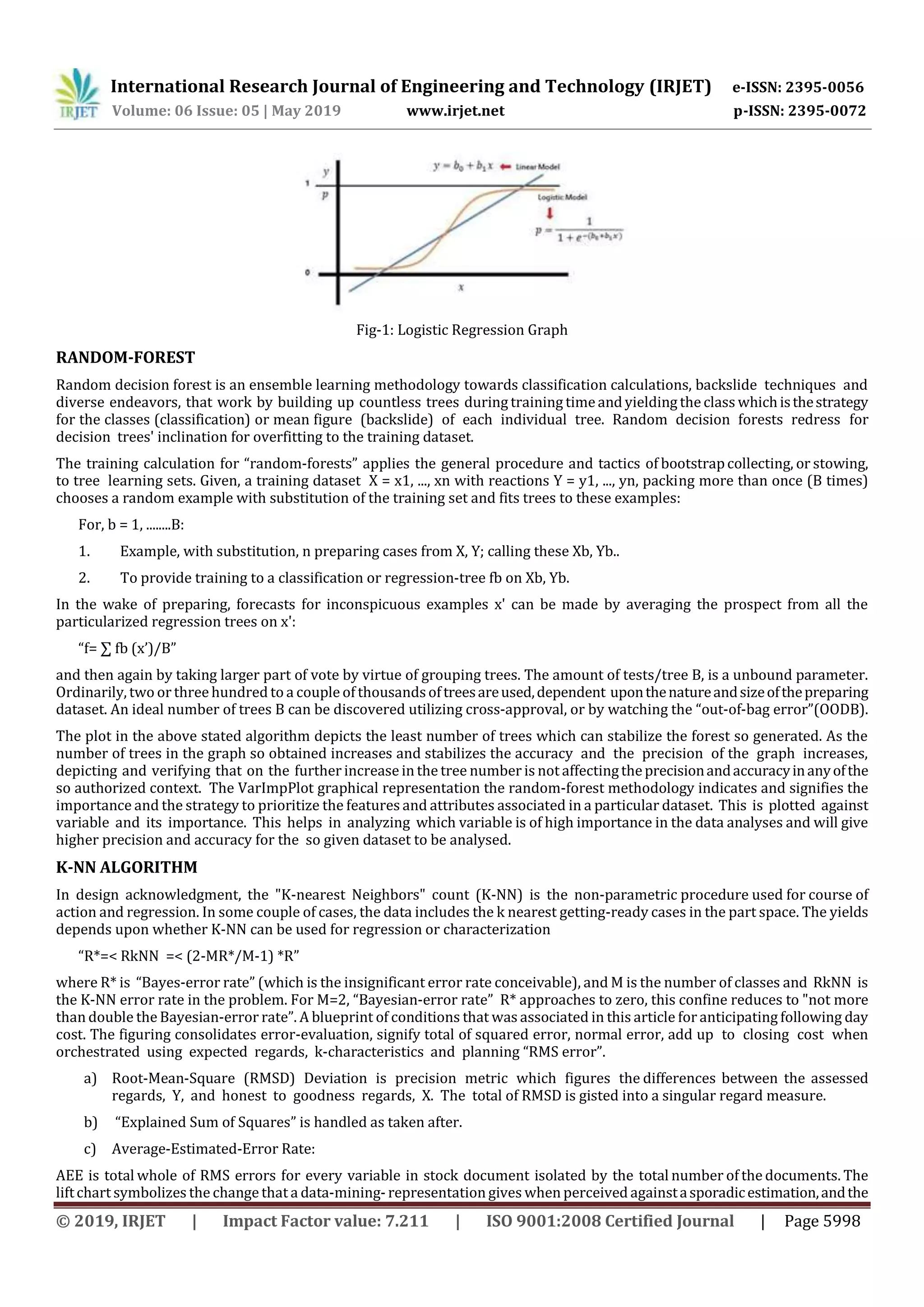
This last condition is the logistic curve for Logistic-regression. It models the non-straight relationship amongst x and y
with a 'S'- like curve for the probabilities that y =1 - that occasion the y occurs. Logistic-Regression uses the logistic function
to locate a model that fits with the information points. The function shows S shaped curve to demonstrate the
information. The curve is restricted in the vicinity of 0 and 1, so it is easy to apply when y is binary.
To predict stock values example of normal cost of the Ith month, such stock cost is considered to be down trended if the
Logistic-Regression esteem is I, p is close to 0 (or is proportional to 0). Sometimes, such stock cost is considered to have
uptrend, if the Logistic Regression esteem I, p is almost 1(or is equal to 1). What's more, the more far from 0 I and, p
must have the lesser probability the stock costs have downtrend, and the different way around. Normal logarithm tasks are
performed on the condition obtained through the probability capacity of joint thickness work with n tests.
International Research Journal of Engineering and Technology (IRJET) e-ISSN: 2395-0056
Volume: 06 Issue: 05 | May 2019 www.irjet.net p-ISSN: 2395-0072
© 2019, IRJET | Impact Factor value: 7.211 | ISO 9001:2008 Certified Journal | Page 5998
Fig-1: Logistic Regression Graph
RANDOM-FOREST
Random decision forest is an ensemble learning methodology towards classification calculations, backslide techniques and
diverse endeavors, that work by building up countless trees during training timeand yielding the class whichisthestrategy
for the classes (classification) or mean figure (backslide) of each individual tree. Random decision forests redress for
decision trees' inclination for overfitting to the training dataset.
The training calculation for “random-forests” applies the general procedure and tactics of bootstrapcollecting, or stowing,
to tree learning sets. Given, a training dataset X = x1, ..., xn with reactions Y = y1, ..., yn, packing more than once (B times)
chooses a random example with substitution of the training set and fits trees to these examples:
For, b = 1, ........B:
1. Example, with substitution, n preparing cases from X, Y; calling these Xb, Yb..
2. To provide training to a classification or regression-tree fb on Xb, Yb.
In the wake of preparing, forecasts for inconspicuous examples x' can be made by averaging the prospect from all the
particularized regression trees on x':
“f= ∑ fb (x’)/B”
and then again by taking larger part of vote by virtue of grouping trees. The amount of tests/tree B, is a unbound parameter.
Ordinarily, two or three hundred to a couple of thousandsoftreesareused,dependent uponthenatureandsizeofthepreparing
dataset. An ideal number of trees B can be discovered utilizing cross-approval, or by watching the “out-of-bag error”(OODB).
The plot in the above stated algorithm depicts the least number of trees which can stabilize the forest so generated. As the
number of trees in the graph so obtained increases and stabilizes the accuracy and the precision of the graph increases,
depicting and verifying that on the further increase in the tree number is not affectingtheprecisionandaccuracyinanyofthe
so authorized context. The VarImpPlot graphical representation the random-forest methodology indicates and signifies the
importance and the strategy to prioritize the features and attributes associated in a particular dataset. This is plotted against
variable and its importance. This helps in analyzing which variable is of high importance in the data analyses and will give
higher precision and accuracy for the so given dataset to be analysed.
K-NN ALGORITHM
In design acknowledgment, the "K-nearest Neighbors" count (K-NN) is the non-parametric procedure used for course of
action and regression. In some couple of cases, the data includes the k nearest getting-ready cases in the part space. The yields
depends upon whether K-NN can be used for regression or characterization
“R*=< RkNN =< (2-MR*/M-1) *R”
where R* is “Bayes-error rate” (which is the insignificant error rate conceivable), and M is the number of classes and RkNN is
the K-NN error rate in the problem. For M=2, “Bayesian-error rate” R* approaches to zero, this confine reduces to "not more
than double the Bayesian-error rate”. A blueprint of conditions that was associated in this article foranticipating following day
cost. The figuring consolidates error-evaluation, signify total of squared error, normal error, add up to closing cost when
orchestrated using expected regards, k-characteristics and planning “RMS error”.
a) Root-Mean-Square (RMSD) Deviation is precision metric which figures the differences between the assessed
regards, Y, and honest to goodness regards, X. The total of RMSD is gisted into a singular regard measure.
b) “Explained Sum of Squares” is handled as taken after.
c) Average-Estimated-Error Rate:
AEE is total whole of RMS errors for every variable in stock document isolated by the total number of the documents. The
liftchart symbolizes the change that a data-mining- representation gives when perceived againstasporadicestimation,andthe
International Research Journal of Engineering and Technology (IRJET) e-ISSN: 2395-0056
Volume: 06 Issue: 05 | May 2019 www.irjet.net p-ISSN: 2395-0072
© 2019, IRJET | Impact Factor value: 7.211 | ISO 9001:2008 Certified Journal | Page 5999
change is imparted with respect to lift-score. By separating the lifting-score, for a combination of part of educational file
and different models, it would then have the capacity to be picked which indicate is exceptional and which level of the cases
inside the enlightening list would get from using the desires show.
ARIMA
‘ARIMA’ is extracted as Autoregressive-Integrated-Moving-Average. ARIMA is additionally referred to as “Box-Jenkins
approach”. Box and Jenkins asserted that non-stationary information can be madeto stationary informationbydifferencingthe
arrangement, Yt. The model for Yt can be composed as,
“Yt =ϕ1Yt−1 +ϕ2Yt−2…ϕpYt−p +ϵt + θ1ϵt−1+ θ2ϵt−2 +…θqϵt−q”
The ARIMA methodology joins three fundamental methods: Auto-Regression(AR): Firstly, auto-relapse the estimations of a
given time arrangement information are relapsed alone slacked esteems, which is shown by the "p" esteem in the
representation. Differencing, (I is for Integration) - This includes differencing the time arrangement information to
dispose of the pattern and change over a non-stationary timearrangement to a standingone.Thisisspecifiedbythe"d"esteem
in the model. Moving-Average(MA): The moving average featureof the model is termed by the "q"whereq,isnumberoflagged-
principle of the error-rate.
5. DATA AGGREGATION:
We obtain the historical dataand extensible timeseriesdatafromtheYahoofinance.Thedatasetscollectedareoffivedifferent –
Apple Inc., Tata Consultancyservice,Infosys,VerizonandJohnsons&Johnsons.Thewholedataset coversdailyactivitysummary
from the period of February, 2015 to February, 2019. The dataset mainly consist of attributes- Date, Open, High, Low , Close,
Adj.close, Volume.
Pre-processing:
i) Creating a Class-label by the name Status which has binary set of values depending on the Opening and closing
price of the stock, if the value of Open price of the stock on a particular day is lesser than the Close then the value in the
class-label will be “1” that denotes the profit and if the value of the Open is greater than the Close then the value
of class-label will be “0” that denotes the Loss in the market on the following date.
“Status” =1, if change >0.5
0 , otherwise
ii) Data Preparation is done because the feature values in the dataset are categorical or factor, not numerical data so, this
creates problem. The machine learning algorithms used in this project, requires numerical data. Normalization of values is
also done for some algorithm to avoid biases from anomalies in dataset and adjustment of values to a common scale.
iii) Data Splitting is done as a total of 1048 pairs of observations are taken. Then dataset is separated into two segments.
The initial segment (545 sets of perceptions) is utilized to decide the specialization of the parameters and models. The
second section (503 sets of perceptions) is held for out-of-test assessment and examination of exhibitions among
different determining models.
iv) Features election is done for selecting the right attributes to be used to build the predicting model that has the
most significance on the class label. This step helped to select the best fit model that can predict the result more precisely.
v) Cross-validation is done after fitting the model to check the error rate in prediction
Table I: Table of Comparision
Sr. No. Algorithm Used Dataset Used
% of
Accuracy
Advantages Limitations
1. Random Forest
(Ensemble Learning)
Apple Inc (APPL) 50.7% Pretty Flexible and
easy to train.
Require more no of trees
to predict accurately that
makes model slow.
Johnsons &
Johnsons (J&J)
80.12%
TATA
Consultancy
service Ltd
53.48%
Verizon (VZ)
77.3%
International Research Journal of Engineering and Technology (IRJET) e-ISSN: 2395-0056
Volume: 06 Issue: 05 | May 2019 www.irjet.net p-ISSN: 2395-0072
© 2019, IRJET | Impact Factor value: 7.211 | ISO 9001:2008 Certified Journal | Page 6000
Infosys Ltd
(INFY)
76%
2.
Logistic Regression
(non-Ensemble
Learning)
Apple Inc (APPL)
76%
Provides very
accurate results.
Selecting right Features
to Fit.
TATA
Consultancy
service Ltd
66%
Johnsons &
Johnsons (J&J)
75%
Verizon (VZ)
71%
Infosys Ltd
(INFY)
72%
3.
ARIMA (Supervised
Algorithm)
Apple Inc (APPL)
52%
Visual plots are
effective
Provides less accurate
results
TATA
Consultancy
service Ltd
45%
Johnsons &
Johnsons (J&J)
54%
Verizon (VZ)
55%
Infosys Ltd
(INFY)
31%
4.
K-Nearest Neighbour Apple Inc (APPL)
74%
Very Simple and
Flexible.
Issue of normalization of
dataset and cant handles
categorical variable well.
TATA
Consultancy
service Ltd
64%
Johnsons &
Johnsons (J&J)
73%
Verizon (VZ)
53%
Infosys Ltd
(INFY)
52%
From the above table a few things turn out to be promptly recognizable. First is, that an assortment of systems have
been utilized, Secondly, on which datasets those algorithms are connected with their exactness and error rate. Advantages
and limitations of algorithms are also mentioned which are faced while performing the experiment. After analyzing theabove
table, Logistic Regression Algorithm performs the best with the predictionwithanaverageaccuracyof74%,second isRandom
Forest Algorithm with the average accuracy of 70%, after this K-NN algorithm performs good whichhasaverageaccuracyrate
of 64%, At last ARIMA model performs with 47% in forecasting the stock market directions.
International Research Journal of Engineering and Technology (IRJET) e-ISSN: 2395-0056
Volume: 06 Issue: 05 | May 2019 www.irjet.net p-ISSN: 2395-0072
© 2019, IRJET | Impact Factor value: 7.211 | ISO 9001:2008 Certified Journal | Page 6001
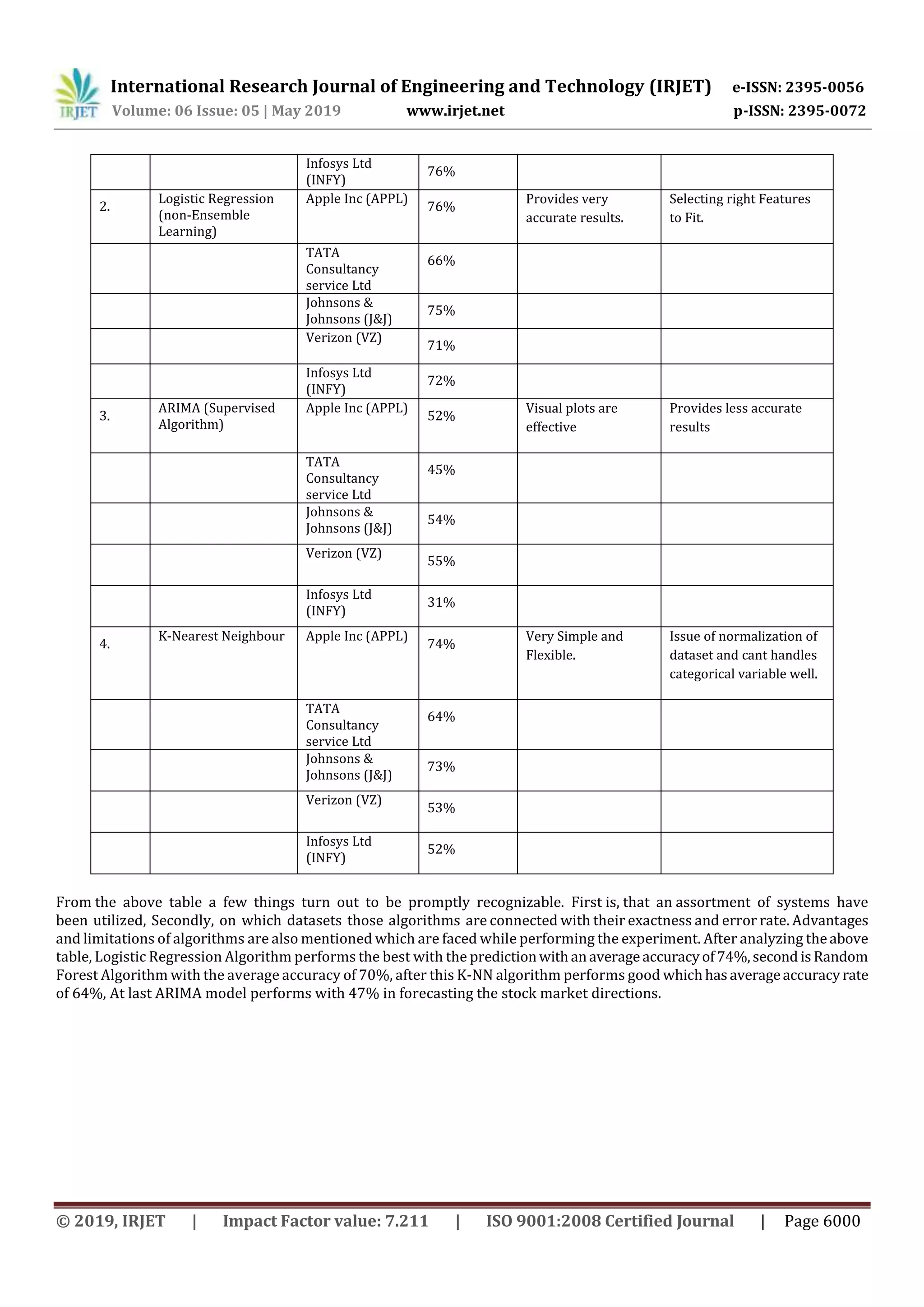
Fig-2: Flow Chart of Algorithm
6. RESULTS
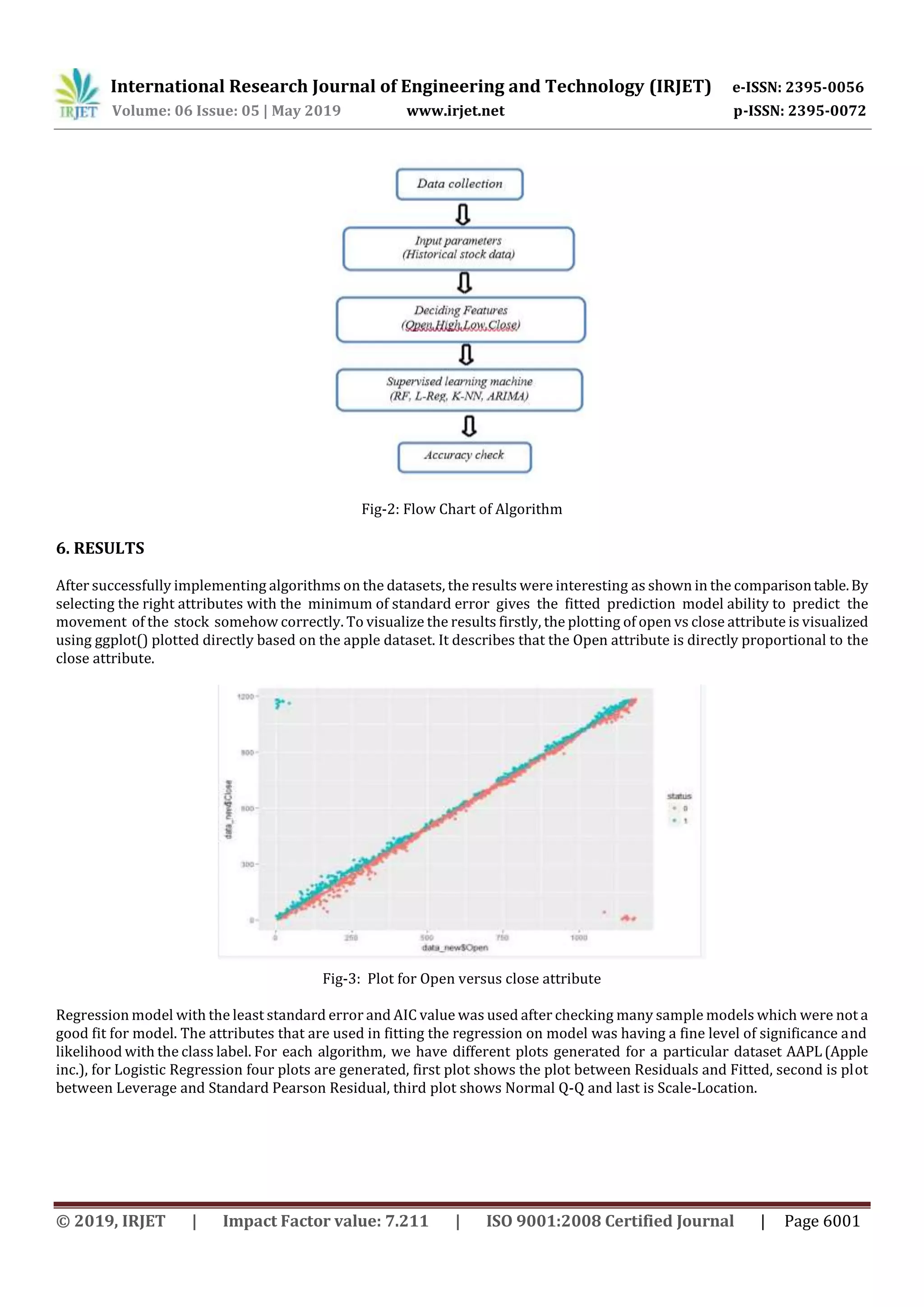
After successfully implementing algorithms on the datasets, the results were interesting as shown in the comparisontable.By
selecting the right attributes with the minimum of standard error gives the fitted prediction model ability to predict the
movement of the stock somehow correctly. To visualize the results firstly, the plotting of open vs close attribute is visualized
using ggplot() plotted directly based on the apple dataset. It describes that the Open attribute is directly proportional to the
close attribute.
Fig-3: Plot for Open versus close attribute
Regression model with the least standard error and AIC value was used after checking many sample models which were not a
good fit for model. The attributes that are used in fitting the regression on model was having a fine level of significance and
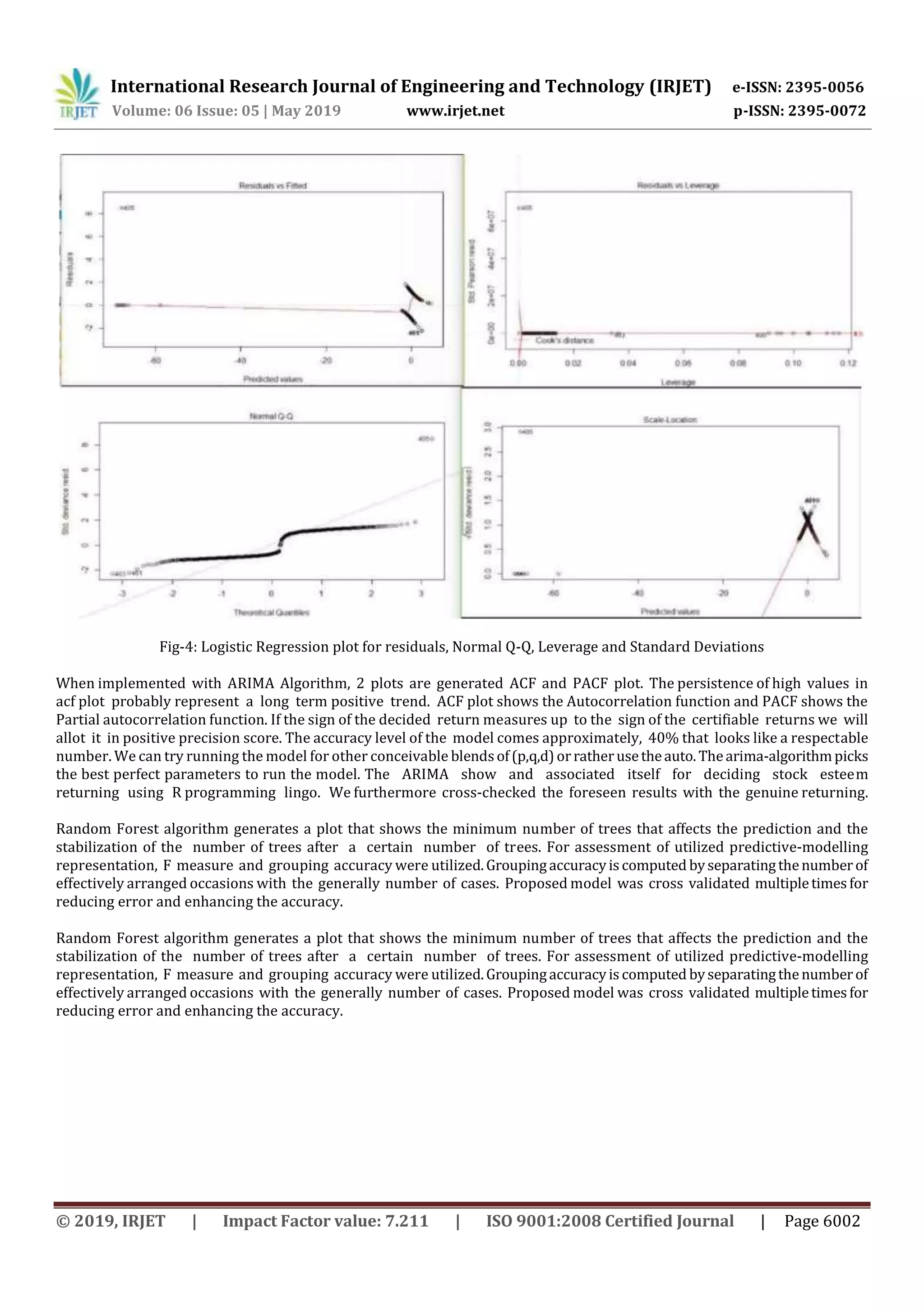
likelihood with the class label. For each algorithm, we have different plots generated for a particular dataset AAPL(Apple
inc.), for Logistic Regression four plots are generated, first plot shows the plot between Residuals and Fitted, second is plot
between Leverage and Standard Pearson Residual, third plot shows Normal Q-Q and last is Scale-Location.
International Research Journal of Engineering and Technology (IRJET) e-ISSN: 2395-0056
Volume: 06 Issue: 05 | May 2019 www.irjet.net p-ISSN: 2395-0072
© 2019, IRJET | Impact Factor value: 7.211 | ISO 9001:2008 Certified Journal | Page 6002
Fig-4: Logistic Regression plot for residuals, Normal Q-Q, Leverage and Standard Deviations
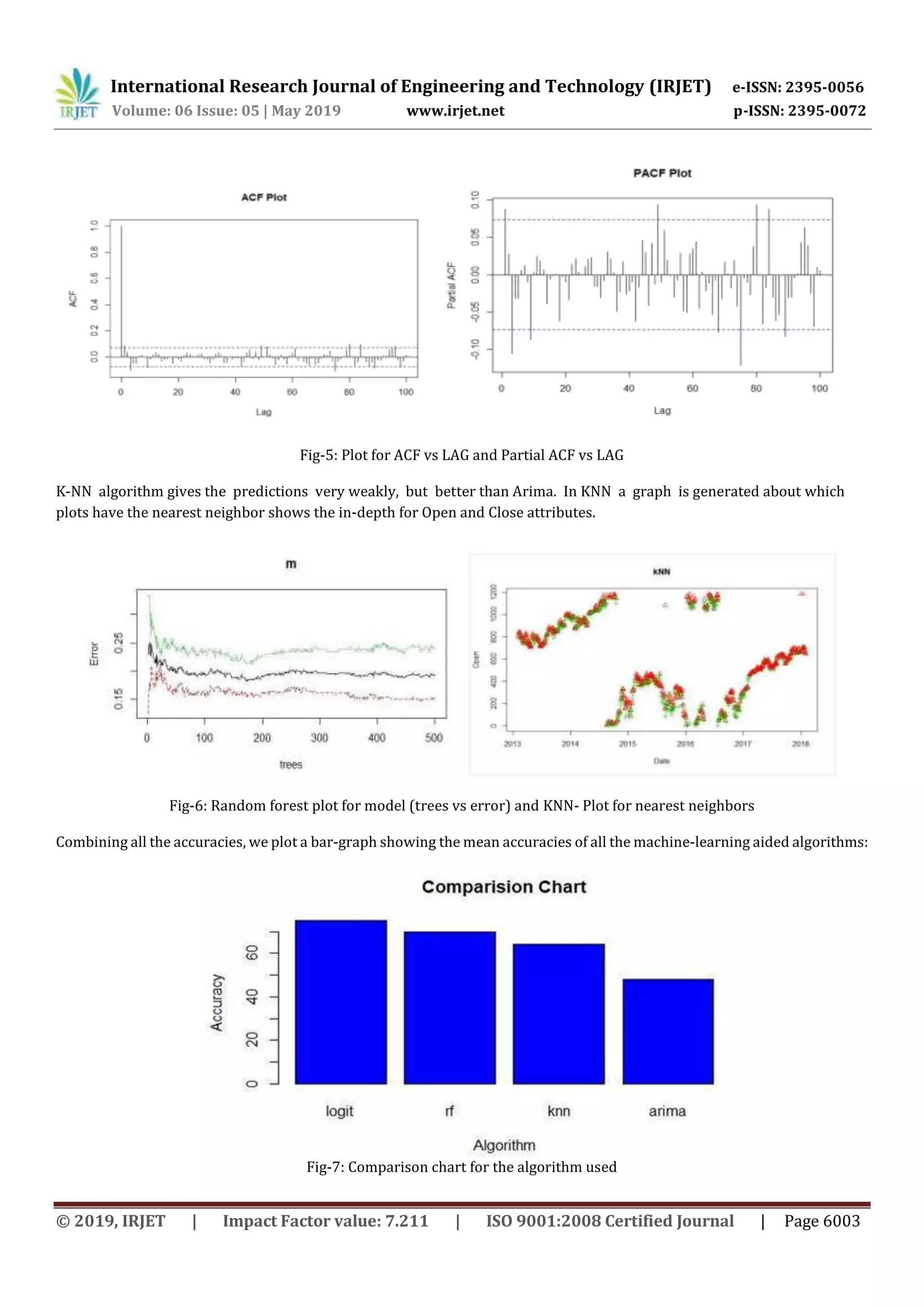
When implemented with ARIMA Algorithm, 2 plots are generated ACF and PACF plot. The persistence of high values in
acf plot probably represent a long term positive trend. ACF plot shows the Autocorrelation function and PACF shows the
Partial autocorrelation function. If the sign of the decided return measures up to the sign of the certifiable returns we will
allot it in positive precision score. The accuracy level of the model comes approximately, 40% that looks like a respectable
number. We can try running the model for other conceivable blendsof(p,q,d)orratherusetheauto.Thearima-algorithmpicks
the best perfect parameters to run the model. The ARIMA show and associated itself for deciding stock esteem
returning using R programming lingo. We furthermore cross-checked the foreseen results with the genuine returning.
Random Forest algorithm generates a plot that shows the minimum number of trees that affects the prediction and the
stabilization of the number of trees after a certain number of trees. For assessment of utilized predictive-modelling
representation, F measure and grouping accuracy were utilized.Groupingaccuracyiscomputed byseparatingthenumberof
effectively arranged occasions with the generally number of cases. Proposed model was cross validated multipletimesfor
reducing error and enhancing the accuracy.
Random Forest algorithm generates a plot that shows the minimum number of trees that affects the prediction and the
stabilization of the number of trees after a certain number of trees. For assessment of utilized predictive-modelling
representation, F measure and grouping accuracy were utilized.Groupingaccuracyiscomputed byseparatingthenumberof
effectively arranged occasions with the generally number of cases. Proposed model was cross validated multipletimesfor
reducing error and enhancing the accuracy.
International Research Journal of Engineering and Technology (IRJET) e-ISSN: 2395-0056
Volume: 06 Issue: 05 | May 2019 www.irjet.net p-ISSN: 2395-0072
© 2019, IRJET | Impact Factor value: 7.211 | ISO 9001:2008 Certified Journal | Page 6003
Fig-5: Plot for ACF vs LAG and Partial ACF vs LAG
K-NN algorithm gives the predictions very weakly, but better than Arima. In KNN a graph is generated about which
plots have the nearest neighbor shows the in-depth for Open and Close attributes.
Fig-6: Random forest plot for model (trees vs error) and KNN- Plot for nearest neighbors
Combining all the accuracies, we plot a bar-graph showing the mean accuracies of all the machine-learning aided algorithms:
Fig-7: Comparison chart for the algorithm used
International Research Journal of Engineering and Technology (IRJET) e-ISSN: 2395-0056
Volume: 06 Issue: 05 | May 2019 www.irjet.net p-ISSN: 2395-0072
© 2019, IRJET | Impact Factor value: 7.211 | ISO 9001:2008 Certified Journal | Page 6004
The bar plot shows that the Logistic Regression with 74% accuracy performs the best when compared to other techniques
which are implemented. Then comes Random Forest algorithm with 70.1% accuracy, then we have KNN 64% with andthe
last comes ARIMA in terms of Accuracy.
7. CONCLUSIONS
In the above paper, we inspected advancements in economic marketpredictions.Bylookingat differentpredictive models, we
discovered that Logistic-regression is offering the capacity to predict and analyzing market movement direction more
precisely than the other existing methods. Differentmodels,forexample,RandomForestandARIMAhaveadditionallyturned
out to be well known in stock market prediction. Random Forest demonstrated its fruitful application in classification
work, ARIMA on time series prediction and financial related applications. K-NN model is also applied in the experiment
which also show some good results in predicting stock market directions.
This shows that it can be conceivable to utilize Logistic-Regression as an effective approach to successfully predict the
future pattern of stock cost. Highlight Index Variables are creative and significant to the approach so proposed. Theyarejust
not simple to both comprehend for the private speculator and acquire from every day stock exchanging data, yet in addition
improve our approach perform than or equivalent to different strategies, e.g. Random- Forest and ARIMA Prediction Model
under similar states of Featured-Index Variables.
This method of choosing enhancing gathering of regression-coefficient enhances predicting accuracy to 74% which is quite
high. The approach so proposed is very low in unpredictability and straight forward or figure it out. Because of utilization
current month to month exchanging data, noteworthy time-viability and soli deliberateness empower clients foresee stock
value pattern of straightaway month simply through considering current month to month monetary information as
opposed to requiring a long haul system of examining furthermore, gathering budgetary information. In any case, one
deformity still exists in our approach looking at that as some component file factors come up short on account of little esteem
(surmised to zero) of this parameter. This is critical to assist examinations of Logistic-Regression representation for stocks in
value incline. Also, there exists the circumstance that element file factors flop in some case, we will think about how to choose
compelling factors to enhance prediction accuracy of stock value incline.
REFERENCES:
[1] C. N. Babu and B. E. Reddy, “Selected Indian stock predictions using a hybrid ARIMA-GARCH model,” 2014 Int. Conf. Adv.
Electron. Comput. Commun. ICAECC 2014, 2015.
[2] M. D. Shubhrata, D. Kaveri, T. Pranit, and S. Bhavana, “Stock Market Prediction and Analysis Using Naïve Bayes,” Int. J.
Recent Innov. Trends Comput. Commun., vol. 4, no.11, pp. 121–124, 2016.
[3] X. Ding, Y. Zhang, T. Liu, and J. Duan, “Deep Learning for Event-Driven Stock Prediction,” no. Ijcai, pp. 2327–2333, 2015.
[4] K. A. Smith and J. N. D. Gupta, “Neural networks in business: Techniques and applications for the operations
researcher,” Comput. Oper. Res., vol. 27, no. 11–12, pp.1023–1044, 2000.
[5] M. S. Babu, N. Geethanjali, and P. B. Satyanarayana, “Clustering Approach to Stock Market Prediction,” vol. 1291, pp. 1281–
1291, 2012.
[6] A. A, Adebiyi, A. K, Charles, A. O, Marion, and O. O, Sunday, “Stock Price Prediction using Neural Network with Hybridized
Market Indicators,” J. Emerg. Trends Comput. Inf. Sci., vol. 3, no. 1, pp. 1–9, 2012.
[7] S. Kayode, “Stock Trend Prediction Using Regression Analysis – A Data Mining Approach,” ARPN J. Syst. Softw., vol. 1, no. 4,
pp. 154–157, 2011.
[8] A. Sharma, D. Bhuriya, and U. Singh, “Survey of Stock Market Prediction Using Machine Learning Approach,” pp. 506–509,
2017.
[9] H. L. Siew and M. J. Nordin, “Regression techniques for the predictionofstock pricetrend,”ICSSBE2012 -Proceedings,2012
Int. Conf. Stat. Sci. Bus. Eng. "Empowering Decis. Mak. with Stat. Sci., pp. 99–103, 2012.
International Research Journal of Engineering and Technology (IRJET) e-ISSN: 2395-0056
Volume: 06 Issue: 05 | May 2019 www.irjet.net p-ISSN: 2395-0072
© 2019, IRJET | Impact Factor value: 7.211 | ISO 9001:2008 Certified Journal | Page 6005
[10] B. Sivakumar and K. Srilatha, “A novel method to segment blood vessels and optic disc in the fundusretinal images,”Res.J.
Pharm. Biol. Chem. Sci., vol. 7, no. 3, pp. 365–373, 2016.
[11] M. P. Mali, H. Karchalkar, A. Jain, A. Singh, and V. Kumar, “Open Price Prediction of Stock Market using Regression
Analysis,” Ijarcce, vol. 6, no. 5, pp. 418–421, 2017.
[12] L. Khaidem, S. Saha, and S. R. Dey, “Predicting the direction of stock market prices using randomforest,”vol.0,no.0,pp.1–
20, 2016.
[13] T. Manojlović and I. Štajduhar, “Predicting stock market trends using random forests: A sample of the Zagreb stock
exchange,” 38th Int. Conv. Inf. Commun. Technol. Electron. Microelectron. MIPRO 2015, no. May, pp. 1189–1193, 2015.
[14] S. B. Imandoust and M. Bolandraftar, “Forecasting the direction of stock market index movement using three data
mining techniques: The case of Tehran Stock Exchange,” Int. J. Eng. Res. Appl., vol. 4, no. 6, pp. 106–117, 2014.
[15] K. Alkhatib, H. Najadat, I. Hmeidi, and M. K. A. Shatnawi, “Stock price prediction using K-nearestneighboralgorithm,”Int.
J. Business, Humanit. Technol., vol. 3, no. 3, pp. 32–44, 2013.
[16] S. H. Liu and F. Zhou, “On stock prediction based on KNN-ANN algorithm,” Proc. 2010 IEEE 5th Int. Conf. Bio-Inspired
Comput. Theor. Appl. BIC-TA 2010, pp. 310–312, 2010.
[17] T. Ye, “Stock forecasting method based on wavelet analysis and ARIMA-SVR model,” Inf. Manag. (ICIM), 2017 3rd Int., pp.
102–106, 2017.
[18] A. A. Ariyo, A. O. Adewumi, and C. K. Ayo, “Stock Price Prediction Using the ARIMA Model,” 2014 UKSim-AMSS 16th Int.
Conf. Comput. Model. Simul., no. March, pp. 106–112, 2014.
[19] P. Li, C. Jing, T. Liang, M. Liu, Z. Chen, and L. Guo, “Autoregressive moving average modeling in the financial sector,”
ICITACEE 2015 - 2nd Int. Conf. Inf. Technol. Comput. Electr. Eng. Green Technol. Strength. Inf. Technol. Electr. Comput. Eng.
Implementation, Proc., no. 4, pp. 68–71, 2016.
[20] R. P. Schumaker and H. Chen, “Textual analysis of stock market prediction using breaking financial news,”ACM Trans.Inf.
Syst., vol. 27, no. 2, pp. 1–19, 2009.

IRJET- Prediction of Stock Market using Machine Learning Algorithms

  • 1.
    International Research Journalof Engineering and Technology (IRJET) e-ISSN: 2395-0056 Volume: 06 Issue: 05 | May 2019 www.irjet.net p-ISSN: 2395-0072 © 2019, IRJET | Impact Factor value: 7.211 | ISO 9001:2008 Certified Journal | Page 5994 Prediction of Stock Market using Machine Learning Algorithms Neha Bhardwaj1, MD Akil Ansari1 1School of Computer Science and Engineering, VIT University, Vellore, Tamil Nadu, India. ---------------------------------------------------------------------***--------------------------------------------------------------------- Abstract - In modern financial market, the most crucial problem is to find essential approach to outline and visualizing the predictions in stock-markets to be made by individuals in order to attain maximum profit by investments. The stock market is a transformative, non-straight dynamical and complex system. Long term investment is one of the major investment decisions. Though, evaluating shares and calculating elementary values for companies for long term investment is difficult. In thispaperwe are going to present comparison of machine learning aided algorithms to evaluate the stock prices in the future to analyze market behaviour. Our method is able to correctly analyze supervised algorithms and compare which algorithm performs the best to predict the future stock market prices in the market. Keywords: Stock market, machine learning, Supervisedlearningalgorithms,Random forest,Logisticregression, K-NN,ARIMA. 1. INTRODUCTION Exchanging the stocks on money markets is one of the significant speculation exercises.Already,scientistsdevelopeddifferent stock examination system that could empower them to envision the bearings of stock esteem development. Predicting and foreseeing of significant worth future cost, in perspective of the present cash relatedinformationand news,isofcolossal useto the financial pros. Financial masters need to know whether some stock will gethigher orloweroverparticulartime-period. To obtain the accurate output, the approach used is to implemented is machine learning along with supervised learning algorithms. Results are tested using different types of supervised learning algorithms with a different set of a features. The prologue to algorithms in exchanging unquestionably changed the share trading system. Calculations made it simple to respond quick to specific occasions on the share trading system. Machine learning algorithms additionally empowered examiners to make models at anticipating costs of stocks significantly simpler. Implementationof machine learning caused that new models can be created in light of the past information. In this paper we will analyse the method for predicting stock market direction using several machine learning algorithms. The paper is composed in mentioned accompanying ways: In Section 2, we will be reviewing the literature survey of several papers done in past few years for this topic . In Section 3, we will describe problem statement, methodology and algorithms we are using for prediction . Section 4 describes the results of our methodology on datasets of five different company . In the last section we will conclude the paper with its results. 2. LITERATURE SURVEY: 1) M.Suresh Babu et al., 2012, this paper investigates the significant clustering calculations: K-Means, Hierarchical grouping calculation and turn around K-Means and look at the execution of these noteworthy clustering calculations on part of effectivelyclasssavvygroupbuildingcapacityofcalculation.Theproposedstrategycomprisesof three stages. To start with, they change over each money related report into an element vector and utilize the various levelled agglomerative grouping strategy to isolate the changed over element vectors into bunches. They consider both subjective and quantitative highlights in monetary reports.Second,theyjointheupsidesoftwogrouping techniques to propose a compelling clustering strategy. Third, picking a fitting number of parts in HAC can limit the bunches produced and in this way enhance the nature of the grouping created by the K-means clustering. 2) Mahajan Shubhrata D et al., 2016, this paper is to anticipate future stock value utilizing forecast idea. In that Parse Records at that point figure anticipated esteem and send to client. Also, consequently perform activities like buy and deal shares utilizing Automation idea. For that utilization Naïve Bayes Algorithm. There isRealtimeAccess by Download log shapes hurray back site and Store in dataset. The investigations uncover a high capability of Naïve Bayes Algorithm in foreseeing the arrival on interest in the offer market. 3) Xiao Ding et al., 2015, recommended that a deep learning technique for occasion driven securities exchange expectation. Initially, occasions are removed from news message, and spoke to as thick vectors, prepared utilizinga
  • 2.
    International Research Journalof Engineering and Technology (IRJET) e-ISSN: 2395-0056 Volume: 06 Issue: 05 | May 2019 www.irjet.net p-ISSN: 2395-0072 © 2019, IRJET | Impact Factor value: 7.211 | ISO 9001:2008 Certified Journal | Page 5995 novel neural tensor system. Second, a deep convolutional neural system is utilized to demonstrate both here and now and long haul impacts of occasions on stock value developments. They exhibited that deep learning is helpful for occasion driven stock value development forecast by proposing a novel neural tensor system for learning occasion embeddings, and utilizing a deep convolutionalneuralsystemtodemonstratethejoinedimpactoflonghauloccasions and here and now occasions on stock value developments. 4) Adebiyi Ayodele et al., 2012, proposed investigation work to enhance the exactness of every day stock value forecast of securities exchange records utilizing artificial neural networks. The examination utilized three-layer, multilayer perceptron models (a feedforward neural system demonstrate) prepared with backpropagation calculation. This paper displays that hybridized approach can possibly upgrade the nature of basic leadership of financial specialists in money markets by offering more precise stock forecast contrasted with existing specialized investigation based approach. 5) Ayodele A. Adebiyi et al., 2012 , presents comprehensive |technique of building stock price predictive model using the ARIMA model. Published stock data obtained from New You are able to Stock Exchange (NYSE) and Nigeria Stock Exchange (NSE) {are being used} with stock price predictive model developed. Outcomes or Benefits obtained revealed that the ARIMA model has a strong potential for immediate prediction and can remain competitive favorably with existing {processes tactics for stock price prediction. 6) Peihao Li, Chaoqun Jing, et al., 2015 , through this paper they proposed a modelling process and present the estimateSSE (Shanghai Stock Exchange)CompositeIndex to see the model's estimation performance, which testifies to be feasible and effective. The forecast condition is essentially a direct condition that alludes to past estimations of unique timeseries and past estimations ofthe blunders.Asshouldbeobviousinthelastexpectation,the pattern can be accurately anticipated by the model implying that both themodelandfreefactorsareaccuratelychosen. 7) C.Narendra Babu and B.Eswara Reddy et al., 2014, proposed a direct half and half model utilizing ARIMA and GRACH is created which protects the information pattern and renders great forecast exactness. Appropriately, the given TSD is deteriorated into two distinctive arrangement utilizing a basic moving normal (MA) filter. One of them is displayed utilizing ARIMA and the other is demonstrated utilizing GARCH relevantly.Theforecastsgotfromboththe models are then melded to acquire the final demonstrateexpectations. Indian Stock market information is considered keeping in mind the end goalto assess the exactness of the proposed display. The execution of this model iscontrasted and conventional models, which uncovers that for multi-venture ahead expectation, theproposed display beats the others as far as both forecast precision and safeguarding information drift. 8) Abdulsalam Sulaiman Olaniyi et al., 2011, proposed in this paper, the serial development of stock costs over some stretch of time extricated from the everyday official rundown of Stock Exchange, are utilized as a part of building a database and estimations of factors were separatedfromthedatabasetoanticipatethefutureestimationsofdifferent factors using time arrangement information that utilized moving normal technique. They exhibited regression investigation as an information mining strategy and created instrument for abusing particularly time arrangement information in money related organization. An expectation framework has been constructed that utilizations information mining method to create intermittently estimates about securities exchange costs and ready to utilize regression investigation as an information mining system to portray the patterns of stock exchange costs and foresee the future securities exchange costs. 9) Jatinder N.D. Gupta et al., 2000, gives a review to the tasks research reader of the fundamental neural network methods, and in addition their verifiableand ebb and flow use in business. Neural networksand information mining are not enchantment answers for issues, in spite of the message indicated by merchants of programming items. They explored neural network strategiesinbusinessfromtheviewpointofthetasksresearcher.Thethree fundamental neural network ways to deal with taking care of business issues have been presented: multi-layered feedforward neural networks, Hopfield neural networks, and self-sorting out neural networks. Every one of these methods discovers regular similaritywith more customary factualand tasks research strategies,and these analogies have been talked about. 10) Dinesh Bhuria et al., 2017, surveyed about stock market prediction using regression techniques and proposed productive regression way todeal with foresee the stock marketcost from stock market information based. In future the consequences of multiple regression approach could be enhanced utilizing more number of factors. This examination ponder is to helpthestockmerchantsandspeculatorsforputtingcashinthestockmarket.Theexpectation
  • 3.
    International Research Journalof Engineering and Technology (IRJET) e-ISSN: 2395-0056 Volume: 06 Issue: 05 | May 2019 www.irjet.net p-ISSN: 2395-0072 © 2019, IRJET | Impact Factor value: 7.211 | ISO 9001:2008 Certified Journal | Page 5996 plays an imperative part in stock market business which is exceptionally confused and testing process due to dynamic nature of the stock market. 11) Md Jan Nordin et al., 2012 , looks at the hypothesis and routine with regards to regression methods for expectation of stock value slant by utilizing a changed informational collection in ordinal information format. In this examination, all information in numerical esteems are changed into ordinal or counted qualities to frame the dataset. Regression based classifiers from WEKA are then utilized as prescient examination to test the ordinal information. The results were thought about and assessed. 12) Bhagyashree Nigade et al., 2017 , surveyed that the stock market does not have an effective programming where the best possible proposals of accessible stocks and the correct speculation investigationaredisplayedinan effective way. The paper clarifies the advancement and execution of a stock value prediction application utilizing machine learning algorithm and protest situated approach of programming framework improvement. The algorithm was utilized as a part of preparing an arrangement of market information gathered for the time of one thousand, two hundred and three days. And a prediction framework has been manufactured that utilizations information mining procedure to deliver intermittently gauges about stock market costs. The utilization of back engendering in neural system empowers us to decrease blunders and enhance exactness of the framework. 13) Hemangi Karchalkar et al., 2017, explained a stock value prediction technique in this undertaking and for this reason regression algorithm and question arranged approach of programming advancement is used. The winning strategies demonstrate a pattern on futuredevelopment of stocks and not the conceivable cost forany stock lateron. It is in this manner desirable over have an instrument that does point a bearing towards value development, as well as demonstrates the doubtlessly cost of the stock itself 14) Luckyson Khaidem et al., 2016, proposed a novel method to limit the danger of interest in stock advertise by foreseeing the profits of a stock utilizing a class of intense machine learning calculations known as ensemble learning. They have utilized four administered learning calculations, i.e “Logistic Regression, Gaussian Discriminant Analysis, Quadratic Discriminant Analysis, and SVM”. 15) T. Manojlović et al., 2015, utilized the ‘Random-forest’ calculation to construct the model used to anticipate 5- days-ahead and 10-daysahead bearings of the CROBEX record andchose stocks. Their outcomes demonstrate that random forests can be effectively used for building predictive models foranticipatingthecourseofsecuritiesexchange patterns. 16) Mohammad Bolandraftar et al., 2014, attempted to create three models and looked at their exhibitions in anticipating the heading of development in every day Tehran Stock Exchange (TSE) file. The models depend on three order procedures, Decision Tree, Random Forest and Naïve Bayesian Classifier. What's more, reasoned that principal investigation assumes less vital part than specialized examination during the time spent basic leadership of brokers and partners. 17) Khalid Alkhatib et al., 2013, applied “K-nearest Neighbour” algorithm and indirect relapse approach so as to anticipate stock costs for an example of six noteworthy organizations recorded on the Jordanian stock exchange to help financial specialists, administration, chiefs, and clients in making right and educated ventures choices. As indicated by the outcomes, the k-NN algorithm is vigorous with little mistake proportion; subsequently the outcomes were sound and furthermore sensible. 18) San- hing Liul et al., 2010, build up a fundamental anticipating model in view of KNN and BP Neural Network. They attempted it in anticipating the stock cost of China stock and test comes about demonstrate that the normal blunders happening in KNN-ANN algorithm are littler than those in KNN algorithm, showing that the anticipating model in light of KNN-ANN algorithm can do better in the stock forecast. 19) Tian Ye et al., 2017 , showed a stock estimating model in light of waveletexaminationand ARIMA-SVR.Thestockcostis disintegrated into remade part and blunder part by wavelet deterioration and wavelet remaking. At that point, the ARIMA show and the SVR display are utilized to gauge the recreated part and the blunder part separately,andthelast forecast outcomes are joined to get the last expectation comes about. The day by day shutting cost of Shanghai Pudong Development Bank from January 5, 2015 to January 29, 2016, was chosen as the trial information, with a sum of 250, of which the initial 220 were the preparation set and the last 30 were the test set to do recreation try. The
  • 4.
    International Research Journalof Engineering and Technology (IRJET) e-ISSN: 2395-0056 Volume: 06 Issue: 05 | May 2019 www.irjet.net p-ISSN: 2395-0072 © 2019, IRJET | Impact Factor value: 7.211 | ISO 9001:2008 Certified Journal | Page 5997 test comes about demonstrate that contrasted and the single determining model, theproposed display is a powerful technique for anticipating stock value, which extraordinarily enhances the precision of estimating. 20) Robert P. Schumaker et al., 2008, discovered that two speculations have significantly affected statistical surveying: Efficient Market Hypothesis (EMH) and Random Walk Theory. In EMH, the cost of a security is an impression of finish showcase data. At whatever pointa change in money related viewpointhappens,themarketwill in a flash alter the security cost to mirror the new data (Fama, 1964). EMH contained three unique levels of data sharing: the powerless frame, the semi-solid and the solid shape. Insidepowerless EMH, justrecordedinformation is implanted inside the present cost. The semi- solid frame goes more remote by joining chronicled and current open data into its costs. The solid shape incorporates verifiable and current open data and additionally private data. From these three structures, it was trusted that business sectors acted proficiently and that immediate value amendments would forestall expectation models. 3. PROBLEM STATEMENT: In order to predict the stock prices in future markets, we have analyzed papers and has given an overview on how these algorithms give precise and accurate future predictions.In thispaper, weusedseveral algorithmsfromwhich weobservedthat not all the algorithms implemented can predict data we need. There has been a basic requirement for computerized and automized ways to deal with powerful and proficient usage of huge measure of money related information to help organizations and people in vital arranging and decision making on investments. 4. METHODOLOGY: We are using R statistical programming language to study and perform this experiment. -R is an extremely flexible statistics programming language that is Open Source and unreservedly accessible for all standard working frameworks. R has as of late encountered a "“explosive growth in use and in user contributed software". The "user-contributedsoftware"is one of the most exceptional and gainful parts of R, as a huge number of clients have contributed code for actualizing probably the most avant-garde measurable strategies, notwithstanding R executing basically all standard measurable investigations. As a result of R's Open Source structure and a group of clients devoted to making R of the most noteworthy quality, the PC code on which the techniques are based is straight forwardly scrutinized and improved. By using R and implementing following Machine learning algorithms on the datasets we are predicting the stock price movement: LOGISTICS-REGRESSION In statistical studies, “Logistic-regression”, is a regression exhibit where the dependent variable(DV) is straight out. Logistic- regression uses the trademark logarithm ability to find the association between variables and utilizes test data to find the coefficients. The limit would then have the capacity to suspect the future results using these coefficients in the logistic condition. This last condition is the logistic curve for Logistic-regression. It models the non-straight relationship amongst x and y with a 'S'- like curve for the probabilities that y =1 - that occasion the y occurs. Logistic-Regression uses the logistic function to locate a model that fits with the information points. The function shows S shaped curve to demonstrate the information. The curve is restricted in the vicinity of 0 and 1, so it is easy to apply when y is binary. To predict stock values example of normal cost of the Ith month, such stock cost is considered to be down trended if the Logistic-Regression esteem is I, p is close to 0 (or is proportional to 0). Sometimes, such stock cost is considered to have uptrend, if the Logistic Regression esteem I, p is almost 1(or is equal to 1). What's more, the more far from 0 I and, p must have the lesser probability the stock costs have downtrend, and the different way around. Normal logarithm tasks are performed on the condition obtained through the probability capacity of joint thickness work with n tests.
  • 5.
    International Research Journalof Engineering and Technology (IRJET) e-ISSN: 2395-0056 Volume: 06 Issue: 05 | May 2019 www.irjet.net p-ISSN: 2395-0072 © 2019, IRJET | Impact Factor value: 7.211 | ISO 9001:2008 Certified Journal | Page 5998 Fig-1: Logistic Regression Graph RANDOM-FOREST Random decision forest is an ensemble learning methodology towards classification calculations, backslide techniques and diverse endeavors, that work by building up countless trees during training timeand yielding the class whichisthestrategy for the classes (classification) or mean figure (backslide) of each individual tree. Random decision forests redress for decision trees' inclination for overfitting to the training dataset. The training calculation for “random-forests” applies the general procedure and tactics of bootstrapcollecting, or stowing, to tree learning sets. Given, a training dataset X = x1, ..., xn with reactions Y = y1, ..., yn, packing more than once (B times) chooses a random example with substitution of the training set and fits trees to these examples: For, b = 1, ........B: 1. Example, with substitution, n preparing cases from X, Y; calling these Xb, Yb.. 2. To provide training to a classification or regression-tree fb on Xb, Yb. In the wake of preparing, forecasts for inconspicuous examples x' can be made by averaging the prospect from all the particularized regression trees on x': “f= ∑ fb (x’)/B” and then again by taking larger part of vote by virtue of grouping trees. The amount of tests/tree B, is a unbound parameter. Ordinarily, two or three hundred to a couple of thousandsoftreesareused,dependent uponthenatureandsizeofthepreparing dataset. An ideal number of trees B can be discovered utilizing cross-approval, or by watching the “out-of-bag error”(OODB). The plot in the above stated algorithm depicts the least number of trees which can stabilize the forest so generated. As the number of trees in the graph so obtained increases and stabilizes the accuracy and the precision of the graph increases, depicting and verifying that on the further increase in the tree number is not affectingtheprecisionandaccuracyinanyofthe so authorized context. The VarImpPlot graphical representation the random-forest methodology indicates and signifies the importance and the strategy to prioritize the features and attributes associated in a particular dataset. This is plotted against variable and its importance. This helps in analyzing which variable is of high importance in the data analyses and will give higher precision and accuracy for the so given dataset to be analysed. K-NN ALGORITHM In design acknowledgment, the "K-nearest Neighbors" count (K-NN) is the non-parametric procedure used for course of action and regression. In some couple of cases, the data includes the k nearest getting-ready cases in the part space. The yields depends upon whether K-NN can be used for regression or characterization “R*=< RkNN =< (2-MR*/M-1) *R” where R* is “Bayes-error rate” (which is the insignificant error rate conceivable), and M is the number of classes and RkNN is the K-NN error rate in the problem. For M=2, “Bayesian-error rate” R* approaches to zero, this confine reduces to "not more than double the Bayesian-error rate”. A blueprint of conditions that was associated in this article foranticipating following day cost. The figuring consolidates error-evaluation, signify total of squared error, normal error, add up to closing cost when orchestrated using expected regards, k-characteristics and planning “RMS error”. a) Root-Mean-Square (RMSD) Deviation is precision metric which figures the differences between the assessed regards, Y, and honest to goodness regards, X. The total of RMSD is gisted into a singular regard measure. b) “Explained Sum of Squares” is handled as taken after. c) Average-Estimated-Error Rate: AEE is total whole of RMS errors for every variable in stock document isolated by the total number of the documents. The liftchart symbolizes the change that a data-mining- representation gives when perceived againstasporadicestimation,andthe
  • 6.
    International Research Journalof Engineering and Technology (IRJET) e-ISSN: 2395-0056 Volume: 06 Issue: 05 | May 2019 www.irjet.net p-ISSN: 2395-0072 © 2019, IRJET | Impact Factor value: 7.211 | ISO 9001:2008 Certified Journal | Page 5999 change is imparted with respect to lift-score. By separating the lifting-score, for a combination of part of educational file and different models, it would then have the capacity to be picked which indicate is exceptional and which level of the cases inside the enlightening list would get from using the desires show. ARIMA ‘ARIMA’ is extracted as Autoregressive-Integrated-Moving-Average. ARIMA is additionally referred to as “Box-Jenkins approach”. Box and Jenkins asserted that non-stationary information can be madeto stationary informationbydifferencingthe arrangement, Yt. The model for Yt can be composed as, “Yt =ϕ1Yt−1 +ϕ2Yt−2…ϕpYt−p +ϵt + θ1ϵt−1+ θ2ϵt−2 +…θqϵt−q” The ARIMA methodology joins three fundamental methods: Auto-Regression(AR): Firstly, auto-relapse the estimations of a given time arrangement information are relapsed alone slacked esteems, which is shown by the "p" esteem in the representation. Differencing, (I is for Integration) - This includes differencing the time arrangement information to dispose of the pattern and change over a non-stationary timearrangement to a standingone.Thisisspecifiedbythe"d"esteem in the model. Moving-Average(MA): The moving average featureof the model is termed by the "q"whereq,isnumberoflagged- principle of the error-rate. 5. DATA AGGREGATION: We obtain the historical dataand extensible timeseriesdatafromtheYahoofinance.Thedatasetscollectedareoffivedifferent – Apple Inc., Tata Consultancyservice,Infosys,VerizonandJohnsons&Johnsons.Thewholedataset coversdailyactivitysummary from the period of February, 2015 to February, 2019. The dataset mainly consist of attributes- Date, Open, High, Low , Close, Adj.close, Volume. Pre-processing: i) Creating a Class-label by the name Status which has binary set of values depending on the Opening and closing price of the stock, if the value of Open price of the stock on a particular day is lesser than the Close then the value in the class-label will be “1” that denotes the profit and if the value of the Open is greater than the Close then the value of class-label will be “0” that denotes the Loss in the market on the following date. “Status” =1, if change >0.5 0 , otherwise ii) Data Preparation is done because the feature values in the dataset are categorical or factor, not numerical data so, this creates problem. The machine learning algorithms used in this project, requires numerical data. Normalization of values is also done for some algorithm to avoid biases from anomalies in dataset and adjustment of values to a common scale. iii) Data Splitting is done as a total of 1048 pairs of observations are taken. Then dataset is separated into two segments. The initial segment (545 sets of perceptions) is utilized to decide the specialization of the parameters and models. The second section (503 sets of perceptions) is held for out-of-test assessment and examination of exhibitions among different determining models. iv) Features election is done for selecting the right attributes to be used to build the predicting model that has the most significance on the class label. This step helped to select the best fit model that can predict the result more precisely. v) Cross-validation is done after fitting the model to check the error rate in prediction Table I: Table of Comparision Sr. No. Algorithm Used Dataset Used % of Accuracy Advantages Limitations 1. Random Forest (Ensemble Learning) Apple Inc (APPL) 50.7% Pretty Flexible and easy to train. Require more no of trees to predict accurately that makes model slow. Johnsons & Johnsons (J&J) 80.12% TATA Consultancy service Ltd 53.48% Verizon (VZ) 77.3%
  • 7.
    International Research Journalof Engineering and Technology (IRJET) e-ISSN: 2395-0056 Volume: 06 Issue: 05 | May 2019 www.irjet.net p-ISSN: 2395-0072 © 2019, IRJET | Impact Factor value: 7.211 | ISO 9001:2008 Certified Journal | Page 6000 Infosys Ltd (INFY) 76% 2. Logistic Regression (non-Ensemble Learning) Apple Inc (APPL) 76% Provides very accurate results. Selecting right Features to Fit. TATA Consultancy service Ltd 66% Johnsons & Johnsons (J&J) 75% Verizon (VZ) 71% Infosys Ltd (INFY) 72% 3. ARIMA (Supervised Algorithm) Apple Inc (APPL) 52% Visual plots are effective Provides less accurate results TATA Consultancy service Ltd 45% Johnsons & Johnsons (J&J) 54% Verizon (VZ) 55% Infosys Ltd (INFY) 31% 4. K-Nearest Neighbour Apple Inc (APPL) 74% Very Simple and Flexible. Issue of normalization of dataset and cant handles categorical variable well. TATA Consultancy service Ltd 64% Johnsons & Johnsons (J&J) 73% Verizon (VZ) 53% Infosys Ltd (INFY) 52% From the above table a few things turn out to be promptly recognizable. First is, that an assortment of systems have been utilized, Secondly, on which datasets those algorithms are connected with their exactness and error rate. Advantages and limitations of algorithms are also mentioned which are faced while performing the experiment. After analyzing theabove table, Logistic Regression Algorithm performs the best with the predictionwithanaverageaccuracyof74%,second isRandom Forest Algorithm with the average accuracy of 70%, after this K-NN algorithm performs good whichhasaverageaccuracyrate of 64%, At last ARIMA model performs with 47% in forecasting the stock market directions.
  • 8.
    International Research Journalof Engineering and Technology (IRJET) e-ISSN: 2395-0056 Volume: 06 Issue: 05 | May 2019 www.irjet.net p-ISSN: 2395-0072 © 2019, IRJET | Impact Factor value: 7.211 | ISO 9001:2008 Certified Journal | Page 6001 Fig-2: Flow Chart of Algorithm 6. RESULTS After successfully implementing algorithms on the datasets, the results were interesting as shown in the comparisontable.By selecting the right attributes with the minimum of standard error gives the fitted prediction model ability to predict the movement of the stock somehow correctly. To visualize the results firstly, the plotting of open vs close attribute is visualized using ggplot() plotted directly based on the apple dataset. It describes that the Open attribute is directly proportional to the close attribute. Fig-3: Plot for Open versus close attribute Regression model with the least standard error and AIC value was used after checking many sample models which were not a good fit for model. The attributes that are used in fitting the regression on model was having a fine level of significance and likelihood with the class label. For each algorithm, we have different plots generated for a particular dataset AAPL(Apple inc.), for Logistic Regression four plots are generated, first plot shows the plot between Residuals and Fitted, second is plot between Leverage and Standard Pearson Residual, third plot shows Normal Q-Q and last is Scale-Location.
  • 9.
    International Research Journalof Engineering and Technology (IRJET) e-ISSN: 2395-0056 Volume: 06 Issue: 05 | May 2019 www.irjet.net p-ISSN: 2395-0072 © 2019, IRJET | Impact Factor value: 7.211 | ISO 9001:2008 Certified Journal | Page 6002 Fig-4: Logistic Regression plot for residuals, Normal Q-Q, Leverage and Standard Deviations When implemented with ARIMA Algorithm, 2 plots are generated ACF and PACF plot. The persistence of high values in acf plot probably represent a long term positive trend. ACF plot shows the Autocorrelation function and PACF shows the Partial autocorrelation function. If the sign of the decided return measures up to the sign of the certifiable returns we will allot it in positive precision score. The accuracy level of the model comes approximately, 40% that looks like a respectable number. We can try running the model for other conceivable blendsof(p,q,d)orratherusetheauto.Thearima-algorithmpicks the best perfect parameters to run the model. The ARIMA show and associated itself for deciding stock esteem returning using R programming lingo. We furthermore cross-checked the foreseen results with the genuine returning. Random Forest algorithm generates a plot that shows the minimum number of trees that affects the prediction and the stabilization of the number of trees after a certain number of trees. For assessment of utilized predictive-modelling representation, F measure and grouping accuracy were utilized.Groupingaccuracyiscomputed byseparatingthenumberof effectively arranged occasions with the generally number of cases. Proposed model was cross validated multipletimesfor reducing error and enhancing the accuracy. Random Forest algorithm generates a plot that shows the minimum number of trees that affects the prediction and the stabilization of the number of trees after a certain number of trees. For assessment of utilized predictive-modelling representation, F measure and grouping accuracy were utilized.Groupingaccuracyiscomputed byseparatingthenumberof effectively arranged occasions with the generally number of cases. Proposed model was cross validated multipletimesfor reducing error and enhancing the accuracy.
  • 10.
    International Research Journalof Engineering and Technology (IRJET) e-ISSN: 2395-0056 Volume: 06 Issue: 05 | May 2019 www.irjet.net p-ISSN: 2395-0072 © 2019, IRJET | Impact Factor value: 7.211 | ISO 9001:2008 Certified Journal | Page 6003 Fig-5: Plot for ACF vs LAG and Partial ACF vs LAG K-NN algorithm gives the predictions very weakly, but better than Arima. In KNN a graph is generated about which plots have the nearest neighbor shows the in-depth for Open and Close attributes. Fig-6: Random forest plot for model (trees vs error) and KNN- Plot for nearest neighbors Combining all the accuracies, we plot a bar-graph showing the mean accuracies of all the machine-learning aided algorithms: Fig-7: Comparison chart for the algorithm used
  • 11.
    International Research Journalof Engineering and Technology (IRJET) e-ISSN: 2395-0056 Volume: 06 Issue: 05 | May 2019 www.irjet.net p-ISSN: 2395-0072 © 2019, IRJET | Impact Factor value: 7.211 | ISO 9001:2008 Certified Journal | Page 6004 The bar plot shows that the Logistic Regression with 74% accuracy performs the best when compared to other techniques which are implemented. Then comes Random Forest algorithm with 70.1% accuracy, then we have KNN 64% with andthe last comes ARIMA in terms of Accuracy. 7. CONCLUSIONS In the above paper, we inspected advancements in economic marketpredictions.Bylookingat differentpredictive models, we discovered that Logistic-regression is offering the capacity to predict and analyzing market movement direction more precisely than the other existing methods. Differentmodels,forexample,RandomForestandARIMAhaveadditionallyturned out to be well known in stock market prediction. Random Forest demonstrated its fruitful application in classification work, ARIMA on time series prediction and financial related applications. K-NN model is also applied in the experiment which also show some good results in predicting stock market directions. This shows that it can be conceivable to utilize Logistic-Regression as an effective approach to successfully predict the future pattern of stock cost. Highlight Index Variables are creative and significant to the approach so proposed. Theyarejust not simple to both comprehend for the private speculator and acquire from every day stock exchanging data, yet in addition improve our approach perform than or equivalent to different strategies, e.g. Random- Forest and ARIMA Prediction Model under similar states of Featured-Index Variables. This method of choosing enhancing gathering of regression-coefficient enhances predicting accuracy to 74% which is quite high. The approach so proposed is very low in unpredictability and straight forward or figure it out. Because of utilization current month to month exchanging data, noteworthy time-viability and soli deliberateness empower clients foresee stock value pattern of straightaway month simply through considering current month to month monetary information as opposed to requiring a long haul system of examining furthermore, gathering budgetary information. In any case, one deformity still exists in our approach looking at that as some component file factors come up short on account of little esteem (surmised to zero) of this parameter. This is critical to assist examinations of Logistic-Regression representation for stocks in value incline. Also, there exists the circumstance that element file factors flop in some case, we will think about how to choose compelling factors to enhance prediction accuracy of stock value incline. REFERENCES: [1] C. N. Babu and B. E. Reddy, “Selected Indian stock predictions using a hybrid ARIMA-GARCH model,” 2014 Int. Conf. Adv. Electron. Comput. Commun. ICAECC 2014, 2015. [2] M. D. Shubhrata, D. Kaveri, T. Pranit, and S. Bhavana, “Stock Market Prediction and Analysis Using Naïve Bayes,” Int. J. Recent Innov. Trends Comput. Commun., vol. 4, no.11, pp. 121–124, 2016. [3] X. Ding, Y. Zhang, T. Liu, and J. Duan, “Deep Learning for Event-Driven Stock Prediction,” no. Ijcai, pp. 2327–2333, 2015. [4] K. A. Smith and J. N. D. Gupta, “Neural networks in business: Techniques and applications for the operations researcher,” Comput. Oper. Res., vol. 27, no. 11–12, pp.1023–1044, 2000. [5] M. S. Babu, N. Geethanjali, and P. B. Satyanarayana, “Clustering Approach to Stock Market Prediction,” vol. 1291, pp. 1281– 1291, 2012. [6] A. A, Adebiyi, A. K, Charles, A. O, Marion, and O. O, Sunday, “Stock Price Prediction using Neural Network with Hybridized Market Indicators,” J. Emerg. Trends Comput. Inf. Sci., vol. 3, no. 1, pp. 1–9, 2012. [7] S. Kayode, “Stock Trend Prediction Using Regression Analysis – A Data Mining Approach,” ARPN J. Syst. Softw., vol. 1, no. 4, pp. 154–157, 2011. [8] A. Sharma, D. Bhuriya, and U. Singh, “Survey of Stock Market Prediction Using Machine Learning Approach,” pp. 506–509, 2017. [9] H. L. Siew and M. J. Nordin, “Regression techniques for the predictionofstock pricetrend,”ICSSBE2012 -Proceedings,2012 Int. Conf. Stat. Sci. Bus. Eng. "Empowering Decis. Mak. with Stat. Sci., pp. 99–103, 2012.
  • 12.
    International Research Journalof Engineering and Technology (IRJET) e-ISSN: 2395-0056 Volume: 06 Issue: 05 | May 2019 www.irjet.net p-ISSN: 2395-0072 © 2019, IRJET | Impact Factor value: 7.211 | ISO 9001:2008 Certified Journal | Page 6005 [10] B. Sivakumar and K. Srilatha, “A novel method to segment blood vessels and optic disc in the fundusretinal images,”Res.J. Pharm. Biol. Chem. Sci., vol. 7, no. 3, pp. 365–373, 2016. [11] M. P. Mali, H. Karchalkar, A. Jain, A. Singh, and V. Kumar, “Open Price Prediction of Stock Market using Regression Analysis,” Ijarcce, vol. 6, no. 5, pp. 418–421, 2017. [12] L. Khaidem, S. Saha, and S. R. Dey, “Predicting the direction of stock market prices using randomforest,”vol.0,no.0,pp.1– 20, 2016. [13] T. Manojlović and I. Štajduhar, “Predicting stock market trends using random forests: A sample of the Zagreb stock exchange,” 38th Int. Conv. Inf. Commun. Technol. Electron. Microelectron. MIPRO 2015, no. May, pp. 1189–1193, 2015. [14] S. B. Imandoust and M. Bolandraftar, “Forecasting the direction of stock market index movement using three data mining techniques: The case of Tehran Stock Exchange,” Int. J. Eng. Res. Appl., vol. 4, no. 6, pp. 106–117, 2014. [15] K. Alkhatib, H. Najadat, I. Hmeidi, and M. K. A. Shatnawi, “Stock price prediction using K-nearestneighboralgorithm,”Int. J. Business, Humanit. Technol., vol. 3, no. 3, pp. 32–44, 2013. [16] S. H. Liu and F. Zhou, “On stock prediction based on KNN-ANN algorithm,” Proc. 2010 IEEE 5th Int. Conf. Bio-Inspired Comput. Theor. Appl. BIC-TA 2010, pp. 310–312, 2010. [17] T. Ye, “Stock forecasting method based on wavelet analysis and ARIMA-SVR model,” Inf. Manag. (ICIM), 2017 3rd Int., pp. 102–106, 2017. [18] A. A. Ariyo, A. O. Adewumi, and C. K. Ayo, “Stock Price Prediction Using the ARIMA Model,” 2014 UKSim-AMSS 16th Int. Conf. Comput. Model. Simul., no. March, pp. 106–112, 2014. [19] P. Li, C. Jing, T. Liang, M. Liu, Z. Chen, and L. Guo, “Autoregressive moving average modeling in the financial sector,” ICITACEE 2015 - 2nd Int. Conf. Inf. Technol. Comput. Electr. Eng. Green Technol. Strength. Inf. Technol. Electr. Comput. Eng. Implementation, Proc., no. 4, pp. 68–71, 2016. [20] R. P. Schumaker and H. Chen, “Textual analysis of stock market prediction using breaking financial news,”ACM Trans.Inf. Syst., vol. 27, no. 2, pp. 1–19, 2009.