Case Study
On
“Stock Market Prediction”
Submitted by
Nehal Kolipaka
(Roll No: 70)
Sem: VII Class: BE
Subject: Machine Learning Lab
Department of Computer Engineering
Academic Year: 2024-25
Contents
Chapter Contents Page No
Abstract 01
Chapter 1 Introduction 02
Chapter 2 Data Collection and Preprocessing 03
Chapter 3 Machine Learning Models for Stock Market Prediction 04
Chapter 4 Time-Series Analysis in Stock Market Prediction 05
Chapter 5 Sentiment Analysis for Stock Market Prediction 06
Chapter 6 Challenges and Limitations of Stock Market Prediction
Models
07
Chapter 7 Conclusion 08
References 09
Abstract
Stock market prediction is a domain of financial analysis that leverages machine
learning and statistical techniques to forecast the future values of stock prices. This
field aims to assist investors in making informed decisions by predicting market
trends, asset prices, and market behaviors. The ultimate goal is to identify
opportunities for profit and to minimize risks in trading.
Key Components and Techniques
Data Acquisition: Gathering historical stock data, news articles, financial reports,
social media trends, and other relevant information from sources such as
YahooFinance, Bloomberg, or Google Finance.
Data Preprocessing: Cleaning and preparing the data for analysis, which includes
handling missing values, normalizing price scales, and removing noise from stock
price fluctuations.
Feature Extraction: Identifying the most influential factors affecting stock prices,
such as technical indicators (moving averages, relative strength index) or
fundamental factors (earnings reports, economic data).
Time Series Analysis: Applying techniques like ARIMA (AutoRegressive
Integrated Moving Average) or LSTM (Long Short-Term Memory networks) to
capture temporal dependencies and trends in stock data.
Machine Learning Models:
Supervised Learning: Algorithms like Linear Regression, Random Forest, and
Support Vector Machines are trained on historical stock data to predict future prices.
Unsupervised Learning: Clustering techniques like K-means help in identifying
patterns and anomalies in the stock market.
Deep Learning: Advanced techniques such as Convolutional Neural Networks
(CNN) and Recurrent Neural Networks (RNN) are used for more accurate
prediction, especially for time-series data.
Sentiment Analysis: Analyzing news headlines, financial reports, or social media
posts using natural language processing (NLP) to gauge market sentiment and its
potential impact on stock prices.
Chapter 1
Introduction
The stock market is a dynamic and intricate system where investors, companies, and
economic forces interact. As one of the most vital components of the global
economy, predicting stock market trends and prices is a task that has intrigued
analysts for decades. Today, emerging technologies are revolutionizing this field,
transforming stock market prediction into a more data-driven and sophisticated
science.
Advanced technologies, such as artificial intelligence, machine learning, and big
data analytics, allow traders to forecast stock prices with greater precision.
Algorithms can analyze vast amounts of historical data, news trends, social media
sentiment, and macroeconomic indicators in real-time, identifying patterns that are
difficult for human analysts to detect. By leveraging these innovations, investors can
enhance their decision-making process, mitigate risks, and seize profit-making
opportunities with more confidence.
Stock market prediction technologies offer investors a powerful set of tools to
navigate the complexities of financial markets. By utilizing cutting-edge techniques,
traders can enhance profitability while reducing risks, making the stock market more
accessible and manageable for both professional and retail investors. As we delve
deeper into this chapter, we will examine how these tools and techniques are applied
in real-world scenarios, illustrating their potential to transform stock trading and
investment strategies.
Chapter 2
Data Collection and Preprocessing
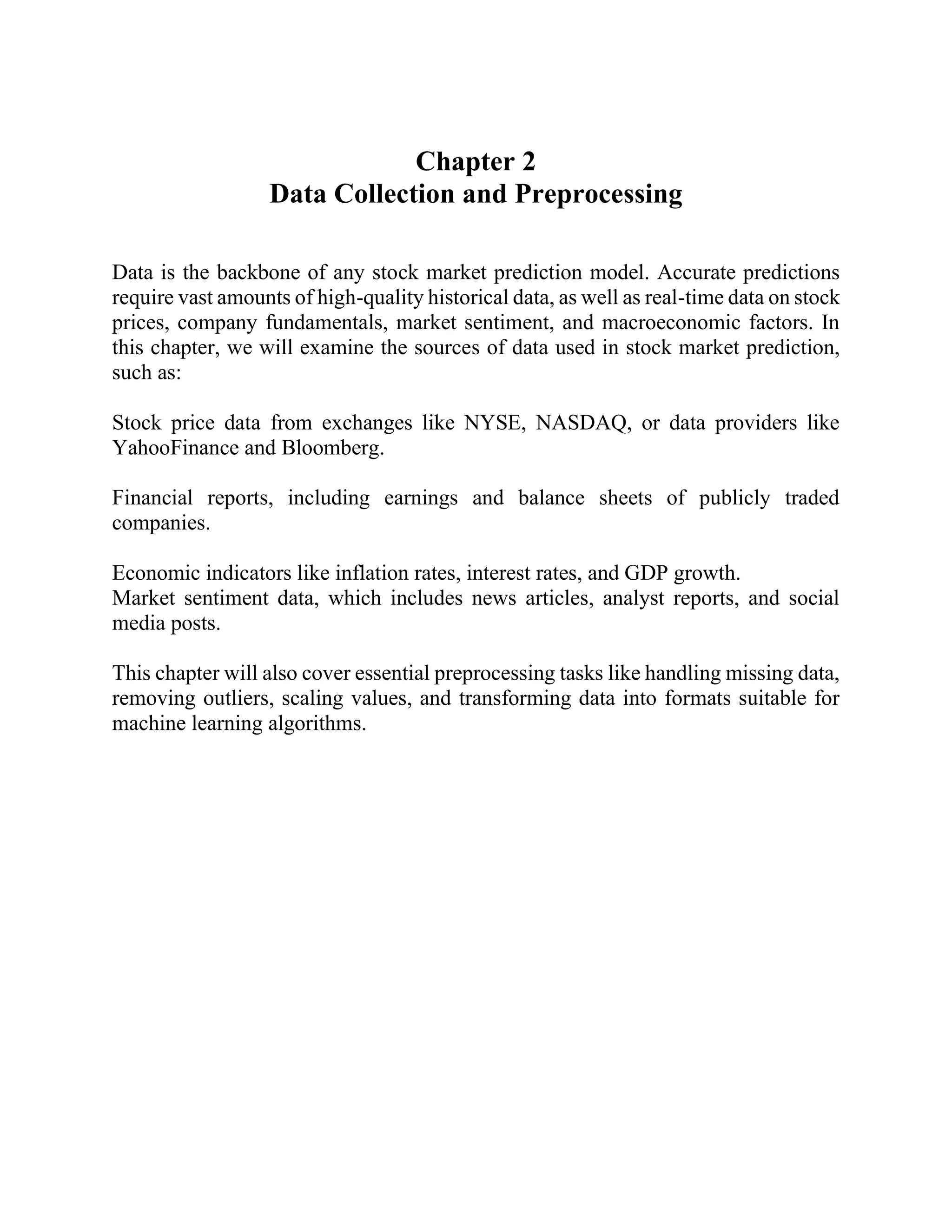
Data is the backbone of any stock market prediction model. Accurate predictions
require vast amounts of high-quality historical data, as well as real-time data on stock
prices, company fundamentals, market sentiment, and macroeconomic factors. In
this chapter, we will examine the sources of data used in stock market prediction,
such as:
Stock price data from exchanges like NYSE, NASDAQ, or data providers like
YahooFinance and Bloomberg.
Financial reports, including earnings and balance sheets of publicly traded
companies.
Economic indicators like inflation rates, interest rates, and GDP growth.
Market sentiment data, which includes news articles, analyst reports, and social
media posts.
This chapter will also cover essential preprocessing tasks like handling missing data,
removing outliers, scaling values, and transforming data into formats suitable for
machine learning algorithms.
Chapter 3
Machine Learning Models for Stock Market Prediction
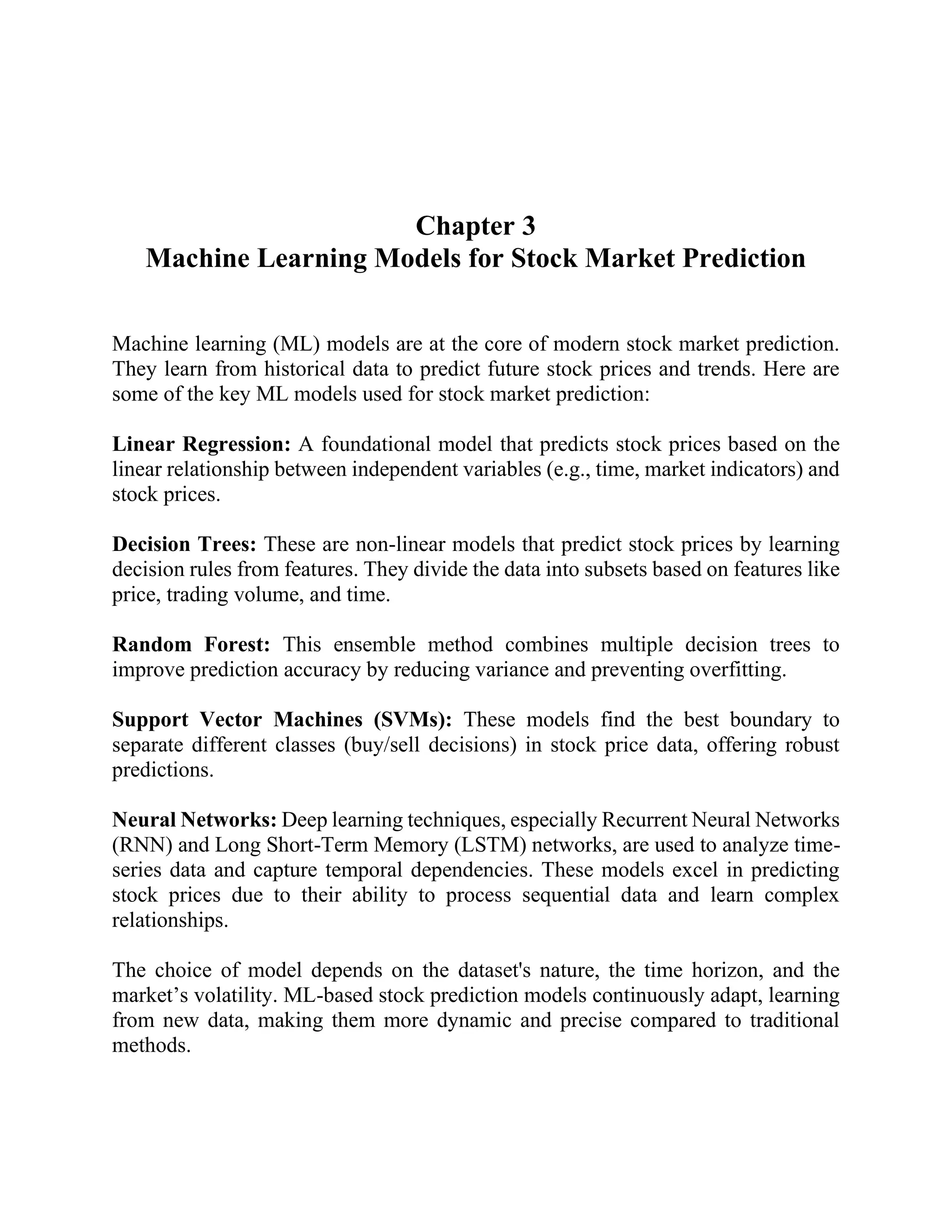
Machine learning (ML) models are at the core of modern stock market prediction.
They learn from historical data to predict future stock prices and trends. Here are
some of the key ML models used for stock market prediction:
Linear Regression: A foundational model that predicts stock prices based on the
linear relationship between independent variables (e.g., time, market indicators) and
stock prices.
Decision Trees: These are non-linear models that predict stock prices by learning
decision rules from features. They divide the data into subsets based on features like
price, trading volume, and time.
Random Forest: This ensemble method combines multiple decision trees to
improve prediction accuracy by reducing variance and preventing overfitting.
Support Vector Machines (SVMs): These models find the best boundary to
separate different classes (buy/sell decisions) in stock price data, offering robust
predictions.
Neural Networks: Deep learning techniques, especially Recurrent Neural Networks
(RNN) and Long Short-Term Memory (LSTM) networks, are used to analyze time-
series data and capture temporal dependencies. These models excel in predicting
stock prices due to their ability to process sequential data and learn complex
relationships.
The choice of model depends on the dataset's nature, the time horizon, and the
market’s volatility. ML-based stock prediction models continuously adapt, learning
from new data, making them more dynamic and precise compared to traditional
methods.
Chapter 4
Time-Series Analysis in Stock Market Prediction
Time-series analysis is essential for stock market prediction, as stock prices are
inherently time-dependent. Key techniques used in time-series forecasting include:
Moving Averages: This smooths out short-term fluctuations in stock prices and helps
identify longer-term trends.
ARIMA (AutoRegressive Integrated Moving Average): A popular statistical model
used for short-term stock price predictions. It uses lagged data to forecast future
values.
LSTM Networks: These deep learning models are specifically designed for time-
series data, as they can capture both long- and short-term dependencies. They
outperform other models in detecting trends over longer periods.
Fourier Transform: This technique breaks down complex price signals into simpler
sine and cosine components, revealing hidden cycles and patterns in stock data.
Time-series analysis, combined with machine learning models, helps in predicting
stock prices more accurately, giving investors an edge in identifying market trends
early.
Chapter 5
Sentiment Analysis for Stock Market Prediction
Sentiment analysis is a key factor in stock market prediction. It involves analyzing
textual data from news articles, social media, financial reports, and analyst opinions
to gauge the overall mood of the market.
News Analytics: Market-moving events are often triggered by news. Analyzing the
tone and content of news articles in real-time helps predict the impact of these events
on stock prices.
Social Media Sentiment: Platforms like Twitter and Reddit have become influential
in stock markets. NLP algorithms can extract and quantify market sentiment from
these platforms, providing valuable insights for short-term stock movements.
Financial Reports and Earnings Calls: NLP can also parse company reports and
earnings calls to assess corporate health and potential future performance.
Sentiment analysis allows traders to get ahead of the market by understanding the
collective behavior of market participants, turning qualitative insights into
actionable data.
Chapter 6
Challenges and Limitations of Stock Market Prediction
Models
While stock market prediction models have become more advanced, several
challenges and limitations remain:
Market Volatility: Sudden geopolitical events, economic downturns, or natural
disasters can render even the most accurate models obsolete in a matter of hours.
Data Quality: Poor or incomplete data, noisy datasets, and outdated information
can affect the accuracy of models. Inaccurate predictions can lead to significant
financial losses.
Overfitting: Machine learning models, particularly deep learning ones, can
sometimes learn patterns that only exist in historical data, leading to poor
generalization in real-world scenarios.
Black-Box Nature of Models: Complex models like deep neural networks often
lack interpretability, making it difficult for traders to understand the rationale behind
predictions.
Ethical and Regulatory Concerns: Algorithmic trading, driven by AI, can create
market instability, leading to rapid price fluctuations. Moreover, regulatory bodies
are still playing catch-up in terms of framing guidelines for AI-driven financial
practices.
Despite these challenges, continuous advancements in AI and data science aim to
address these limitations, improving the reliability and accuracy of stock market
predictions.
Chapter 7
Conclusion
The integration of artificial intelligence, machine learning, and big data analytics in
stock market prediction has fundamentally transformed how traders and investors
navigate the financial markets. From predicting stock price movements to analyzing
sentiment and optimizing portfolios, AI-powered models provide unparalleled
insights and opportunities. The advancements in AI have made it possible to process
large-scale data, detect hidden patterns, and forecast stock prices with greater
accuracy than ever before.
While traditional approaches such as technical and fundamental analysis still hold
value, the addition of machine learning and AI enables a more data-driven approach
that minimizes human biases. The use of techniques like time-series analysis, neural
networks, and sentiment analysis allows models to capture both quantitative and
qualitative factors influencing stock prices, making predictions more comprehensive
and insightful.
However, despite the great promise of these technologies, several challenges remain.
Stock markets are inherently volatile and unpredictable, and even the most
sophisticated models may fail during times of extreme uncertainty, such as financial
crises or geopolitical shocks. Additionally, issues like overfitting, data quality, and
the "black box" nature of some AI models continue to present limitations that must
be addressed.
Ultimately, while stock market prediction will never be an exact science, the
adoption of AI and machine learning represents a significant leap forward. These
technologies are set to become indispensable tools for investors, enabling them to
better understand market dynamics, identify profitable opportunities, and mitigate
risks. As AI continues to evolve, it will likely democratize financial analysis, making
sophisticated prediction models more accessible to individual traders and retail
investors, potentially reshaping the entire landscape of investment.
In conclusion, AI-driven stock market prediction is a powerful tool that offers both
opportunities and challenges. As we move toward a future of even greater
technological integration in finance, continued research and innovation will be key
to refining these tools and maximizing their potential for market forecasting.
.
References
A. Tsantekidis et al., “Using Deep Learning to Forecast Stock Prices,” IEEE
Transactions on Neural Networks and Learning Systems, vol. 29, no. 6, 2020.
P. Patel, “A Survey on Stock Market Prediction Using Machine Learning,”
Journal of Financial Technology, 2021.
R. Schumaker and H. Chen, “Textual Analysis for Stock Market Prediction,”
Decision Support Systems, vol. 55, no. 4, 2021.
J. Bollen et al., “Twitter Mood Predicts the Stock Market,” Journal of
Computational Science, vol. 2, no. 1, 2021.
S. Fischer, “Quantum Computing and Financial Markets,” Nature Quantum
Information, 2023.

CASE STUDY ON STOCK MARKET PREDICTION IN ML

  • 1.
    Case Study On “Stock MarketPrediction” Submitted by Nehal Kolipaka (Roll No: 70) Sem: VII Class: BE Subject: Machine Learning Lab Department of Computer Engineering Academic Year: 2024-25
  • 2.
    Contents Chapter Contents PageNo Abstract 01 Chapter 1 Introduction 02 Chapter 2 Data Collection and Preprocessing 03 Chapter 3 Machine Learning Models for Stock Market Prediction 04 Chapter 4 Time-Series Analysis in Stock Market Prediction 05 Chapter 5 Sentiment Analysis for Stock Market Prediction 06 Chapter 6 Challenges and Limitations of Stock Market Prediction Models 07 Chapter 7 Conclusion 08 References 09
  • 3.
    Abstract Stock market predictionis a domain of financial analysis that leverages machine learning and statistical techniques to forecast the future values of stock prices. This field aims to assist investors in making informed decisions by predicting market trends, asset prices, and market behaviors. The ultimate goal is to identify opportunities for profit and to minimize risks in trading. Key Components and Techniques Data Acquisition: Gathering historical stock data, news articles, financial reports, social media trends, and other relevant information from sources such as YahooFinance, Bloomberg, or Google Finance. Data Preprocessing: Cleaning and preparing the data for analysis, which includes handling missing values, normalizing price scales, and removing noise from stock price fluctuations. Feature Extraction: Identifying the most influential factors affecting stock prices, such as technical indicators (moving averages, relative strength index) or fundamental factors (earnings reports, economic data). Time Series Analysis: Applying techniques like ARIMA (AutoRegressive Integrated Moving Average) or LSTM (Long Short-Term Memory networks) to capture temporal dependencies and trends in stock data. Machine Learning Models: Supervised Learning: Algorithms like Linear Regression, Random Forest, and Support Vector Machines are trained on historical stock data to predict future prices. Unsupervised Learning: Clustering techniques like K-means help in identifying patterns and anomalies in the stock market. Deep Learning: Advanced techniques such as Convolutional Neural Networks (CNN) and Recurrent Neural Networks (RNN) are used for more accurate prediction, especially for time-series data. Sentiment Analysis: Analyzing news headlines, financial reports, or social media posts using natural language processing (NLP) to gauge market sentiment and its potential impact on stock prices.
  • 4.
    Chapter 1 Introduction The stockmarket is a dynamic and intricate system where investors, companies, and economic forces interact. As one of the most vital components of the global economy, predicting stock market trends and prices is a task that has intrigued analysts for decades. Today, emerging technologies are revolutionizing this field, transforming stock market prediction into a more data-driven and sophisticated science. Advanced technologies, such as artificial intelligence, machine learning, and big data analytics, allow traders to forecast stock prices with greater precision. Algorithms can analyze vast amounts of historical data, news trends, social media sentiment, and macroeconomic indicators in real-time, identifying patterns that are difficult for human analysts to detect. By leveraging these innovations, investors can enhance their decision-making process, mitigate risks, and seize profit-making opportunities with more confidence. Stock market prediction technologies offer investors a powerful set of tools to navigate the complexities of financial markets. By utilizing cutting-edge techniques, traders can enhance profitability while reducing risks, making the stock market more accessible and manageable for both professional and retail investors. As we delve deeper into this chapter, we will examine how these tools and techniques are applied in real-world scenarios, illustrating their potential to transform stock trading and investment strategies.
  • 5.
    Chapter 2 Data Collectionand Preprocessing Data is the backbone of any stock market prediction model. Accurate predictions require vast amounts of high-quality historical data, as well as real-time data on stock prices, company fundamentals, market sentiment, and macroeconomic factors. In this chapter, we will examine the sources of data used in stock market prediction, such as: Stock price data from exchanges like NYSE, NASDAQ, or data providers like YahooFinance and Bloomberg. Financial reports, including earnings and balance sheets of publicly traded companies. Economic indicators like inflation rates, interest rates, and GDP growth. Market sentiment data, which includes news articles, analyst reports, and social media posts. This chapter will also cover essential preprocessing tasks like handling missing data, removing outliers, scaling values, and transforming data into formats suitable for machine learning algorithms.
  • 6.
    Chapter 3 Machine LearningModels for Stock Market Prediction Machine learning (ML) models are at the core of modern stock market prediction. They learn from historical data to predict future stock prices and trends. Here are some of the key ML models used for stock market prediction: Linear Regression: A foundational model that predicts stock prices based on the linear relationship between independent variables (e.g., time, market indicators) and stock prices. Decision Trees: These are non-linear models that predict stock prices by learning decision rules from features. They divide the data into subsets based on features like price, trading volume, and time. Random Forest: This ensemble method combines multiple decision trees to improve prediction accuracy by reducing variance and preventing overfitting. Support Vector Machines (SVMs): These models find the best boundary to separate different classes (buy/sell decisions) in stock price data, offering robust predictions. Neural Networks: Deep learning techniques, especially Recurrent Neural Networks (RNN) and Long Short-Term Memory (LSTM) networks, are used to analyze time- series data and capture temporal dependencies. These models excel in predicting stock prices due to their ability to process sequential data and learn complex relationships. The choice of model depends on the dataset's nature, the time horizon, and the market’s volatility. ML-based stock prediction models continuously adapt, learning from new data, making them more dynamic and precise compared to traditional methods.
  • 7.
    Chapter 4 Time-Series Analysisin Stock Market Prediction Time-series analysis is essential for stock market prediction, as stock prices are inherently time-dependent. Key techniques used in time-series forecasting include: Moving Averages: This smooths out short-term fluctuations in stock prices and helps identify longer-term trends. ARIMA (AutoRegressive Integrated Moving Average): A popular statistical model used for short-term stock price predictions. It uses lagged data to forecast future values. LSTM Networks: These deep learning models are specifically designed for time- series data, as they can capture both long- and short-term dependencies. They outperform other models in detecting trends over longer periods. Fourier Transform: This technique breaks down complex price signals into simpler sine and cosine components, revealing hidden cycles and patterns in stock data. Time-series analysis, combined with machine learning models, helps in predicting stock prices more accurately, giving investors an edge in identifying market trends early.
  • 8.
    Chapter 5 Sentiment Analysisfor Stock Market Prediction Sentiment analysis is a key factor in stock market prediction. It involves analyzing textual data from news articles, social media, financial reports, and analyst opinions to gauge the overall mood of the market. News Analytics: Market-moving events are often triggered by news. Analyzing the tone and content of news articles in real-time helps predict the impact of these events on stock prices. Social Media Sentiment: Platforms like Twitter and Reddit have become influential in stock markets. NLP algorithms can extract and quantify market sentiment from these platforms, providing valuable insights for short-term stock movements. Financial Reports and Earnings Calls: NLP can also parse company reports and earnings calls to assess corporate health and potential future performance. Sentiment analysis allows traders to get ahead of the market by understanding the collective behavior of market participants, turning qualitative insights into actionable data.
  • 9.
    Chapter 6 Challenges andLimitations of Stock Market Prediction Models While stock market prediction models have become more advanced, several challenges and limitations remain: Market Volatility: Sudden geopolitical events, economic downturns, or natural disasters can render even the most accurate models obsolete in a matter of hours. Data Quality: Poor or incomplete data, noisy datasets, and outdated information can affect the accuracy of models. Inaccurate predictions can lead to significant financial losses. Overfitting: Machine learning models, particularly deep learning ones, can sometimes learn patterns that only exist in historical data, leading to poor generalization in real-world scenarios. Black-Box Nature of Models: Complex models like deep neural networks often lack interpretability, making it difficult for traders to understand the rationale behind predictions. Ethical and Regulatory Concerns: Algorithmic trading, driven by AI, can create market instability, leading to rapid price fluctuations. Moreover, regulatory bodies are still playing catch-up in terms of framing guidelines for AI-driven financial practices. Despite these challenges, continuous advancements in AI and data science aim to address these limitations, improving the reliability and accuracy of stock market predictions.
  • 10.
    Chapter 7 Conclusion The integrationof artificial intelligence, machine learning, and big data analytics in stock market prediction has fundamentally transformed how traders and investors navigate the financial markets. From predicting stock price movements to analyzing sentiment and optimizing portfolios, AI-powered models provide unparalleled insights and opportunities. The advancements in AI have made it possible to process large-scale data, detect hidden patterns, and forecast stock prices with greater accuracy than ever before. While traditional approaches such as technical and fundamental analysis still hold value, the addition of machine learning and AI enables a more data-driven approach that minimizes human biases. The use of techniques like time-series analysis, neural networks, and sentiment analysis allows models to capture both quantitative and qualitative factors influencing stock prices, making predictions more comprehensive and insightful. However, despite the great promise of these technologies, several challenges remain. Stock markets are inherently volatile and unpredictable, and even the most sophisticated models may fail during times of extreme uncertainty, such as financial crises or geopolitical shocks. Additionally, issues like overfitting, data quality, and the "black box" nature of some AI models continue to present limitations that must be addressed. Ultimately, while stock market prediction will never be an exact science, the adoption of AI and machine learning represents a significant leap forward. These technologies are set to become indispensable tools for investors, enabling them to better understand market dynamics, identify profitable opportunities, and mitigate risks. As AI continues to evolve, it will likely democratize financial analysis, making sophisticated prediction models more accessible to individual traders and retail investors, potentially reshaping the entire landscape of investment. In conclusion, AI-driven stock market prediction is a powerful tool that offers both opportunities and challenges. As we move toward a future of even greater technological integration in finance, continued research and innovation will be key to refining these tools and maximizing their potential for market forecasting.
  • 11.
    . References A. Tsantekidis etal., “Using Deep Learning to Forecast Stock Prices,” IEEE Transactions on Neural Networks and Learning Systems, vol. 29, no. 6, 2020. P. Patel, “A Survey on Stock Market Prediction Using Machine Learning,” Journal of Financial Technology, 2021. R. Schumaker and H. Chen, “Textual Analysis for Stock Market Prediction,” Decision Support Systems, vol. 55, no. 4, 2021. J. Bollen et al., “Twitter Mood Predicts the Stock Market,” Journal of Computational Science, vol. 2, no. 1, 2021. S. Fischer, “Quantum Computing and Financial Markets,” Nature Quantum Information, 2023.