Stock Market Analysis using
Supervised Machine Learning
Paper by : Kunal Pahwa and Neha Agarwal
Presented by : Priyanshu Gandhi (C008)
● This paper proposes to use machine learning algorithm to predict the future
stock price for exchange by using open source libraries
● In this paper author has talked about:-
○ What is stock market?
○ How share price changing?
○ What data to use for training?
○ How to train your algorithm?
○ What are the result?
○ Some helpful hints.
○ Some common mistake people do.
Overview
Introduction
● Stock market is place where a normal person would trade stocks, make
investments and earn some money out of companies that sell a part of
themselves on this platform.
● A company lists its stock at a price called the IPO :- This is the offer price at
which the company sells the stock and raises money.
● Linear regression in statistics :- Identify the dependents and independent
variables and try to establish or identify an existing relationship amongst
them.
● Accuracy of your classifier ∝ to the amount of data provided and the attributes
selected.
Prediction Model
A. Data Analysis Stage
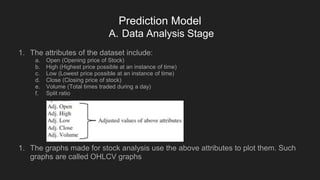
1. The attributes of the dataset include:
a. Open (Opening price of Stock)
b. High (Highest price possible at an instance of time)
c. Low (Lowest price possible at an instance of time)
d. Close (Closing price of stock)
e. Volume (Total times traded during a day)
f. Split ratio
1. The graphs made for stock analysis use the above attributes to plot them. Such
graphs are called OHLCV graphs
A. Data Analysis Stage
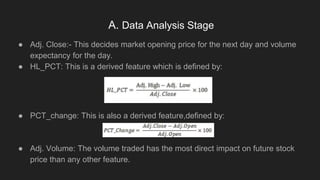
● Adj. Close:- This decides market opening price for the next day and volume
expectancy for the day.
● HL_PCT: This is a derived feature which is defined by:
● PCT_change: This is also a derived feature,defined by:
● Adj. Volume: The volume traded has the most direct impact on future stock
price than any other feature.
B. Training and Testing Stage
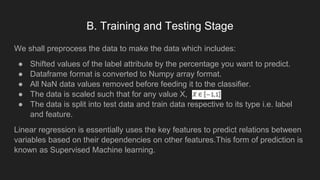
We shall preprocess the data to make the data which includes:
● Shifted values of the label attribute by the percentage you want to predict.
● Dataframe format is converted to Numpy array format.
● All NaN data values removed before feeding it to the classifier.
● The data is scaled such that for any value X,
● The data is split into test data and train data respective to its type i.e. label
and feature.
Linear regression is essentially uses the key features to predict relations between
variables based on their dependencies on other features.This form of prediction is
known as Supervised Machine learning.
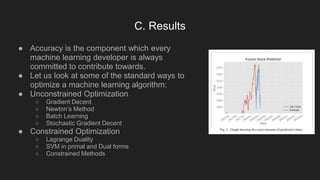
C. Results
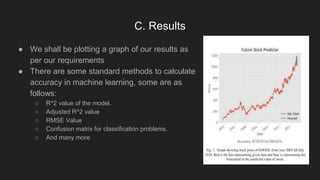
● We shall be plotting a graph of our results as
per our requirements
● There are some standard methods to calculate
accuracy in machine learning, some are as
follows:
○ R^2 value of the model.
○ Adjusted R^2 value
○ RMSE Value
○ Confusion matrix for classification problems.
○ And many more
C. Results
● Accuracy is the component which every
machine learning developer is always
committed to contribute towards.
● Let us look at some of the standard ways to
optimize a machine learning algorithm:
● Unconstrained Optimization
○ Gradient Decent
○ Newton’s Method
○ Batch Learning
○ Stochastic Gradient Decent
● Constrained Optimization
○ Lagrange Duality
○ SVM in primal and Dual forms
○ Constrained Methods
Helpful Hints
A. Requirements and Specification
B. Careful function Analysis
C. Implementation
D. Training & Testing
E. Optimization
Some Common Mistakes
● Bad annotation of training and testing datasets
● Poor understanding of algorithms’ assumptions
● Poor understanding of algorithms’ parameters
● Failure to understand objective
● Not understanding the data
● Avoid leakage (Features, information)
● Not enough data to train the classifier
● Using machine learning where it is not necessary
Conclusion
● Machine learning as we have seen till now, is a very powerful tool and as
evitable, it has some great application.
● Machine learning have found tremendous application and has evolved further
into deep learning and neural networks, but the core idea is more or less the
same for all of them.
● This paper is limited to only supervised machine learning, and tries to explain
only the fundamentals of this complex process.
References
1. Andrew McCallum, Kamal Nigam, Jason Rennie, Kristie Seymore “A Machine learning approach to Building
domain-specific Search engine”, IJCAI, 1999 - Citeseer
2. Yadav, Sameer. (2017). STOCK MARKET VOLATILITY - A STUDY OF INDIAN STOCK MARKET. Global
Journal for Research Analysis. 6. 629-632.
3. Montgomery, D.C., Peck, E.A. and Vining, G.G., 2012. Introduction to linear regression analysis (Vol. 821).
John Wiley & Sons.
4. Draper, N.R.; Smith, H. (1998). Applied Regression Analysis (3rd ed.). John Wiley. ISBN 0-471-17082-8.
5. Robert S. Pindyck and Daniel L. Rubinfeld (1998, 4h ed.). Econometric Models and Economic Forecasts
6. “Linear Regression”, 1997-1998, Yale University http://www.stat.yale.edu/Courses/1997-98/101/linreg.htm
7. Agarwal (July 14, 2017). "Introduction to the Stock Market". Intelligent Economist. Retrieved December 18,
2017.
8. Jason Brownlee, March 2016, “Linear Regression for machine learning”, Machine learning mastery, viewed
on December 2018, https://machinelearningmastery.com/linear-regression-for-machinelearning/
9. Google Developers, Oct 2018, “Decending into ML: Linear Regression”, Google LLC,
https://developers.google.com/machinelearning/crash-course/descending-into-ml/linear-regression
10. Fiess, N.M. and MacDonald, R., 2002. Towards the fundamentals of technical analysis: analysing the
information content of High, Low and Close prices. Economic Modelling, 19(3), pp.353-374.
11. Hurwitz, E. and Marwala, T., 2012. Common mistakes when applying computational intelligence and
machine learning to stock market modelling. arXiv preprint arXiv:1208.4429.
Thank You

Stock market analysis using supervised machine learning

  • 1.
    Stock Market Analysisusing Supervised Machine Learning Paper by : Kunal Pahwa and Neha Agarwal Presented by : Priyanshu Gandhi (C008)
  • 2.
    ● This paperproposes to use machine learning algorithm to predict the future stock price for exchange by using open source libraries ● In this paper author has talked about:- ○ What is stock market? ○ How share price changing? ○ What data to use for training? ○ How to train your algorithm? ○ What are the result? ○ Some helpful hints. ○ Some common mistake people do. Overview
  • 3.
    Introduction ● Stock marketis place where a normal person would trade stocks, make investments and earn some money out of companies that sell a part of themselves on this platform. ● A company lists its stock at a price called the IPO :- This is the offer price at which the company sells the stock and raises money. ● Linear regression in statistics :- Identify the dependents and independent variables and try to establish or identify an existing relationship amongst them. ● Accuracy of your classifier ∝ to the amount of data provided and the attributes selected.
  • 4.
    Prediction Model A. DataAnalysis Stage 1. The attributes of the dataset include: a. Open (Opening price of Stock) b. High (Highest price possible at an instance of time) c. Low (Lowest price possible at an instance of time) d. Close (Closing price of stock) e. Volume (Total times traded during a day) f. Split ratio 1. The graphs made for stock analysis use the above attributes to plot them. Such graphs are called OHLCV graphs
  • 5.
    A. Data AnalysisStage ● Adj. Close:- This decides market opening price for the next day and volume expectancy for the day. ● HL_PCT: This is a derived feature which is defined by: ● PCT_change: This is also a derived feature,defined by: ● Adj. Volume: The volume traded has the most direct impact on future stock price than any other feature.
  • 6.
    B. Training andTesting Stage We shall preprocess the data to make the data which includes: ● Shifted values of the label attribute by the percentage you want to predict. ● Dataframe format is converted to Numpy array format. ● All NaN data values removed before feeding it to the classifier. ● The data is scaled such that for any value X, ● The data is split into test data and train data respective to its type i.e. label and feature. Linear regression is essentially uses the key features to predict relations between variables based on their dependencies on other features.This form of prediction is known as Supervised Machine learning.
  • 7.
    C. Results ● Weshall be plotting a graph of our results as per our requirements ● There are some standard methods to calculate accuracy in machine learning, some are as follows: ○ R^2 value of the model. ○ Adjusted R^2 value ○ RMSE Value ○ Confusion matrix for classification problems. ○ And many more
  • 8.
    C. Results ● Accuracyis the component which every machine learning developer is always committed to contribute towards. ● Let us look at some of the standard ways to optimize a machine learning algorithm: ● Unconstrained Optimization ○ Gradient Decent ○ Newton’s Method ○ Batch Learning ○ Stochastic Gradient Decent ● Constrained Optimization ○ Lagrange Duality ○ SVM in primal and Dual forms ○ Constrained Methods
  • 9.
    Helpful Hints A. Requirementsand Specification B. Careful function Analysis C. Implementation D. Training & Testing E. Optimization Some Common Mistakes ● Bad annotation of training and testing datasets ● Poor understanding of algorithms’ assumptions ● Poor understanding of algorithms’ parameters ● Failure to understand objective ● Not understanding the data ● Avoid leakage (Features, information) ● Not enough data to train the classifier ● Using machine learning where it is not necessary
  • 10.
    Conclusion ● Machine learningas we have seen till now, is a very powerful tool and as evitable, it has some great application. ● Machine learning have found tremendous application and has evolved further into deep learning and neural networks, but the core idea is more or less the same for all of them. ● This paper is limited to only supervised machine learning, and tries to explain only the fundamentals of this complex process.
  • 11.
    References 1. Andrew McCallum,Kamal Nigam, Jason Rennie, Kristie Seymore “A Machine learning approach to Building domain-specific Search engine”, IJCAI, 1999 - Citeseer 2. Yadav, Sameer. (2017). STOCK MARKET VOLATILITY - A STUDY OF INDIAN STOCK MARKET. Global Journal for Research Analysis. 6. 629-632. 3. Montgomery, D.C., Peck, E.A. and Vining, G.G., 2012. Introduction to linear regression analysis (Vol. 821). John Wiley & Sons. 4. Draper, N.R.; Smith, H. (1998). Applied Regression Analysis (3rd ed.). John Wiley. ISBN 0-471-17082-8. 5. Robert S. Pindyck and Daniel L. Rubinfeld (1998, 4h ed.). Econometric Models and Economic Forecasts 6. “Linear Regression”, 1997-1998, Yale University http://www.stat.yale.edu/Courses/1997-98/101/linreg.htm 7. Agarwal (July 14, 2017). "Introduction to the Stock Market". Intelligent Economist. Retrieved December 18, 2017. 8. Jason Brownlee, March 2016, “Linear Regression for machine learning”, Machine learning mastery, viewed on December 2018, https://machinelearningmastery.com/linear-regression-for-machinelearning/ 9. Google Developers, Oct 2018, “Decending into ML: Linear Regression”, Google LLC, https://developers.google.com/machinelearning/crash-course/descending-into-ml/linear-regression 10. Fiess, N.M. and MacDonald, R., 2002. Towards the fundamentals of technical analysis: analysing the information content of High, Low and Close prices. Economic Modelling, 19(3), pp.353-374. 11. Hurwitz, E. and Marwala, T., 2012. Common mistakes when applying computational intelligence and machine learning to stock market modelling. arXiv preprint arXiv:1208.4429.
  • 12.