Download to read offline
![International Research Journal of Engineering and Technology (IRJET) e-ISSN: 2395-0056
Volume: 05 Issue: 10 | Oct 2018 www.irjet.net p-ISSN: 2395-0072
© 2018, IRJET | Impact Factor value: 7.211 | ISO 9001:2008 Certified Journal | Page 189
PI CONTROLLER BASED SHUNT CONNECTED THREE PHASE ACTIVE
POWER FILTER
Abhilasha N. Salunkhe1, Dr. Paresh J. Shah2
1PG Scholar,Department of Electrical Engineering, SSBT’s College of Engineering & Technology, Jalgaon.
2Professor, Department of Electrical Engineering, SSBT’s College of Engineering & Technology, Jalgaon.
----------------------------------------------------------------------------***---------------------------------------------------------------------
Abstract – In recent years the large scale use of the power
electronic equipment has led to an increase of harmonics in
the power system. The harmonics results into a poor power
quality and have great adverse economic impact on the
utilities and customer so to mitigate current harmonic we
were used shunt active power filter (SHAF). Proportional
integral (PI) technique is utilize to control the performance of
SHAF. The projected PI with SHAF monitoringstructureunder
steady working circumstances is established to recover the
power quality is simulated with MATLAB/ SIMULINK.
Key Words: Harmonics, Shunt Active Filter, DC link
voltage, PI controller.
1. INTRODUCTION
The large scale use of the non-linear loadssuchasadjustable
speed drives, traction drives, etc. [1] and power converters
has contributed for the deterioration of the power quality
and this has resulted in to a great economic loss. Thus it is
important to develop the equipment that can mitigate the
problem of poor power quality.
Power Quality (PQ) [2], is defined as "any power problem
established in voltage, current or frequency deviation which
leads to damage, malfunctioning, disoperation of the
consumer equipment". Poor power quality causes many
damages to the system, and has a contrary economic impact
on the utilities and customers. Highly automatic electric
equipment, in particular, causes enormous economic loss
every year. The problems of harmonics can be reduced or
mitigated by the use of power filters. The Active power
filters have been proven very effectiveinthe reductionofthe
system harmonics [3]. One of the most severe and common
power quality problem is current harmonics. Particularly,
voltage harmonics [1] and power distribution equipment
problems result from current harmonics.
The voltage generated at the generating station isnotpurely
Sinusoidal. Due to the non-uniformity of the magnetic field
and the winding distribution in a working AC machine,
voltage waveform distortions are created, and thus the
voltage obtained is not purely sinusoidal. The distortion at
the point of generation is very small (about 1% to 2%), but
still it exists. Due to this deviation from the pure sine wave,
voltage harmonics occurs.
Each time a pure AC voltage is realistic to load, after that
load current drawn by the load is proportional tothevoltage
and impedance and monitors the covering of the voltage
waveform. These loads are referred to as linear loads (loads
where the voltage and current follow one another without
any distortion to their pure sine waves) [4]. Some loads
cause the current to vary disproportionately with the
voltage during each half cycle. These loads are defined as
non-linear loads. The current harmonics and the voltage
harmonics are generated because of these non-linear
loads.so due to non linear load effects many problem’s like
electro-magnetic interference (EMI), power system voltage
fluctuations low low powerfactor,lowenergyefficiency, and
so on. Hence, it is necessary to compensate this effects [5].
2. ORGANIZATION OF CONTROL CONVERTERS
The accuracy in the estimation of the ac grid voltage
parameters has a stronginfluenceintheoverall performance
of grid-connected power converters. A precise
synchronization algorithm is needed to estimate the grid
voltage parameters, i.e., voltage amplitude, frequency, and
phase angle, as these values are needed for conducting an
accurate control of the active and the reactive power
delivered to the grid. In addition, a precise monitoring ofthe
grid conditions is mandatory in order to determine themost
suitable operation mode of the converters, as well as for
supporting properly the connection and disconnection
maneuvers. Due to the significance of the control of
microgrids under generic grid conditions, the
synchronization system should be able to confirm a proper
behavior underunbalancedanddistortedvoltageconditions.
The synchronization system should be able to work on both
grid-connected and islandmodesbyusingpowerconverters.
Change between these two process the synchronizationunit
should provide precise synchronization signals which allow
the grid-forming power converter for establish a stable
voltage. In the island mode, the synchronization system
works as an oscillator at a fixed frequency ω∗ . In transient
operation, the voltage generated by the grid-forming power
converter should be resynchronized with the restored grid
voltage. The synchronization system slowlyvariesthephase
angle and frequency of the island’s voltage to resynchronize
with the grid voltage. All the grid-feeding power converters
linked to such microgrid would be exposed to the re-joining
frequency and phase angle transients, so that this maneuver
has to be prepared in a stable and secure way.
2.1. Synchronous Reference Frame Phase-Locked Loop
The phase-locked loop technologyhasextensivelybeenused
to synchronize grid-connected power converters with the
grid voltage. In three-phase systems, the synchronous](https://image.slidesharecdn.com/irjet-v5i1034-181023090832/85/IRJET-PI-Controller-based-Shunt-Connected-Three-Phase-Active-Power-Filter-1-320.jpg)
![International Research Journal of Engineering and Technology (IRJET) e-ISSN: 2395-0056
Volume: 05 Issue: 10 | Oct 2018 www.irjet.net p-ISSN: 2395-0072
© 2018, IRJET | Impact Factor value: 7.211 | ISO 9001:2008 Certified Journal | Page 189
PI CONTROLLER BASED SHUNT CONNECTED THREE PHASE ACTIVE
POWER FILTER
Abhilasha N. Salunkhe1, Dr. Paresh J. Shah2
1PG Scholar,Department of Electrical Engineering, SSBT’s College of Engineering & Technology, Jalgaon.
2Professor, Department of Electrical Engineering, SSBT’s College of Engineering & Technology, Jalgaon.
----------------------------------------------------------------------------***---------------------------------------------------------------------
Abstract – In recent years the large scale use of the power
electronic equipment has led to an increase of harmonics in
the power system. The harmonics results into a poor power
quality and have great adverse economic impact on the
utilities and customer so to mitigate current harmonic we
were used shunt active power filter (SHAF). Proportional
integral (PI) technique is utilize to control the performance of
SHAF. The projected PI with SHAF monitoringstructureunder
steady working circumstances is established to recover the
power quality is simulated with MATLAB/ SIMULINK.
Key Words: Harmonics, Shunt Active Filter, DC link
voltage, PI controller.
1. INTRODUCTION
The large scale use of the non-linear loadssuchasadjustable
speed drives, traction drives, etc. [1] and power converters
has contributed for the deterioration of the power quality
and this has resulted in to a great economic loss. Thus it is
important to develop the equipment that can mitigate the
problem of poor power quality.
Power Quality (PQ) [2], is defined as "any power problem
established in voltage, current or frequency deviation which
leads to damage, malfunctioning, disoperation of the
consumer equipment". Poor power quality causes many
damages to the system, and has a contrary economic impact
on the utilities and customers. Highly automatic electric
equipment, in particular, causes enormous economic loss
every year. The problems of harmonics can be reduced or
mitigated by the use of power filters. The Active power
filters have been proven very effectiveinthe reductionofthe
system harmonics [3]. One of the most severe and common
power quality problem is current harmonics. Particularly,
voltage harmonics [1] and power distribution equipment
problems result from current harmonics.
The voltage generated at the generating station isnotpurely
Sinusoidal. Due to the non-uniformity of the magnetic field
and the winding distribution in a working AC machine,
voltage waveform distortions are created, and thus the
voltage obtained is not purely sinusoidal. The distortion at
the point of generation is very small (about 1% to 2%), but
still it exists. Due to this deviation from the pure sine wave,
voltage harmonics occurs.
Each time a pure AC voltage is realistic to load, after that
load current drawn by the load is proportional tothevoltage
and impedance and monitors the covering of the voltage
waveform. These loads are referred to as linear loads (loads
where the voltage and current follow one another without
any distortion to their pure sine waves) [4]. Some loads
cause the current to vary disproportionately with the
voltage during each half cycle. These loads are defined as
non-linear loads. The current harmonics and the voltage
harmonics are generated because of these non-linear
loads.so due to non linear load effects many problem’s like
electro-magnetic interference (EMI), power system voltage
fluctuations low low powerfactor,lowenergyefficiency, and
so on. Hence, it is necessary to compensate this effects [5].
2. ORGANIZATION OF CONTROL CONVERTERS
The accuracy in the estimation of the ac grid voltage
parameters has a stronginfluenceintheoverall performance
of grid-connected power converters. A precise
synchronization algorithm is needed to estimate the grid
voltage parameters, i.e., voltage amplitude, frequency, and
phase angle, as these values are needed for conducting an
accurate control of the active and the reactive power
delivered to the grid. In addition, a precise monitoring ofthe
grid conditions is mandatory in order to determine themost
suitable operation mode of the converters, as well as for
supporting properly the connection and disconnection
maneuvers. Due to the significance of the control of
microgrids under generic grid conditions, the
synchronization system should be able to confirm a proper
behavior underunbalancedanddistortedvoltageconditions.
The synchronization system should be able to work on both
grid-connected and islandmodesbyusingpowerconverters.
Change between these two process the synchronizationunit
should provide precise synchronization signals which allow
the grid-forming power converter for establish a stable
voltage. In the island mode, the synchronization system
works as an oscillator at a fixed frequency ω∗ . In transient
operation, the voltage generated by the grid-forming power
converter should be resynchronized with the restored grid
voltage. The synchronization system slowlyvariesthephase
angle and frequency of the island’s voltage to resynchronize
with the grid voltage. All the grid-feeding power converters
linked to such microgrid would be exposed to the re-joining
frequency and phase angle transients, so that this maneuver
has to be prepared in a stable and secure way.
2.1. Synchronous Reference Frame Phase-Locked Loop
The phase-locked loop technologyhasextensivelybeenused
to synchronize grid-connected power converters with the
grid voltage. In three-phase systems, the synchronous](https://image.slidesharecdn.com/irjet-v5i1034-181023090832/75/IRJET-PI-Controller-based-Shunt-Connected-Three-Phase-Active-Power-Filter-1-2048.jpg)
![International Research Journal of Engineering and Technology (IRJET) e-ISSN: 2395-0056
Volume: 05 Issue: 10 | Oct 2018 www.irjet.net p-ISSN: 2395-0072
© 2018, IRJET | Impact Factor value: 7.211 | ISO 9001:2008 Certified Journal | Page 190
reference frame phase-locked loop (SRF-PLL) has been
broadly used for this purpose. The structure of the SRF-PLL
is depicted in Fig.1. By using Park transformation when the
abc reference frame into the rotating dq reference frame
then SRF-PLLdecodesthethree-phaseinstantaneousvoltage
waveforms. The angular position of this dq reference frame
is controlled through a feedback control loop which drives
the vq component to zero. In this synchronization structure,
the estimated grid frequency is . As depicted in Fig. 1, the
value of the rated frequency is normally included as a feed
forward in order to improve the dynamics of the phase
estimation , which is obtained by integrating . [6]–[9].
In spite of the good behavior of the SRF-PLL under balanced
grid conditions, its performance is deteriorated when the
three phase input signal becomes unbalanced or distorted
[10], [11].
To overcome this drawback, some advanced grid
synchronization techniques have been proposed in the
literature. This is for instance the case of the decoupled
double-synchronous reference frame PLL, which is an
enhanced PLL that stems from the same operation principle
as the SRF-PLL, but improves its phase-angleandmagnitude
estimation under unbalanced conditions [12], [13].
Fig.-1 Block diagram of SRF PLL
2.2.StationaryReferenceFrameFrequency-LockedLoop
As an alternative to PLL-based synchronization structures,
other implementations based on a frequency-locked loop
(FLL) can be used. Among different proposals, the
synchronization structures basedontheimplementation ofa
second-order generalized integrator (SOGI) and an FLL to
detect the grid voltage components, and , as well
as the grid frequency [14], as is presented in Fig. 2, have
proven to be effectiveandaccurateundergeneric conditions.
The SOGI is implemented in both αβ axis, giving rise to a
dual-SOGI (DSOGI) structure, which is an adaptivebandpass
filter that provides the filtered version of the input voltage
vector , as well as its quadrature component . The
resonance frequency of the DSOGI is the grid frequency
estimated by the FLL. One of the mainadvantagesofusing an
FLL lays on the fact that this structure is less sensitive than
the PLL to phaseangle jumps that may occur in the grid
voltage during transient grid faults, thus improving its
performance under abnormal grid conditions [15].
Fig.-2 Block diagram of DSOGI FLL
This interesting feature of the FLL provides a fast dynamic
response with low overshooting, thus allowing a fast and a
smooth transition between the grid-connected and the
islanded operating modes of the microgrid.
3. DC LINK VOLTAGE REGULATION BY USING PI
Fig. 3 shows the construction ofthecontrollercircuit.System
contains of PI controller, limiter and three phase sine wave
generator for reference current and switching signals
generation [16]. It is known that the real power of the
system changes and that is compensated by the DC link
capacitor voltage. The fresh capacitor voltage is matched
with a reference voltage and error signal which is given to
the PI controller.
Fig.-3 Conventional PI Controller
Then the error signal passing through a PI controller, which
gives to zero steady error in tracking the reference current
signal. The output of the controller is in peak value of the
supply current (Imax), which is composed of two
components: (a) fundamental active power component of
load current and (b) loss component of APF; to maintain the
average capacitor voltage to a constant value. This peak
value of the current (Imax) is multiplied with the respective
source voltages for generate the reference compensating
currents. Hysteresis band giveserrorsignal whichcompared](https://image.slidesharecdn.com/irjet-v5i1034-181023090832/85/IRJET-PI-Controller-based-Shunt-Connected-Three-Phase-Active-Power-Filter-2-320.jpg)
![International Research Journal of Engineering and Technology (IRJET) e-ISSN: 2395-0056
Volume: 05 Issue: 10 | Oct 2018 www.irjet.net p-ISSN: 2395-0072
© 2018, IRJET | Impact Factor value: 7.211 | ISO 9001:2008 Certified Journal | Page 191
and sense actual current (Isa, Isb, Isc) and reference current
(I*sa, I*sb, I*sc).
Fig. 4 shows how the error signal is generated by comparing
the two currents. The output of this hysteresis band is used
to give the gating signal, which controls the converter
switches and using this gating signal the compensating
current are generated. The source currents are prepared to
monitor the sinusoidal reference current, within a fixed
hysteretic band. The width of hysteresis window, harmonic
spectrum and the device switching frequency is determines
by the source current pattern. In this scheme, each phase of
the converter is controlled independently. To increase the
current of a particular phase, the lower switch of the
converter associated with that particular phase is turned on
while to decrease the current the upper switch of the
respective converter phase is turned on. With this, one can
realize the potential and feasibility of PIcontroller[17],[18].
(a) Current Wave of Current Controller
(b) Current Controller Waveform
Fig.-4 Hysteresis Band
4. SIMULATIONS
Table-1 System parameters used in Simulink
The three-phase three-wire system with a non-linear loadis
equipped with shunt active filter for mitigating the current
harmonics. PI controller and FLC are used to control the
shunt active filter under non linear load condition. Table 1
shows the systemparametersofthesourcevoltagecondition
circuit that has been analyzed.
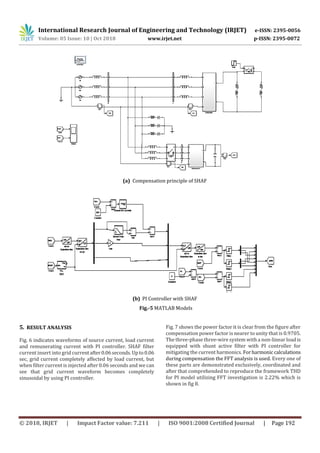
MATLAB Model of Compensation Principle of SHAF
Fig. 5 shows the MATLAB modules of compensation
principle of SHAF system and PI controller. The bridge of
eight IGBTs block set is used to build three phase voltage
source inverter. The inductor, capacitor, resistorareinclude
in the filter design. This filter illuminates the higher order
harmonic. From the scope the compensation status is
observed. Reference generator block detect the sag voltage
and convert this in to two stationary voltages. The pulse
generator block generates pulses form PWM topology. The
block can be used to fire the forced commutated devices
IGBTs of three phase inverter.
The pulses of measured voltages are generated by
comparing a repeating waveform to a reference modulating
signal. The modulating signals can be generated bymeansof
selecting sectors of hexagon, calculating switching time and
selecting switching pulses. Once the sag is appearing on one
of the feeder, reference signal generate pulseforthreephase
inverter. This PWM pulses applied to the gates of the IGBTs
for triggering. The inverter circuit converts DC signal in to
AC signal. The output voltage is then measure on the scope
labeled as result. Because of the LC filter pure sine wave
output is obtained.
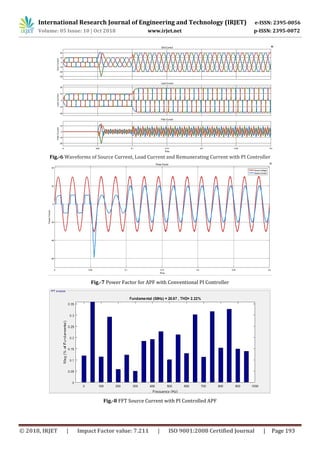
From the FFT analysis the THD of a periodic
distorted signal is measured graphically. The THD is
measured for voltage. The total harmonicdistortiontheratio
of RMS value of total harmonics of the signal, divided by the
RMS value of its fundamental signal.
System parameters Values
Source voltage 300V(Peak)
DC Link Capacitance 1.3mF
Load impedance 50Ω,100mH
FLC 7*7 Triangular
Sample Interval 5e-5 s
Smoothing Reactance 1.8mH,120μF](https://image.slidesharecdn.com/irjet-v5i1034-181023090832/85/IRJET-PI-Controller-based-Shunt-Connected-Three-Phase-Active-Power-Filter-3-320.jpg)
![International Research Journal of Engineering and Technology (IRJET) e-ISSN: 2395-0056
Volume: 05 Issue: 10 | Oct 2018 www.irjet.net p-ISSN: 2395-0072
© 2018, IRJET | Impact Factor value: 7.211 | ISO 9001:2008 Certified Journal | Page 194
6. CONSLUSION
Improvement of power class and relative power
compensation for renewable based power generation has
been proposed in this system. Major advantagesofprojected
system are related to its simplicity, demonstrating and
implementation. A model has been developed in MATLAB
SIMULINK and simulated to verify the results. PI controller
offers fast alternation to mitigate current harmonic and
improve power quality by using theshuntactivefilter,which
gives total THD 2.22% as well as improve power factor.
REFERENCES
[1] Akagi H, “New trends in active filters for power
conditioning,” IEEE Trans IndAppl pp. 1312–221996.
[2] H. Rudnick, Juan Dixon and Luis Moran,“Active power
filters as a solution to power quality problems in
distribution networks,” IEEE power & energy
magazine, pp. 32-40, Sept/Oct. 2003.
[3] Abhilasha N. Salunkhe, Dr. Paresh J. Shah, “Power
Quality Improvement Technique for Voltage Source
Inverter,” Pratibha: International Journal of Science
Spirituality business and technology, vol.6, no.1, pp.
69-72, January 2018.
[4] A. Mansoor, W. M. Gardy, P. T. Staats, R. S. Thallam, M.
T. Doyle, and M. J. Samotyj, “Predicting the net
harmonic current produced by large numbers of
distributed single phase computer loads,”IEEETrans.
Power Delivery, Vol.10, pp. 2001-2006, 1994.
[5] Abhilasha N. Salunkhe, Dr.PareshJ.Shah,“FuzzyLogic
Controller Based Active Power Filter for Voltage
Source Inverter,” International Journal of Research,
vol.7, issue 7, pp.14-23, July 2018.
[6] P. Rodriguez, A. Luna, R. Teodorescu, F. Iov, and F.
Blaabjerg, “Fault ride-through capability
implementation in wind turbine converters using a
decoupled double synchronous reference framePLL,”
in Proc. Eur. Conf. Power Electron. Appl., 2007, pp. 1–
10.
[7] V. Kaura and V. Blasko, “Operation of a phase locked
loop system under distorted utility conditions,” IEEE
Trans. Ind. Appl., vol. 33, no. 1, pp. 58-63, Jan./Feb.
1997.
[8] S. K. Chung, “A phase tracking system for three phase
utility interface inverters,” IEEE Trans. Power
Electron., vol. 15, no. 3, pp. 431–438, May 2000.
[9] A. Timbus, R. Teodorescu, F. Blaabjerg, and M.Liserre,
“Synchronization methods forthreephasedistributed
power generation systems. An overview and
evaluation,” in Proc. IEEE 36th Power Electron. Spec.
Conf., 2005, pp. 2474–2481.
[10] R. M. Santos Filho, P. F. Seixas, P. C. Cortizo, L. A. B.
Torres, and A. F. Souza, “Comparison of three single-
phase PLL algorithms for UPS applications,” IEEE
Trans. Ind. Electron., vol. 55, no. 8, pp. 2923–2932,
Aug. 2008.
[11] S. Shinnaka, “A robust single-phase PLL system with
stable and fast tracking,” IEEE Trans. Ind. Appl., vol.
44, no. 2, pp. 624–633, Mar./Apr. 2008.
[12] P. Rodriguez, J. Pou, J. Bergas, J. I. Candela, R. P.
Burgos, and D. Boroyevich, “Decoupled double
synchronous reference frame PLL for power
converters control,” IEEE Trans. Power Electron., vol.
22, no. 2, pp. 584– 592, Mar. 2007.
[13] S. Cobreces, E. J. Bueno, D. Pizarro, F. J. Rodriguez, and
F. Huerta, “Grid impedance monitoring system for
distributed power generation electronic interfaces,”
IEEE Trans. Instrum. Meas., vol. 58, no. 9, pp. 3112–
3121, Sep. 2009.
[14] P. Rodriguez, A. Luna, M. Ciobotaru, R. Teodorescu,
and F. Blaabjerg, “Advanced Grid synchronization
system for power converters under unbalanced and
distorted operating conditions,” in Proc. IEEE 32nd
Annu. Conf. Ind. Electron, pp. 5173-5178, 2006.
[15] P. Rodriguez, A. Luna, I. Candela, R. Rosas, R.
Teodorescu, and F. Blaabjerg, “Multi-resonant
frequency-locked loop for grid synchronization of
power converters under distorted grid conditions,”
IEEE Trans. Ind. Electron., vol. 58, no. 1, pp. 127-138,
Jan. 2011.
[16] Chaoui Abdelmadjid, KrimFateh, Gaubert Jean-Paul,
Rambault Laurent, “DPCcontrolledthree-phaseactive
filter for power quality improvement,” Electrical Int J
Electr Power Energy System pp. 476-85, 2008.
[17] Suresh Mikkili, Panda AK., “Real-timeimplementation
of PI and fuzzy logic controllers based shunt active
filter control strategies for power quality
improvement,” Int J Electr Power Energy Syst., pp.
1114- 26, 2012.
[18] Suresh Mikkili, Panda A. K., “PI and fuzzy logic
controller based 3-phase 4-wire Shunt activefilterfor
mitigation of Current harmonics with Id-Iq control
strategy,” Power Electron (JPE), pp. 914-21, 2011.](https://image.slidesharecdn.com/irjet-v5i1034-181023090832/85/IRJET-PI-Controller-based-Shunt-Connected-Three-Phase-Active-Power-Filter-6-320.jpg)

This document describes a simulation of a shunt active power filter with a PI controller to mitigate current harmonics from nonlinear loads. It begins with an introduction to power quality issues caused by nonlinear loads and an overview of active power filters. It then describes the system configuration, including the PI controller used to regulate the DC link voltage of the active power filter inverter. Simulation results in MATLAB/Simulink show the PI controller is effective at eliminating current harmonics on the source side, improving the power factor to near unity and reducing the total harmonic distortion to 2.22%. The system is concluded to offer fast compensation of current harmonics and improved power quality through use of the shunt active power filter with PI control.


![Final presentation [Autosaved].pptxFinal presentation [Autosaved].pptxFinal p...](https://cdn.slidesharecdn.com/ss_thumbnails/finalpresentationautosaved-250527075000-e9e51fee-thumbnail.jpg?width=640&height=640&fit=bounds)


![[Deck] What's New in Spark-Iceberg Integration via DSV2.pptx](https://cdn.slidesharecdn.com/ss_thumbnails/deckwhatsnewinspark-icebergintegrationviadsv2-260210005337-25955b12-thumbnail.jpg?width=640&height=640&fit=bounds)


