Kaleemullah et al. Int. Journal of Engineering Research and Application www.ijera.com
ISSN : 2248-9622, Vol. 6, Issue 6, ( Part -4) June 2016, pp.01-08
www.ijera.com 1 | P a g e
Adaptive Fuzzy PID Based Control Strategy For 3Phase 4Wire
Shunt Active Filter To Mitigate Current Harmonics Of Grid
Interconnection Of Renewable Energy Based Distribution System
Kaleemullah1
*, Amjad Khan2
**, Dr. Muhammad Naeem Arbaab3
***
12
PG Research student, Dept. of EEE, University of Engineering and technology Peshawar, KP, Pakistan,
3
Research Scholar, Dept. of EEE, University of Engineering and technology Peshawar, KP, Pakistan
ABSTRACT
This paper presents a new control strategy for controlling the shunt active power filter to compensate reactive
power and to reduce the unwanted harmonics in the grid current. Shunt active filter act as a current source which
is connected in parallel with a non-linear load and controlled to produce the required compensating current. The
proposed control strategy is based on the fuzzy PID controller which is used for determining the reference
compensating currents of the three-phase shunt active power filters. Simulations are carried out using
MATLAB/SIMULINK to verify the performance of the proposed controller. The output shows the controller has
fast dynamic response high accuracy of tracking DC voltage reference and robust to load parameters variations.
Index Terms: Active power filter (APF), fuzzy controller, Fuzzy PID controller, distributed generation (DG),
distribution system, grid interconnection
I. INTRODUCTION
The non-renewable- energy decreases at a
faster pace has made renewable energy as a future
energy source. Renewable energy-based power
generation systems has many advantages such as the
development of clean energy, reduce global
warming etc. But on the other hand, renewable
energy intermittently when it is directly connected to
the grid caused many power quality issues such as
harmonics, voltage sags, break etc. [1].The
distributed generation schemes are widely uses
power electronic interface for grid connections,
because of its fast response, harmonic compensation
and reactive power compensation. Due to the
widespread use of non-linear loads large amounts of
harmonic currents are injected into the power
systems. These harmonic currents flowing through
the impedance of the supply system causing
harmonic currents to pull by other loads connected
to the PCC. The persistence of current harmonics
and voltage in the power system increases the losses
in the lines, decrease the power factor and may cause
timing errors in sensitive electronic equipment.
Three phases balanced non-linear loads such as
motor drivers, silicon controlled rectifiers (SCR),
large uninterruptible power supplies (UPS) produce
harmonic currents and voltages that are harmonics of
positive sequence as 7th, 13th, etc. and negative-
sequence harmonics like 5th, 11th, etc. Single phase
non-linear loads such as switch-mode power
supplies in computer equipment produce harmonic
currents and voltages which are third order zero-
sequence harmonics, triplen harmonics like 3rd, 9th,
15th, 21st, etc. Unlike positive and negative-
sequence harmonic currents, triplen harmonic
currents do not cancel but add arithmetically at the
neutral bus. This result’s the neutral current that
touches magnitudes as high as 1.73 times the phase
current. In addition to the risk of cables and
transformers overheating, the third harmonic can
recede energy efficiency [2]. The method of current
harmonics reduction reduces passive LC filters
which are simple and low cost. However, these
filters have drawbacks as well like large size, tuning
and risk of resonance problems. As harmonic
pollution is severe in power networks, power system
engineer developed dynamic and adjustable
solutions to the power quality problems. Such
equipment is known as Active Filters (AF’s) [3].
These filters are used to compensate the load current
harmonics and improve the power factor.
In addition to eliminating the harmonic
currents and improving the power factor, SAF can
maintain the balance of electrical system under the
unbalanced load condition and nonlinear loads [4-6].
In general, the performance of SAF is based on three
design criteria [7-12]: i) the design of the power
inverter; ii) the types of current regulators used; iii)
the methods used to obtain the reference current.
Several control techniques have been used to obtain
the reference current. These techniques such as the
theory of instantaneous reactive power [7], notch
filters [9], the control flow based [10], the theory of
balance of power [9] - [13], and the controller
sliding mode have been used to improve the
performance of active filters. However, most of
these control techniques include a number of
transformations and are difficult to implement.
RESEARCH ARTICLE OPEN ACCESS
Kaleemullah et al. Int. Journal of Engineering Research and Application www.ijera.com
ISSN : 2248-9622, Vol. 6, Issue 6, ( Part -4) June 2016, pp.01-08
www.ijera.com 2 | P a g e
In this study, a new control strategy is
introduced that is based on Fuzzy PID controller. As
PID is regarded as the standard control structures of
the classical control theory, and fuzzy controllers
have positioned themselves as a counterpart of
classical PID controllers on the same dominant role
at the knowledge rich spectrum (Åström and
Hagglund 1995, Oh et al. 2004). PID controllers are
designed for linear systems and they provide a
preferable cost/benefit ratio. However, the presences
of nonlinear effects limit their performances. Fuzzy
controllers are successful applied to non-linear
system because of their knowledge based nonlinear
structural characteristics. Hybridization of these two
controller structures comes to one’s mind
immediately to exploit the beneficial sides of both
categories. Basically, in this design methodology,
the classical PID and fuzzy controller have been
combined by a blending mechanism that depends on
a certain function of actuating error. Simulations are
performed on MATLAB®/Simulink toolbox to
illustrate the efficiency of the proposed method.
The paper is organized as follows: Section
II describes the system description and controller for
interfacing grid inverter. An Extensive Matlab
simulation study is presented in Section III and
Section IV concludes the paper
Fig. 1. Schematic of proposed renewable based
distributed generation system.
II. SYSTEM DESCRIPTION
The proposed system consists of RES
connected to the dc-link of a grid-interfacing
inverter as shown in Fig. 1. The shunt active filter is
a key element of a system of DG, since it
interconnects the renewable energy source to the
grid and provides the generated power. The RES can
be a DC source or an AC source coupled to the DC
bus rectifier. Usually, the fuel cell and photovoltaic
energy sources generate power at variable low dc
voltage, while the variable speed wind turbines
generate power at variable ac voltage. Thus, the
power generated from these renewable sources needs
power conditioning (i.e., dc/dc or ac/dc) before
connecting on dc-link. The dc-capacitor decouples
the RES from grid and also allows independent
control of converters on either side of dc-link.
A. DC-Link Voltage and Power Control Operation
Due to the intermittent nature of the RES,
the generated power is variable in nature. The dc-
link plays an important role in the transfer of this
power from variable renewable energy to the grid.
RES are represented as current sources connected to
the dc-link of a grid-interfacing inverter. Figure 2
shows a systematic representation of energy transfer
from renewable energy sources to the grid via the
DC-link. The current injected by renewable into dc-
link at voltage level can be given as
Idc1=PRES / Vdc (1)
Where PREN is the power generated from RES.
Fig. 2. DC-Link equivalent diagram
The current flow on the other side of dc-
link can be represented as
Idc2=Pinv /Vdc= (Pg+Ploss) / Vdc (2)
Where PG and PLoss are total power available at grid-
interfacing inverter side, active power supplied to
the grid and inverter losses, respectively. If inverter
losses are negligible then PREN= PINV.
B. Control of Grid Interfacing Inverter:
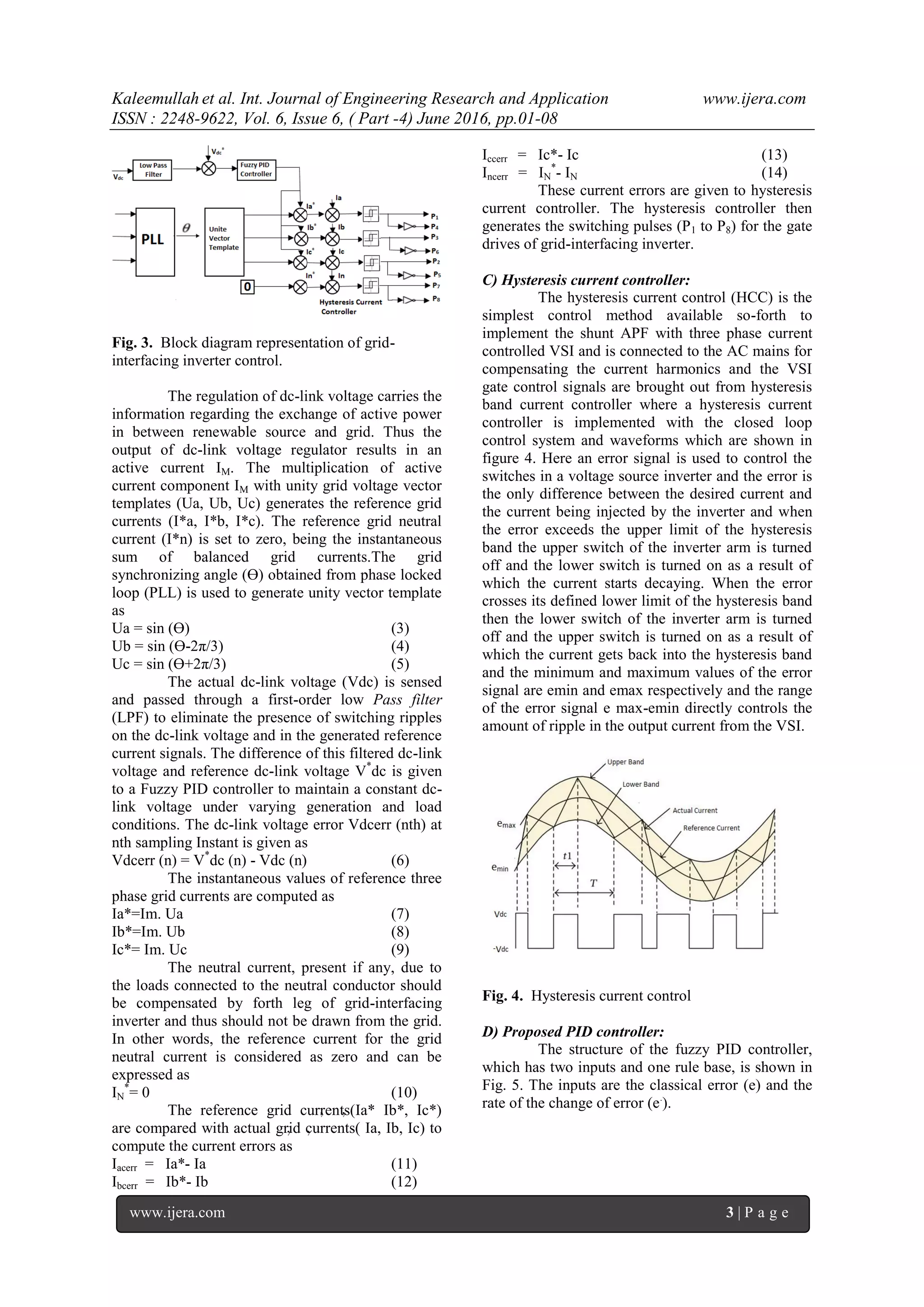
The control diagram of grid- interfacing
inverter for a 3-phase 4-wire system is shown in Fig.
3. The fourth leg of inverter is used to compensate
the neutral current of load. While performing the
power management operation, the inverter is
actively controlled in such a way that it always
draws/supplies fundamental active power from/ to
the grid. If the load connected to the PCC is non-
linear or unbalanced or the combination of both, the
given control approach also compensates the
harmonics, unbalance, and neutral current.
The duty ratio of inverter switches are
varied in a power cycle such that the combination of
load and inverter injected power appears as balanced
resistive load to the grid.
Kaleemullah et al. Int. Journal of Engineering Research and Application www.ijera.com
ISSN : 2248-9622, Vol. 6, Issue 6, ( Part -4) June 2016, pp.01-08
www.ijera.com 3 | P a g e
Fig. 3. Block diagram representation of grid-
interfacing inverter control.
The regulation of dc-link voltage carries the
information regarding the exchange of active power
in between renewable source and grid. Thus the
output of dc-link voltage regulator results in an
active current IM. The multiplication of active
current component IM with unity grid voltage vector
templates (Ua, Ub, Uc) generates the reference grid
currents (I*a, I*b, I*c). The reference grid neutral
current (I*n) is set to zero, being the instantaneous
sum of balanced grid currents.The grid
synchronizing angle (Ɵ) obtained from phase locked
loop (PLL) is used to generate unity vector template
as
Ua = sin (Ɵ) (3)
Ub = sin (Ɵ-2π/3) (4)
Uc = sin (Ɵ+2π/3) (5)
The actual dc-link voltage (Vdc) is sensed
and passed through a first-order low Pass filter
(LPF) to eliminate the presence of switching ripples
on the dc-link voltage and in the generated reference
current signals. The difference of this filtered dc-link
voltage and reference dc-link voltage V*
dc is given
to a Fuzzy PID controller to maintain a constant dc-
link voltage under varying generation and load
conditions. The dc-link voltage error Vdcerr (nth) at
nth sampling Instant is given as
Vdcerr (n) = V*
dc (n) - Vdc (n) (6)
The instantaneous values of reference three
phase grid currents are computed as
Ia*=Im. Ua (7)
Ib*=Im. Ub (8)
Ic*= Im. Uc (9)
The neutral current, present if any, due to
the loads connected to the neutral conductor should
be compensated by forth leg of grid-interfacing
inverter and thus should not be drawn from the grid.
In other words, the reference current for the grid
neutral current is considered as zero and can be
expressed as
IN
*
= 0 (10)
The reference grid currents(Ia* Ib*, Ic*)
are compared with actual grid currents( Ia, Ib, Ic) to
compute the current errors as
Iacerr = Ia*- Ia (11)
Ibcerr = Ib*- Ib (12)
Iccerr = Ic*- Ic (13)
Incerr = IN
*
- IN (14)
These current errors are given to hysteresis
current controller. The hysteresis controller then
generates the switching pulses (P1 to P8) for the gate
drives of grid-interfacing inverter.
C) Hysteresis current controller:
The hysteresis current control (HCC) is the
simplest control method available so-forth to
implement the shunt APF with three phase current
controlled VSI and is connected to the AC mains for
compensating the current harmonics and the VSI
gate control signals are brought out from hysteresis
band current controller where a hysteresis current
controller is implemented with the closed loop
control system and waveforms which are shown in
figure 4. Here an error signal is used to control the
switches in a voltage source inverter and the error is
the only difference between the desired current and
the current being injected by the inverter and when
the error exceeds the upper limit of the hysteresis
band the upper switch of the inverter arm is turned
off and the lower switch is turned on as a result of
which the current starts decaying. When the error
crosses its defined lower limit of the hysteresis band
then the lower switch of the inverter arm is turned
off and the upper switch is turned on as a result of
which the current gets back into the hysteresis band
and the minimum and maximum values of the error
signal are emin and emax respectively and the range
of the error signal e max-emin directly controls the
amount of ripple in the output current from the VSI.
Fig. 4. Hysteresis current control
D) Proposed PID controller:
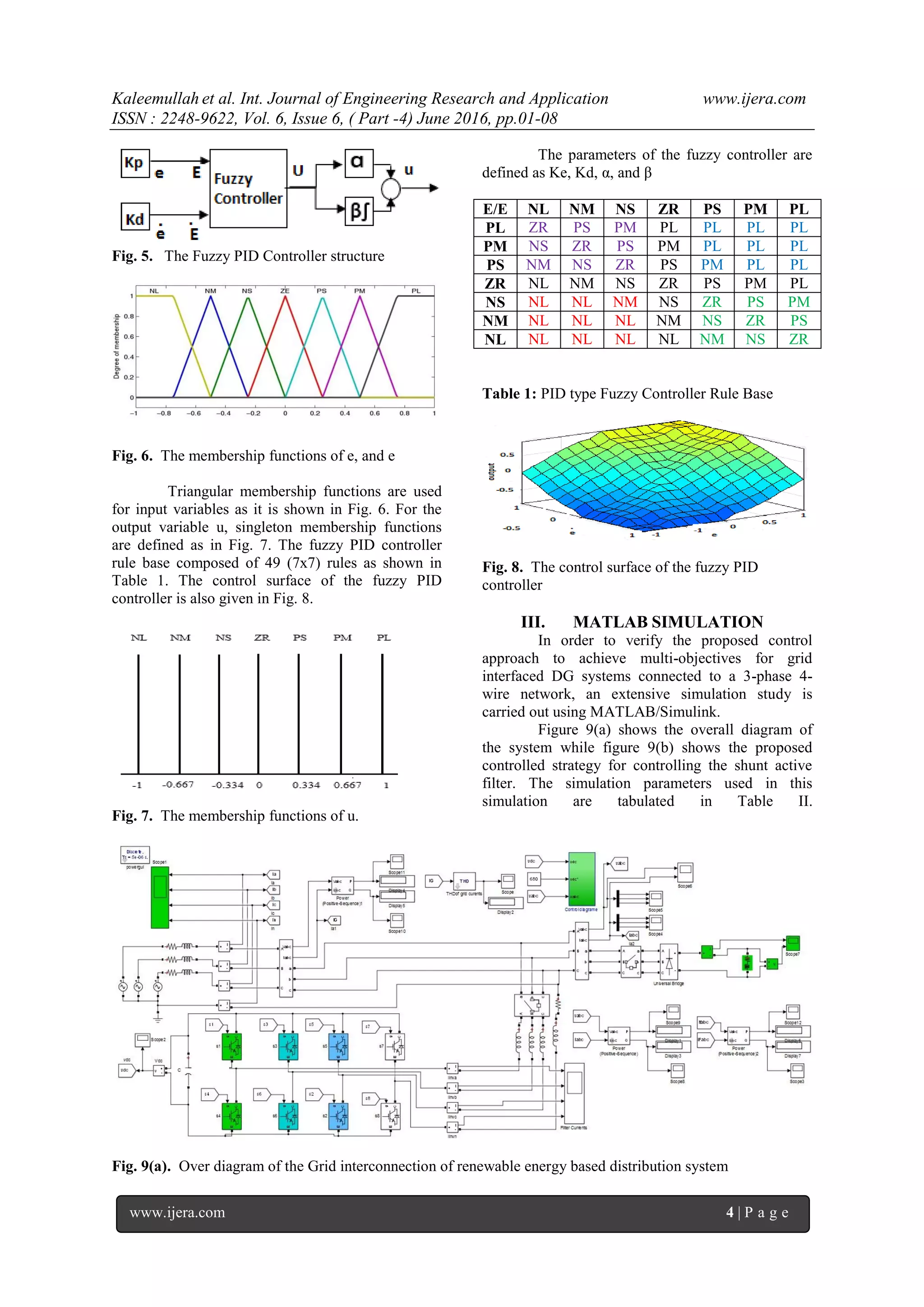
The structure of the fuzzy PID controller,
which has two inputs and one rule base, is shown in
Fig. 5. The inputs are the classical error (e) and the
rate of the change of error (e.
).
Kaleemullah et al. Int. Journal of Engineering Research and Application www.ijera.com
ISSN : 2248-9622, Vol. 6, Issue 6, ( Part -4) June 2016, pp.01-08
www.ijera.com 4 | P a g e
Fig. 5. The Fuzzy PID Controller structure
Fig. 6. The membership functions of e, and e
Triangular membership functions are used
for input variables as it is shown in Fig. 6. For the
output variable u, singleton membership functions
are defined as in Fig. 7. The fuzzy PID controller
rule base composed of 49 (7x7) rules as shown in
Table 1. The control surface of the fuzzy PID
controller is also given in Fig. 8.
Fig. 7. The membership functions of u.
The parameters of the fuzzy controller are
defined as Ke, Kd, α, and β
E/E NL NM NS ZR PS PM PL
PL ZR PS PM PL PL PL PL
PM NS ZR PS PM PL PL PL
PS NM NS ZR PS PM PL PL
ZR NL NM NS ZR PS PM PL
NS NL NL NM NS ZR PS PM
NM NL NL NL NM NS ZR PS
NL NL NL NL NL NM NS ZR
Table 1: PID type Fuzzy Controller Rule Base
Fig. 8. The control surface of the fuzzy PID
controller
III. MATLAB SIMULATION
In order to verify the proposed control
approach to achieve multi-objectives for grid
interfaced DG systems connected to a 3-phase 4-
wire network, an extensive simulation study is
carried out using MATLAB/Simulink.
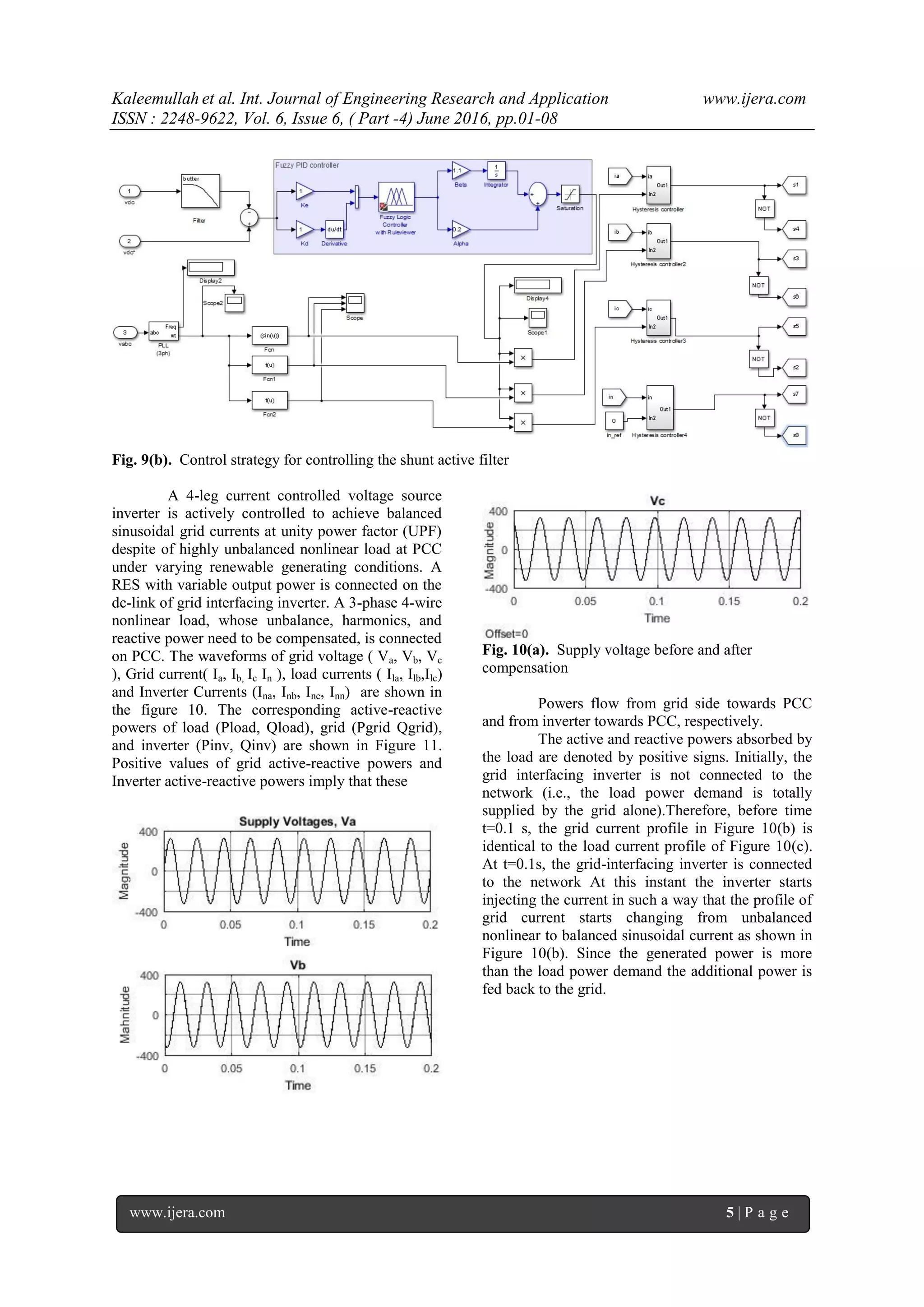
Figure 9(a) shows the overall diagram of
the system while figure 9(b) shows the proposed
controlled strategy for controlling the shunt active
filter. The simulation parameters used in this
simulation are tabulated in Table II.
Fig. 9(a). Over diagram of the Grid interconnection of renewable energy based distribution system
Kaleemullah et al. Int. Journal of Engineering Research and Application www.ijera.com
ISSN : 2248-9622, Vol. 6, Issue 6, ( Part -4) June 2016, pp.01-08
www.ijera.com 5 | P a g e
Fig. 9(b). Control strategy for controlling the shunt active filter
A 4-leg current controlled voltage source
inverter is actively controlled to achieve balanced
sinusoidal grid currents at unity power factor (UPF)
despite of highly unbalanced nonlinear load at PCC
under varying renewable generating conditions. A
RES with variable output power is connected on the
dc-link of grid interfacing inverter. A 3-phase 4-wire
nonlinear load, whose unbalance, harmonics, and
reactive power need to be compensated, is connected
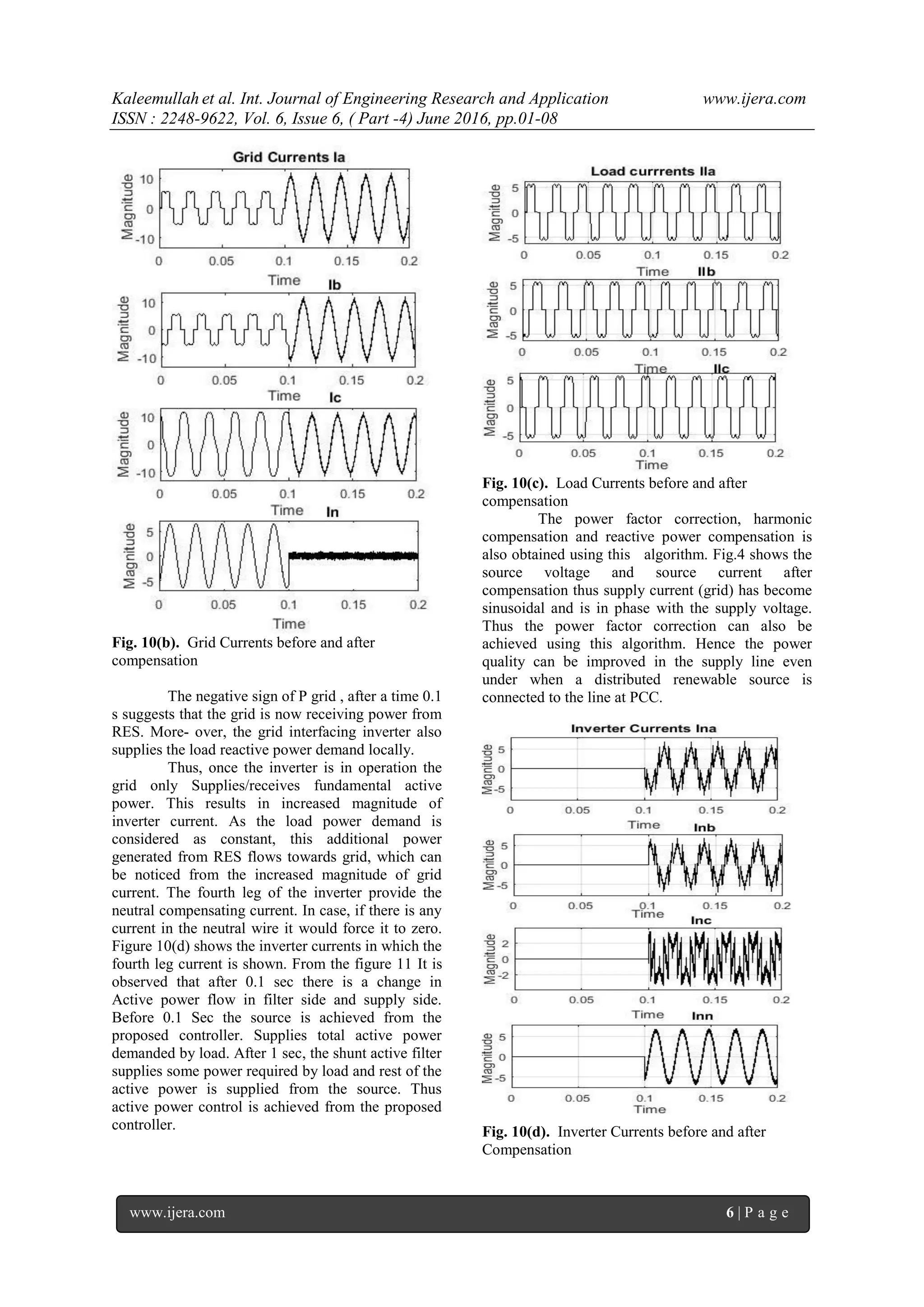
on PCC. The waveforms of grid voltage ( Va, Vb, Vc
), Grid current( Ia, Ib, Ic In ), load currents ( Ila, Ilb,Ilc)
and Inverter Currents (Ina, Inb, Inc, Inn) are shown in
the figure 10. The corresponding active-reactive
powers of load (Pload, Qload), grid (Pgrid Qgrid),
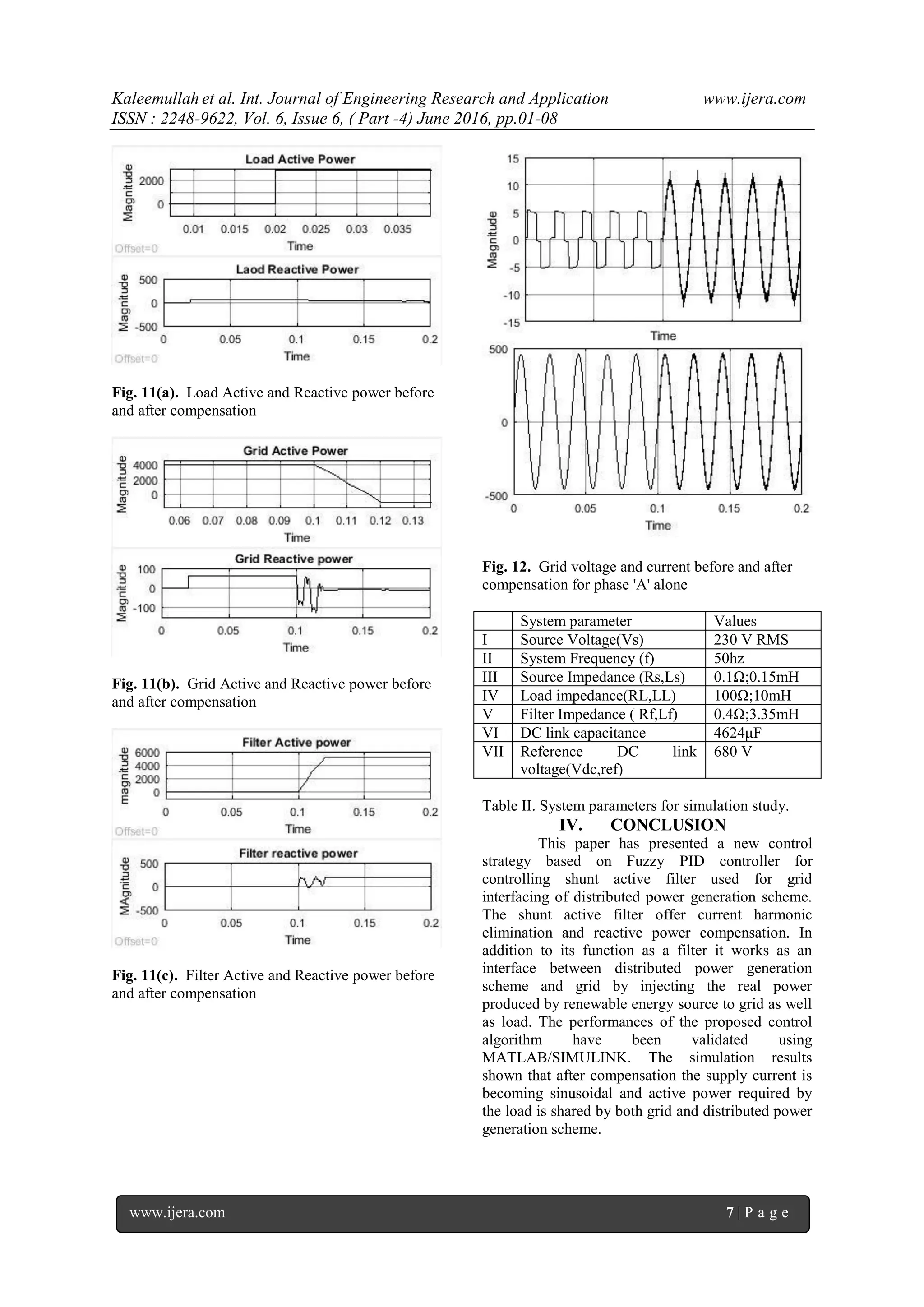
and inverter (Pinv, Qinv) are shown in Figure 11.
Positive values of grid active-reactive powers and
Inverter active-reactive powers imply that these
Fig. 10(a). Supply voltage before and after
compensation
Powers flow from grid side towards PCC
and from inverter towards PCC, respectively.
The active and reactive powers absorbed by
the load are denoted by positive signs. Initially, the
grid interfacing inverter is not connected to the
network (i.e., the load power demand is totally
supplied by the grid alone).Therefore, before time
t=0.1 s, the grid current profile in Figure 10(b) is
identical to the load current profile of Figure 10(c).
At t=0.1s, the grid-interfacing inverter is connected
to the network At this instant the inverter starts
injecting the current in such a way that the profile of
grid current starts changing from unbalanced
nonlinear to balanced sinusoidal current as shown in
Figure 10(b). Since the generated power is more
than the load power demand the additional power is
fed back to the grid.
Kaleemullah et al. Int. Journal of Engineering Research and Application www.ijera.com
ISSN : 2248-9622, Vol. 6, Issue 6, ( Part -4) June 2016, pp.01-08
www.ijera.com 6 | P a g e
Fig. 10(b). Grid Currents before and after
compensation
The negative sign of P grid , after a time 0.1
s suggests that the grid is now receiving power from
RES. More- over, the grid interfacing inverter also
supplies the load reactive power demand locally.
Thus, once the inverter is in operation the
grid only Supplies/receives fundamental active
power. This results in increased magnitude of
inverter current. As the load power demand is
considered as constant, this additional power
generated from RES flows towards grid, which can
be noticed from the increased magnitude of grid
current. The fourth leg of the inverter provide the
neutral compensating current. In case, if there is any
current in the neutral wire it would force it to zero.
Figure 10(d) shows the inverter currents in which the
fourth leg current is shown. From the figure 11 It is
observed that after 0.1 sec there is a change in
Active power flow in filter side and supply side.
Before 0.1 Sec the source is achieved from the
proposed controller. Supplies total active power
demanded by load. After 1 sec, the shunt active filter
supplies some power required by load and rest of the
active power is supplied from the source. Thus
active power control is achieved from the proposed
controller.
Fig. 10(c). Load Currents before and after
compensation
The power factor correction, harmonic
compensation and reactive power compensation is
also obtained using this algorithm. Fig.4 shows the
source voltage and source current after
compensation thus supply current (grid) has become
sinusoidal and is in phase with the supply voltage.
Thus the power factor correction can also be
achieved using this algorithm. Hence the power
quality can be improved in the supply line even
under when a distributed renewable source is
connected to the line at PCC.
Fig. 10(d). Inverter Currents before and after
Compensation
Kaleemullah et al. Int. Journal of Engineering Research and Application www.ijera.com
ISSN : 2248-9622, Vol. 6, Issue 6, ( Part -4) June 2016, pp.01-08
www.ijera.com 7 | P a g e
Fig. 11(a). Load Active and Reactive power before
and after compensation
Fig. 11(b). Grid Active and Reactive power before
and after compensation
Fig. 11(c). Filter Active and Reactive power before
and after compensation
Fig. 12. Grid voltage and current before and after
compensation for phase 'A' alone
System parameter Values
I Source Voltage(Vs) 230 V RMS
II System Frequency (f) 50hz
III Source Impedance (Rs,Ls) 0.1Ω;0.15mH
IV Load impedance(RL,LL) 100Ω;10mH
V Filter Impedance ( Rf,Lf) 0.4Ω;3.35mH
VI DC link capacitance 4624μF
VII Reference DC link
voltage(Vdc,ref)
680 V
Table II. System parameters for simulation study.
IV. CONCLUSION
This paper has presented a new control
strategy based on Fuzzy PID controller for
controlling shunt active filter used for grid
interfacing of distributed power generation scheme.
The shunt active filter offer current harmonic
elimination and reactive power compensation. In
addition to its function as a filter it works as an
interface between distributed power generation
scheme and grid by injecting the real power
produced by renewable energy source to grid as well
as load. The performances of the proposed control
algorithm have been validated using
MATLAB/SIMULINK. The simulation results
shown that after compensation the supply current is
becoming sinusoidal and active power required by
the load is shared by both grid and distributed power
generation scheme.
Kaleemullah et al. Int. Journal of Engineering Research and Application www.ijera.com
ISSN : 2248-9622, Vol. 6, Issue 6, ( Part -4) June 2016, pp.01-08
www.ijera.com 8 | P a g e
REFERENCES
[1]. H. R. Enslin and P. 1. M. Heskes,
"Harmonic interaction between a large
number of distributed power inverters and
the distribution network, "IEEE Trans.
Power Electron., vol. 19, no. 6, pp. 1586-
1593.Nov. 2004.
[2]. Recommended Practices and Requirements
for Harmonic Control in Electrical Power
System, IEEE 519-1992
[3]. António Martins , José Ferreira and Helder
Azevedo” Active Power Filters for
Harmonic Elimination and Power Quality
Improvement” DOI: 10.5772/13882
[4]. Chandra,A., Singh,B., Al-Haddad,K., An
improved control algorithm of shunt active
filter for voltage regulation, harmonic
elimination, power-factor correction, and
balancing of nonlinear loads. IEEE
Transaction on Power Electronics 2000; 15
(6): 495-503.
[5]. Buso,S., Malesani,L., Mattavelli,P.,
Veronese,R. Design and fully digital
control of parallel active filters for
thyristor rectifiers to comply with IEC-
1000-3-2 standards,” IEEE Transactions on
Industry Applications 1998; 34 (3): 508-
517.
[6]. Fujita,H., Akagi,H., The unified power
quality conditioner: the integration of
series-and shunt-active filters. IEEE
Transactions on Power Electronics 1998;
13 (2): 577-584.
[7]. Akagi,H., Kanazawa,Y., Nabae,A.,
Instantaneous reactive power compensators
comprising switching devices without
energy storage components. IEEE
Transactions on Industry Applications
1984; IA-20: 625-630.
[8]. Singh,B., Al-Haddad,K., Chandra,A.,
Active power filter with sliding mode
control. In: proc. Inst. Elect. Eng.,
Generation Transm. Distrib. 1997;144:
564-568
[9]. Rastogi,M., Mohan,N., Edris,A., Hybrid-
active power filtering of harmonic currents
in power systems. IEEE Transactions on
Power Delivery 1995; 10 (3): 1994-2000.
[10]. Bhattacharya,S., Veliman,A., Divan,A.,
Lorenz,R. Flux based active power filter
controller. In: Proc. IEEE-IAS Annual
Meeting Record, 1995; 2483-2491.
[11]. Jou,H., Performance compression of the
three- phase active power filter algorithms.
In: proc. Inst. Elect. Eng., Generation
Transm. Distrib. 1995; 142: 646-652.
[12]. Dixon,J., Garcia,J., Moran,I., Control
system for three-phase active power filter
which simultaneously compensates power
factor and unbalanced loads. IEEE
Transactions on Industrial Electronics
1995; 42 (6): 636-641.
[13]. Barbosa,P., Santisteban,J., Watanabe,E.,
Shunt- series active power filter for
rectifier's ac and dc sides. IEE Proc.-
Electrical Power Application 1998; 145
(6): 577-584.
[14]. Peng,F.,Harmonic source and filtering
approaches. IEEE Transactions on industry
applications 2001;7(4): 18-25
Kaleem ullah received the B.Sc degree
from the Department of Electrical and
Electronics, University of Engineering and
Technology Peshawar, Khyber
Pakhtunkhwa, Pakistan in 2013.He is doing
his Master from the same University with
specialization in Electrical Power. His
research deal with the power quality
problem in transmission lines and with
distributed generation. His e-mail address is
Kaleem.icpp1366@gmail.com
Amjad khan received the B.Sc degree
from the Department of Electrical and
Electronics, University of Engineering and
Technology Peshawar, Khyber
Pakhtunkhwa, Pakistan, in 2013.He is
doing his Master from the same University
with specialization in Electrical Power. His
research interests are in Distributed
generation. His e-mail address is
k_amjad461@yahoo.com
Dr Muhammad Naeem Arbab received
the B.Sc degree from the Department of
Electrical and Electronics, University of
Engineering and Technology Peshawar,
Khyber Paktun Khwa, Pakistan, in 1989
and M.S. and Ph.D. degrees from
University of Manchester, UK. He is
currently a professor in Department of
Electrical Engineering of UET Peshawar.
His email address is mnarbab@yahoo.com

Adaptive Fuzzy PID Based Control Strategy For 3Phase 4Wire Shunt Active Filter To Mitigate Current Harmonics Of Grid Interconnection Of Renewable Energy Based Distribution System

  • 1.
    Kaleemullah et al.Int. Journal of Engineering Research and Application www.ijera.com ISSN : 2248-9622, Vol. 6, Issue 6, ( Part -4) June 2016, pp.01-08 www.ijera.com 1 | P a g e Adaptive Fuzzy PID Based Control Strategy For 3Phase 4Wire Shunt Active Filter To Mitigate Current Harmonics Of Grid Interconnection Of Renewable Energy Based Distribution System Kaleemullah1 *, Amjad Khan2 **, Dr. Muhammad Naeem Arbaab3 *** 12 PG Research student, Dept. of EEE, University of Engineering and technology Peshawar, KP, Pakistan, 3 Research Scholar, Dept. of EEE, University of Engineering and technology Peshawar, KP, Pakistan ABSTRACT This paper presents a new control strategy for controlling the shunt active power filter to compensate reactive power and to reduce the unwanted harmonics in the grid current. Shunt active filter act as a current source which is connected in parallel with a non-linear load and controlled to produce the required compensating current. The proposed control strategy is based on the fuzzy PID controller which is used for determining the reference compensating currents of the three-phase shunt active power filters. Simulations are carried out using MATLAB/SIMULINK to verify the performance of the proposed controller. The output shows the controller has fast dynamic response high accuracy of tracking DC voltage reference and robust to load parameters variations. Index Terms: Active power filter (APF), fuzzy controller, Fuzzy PID controller, distributed generation (DG), distribution system, grid interconnection I. INTRODUCTION The non-renewable- energy decreases at a faster pace has made renewable energy as a future energy source. Renewable energy-based power generation systems has many advantages such as the development of clean energy, reduce global warming etc. But on the other hand, renewable energy intermittently when it is directly connected to the grid caused many power quality issues such as harmonics, voltage sags, break etc. [1].The distributed generation schemes are widely uses power electronic interface for grid connections, because of its fast response, harmonic compensation and reactive power compensation. Due to the widespread use of non-linear loads large amounts of harmonic currents are injected into the power systems. These harmonic currents flowing through the impedance of the supply system causing harmonic currents to pull by other loads connected to the PCC. The persistence of current harmonics and voltage in the power system increases the losses in the lines, decrease the power factor and may cause timing errors in sensitive electronic equipment. Three phases balanced non-linear loads such as motor drivers, silicon controlled rectifiers (SCR), large uninterruptible power supplies (UPS) produce harmonic currents and voltages that are harmonics of positive sequence as 7th, 13th, etc. and negative- sequence harmonics like 5th, 11th, etc. Single phase non-linear loads such as switch-mode power supplies in computer equipment produce harmonic currents and voltages which are third order zero- sequence harmonics, triplen harmonics like 3rd, 9th, 15th, 21st, etc. Unlike positive and negative- sequence harmonic currents, triplen harmonic currents do not cancel but add arithmetically at the neutral bus. This result’s the neutral current that touches magnitudes as high as 1.73 times the phase current. In addition to the risk of cables and transformers overheating, the third harmonic can recede energy efficiency [2]. The method of current harmonics reduction reduces passive LC filters which are simple and low cost. However, these filters have drawbacks as well like large size, tuning and risk of resonance problems. As harmonic pollution is severe in power networks, power system engineer developed dynamic and adjustable solutions to the power quality problems. Such equipment is known as Active Filters (AF’s) [3]. These filters are used to compensate the load current harmonics and improve the power factor. In addition to eliminating the harmonic currents and improving the power factor, SAF can maintain the balance of electrical system under the unbalanced load condition and nonlinear loads [4-6]. In general, the performance of SAF is based on three design criteria [7-12]: i) the design of the power inverter; ii) the types of current regulators used; iii) the methods used to obtain the reference current. Several control techniques have been used to obtain the reference current. These techniques such as the theory of instantaneous reactive power [7], notch filters [9], the control flow based [10], the theory of balance of power [9] - [13], and the controller sliding mode have been used to improve the performance of active filters. However, most of these control techniques include a number of transformations and are difficult to implement. RESEARCH ARTICLE OPEN ACCESS
  • 2.
    Kaleemullah et al.Int. Journal of Engineering Research and Application www.ijera.com ISSN : 2248-9622, Vol. 6, Issue 6, ( Part -4) June 2016, pp.01-08 www.ijera.com 2 | P a g e In this study, a new control strategy is introduced that is based on Fuzzy PID controller. As PID is regarded as the standard control structures of the classical control theory, and fuzzy controllers have positioned themselves as a counterpart of classical PID controllers on the same dominant role at the knowledge rich spectrum (Åström and Hagglund 1995, Oh et al. 2004). PID controllers are designed for linear systems and they provide a preferable cost/benefit ratio. However, the presences of nonlinear effects limit their performances. Fuzzy controllers are successful applied to non-linear system because of their knowledge based nonlinear structural characteristics. Hybridization of these two controller structures comes to one’s mind immediately to exploit the beneficial sides of both categories. Basically, in this design methodology, the classical PID and fuzzy controller have been combined by a blending mechanism that depends on a certain function of actuating error. Simulations are performed on MATLAB®/Simulink toolbox to illustrate the efficiency of the proposed method. The paper is organized as follows: Section II describes the system description and controller for interfacing grid inverter. An Extensive Matlab simulation study is presented in Section III and Section IV concludes the paper Fig. 1. Schematic of proposed renewable based distributed generation system. II. SYSTEM DESCRIPTION The proposed system consists of RES connected to the dc-link of a grid-interfacing inverter as shown in Fig. 1. The shunt active filter is a key element of a system of DG, since it interconnects the renewable energy source to the grid and provides the generated power. The RES can be a DC source or an AC source coupled to the DC bus rectifier. Usually, the fuel cell and photovoltaic energy sources generate power at variable low dc voltage, while the variable speed wind turbines generate power at variable ac voltage. Thus, the power generated from these renewable sources needs power conditioning (i.e., dc/dc or ac/dc) before connecting on dc-link. The dc-capacitor decouples the RES from grid and also allows independent control of converters on either side of dc-link. A. DC-Link Voltage and Power Control Operation Due to the intermittent nature of the RES, the generated power is variable in nature. The dc- link plays an important role in the transfer of this power from variable renewable energy to the grid. RES are represented as current sources connected to the dc-link of a grid-interfacing inverter. Figure 2 shows a systematic representation of energy transfer from renewable energy sources to the grid via the DC-link. The current injected by renewable into dc- link at voltage level can be given as Idc1=PRES / Vdc (1) Where PREN is the power generated from RES. Fig. 2. DC-Link equivalent diagram The current flow on the other side of dc- link can be represented as Idc2=Pinv /Vdc= (Pg+Ploss) / Vdc (2) Where PG and PLoss are total power available at grid- interfacing inverter side, active power supplied to the grid and inverter losses, respectively. If inverter losses are negligible then PREN= PINV. B. Control of Grid Interfacing Inverter: The control diagram of grid- interfacing inverter for a 3-phase 4-wire system is shown in Fig. 3. The fourth leg of inverter is used to compensate the neutral current of load. While performing the power management operation, the inverter is actively controlled in such a way that it always draws/supplies fundamental active power from/ to the grid. If the load connected to the PCC is non- linear or unbalanced or the combination of both, the given control approach also compensates the harmonics, unbalance, and neutral current. The duty ratio of inverter switches are varied in a power cycle such that the combination of load and inverter injected power appears as balanced resistive load to the grid.
  • 3.
    Kaleemullah et al.Int. Journal of Engineering Research and Application www.ijera.com ISSN : 2248-9622, Vol. 6, Issue 6, ( Part -4) June 2016, pp.01-08 www.ijera.com 3 | P a g e Fig. 3. Block diagram representation of grid- interfacing inverter control. The regulation of dc-link voltage carries the information regarding the exchange of active power in between renewable source and grid. Thus the output of dc-link voltage regulator results in an active current IM. The multiplication of active current component IM with unity grid voltage vector templates (Ua, Ub, Uc) generates the reference grid currents (I*a, I*b, I*c). The reference grid neutral current (I*n) is set to zero, being the instantaneous sum of balanced grid currents.The grid synchronizing angle (Ɵ) obtained from phase locked loop (PLL) is used to generate unity vector template as Ua = sin (Ɵ) (3) Ub = sin (Ɵ-2π/3) (4) Uc = sin (Ɵ+2π/3) (5) The actual dc-link voltage (Vdc) is sensed and passed through a first-order low Pass filter (LPF) to eliminate the presence of switching ripples on the dc-link voltage and in the generated reference current signals. The difference of this filtered dc-link voltage and reference dc-link voltage V* dc is given to a Fuzzy PID controller to maintain a constant dc- link voltage under varying generation and load conditions. The dc-link voltage error Vdcerr (nth) at nth sampling Instant is given as Vdcerr (n) = V* dc (n) - Vdc (n) (6) The instantaneous values of reference three phase grid currents are computed as Ia*=Im. Ua (7) Ib*=Im. Ub (8) Ic*= Im. Uc (9) The neutral current, present if any, due to the loads connected to the neutral conductor should be compensated by forth leg of grid-interfacing inverter and thus should not be drawn from the grid. In other words, the reference current for the grid neutral current is considered as zero and can be expressed as IN * = 0 (10) The reference grid currents(Ia* Ib*, Ic*) are compared with actual grid currents( Ia, Ib, Ic) to compute the current errors as Iacerr = Ia*- Ia (11) Ibcerr = Ib*- Ib (12) Iccerr = Ic*- Ic (13) Incerr = IN * - IN (14) These current errors are given to hysteresis current controller. The hysteresis controller then generates the switching pulses (P1 to P8) for the gate drives of grid-interfacing inverter. C) Hysteresis current controller: The hysteresis current control (HCC) is the simplest control method available so-forth to implement the shunt APF with three phase current controlled VSI and is connected to the AC mains for compensating the current harmonics and the VSI gate control signals are brought out from hysteresis band current controller where a hysteresis current controller is implemented with the closed loop control system and waveforms which are shown in figure 4. Here an error signal is used to control the switches in a voltage source inverter and the error is the only difference between the desired current and the current being injected by the inverter and when the error exceeds the upper limit of the hysteresis band the upper switch of the inverter arm is turned off and the lower switch is turned on as a result of which the current starts decaying. When the error crosses its defined lower limit of the hysteresis band then the lower switch of the inverter arm is turned off and the upper switch is turned on as a result of which the current gets back into the hysteresis band and the minimum and maximum values of the error signal are emin and emax respectively and the range of the error signal e max-emin directly controls the amount of ripple in the output current from the VSI. Fig. 4. Hysteresis current control D) Proposed PID controller: The structure of the fuzzy PID controller, which has two inputs and one rule base, is shown in Fig. 5. The inputs are the classical error (e) and the rate of the change of error (e. ).
  • 4.
    Kaleemullah et al.Int. Journal of Engineering Research and Application www.ijera.com ISSN : 2248-9622, Vol. 6, Issue 6, ( Part -4) June 2016, pp.01-08 www.ijera.com 4 | P a g e Fig. 5. The Fuzzy PID Controller structure Fig. 6. The membership functions of e, and e Triangular membership functions are used for input variables as it is shown in Fig. 6. For the output variable u, singleton membership functions are defined as in Fig. 7. The fuzzy PID controller rule base composed of 49 (7x7) rules as shown in Table 1. The control surface of the fuzzy PID controller is also given in Fig. 8. Fig. 7. The membership functions of u. The parameters of the fuzzy controller are defined as Ke, Kd, α, and β E/E NL NM NS ZR PS PM PL PL ZR PS PM PL PL PL PL PM NS ZR PS PM PL PL PL PS NM NS ZR PS PM PL PL ZR NL NM NS ZR PS PM PL NS NL NL NM NS ZR PS PM NM NL NL NL NM NS ZR PS NL NL NL NL NL NM NS ZR Table 1: PID type Fuzzy Controller Rule Base Fig. 8. The control surface of the fuzzy PID controller III. MATLAB SIMULATION In order to verify the proposed control approach to achieve multi-objectives for grid interfaced DG systems connected to a 3-phase 4- wire network, an extensive simulation study is carried out using MATLAB/Simulink. Figure 9(a) shows the overall diagram of the system while figure 9(b) shows the proposed controlled strategy for controlling the shunt active filter. The simulation parameters used in this simulation are tabulated in Table II. Fig. 9(a). Over diagram of the Grid interconnection of renewable energy based distribution system
  • 5.
    Kaleemullah et al.Int. Journal of Engineering Research and Application www.ijera.com ISSN : 2248-9622, Vol. 6, Issue 6, ( Part -4) June 2016, pp.01-08 www.ijera.com 5 | P a g e Fig. 9(b). Control strategy for controlling the shunt active filter A 4-leg current controlled voltage source inverter is actively controlled to achieve balanced sinusoidal grid currents at unity power factor (UPF) despite of highly unbalanced nonlinear load at PCC under varying renewable generating conditions. A RES with variable output power is connected on the dc-link of grid interfacing inverter. A 3-phase 4-wire nonlinear load, whose unbalance, harmonics, and reactive power need to be compensated, is connected on PCC. The waveforms of grid voltage ( Va, Vb, Vc ), Grid current( Ia, Ib, Ic In ), load currents ( Ila, Ilb,Ilc) and Inverter Currents (Ina, Inb, Inc, Inn) are shown in the figure 10. The corresponding active-reactive powers of load (Pload, Qload), grid (Pgrid Qgrid), and inverter (Pinv, Qinv) are shown in Figure 11. Positive values of grid active-reactive powers and Inverter active-reactive powers imply that these Fig. 10(a). Supply voltage before and after compensation Powers flow from grid side towards PCC and from inverter towards PCC, respectively. The active and reactive powers absorbed by the load are denoted by positive signs. Initially, the grid interfacing inverter is not connected to the network (i.e., the load power demand is totally supplied by the grid alone).Therefore, before time t=0.1 s, the grid current profile in Figure 10(b) is identical to the load current profile of Figure 10(c). At t=0.1s, the grid-interfacing inverter is connected to the network At this instant the inverter starts injecting the current in such a way that the profile of grid current starts changing from unbalanced nonlinear to balanced sinusoidal current as shown in Figure 10(b). Since the generated power is more than the load power demand the additional power is fed back to the grid.
  • 6.
    Kaleemullah et al.Int. Journal of Engineering Research and Application www.ijera.com ISSN : 2248-9622, Vol. 6, Issue 6, ( Part -4) June 2016, pp.01-08 www.ijera.com 6 | P a g e Fig. 10(b). Grid Currents before and after compensation The negative sign of P grid , after a time 0.1 s suggests that the grid is now receiving power from RES. More- over, the grid interfacing inverter also supplies the load reactive power demand locally. Thus, once the inverter is in operation the grid only Supplies/receives fundamental active power. This results in increased magnitude of inverter current. As the load power demand is considered as constant, this additional power generated from RES flows towards grid, which can be noticed from the increased magnitude of grid current. The fourth leg of the inverter provide the neutral compensating current. In case, if there is any current in the neutral wire it would force it to zero. Figure 10(d) shows the inverter currents in which the fourth leg current is shown. From the figure 11 It is observed that after 0.1 sec there is a change in Active power flow in filter side and supply side. Before 0.1 Sec the source is achieved from the proposed controller. Supplies total active power demanded by load. After 1 sec, the shunt active filter supplies some power required by load and rest of the active power is supplied from the source. Thus active power control is achieved from the proposed controller. Fig. 10(c). Load Currents before and after compensation The power factor correction, harmonic compensation and reactive power compensation is also obtained using this algorithm. Fig.4 shows the source voltage and source current after compensation thus supply current (grid) has become sinusoidal and is in phase with the supply voltage. Thus the power factor correction can also be achieved using this algorithm. Hence the power quality can be improved in the supply line even under when a distributed renewable source is connected to the line at PCC. Fig. 10(d). Inverter Currents before and after Compensation
  • 7.
    Kaleemullah et al.Int. Journal of Engineering Research and Application www.ijera.com ISSN : 2248-9622, Vol. 6, Issue 6, ( Part -4) June 2016, pp.01-08 www.ijera.com 7 | P a g e Fig. 11(a). Load Active and Reactive power before and after compensation Fig. 11(b). Grid Active and Reactive power before and after compensation Fig. 11(c). Filter Active and Reactive power before and after compensation Fig. 12. Grid voltage and current before and after compensation for phase 'A' alone System parameter Values I Source Voltage(Vs) 230 V RMS II System Frequency (f) 50hz III Source Impedance (Rs,Ls) 0.1Ω;0.15mH IV Load impedance(RL,LL) 100Ω;10mH V Filter Impedance ( Rf,Lf) 0.4Ω;3.35mH VI DC link capacitance 4624μF VII Reference DC link voltage(Vdc,ref) 680 V Table II. System parameters for simulation study. IV. CONCLUSION This paper has presented a new control strategy based on Fuzzy PID controller for controlling shunt active filter used for grid interfacing of distributed power generation scheme. The shunt active filter offer current harmonic elimination and reactive power compensation. In addition to its function as a filter it works as an interface between distributed power generation scheme and grid by injecting the real power produced by renewable energy source to grid as well as load. The performances of the proposed control algorithm have been validated using MATLAB/SIMULINK. The simulation results shown that after compensation the supply current is becoming sinusoidal and active power required by the load is shared by both grid and distributed power generation scheme.
  • 8.
    Kaleemullah et al.Int. Journal of Engineering Research and Application www.ijera.com ISSN : 2248-9622, Vol. 6, Issue 6, ( Part -4) June 2016, pp.01-08 www.ijera.com 8 | P a g e REFERENCES [1]. H. R. Enslin and P. 1. M. Heskes, "Harmonic interaction between a large number of distributed power inverters and the distribution network, "IEEE Trans. Power Electron., vol. 19, no. 6, pp. 1586- 1593.Nov. 2004. [2]. Recommended Practices and Requirements for Harmonic Control in Electrical Power System, IEEE 519-1992 [3]. António Martins , José Ferreira and Helder Azevedo” Active Power Filters for Harmonic Elimination and Power Quality Improvement” DOI: 10.5772/13882 [4]. Chandra,A., Singh,B., Al-Haddad,K., An improved control algorithm of shunt active filter for voltage regulation, harmonic elimination, power-factor correction, and balancing of nonlinear loads. IEEE Transaction on Power Electronics 2000; 15 (6): 495-503. [5]. Buso,S., Malesani,L., Mattavelli,P., Veronese,R. Design and fully digital control of parallel active filters for thyristor rectifiers to comply with IEC- 1000-3-2 standards,” IEEE Transactions on Industry Applications 1998; 34 (3): 508- 517. [6]. Fujita,H., Akagi,H., The unified power quality conditioner: the integration of series-and shunt-active filters. IEEE Transactions on Power Electronics 1998; 13 (2): 577-584. [7]. Akagi,H., Kanazawa,Y., Nabae,A., Instantaneous reactive power compensators comprising switching devices without energy storage components. IEEE Transactions on Industry Applications 1984; IA-20: 625-630. [8]. Singh,B., Al-Haddad,K., Chandra,A., Active power filter with sliding mode control. In: proc. Inst. Elect. Eng., Generation Transm. Distrib. 1997;144: 564-568 [9]. Rastogi,M., Mohan,N., Edris,A., Hybrid- active power filtering of harmonic currents in power systems. IEEE Transactions on Power Delivery 1995; 10 (3): 1994-2000. [10]. Bhattacharya,S., Veliman,A., Divan,A., Lorenz,R. Flux based active power filter controller. In: Proc. IEEE-IAS Annual Meeting Record, 1995; 2483-2491. [11]. Jou,H., Performance compression of the three- phase active power filter algorithms. In: proc. Inst. Elect. Eng., Generation Transm. Distrib. 1995; 142: 646-652. [12]. Dixon,J., Garcia,J., Moran,I., Control system for three-phase active power filter which simultaneously compensates power factor and unbalanced loads. IEEE Transactions on Industrial Electronics 1995; 42 (6): 636-641. [13]. Barbosa,P., Santisteban,J., Watanabe,E., Shunt- series active power filter for rectifier's ac and dc sides. IEE Proc.- Electrical Power Application 1998; 145 (6): 577-584. [14]. Peng,F.,Harmonic source and filtering approaches. IEEE Transactions on industry applications 2001;7(4): 18-25 Kaleem ullah received the B.Sc degree from the Department of Electrical and Electronics, University of Engineering and Technology Peshawar, Khyber Pakhtunkhwa, Pakistan in 2013.He is doing his Master from the same University with specialization in Electrical Power. His research deal with the power quality problem in transmission lines and with distributed generation. His e-mail address is Kaleem.icpp1366@gmail.com Amjad khan received the B.Sc degree from the Department of Electrical and Electronics, University of Engineering and Technology Peshawar, Khyber Pakhtunkhwa, Pakistan, in 2013.He is doing his Master from the same University with specialization in Electrical Power. His research interests are in Distributed generation. His e-mail address is k_amjad461@yahoo.com Dr Muhammad Naeem Arbab received the B.Sc degree from the Department of Electrical and Electronics, University of Engineering and Technology Peshawar, Khyber Paktun Khwa, Pakistan, in 1989 and M.S. and Ph.D. degrees from University of Manchester, UK. He is currently a professor in Department of Electrical Engineering of UET Peshawar. His email address is mnarbab@yahoo.com