International Research Journal of Engineering and Technology (IRJET) e-ISSN: 2395-0056
Volume: 06 Issue: 05 | May 2019 www.irjet.net p-ISSN: 2395-0072
© 2019, IRJET | Impact Factor value: 7.211 | ISO 9001:2008 Certified Journal | Page 4707
Machine Learning Processing for Intrusion Detection
Ms. Vandana Vishnu Ardad, Ms. Ankita Dhar, Dr. Shikha Nema
1Student, Dept. of Electronics Engineering, Usha Mittal Institute of Technology, Maharashtra, India
2Student, Dept. of Electronics Engineering, Usha Mittal Institute of Technology, Maharashtra, India
3Head of Department, Dept. of Electronics and communication, Usha Mittal Institute of Technology, Maharashtra,
India
---------------------------------------------------------------------***---------------------------------------------------------------------
Abstract - —In current scenarios, data is one of the most
valuable resource. The safety of data through any network
is one of the most important factors for any system,
company or organization. For better prediction of abnormal
networks which can create troubles within the system or are
threat to the valuable data, network intrusion detection
systems are used. There are various machine learning
techniques for many applications that works equally well on
all data sets. In this paper five different Machine Learning
algorithms are provided against KDD dataset with which
intrusions can be detected. The accuracy of logistic
regression, naive bays, support vector machine, K nearest
neighbor and decision tree are discussed and analyzed with
the help of ROC’s. Among the various techniques decision
tree gives optimum accuracy i.e. 99.83%.
Key Words: IDS, Machine learning techniques,
Confusion matrix, ROC’s, Accuracy.
1. INTRODUCTION
Data these days has developed to be the most important
part of our day to day life. Be it our work, our bank
transactions, our personal details or for business
purposes. So its security is one of the major issues right
now. The companies and business setups invest a lot and
lot of money in cyber security or simply for the security of
their data. Intrusion Detection system serve a pivotal role
in securing computer networks.
IDS stand for Intrusion Detection System. To protect from
cyber attacks many new advancements have been made
like introduction of statistics or artificial intelligence.
Automatic intrusion detection system has become an
important examination topic. Till now researchers have
studied on Intrusion Detection Systems (IDS) successfully
with the capability of detecting attacks in various fields;
now latest on the scene are Machine Learning (ML)
Approaches. In this paper a machine learning approach is
used to distinguish between normal and abnormal
network. ML processing algorithms can improve
processing speed especially dealing with big data sets.
Machine learning techniques are the sets of algorithms
that have improved performance in the situations they
have already encountered with vast range of applications
such as speech recognition, pattern detection, outlier
analysis etc. There are a number of machine learning
techniques developed for many applications and there is
no universal technique which work equally well on all data
sets. In this work, we evaluated the machine learning
algorithms for intrusion detection. The motive here is to
evaluate classification accuracy of a supervised learning
algorithm. In this paper the KDD data set is used for
intrusion detection [1].
2. LITERATURE SURVEY
Traditional methods of IDS were based on low level
attacks and generated isolated alerts. Although there was
a logical connection between them but still it was
incapable of giving combined results. To overcome this
problem, DIDS was used [2]. The DIDS combines all these
scattered alerts and makes use of their logical relationship,
thus obtaining additional information. The huge range of
small low cost embedded devices provided with one or
more sensors are interconnected through wireless or
cable network integrated to the internet. But the system
used were not simple and used
Several technologies and network resources making it
more complicated. Also due to this fact sophisticated
management was necessary by learned and experienced
administrators.
Further, sensor fusion was done to detect the abnormal
Networks accurately [3]. IDS have distinct preferences for
detecting a particular class of attack with improved
accuracy while performing moderately on other classes. So
deploying different methods on same network can give
better and accurate detection. The main issue in this case
was the false alarming. Handling of sensors was complex.
Moreover the management was difficult as well. The
process became slow as various sensors and methods
were used.
To avoid the above complexities, a simple software
application is used. Also programmable signature
matching is used [4]. Networks use deep packet inspection
to enable sophisticated services like intrusion detection.
Signature matching is the heart of deep packet inspection
which involves matching resupplied signature to network
payloads at line rates. Content searching/ matching
detects a variety of attacks. This method is efficient but
does not use or apply machine learning capabilities to
generalize signature matching techniques.
Further the network analysis here is done with the help of
machine learning techniques. Various machine learning
methods are applied on a data set known as KDD. The
accuracy of different machine learning methods on this
dataset is calculated. The machine learning approach is
International Research Journal of Engineering and Technology (IRJET) e-ISSN: 2395-0056
Volume: 06 Issue: 05 | May 2019 www.irjet.net p-ISSN: 2395-0072
© 2019, IRJET | Impact Factor value: 7.211 | ISO 9001:2008 Certified Journal | Page 4708
intelligent and involves various steps to distinguish
between the normal and abnormal networks efficiently
[1].
3. DATASET
The KDD dataset is a derived from big DARPA dataset used
for intrusion detection.
3.1 Intrusion detector learning
A predictive model is built so that the data can be
classified so as to detect an intrusion if present. The
learning process includes building this model only. Its
main agenda is to makes a model which is able to
distinguish between good and bad network.
DARPA was prepared to evaluate the intrusion detection
in 1998[5]. The KDD dataset is the version of this data set.
Lincoln Labs worked for 9 weeks to acquire raw TCP
dump data for a LAN. The LAN was tested on an Air Force
Environment and preparation for many attacks was done.
The training data was 4GB of compressed binary TCP data.
This data was then processed for 5 million connection
records. Each connection here is labeled as normal or
attack type [6].
3.2 Attack types
1. DoS: Denial of service.
2. Probing: probing attack like port scanning
3. U2R: unauthorized access to the root.
4. R2L: unauthorized access from remote system.
syn flooding, port scanning, buffer overflow attacks,
password guessing are the examples of DoS, Probbing,
U2R and R2L respectively. This data set has 24 training
attack and 14 types for the test data. Conclusion records
used the destination host and the construction of window
was made by 100 connections. In this model, 80% training
set is used and 20% test set is there. Now for mining the
unstructured data portions of packets automatically, few
useful algorithms are there. Stolfo et al used domain
knowledge to add features
which look for suspicious behavior in the data portions,
like the number of failed login attempts. These features
are known as”content” features. A few set of features are
given in the three tables below which are defined for the
connection records.
Table -1: Basic features of individual TCP connections
Feature
Name
Description
duration length of the connection
protocol_ty
pe
type of the protocol e.g tcp, ip etc.
service destination network service, e.g., http, telnet,
etc.
src_ bytes from source to destination - number of data
bytes
dst_bytes from destination to source - number of data
bytes
Flag status of the connection = error or normal
land if connection is from/to the same host = 1; 0
otherwise
wrong_
fragment
number of fragments which are ”wrong”
urgent number of packets which are urgent
Table -2: Content features within a connection suggested
by domain knowledge
Feature Name Description
hot number of indicators which are ”hot”
num_ failed num failed logins failed login attempts
logged_ in if successfully logged in = 1; 0 otherwise
num_
compromised
number of conditions which are
”compromised”
root_shell if root shell is obtained = 1; 0 otherwise
su_ attempted if ”su root” command attempted = 1 ; 0
otherwise
num_root ”root” accesses
num_file_
creations
number of operations for file creation
num_ shells shell prompts
num_access_ files operations on access control files
num _outbound_
cmds
in an ftp session, number of outbound
commands.
is_ hot_login if the login belongs to the ”hot” list = 1; 0
otherwise
is_ guest_ login if the login is a ”guest” login = 1; 0
otherwise
International Research Journal of Engineering and Technology (IRJET) e-ISSN: 2395-0056
Volume: 06 Issue: 05 | May 2019 www.irjet.net p-ISSN: 2395-0072
© 2019, IRJET | Impact Factor value: 7.211 | ISO 9001:2008 Certified Journal | Page 4709
Table -3: Traffic features computed using a two-second
time Window
Feature Name Type Description
count in the past two seconds as the same
connection as the current, the
number of connections to the same
host
Note: The following features refer to
these same host connections.
serror_ rate percentage of connections that have
”SYN” errors
rerror_ rate percentage of connections with
”REJ” errors
same_ srv_ rate percentage of connections to the
same service
diff_ srv_ rate percentage of connections to
different services
srv_ count in the past two seconds as the same
connection as the current, the
number of connections to the same
server
Note: The following features refer to
these same service connections.
srv_ serror_ rate percentage of connections with
”SYN” errors
srv_ rerror_ rate percentage of connections with
”REJ” errors
srv_ diff_ host_ rate percentage of connections to
different hosts
4. MACHINE LEARNING ALGORITHMS
4.1 Logistic Regression
It is used when only two outputs are there. It doesn’t work
on linear equation type of classes. For each experiment,
only two values can be there. It produces a curve of
outcomes having values between 0 and 1 only or yes/no
[7].
The fundamental equation of linear model is:
g(E(y)) = ⍶+ß x1 + x2 (1)
The value lies between any ranges. But to compress the
data to 0 and we used the sigmoid function for squashing.
Sigmoid Function of Logistic Function is:
g(x) =1/(1 + e˄(-x)) (2)
4.2 Naive Bayes
This algorithm is based on the Bayes theorem used in
probability. This classifier considers the features to be
independent. The features independently contribute to the
output probability.
This is one of the easiest to understand and fairly efficient
way of classifying different type of classes as the
calculation is easy. The classifier uses this simple formula
based on Bayes theorem.
P(x/y) =p(y/x)p(x)/p(y) (3)
Above,
P(x/y) is the later probability of the event.
P(x) is the former probability of the event.
P(y/x) is the likelihood
P(y) is the former probability of predictor.
4.3 Support Vector Machine
This classifier is based on separating two types of
categories by using a hyperplane. Hyperplane is a feature
by which two different classes which have different
features are separated out. The hyperplane must have
maximum distance between the data of both classes.[7]
The data, in the form of points, is plotted in a frame and
best possible hyperplane is chosen to separate the two
classes have distinct data points.
In SVM, the output taken from the linear function like
linear regression is squashed and we get the values
between -1 and 1.Here the main focus is on to maximize
the distance between the hyperplane and data points. so to
achieve this we use a cost function. The formula for cost
function:
)) ) ) (4)
4.4 K Nearest Neighbor
It is used for both linear and classification problems. In
this method of classification, we choose a factor k i.e. the
value of k is selected. And with the help of that value we
create boundaries. These boundaries then help in
distinguishing different kind of classes.[9] As the value of k
is increased, the boundaries become smoother. Based on
the majority votes of the neighbors, the outcome is
processed. There is no assumption of the data so it is
useful for the real time applications.
4.5 Decision Tree:
It is a graphical representation which is computed by the
method of branching. The branches of various small
possibilities are setup. Based on the homogeneity of the
different sets a final set is created. It is a type of
supervised learning. The samples are differentiated into
two or more sets. The samples are segregated based on
the values and then the best homogeneous set is created.
This classifier is very easy to understand and it is one of
the fastest ways to compute the outcome.[10]
5. IMPLEMENTATION
We used SPYDER software to run the machine learning
algorithms. It writes and run codes in PYTHON language.
For ease of understanding the codes for different
classifiers are written in PYTHON. SPYDER has inbuilt
International Research Journal of Engineering and Technology (IRJET) e-ISSN: 2395-0056
Volume: 06 Issue: 05 | May 2019 www.irjet.net p-ISSN: 2395-0072
© 2019, IRJET | Impact Factor value: 7.211 | ISO 9001:2008 Certified Journal | Page 4710
functions and packages for classifiers. Hence this makes it
easy to write and apply codes on this software. IT is a
powerful interactive development environment for the
Python language and also provides an object inspector
that executes in the context of the console. Python
includes numpy library which is used to acquire the
numerical values. It also include package from library
known as the pandas which is used to acquire the data set.
With the help of this function we can access dataset for the
code.[8] The train set and test set is divided and to avoid
any randomness after that we put random state i.e 0. The
average and mean values are pre calculated. Then
classifiers use this data for their processing and next step
includes importing of classifiers from the library. These
classifiers then give the accuracy on data set. The
predicted value is calculated using training data set and
the test data set is used to make out the difference
between actual and predicted values which gives us
accuracy based on confusion matrix.
5.1 Confusion Matrix
A confusion matrix tells us about the overall efficiency and
accuracy of an algorithm over a data set. It is based on test
data sets for which the true values are known. It is an
efficient way of calculating the accuracy. It gives us the
knowledge about the true positive and true negative
values and also false positive and false negative values of a
particular classifier over a data set. Therefore confusion
matrix is as follows:
[ ]
Where
TP : True Positive data
TN : True Negative data
FP : False Positive data
FN : False Negative data
5.2 Accuracy is given as follows
Accuracy=(TruePositive+TrueNegative)/(TotalData
Samples) (5)
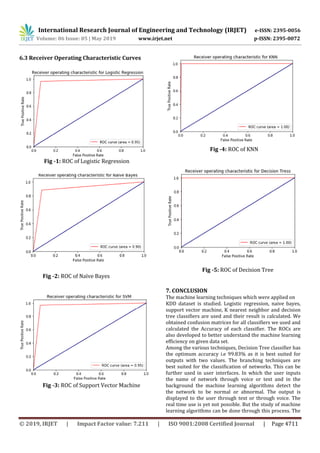
5.3 Receiver Operating Characteristic curve (ROC
curve)
The Receiver Operating Characteristic curve is obtained by
plotting the rate of true positive value (TPR) versus the
rate of false positive value (FPR) at different threshold
settings. In machine learning the true-positive rate is also
known as sensitivity, or probability of detection and the
false-positive rate is known as the fall out or probability of
false alarm which is calculated as 1 specifically. In general,
the ROC curve can be generated if the probability
distributions of detection as well as false alarm are known,
by plotting the cumulative distribution function of the
detection (probability values) in the y axis against the
cumulative distribution function of the false alarm
(probability values) on the x axis.
6. RESULT
6.1 Confusion Matrix
Table-4: Confusion Matrix table
Classifier Type Confusion Matrix
Logistic
Regression
[ ]
Naïve Bayes [ ]
Support Vector
Machine
[ ]
KNN [ ]
Decision Tree [ ]
6.2 Accuracy
Table-5: Accuracy Table:
Classifier Used Accuracy
Logistic Regression 95%
Naïve Bayes 90%
Support Vector Machine 95.5%
KNN 99.51%
Decision Tree 99.83%
International Research Journal of Engineering and Technology (IRJET) e-ISSN: 2395-0056
Volume: 06 Issue: 05 | May 2019 www.irjet.net p-ISSN: 2395-0072
© 2019, IRJET | Impact Factor value: 7.211 | ISO 9001:2008 Certified Journal | Page 4711
6.3 Receiver Operating Characteristic Curves
Fig -1: ROC of Logistic Regression
Fig -2: ROC of Naïve Bayes
Fig -3: ROC of Support Vector Machine
Fig -4: ROC of KNN
Fig -5: ROC of Decision Tree
7. CONCLUSION
The machine learning techniques which were applied on
KDD dataset is studied. Logistic regression, naive bayes,
support vector machine, K nearest neighbor and decision
tree classifiers are used and their result is calculated. We
obtained confusion matrices for all classifiers we used and
calculated the Accuracy of each classifier. The ROCs are
also developed to better understand the machine learning
efficiency on given data set.
Among the various techniques, Decision Tree classifier has
the optimum accuracy i.e 99.83% as it is best suited for
outputs with two values. The branching techniques are
best suited for the classification of networks. This can be
further used in user interfaces. In which the user inputs
the name of network through voice or text and in the
background the machine learning algorithms detect the
the network to be normal or abnormal. The output is
displayed to the user through text or through voice. The
real time use is yet not possible. But the study of machine
learning algorithms can be done through this process. The
International Research Journal of Engineering and Technology (IRJET) e-ISSN: 2395-0056
Volume: 06 Issue: 05 | May 2019 www.irjet.net p-ISSN: 2395-0072
© 2019, IRJET | Impact Factor value: 7.211 | ISO 9001:2008 Certified Journal | Page 4712
machine learning techniques thus can be used to detect
intrusions and they have a good efficiency and accuracy as
well.
REFERENCES
[1] Machine Learning techniques for Intrusion detection: A
comparative Analysis. Yasir Hamid, M Sugumaran, Ludovic
Journaux. November 2016.
[2] Network intrusion Traditional detection system
embedded on smart sensors. IEEE Trans. on Industrial
electronics, March 2011.
[3] Improvement in intrusion detection with advance in
sensor fusion, IEEE Trans. on information forensics and
security, September 2009
[4] Evaluating GPU for network packet signature
matching, in March, 2009.
[5] Usefulness of DARPA dataset for Intrusion Detection
System.
[6] Cost- based modeling and evaluation for data mining
with application to fraud and Intrusion Detection.
[7] Supervised Machine Learning: A Review of
Classification Techniques by S. B. Kotsiantis.
[8] R. Heady, G. F. Luger, A. Maccabe, and M. Servilla, The
architecture of a network level intrusion detection system.
Department of Computer Science, College of Engineering,
University of New Mexico, 1990.
[9] W. Lee, S. J. Stolfo, and others, Data mining approaches
for intrusion detection, in Usenix security, 1998.
[10] M. Khan and S. M. K. Quadri, Evaluating Various
Learning Techniques for Efficiency, International Journal
of Engineering and Advanced Technology (IJEAT), vol. 2,
no. 2, pp. 326331, 2012.

IRJET- Machine Learning Processing for Intrusion Detection

  • 1.
    International Research Journalof Engineering and Technology (IRJET) e-ISSN: 2395-0056 Volume: 06 Issue: 05 | May 2019 www.irjet.net p-ISSN: 2395-0072 © 2019, IRJET | Impact Factor value: 7.211 | ISO 9001:2008 Certified Journal | Page 4707 Machine Learning Processing for Intrusion Detection Ms. Vandana Vishnu Ardad, Ms. Ankita Dhar, Dr. Shikha Nema 1Student, Dept. of Electronics Engineering, Usha Mittal Institute of Technology, Maharashtra, India 2Student, Dept. of Electronics Engineering, Usha Mittal Institute of Technology, Maharashtra, India 3Head of Department, Dept. of Electronics and communication, Usha Mittal Institute of Technology, Maharashtra, India ---------------------------------------------------------------------***--------------------------------------------------------------------- Abstract - —In current scenarios, data is one of the most valuable resource. The safety of data through any network is one of the most important factors for any system, company or organization. For better prediction of abnormal networks which can create troubles within the system or are threat to the valuable data, network intrusion detection systems are used. There are various machine learning techniques for many applications that works equally well on all data sets. In this paper five different Machine Learning algorithms are provided against KDD dataset with which intrusions can be detected. The accuracy of logistic regression, naive bays, support vector machine, K nearest neighbor and decision tree are discussed and analyzed with the help of ROC’s. Among the various techniques decision tree gives optimum accuracy i.e. 99.83%. Key Words: IDS, Machine learning techniques, Confusion matrix, ROC’s, Accuracy. 1. INTRODUCTION Data these days has developed to be the most important part of our day to day life. Be it our work, our bank transactions, our personal details or for business purposes. So its security is one of the major issues right now. The companies and business setups invest a lot and lot of money in cyber security or simply for the security of their data. Intrusion Detection system serve a pivotal role in securing computer networks. IDS stand for Intrusion Detection System. To protect from cyber attacks many new advancements have been made like introduction of statistics or artificial intelligence. Automatic intrusion detection system has become an important examination topic. Till now researchers have studied on Intrusion Detection Systems (IDS) successfully with the capability of detecting attacks in various fields; now latest on the scene are Machine Learning (ML) Approaches. In this paper a machine learning approach is used to distinguish between normal and abnormal network. ML processing algorithms can improve processing speed especially dealing with big data sets. Machine learning techniques are the sets of algorithms that have improved performance in the situations they have already encountered with vast range of applications such as speech recognition, pattern detection, outlier analysis etc. There are a number of machine learning techniques developed for many applications and there is no universal technique which work equally well on all data sets. In this work, we evaluated the machine learning algorithms for intrusion detection. The motive here is to evaluate classification accuracy of a supervised learning algorithm. In this paper the KDD data set is used for intrusion detection [1]. 2. LITERATURE SURVEY Traditional methods of IDS were based on low level attacks and generated isolated alerts. Although there was a logical connection between them but still it was incapable of giving combined results. To overcome this problem, DIDS was used [2]. The DIDS combines all these scattered alerts and makes use of their logical relationship, thus obtaining additional information. The huge range of small low cost embedded devices provided with one or more sensors are interconnected through wireless or cable network integrated to the internet. But the system used were not simple and used Several technologies and network resources making it more complicated. Also due to this fact sophisticated management was necessary by learned and experienced administrators. Further, sensor fusion was done to detect the abnormal Networks accurately [3]. IDS have distinct preferences for detecting a particular class of attack with improved accuracy while performing moderately on other classes. So deploying different methods on same network can give better and accurate detection. The main issue in this case was the false alarming. Handling of sensors was complex. Moreover the management was difficult as well. The process became slow as various sensors and methods were used. To avoid the above complexities, a simple software application is used. Also programmable signature matching is used [4]. Networks use deep packet inspection to enable sophisticated services like intrusion detection. Signature matching is the heart of deep packet inspection which involves matching resupplied signature to network payloads at line rates. Content searching/ matching detects a variety of attacks. This method is efficient but does not use or apply machine learning capabilities to generalize signature matching techniques. Further the network analysis here is done with the help of machine learning techniques. Various machine learning methods are applied on a data set known as KDD. The accuracy of different machine learning methods on this dataset is calculated. The machine learning approach is
  • 2.
    International Research Journalof Engineering and Technology (IRJET) e-ISSN: 2395-0056 Volume: 06 Issue: 05 | May 2019 www.irjet.net p-ISSN: 2395-0072 © 2019, IRJET | Impact Factor value: 7.211 | ISO 9001:2008 Certified Journal | Page 4708 intelligent and involves various steps to distinguish between the normal and abnormal networks efficiently [1]. 3. DATASET The KDD dataset is a derived from big DARPA dataset used for intrusion detection. 3.1 Intrusion detector learning A predictive model is built so that the data can be classified so as to detect an intrusion if present. The learning process includes building this model only. Its main agenda is to makes a model which is able to distinguish between good and bad network. DARPA was prepared to evaluate the intrusion detection in 1998[5]. The KDD dataset is the version of this data set. Lincoln Labs worked for 9 weeks to acquire raw TCP dump data for a LAN. The LAN was tested on an Air Force Environment and preparation for many attacks was done. The training data was 4GB of compressed binary TCP data. This data was then processed for 5 million connection records. Each connection here is labeled as normal or attack type [6]. 3.2 Attack types 1. DoS: Denial of service. 2. Probing: probing attack like port scanning 3. U2R: unauthorized access to the root. 4. R2L: unauthorized access from remote system. syn flooding, port scanning, buffer overflow attacks, password guessing are the examples of DoS, Probbing, U2R and R2L respectively. This data set has 24 training attack and 14 types for the test data. Conclusion records used the destination host and the construction of window was made by 100 connections. In this model, 80% training set is used and 20% test set is there. Now for mining the unstructured data portions of packets automatically, few useful algorithms are there. Stolfo et al used domain knowledge to add features which look for suspicious behavior in the data portions, like the number of failed login attempts. These features are known as”content” features. A few set of features are given in the three tables below which are defined for the connection records. Table -1: Basic features of individual TCP connections Feature Name Description duration length of the connection protocol_ty pe type of the protocol e.g tcp, ip etc. service destination network service, e.g., http, telnet, etc. src_ bytes from source to destination - number of data bytes dst_bytes from destination to source - number of data bytes Flag status of the connection = error or normal land if connection is from/to the same host = 1; 0 otherwise wrong_ fragment number of fragments which are ”wrong” urgent number of packets which are urgent Table -2: Content features within a connection suggested by domain knowledge Feature Name Description hot number of indicators which are ”hot” num_ failed num failed logins failed login attempts logged_ in if successfully logged in = 1; 0 otherwise num_ compromised number of conditions which are ”compromised” root_shell if root shell is obtained = 1; 0 otherwise su_ attempted if ”su root” command attempted = 1 ; 0 otherwise num_root ”root” accesses num_file_ creations number of operations for file creation num_ shells shell prompts num_access_ files operations on access control files num _outbound_ cmds in an ftp session, number of outbound commands. is_ hot_login if the login belongs to the ”hot” list = 1; 0 otherwise is_ guest_ login if the login is a ”guest” login = 1; 0 otherwise
  • 3.
    International Research Journalof Engineering and Technology (IRJET) e-ISSN: 2395-0056 Volume: 06 Issue: 05 | May 2019 www.irjet.net p-ISSN: 2395-0072 © 2019, IRJET | Impact Factor value: 7.211 | ISO 9001:2008 Certified Journal | Page 4709 Table -3: Traffic features computed using a two-second time Window Feature Name Type Description count in the past two seconds as the same connection as the current, the number of connections to the same host Note: The following features refer to these same host connections. serror_ rate percentage of connections that have ”SYN” errors rerror_ rate percentage of connections with ”REJ” errors same_ srv_ rate percentage of connections to the same service diff_ srv_ rate percentage of connections to different services srv_ count in the past two seconds as the same connection as the current, the number of connections to the same server Note: The following features refer to these same service connections. srv_ serror_ rate percentage of connections with ”SYN” errors srv_ rerror_ rate percentage of connections with ”REJ” errors srv_ diff_ host_ rate percentage of connections to different hosts 4. MACHINE LEARNING ALGORITHMS 4.1 Logistic Regression It is used when only two outputs are there. It doesn’t work on linear equation type of classes. For each experiment, only two values can be there. It produces a curve of outcomes having values between 0 and 1 only or yes/no [7]. The fundamental equation of linear model is: g(E(y)) = ⍶+ß x1 + x2 (1) The value lies between any ranges. But to compress the data to 0 and we used the sigmoid function for squashing. Sigmoid Function of Logistic Function is: g(x) =1/(1 + e˄(-x)) (2) 4.2 Naive Bayes This algorithm is based on the Bayes theorem used in probability. This classifier considers the features to be independent. The features independently contribute to the output probability. This is one of the easiest to understand and fairly efficient way of classifying different type of classes as the calculation is easy. The classifier uses this simple formula based on Bayes theorem. P(x/y) =p(y/x)p(x)/p(y) (3) Above, P(x/y) is the later probability of the event. P(x) is the former probability of the event. P(y/x) is the likelihood P(y) is the former probability of predictor. 4.3 Support Vector Machine This classifier is based on separating two types of categories by using a hyperplane. Hyperplane is a feature by which two different classes which have different features are separated out. The hyperplane must have maximum distance between the data of both classes.[7] The data, in the form of points, is plotted in a frame and best possible hyperplane is chosen to separate the two classes have distinct data points. In SVM, the output taken from the linear function like linear regression is squashed and we get the values between -1 and 1.Here the main focus is on to maximize the distance between the hyperplane and data points. so to achieve this we use a cost function. The formula for cost function: )) ) ) (4) 4.4 K Nearest Neighbor It is used for both linear and classification problems. In this method of classification, we choose a factor k i.e. the value of k is selected. And with the help of that value we create boundaries. These boundaries then help in distinguishing different kind of classes.[9] As the value of k is increased, the boundaries become smoother. Based on the majority votes of the neighbors, the outcome is processed. There is no assumption of the data so it is useful for the real time applications. 4.5 Decision Tree: It is a graphical representation which is computed by the method of branching. The branches of various small possibilities are setup. Based on the homogeneity of the different sets a final set is created. It is a type of supervised learning. The samples are differentiated into two or more sets. The samples are segregated based on the values and then the best homogeneous set is created. This classifier is very easy to understand and it is one of the fastest ways to compute the outcome.[10] 5. IMPLEMENTATION We used SPYDER software to run the machine learning algorithms. It writes and run codes in PYTHON language. For ease of understanding the codes for different classifiers are written in PYTHON. SPYDER has inbuilt
  • 4.
    International Research Journalof Engineering and Technology (IRJET) e-ISSN: 2395-0056 Volume: 06 Issue: 05 | May 2019 www.irjet.net p-ISSN: 2395-0072 © 2019, IRJET | Impact Factor value: 7.211 | ISO 9001:2008 Certified Journal | Page 4710 functions and packages for classifiers. Hence this makes it easy to write and apply codes on this software. IT is a powerful interactive development environment for the Python language and also provides an object inspector that executes in the context of the console. Python includes numpy library which is used to acquire the numerical values. It also include package from library known as the pandas which is used to acquire the data set. With the help of this function we can access dataset for the code.[8] The train set and test set is divided and to avoid any randomness after that we put random state i.e 0. The average and mean values are pre calculated. Then classifiers use this data for their processing and next step includes importing of classifiers from the library. These classifiers then give the accuracy on data set. The predicted value is calculated using training data set and the test data set is used to make out the difference between actual and predicted values which gives us accuracy based on confusion matrix. 5.1 Confusion Matrix A confusion matrix tells us about the overall efficiency and accuracy of an algorithm over a data set. It is based on test data sets for which the true values are known. It is an efficient way of calculating the accuracy. It gives us the knowledge about the true positive and true negative values and also false positive and false negative values of a particular classifier over a data set. Therefore confusion matrix is as follows: [ ] Where TP : True Positive data TN : True Negative data FP : False Positive data FN : False Negative data 5.2 Accuracy is given as follows Accuracy=(TruePositive+TrueNegative)/(TotalData Samples) (5) 5.3 Receiver Operating Characteristic curve (ROC curve) The Receiver Operating Characteristic curve is obtained by plotting the rate of true positive value (TPR) versus the rate of false positive value (FPR) at different threshold settings. In machine learning the true-positive rate is also known as sensitivity, or probability of detection and the false-positive rate is known as the fall out or probability of false alarm which is calculated as 1 specifically. In general, the ROC curve can be generated if the probability distributions of detection as well as false alarm are known, by plotting the cumulative distribution function of the detection (probability values) in the y axis against the cumulative distribution function of the false alarm (probability values) on the x axis. 6. RESULT 6.1 Confusion Matrix Table-4: Confusion Matrix table Classifier Type Confusion Matrix Logistic Regression [ ] Naïve Bayes [ ] Support Vector Machine [ ] KNN [ ] Decision Tree [ ] 6.2 Accuracy Table-5: Accuracy Table: Classifier Used Accuracy Logistic Regression 95% Naïve Bayes 90% Support Vector Machine 95.5% KNN 99.51% Decision Tree 99.83%
  • 5.
    International Research Journalof Engineering and Technology (IRJET) e-ISSN: 2395-0056 Volume: 06 Issue: 05 | May 2019 www.irjet.net p-ISSN: 2395-0072 © 2019, IRJET | Impact Factor value: 7.211 | ISO 9001:2008 Certified Journal | Page 4711 6.3 Receiver Operating Characteristic Curves Fig -1: ROC of Logistic Regression Fig -2: ROC of Naïve Bayes Fig -3: ROC of Support Vector Machine Fig -4: ROC of KNN Fig -5: ROC of Decision Tree 7. CONCLUSION The machine learning techniques which were applied on KDD dataset is studied. Logistic regression, naive bayes, support vector machine, K nearest neighbor and decision tree classifiers are used and their result is calculated. We obtained confusion matrices for all classifiers we used and calculated the Accuracy of each classifier. The ROCs are also developed to better understand the machine learning efficiency on given data set. Among the various techniques, Decision Tree classifier has the optimum accuracy i.e 99.83% as it is best suited for outputs with two values. The branching techniques are best suited for the classification of networks. This can be further used in user interfaces. In which the user inputs the name of network through voice or text and in the background the machine learning algorithms detect the the network to be normal or abnormal. The output is displayed to the user through text or through voice. The real time use is yet not possible. But the study of machine learning algorithms can be done through this process. The
  • 6.
    International Research Journalof Engineering and Technology (IRJET) e-ISSN: 2395-0056 Volume: 06 Issue: 05 | May 2019 www.irjet.net p-ISSN: 2395-0072 © 2019, IRJET | Impact Factor value: 7.211 | ISO 9001:2008 Certified Journal | Page 4712 machine learning techniques thus can be used to detect intrusions and they have a good efficiency and accuracy as well. REFERENCES [1] Machine Learning techniques for Intrusion detection: A comparative Analysis. Yasir Hamid, M Sugumaran, Ludovic Journaux. November 2016. [2] Network intrusion Traditional detection system embedded on smart sensors. IEEE Trans. on Industrial electronics, March 2011. [3] Improvement in intrusion detection with advance in sensor fusion, IEEE Trans. on information forensics and security, September 2009 [4] Evaluating GPU for network packet signature matching, in March, 2009. [5] Usefulness of DARPA dataset for Intrusion Detection System. [6] Cost- based modeling and evaluation for data mining with application to fraud and Intrusion Detection. [7] Supervised Machine Learning: A Review of Classification Techniques by S. B. Kotsiantis. [8] R. Heady, G. F. Luger, A. Maccabe, and M. Servilla, The architecture of a network level intrusion detection system. Department of Computer Science, College of Engineering, University of New Mexico, 1990. [9] W. Lee, S. J. Stolfo, and others, Data mining approaches for intrusion detection, in Usenix security, 1998. [10] M. Khan and S. M. K. Quadri, Evaluating Various Learning Techniques for Efficiency, International Journal of Engineering and Advanced Technology (IJEAT), vol. 2, no. 2, pp. 326331, 2012.