International Research Journal of Engineering and Technology (IRJET) e-ISSN: 2395-0056
Volume: 06 Issue: 12 | Dec 2019 www.irjet.net p-ISSN: 2395-0072
© 2019, IRJET | Impact Factor value: 7.34 | ISO 9001:2008 Certified Journal | Page 751
ELECTRIC VEHICLE MECHANISM
Anusha. S1, Harshitha. D.S2, Amrutha. B.R3, Pavan Kumar. E4
1,2,3BE Students, Sai Vidya Institute of Technology, Bangalore, India
4Professor, Department of Electronics and Communication, Sai Vidya Institute of Technology, Bangalore, India
----------------------------------------------------------------------***---------------------------------------------------------------------
Abstract – This paper deals with electric vehicle mechanism. The main aim of EVM is to overcome the pollution and to save the
resources like petrol, diesel for future generation. In electric vehicles electric motors are used for the movementoftheautomobile,
electricity is the only resources for this. Electricity can be obtained by batteries or by the solar panels. Electric generator converts
solar energy into electricity. Lithium ion battery is used mainly. Components, energysources, batteries, efficiency, electromagnetic
radiation, charging, battery swapping and safety are the main properties of EV. Earlier these vehicles didn’t came into proper
picture, nowadays many countries are looking forward to this. Electric vehicle and IC engine are compared with their limitation
and advantages. Series hybrid vehicle mechanism is the proper electric vehicle mechanism in present generation.
Key Words: Working of EV, comparison with IC engines, electricity sources, motor types, future electric car
1. INTRODUCTION
An electric vehicle, also called EV, it uses one or more electric motors or traction motors for pushing vehicle.These maybe
powered through a collector system be electricity from off-vehicle sources or may be self-contained with battery, solarpanels
or electric generator. Electric generator which convertsfuel to electricity.Thepowerof electricmotoraremeasured inkilowatt
(kW). 100kw is equal to 134horsepower. Electric motors can give their maximum torque over a wide RPM range.The
performance of an internal combustion engine can also deliver its maximum torque within a limited rangeoftheenginespeed
for 100KW, whereas the electric motor exceeds the performance of an internal combustion engine by delivering its maximum
torque over a wide RPM range for the same 100KW of power, these are losses in the motor and the drivetrain during the
process of connection of electrical energy to mechanical energy. Over 90% of the electrical energy from the battery in
converted to mechanical energy.
Generally, Direct current (DC) electricity is fed to DC/AC inverter in order to convert it into alternatingcurrent(AC)electricity
which is connected to a 3 phase AC motor.
1.1 History
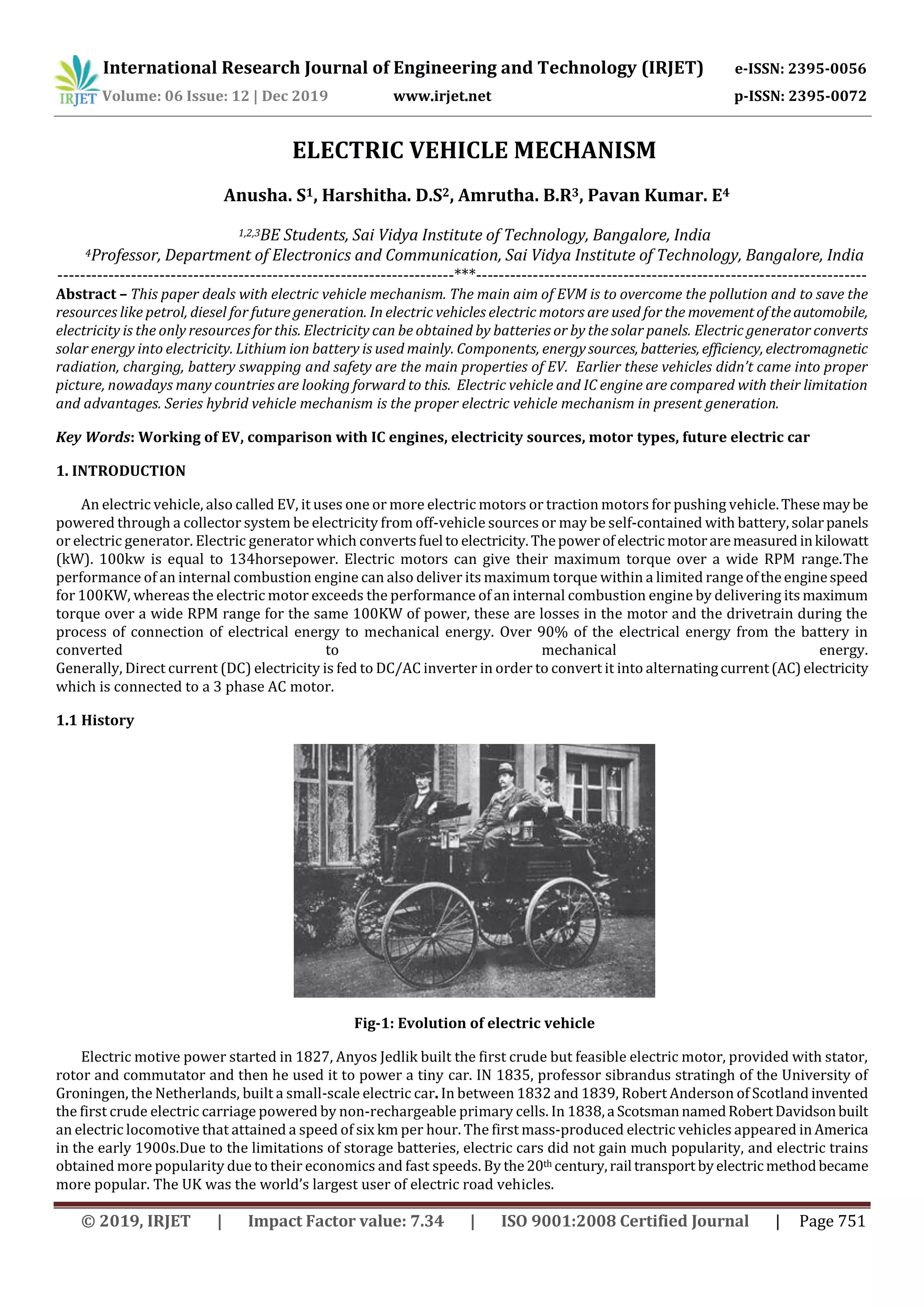
Fig-1: Evolution of electric vehicle
Electric motive power started in 1827, Anyos Jedlik built the first crude but feasible electric motor, provided with stator,
rotor and commutator and then he used it to power a tiny car. IN 1835, professor sibrandus stratingh of the University of
Groningen, the Netherlands, built a small-scale electric car. In between 1832 and 1839, Robert Anderson of Scotland invented
the first crude electric carriage powered by non-rechargeable primary cells. In 1838,a ScotsmannamedRobertDavidsonbuilt
an electric locomotive that attained a speed of six km per hour. The first mass-produced electric vehicles appeared in America
in the early 1900s.Due to the limitations of storage batteries, electric cars did not gain much popularity, and electric trains
obtained more popularity due to their economics and fast speeds. By the20th century,rail transport byelectricmethodbecame
more popular. The UK was the world’s largest user of electric road vehicles.
International Research Journal of Engineering and Technology (IRJET) e-ISSN: 2395-0056
Volume: 06 Issue: 12 | Dec 2019 www.irjet.net p-ISSN: 2395-0072
© 2019, IRJET | Impact Factor value: 7.34 | ISO 9001:2008 Certified Journal | Page 752
1.2 Working
Fig-2: Series hybrid vehicle mechanism
Electric vehicles have achievedsuperiorperformancebyanalysingthetechnology behindtheinduction. Twotypesofmotor
are rotor-collection of conducting have short circuited by end rings and stator-3 phase AC input powerisgivento stator.The3
phase AC current in the coils producer a rotating magnitude field, they induce current on the rotor ball to make it sun. In an
induction motor the rotor always lags behind RMF. An inductionmotordoesnotcontainbrushesorpermanentmagnet butitis
powerful and strong. N is directly proportional to f. The speed of the induction motor depends on the frequency of the AC
power supply. By varying the frequency of the power supply we will be able to alter the drive wheel speed. This fact of the
electric vehicle makes speed control easy and reliable the motor speed can rang 0to18, 000 rpm.This is the main advantage of
electric vehicle when compose to the internal combustion vehicles.
Internal combustion engine produces usable torque and power output only within limited speed range. Connecting the
engine rotation directly to the drive wheel is not a level idea, therefore we introduce a transmission to vary the speed of the
drive wheel. Inductor motor speed ranges from 2000-4000 rpm but inanelectricvehicle,thespeedvaryingtransmissionisnot
needed.For some electric cars and electric trains, DC motors are often used, but in some cases universal motorsarebeingused.
In recent production various such motor types have be implemented for example- Induction motor within Tesla motors and
permanent magnetic machines in Nissan leaf and Chevrolet bolt
2. Comparison with IC engine
Fig-3: Comparison
An IC engine does not produce direct rotational motion. The linear motion of the given piston has to be converted to
rotational motion, this causes major mechanical balance in problems. The power outputofICengineisalwaysineven,therefore
we need many accessorises to solve these problems. On the other hand electric vehicles will have direct rotational motion and
uniform power output in addictionwithaninductionmotor.Manycomponentsimplementedininternalcombustionengine.Asa
result of which we get a great response rate and a higher power to weight ratio resulting superior vehicle performance.
International Research Journal of Engineering and Technology (IRJET) e-ISSN: 2395-0056
Volume: 06 Issue: 12 | Dec 2019 www.irjet.net p-ISSN: 2395-0072
© 2019, IRJET | Impact Factor value: 7.34 | ISO 9001:2008 Certified Journal | Page 753
IC EVM
Weight 180kg 31.8kg
Power 140kW 270kW
W/p 0.8kW/kg 8.5kW/kg
Induction motor receiver the power from a battery package the battery produces dc power. So before gettingratethemotor
it has to be created into AC and inverter used for the conversion of DC to AC. The inverter can carry the amplitude of AC power
which in turn control the output of the motor power. Therefore inverter acts as a brain of electric vehicle. Battery pack is a
collection of lithium ion cells. These cells are connected in combination of series and parallel to produce the required power to
run the electric vehicle. Glycol coolant id pass through the gaps between the cells. Instead of using big cells many small cells are
used to promote effective cooling, thisminimizethermalhotspotsandalsotemperatureisdistributedevenlythisensureshigher
battery pack life. The power produced by the motor transferred to the drive wheels through gear box. Achieving reversegearis
quite easy in electric vehiclesjust by changing the order of power phase.Thegearboxconsistsofanopendifferential,thesehave
a problem of traction control like in the case of slippery surface, even then the electric vehicleusesopendifferentialbecauseitis
more rugged and can carry more torque. The problem thatoccursinopendifferentialcanbeovercomebytwomethodsselective
breakingand cutting the power supply. In internal combustion engine the power supplycut bycuttingthefuelisnotsoeffective
therefore in induction motor this power supply cut is effective, because this complex mechanical hardware system is replaced
with a smart software.
Electricity sources
The EV’s derive electricity from multiple sources like diesel, fuel cell, nuclear energy and also solar energy.
The EV’s can also derive electricity by the on board rechargeable electricity storage system (RESS)andonhighwayrecharging
purpose we use a direct continuous connection to land based generation plants. ForlargeEV’ssuchassubmarine,thechemical
energy can be replaced by nuclear reactor that provides heat which initiates the stream turbine.
The power storage method of electric vehicles involves,
Chemical energy stored on the vehicle-battery electric vehicle, especially for lithium –ion battery.
Kinetic energy storage-fly wheels.
Static energy storage-electric double layer capacitor.
The Electric double layer capacitors and the flywheels are rechargeable. By avoiding unnecessary conversions the energy
conversion efficiency can be improved.
The Electro-chemical batteries conversion can easily
be reversed by allowing the electric energy to be stored in the form of chemical energy.
3. Conclusions
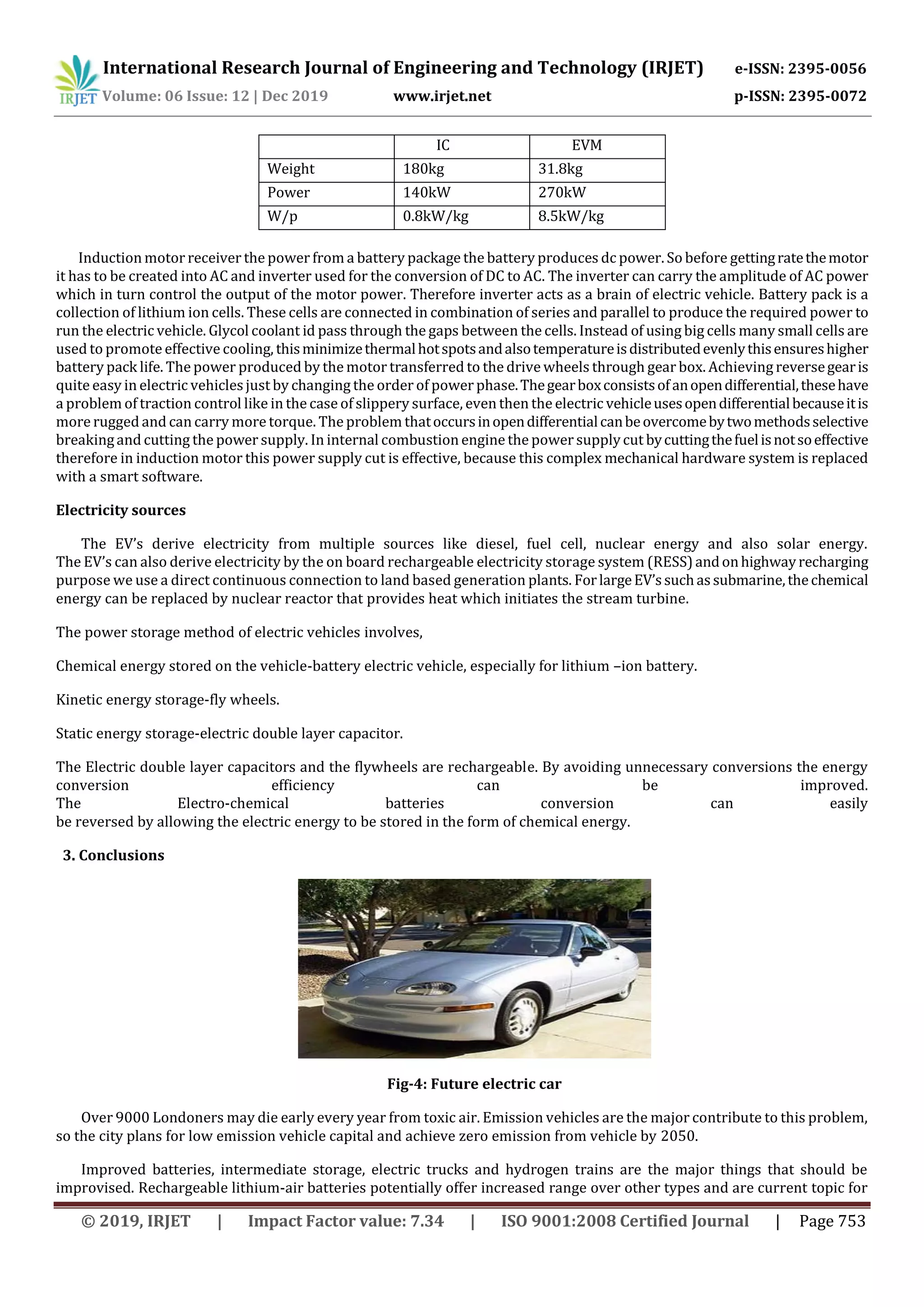
Fig-4: Future electric car
Over 9000 Londoners may die early every year from toxic air. Emission vehicles are the major contribute to this problem,
so the city plans for low emission vehicle capital and achieve zero emission from vehicle by 2050.
Improved batteries, intermediate storage, electric trucks and hydrogen trains are the major things that should be
improvised. Rechargeable lithium-air batteries potentially offer increased range over other types and are current topic for
International Research Journal of Engineering and Technology (IRJET) e-ISSN: 2395-0056
Volume: 06 Issue: 12 | Dec 2019 www.irjet.net p-ISSN: 2395-0072
© 2019, IRJET | Impact Factor value: 7.34 | ISO 9001:2008 Certified Journal | Page 754
research. Another improvement is to decouple the electric motor from the battery through electronic control, employing
supercapacitors to buffer large but short power demands and regenerative braking energy. This electric vehicles are better
than IC engines in this present world and also to save resources for future.
REFERENCES
[1] www.jklossner.com
[2] www.inderscience.com
[3] Automobile Mechanics by A.K.Babu, S.C.Sharma and T.R.Ranga.
[4] Automotive electrical and electronics 2nd edition by A.K.Babu.

IRJET- Electric Vehicle Mechanism

  • 1.
    International Research Journalof Engineering and Technology (IRJET) e-ISSN: 2395-0056 Volume: 06 Issue: 12 | Dec 2019 www.irjet.net p-ISSN: 2395-0072 © 2019, IRJET | Impact Factor value: 7.34 | ISO 9001:2008 Certified Journal | Page 751 ELECTRIC VEHICLE MECHANISM Anusha. S1, Harshitha. D.S2, Amrutha. B.R3, Pavan Kumar. E4 1,2,3BE Students, Sai Vidya Institute of Technology, Bangalore, India 4Professor, Department of Electronics and Communication, Sai Vidya Institute of Technology, Bangalore, India ----------------------------------------------------------------------***--------------------------------------------------------------------- Abstract – This paper deals with electric vehicle mechanism. The main aim of EVM is to overcome the pollution and to save the resources like petrol, diesel for future generation. In electric vehicles electric motors are used for the movementoftheautomobile, electricity is the only resources for this. Electricity can be obtained by batteries or by the solar panels. Electric generator converts solar energy into electricity. Lithium ion battery is used mainly. Components, energysources, batteries, efficiency, electromagnetic radiation, charging, battery swapping and safety are the main properties of EV. Earlier these vehicles didn’t came into proper picture, nowadays many countries are looking forward to this. Electric vehicle and IC engine are compared with their limitation and advantages. Series hybrid vehicle mechanism is the proper electric vehicle mechanism in present generation. Key Words: Working of EV, comparison with IC engines, electricity sources, motor types, future electric car 1. INTRODUCTION An electric vehicle, also called EV, it uses one or more electric motors or traction motors for pushing vehicle.These maybe powered through a collector system be electricity from off-vehicle sources or may be self-contained with battery, solarpanels or electric generator. Electric generator which convertsfuel to electricity.Thepowerof electricmotoraremeasured inkilowatt (kW). 100kw is equal to 134horsepower. Electric motors can give their maximum torque over a wide RPM range.The performance of an internal combustion engine can also deliver its maximum torque within a limited rangeoftheenginespeed for 100KW, whereas the electric motor exceeds the performance of an internal combustion engine by delivering its maximum torque over a wide RPM range for the same 100KW of power, these are losses in the motor and the drivetrain during the process of connection of electrical energy to mechanical energy. Over 90% of the electrical energy from the battery in converted to mechanical energy. Generally, Direct current (DC) electricity is fed to DC/AC inverter in order to convert it into alternatingcurrent(AC)electricity which is connected to a 3 phase AC motor. 1.1 History Fig-1: Evolution of electric vehicle Electric motive power started in 1827, Anyos Jedlik built the first crude but feasible electric motor, provided with stator, rotor and commutator and then he used it to power a tiny car. IN 1835, professor sibrandus stratingh of the University of Groningen, the Netherlands, built a small-scale electric car. In between 1832 and 1839, Robert Anderson of Scotland invented the first crude electric carriage powered by non-rechargeable primary cells. In 1838,a ScotsmannamedRobertDavidsonbuilt an electric locomotive that attained a speed of six km per hour. The first mass-produced electric vehicles appeared in America in the early 1900s.Due to the limitations of storage batteries, electric cars did not gain much popularity, and electric trains obtained more popularity due to their economics and fast speeds. By the20th century,rail transport byelectricmethodbecame more popular. The UK was the world’s largest user of electric road vehicles.
  • 2.
    International Research Journalof Engineering and Technology (IRJET) e-ISSN: 2395-0056 Volume: 06 Issue: 12 | Dec 2019 www.irjet.net p-ISSN: 2395-0072 © 2019, IRJET | Impact Factor value: 7.34 | ISO 9001:2008 Certified Journal | Page 752 1.2 Working Fig-2: Series hybrid vehicle mechanism Electric vehicles have achievedsuperiorperformancebyanalysingthetechnology behindtheinduction. Twotypesofmotor are rotor-collection of conducting have short circuited by end rings and stator-3 phase AC input powerisgivento stator.The3 phase AC current in the coils producer a rotating magnitude field, they induce current on the rotor ball to make it sun. In an induction motor the rotor always lags behind RMF. An inductionmotordoesnotcontainbrushesorpermanentmagnet butitis powerful and strong. N is directly proportional to f. The speed of the induction motor depends on the frequency of the AC power supply. By varying the frequency of the power supply we will be able to alter the drive wheel speed. This fact of the electric vehicle makes speed control easy and reliable the motor speed can rang 0to18, 000 rpm.This is the main advantage of electric vehicle when compose to the internal combustion vehicles. Internal combustion engine produces usable torque and power output only within limited speed range. Connecting the engine rotation directly to the drive wheel is not a level idea, therefore we introduce a transmission to vary the speed of the drive wheel. Inductor motor speed ranges from 2000-4000 rpm but inanelectricvehicle,thespeedvaryingtransmissionisnot needed.For some electric cars and electric trains, DC motors are often used, but in some cases universal motorsarebeingused. In recent production various such motor types have be implemented for example- Induction motor within Tesla motors and permanent magnetic machines in Nissan leaf and Chevrolet bolt 2. Comparison with IC engine Fig-3: Comparison An IC engine does not produce direct rotational motion. The linear motion of the given piston has to be converted to rotational motion, this causes major mechanical balance in problems. The power outputofICengineisalwaysineven,therefore we need many accessorises to solve these problems. On the other hand electric vehicles will have direct rotational motion and uniform power output in addictionwithaninductionmotor.Manycomponentsimplementedininternalcombustionengine.Asa result of which we get a great response rate and a higher power to weight ratio resulting superior vehicle performance.
  • 3.
    International Research Journalof Engineering and Technology (IRJET) e-ISSN: 2395-0056 Volume: 06 Issue: 12 | Dec 2019 www.irjet.net p-ISSN: 2395-0072 © 2019, IRJET | Impact Factor value: 7.34 | ISO 9001:2008 Certified Journal | Page 753 IC EVM Weight 180kg 31.8kg Power 140kW 270kW W/p 0.8kW/kg 8.5kW/kg Induction motor receiver the power from a battery package the battery produces dc power. So before gettingratethemotor it has to be created into AC and inverter used for the conversion of DC to AC. The inverter can carry the amplitude of AC power which in turn control the output of the motor power. Therefore inverter acts as a brain of electric vehicle. Battery pack is a collection of lithium ion cells. These cells are connected in combination of series and parallel to produce the required power to run the electric vehicle. Glycol coolant id pass through the gaps between the cells. Instead of using big cells many small cells are used to promote effective cooling, thisminimizethermalhotspotsandalsotemperatureisdistributedevenlythisensureshigher battery pack life. The power produced by the motor transferred to the drive wheels through gear box. Achieving reversegearis quite easy in electric vehiclesjust by changing the order of power phase.Thegearboxconsistsofanopendifferential,thesehave a problem of traction control like in the case of slippery surface, even then the electric vehicleusesopendifferentialbecauseitis more rugged and can carry more torque. The problem thatoccursinopendifferentialcanbeovercomebytwomethodsselective breakingand cutting the power supply. In internal combustion engine the power supplycut bycuttingthefuelisnotsoeffective therefore in induction motor this power supply cut is effective, because this complex mechanical hardware system is replaced with a smart software. Electricity sources The EV’s derive electricity from multiple sources like diesel, fuel cell, nuclear energy and also solar energy. The EV’s can also derive electricity by the on board rechargeable electricity storage system (RESS)andonhighwayrecharging purpose we use a direct continuous connection to land based generation plants. ForlargeEV’ssuchassubmarine,thechemical energy can be replaced by nuclear reactor that provides heat which initiates the stream turbine. The power storage method of electric vehicles involves, Chemical energy stored on the vehicle-battery electric vehicle, especially for lithium –ion battery. Kinetic energy storage-fly wheels. Static energy storage-electric double layer capacitor. The Electric double layer capacitors and the flywheels are rechargeable. By avoiding unnecessary conversions the energy conversion efficiency can be improved. The Electro-chemical batteries conversion can easily be reversed by allowing the electric energy to be stored in the form of chemical energy. 3. Conclusions Fig-4: Future electric car Over 9000 Londoners may die early every year from toxic air. Emission vehicles are the major contribute to this problem, so the city plans for low emission vehicle capital and achieve zero emission from vehicle by 2050. Improved batteries, intermediate storage, electric trucks and hydrogen trains are the major things that should be improvised. Rechargeable lithium-air batteries potentially offer increased range over other types and are current topic for
  • 4.
    International Research Journalof Engineering and Technology (IRJET) e-ISSN: 2395-0056 Volume: 06 Issue: 12 | Dec 2019 www.irjet.net p-ISSN: 2395-0072 © 2019, IRJET | Impact Factor value: 7.34 | ISO 9001:2008 Certified Journal | Page 754 research. Another improvement is to decouple the electric motor from the battery through electronic control, employing supercapacitors to buffer large but short power demands and regenerative braking energy. This electric vehicles are better than IC engines in this present world and also to save resources for future. REFERENCES [1] www.jklossner.com [2] www.inderscience.com [3] Automobile Mechanics by A.K.Babu, S.C.Sharma and T.R.Ranga. [4] Automotive electrical and electronics 2nd edition by A.K.Babu.