Open Access
ISSN: 2165-784X
Journal of Civil & Environmental Engineering
Research Article
Volume 10:5, 2020
DOI: 10.37421/jcce.2020.10.357
Abstract
The growing use of Building Information Modelling in the construction as an emerging concept is a digital approach replacing traditional approaches
gradually. With the changing scenario in the industry with the introduction of technology, the adoption of BIM has brought forth many a debates
among professionals. With the growing technological advancements, there is also a growing need for knowledge; hence many professionals
and researchers are working on various aspects of research in various fields of BIM. The paper aims to review the amount of research done on
the use and adoption of BIM in various fields of construction project. By examining 130 publications from various sources, a cumulative analysis
of the fields of research and progression in publication has been studied and established. The results got henceforth from the paper indicate a
progressive increase in the research done in various fields of construction projects.
Keywords: Building Information modelling • Construction project • Design • Construction • Operation and management • Sustainability and energy
• Project lifecycle
A Research Study Done on the Adaptation of Building Information
Modelling in Various Fields of a Construction Project
Gauthami Krishna*
Masters in Architecture & Environmental Design, Jawaharlal Nehru Architecture and Fine Arts University (JNAFAU), Hyderabad, India
*Address for Correspondence: Gauthami Krishna, Masters in Architecture
& Environmental Design, Jawaharlal Nehru Architecture and Fine Arts
University (JNAFAU), Hyderabad, India, Tel: + 9533499759; E-mail:
gauthamisuccess@gmail.com
Copyright: © 2020 Krishna G. This is an open-access article distributed under the
terms of the Creative Commons Attribution License, which permits unrestricted
use, distribution, and reproduction in any medium, provided the original author
and source are credited.
Received 30 July, 2020; Accepted 17 August, 2020; Published 24
August, 2020
Introduction
Building information modelling is a digital form of recording the entire
project lifecycle including all the phases from conceptual designing till the
construction also including the operation [1] and production management [2].
Breaking through manual working approaches, it provides more information
flow between all work-sectors involved in the project. Despite its recent entry
into the construction industry, the use of BIM in project helps create a language
among the parties involved in the project helping the project manager in various
disciplines and phases [3], revolutionising the building design, construction
and day-to-day operations, enhancing the efficiency of project [4]. Creating a
virtual and reliable source of information with respect to various parameters,
BIM is the emerging technology handling information in the AEC industry [5].
In context to the varied application of BIM by various public and private
investors involved in the construction industry, are investing on a large scale
into BIM [6].
Despite its advantages and use in many construction projects, the industry
itself obstructs its full use [1] and effective application [7]. Hence government
initiatives to increase the role of BIM can change the practices in the industry
[1], with various initiatives like policy formation, BIM organisation, research
areas identification etc. having been formulated by various BIM fields in USA,
Norway, Finland, Denmark, Singapore and Hong Kong [8], resulting in an
increase in its use over past few years in various countries like North America,
U.K., Scandinavia etc. [7].
Although BIM in developed nations is well established, the construction
companies in developing nations are facing many hurdles with respect to
technological, social and economic aspects [9]. The rate at which BIM is being
adopted is relatively slow in Chinese construction industry [10] and also in
Pakistan industry [11].
Despite its varied uses BIM’s hands have not yet extended completely
to certain aspects like sustainability, renovation and re-construction, energy
simulation tools and adaptation of social sustainability into a project [12]. The
need of technical support, reduced construction cost benefits and software
package with the use of BIM are also yet to be addressed [13].
In the Architecture, Engineering, Construction and Operations (AECO)
industry the use of BIM has been explicit with an expansive knowledge
base [14] but few of the areas in which BIM is lagging behind have come
forth after extensive research in the field [12]. Considering the positives and
negatives, advantages and drawbacks that are faced due to the use of BIM
in a construction project, various professionals have contributed researches
on various platforms. The paper aims to examine 130 publications on the
adaptation of BIM in construction project during various phases. Categorising
into 6 broad aspects - BIM, Design, Construction, Operation and Maintenance,
Sustainability and Energy and Project Lifecycle. Firstly extensive research
done on BIM with respect to relevance, use, software, benefits, and adoption;
Design stages of macro and micro level planning, building, landscape,
renovation and conservation, heritage buildings etc; Construction with the
broad aspects of construction management, conflict management, information
management, etc; Operation and Management from project delivery to the
end of building; Sustainability and Energy and the overall Project Lifecycle
Assessment. The paper elaborates further on the fields mentioned above.
Study Area
BIM is widely used for designing, construction and management of the
project involving a digital representation of the project also changing the
way in which the building looks, functions, designed and built. Calculating
and documenting the time, cost and labour required it acts as a source for
better construction management and practices [15]. Integrated construction
environment backs up the effective use of BIM in the growing trends of energy
efficient and sustainable building construction [16] and project lifecycle [17].
BIM
BIM software is a computer programming language that enables the users
to build models provided with necessary information that has multiple visual
programming languages providing operators with specific languages that can
be used for Industry foundation classes models and code compliance checking
J Civil Environ Eng, Volume 10:5, 2020
Krishna G
Page 2 of 6
[18] a standard semantically rich 3D modelling tool that is one of the most
popular schema model currently used in the industry [19].
Design
Considering the technology driven transformation, various core aspects
with respect to design i.e., understanding, collaboration, decision making etc
can be addressed to and integrated with the help of BIM [20,21]. With the
emerging concept of smart city, the integrated application of BIM and GIS has
taken a new direction and is in the stage of early exploration [22]. Aiding smart
city initiatives, BIM-GIS based systems for energy planning is proposed as a
solution to optimally and technically integrate the emerging smart city concept
[23]. With respect to the professional’s interaction with the client in connection
to design, construction and maintenance process on a functional level. The
integrated use of BIM with a gaming engine has been proved to be a promising
potential support that enables functional collaboration and interaction of
both the parties providing a practical solution to the little addressed issue
[24]. Heritage Building Information Modelling tools are used in restoration of
buildings in a retrofitting and conservation framework [25]. Extending further,
the use of BIM for landscape projects enables the designer to establish a more
informative working environment increasing fields for designing and managing
the project and schedule backed up with managerial, scientific, professional
and practical approach [26].
Construction
Various project management benefits with the help of BIM can be
achieved making use of BIM as a feasible and promising source of identifying
the progress, conflict checks, construction resource management and cost
benefits [27,28]. BIM can be used by project managers to avoid unnecessary
works and save time and cost [29], improving work flow with visual base of the
project [30], providing for a successful project delivery [29]. With the use of BIM,
construction conflicts can be predicted and rectified or eliminated improving
the efficiency of project delivery [31]. Ensuring practical understanding of the
whole project, BIM ensures a check and helps predict probability of accidents
[32]. Safety planning and management at construction sites can also be
improved with the help of BIM, 3D and 4D simulations and other visualisation
technologies [33-35].
Operation and Management
Integration of BIM with facility management, BMS and front-end sensor
data visualisation aided environmental sensing helping the operation and
maintenance stages [36,37]. The information stored in BIM while construction
if retrieved during the operation stage can significantly increase the service life
of the project also making the maintenance easy [38]. Furthermore BIM can
also be used to ensure fire safety with respect to evacuation assessment and
route planning, safety education and equipment planning [39]. BIM with the
involvement of the client, with his/her maturity levels as a potential ability to
interact with the BIM can help monitor the benefits of BIM in building disaster
management as well [40].
Sustainability and Energy
BIM’s ability to serve as a multidisciplinary has made it feasible to explore
its sustainability value [41]. With the growing importance and need of BIM
in the construction industry, most construction companies are adopting BIM
technologies in adaptation to the changing context, towards more sustainable
environment [42]. Recent advancements have seen the integration of Building
Information Modelling and Building Energy Modelling in the light of achieving
growing energy conservation needs leading to updates in environmental
policies [43]. When plugged in with an energy performance analysis tool, BIM
can also act as an energy simulation tool providing the designers with greater
fields with respect to sustainability and energy efficient factors [41].
Project Lifecycle
The innovations of BIM have continuous adaptation 3D model that
provides information, data and a series of steps with respect to optimization
and preparation of design requirements, construction, processing and pulling
down covering the process of building lifecycle management [44,45].
People, process and technology form a basis for resistance in adoption
of BIM in most of the newly entering construction companies, while on the
contrary experienced and advanced construction companies are increasingly
adopting BIM for its efficiency and competitive advantages [46]. BIM, even
though being of great advantages with respect to project quality and costs, it
requires certain changes to be adopted with its current practices in terms of its
use in processing and technology for project management. Hence emphasizing
the roles and responsibilities of the construction players using BIM might
differ from conventional practices [47]. The role of sufficient information to be
acquired from contractors and operators to facilitate the BIM software is very
crucial. It is well known that BIM helps in various decisions making and project
delivery aspects but its full benefits cannot be exploited unless the relation
between site and model is linked correctly [13].
The divergent application of various fields within BIM has also been
explored with a set of defined components and boundaries outlined providing
a set of guidelines and BIM framework [14]. The integration of BIM and
off-site construction are increasingly being applied in the AEC industry
with its advantages in aiding the project stakeholders with visualization,
waste management etc., and lot of research is also being done to bring out
advantages and applications of BIM [48].
Research Methodology and Data Analy-
sis
Methodology
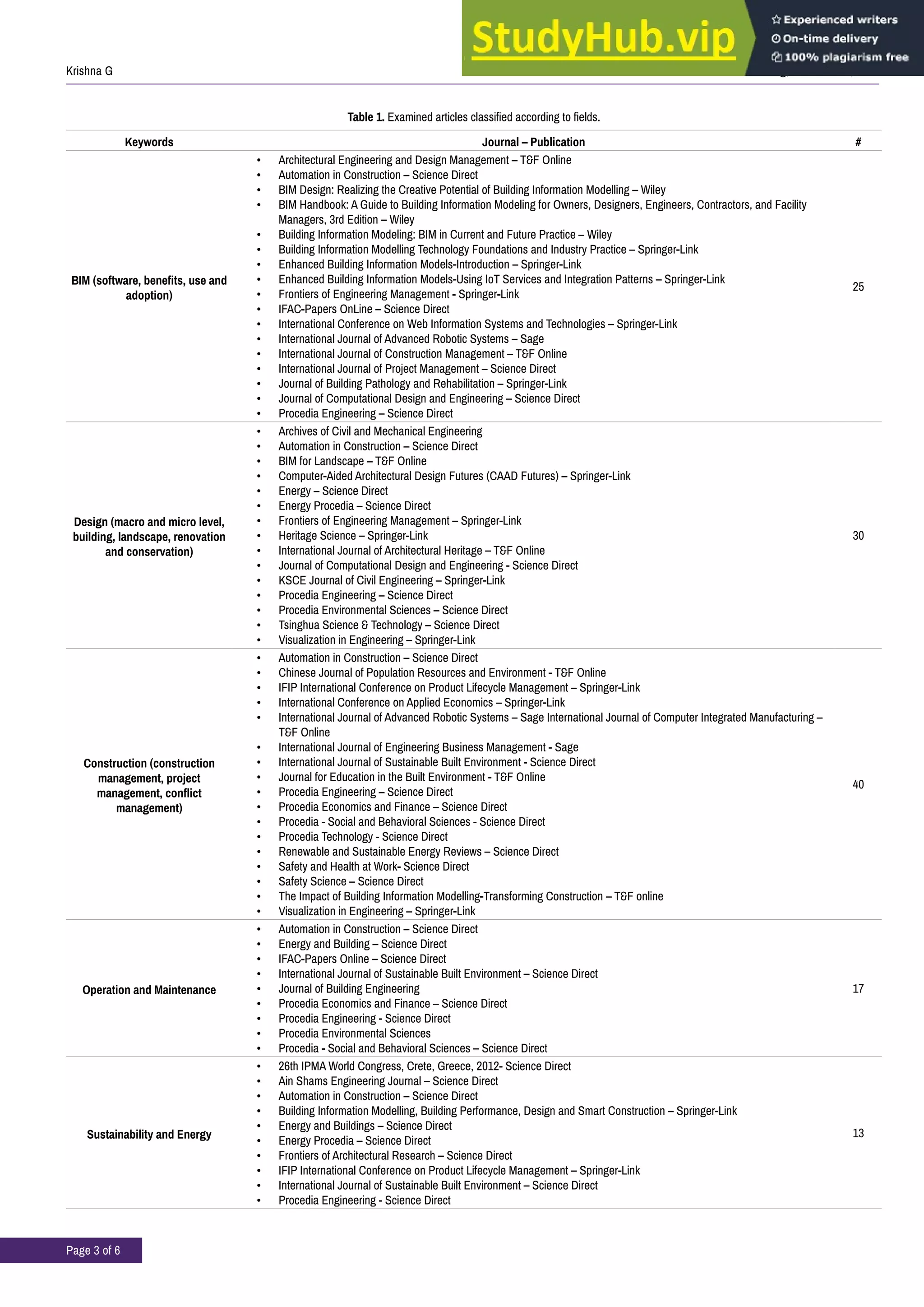
To review, a three step model examines journal articles, conference papers
and books. The first step, journal articles, conference papers and books are
classified according to the fields. The found journals were further categorised
under a table dealing with:
• BIM
• Design
• Construction
• Operation and Management
• Sustainability and Energy and
• Project Lifecycle (Table 1).
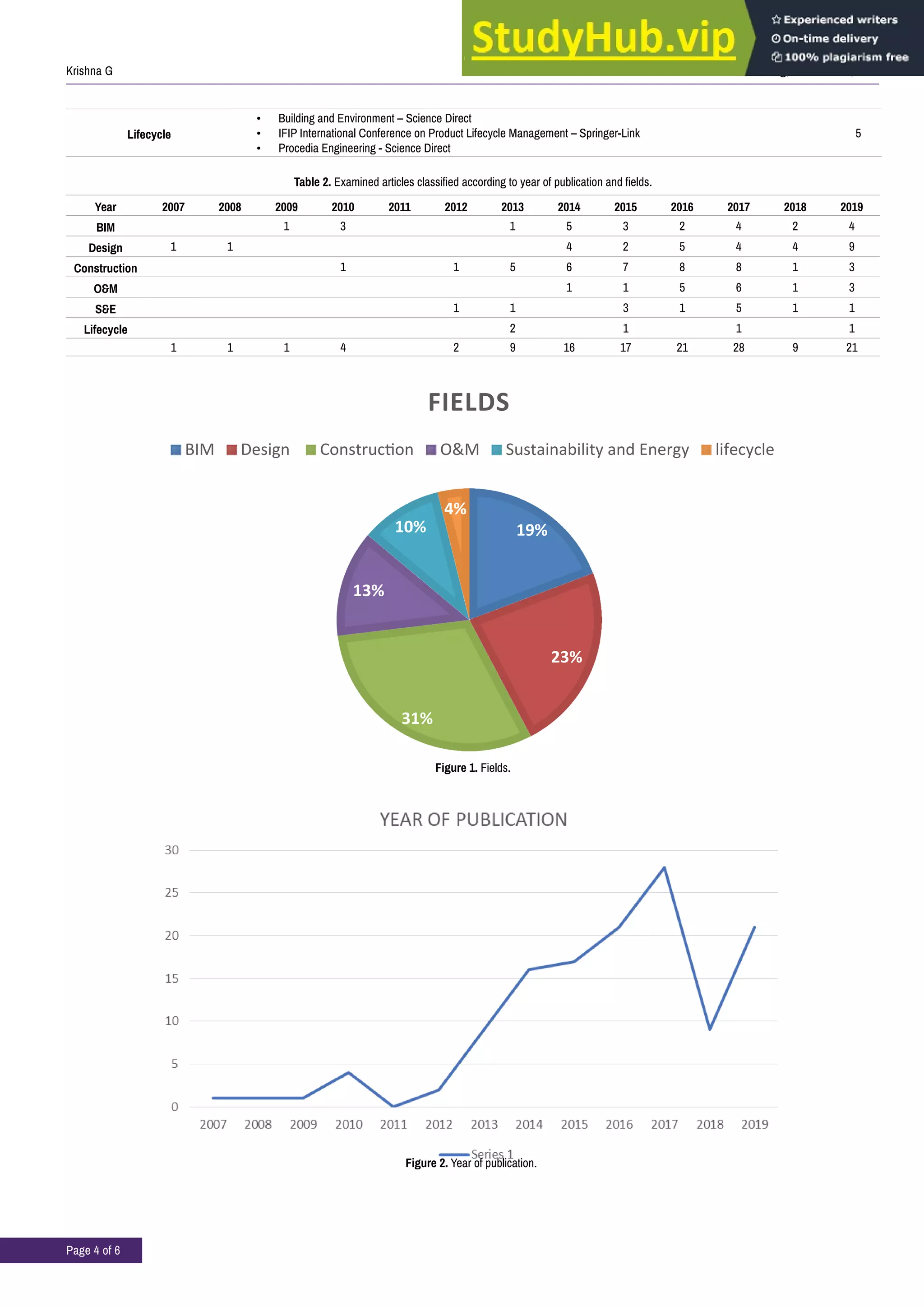
The second step included the year of publication of the articles, conference
papers and books. The third step involved the cumulating of both first and
second steps (Table 2).
Over 130 publications (journal articles, conference papers and books)
were examined with 111 journal articles, 10 books and 9 conference papers.
Figure 1 elaborates the percentage of research done in various fields of project
life. Figure 2 represents the research done in various years starting from 2007-
2019. Figure 3 is a cumulative analysis of the amount of research done in
various fields from 2007-2019. These figures indicate the increase in research
with respect to the fields, with the highest contribution of research being done
for construction phase of the project. Design phase stands next highest. While
there is still research going on with respect to operation and management
stages, the research on sustainability and energy is progressive. Research
on BIM is increasing day-by-day with its increasing adaptation; research in
specific fields is on a varied scale.
Discussion and Inferences
From visualization of the project enhancing the decision making process
and tracking digital project documents [49], the early architectural design stage
[50], the planning and preplanning stages [51], micro and macro level planning
[17], construction safety [52], Facility management [53], Construction Waste
J Civil Environ Eng, Volume 10:5, 2020
Krishna G
Page 3 of 6
Table 1. Examined articles classified according to fields.
Keywords Journal – Publication #
BIM (software, benefits, use and
adoption)
• Architectural Engineering and Design Management – T&F Online
• Automation in Construction – Science Direct
• BIM Design: Realizing the Creative Potential of Building Information Modelling – Wiley
• BIM Handbook: A Guide to Building Information Modeling for Owners, Designers, Engineers, Contractors, and Facility
Managers, 3rd Edition – Wiley
• Building Information Modeling: BIM in Current and Future Practice – Wiley
• Building Information Modelling Technology Foundations and Industry Practice – Springer-Link
• Enhanced Building Information Models-Introduction – Springer-Link
• Enhanced Building Information Models-Using IoT Services and Integration Patterns – Springer-Link
• Frontiers of Engineering Management - Springer-Link
• IFAC-Papers OnLine – Science Direct
• International Conference on Web Information Systems and Technologies – Springer-Link
• International Journal of Advanced Robotic Systems – Sage
• International Journal of Construction Management – T&F Online
• International Journal of Project Management – Science Direct
• Journal of Building Pathology and Rehabilitation – Springer-Link
• Journal of Computational Design and Engineering – Science Direct
• Procedia Engineering – Science Direct
25
Design (macro and micro level,
building, landscape, renovation
and conservation)
• Archives of Civil and Mechanical Engineering
• Automation in Construction – Science Direct
• BIM for Landscape – T&F Online
• Computer-Aided Architectural Design Futures (CAAD Futures) – Springer-Link
• Energy – Science Direct
• Energy Procedia – Science Direct
• Frontiers of Engineering Management – Springer-Link
• Heritage Science – Springer-Link
• International Journal of Architectural Heritage – T&F Online
• Journal of Computational Design and Engineering - Science Direct
• KSCE Journal of Civil Engineering – Springer-Link
• Procedia Engineering – Science Direct
• Procedia Environmental Sciences – Science Direct
• Tsinghua Science & Technology – Science Direct
• Visualization in Engineering – Springer-Link
30
Construction (construction
management, project
management, conflict
management)
• Automation in Construction – Science Direct
• Chinese Journal of Population Resources and Environment - T&F Online
• IFIP International Conference on Product Lifecycle Management – Springer-Link
• International Conference on Applied Economics – Springer-Link
• International Journal of Advanced Robotic Systems – Sage International Journal of Computer Integrated Manufacturing –
T&F Online
• International Journal of Engineering Business Management - Sage
• International Journal of Sustainable Built Environment - Science Direct
• Journal for Education in the Built Environment - T&F Online
• Procedia Engineering – Science Direct
• Procedia Economics and Finance – Science Direct
• Procedia - Social and Behavioral Sciences - Science Direct
• Procedia Technology - Science Direct
• Renewable and Sustainable Energy Reviews – Science Direct
• Safety and Health at Work- Science Direct
• Safety Science – Science Direct
• The Impact of Building Information Modelling-Transforming Construction – T&F online
• Visualization in Engineering – Springer-Link
40
Operation and Maintenance
• Automation in Construction – Science Direct
• Energy and Building – Science Direct
• IFAC-Papers Online – Science Direct
• International Journal of Sustainable Built Environment – Science Direct
• Journal of Building Engineering
• Procedia Economics and Finance – Science Direct
• Procedia Engineering - Science Direct
• Procedia Environmental Sciences
• Procedia - Social and Behavioral Sciences – Science Direct
17
Sustainability and Energy
• 26th IPMA World Congress, Crete, Greece, 2012- Science Direct
• Ain Shams Engineering Journal – Science Direct
• Automation in Construction – Science Direct
• Building Information Modelling, Building Performance, Design and Smart Construction – Springer-Link
• Energy and Buildings – Science Direct
• Energy Procedia – Science Direct
• Frontiers of Architectural Research – Science Direct
• IFIP International Conference on Product Lifecycle Management – Springer-Link
• International Journal of Sustainable Built Environment – Science Direct
• Procedia Engineering - Science Direct
13
J Civil Environ Eng, Volume 10:5, 2020
Krishna G
Page 4 of 6
Lifecycle
• Building and Environment – Science Direct
• IFIP International Conference on Product Lifecycle Management – Springer-Link
• Procedia Engineering - Science Direct
5
Table 2. Examined articles classified according to year of publication and fields.
Year 2007 2008 2009 2010 2011 2012 2013 2014 2015 2016 2017 2018 2019
BIM 1 3 1 5 3 2 4 2 4
Design 1 1 4 2 5 4 4 9
Construction 1 1 5 6 7 8 8 1 3
O&M 1 1 5 6 1 3
S&E 1 1 3 1 5 1 1
Lifecycle 2 1 1 1
1 1 1 4 2 9 16 17 21 28 9 21
19%
23%
31%
13%
10%
4%
FIELDS
BIM Design Construction O&M Sustainability and Energy lifecycle
Figure 1. Fields.
Figure 2. Year of publication.
J Civil Environ Eng, Volume 10:5, 2020
Krishna G
Page 5 of 6
Management [54], building performance management [55], eco-feedback
systems engaging the end users [56], with respect to technology, urban
governance, life cycle and energy management [17] BIM acts as a mediator
creating a relationship that conflicts the existing work practices and provides a
new dimension to work environment [57].
Solutions provided to overcome [58] the on-site implementation [59],
data accumulation and exchange [60], semantic web technologies to track
uncertainties and risks [61], research prevent design hindrances in renovation
projects [62] have provided scope for better implementation of BIM [63].
Conclusion
Despite the many advantages of using BIM, there is a stigma surrounding
it to be a disruptive force that is changing the way of designing, building and
managing the built structures. But insights into the essays composed by
leaders from professional sources provided the potential benefits of using BIM
speculating its future.
References
1. Borrmann, André, M König, Koch C and J Beetz. “Buiiding information modeling”
Springer International Publishing (2018).
2. Brito, Douglas M and Emerson AM Ferreira. “Strategies for Representation and
Analyses of 4D Modeling Applied to Construction Project Management” Procedia
Economics and Finance Science Direct 21 (2015): 374-382.
3. Rokooei, Saeed. “Building Information Modeling in Project Management:
Necessities, Challenges and Outcomes” Procedia - Social and Behavioral Sciences
210 (2015): 87-95.
4. Garber, Richard. “BIM Design: Realising the Creative Potential of Building
Information Modelling” Wiley (2014).
5. Bartosz,Jankowski,JakubProkockiandMichałKrzemiński.“FunctionalAssessment
of BIM Methodology Based on Implementation in Design and Construction
Company” Procedia Engineering – Science Direct 111 (2015): 351-355.
6. Beata, Grzyl, Emilia Miszewska-Urbańska and Magdalena Apollo. “Building
Information Modelling as an Opportunity and Risk for Stakeholders Involved in
Construction Investment Process” Procedia Engineering 196 (2017): 1026-1033.
7. Smith, Peter Smith. “BIM Implementation – Global Strategies” Science direct (2014).
8. Wong, Andy KD, Francis KW Wong and Abid Nadeem. “Attributes of Building
Information Modelling Implementations in Various Countries. Architectural
Engineering and Design Management 6 (2010): 288-302.
9. Bui, Nam, Christoph Merschbrock and Bjørn Erik Munkvold. “A Review of Building
Information Modelling for Construction in Developing Countries” Procedia
Engineering 164 (2016): 487-494.
10. M, Herr, Christiane and Thomas Fischer. “BIM adoption across the Chinese AEC
industries: An extended BIM adoption model” Journal of Computational Design and
Engineering 6 (2019): 173-178.
11. R, Masood, MKN Kharal and AR Nasir. “Is BIM Adoption Advantageous for
Construction Industry of Pakistan?” Procedia Engineering 77 (2014): 229-238.
12. Chong, Heap-Yih, Cen-Ying Lee and Xiangyu Wang. “A mixed review of the
adoption of Building Information Modelling (BIM) for sustainability” A mixed review
of the adoption of Building Information Modelling (BIM) for sustainability 142 (2017):
4114-4126.
13. Chandra, Herry Pintardi, Paulus Nugraha and Evan Sutanto Putra. “Building
Information Modeling in the Architecture-engineering Construction Project in
Surabaya” Procedia Engineering 171 (2017): 348-353.
14. Succar, Bilal. “Building information modelling framework: A research and delivery
foundation for industry stakeholders” Automation in Construction 18 (2009): 357-
375.
15. Sacks, Rafael, Chuck Eastman, Ghang Lee and Paul Teicholz. “BIM Handbook:
A Guide to Building Information Modeling for Owners, Designers, Engineers,
Contractors, and Facility Managers” Wiley (2018).
16. Zhang, Miao, Dan Tan and Yang Zhang. “Analysis of BIM application relationship
with integration degree of construction environment” Chinese Journal of Population
Resources and Environment 11 (2013): 92-96.
17. Hao, Wang, Yisha Pan and Xiaochun Luo. “Integration of BIM and GIS in sustainable
built environment: A review and bibliometric analysis” Automation in Construction
103 (2019): 41-52.
18. Cornelius, Preidel, Simon Daum and André Borrmann. “Data retrieval from building
information models based on visual programming” Springer Link (2017).
19. Isikdag, Umit. “Enhanced Building Information Models” Springer Link (2015).
20. Forsythe, Perry, Julie Jupp and Anil Sawhney. “Building Information Modelling
in Tertiary Construction Project Management Education: A Programme-wide
Implementation Strategy” Journal for eduation in the Built Environemnt 8 (2013):
16-34.
21. Paweł, Nowak, Mariola Książek, Marcin Draps and Jacek Zawistowski. “Decision
Figure 3. Cumulative analysis of the fields and year of publication.
J Civil Environ Eng, Volume 10:5, 2020
Krishna G
Page 6 of 6
Making with Use of Building Information Modeling” Procedia Engineering 153
(2016): 519-526.
22. Ma, Zhiliang and Yuan Ren. “Integrated Application of BIM and GIS: An Overview”
Procedia Engineering (2014).
23. Shinji Yamamura, Liyang Fan and Yoshiyasu Suzuki. “Assessment of Urban Energy
Performance through Integration of BIM and GIS for Smart City Planning” Procedia
Engineering 180 (2017): 1432-1472.
24. Edwards, Gareth, Haijiang Li and Bin Wang. “BIM based collaborative and
interactive design process using computer game engine for general end-users”
Visualization in Engineering 3 (2015): 4.
25. Khodeir, Laila M, Dalia Aly and ShaimaaTarek. “Integrating HBIM (Heritage Building
Information Modeling) Tools in theApplication of Sustainable Retrofitting of Heritage
Buildings in Egypt” Procedia Environmental Sciences 34 (2016): 258-270.
26. Institute, L. “BIM for Landscape” Taylor and Francis (2016).
27. Li, Jian, Lei Hou, Xiangyu Wang and Jun Wang. “A Project-Based Quantification of
BIM Benefits” Interantional Journal of Advanced Robotics System 11 (2014).
28. Aleksander K Nicał and Wojciech Wodyński. “Enhancing Facility Management
through BIM 6D” Procedia Engineering - ScienceDirect 164 (2016): 299-306.
29. Fazli, Abdulsame, SajadFathi, Mohammad Hadi Enferadi and Mayram Fazli, et al.
“Appraising Effectiveness of Building Information Management (BIM) in Project
Management” Procedia Technology – Science Direct 16 (2014): 1116-1125.
30. Sacks, Rafael, Milan Radosavljevic and Ronen Barak. “Requirements for building
information modeling based lean production management systems for construction”
Automation in Construction- ScienceDirect 19 (2010): 641-655.
31. Charehzehi, Aref, Chang Saar Chai, Aminah Md Yusof and Heap-Yih Chong, et al.
“Building information modeling in construction conflict management” International
Journal of Engineering Business Management 9 (2017).
32. Ganah,Abdulkadir and GodfaurdAJohn. “Integrating Building Information Modeling
and Health and Safety for Onsite Construction” Safety and Health at Work 6 (2015):
39-45.
33. Azhar, Salman. “Role of Visualization Technologies in Safety Planning and
Management at Construction Jobsites” Procedia Engineering 171 (2017): 215-226.
34. Hongling, Guo, Yu Yantao, Zhang Weisheng and Li Yan. “BIM and Safety Rules
Based Automated Identification of Unsafe Design Factors in Construction” Procedia
Engineering 164 (2016): 467-472.
35. Zhang, Sijie, Jochen Teizer, Jin-Kook Lee and Charles M Eastman. “Building
Information Modeling (BIM) and Safety: Automatic Safety Checking of Construction
Models and Schedules” Automation in Construction 29 (2013): 183-195.
36. Chien, Szu-cheng, Tzu-chun Chuang, Huei-Sheng Yu and Yi Han. “Implementation
of Cloud BIM-based Platform towards High-performance Building Services”
Procedia Environmental Sciences 38 (2017): 436-444.
37. Oti, AH, E Kurul J, F Cheung and JHM Tah. “A framework for the utilization of
Building Management System data in building information models for building
design and operation” Automation in Construction 72 (2016): 195-210.
38. Marchini, A and JO Patzlaff. “Building information modeling (BIM) application in civil
constructions intending the increase of service life” Journal of Building Pathology
and Rehabilitation (2016).
39. Wang, Shih-Hsu, Wei-Chih Wang, Kun-Chi Wang and Shih-YuShih. “Applying
building information modeling to support fire safety management” Automation in
Construction 59 (2017): 158-167.
40. Dakhil,Ammar and MustafaAlshawi. “Client's Role in Building Disaster Management
through Building Information Modelling” Procedia Economics and Finance 18
(2014): 47-54.
41. Samuel, Egwunatum I, EstherJoseph-Akwara and Akaigwe Richard. “Assessment
of energy utilization and leakages in buildings with building information model
energy” Frontiers of Architectural Research 6 (2017): 29-41.
42. Aladag, Hande, Gökhan Demirdögen and Zeynep Isık. “Building Information
Modeling (BIM) Use in Turkish Construction Industry” Procedia Engineering 161
(2016): 174-179.
43. Khodeir, Laila Mohamed and Ashraf Ali Nessim. “BIM 2 BEM integrated approach:
Examining status of the adoption of building information modelling and building
energy models in Egyptian architectural firms” Ain Shams Engineering Journal 9
(2018): 1781-1790.
44. Ustinovičius, Leonas, Romas Rasiulis, LukaszNazarko and Tatjana Vilutienė.
“Innovative Research Projects in the Field of Building Lifecycle Management”
Procedia Engineering 122 (2015): 166-171.
45. Migilinskas, Darius, Vladimir Popov, Virgaudas Juocevicius and Leonas
Ustinovichius. “The Benefits, Obstacles and Problems of Practical Bim
Implementation” Procedia Engineering 57 (2013): 767-774.
46. Ali, KN, WI Enegbuma, AC Ologbo and UG Aliagha. “Preliminary Study Impact of
Building Information Modelling Use in Malaysia” IFIP International Conference on
Product Lifecycle Management (2014): 51-62.
47. Latiffi, Aryani Ahmad, Juliana Brahim and Mohamad Syazli Fathi. “Roles and
Responsibilities of Construction Players in Projects Using Building Information
Modeling” IFIP International Conference on Product Lifecycle Management (2015):
173-182.
48. Yin, Xianfei, HexuLiu, Yuan Chen and Mohamed Al-Hussein. “Building information
modelling for off-site construction: Review and future directions” Automation in
Construction 101(2019): 72-91.
49. Bolshakova, Veronika. “Frontiers of Engineering Management” Springer Link
(2019).
50. Penttilä, Hannu. “Early Architectural Design and BIM. Computer-Aided Architectural
Design Futures” Springer Link (2007): 291-302.
51. Peckienė, Aurelija and Leonas Ustinovičius. “Possibilities for Building Spatial
Planning using BIM Methodology” Procedia Engineering 172 (2017): 851-858.
52. Akram, Ramsha, Muhammad Jamaluddin Thaheem, Abdur Rehman Nasir
and Tauha Hussain Ali “Exploring the role of building information modeling in
construction safety through science mapping” Safety Science 120 (2019): 456-470.
53. Aziz, Nor Diana, Abdul Hadi Nawawi and Nor Rima Muhamad Ariff. “Building
Information Modelling (BIM) in Facilities Management: Opportunities to be
Considered by Facility Managers” Procedia - Social and Behavioral Sciences 243
(2016): 353-362.
54. Lu, Weisheng, Chris Webster, Ke Chen and. Xiaoling Zhang. “Computational
Building Information Modelling for construction waste management: Moving from
rhetoric to reality” Renewable and Sustainable Energy Reviews 68 (2017): 587-595.
55. Gerrish, Tristan, Kirti Ruikar, Malcolm Cook and Mark Johnson. “BIM application
to building energy performance visualisation and management: Challenges and
potential” Energy and Buildings 144 (2017): 218-228.
56. Truong, Hanh. “Method for visualizing energy use in building information models”
Energy Procedia 142 (2017): 2541-2546.
57. Voordijk, Hans. “Building information modeling and its impact on users in the
lifeworld: a mediation perspective” Frontiers of Engineering Management 6 (2019):
193-206.
58. Morlhon, Romain, Robert Pellerin and Mario Bourgault. “Building Information
Modeling Implementation through Maturity Evaluation and Critical Success Factors
Management” Procedia Technology 16 (2014): 1126-1134.
59. Bargstädt, Hans-Joachim. “Challenges of BIM for Construction Site Operations”
Procedia Engineering 117 (2015): 52-59.
60. Pishdad-Bozorgi, Pardis, Xinghua Gao, Charles Eastman and Alonzo PatrickSelf.
“Planning and developing facility management-enabled building information model
(FM-enabled BIM)” Automation in Construction 87 (2018): 22-38.
61. Pruvost, Hervé and Raimar J Scherer “Analysis of Risk in Building Life Cycle
Coupling BIM-based Energy Simulation and Semantic Modeling” Procedia
Engineering 196 (2017): 1103-1113.
62. Stegnar, G and T Cerovšek. “Information needs for progressive BIM methodology
supporting the holistic energy renovation of office buildings” Energy 173 (2019):
317-331.
63. Kensek, Karen and Douglas Noble. “Building Information Modeling: BIM in Current
and Future Practice” Wiley (2014).
How to cite this article: Krishna, Gauthami. “A Research Study Done on the
Adaptation of Building Information Modelling in Various Fields of a Construction
Project.” Civil Environ Eng 10 (2020): 357 doi: 10.37421/jcce.2020.10.357

A Research Study Done On The Adaptation Of Building Information Modelling In Various Fields Of A Construction Project

  • 1.
    Open Access ISSN: 2165-784X Journalof Civil & Environmental Engineering Research Article Volume 10:5, 2020 DOI: 10.37421/jcce.2020.10.357 Abstract The growing use of Building Information Modelling in the construction as an emerging concept is a digital approach replacing traditional approaches gradually. With the changing scenario in the industry with the introduction of technology, the adoption of BIM has brought forth many a debates among professionals. With the growing technological advancements, there is also a growing need for knowledge; hence many professionals and researchers are working on various aspects of research in various fields of BIM. The paper aims to review the amount of research done on the use and adoption of BIM in various fields of construction project. By examining 130 publications from various sources, a cumulative analysis of the fields of research and progression in publication has been studied and established. The results got henceforth from the paper indicate a progressive increase in the research done in various fields of construction projects. Keywords: Building Information modelling • Construction project • Design • Construction • Operation and management • Sustainability and energy • Project lifecycle A Research Study Done on the Adaptation of Building Information Modelling in Various Fields of a Construction Project Gauthami Krishna* Masters in Architecture & Environmental Design, Jawaharlal Nehru Architecture and Fine Arts University (JNAFAU), Hyderabad, India *Address for Correspondence: Gauthami Krishna, Masters in Architecture & Environmental Design, Jawaharlal Nehru Architecture and Fine Arts University (JNAFAU), Hyderabad, India, Tel: + 9533499759; E-mail: gauthamisuccess@gmail.com Copyright: © 2020 Krishna G. This is an open-access article distributed under the terms of the Creative Commons Attribution License, which permits unrestricted use, distribution, and reproduction in any medium, provided the original author and source are credited. Received 30 July, 2020; Accepted 17 August, 2020; Published 24 August, 2020 Introduction Building information modelling is a digital form of recording the entire project lifecycle including all the phases from conceptual designing till the construction also including the operation [1] and production management [2]. Breaking through manual working approaches, it provides more information flow between all work-sectors involved in the project. Despite its recent entry into the construction industry, the use of BIM in project helps create a language among the parties involved in the project helping the project manager in various disciplines and phases [3], revolutionising the building design, construction and day-to-day operations, enhancing the efficiency of project [4]. Creating a virtual and reliable source of information with respect to various parameters, BIM is the emerging technology handling information in the AEC industry [5]. In context to the varied application of BIM by various public and private investors involved in the construction industry, are investing on a large scale into BIM [6]. Despite its advantages and use in many construction projects, the industry itself obstructs its full use [1] and effective application [7]. Hence government initiatives to increase the role of BIM can change the practices in the industry [1], with various initiatives like policy formation, BIM organisation, research areas identification etc. having been formulated by various BIM fields in USA, Norway, Finland, Denmark, Singapore and Hong Kong [8], resulting in an increase in its use over past few years in various countries like North America, U.K., Scandinavia etc. [7]. Although BIM in developed nations is well established, the construction companies in developing nations are facing many hurdles with respect to technological, social and economic aspects [9]. The rate at which BIM is being adopted is relatively slow in Chinese construction industry [10] and also in Pakistan industry [11]. Despite its varied uses BIM’s hands have not yet extended completely to certain aspects like sustainability, renovation and re-construction, energy simulation tools and adaptation of social sustainability into a project [12]. The need of technical support, reduced construction cost benefits and software package with the use of BIM are also yet to be addressed [13]. In the Architecture, Engineering, Construction and Operations (AECO) industry the use of BIM has been explicit with an expansive knowledge base [14] but few of the areas in which BIM is lagging behind have come forth after extensive research in the field [12]. Considering the positives and negatives, advantages and drawbacks that are faced due to the use of BIM in a construction project, various professionals have contributed researches on various platforms. The paper aims to examine 130 publications on the adaptation of BIM in construction project during various phases. Categorising into 6 broad aspects - BIM, Design, Construction, Operation and Maintenance, Sustainability and Energy and Project Lifecycle. Firstly extensive research done on BIM with respect to relevance, use, software, benefits, and adoption; Design stages of macro and micro level planning, building, landscape, renovation and conservation, heritage buildings etc; Construction with the broad aspects of construction management, conflict management, information management, etc; Operation and Management from project delivery to the end of building; Sustainability and Energy and the overall Project Lifecycle Assessment. The paper elaborates further on the fields mentioned above. Study Area BIM is widely used for designing, construction and management of the project involving a digital representation of the project also changing the way in which the building looks, functions, designed and built. Calculating and documenting the time, cost and labour required it acts as a source for better construction management and practices [15]. Integrated construction environment backs up the effective use of BIM in the growing trends of energy efficient and sustainable building construction [16] and project lifecycle [17]. BIM BIM software is a computer programming language that enables the users to build models provided with necessary information that has multiple visual programming languages providing operators with specific languages that can be used for Industry foundation classes models and code compliance checking
  • 2.
    J Civil EnvironEng, Volume 10:5, 2020 Krishna G Page 2 of 6 [18] a standard semantically rich 3D modelling tool that is one of the most popular schema model currently used in the industry [19]. Design Considering the technology driven transformation, various core aspects with respect to design i.e., understanding, collaboration, decision making etc can be addressed to and integrated with the help of BIM [20,21]. With the emerging concept of smart city, the integrated application of BIM and GIS has taken a new direction and is in the stage of early exploration [22]. Aiding smart city initiatives, BIM-GIS based systems for energy planning is proposed as a solution to optimally and technically integrate the emerging smart city concept [23]. With respect to the professional’s interaction with the client in connection to design, construction and maintenance process on a functional level. The integrated use of BIM with a gaming engine has been proved to be a promising potential support that enables functional collaboration and interaction of both the parties providing a practical solution to the little addressed issue [24]. Heritage Building Information Modelling tools are used in restoration of buildings in a retrofitting and conservation framework [25]. Extending further, the use of BIM for landscape projects enables the designer to establish a more informative working environment increasing fields for designing and managing the project and schedule backed up with managerial, scientific, professional and practical approach [26]. Construction Various project management benefits with the help of BIM can be achieved making use of BIM as a feasible and promising source of identifying the progress, conflict checks, construction resource management and cost benefits [27,28]. BIM can be used by project managers to avoid unnecessary works and save time and cost [29], improving work flow with visual base of the project [30], providing for a successful project delivery [29]. With the use of BIM, construction conflicts can be predicted and rectified or eliminated improving the efficiency of project delivery [31]. Ensuring practical understanding of the whole project, BIM ensures a check and helps predict probability of accidents [32]. Safety planning and management at construction sites can also be improved with the help of BIM, 3D and 4D simulations and other visualisation technologies [33-35]. Operation and Management Integration of BIM with facility management, BMS and front-end sensor data visualisation aided environmental sensing helping the operation and maintenance stages [36,37]. The information stored in BIM while construction if retrieved during the operation stage can significantly increase the service life of the project also making the maintenance easy [38]. Furthermore BIM can also be used to ensure fire safety with respect to evacuation assessment and route planning, safety education and equipment planning [39]. BIM with the involvement of the client, with his/her maturity levels as a potential ability to interact with the BIM can help monitor the benefits of BIM in building disaster management as well [40]. Sustainability and Energy BIM’s ability to serve as a multidisciplinary has made it feasible to explore its sustainability value [41]. With the growing importance and need of BIM in the construction industry, most construction companies are adopting BIM technologies in adaptation to the changing context, towards more sustainable environment [42]. Recent advancements have seen the integration of Building Information Modelling and Building Energy Modelling in the light of achieving growing energy conservation needs leading to updates in environmental policies [43]. When plugged in with an energy performance analysis tool, BIM can also act as an energy simulation tool providing the designers with greater fields with respect to sustainability and energy efficient factors [41]. Project Lifecycle The innovations of BIM have continuous adaptation 3D model that provides information, data and a series of steps with respect to optimization and preparation of design requirements, construction, processing and pulling down covering the process of building lifecycle management [44,45]. People, process and technology form a basis for resistance in adoption of BIM in most of the newly entering construction companies, while on the contrary experienced and advanced construction companies are increasingly adopting BIM for its efficiency and competitive advantages [46]. BIM, even though being of great advantages with respect to project quality and costs, it requires certain changes to be adopted with its current practices in terms of its use in processing and technology for project management. Hence emphasizing the roles and responsibilities of the construction players using BIM might differ from conventional practices [47]. The role of sufficient information to be acquired from contractors and operators to facilitate the BIM software is very crucial. It is well known that BIM helps in various decisions making and project delivery aspects but its full benefits cannot be exploited unless the relation between site and model is linked correctly [13]. The divergent application of various fields within BIM has also been explored with a set of defined components and boundaries outlined providing a set of guidelines and BIM framework [14]. The integration of BIM and off-site construction are increasingly being applied in the AEC industry with its advantages in aiding the project stakeholders with visualization, waste management etc., and lot of research is also being done to bring out advantages and applications of BIM [48]. Research Methodology and Data Analy- sis Methodology To review, a three step model examines journal articles, conference papers and books. The first step, journal articles, conference papers and books are classified according to the fields. The found journals were further categorised under a table dealing with: • BIM • Design • Construction • Operation and Management • Sustainability and Energy and • Project Lifecycle (Table 1). The second step included the year of publication of the articles, conference papers and books. The third step involved the cumulating of both first and second steps (Table 2). Over 130 publications (journal articles, conference papers and books) were examined with 111 journal articles, 10 books and 9 conference papers. Figure 1 elaborates the percentage of research done in various fields of project life. Figure 2 represents the research done in various years starting from 2007- 2019. Figure 3 is a cumulative analysis of the amount of research done in various fields from 2007-2019. These figures indicate the increase in research with respect to the fields, with the highest contribution of research being done for construction phase of the project. Design phase stands next highest. While there is still research going on with respect to operation and management stages, the research on sustainability and energy is progressive. Research on BIM is increasing day-by-day with its increasing adaptation; research in specific fields is on a varied scale. Discussion and Inferences From visualization of the project enhancing the decision making process and tracking digital project documents [49], the early architectural design stage [50], the planning and preplanning stages [51], micro and macro level planning [17], construction safety [52], Facility management [53], Construction Waste
  • 3.
    J Civil EnvironEng, Volume 10:5, 2020 Krishna G Page 3 of 6 Table 1. Examined articles classified according to fields. Keywords Journal – Publication # BIM (software, benefits, use and adoption) • Architectural Engineering and Design Management – T&F Online • Automation in Construction – Science Direct • BIM Design: Realizing the Creative Potential of Building Information Modelling – Wiley • BIM Handbook: A Guide to Building Information Modeling for Owners, Designers, Engineers, Contractors, and Facility Managers, 3rd Edition – Wiley • Building Information Modeling: BIM in Current and Future Practice – Wiley • Building Information Modelling Technology Foundations and Industry Practice – Springer-Link • Enhanced Building Information Models-Introduction – Springer-Link • Enhanced Building Information Models-Using IoT Services and Integration Patterns – Springer-Link • Frontiers of Engineering Management - Springer-Link • IFAC-Papers OnLine – Science Direct • International Conference on Web Information Systems and Technologies – Springer-Link • International Journal of Advanced Robotic Systems – Sage • International Journal of Construction Management – T&F Online • International Journal of Project Management – Science Direct • Journal of Building Pathology and Rehabilitation – Springer-Link • Journal of Computational Design and Engineering – Science Direct • Procedia Engineering – Science Direct 25 Design (macro and micro level, building, landscape, renovation and conservation) • Archives of Civil and Mechanical Engineering • Automation in Construction – Science Direct • BIM for Landscape – T&F Online • Computer-Aided Architectural Design Futures (CAAD Futures) – Springer-Link • Energy – Science Direct • Energy Procedia – Science Direct • Frontiers of Engineering Management – Springer-Link • Heritage Science – Springer-Link • International Journal of Architectural Heritage – T&F Online • Journal of Computational Design and Engineering - Science Direct • KSCE Journal of Civil Engineering – Springer-Link • Procedia Engineering – Science Direct • Procedia Environmental Sciences – Science Direct • Tsinghua Science & Technology – Science Direct • Visualization in Engineering – Springer-Link 30 Construction (construction management, project management, conflict management) • Automation in Construction – Science Direct • Chinese Journal of Population Resources and Environment - T&F Online • IFIP International Conference on Product Lifecycle Management – Springer-Link • International Conference on Applied Economics – Springer-Link • International Journal of Advanced Robotic Systems – Sage International Journal of Computer Integrated Manufacturing – T&F Online • International Journal of Engineering Business Management - Sage • International Journal of Sustainable Built Environment - Science Direct • Journal for Education in the Built Environment - T&F Online • Procedia Engineering – Science Direct • Procedia Economics and Finance – Science Direct • Procedia - Social and Behavioral Sciences - Science Direct • Procedia Technology - Science Direct • Renewable and Sustainable Energy Reviews – Science Direct • Safety and Health at Work- Science Direct • Safety Science – Science Direct • The Impact of Building Information Modelling-Transforming Construction – T&F online • Visualization in Engineering – Springer-Link 40 Operation and Maintenance • Automation in Construction – Science Direct • Energy and Building – Science Direct • IFAC-Papers Online – Science Direct • International Journal of Sustainable Built Environment – Science Direct • Journal of Building Engineering • Procedia Economics and Finance – Science Direct • Procedia Engineering - Science Direct • Procedia Environmental Sciences • Procedia - Social and Behavioral Sciences – Science Direct 17 Sustainability and Energy • 26th IPMA World Congress, Crete, Greece, 2012- Science Direct • Ain Shams Engineering Journal – Science Direct • Automation in Construction – Science Direct • Building Information Modelling, Building Performance, Design and Smart Construction – Springer-Link • Energy and Buildings – Science Direct • Energy Procedia – Science Direct • Frontiers of Architectural Research – Science Direct • IFIP International Conference on Product Lifecycle Management – Springer-Link • International Journal of Sustainable Built Environment – Science Direct • Procedia Engineering - Science Direct 13
  • 4.
    J Civil EnvironEng, Volume 10:5, 2020 Krishna G Page 4 of 6 Lifecycle • Building and Environment – Science Direct • IFIP International Conference on Product Lifecycle Management – Springer-Link • Procedia Engineering - Science Direct 5 Table 2. Examined articles classified according to year of publication and fields. Year 2007 2008 2009 2010 2011 2012 2013 2014 2015 2016 2017 2018 2019 BIM 1 3 1 5 3 2 4 2 4 Design 1 1 4 2 5 4 4 9 Construction 1 1 5 6 7 8 8 1 3 O&M 1 1 5 6 1 3 S&E 1 1 3 1 5 1 1 Lifecycle 2 1 1 1 1 1 1 4 2 9 16 17 21 28 9 21 19% 23% 31% 13% 10% 4% FIELDS BIM Design Construction O&M Sustainability and Energy lifecycle Figure 1. Fields. Figure 2. Year of publication.
  • 5.
    J Civil EnvironEng, Volume 10:5, 2020 Krishna G Page 5 of 6 Management [54], building performance management [55], eco-feedback systems engaging the end users [56], with respect to technology, urban governance, life cycle and energy management [17] BIM acts as a mediator creating a relationship that conflicts the existing work practices and provides a new dimension to work environment [57]. Solutions provided to overcome [58] the on-site implementation [59], data accumulation and exchange [60], semantic web technologies to track uncertainties and risks [61], research prevent design hindrances in renovation projects [62] have provided scope for better implementation of BIM [63]. Conclusion Despite the many advantages of using BIM, there is a stigma surrounding it to be a disruptive force that is changing the way of designing, building and managing the built structures. But insights into the essays composed by leaders from professional sources provided the potential benefits of using BIM speculating its future. References 1. Borrmann, André, M König, Koch C and J Beetz. “Buiiding information modeling” Springer International Publishing (2018). 2. Brito, Douglas M and Emerson AM Ferreira. “Strategies for Representation and Analyses of 4D Modeling Applied to Construction Project Management” Procedia Economics and Finance Science Direct 21 (2015): 374-382. 3. Rokooei, Saeed. “Building Information Modeling in Project Management: Necessities, Challenges and Outcomes” Procedia - Social and Behavioral Sciences 210 (2015): 87-95. 4. Garber, Richard. “BIM Design: Realising the Creative Potential of Building Information Modelling” Wiley (2014). 5. Bartosz,Jankowski,JakubProkockiandMichałKrzemiński.“FunctionalAssessment of BIM Methodology Based on Implementation in Design and Construction Company” Procedia Engineering – Science Direct 111 (2015): 351-355. 6. Beata, Grzyl, Emilia Miszewska-Urbańska and Magdalena Apollo. “Building Information Modelling as an Opportunity and Risk for Stakeholders Involved in Construction Investment Process” Procedia Engineering 196 (2017): 1026-1033. 7. Smith, Peter Smith. “BIM Implementation – Global Strategies” Science direct (2014). 8. Wong, Andy KD, Francis KW Wong and Abid Nadeem. “Attributes of Building Information Modelling Implementations in Various Countries. Architectural Engineering and Design Management 6 (2010): 288-302. 9. Bui, Nam, Christoph Merschbrock and Bjørn Erik Munkvold. “A Review of Building Information Modelling for Construction in Developing Countries” Procedia Engineering 164 (2016): 487-494. 10. M, Herr, Christiane and Thomas Fischer. “BIM adoption across the Chinese AEC industries: An extended BIM adoption model” Journal of Computational Design and Engineering 6 (2019): 173-178. 11. R, Masood, MKN Kharal and AR Nasir. “Is BIM Adoption Advantageous for Construction Industry of Pakistan?” Procedia Engineering 77 (2014): 229-238. 12. Chong, Heap-Yih, Cen-Ying Lee and Xiangyu Wang. “A mixed review of the adoption of Building Information Modelling (BIM) for sustainability” A mixed review of the adoption of Building Information Modelling (BIM) for sustainability 142 (2017): 4114-4126. 13. Chandra, Herry Pintardi, Paulus Nugraha and Evan Sutanto Putra. “Building Information Modeling in the Architecture-engineering Construction Project in Surabaya” Procedia Engineering 171 (2017): 348-353. 14. Succar, Bilal. “Building information modelling framework: A research and delivery foundation for industry stakeholders” Automation in Construction 18 (2009): 357- 375. 15. Sacks, Rafael, Chuck Eastman, Ghang Lee and Paul Teicholz. “BIM Handbook: A Guide to Building Information Modeling for Owners, Designers, Engineers, Contractors, and Facility Managers” Wiley (2018). 16. Zhang, Miao, Dan Tan and Yang Zhang. “Analysis of BIM application relationship with integration degree of construction environment” Chinese Journal of Population Resources and Environment 11 (2013): 92-96. 17. Hao, Wang, Yisha Pan and Xiaochun Luo. “Integration of BIM and GIS in sustainable built environment: A review and bibliometric analysis” Automation in Construction 103 (2019): 41-52. 18. Cornelius, Preidel, Simon Daum and André Borrmann. “Data retrieval from building information models based on visual programming” Springer Link (2017). 19. Isikdag, Umit. “Enhanced Building Information Models” Springer Link (2015). 20. Forsythe, Perry, Julie Jupp and Anil Sawhney. “Building Information Modelling in Tertiary Construction Project Management Education: A Programme-wide Implementation Strategy” Journal for eduation in the Built Environemnt 8 (2013): 16-34. 21. Paweł, Nowak, Mariola Książek, Marcin Draps and Jacek Zawistowski. “Decision Figure 3. Cumulative analysis of the fields and year of publication.
  • 6.
    J Civil EnvironEng, Volume 10:5, 2020 Krishna G Page 6 of 6 Making with Use of Building Information Modeling” Procedia Engineering 153 (2016): 519-526. 22. Ma, Zhiliang and Yuan Ren. “Integrated Application of BIM and GIS: An Overview” Procedia Engineering (2014). 23. Shinji Yamamura, Liyang Fan and Yoshiyasu Suzuki. “Assessment of Urban Energy Performance through Integration of BIM and GIS for Smart City Planning” Procedia Engineering 180 (2017): 1432-1472. 24. Edwards, Gareth, Haijiang Li and Bin Wang. “BIM based collaborative and interactive design process using computer game engine for general end-users” Visualization in Engineering 3 (2015): 4. 25. Khodeir, Laila M, Dalia Aly and ShaimaaTarek. “Integrating HBIM (Heritage Building Information Modeling) Tools in theApplication of Sustainable Retrofitting of Heritage Buildings in Egypt” Procedia Environmental Sciences 34 (2016): 258-270. 26. Institute, L. “BIM for Landscape” Taylor and Francis (2016). 27. Li, Jian, Lei Hou, Xiangyu Wang and Jun Wang. “A Project-Based Quantification of BIM Benefits” Interantional Journal of Advanced Robotics System 11 (2014). 28. Aleksander K Nicał and Wojciech Wodyński. “Enhancing Facility Management through BIM 6D” Procedia Engineering - ScienceDirect 164 (2016): 299-306. 29. Fazli, Abdulsame, SajadFathi, Mohammad Hadi Enferadi and Mayram Fazli, et al. “Appraising Effectiveness of Building Information Management (BIM) in Project Management” Procedia Technology – Science Direct 16 (2014): 1116-1125. 30. Sacks, Rafael, Milan Radosavljevic and Ronen Barak. “Requirements for building information modeling based lean production management systems for construction” Automation in Construction- ScienceDirect 19 (2010): 641-655. 31. Charehzehi, Aref, Chang Saar Chai, Aminah Md Yusof and Heap-Yih Chong, et al. “Building information modeling in construction conflict management” International Journal of Engineering Business Management 9 (2017). 32. Ganah,Abdulkadir and GodfaurdAJohn. “Integrating Building Information Modeling and Health and Safety for Onsite Construction” Safety and Health at Work 6 (2015): 39-45. 33. Azhar, Salman. “Role of Visualization Technologies in Safety Planning and Management at Construction Jobsites” Procedia Engineering 171 (2017): 215-226. 34. Hongling, Guo, Yu Yantao, Zhang Weisheng and Li Yan. “BIM and Safety Rules Based Automated Identification of Unsafe Design Factors in Construction” Procedia Engineering 164 (2016): 467-472. 35. Zhang, Sijie, Jochen Teizer, Jin-Kook Lee and Charles M Eastman. “Building Information Modeling (BIM) and Safety: Automatic Safety Checking of Construction Models and Schedules” Automation in Construction 29 (2013): 183-195. 36. Chien, Szu-cheng, Tzu-chun Chuang, Huei-Sheng Yu and Yi Han. “Implementation of Cloud BIM-based Platform towards High-performance Building Services” Procedia Environmental Sciences 38 (2017): 436-444. 37. Oti, AH, E Kurul J, F Cheung and JHM Tah. “A framework for the utilization of Building Management System data in building information models for building design and operation” Automation in Construction 72 (2016): 195-210. 38. Marchini, A and JO Patzlaff. “Building information modeling (BIM) application in civil constructions intending the increase of service life” Journal of Building Pathology and Rehabilitation (2016). 39. Wang, Shih-Hsu, Wei-Chih Wang, Kun-Chi Wang and Shih-YuShih. “Applying building information modeling to support fire safety management” Automation in Construction 59 (2017): 158-167. 40. Dakhil,Ammar and MustafaAlshawi. “Client's Role in Building Disaster Management through Building Information Modelling” Procedia Economics and Finance 18 (2014): 47-54. 41. Samuel, Egwunatum I, EstherJoseph-Akwara and Akaigwe Richard. “Assessment of energy utilization and leakages in buildings with building information model energy” Frontiers of Architectural Research 6 (2017): 29-41. 42. Aladag, Hande, Gökhan Demirdögen and Zeynep Isık. “Building Information Modeling (BIM) Use in Turkish Construction Industry” Procedia Engineering 161 (2016): 174-179. 43. Khodeir, Laila Mohamed and Ashraf Ali Nessim. “BIM 2 BEM integrated approach: Examining status of the adoption of building information modelling and building energy models in Egyptian architectural firms” Ain Shams Engineering Journal 9 (2018): 1781-1790. 44. Ustinovičius, Leonas, Romas Rasiulis, LukaszNazarko and Tatjana Vilutienė. “Innovative Research Projects in the Field of Building Lifecycle Management” Procedia Engineering 122 (2015): 166-171. 45. Migilinskas, Darius, Vladimir Popov, Virgaudas Juocevicius and Leonas Ustinovichius. “The Benefits, Obstacles and Problems of Practical Bim Implementation” Procedia Engineering 57 (2013): 767-774. 46. Ali, KN, WI Enegbuma, AC Ologbo and UG Aliagha. “Preliminary Study Impact of Building Information Modelling Use in Malaysia” IFIP International Conference on Product Lifecycle Management (2014): 51-62. 47. Latiffi, Aryani Ahmad, Juliana Brahim and Mohamad Syazli Fathi. “Roles and Responsibilities of Construction Players in Projects Using Building Information Modeling” IFIP International Conference on Product Lifecycle Management (2015): 173-182. 48. Yin, Xianfei, HexuLiu, Yuan Chen and Mohamed Al-Hussein. “Building information modelling for off-site construction: Review and future directions” Automation in Construction 101(2019): 72-91. 49. Bolshakova, Veronika. “Frontiers of Engineering Management” Springer Link (2019). 50. Penttilä, Hannu. “Early Architectural Design and BIM. Computer-Aided Architectural Design Futures” Springer Link (2007): 291-302. 51. Peckienė, Aurelija and Leonas Ustinovičius. “Possibilities for Building Spatial Planning using BIM Methodology” Procedia Engineering 172 (2017): 851-858. 52. Akram, Ramsha, Muhammad Jamaluddin Thaheem, Abdur Rehman Nasir and Tauha Hussain Ali “Exploring the role of building information modeling in construction safety through science mapping” Safety Science 120 (2019): 456-470. 53. Aziz, Nor Diana, Abdul Hadi Nawawi and Nor Rima Muhamad Ariff. “Building Information Modelling (BIM) in Facilities Management: Opportunities to be Considered by Facility Managers” Procedia - Social and Behavioral Sciences 243 (2016): 353-362. 54. Lu, Weisheng, Chris Webster, Ke Chen and. Xiaoling Zhang. “Computational Building Information Modelling for construction waste management: Moving from rhetoric to reality” Renewable and Sustainable Energy Reviews 68 (2017): 587-595. 55. Gerrish, Tristan, Kirti Ruikar, Malcolm Cook and Mark Johnson. “BIM application to building energy performance visualisation and management: Challenges and potential” Energy and Buildings 144 (2017): 218-228. 56. Truong, Hanh. “Method for visualizing energy use in building information models” Energy Procedia 142 (2017): 2541-2546. 57. Voordijk, Hans. “Building information modeling and its impact on users in the lifeworld: a mediation perspective” Frontiers of Engineering Management 6 (2019): 193-206. 58. Morlhon, Romain, Robert Pellerin and Mario Bourgault. “Building Information Modeling Implementation through Maturity Evaluation and Critical Success Factors Management” Procedia Technology 16 (2014): 1126-1134. 59. Bargstädt, Hans-Joachim. “Challenges of BIM for Construction Site Operations” Procedia Engineering 117 (2015): 52-59. 60. Pishdad-Bozorgi, Pardis, Xinghua Gao, Charles Eastman and Alonzo PatrickSelf. “Planning and developing facility management-enabled building information model (FM-enabled BIM)” Automation in Construction 87 (2018): 22-38. 61. Pruvost, Hervé and Raimar J Scherer “Analysis of Risk in Building Life Cycle Coupling BIM-based Energy Simulation and Semantic Modeling” Procedia Engineering 196 (2017): 1103-1113. 62. Stegnar, G and T Cerovšek. “Information needs for progressive BIM methodology supporting the holistic energy renovation of office buildings” Energy 173 (2019): 317-331. 63. Kensek, Karen and Douglas Noble. “Building Information Modeling: BIM in Current and Future Practice” Wiley (2014). How to cite this article: Krishna, Gauthami. “A Research Study Done on the Adaptation of Building Information Modelling in Various Fields of a Construction Project.” Civil Environ Eng 10 (2020): 357 doi: 10.37421/jcce.2020.10.357