International Research Journal of Engineering and Technology (IRJET) e-ISSN: 2395-0056
Volume: 05 Issue: 01 | Jan-2018 www.irjet.net p-ISSN: 2395-0072
© 2018, IRJET | Impact Factor value: 6.171 | ISO 9001:2008 Certified Journal | Page 1329
A REVIEW ON CHALLENGES INVOLVED IN IMPLEMENTING BUILDING
INFORMATION MODELING IN CONSTRUCTION INDUSTRY
S.MEGANATHAN 1, N.NANDHINI 2
1 PG Scholar, Department of Civil Engineering, Kongu Engineering College, Perundurai, India.
2 Assistant Professor, Department of Civil Engineering, Kongu Engineering College, Perundurai, India.
---------------------------------------------------------------------***---------------------------------------------------------------------
Abstract - The Indian Construction industry is still at the
very infancy stage with the adoption of Building Information
Modeling (BIM) to improve the design, construction, and
facility management of construction projects. Therefore,
several issues about data acquisition and management arise
during the design creation and development of a construction
project due to the complexity, ambiguity, and fragmented
nature of the Indian construction industry. The main
objectives of this paper to find the challenges while
implementing BIM inconstruction projects.Thechallengesare
management process change difficulties, inadequate top
management commitment, Rise in short term course, Lack of
BIM standards, Unclear the legal liabilities these are the main
challenges were faced by construction industries while
implementing BIM in construction projects. This paper
suggests a strategy for India’s Construction firms to
successfully implement BIM in their current working
processes. The research method involves studying the present
state of BIM information in the Indian manufacture industry
along with the appraisal used for data collectionregardingthe
troubles faced by the Indian manufacture firms concerning
BIM. The data allowed drawing conclusive inferences on how
fragmented organizational structures inhibit the use of BIM
and how effective BIM adoption coupled with collaboration
can aid in aligning goals of project participants.
Key words: Building Information Modeling (BIM),
Architecture Engineering and Construction, Facilities
Management (FM), Building Performance Modeling (BPM),
Construction Industry.
1. INTRODUCTION
Building information modeling (BIM) is one of the best part
promising modern developments in the construction
industry. With BIM expertise, an accurate virtual model of a
building is digitally constructed. This representation,known
as a building information model, can be used for forecast,
drawing, production, and process of the facility. Building
Information Modeling (BIM) is not just a tool but it is a
process and software, but also implementing a new way of
thinking. BIM has been adopted or is being adopted by more
and more companies; its usefulness has expanded beyond
the original design phase activities. The efficiency of BIM in
comparison to Computer-Aided Design (CAD) improved
53%, 50%, 20%, and 91% as saving in schematic, design
development, construction documents, and checking and
coordination respectively. Building Information Modeling
(BIM) has been adopted by many Architecture, Engineering
and Construction (AEC) firms in many other countries,
India’s firms seem to be behind in this current trend of
appropriately adopting the BIM technology. In order to
propose a strategy for India’s AEC firms to successfully
implement BIM in their current working processes, this
paper studied the current state of BIM knowledgealongwith
the online review used for information collection on the
subject of the troubles faced by the Indian AEC firms. The
data was analyzed to determine essential changes for
individuals and for the discipline, solutions to overcome
barriers, and effective ways to introduce BIM capacities.
2. BACKGROUD OF BIM
A multi-dimensional tool, Building Information Modeling
(BIM) is process that supports virtual design and
construction methodologies putting all team members
together throughout the entire design and construction
process and beyond to the operations in maintenance of the
building, during itsworking life. Typically,BIMisoneholistic
process using real time, intellectual modeling software
effectively working in 3D, 4D (3D + time), and 5D (4D + cost)
to improve productivity, to save money and time in the
design and construction phases, and to reduce operating
costs after construction. In distinguish; the Indian
construction industry is not beating the proper prospective
of BIM tools. A majority of the architectural and engineering
firms in India still rely on two-dimensional Computer Aided
Design (CAD) drawings. This usage of traditional methods
neither impliesthat the Indian designers are ignorantofBIM
and its ability, nor does it exhibit a paucity of skilled BIM
usersin the Indian Construction industry. In fact, there is lot
of outsourcing for a full range of BIM services by
development centersin India, delivering built environments
for projects designed in the USA, the UK, and European
countries. Currently, there is no clear consistency about the
processof implementing or usingBIM forConstructionfirms
in India. Even the Associated General Contractors (AGC) of
America realizes that there is an absence of a single
document that instructs BIM application for firms. This fact
creates the need to standardize and create guidelinesforthe
implementation of a BIM process in the construction
industry.
3. LITERATURE REVIEW
Yang Zou et al (2017) This paper presents a summary of
traditional risk management, and a comprehensive and
extensive review of published literature concerning the
latest efforts of managing risk using technologies, such as
International Research Journal of Engineering and Technology (IRJET) e-ISSN: 2395-0056
Volume: 05 Issue: 01 | Jan-2018 www.irjet.net p-ISSN: 2395-0072
© 2018, IRJET | Impact Factor value: 6.171 | ISO 9001:2008 Certified Journal | Page 1330
BIM, automatic rule checking, knowledge based systems,
reactive and proactive IT (information technology)-based
safety systems. The findingsshow that BIM couldnotonlybe
utilized to support the project development process as a
systematic risk management tool, but it could also serve asa
core data generator and platform to allow other BIM-based
tools to perform further risk analysis
Abuzar Aftab et al (2016) this study involves finding the
awareness and adoption of BIM in the world among the
construction professionals like Builders, Contractors, Site
Engineers, and Design Engineers and among the professors
and students of different Civil Engineering Colleges
Ziga Turk et al (2016) the most important contribution of
BIM is not that it is a tool of automation or integration but a
tool of further specialization. Specialization is a key to the
division of labor, which results in using more knowledge, in
higher productivity and in greater creativity.
Ali Ghaffarianhoseini et al (2016) this paper aims to
discuss the reality of BIM, its widespread benefits and
current level of uptake. The risks and challenges associated
with the adoption of BIM, as well as recommendations
regarding how future BIM adoption could be developed are
also highlighted.
Nor Diana Aziz et al (2016) In this study, the opportunities
acquire by the organization implement BIM in FM for the
benefit of QOL in the workplace are reviewed. Although the
implementation of BIM is not an easy thing, BIM promising
to benefits of efficient Information Management (IM) in
Facilities Management (FM).
Pawel Nowak et al (2016) this paper presents possibilities
of Building Information Modeling (BIM) techniques and
relevant software for decision making optimization in
construction. Some relevant description of BIM elements
needed for optimization in construction investmentprocess.
Olufolahan Oduyemi et al (2016) this paper represent
some recommendations such asthe establishmentofproper
mechanisms to monitor the performance of BPM related
constructions are suggested to allow for its continuous
implementation. This research consolidates collective
movements towards wider implementation of Building
Performance Modeling (BPM) and forms a base for
developing a sound BIM strategy and guidance.
Kuo-Feng Chien et al (2014) Building information
modeling (BIM) technology exhibits strong potential to
become the core technology used in the construction
industry. This study identified the critical risk factorsofBIM
projects at various levels and proposes relative risk-
response strategies for a case study project.
Arto Kiviniemi et al (2014) In this paper we document
some of the issues involved in the adoption of BIM in FMand
identify some of the enablers and barriers to BIM
implementation in FM. Results confirmthelackofawareness
the potential of BIM in the operation phase and need of clear
guidelines for the implementation of BIM in FM defining
required level of integration, standard BIMprotocolsandthe
key deliverables for FM purposes.
Han Yan et al (2008) this paper concludes that
improvements are still needed in the development of BIM
technology. Secondly, the paper concludes that complete
adoption of the technology by the AEC industry will take a
few more years.
4. OBJECTIVES
The purpose of this project is to investigate a strategy to
achieve successful ways of implementing BIM at
Construction firms in India. The objectives are as follows:
 To identify the challenges involved while
implementing BIM in construction projects.
 To study potential advantages/benefits of
transitioning the Indian AEC industry from 2D CAD
to BIM.
 To assess the impediments and driving factors
those prohibit the implementation of BIM in India.
 To propose successful implementation strategy for
BIM at AEC firms in India.
5. AWARNESS OF BIM
Building Information Modeling (BIM) is getting increased
attention day-by-day due to its many benefits, including
clash detection, collaboration between contract parties,
visualization future structure, optimized schedule and
project control, waste control, design documentation, and
harmonized facilitiesmanagement. As such, many countries
have already adopted BIM, and many other countries are
exploring the potential of adopting it.
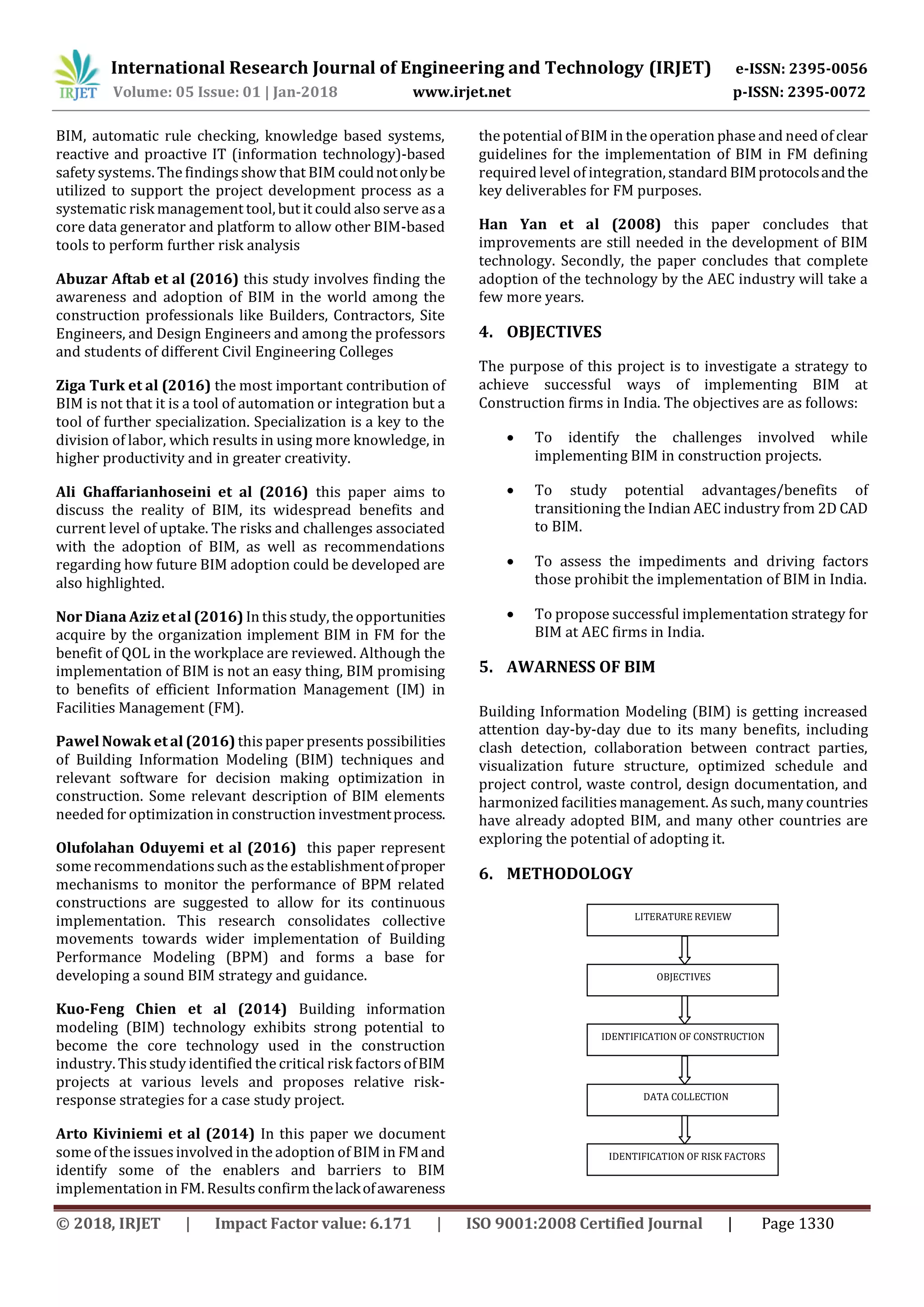
6. METHODOLOGY
LITERATURE REVIEW
OBJECTIVES
DATA COLLECTION
IDENTIFICATION OF CONSTRUCTION
IDENTIFICATION OF RISK FACTORS
International Research Journal of Engineering and Technology (IRJET) e-ISSN: 2395-0056
Volume: 05 Issue: 01 | Jan-2018 www.irjet.net p-ISSN: 2395-0072
© 2018, IRJET | Impact Factor value: 6.171 | ISO 9001:2008 Certified Journal | Page 1331
7. RISK FACTORS
7.1 Technical risk
 Inadequate project experience.
 Lack of software compatibility.
 Inefficient data interoperability.
7.2 Management Risk
 Management process change difficulties.
 Inadequate top management commitment.
7.3 Environmental Risk
 Lack of available skilled personnel.
 Increase in short-term workload.
7.4 Legal Risk
 Lack of BIM standards.
 Unclear legal liability.
7.5 Financial Risk
 Rise in short-term costs.
 Additional expenditures
8. CONCLUSION
This study involving the Indian AEC firms consideration of
BIM implementation and suggesting strategies based on
those factors. The majorreasons for this conditionbeinghigh
cost of software, low demand from the clients, inadequate
project experiences, managementprocesschangedifficulties,
inadequate of top management commitment, unclear the
legal liabilities, lack of skilled and trained employees. The
uncontrolled tradition about BIM usage and the lethargic
attitude of professionals towards validating the facts are
keeping the firms away from embracing the BIMtechnology.
Promotion of the usage of BIM in the Indian construction
industry based on the assumption that the firms are
proactively involved with implementing BIM.
REFERENCES
1. Abuzar Aftab Shaikh, Ramya Raju, Nida L. Malim and
Geetha K.Jayaraj, “Awareness and Adoption of BIM in
Construction Industry,” International Journal onRecent
and Innovation Trends in Computing and
Communication, Vol.4, no.4, May 2016, pp.204-208.
2. Ali Ghaffarianhoseini, John Tookey, Amirhosein
Ghaffarianhoseini, Nicola Naismith, Salman Azhar, Olia
Efimova, Kaamran Raahemifar, “Building Information
Modeling (BIM) uptake: Clear benefits, Understanding
its Implementation, Risks and Challenges,” Science
Direct, Vol.83, no.4, June 2016, pp.1-8.
3. Arto Kiviniemi and Ricardo Codinhoto, “Challenges in
the Implementation BIM for FM – Case Manchester
Town Hall Complex”, ASCE, Vol.35 (2), Jan2014,pp.665-
672.
4. Han Yan and Peter Damian, “Benefits and Barriers of
Building Information Modeling”, Tingushua University
Press, Vol.15 (6), Feb 2016, pp.189-398.
5. Jongsung Won and Jack C.P. Cheng,“IdentifyingPotential
Opportunities of Building Information Modeling for
Construction and Demolition Waste Management and
Minimization, Science Direct, Vol.79, no.9, Mar 2017,
pp.3-18.
6. Kuo-Feng Chien, Zong Han Wu and Shyh Chang Huang,
“Identifying and Assessing Critical Risk Factors for BIM
Projects”, ASEC, Vol. 45(5), Jan 2016, pp.1-15.
7. Na Lu and ThomasKorman,“ImplementationofBuilding
Information Modelling (BIM) in Modular Construction:
Benefits and Challenges”, ASCE, Vol.70 (4), Jul 2014,
pp.687-786.
8. Nor Diana Aziz, Abdul Hadi Nawaki and Nor Muhamad
Ariff, “Building Information Modeling (BIM) in Facilities
Management: Opportunitiesto be consideredbyFacility
Managers”, ASCE, Vol. 23(4), Oct 2016, pp.353-362.
9. Olufolahan Oduyemi and Michael Okoroh, “Building
performance modeling for sustainable building design”,
ASCE, Vol. 5, no.9, Aug 2016, pp.461-469.
10. Pawel Nowak, Mariola Ksiazek, Marcin Draps and Jacek
Zawistowski, “Decision Making with use of Building
Information Modeling”, Science Direct, Vol.15(3), Jan
2016, pp. 519-526.
11. Salman Azhar, “Building Information Modeling (BIM):
Trends, Benefits, Risks, and challenges for the AEC
Industry”, Leadership and Management in Engineering,
Vol. 11, no.5, Mar 2011, pp. 241-252.
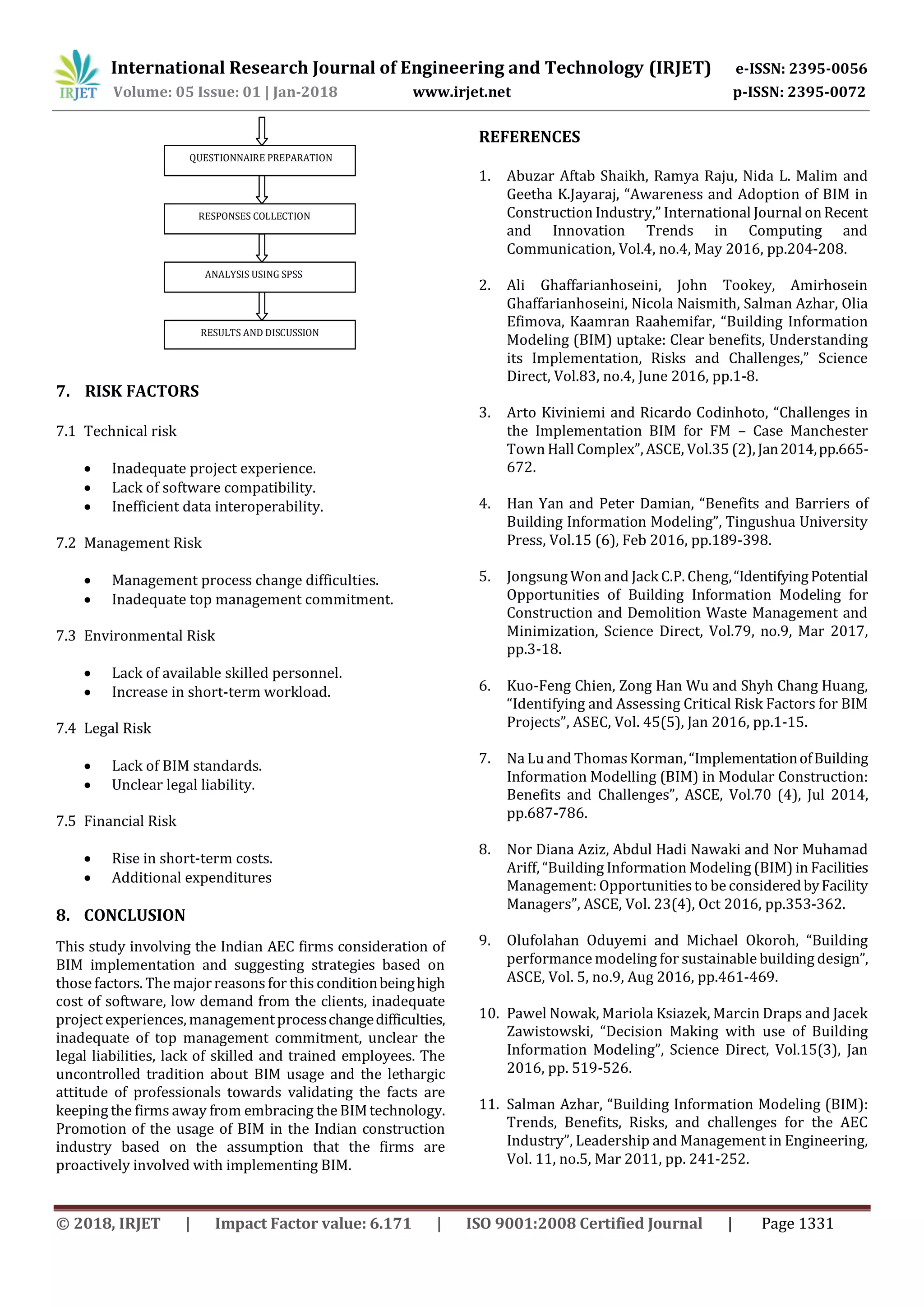
QUESTIONNAIRE PREPARATION
RESPONSES COLLECTION
ANALYSIS USING SPSS
RESULTS AND DISCUSSION
International Research Journal of Engineering and Technology (IRJET) e-ISSN: 2395-0056
Volume: 05 Issue: 01 | Jan-2018 www.irjet.net p-ISSN: 2395-0072
© 2018, IRJET | Impact Factor value: 6.171 | ISO 9001:2008 Certified Journal | Page 1332
12. B.Thomson and Ryan G. Miner, “Building Information
Modeling - BIM: Contractual Risks are changing with
Technology”, ASCE, Vol.7, no.7, Apr 2011, pp.115-230.
13. Xue Li, Jing Xu, and Qun Zhang, “Research on
Construction Schedule Management Based on BIM
Technology”, Science Direct, Vol. 17(4), Oct 2017,
pp.657-667.
14. Yang Zou, Arto Kiviniemi and Stephen W.Jones, “A
Review of Risk Management through BIM and BIM-
Related Technologies”, Safety Science, Vol. 9(7), Nov
2017, pp.88-98.
15. Ziga Turk, “Ten Questions Concerning Building
Information Modeling”, Science Direct, Vol.107, no.6,
May 2016, pp.274-284.

A Review on Challenges Involved in Implementing Building Information Modeling in Construction Industry

  • 1.
    International Research Journalof Engineering and Technology (IRJET) e-ISSN: 2395-0056 Volume: 05 Issue: 01 | Jan-2018 www.irjet.net p-ISSN: 2395-0072 © 2018, IRJET | Impact Factor value: 6.171 | ISO 9001:2008 Certified Journal | Page 1329 A REVIEW ON CHALLENGES INVOLVED IN IMPLEMENTING BUILDING INFORMATION MODELING IN CONSTRUCTION INDUSTRY S.MEGANATHAN 1, N.NANDHINI 2 1 PG Scholar, Department of Civil Engineering, Kongu Engineering College, Perundurai, India. 2 Assistant Professor, Department of Civil Engineering, Kongu Engineering College, Perundurai, India. ---------------------------------------------------------------------***--------------------------------------------------------------------- Abstract - The Indian Construction industry is still at the very infancy stage with the adoption of Building Information Modeling (BIM) to improve the design, construction, and facility management of construction projects. Therefore, several issues about data acquisition and management arise during the design creation and development of a construction project due to the complexity, ambiguity, and fragmented nature of the Indian construction industry. The main objectives of this paper to find the challenges while implementing BIM inconstruction projects.Thechallengesare management process change difficulties, inadequate top management commitment, Rise in short term course, Lack of BIM standards, Unclear the legal liabilities these are the main challenges were faced by construction industries while implementing BIM in construction projects. This paper suggests a strategy for India’s Construction firms to successfully implement BIM in their current working processes. The research method involves studying the present state of BIM information in the Indian manufacture industry along with the appraisal used for data collectionregardingthe troubles faced by the Indian manufacture firms concerning BIM. The data allowed drawing conclusive inferences on how fragmented organizational structures inhibit the use of BIM and how effective BIM adoption coupled with collaboration can aid in aligning goals of project participants. Key words: Building Information Modeling (BIM), Architecture Engineering and Construction, Facilities Management (FM), Building Performance Modeling (BPM), Construction Industry. 1. INTRODUCTION Building information modeling (BIM) is one of the best part promising modern developments in the construction industry. With BIM expertise, an accurate virtual model of a building is digitally constructed. This representation,known as a building information model, can be used for forecast, drawing, production, and process of the facility. Building Information Modeling (BIM) is not just a tool but it is a process and software, but also implementing a new way of thinking. BIM has been adopted or is being adopted by more and more companies; its usefulness has expanded beyond the original design phase activities. The efficiency of BIM in comparison to Computer-Aided Design (CAD) improved 53%, 50%, 20%, and 91% as saving in schematic, design development, construction documents, and checking and coordination respectively. Building Information Modeling (BIM) has been adopted by many Architecture, Engineering and Construction (AEC) firms in many other countries, India’s firms seem to be behind in this current trend of appropriately adopting the BIM technology. In order to propose a strategy for India’s AEC firms to successfully implement BIM in their current working processes, this paper studied the current state of BIM knowledgealongwith the online review used for information collection on the subject of the troubles faced by the Indian AEC firms. The data was analyzed to determine essential changes for individuals and for the discipline, solutions to overcome barriers, and effective ways to introduce BIM capacities. 2. BACKGROUD OF BIM A multi-dimensional tool, Building Information Modeling (BIM) is process that supports virtual design and construction methodologies putting all team members together throughout the entire design and construction process and beyond to the operations in maintenance of the building, during itsworking life. Typically,BIMisoneholistic process using real time, intellectual modeling software effectively working in 3D, 4D (3D + time), and 5D (4D + cost) to improve productivity, to save money and time in the design and construction phases, and to reduce operating costs after construction. In distinguish; the Indian construction industry is not beating the proper prospective of BIM tools. A majority of the architectural and engineering firms in India still rely on two-dimensional Computer Aided Design (CAD) drawings. This usage of traditional methods neither impliesthat the Indian designers are ignorantofBIM and its ability, nor does it exhibit a paucity of skilled BIM usersin the Indian Construction industry. In fact, there is lot of outsourcing for a full range of BIM services by development centersin India, delivering built environments for projects designed in the USA, the UK, and European countries. Currently, there is no clear consistency about the processof implementing or usingBIM forConstructionfirms in India. Even the Associated General Contractors (AGC) of America realizes that there is an absence of a single document that instructs BIM application for firms. This fact creates the need to standardize and create guidelinesforthe implementation of a BIM process in the construction industry. 3. LITERATURE REVIEW Yang Zou et al (2017) This paper presents a summary of traditional risk management, and a comprehensive and extensive review of published literature concerning the latest efforts of managing risk using technologies, such as
  • 2.
    International Research Journalof Engineering and Technology (IRJET) e-ISSN: 2395-0056 Volume: 05 Issue: 01 | Jan-2018 www.irjet.net p-ISSN: 2395-0072 © 2018, IRJET | Impact Factor value: 6.171 | ISO 9001:2008 Certified Journal | Page 1330 BIM, automatic rule checking, knowledge based systems, reactive and proactive IT (information technology)-based safety systems. The findingsshow that BIM couldnotonlybe utilized to support the project development process as a systematic risk management tool, but it could also serve asa core data generator and platform to allow other BIM-based tools to perform further risk analysis Abuzar Aftab et al (2016) this study involves finding the awareness and adoption of BIM in the world among the construction professionals like Builders, Contractors, Site Engineers, and Design Engineers and among the professors and students of different Civil Engineering Colleges Ziga Turk et al (2016) the most important contribution of BIM is not that it is a tool of automation or integration but a tool of further specialization. Specialization is a key to the division of labor, which results in using more knowledge, in higher productivity and in greater creativity. Ali Ghaffarianhoseini et al (2016) this paper aims to discuss the reality of BIM, its widespread benefits and current level of uptake. The risks and challenges associated with the adoption of BIM, as well as recommendations regarding how future BIM adoption could be developed are also highlighted. Nor Diana Aziz et al (2016) In this study, the opportunities acquire by the organization implement BIM in FM for the benefit of QOL in the workplace are reviewed. Although the implementation of BIM is not an easy thing, BIM promising to benefits of efficient Information Management (IM) in Facilities Management (FM). Pawel Nowak et al (2016) this paper presents possibilities of Building Information Modeling (BIM) techniques and relevant software for decision making optimization in construction. Some relevant description of BIM elements needed for optimization in construction investmentprocess. Olufolahan Oduyemi et al (2016) this paper represent some recommendations such asthe establishmentofproper mechanisms to monitor the performance of BPM related constructions are suggested to allow for its continuous implementation. This research consolidates collective movements towards wider implementation of Building Performance Modeling (BPM) and forms a base for developing a sound BIM strategy and guidance. Kuo-Feng Chien et al (2014) Building information modeling (BIM) technology exhibits strong potential to become the core technology used in the construction industry. This study identified the critical risk factorsofBIM projects at various levels and proposes relative risk- response strategies for a case study project. Arto Kiviniemi et al (2014) In this paper we document some of the issues involved in the adoption of BIM in FMand identify some of the enablers and barriers to BIM implementation in FM. Results confirmthelackofawareness the potential of BIM in the operation phase and need of clear guidelines for the implementation of BIM in FM defining required level of integration, standard BIMprotocolsandthe key deliverables for FM purposes. Han Yan et al (2008) this paper concludes that improvements are still needed in the development of BIM technology. Secondly, the paper concludes that complete adoption of the technology by the AEC industry will take a few more years. 4. OBJECTIVES The purpose of this project is to investigate a strategy to achieve successful ways of implementing BIM at Construction firms in India. The objectives are as follows:  To identify the challenges involved while implementing BIM in construction projects.  To study potential advantages/benefits of transitioning the Indian AEC industry from 2D CAD to BIM.  To assess the impediments and driving factors those prohibit the implementation of BIM in India.  To propose successful implementation strategy for BIM at AEC firms in India. 5. AWARNESS OF BIM Building Information Modeling (BIM) is getting increased attention day-by-day due to its many benefits, including clash detection, collaboration between contract parties, visualization future structure, optimized schedule and project control, waste control, design documentation, and harmonized facilitiesmanagement. As such, many countries have already adopted BIM, and many other countries are exploring the potential of adopting it. 6. METHODOLOGY LITERATURE REVIEW OBJECTIVES DATA COLLECTION IDENTIFICATION OF CONSTRUCTION IDENTIFICATION OF RISK FACTORS
  • 3.
    International Research Journalof Engineering and Technology (IRJET) e-ISSN: 2395-0056 Volume: 05 Issue: 01 | Jan-2018 www.irjet.net p-ISSN: 2395-0072 © 2018, IRJET | Impact Factor value: 6.171 | ISO 9001:2008 Certified Journal | Page 1331 7. RISK FACTORS 7.1 Technical risk  Inadequate project experience.  Lack of software compatibility.  Inefficient data interoperability. 7.2 Management Risk  Management process change difficulties.  Inadequate top management commitment. 7.3 Environmental Risk  Lack of available skilled personnel.  Increase in short-term workload. 7.4 Legal Risk  Lack of BIM standards.  Unclear legal liability. 7.5 Financial Risk  Rise in short-term costs.  Additional expenditures 8. CONCLUSION This study involving the Indian AEC firms consideration of BIM implementation and suggesting strategies based on those factors. The majorreasons for this conditionbeinghigh cost of software, low demand from the clients, inadequate project experiences, managementprocesschangedifficulties, inadequate of top management commitment, unclear the legal liabilities, lack of skilled and trained employees. The uncontrolled tradition about BIM usage and the lethargic attitude of professionals towards validating the facts are keeping the firms away from embracing the BIMtechnology. Promotion of the usage of BIM in the Indian construction industry based on the assumption that the firms are proactively involved with implementing BIM. REFERENCES 1. Abuzar Aftab Shaikh, Ramya Raju, Nida L. Malim and Geetha K.Jayaraj, “Awareness and Adoption of BIM in Construction Industry,” International Journal onRecent and Innovation Trends in Computing and Communication, Vol.4, no.4, May 2016, pp.204-208. 2. Ali Ghaffarianhoseini, John Tookey, Amirhosein Ghaffarianhoseini, Nicola Naismith, Salman Azhar, Olia Efimova, Kaamran Raahemifar, “Building Information Modeling (BIM) uptake: Clear benefits, Understanding its Implementation, Risks and Challenges,” Science Direct, Vol.83, no.4, June 2016, pp.1-8. 3. Arto Kiviniemi and Ricardo Codinhoto, “Challenges in the Implementation BIM for FM – Case Manchester Town Hall Complex”, ASCE, Vol.35 (2), Jan2014,pp.665- 672. 4. Han Yan and Peter Damian, “Benefits and Barriers of Building Information Modeling”, Tingushua University Press, Vol.15 (6), Feb 2016, pp.189-398. 5. Jongsung Won and Jack C.P. Cheng,“IdentifyingPotential Opportunities of Building Information Modeling for Construction and Demolition Waste Management and Minimization, Science Direct, Vol.79, no.9, Mar 2017, pp.3-18. 6. Kuo-Feng Chien, Zong Han Wu and Shyh Chang Huang, “Identifying and Assessing Critical Risk Factors for BIM Projects”, ASEC, Vol. 45(5), Jan 2016, pp.1-15. 7. Na Lu and ThomasKorman,“ImplementationofBuilding Information Modelling (BIM) in Modular Construction: Benefits and Challenges”, ASCE, Vol.70 (4), Jul 2014, pp.687-786. 8. Nor Diana Aziz, Abdul Hadi Nawaki and Nor Muhamad Ariff, “Building Information Modeling (BIM) in Facilities Management: Opportunitiesto be consideredbyFacility Managers”, ASCE, Vol. 23(4), Oct 2016, pp.353-362. 9. Olufolahan Oduyemi and Michael Okoroh, “Building performance modeling for sustainable building design”, ASCE, Vol. 5, no.9, Aug 2016, pp.461-469. 10. Pawel Nowak, Mariola Ksiazek, Marcin Draps and Jacek Zawistowski, “Decision Making with use of Building Information Modeling”, Science Direct, Vol.15(3), Jan 2016, pp. 519-526. 11. Salman Azhar, “Building Information Modeling (BIM): Trends, Benefits, Risks, and challenges for the AEC Industry”, Leadership and Management in Engineering, Vol. 11, no.5, Mar 2011, pp. 241-252. QUESTIONNAIRE PREPARATION RESPONSES COLLECTION ANALYSIS USING SPSS RESULTS AND DISCUSSION
  • 4.
    International Research Journalof Engineering and Technology (IRJET) e-ISSN: 2395-0056 Volume: 05 Issue: 01 | Jan-2018 www.irjet.net p-ISSN: 2395-0072 © 2018, IRJET | Impact Factor value: 6.171 | ISO 9001:2008 Certified Journal | Page 1332 12. B.Thomson and Ryan G. Miner, “Building Information Modeling - BIM: Contractual Risks are changing with Technology”, ASCE, Vol.7, no.7, Apr 2011, pp.115-230. 13. Xue Li, Jing Xu, and Qun Zhang, “Research on Construction Schedule Management Based on BIM Technology”, Science Direct, Vol. 17(4), Oct 2017, pp.657-667. 14. Yang Zou, Arto Kiviniemi and Stephen W.Jones, “A Review of Risk Management through BIM and BIM- Related Technologies”, Safety Science, Vol. 9(7), Nov 2017, pp.88-98. 15. Ziga Turk, “Ten Questions Concerning Building Information Modeling”, Science Direct, Vol.107, no.6, May 2016, pp.274-284.