Introduction:
HISTORY
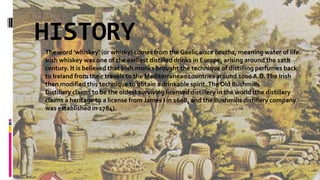
 The word 'whiskey' (or whisky) comes from the Gaelic uisce beatha, meaning water of life.
Irish whiskey was one of the earliest distilled drinks in Europe, arising around the 12th
century. It is believed that Irish monks brought the technique of distilling perfumes back
to Ireland from their travels to the Mediterranean countries around 1000A.D.The Irish
then modified this technique to obtain a drinkable spirit.The Old Bushmills
Distillery claims to be the oldest surviving licensed distillery in the world (the distillery
claims a heritage to a license from James I in 1608, and the Bushmills distillery company
was established in 1784).
PRODUCTION:
 Malting:
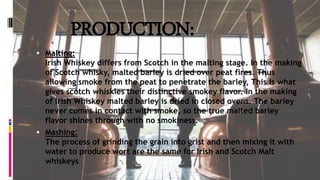
Irish Whiskey differs from Scotch in the malting stage. In the making
of Scotch whisky, malted barley is dried over peat fires. Thus
allowing smoke from the peat to penetrate the barley, This is what
gives scotch whiskies their distinctive smokey flavor. In the making
of Irish Whiskey malted barley is dried in closed ovens. The barley
never comes in contact with smoke, so the true malted barley
flavor shines through with no smokiness.
 Mashing:
The process of grinding the grain into grist and then mixing it with
water to produce wort are the same for Irish and Scotch Malt
whiskeys
 Fermentation:
Once again the same basic process applies to both Irish and
Scotch Whiskeys. Yeast is added to convert the liquids' sugars
into alcohol
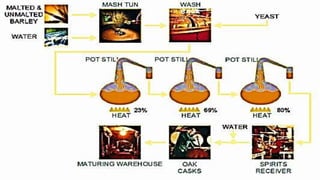
 Distillation:
During this stage the alcohol with a lower boiling point than
water is steamed off. The shape of the still contributes to the
final character of the finished product and in Ireland the stills
are generally larger than Scottish ones.
Generally, Scotch whiskies are distilled only twice. Irish
Whiskeys, however, are usually but not always triple distilled.
Because each stage of distillation increases the purity and
smoothness of the whiskey, This is what makes Irish Whiskey
particularly pure and smooth.
 Maturation:
Once again the process of making Irish or Scotch is similar in
Styles of Irish Whiskey:
 Single Malt Irish whiskey is made from 100% malted barley by a single distillery
in a pot still.
 Grain whiskey is particularly light in style. Made from corn or wheat, grain
whiskey is produced in column stills.
 Blended whiskey constitutes 90% all Irish whiskey production. Jameson and
Kilbeggan are famous blended Irish whiskies.
 Pure Pot Still whiskey is a blend of both malted and unmalted barley distilled in
a pot still. Pure Pot Still is a style of whiskey unique to Ireland.
LEGAL DEFINATION:
 Key regulations defining Irish whiskey and its
production are established by the Irish Whiskey
Act of 1980
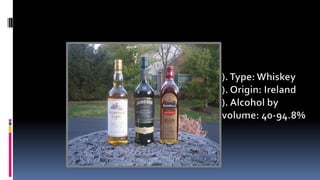
 Irish whiskey must be distilled and aged on the island of Ireland
 The contained spirits must be distilled to an alcohol by volume level
of less than 94.8% from a yeast-fermented mash of cereal grains
(saccharified by the diastase of malt contained therein, with or
without other natural diastases) in such a way that the distillate has
an aroma and flavour derived from the materials used
 The product must be aged for at least three years in wooden casks
 If the spirits comprise a blend of two or more such distillates, the
product is referred to as a "blended" Irish whiskey
Secret Behind Smoothness :-
 Most Irish pot still whiskey is distilled three times, while most (but not all) Scotch
whisky, is distilled twice.
 Peat is rarely used in the malting process, so that Irish whiskey has a smoother finish
as opposed to the smoky, earthy overtones common to some Scotches.
Distilleries
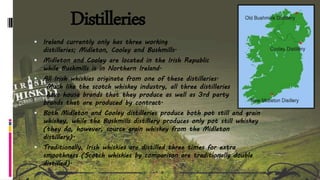
 Ireland currently only has three working
distilleries; Midleton, Cooley and Bushmills.
 Midleton and Cooley are located in the Irish Republic
while Bushmills is in Northern Ireland.
 All Irish whiskies originate from one of these distilleries.
Much like the scotch whiskey industry, all three distilleries
have house brands that they produce as well as 3rd party
brands that are produced by contract.
 Both Midleton and Cooley distilleries produce both pot still and grain
whiskey, while the Bushmills distillery produces only pot still whiskey
(they do, however, source grain whiskey from the Midleton
distillery).
 Traditionally, Irish whiskies are distilled three times for extra
smoothness (Scotch whiskies by comparison are traditionally double
distilled).
Age:
 By Irish law, all whiskies must be aged a minimum of three years in barrels.
 Potcheen or Irish moonshine distillates don't meet the age requirement to be
labeled as Irish whiskey. Similar to American white dog, this is new make of
spirit that has seen little to no time in barrel. Knockeen Hills and Bunratty are
two popular brands.
Famous Brands of Irish
Whiskey:
 . Jameson is produced
by the Midleton distillery
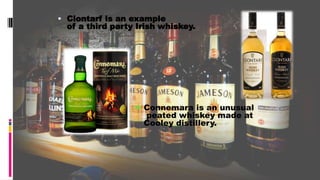
 Clontarf is an example
of a third party Irish whiskey.
 Connemara is an unusual
peated whiskey made at
Cooley distillery.
 Greenore is a single grain
whiskey from Cooley.
 Green Spot is a legendary
pure pot still whiskey made
by Midleton for Mitchell's of Dublin.
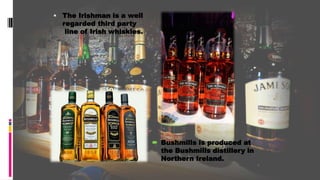
 The Irishman is a well
regarded third party
line of Irish whiskies.
 Bushmills is produced at
the Bushmills distillery in
Northern Ireland.
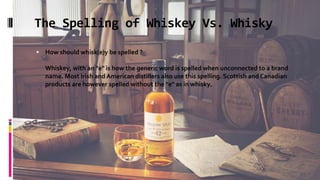
The Spelling of Whiskey Vs. Whisky
 How should whisk(e)y be spelled ?
Whiskey, with an "e" is how the generic word is spelled when unconnected to a brand
name. Most Irish and American distillers also use this spelling. Scottish and Canadian
products are however spelled without the "e" as in whisky.
Irish whiskey

Irish whiskey

  • 2.
  • 3.
    HISTORY  The word'whiskey' (or whisky) comes from the Gaelic uisce beatha, meaning water of life. Irish whiskey was one of the earliest distilled drinks in Europe, arising around the 12th century. It is believed that Irish monks brought the technique of distilling perfumes back to Ireland from their travels to the Mediterranean countries around 1000A.D.The Irish then modified this technique to obtain a drinkable spirit.The Old Bushmills Distillery claims to be the oldest surviving licensed distillery in the world (the distillery claims a heritage to a license from James I in 1608, and the Bushmills distillery company was established in 1784).
  • 4.
    PRODUCTION:  Malting: Irish Whiskeydiffers from Scotch in the malting stage. In the making of Scotch whisky, malted barley is dried over peat fires. Thus allowing smoke from the peat to penetrate the barley, This is what gives scotch whiskies their distinctive smokey flavor. In the making of Irish Whiskey malted barley is dried in closed ovens. The barley never comes in contact with smoke, so the true malted barley flavor shines through with no smokiness.  Mashing: The process of grinding the grain into grist and then mixing it with water to produce wort are the same for Irish and Scotch Malt whiskeys
  • 5.
     Fermentation: Once againthe same basic process applies to both Irish and Scotch Whiskeys. Yeast is added to convert the liquids' sugars into alcohol  Distillation: During this stage the alcohol with a lower boiling point than water is steamed off. The shape of the still contributes to the final character of the finished product and in Ireland the stills are generally larger than Scottish ones. Generally, Scotch whiskies are distilled only twice. Irish Whiskeys, however, are usually but not always triple distilled. Because each stage of distillation increases the purity and smoothness of the whiskey, This is what makes Irish Whiskey particularly pure and smooth.  Maturation: Once again the process of making Irish or Scotch is similar in
  • 7.
    Styles of IrishWhiskey:  Single Malt Irish whiskey is made from 100% malted barley by a single distillery in a pot still.  Grain whiskey is particularly light in style. Made from corn or wheat, grain whiskey is produced in column stills.  Blended whiskey constitutes 90% all Irish whiskey production. Jameson and Kilbeggan are famous blended Irish whiskies.  Pure Pot Still whiskey is a blend of both malted and unmalted barley distilled in a pot still. Pure Pot Still is a style of whiskey unique to Ireland.
  • 8.
    LEGAL DEFINATION:  Keyregulations defining Irish whiskey and its production are established by the Irish Whiskey Act of 1980  Irish whiskey must be distilled and aged on the island of Ireland  The contained spirits must be distilled to an alcohol by volume level of less than 94.8% from a yeast-fermented mash of cereal grains (saccharified by the diastase of malt contained therein, with or without other natural diastases) in such a way that the distillate has an aroma and flavour derived from the materials used  The product must be aged for at least three years in wooden casks  If the spirits comprise a blend of two or more such distillates, the product is referred to as a "blended" Irish whiskey
  • 9.
    Secret Behind Smoothness:-  Most Irish pot still whiskey is distilled three times, while most (but not all) Scotch whisky, is distilled twice.  Peat is rarely used in the malting process, so that Irish whiskey has a smoother finish as opposed to the smoky, earthy overtones common to some Scotches.
  • 10.
    Distilleries  Ireland currentlyonly has three working distilleries; Midleton, Cooley and Bushmills.  Midleton and Cooley are located in the Irish Republic while Bushmills is in Northern Ireland.  All Irish whiskies originate from one of these distilleries. Much like the scotch whiskey industry, all three distilleries have house brands that they produce as well as 3rd party brands that are produced by contract.  Both Midleton and Cooley distilleries produce both pot still and grain whiskey, while the Bushmills distillery produces only pot still whiskey (they do, however, source grain whiskey from the Midleton distillery).  Traditionally, Irish whiskies are distilled three times for extra smoothness (Scotch whiskies by comparison are traditionally double distilled).
  • 11.
    Age:  By Irishlaw, all whiskies must be aged a minimum of three years in barrels.  Potcheen or Irish moonshine distillates don't meet the age requirement to be labeled as Irish whiskey. Similar to American white dog, this is new make of spirit that has seen little to no time in barrel. Knockeen Hills and Bunratty are two popular brands.
  • 12.
    Famous Brands ofIrish Whiskey:  . Jameson is produced by the Midleton distillery
  • 13.
     Clontarf isan example of a third party Irish whiskey.  Connemara is an unusual peated whiskey made at Cooley distillery.
  • 14.
     Greenore isa single grain whiskey from Cooley.  Green Spot is a legendary pure pot still whiskey made by Midleton for Mitchell's of Dublin.
  • 15.
     The Irishmanis a well regarded third party line of Irish whiskies.  Bushmills is produced at the Bushmills distillery in Northern Ireland.
  • 16.
    The Spelling ofWhiskey Vs. Whisky  How should whisk(e)y be spelled ? Whiskey, with an "e" is how the generic word is spelled when unconnected to a brand name. Most Irish and American distillers also use this spelling. Scottish and Canadian products are however spelled without the "e" as in whisky.