Risk report


Hedging climate change
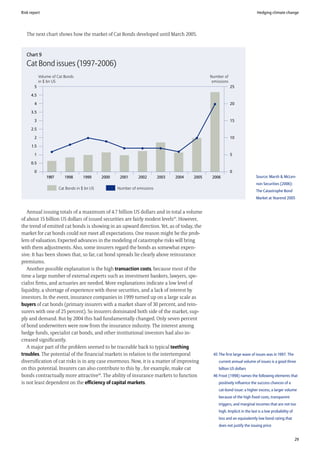
How insurers can manage the risk of increasing natural catastrophes
Risk report                                                                                                                                       Hedging climate change


Content
                                          page 3                                                      page 5                                                      page 10


                                                              1                                                           2
Natural catastrophes in the                                Natural catastrophes                                        Future insurance potential
grip of climate change                                     on the march                                                in natural catastrophes


                                        page 16                                                     page 19                                                       page 24


   3                                                          4                                                           5
Catastrophe risk in im-                                    Are catastrophe risks                                       Path to the future
portant markets is heavily                                 capable of being efficiently                                1. Extending the insurability of cat risk
under-insured                                              insured?                                                    2. Rethinking the role of the state
                                                                                                                       3. Private and public risk partnerships:
                                                                                                                          the example of flood insurance


                                                                                                                       Bibliography                               page 34


Imprint
Risk report: “Hedging climate change” | Publication: September 2007 | Author: Allianz Dresdner Economic Research, Dr. Helmut Kesting | Published by: Allianz SE
Layout: Volk:art 51 GmbH, Munich | Contact: Michael Anthony, Allianz SE, Group Communications/Corporate Affairs, Königinstrasse 28, D-80802 Munich
email: michael.anthony@allianz.com

                                                                                                                                                                            2
Risk report                                                                                                         Hedging climate change


   Natural catastrophes
   in the grip of climate
   change


   t the beginning of February 2007, the Intergovernmental Panel on Climate Change
A  (IPCC) published the first part of its Fourth Assessment Report on world climate
change.1

On the origins of climate changes, the report finds that:
• The main cause is the greenhouse effect which, in the first instance, can be attrib-
  uted to an increased level of carbon dioxide in the air. This rose by 30 percent
  between 1900 and 2005. Almost half of the increase has come in the past 25 years.
  Seventy-eight percent of the higher CO2 concentration has been caused by the use
  of fossil fuels. Another 22 percent is because of changes in land use (such as in-
  creases in arable land).
• Further causes include rises in the amounts of other significant greenhouse gases
  such as methane and nitrous oxide. Their combined increase amounts to half the
  increase in CO2 levels.
• By way of comparison, changes in solar radiation have exerted a minimal influ-
  ence.

A broad consensus exists that the main cause of climate change is human activity
(especially CO2 emissions). We have ourselves to blame for the rise in global tem-
peratures.
   At the same time, however, this means that we are in a position to influence climate
positively. But this means quicker, more effective and globally coordinated efforts.      1 The IPCC was set up in 1998 by the World Mete-
At the moment, the concentration of CO2 in the atmosphere is about 400 ppm (parts            orological Organization (WMO) and the United
per million). The current rate of increase is at least 2 ppm a year. However, this rate      Nations Environment Programme (UNEP).
is rising because energy and transport needs are increasing worldwide. Even if CO2           As an institution independent of governments,
emissions were immediately held to present levels, greenhouse-gas concentrations             the organization has the task of assessing on a
would still rise to 550 ppm by 2050. The rise in temperatures of the earth’s surface         regular basis the state of knowledge of climate
would not stop but would, over the next decades, increase by at least half a degree.         change and the effects of these changes on
   The transition to the post-fossil fuel age involves the largest program of renewal        human society. More information can be found
and restructuring that the world economy has ever seen.2 Especially affected is elec-        on the institution’s web site (www.ipcc.ch)
tricity generation (power stations), which is responsible for 40 percent of CO2 emis-     2 See essay by Peter Hennicke in Handelsblatt
sions, transport (20 percent), industry (18 percent), plus housebuilding, service            (20.03.07, 9)


                                                                                                                                               3
Risk report                                                                                                         Hedging climate change


industries and agriculture (together about 13 percent). Clearly, this restructuring
also involves changes in consumer habits. Climate protection is not just a matter of
money. At the same time new markets and opportunities for growth are emerging.
The markets for energy efficiency and renewable energy are alone showing a global
growth rate of between 10 and 20 percent.
   Allianz SE has for years been warning – as have other insurers – of the results of
unhindered climate change.3 In cooperation with the WWF (World Wide Fund for
Nature) over a number of years, Allianz SE has supported many projects and initia-
tives to strengthen climate protection. It belongs to the Global Roundtable on Climate
Change (GROCC)4 and espouses a broad alliance of all societal forces to work towards
a sustainable energy systems capable of achieving economic growth. Other compa-
nies within the Allianz Group are also committed to climate protection. Dresdner
Bank is the market leader in European Union (EU) Emissions Trading Scheme CO2
certificates. But this is not merely a matter of supporting noble ideals such as the
preservation of life’s fundamentals for future generations. For both Allianz and Dres-
dner Bank, earth warming has long become a matter of business. Regardless of
whether it is insurance, emissions trading, asset management or project financing,
many areas of activity need to take into consideration the effects of climate change.5
   Further activity involves the effects of climate change on insurance markets. At
the core of the issue is to what extent, or under which conditions, catastrophes
caused by climate change will be insurable. This is crucial because questions of pros-
perity are linked with insurance: entities such as institutions can protect themselves
from damage that threatens their existence. At the same time, positive influences on
entire economies result when people can act with the backing of insurance – they
are more prepared to enter high-risk innovative projects than they would be without
insurance.
   The next part of the report documents the development of damage caused by nat-
ural catastrophes. In view of the existing massive under insuring, it investigates why
markets cannot function effectively when dealing with catastrophe damage. It con-
cludes by discussing private and state initiatives.

The study reaches the following main conclusions:
• The number of catastrophes caused by natural forces, as well as the extent of the
  damage, indicates a significantly rising trend (Chapter 1) .
• The insurance potential is enormous. Annual expected average total damage be-
  tween 2010 and 2020 is estimated at 80-120 billion US dollars (in today’s prices).
  But because of the high degree of variability, the real damage could significantly
  depart from this figure (Chapter 2).
• These risks are greatly under-insured. As a whole, the markets for catastrophe
  risks do not functions optimally. They are linked with the specific characteristics of
  such large risks which, among other things, makes their diversification difficult
  (Chapter 3 and 4).
• Innovative developments by insurers such as catastrophe bonds, (cat bonds)
  which enable risks to be transferred on capital markets, as well as private and
  public risk partnerships, can help improve the insurability of catastrophe risks
  (Chapter 5).


                                                                                           3 To examine the activities of the European
                                                                                              Insurance and Reinsurance Federation on
                                                                                              climate change, see www.cea.assur.org
                                                                                           4 See www.earth.columbia.edu/grocc
                                                                                           5 See www.allianz.com/Klima


                                                                                                                                         4
Risk report                                                                                                           Hedging climate change


   1
   Natural catastrophes
   on the march

    oth the frequency and extent of natural catastrophes have, over recent years,
B   increased notably. Before taking a closer look at this, some concepts need to be
clarified.
   Where many separate cases of damage have a common cause, they are said to be
in a close time and geographical context. If the total amount of damage reaches an
extraordinarily high level measured against “normal” conditions, the reference is to
a catastrophe.6 But catastrophes occur in different categories.
   A natural catastrophe is described as one being caused by natural forces. These
include flooding, storms, earthquakes, tidal waves, drought/bushfire/heat, cold/frost,
hail or avalanches. The extent of the damage depends not only on the strength of the
natural force. A role is played by preventive measures as well as technical or organi-
zational factors that can help limit the consequences. The overall damage from a         6 What precisely “extraordinarily high” is is obvi-
natural catastrophe always has a social dimension.                                          ously an issue of convention. For the reporting
   Man-made catastrophes are events that are closely associated with human activity.        year of 2006, Swiss Re used, among others, the
Mostly of the time these involves a large object in a confined space, such as a build-      following definition: for insurance losses in ship-
ing complex.7 Among such catastrophes are, for example, large fires, explosions, air        ping, 16.1 million U.S. dollars; in civil aviation,
crashes, or mine disasters.                                                                 32.2 million U.S. dollars; and in other areas, 40
   Terrorist attacks are a special category of catastrophe risk. They are not due to        million U.S. dollars. Smaller claims were there-
chance but a result of premeditated human action. In contrast to natural or man-            fore not included in the sigma catastrophe data
made catastrophes, the probability of occurrence cannot be assessed using the               bank. As well as that, adjustments for inflation
usual insurance processes.                                                                  were made to ensure consistency of data
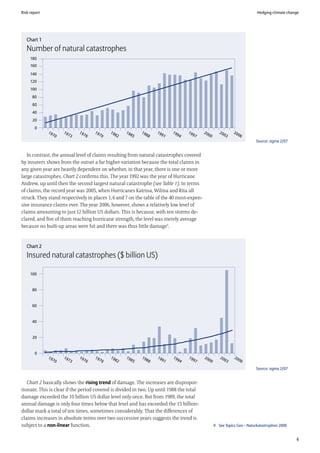
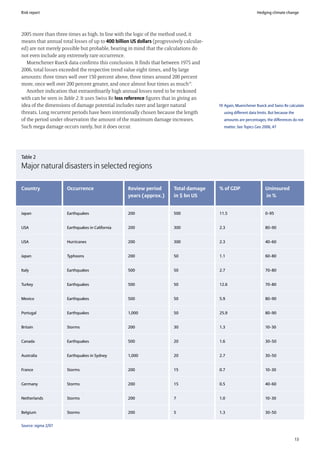
   The number of natural catastrophes since 1970 is shown in Chart 18. The trend is      7 Wars, including civil wars and events that resem-
clearly upwards. The annual number of natural catastrophes has, over the period,            ble wars, are excluded
continually risen. The representation of the trend as straight (linear function) ac-     8 The sources are the catastrophe data banks of
cords with the overall picture of the data. The vast majority of natural catastrophes       the two largest reinsurance companies, Swiss Re
are weather-related (see Chart 3). This suggests that there is a connection between         and Muenchener Rueck. See the equivalent
the increases in natural catastrophes and the likewise slow but constantly rising           indices from sigma (www.swissre.com) and Top-
increases in global temperatures as a consequence of climate change.                        ics Geo (www.munichre.com)


                                                                                                                                                  5
Risk report                                                                                                                                         Hedging climate change


   Chart 1
   Number of natural catastrophes
     180
     160

     140
     120
     100
      80
      60
      40
      20
       0
              19        19        19        19        19        19        19        19        19        19        20           20        20
                   70        73        76        79        82        85        88        91        94        97        00           03        06
                                                                                                                                                   Source: sigma 2/07


   In contrast, the annual level of claims resulting from natural catastrophes covered
by insurers shows from the outset a far higher variation because the total claims in
any given year are heavily dependent on whether, in that year, there is one or more
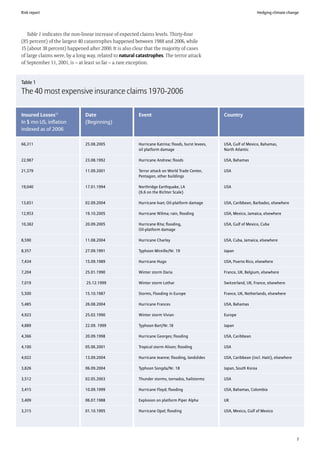
large catastrophes. Chart 2 confirms this. The year 1992 was the year of Hurricane
Andrew, up until then the second largest natural catastrophe (see Table 1). In terms
of claims, the record year was 2005, when Hurricanes Katrina, Wilma and Rita all
struck. They stand respectively in places 1, 6 and 7 on the table of the 40 most-expen-
sive insurance claims ever. The year 2006, however, shows a relatively low level of
claims amounting to just 12 billion US dollars. This is because, with ten storms de-
clared, and five of them reaching hurricane strength, the level was merely average
because no built-up areas were hit and there was thus little damage9.


   Chart 2
   Insured natural catastrophes ($ billion US)

     100


      80


      60


      40


      20


       0
              19        19        19        19        19        19        19        19        19        19        20           20        20
                   70        73        76        79        82        85        88        91        94        97        00           03        06

                                                                                                                                                   Source: sigma 2/07


   Chart 2 basically shows the rising trend of damage. The increases are dispropor-
tionate. This is clear if the period covered is divided in two. Up until 1988 the total
damage exceeded the 10 billion US dollar level only once. But from 1989, the total
annual damage is only four times below that level and has exceeded the 15 billion-
dollar mark a total of ten times, sometimes considerably. That the differences of
claims increases in absolute terms over two successive years suggests the trend is
subject to a non-linear function.                                                                                           9 See Topics Geo – Naturkatastrophen 2006


                                                                                                                                                                        6
Risk report                                                                                                             Hedging climate change


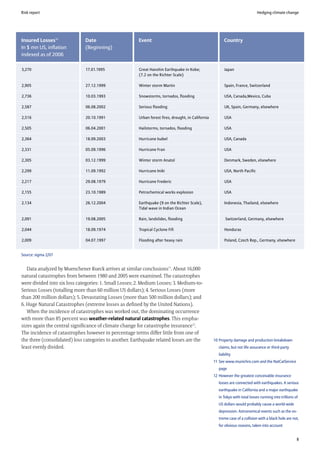
   Table 1 indicates the non-linear increase of expected claims levels. Thirty-four
(85 percent) of the largest 40 catastrophes happened between 1988 and 2006, while
15 (about 38 percent) happened after 2000. It is also clear that the majority of cases
of large claims were, by a long way, related to natural catastrophes. The terror attack
of September 11, 2001, is – at least so far – a rare exception.


Table 1
The 40 most expensive insurance claims 1970-2006

Insured Losses10              Date                      Event                                      Country
In $ mn US, inflation         (Beginning)
indexed as of 2006

66,311                        25.08.2005                Hurricane Katrina; floods, burst levees,   USA, Gulf of Mexico, Bahamas,
                                                        oil platform damage                        North Atlantic

22,987                        23.08.1992                Hurricane Andrew; floods                   USA, Bahamas

21,379                        11.09.2001                Terror attack on World Trade Center,       USA
                                                        Pentagon, other buildings

19,040                        17.01.1994                Northridge Earthquake, LA                  USA
                                                        (6.6 on the Richter Scale)

13,651                        02.09.2004                Hurricane Ivan; Oil-platform damage        USA, Caribbean, Barbados, elsewhere

12,953                        19.10.2005                Hurricane Wilma; rain, flooding            USA, Mexico, Jamaica, elsewhere

10,382                        20.09.2005                Hurricane Rita; flooding,                  USA, Gulf of Mexico, Cuba
                                                        Oil-platform damage

8,590                         11.08.2004                Hurricane Charley                          USA, Cuba, Jamaica, elsewhere

8,357                         27.09.1991                Typhoon Mireille/Nr. 19                    Japan

7,434                         15.09.1989                Hurricane Hugo                             USA, Puerto Rico, elsewhere

7,204                         25.01.1990                Winter storm Daria                         France, UK, Belgium, elsewhere

7,019                          25.12.1999               Winter storm Lothar                        Switzerland, UK, France, elsewhere

5,500                         15.10.1987                Storms, Flooding in Europe                 France, UK, Netherlands, elsewhere

5,485                         26.08.2004                Hurricane Frances                          USA, Bahamas

4,923                         25.02.1990                Winter storm Vivian                        Europe

4,889                         22.09. 1999               Typhoon Bart/Nr. 18                        Japan

4,366                         20.09.1998                Hurricane Georges; flooding                USA, Caribbean

4,100                         05.06.2001                Tropical storm Alison; flooding            USA

4,022                         13.09.2004                Hurricane Jeanne; flooding, landslides     USA, Caribbean (incl. Haiti), elsewhere

3,826                         06.09.2004                Typhoon Songda/Nr. 18                      Japan, South Korea

3,512                         02.05.2003                Thunder storms, tornados, hailstorms       USA

3,415                         10.09.1999                Hurricane Floyd; flooding                  USA, Bahamas, Colombia

3,409                         06.07.1988                Explosion on platform Piper Alpha          UK

3,315                         01.10.1995                Hurricane Opal; flooding                   USA, Mexico, Gulf of Mexico


                                                                                                                                             7
Risk report                                                                                                                      Hedging climate change


Insured Losses10              Date                      Event                                               Country
In $ mn US, inflation         (Beginning)
indexed as of 2006

3,270                         17.01.1995                Great Hanshin Earthquake in Kobe;                   Japan
                                                        (7.2 on the Richter Scale)

2,905                         27.12.1999                Winter storm Martin                                 Spain, France, Switzerland

2,736                         10.03.1993                Snowstorms, tornados, flooding                      USA, Canada,Mexico, Cuba

2,587                         06.08.2002                Serious flooding                                    UK, Spain, Germany, elsewhere

2,516                         20.10.1991                Urban forest fires, drought, in California          USA

2,505                         06.04.2001                Hailstorms, tornados, flooding                      USA

2,364                         18.09.2003                Hurricane Isabel                                    USA, Canada

2,331                         05.09.1996                Hurricane Fran                                      USA

2,305                         03.12.1999                Winter storm Anatol                                 Denmark, Sweden, elsewhere

2,299                         11.09.1992                Hurricane Iniki                                     USA, North Pacific

2,217                         29.08.1979                Hurricane Frederic                                  USA

2,155                         23.10.1989                Petrochemical works explosion                       USA

2,134                         26.12.2004                Earthquake (9 on the Richter Scale),                Indonesia, Thailand, elsewhere
                                                        Tidal wave in Indian Ocean

2,091                         19.08.2005                Rain, landslides, flooding                           Switzerland, Germany, elsewhere

2,044                         18.09.1974                Tropical Cyclone Fifi                               Honduras

2,009                         04.07.1997                Flooding after heavy rain                           Poland, Czech Rep., Germany, elsewhere


Source: sigma 2/07


   Data analyzed by Muenchener Rueck arrives at similar conclusions11. About 16,000
natural catastrophes from between 1980 and 2005 were examined. The catastrophes
were divided into six loss categories: 1. Small Losses; 2. Medium Losses; 3. Medium-to-
Serious Losses (totalling more than 60 million US dollars); 4. Serious Losses (more
than 200 million dollars); 5. Devastating Losses (more than 500 million dollars); and
6. Huge Natural Catastrophes (extreme losses as defined by the United Nations).
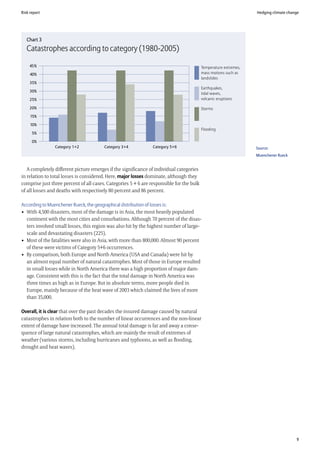
   When the incidence of catastrophes was worked out, the dominating occurrence
with more than 85 percent was weather-related natural catastrophes. This empha-
sizes again the central significance of climate change for catastrophe insurance12.
The incidence of catastrophes however in percentage terms differ little from one of
the three (consolidated) loss categories to another. Earthquake related losses are the               10 Property damage and production breakdown
least evenly divided.                                                                                   claims, but not life assurance or third-party
                                                                                                        liability
                                                                                                     11 See www.munichre.com and the NatCatService
                                                                                                        page
                                                                                                     12 However the greatest conceivable insurance
                                                                                                        losses are connected with earthquakes. A serious
                                                                                                        earthquake in California and a major earthquake
                                                                                                        in Tokyo with total losses running into trillions of
                                                                                                        US dollars would probably cause a world-wide
                                                                                                        depression. Astronomical events such as the ex-
                                                                                                        treme case of a collision with a black hole are not,
                                                                                                        for obvious reasons, taken into account


                                                                                                                                                           8
Risk report                                                                                                       Hedging climate change


   Chart 3
   Catastrophes according to category (1980-2005)

    45%                                                                                   Temperature extremes,
     40%                                                                                  mass motions such as
                                                                                          landslides
    35%
                                                                                          Earthquakes,
    30%
                                                                                          tidal waves,
    25%                                                                                   volcanic eruptions

    20%                                                                                   Storms
     15%

     10%
                                                                                          Flooding
      5%

      0%
                Category 1+2            Category 3+4            Category 5+6                                      Source:
                                                                                                                  Muenchener Rueck


   A completely different picture emerges if the significance of individual categories
in relation to total losses is considered. Here, major losses dominate, although they
comprise just three percent of all cases. Categories 5 + 6 are responsible for the bulk
of all losses and deaths with respectively 80 percent and 86 percent.

According to Muenchener Rueck, the geographical distribution of losses is:
• With 4,500 disasters, most of the damage is in Asia, the most heavily populated
  continent with the most cities and conurbations. Although 70 percent of the disas-
  ters involved small losses, this region was also hit by the highest number of large-
  scale and devastating disasters (225).
• Most of the fatalities were also in Asia, with more than 800,000. Almost 90 percent
  of these were victims of Category 5+6 occurrences.
• By comparison, both Europe and North America (USA and Canada) were hit by
  an almost equal number of natural catastrophes. Most of those in Europe resulted
  in small losses while in North America there was a high proportion of major dam-
  age. Consistent with this is the fact that the total damage in North America was
  three times as high as in Europe. But in absolute terms, more people died in
  Europe, mainly because of the heat wave of 2003 which claimed the lives of more
  than 35,000.

Overall, it is clear that over the past decades the insured damage caused by natural
catastrophes in relation both to the number of linear occurrences and the non-linear
extent of damage have increased. The annual total damage is far and away a conse-
quence of large natural catastrophes, which are mainly the result of extremes of
weather (various storms, including hurricanes and typhoons, as well as flooding,
drought and heat waves).


                                                                                                                                      9
Risk report                                                                                                              Hedging climate change


   2
   Future insurance potential
   in natural catastrophes


     s impressive as the losses are, they cannot be said to reflect the extent of the real
A    damage. There are various reasons. The report on insured losses put together
by Swiss Re does not cover all actual insured losses. The central issues are property
damage and production interruptions. Because of slow data accumulation, liability
insurance and life assurance were also not included.
   Non-insured losses are also part of the picture. Apart from private losses, this also
includes damage to public infrastructure, which is almost never insured.
   An important role is played by the way the term “damage” is defined13. Insurers
mostly choose a relatively tight interpretation in the interests of topicality, precision,
and commercially related reasons that in the first instance aim at defining immedi-
ate losses. Broader economic analyses tend to take into greater consideration indirect
losses such as consequential damage. In this way, apart from the immediate costs of
a loss of production because of damaged manufacturing capacity, projected reduc-
tions in growth are also considered.
   Definitions can, in fact, be so broad that even “non-monetary” damage such as loss
of quality of life can be included. However, there are usually insuperable problems in
estimating and assessing such losses. The difficulties of arriving at a “quantitatively
measurable assessment” were especially clear in the case of the tidal wave that in
2004 was unleashed by a submarine earthquake in the Indian Ocean. In Table 1, it is
listed in fourth-to-last-place because, in the first instance, losses in the tourist indus-
try were taken into account. The insured losses were estimated at only about two bil-
lion US dollars. That is in no way commensurate with a human tragedy that resulted
in the deaths of more than 280,000 people and the destruction of the means of exis-
tence for innumerable families.                                                               13 It has already bee pointed out that the term
   This is why the various estimates of total damage are only to some extent compa-              “natural catastrophe” is defined differently by
rable and need to be interpreted with reference to the methods used in compilation.              Swiss Re and Muenchener Rueck. Typically,
This means they should be used as a guide only rather than an exact estimate. In                 Muenchener Rueck’s numbers are smaller
spite of these problems, the differences between insured and real losses is relevant             because of a tighter definition


                                                                                                                                                   10
Risk report                                                                                                             Hedging climate change


because the latter can be many times bigger. One spectacular example is that of Hur-
ricane Katrina, in August 2005, which is the biggest individual case of loss (see Table
1). The insured losses amounted to 49 billion US dollars whereas the total losses
amounted to 144 billion dollars14.
   This disproportion between total losses and insured losses is greatest in develop-
ing countries, where insurance markets are rudimentary. In 1996 flooding in China
caused losses of about 24 billion US dollars, of which less than 500 million dollars
were covered by insurance – a ratio of 48-to-one, high which ever way it is looked at.
Two years later, more flooding in China caused an economic loss of 30 billion dollars.
Insurance covered just one billion dollars – a ratio of 30 to one.
   But cases of extremely high imbalances between total losses and insured losses
are also known in industrialized countries. In the Kobe earthquake of 1995, the ratio
was 37 to one – 110 billion dollars to just three billion dollars. Normally, this ratio is
between 1.5 and 5, depending on the tightness of damage definition. Improved insur-
ance options, obligatory safeguards (such as in the case of mortgage credit) and bet-
ter provisions against contingencies ensure that at least relatively closely defined
total losses do not exceed insured losses by more than a low single figure15.
   Scientists and specialized companies develop complex catastrophe models to help
estimate future losses in natural catastrophes. These models use specific regional
influences to predict the consequences of climate change in terms of the respective
loss categories. (See Chapter 5.1) Ideally, the accumulation of a wealth of individual
factors would then result in a global pattern.
   Because of the available information, such a bottoms-up approach is however,
not really practicable. The catastrophe models are drawn up specifically with the rel-
evant risks in mind with the result that an incalculable number of equivalent model
results need to be processed. This more-or-less trips up on the fact that free access
to most model results is not available. Instead, the alternative here is to estimate pro-
jected global losses over the next decade (2010-2019) with the aid of a simple statis-
tical process. The trend of insured losses is first extrapolated; this result is then cal-
culated into projected total losses.
   This process is, however, based on the assumption that over the following years,
the fundamental cause-effect structure remains essentially the same. This makes
sense. At a global level, three main factors are responsible for climate-related natu-
ral catastrophes. The first is climate change itself. The temperature rises caused by
it have been noticeable in the past few years. According to the World Meteorological
Organization, 2006 will probably go down as the sixth warmest year on record. The
past six years are now among the seven “record years.”16
   Climate change marches on. That is not surprising, because the climate reacts
to changed greenhouse-gas emissions very sluggishly and with considerable time
delays. In comparison with pre-industrial levels (1750-1850) the global average tem-
perature has risen half a degree Celsius. And it is certain that the current greenhouse-     14 Sigma 2/07, 13. The proportion is smaller if the
gas concentration in the atmosphere will lead to an increase of at least another half           state’s own NFIP National Flood Insurance Pro-
degree in the coming decades.                                                                   gram is considered, because the insured losses
   The extent of global losses caused by natural catastrophes is influenced by two              then rise to 66.3 billion dollars. On the other
other main factors: one is worldwide economic growth, and the other is urbanization,            hand, the total losses from Katrina are estimated
a process that goes hand in hand with flight from the land. In 1950, 2.5 billion people,        at up to 170 billion dollars (Kunreuther/Michel-
or 30 percent of the world’s population, lived in cities. According to United Nations’          Kerjn, 2007, 22), which increases the difference
estimates, by 2025, a total of 8.3 billion people, or 60 percent of the world’s popula-      15 See Kunreuther/Michel-Kerjn, 2007
tion, will be in cities. The number of mega cities with more than 10 million people          16 For a description of the extreme weather condi-
will increase from 12 in 1990 to 26 in 2015. Both these factors, growth and urbaniza-           tions in 2006, and their position in a larger con-
tion, are bringing about an increase in the concentration of assets in endangered               text, see Topics Geo (2006), 42
regions17. It is plausible to assume that in the next few years there will be no change      17 In addition, coastal regions such as Florida have
in the basic trends – as with climate change.                                                   a magnet effect. The population of Florida is ris-
   This leads to an estimate of average losses for the period 2010-2019. On the basis           ing from 6.8 million in 1950 to a projected 19.3
of deducing an average from insured-losses data (see Chart 2) a potential trend func-           million by 2010. See Kunreuther/Michel-Kerjan,
tion emerges. The determining coefficient of 0.954 shows that the value of the trend            2007


                                                                                                                                                  11
Risk report                                                                                                            Hedging climate change


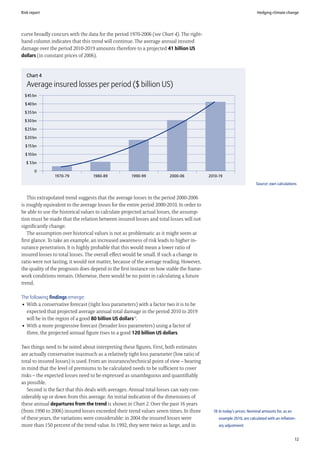
curve broadly concurs with the data for the period 1970-2006 (see Chart 4). The right-
hand column indicates that this trend will continue. The average annual insured
damage over the period 2010-2019 amounts therefore to a projected 41 billion US
dollars (in constant prices of 2006).


   Chart 4
   Average insured losses per period ($ billion US)
  $45 bn

  $40 bn

  $35 bn

  $30 bn

  $25 bn

  $20 bn

  $15 bn

  $10 bn

  $ 5 bn

       0
                1970-79            1980-89           1990-99            2000-06            2010-19
                                                                                                                       Source: own calculations


   This extrapolated trend suggests that the average losses in the period 2000-2006
is roughly equivalent to the average losses for the entire period 2000-2010. In order to
be able to use the historical values to calculate projected actual losses, the assump-
tion must be made that the relation between insured losses and total losses will not
significantly change.
   The assumption over historical values is not as problematic as it might seem at
first glance. To take an example, an increased awareness of risk leads to higher in-
surance penetration. It is highly probable that this would mean a lower ratio of
insured losses to total losses. The overall effect would be small. If such a change in
ratio were not lasting, it would not matter, because of the average reading. However,
the quality of the prognosis does depend in the first instance on how stable the frame-
work conditions remain. Otherwise, there would be no point in calculating a future
trend.

The following findings emerge:
• With a conservative forecast (tight loss parameters) with a factor two it is to be
  expected that projected average annual total damage in the period 2010 to 2019
  will be in the region of a good 80 billion US dollars18.
• With a more progressive forecast (broader loss parameters) using a factor of
  three, the projected annual figure rises to a good 120 billion US dollars.

Two things need to be noted about interpreting these figures. First, both estimates
are actually conservative inasmuch as a relatively tight loss parameter (low ratio of
total to insured losses) is used. From an insurance/technical point of view – bearing
in mind that the level of premiums to be calculated needs to be sufficient to cover
risks – the expected losses need to be expressed as unambiguous and quantifiably
as possible.
   Second is the fact that this deals with averages. Annual total losses can vary con-
siderably up or down from this average. An initial indication of the dimensions of
these annual departures from the trend is shown in Chart 2. Over the past 16 years
(from 1990 to 2006) insured losses exceeded their trend values seven times. In three         18 In today’s prices. Nominal amounts for, as an
of these years, the variations were considerable: in 2004 the insured losses were               example 2010, are calculated with an inflation-
more than 150 percent of the trend value. In 1992, they were twice as large, and in             ary adjustment


                                                                                                                                                12
Risk report                                                                                                      Hedging climate change


2005 more than three times as high. In line with the logic of the method used, it
means that annual total losses of up to 400 billion US dollars (progressively calculat-
ed) are not merely possible but probable, bearing in mind that the calculations do
not even include any extremely rare occurrence.
   Muenchener Rueck data confirms this conclusion. It finds that between 1975 and
2006, total losses exceeded the respective trend value eight times, and by large
amounts: three times well over 150 percent above, three times around 200 percent
more, once well over 200 percent greater, and once almost four times as much19.
   Another indication that extraordinarily high annual losses need to be reckoned
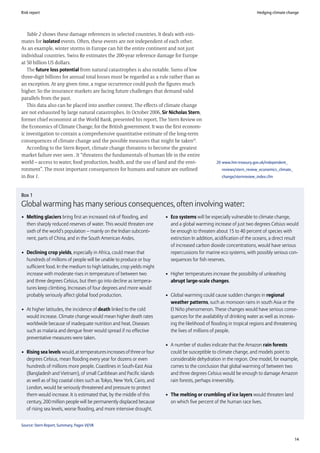
with can be seen in Table 2. It uses Swiss Re loss reference figures that in giving an
idea of the dimensions of damage potential includes rarer and larger natural              19 Again, Muenchener Rueck and Swiss Re calculate
threats. Long recurrent periods have been intentionally chosen because the length            using different data limits. But because the
of the period under observation the amount of the maximum damage increases.                  amounts are percentages, the differences do not
Such mega damage occurs rarely, but it does occur.                                           matter. See Topics Geo 2006, 47


Table 2
Major natural disasters in selected regions

Country              Occurrence                    Review period         Total damage     % of GDP                    Uninsured
                                                   years (approx.)       in $ bn US                                   in %


Japan                Earthquakes                   200                   500              11.5                        0-95


USA                  Earthquakes in California     200                   300              2.3                         80-90


USA                  Hurricanes                    200                   300              2.3                         40-60


Japan                Typhoons                      200                   50               1.1                         60-80


Italy                Earthquakes                   500                   50               2.7                         70-80


Turkey               Earthquakes                   500                   50               12.6                        70-80


Mexico               Earthquakes                   500                   50               5.9                         80-90


Portugal             Earthquakes                   1,000                 50               25.9                        80-90


Britain              Storms                        200                   30               1.3                         10-30


Canada               Earthquakes                   500                   20               1.6                         30-50


Australia            Earthquakes in Sydney         1,000                 20               2.7                         30-50


France               Storms                        200                   15               0.7                         10-30


Germany              Storms                        200                   15               0.5                         40-60


Netherlands          Storms                        200                   7                1.0                         10-30


Belgium              Storms                        200                   5                1.3                         30-50


Source: sigma 2/07


                                                                                                                                            13
Risk report                                                                                                              Hedging climate change


   Table 2 shows these damage references in selected countries. It deals with esti-
mates for isolated events. Often, these events are not independent of each other.
As an example, winter storms in Europe can hit the entire continent and not just
individual countries. Swiss Re estimates the 200-year reference damage for Europe
at 50 billion US dollars.
   The future loss potential from natural catastrophes is also notable. Sums of low
three-digit billions for annual total losses must be regarded as a rule rather than as
an exception. At any given time, a rogue occurrence could push the figures much
higher. So the insurance markets are facing future challenges that demand valid
parallels from the past.
   This data also can be placed into another context. The effects of climate change
are not exhausted by large natural catastrophes. In October 2006, Sir Nicholas Stern,
former chief economist at the World Bank, presented his report, The Stern Review on
the Economics of Climate Change, for the British government. It was the first econom-
ic investigation to contain a comprehensive quantitative estimate of the long-term
consequences of climate change and the possible measures that might be taken20.
   According to the Stern Report, climate change threatens to become the greatest
market failure ever seen . It “threatens the fundamentals of human life in the entire
world – access to water, food production, health, and the use of land and the envi-                20 www.hm-treasury.gov.uk/independent_
ronment”. The most important consequences for humans and nature are outlined                          reviews/stern_review_economics_climate_
in Box 1.                                                                                             change/sternreview_index.cfm


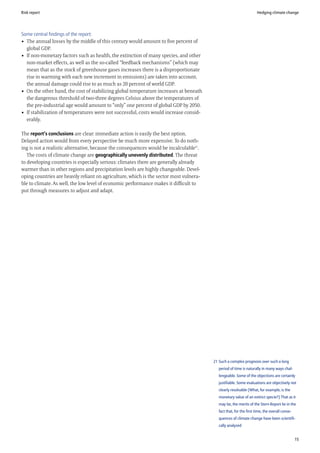
Box 1
Global warming has many serious consequences, often involving water:
• Melting glaciers bring first an increased risk of flooding, and        • Eco systems will be especially vulnerable to climate change,
  then sharply reduced reserves of water. This would threaten one          and a global warming increase of just two degrees Celsius would
  sixth of the world’s population – mainly on the Indian subconti-         be enough to threaten about 15 to 40 percent of species with
  nent, parts of China, and in the South American Andes.                   extinction In addition, acidification of the oceans, a direct result
                                                                           of increased carbon dioxide concentrations, would have serious
• Declining crop yields, especially in Africa, could mean that             repercussions for marine eco systems, with possibly serious con-
  hundreds of millions of people will be unable to produce or buy          sequences for fish reserves.
  sufficient food. In the medium to high latitudes, crop yields might
  increase with moderate rises in temperature of between two             • Higher temperatures increase the possibility of unleashing
  and three degrees Celsius, but then go into decline as tempera-          abrupt large-scale changes.
  tures keep climbing. Increases of four degrees and more would
  probably seriously affect global food production.                      • Global warming could cause sudden changes in regional
                                                                           weather patterns, such as monsoon rains in south Asia or the
• At higher latitudes, the incidence of death linked to the cold           El Niño phenomenon. These changes would have serious conse-
  would increase. Climate change would mean higher death rates             quences for the availability of drinking water as well as increas-
  worldwide because of inadequate nutrition and heat. Diseases             ing the likelihood of flooding in tropical regions and threatening
  such as malaria and dengue fever would spread if no effective            the lives of millions of people.
  preventative measures were taken.
                                                                         • A number of studies indicate that the Amazon rain forests
• Rising sea levels would, at temperatures increases of three or four      could be susceptible to climate change, and models point to
  degrees Celsius, mean flooding every year for dozens or even             considerable dehydration in the region. One model, for example,
  hundreds of millions more people. Coastlines in South-East Asia          comes to the conclusion that global warming of between two
  (Bangladesh and Vietnam), of small Caribbean and Pacific islands         and three degrees Celsius would be enough to damage Amazon
  as well as of big coastal cities such as Tokyo, New York, Cairo, and     rain forests, perhaps irreversibly.
  London, would be seriously threatened and pressure to protect
  them would increase. It is estimated that, by the middle of this       • The melting or crumbling of ice layers would threaten land
  century, 200 million people will be permanently displaced because        on which five percent of the human race lives.
  of rising sea levels, worse flooding, and more intensive drought.


Source: Stern Report, Summary, Pages VI/VII


                                                                                                                                                14
Risk report                                                                                                         Hedging climate change


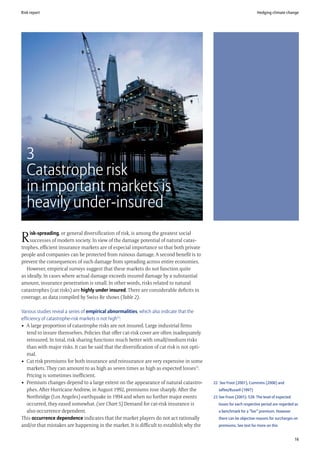
Some central findings of the report:
• The annual losses by the middle of this century would amount to five percent of
  global GDP.
• If non-monetary factors such as health, the extinction of many species, and other
  non-market effects, as well as the so-called “feedback mechanisms” (which may
  mean that as the stock of greenhouse gases increases there is a disproportionate
  rise in warming with each new increment in emissions) are taken into account,
  the annual damage could rise to as much as 20 percent of world GDP.
• On the other hand, the cost of stabilizing global temperature increases at beneath
  the dangerous threshold of two-three degrees Celsius above the temperatures of
  the pre-industrial age would amount to “only” one percent of global GDP by 2050.
• If stabilization of temperatures were not successful, costs would increase consid-
  erably.

The report’s conclusions are clear: immediate action is easily the best option.
Delayed action would from every perspective be much more expensive. To do noth-
ing is not a realistic alternative, because the consequences would be incalculable21.
   The costs of climate change are geographically unevenly distributed. The threat
to developing countries is especially serious: climates there are generally already
warmer than in other regions and precipitation levels are highly changeable. Devel-
oping countries are heavily reliant on agriculture, which is the sector most vulnera-
ble to climate. As well, the low level of economic performance makes it difficult to
put through measures to adjust and adapt.


                                                                                        21 Such a complex prognosis over such a long
                                                                                           period of time is naturally in many ways chal-
                                                                                           lengeable. Some of the objections are certainly
                                                                                           justifiable. Some evaluations are objectively not
                                                                                           clearly resolvable (What, for example, is the
                                                                                           monetary value of an extinct specie?) That as it
                                                                                           may be, the merits of the Stern Report lie in the
                                                                                           fact that, for the first time, the overall conse-
                                                                                           quences of climate change have been scientifi-
                                                                                           cally analyzed


                                                                                                                                               15
Risk report                                                                                                             Hedging climate change


   3
   Catastrophe risk
   in important markets is
   heavily under-insured
    isk-spreading, or general diversification of risk, is among the greatest social
R   successes of modern society. In view of the damage potential of natural catas-
trophes, efficient insurance markets are of especial importance so that both private
people and companies can be protected from ruinous damage. A second benefit is to
prevent the consequences of such damage from spreading across entire economies.
   However, empirical surveys suggest that these markets do not function quite
as ideally. In cases where actual damage exceeds insured damage by a substantial
amount, insurance penetration is small. In other words, risks related to natural
catastrophes (cat risks) are highly under insured. There are considerable deficits in
coverage, as data compiled by Swiss Re shows (Table 2).

Various studies reveal a series of empirical abnormalities, which also indicate that the
efficiency of catastrophe-risk markets is not high22:
• A large proportion of catastrophe risks are not insured. Large industrial firms
   tend to insure themselves. Policies that offer cat-risk cover are often inadequately
   reinsured. In total, risk sharing functions much better with small/medium risks
   than with major risks. It can be said that the diversification of cat risk is not opti-
   mal.
• Cat risk premiums for both insurance and reinsurance are very expensive in some
   markets. They can amount to as high as seven times as high as expected losses23.
   Pricing is sometimes inefficient.
• Premium changes depend to a large extent on the appearance of natural catastro-            22 See Froot (2001), Cummins (2006) and
   phes. After Hurricane Andrew, in August 1992, premiums rose sharply. After the               Jaffee/Russell (1997)
   Northridge (Los Angeles) earthquake in 1994 and when no further major events              23 See Froot (2001): 539. The level of expected
   occurred, they eased somewhat. (see Chart 5) Demand for cat-risk insurance is                losses for each respective period are regarded as
   also occurrence dependent.                                                                   a benchmark for a “fair” premium. However
This occurrence dependence indicates that the market players do not act rationally              there can be objective reasons for surcharges on
and/or that mistakes are happening in the market. It is difficult to establish why the          premiums. See text for more on this


                                                                                                                                               16
Risk report                                                                                                                                                                   Hedging climate change


absence of a catastrophe during a relatively short period should result in either a
reassessment of projected losses (and thus premiums) or of demand. On the other
hand, the appearance of a catastrophe can cause a reassessment of risk provided
that new information (over, for example, the level of damage) emerges. But only
then. There is no automatic actuarial context between the occurrence of a catastro-
phe and changes in premiums.
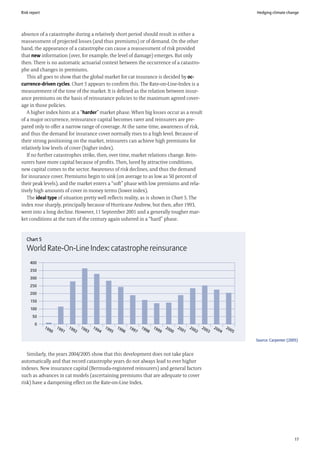
   This all goes to show that the global market for cat insurance is decided by oc-
currence-driven cycles. Chart 5 appears to confirm this. The Rate-on-Line-Index is a
measurement of the tone of the market. It is defined as the relation between insur-
ance premiums on the basis of reinsurance policies to the maximum agreed cover-
age in those policies.
   A higher index hints at a “harder” market phase. When big losses occur as a result
of a major occurrence, reinsurance capital becomes rarer and reinsurers are pre-
pared only to offer a narrow range of coverage. At the same time, awareness of risk,
and thus the demand for insurance cover normally rises to a high level. Because of
their strong positioning on the market, reinsurers can achieve high premiums for
relatively low levels of cover (higher index).
   If no further catastrophes strike, then, over time, market relations change. Rein-
surers have more capital because of profits. Then, lured by attractive conditions,
new capital comes to the sector. Awareness of risk declines, and thus the demand
for insurance cover. Premiums begin to sink (on average to as low as 50 percent of
their peak levels), and the market enters a “soft” phase with low premiums and rela-
tively high amounts of cover in money terms (lower index).
   The ideal type of situation pretty well reflects reality, as is shown in Chart 5. The
index rose sharply, principally because of Hurricane Andrew, but then, after 1993,
went into a long decline. However, 11 September 2001 and a generally tougher mar-
ket conditions at the turn of the century again ushered in a “hard” phase.


   Chart 5
   World Rate-On-Line Index: catastrophe reinsurance
     400
     350
     300
     250
     200
     150
     100
      50
       0
              19        19        19        19        19        19        19        19        19        19        20        20        20        20        20        20
                   90        91        92        93        94        95        96        97        98        99        00        01        02        03        04        05

                                                                                                                                                                              Source: Carpenter (2005)


   Similarly, the years 2004/2005 show that this development does not take place
automatically and that record catastrophe years do not always lead to ever higher
indexes. New insurance capital (Bermuda-registered reinsurers) and general factors
such as advances in cat models (ascertaining premiums that are adequate to cover
risk) have a dampening effect on the Rate-on-Line Index.


                                                                                                                                                                                                    17
Risk report                                                                                                                                                         Hedging climate change


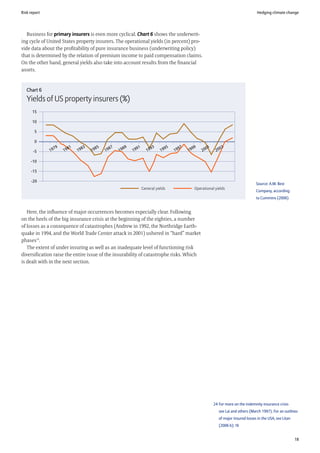
   Business for primary insurers is even more cyclical. Chart 6 shows the underwrit-
ing cycle of United States property insurers. The operational yields (in percent) pro-
vide data about the profitability of pure insurance business (underwriting policy)
that is determined by the relation of premium income to paid compensation claims.
On the other hand, general yields also take into account results from the financial
assets.


   Chart 6
   Yields of US property insurers (%)
      15

      10

       5

       0
                   79        81        83        85        87        89        91           93        95        97        99        01         03
       -5     19        19        19        19        19        19        19           19        19        19        19        20         20

     -10

     -15

     -20
                                                                                                                                                                   Source: A.M. Best
                                                                                    General yields                         Operational yields
                                                                                                                                                                   Company, according
                                                                                                                                                                   to Cummins (2006)


   Here, the influence of major occurrences becomes especially clear. Following
on the heels of the big insurance crisis at the beginning of the eighties, a number
of losses as a consequence of catastrophes (Andrew in 1992, the Northridge Earth-
quake in 1994, and the World Trade Center attack in 2001) ushered in “hard” market
phases24.
   The extent of under insuring as well as an inadequate level of functioning risk
diversification raise the entire issue of the insurability of catastrophe risks. Which
is dealt with in the next section.


                                                                                                                                         24 For more on the indemnity insurance crisis
                                                                                                                                            see Lai and others (March 1997). For an outlines
                                                                                                                                            of major insured losses in the USA, see Litan
                                                                                                                                            (2006 b): 16


                                                                                                                                                                                            18
Risk report                                                                                                                     Hedging climate change


    4
    Are catastrophe
    risks capable of
    being efficiently
    insured?


   nsurers take on risks and then diversify by grouping similar risks in a collective.
I  This spreading of risks in a group works best when it deals with many individual
risks of limited extent and not connected with one another. One example of this is
motor vehicle insurance. In this case, the total losses vary relatively little from year
to year. This enables simple premium strategies. For example, premiums can be
adjusted to the average losses of the past three years25.
   In such situations, the insurer can assume that, in any given period, premium
income will essentially be sufficient to cover insured losses. Of course additional
capital is required as a buffer just in case total losses in any given year are unexpect-
edly high. But this demand for capital is relatively small and visible at a glance be-
cause losses and premiums develop overwhelmingly constantly and in accord with
one another.

These examples allow various criteria that are relevant to the insurability of risks to be elabo-
rated (in Box 2, insurability is dealt with using mathematical and statistical yardsticks):
• A large number of people need to be exposed to a certain risk. They then form a
   group within which risk spreading can take place. The insured must be averse to
   risk. This implies a readiness to use financial means to transfer the risk to a third            25 Of course determining levels of premiums is
   party.                                                                                              subject to other factors such as the competitive
• A private offer to insure these risks comes about when the insuring company is in                    situation. But on the issue of risk insurability this
   a position to levy an appropriate premium. The prerequisite is that the probability                 is a secondary matter
   of occurrence and the extent of damage can be reliably estimated. This applies                   26 An ex-ante moral hazard emerges in the case of
   particularly in “high-frequency – low-severity” risks (as in the above example).                    catastrophe risk, for example, if, after an insur-
• Occurrence and extent of damage must not be subject to influence by the insured                      ance policy has been signed, prevention meas-
   party. If that were the case, the moral-hazard situation might come into play. This                 ures are not taken. An ex-post moral hazard situ-
   might take the form, for example, where the insured party is more prepared to                       ation arises when the insured party desists, after
   take risks than he or she would be without insurance. The result of this would be                   the outbreak of a catastrophe, to act to limit the
   doubts about the calculability of risks26.                                                          extent of that catastrophe (Pfister 2003: 12)


                                                                                                                                                          19
Risk report                                                                                                                    Hedging climate change


Box 2
Insurability and risk classification27
In mathematical terms, insurability rests on two laws of statistics:      requirements per policy strive towards zero. This lends weight to
the law of large numbers and the central limit theorem. Losses            the conclusion that the insurer remains solvent if he determines
resulting from exposure to a risk can be interpreted as a random          the premium approximately with the aid of the projected damage.
variable. Damage occurring within a certain period forms a random         Insurance markets with many identically spread , independent risks
sample of this random variable. In accordance with the law of large       with moderate variations are consequently locally insurable (=
numbers, the middle value of this random sample tends “almost             only through the primary insurer).
certainly” to move against the expectancy value of the random
variable, provided that the extent of the random sample equates           With increasing capital requirements, reinsurance becomes
with a desired size. In an insurance context, this means that the         important. This is the case with large variations and less identically
expected losses (= the fair premium) can be reliably approxi-             spread but statistically independent risks. If the risks are correlated
mated with the help of a middle value of realizations from the pre-       among each other, then the capital requirements per policy rise
vious period provided we are dealing with a high-frequency risk           rapidly in line with the number of risks. Instead of risk spreading
under which many cases of realizations (large random sample) are          inside the group, the accumulation of risks becomes a threat.
available. Alternatively, these many cases of realizations made by        Under certain circumstances, reinsurance can even here step in.
insurers (collective) inside a year can be equated with identically       Locally dependent risks can be globally independent. Take the
distributed random variables (same risk). On the other hand, medi-        examples of losses caused by tornados in the Mid West of the Unit-
um levels of losses give a reliable approximation of the expected         ed States and Australia. The reinsurer can also diversify in that he
damage (fair premium), provided the group and thus the number             retains a global portfolio containing many risks that are independ-
of realizations is high.                                                  ent of each other. Locally uninsurable risks that in this way, with the
                                                                          help of a reinsurer are globally diversifiable, are termed globally
The insurer, however, needs to retain capital in case of unexpected       insurable risks. With an increasing dimension of these risks, tradi-
losses. These capital requirements can be calculated with the aid         tional reinsurers however do push up against limits, so that new
of this central limit theorem. Then the (standardized) spread of          methods of risk diversification become crucial. (see Chapter 5.1)
unexpected losses (= total of damage minus premium income)
tends with increasing random surveys (large collective) against the
normal distribution. It transpires that in a large group, identical and
independently spread risks with relatively small variations of capital


    If all the above criteria are fulfilled, then conditions are ideal and the process of
risk spreading functions optimally in the group. But for natural catastrophes, the cri-
teria are either not or only partly fulfilled because with catastrophe risks (cat risks),
it is a matter of “low-frequency – high severity” risks. From an actuarial viewpoint,
this has weighty consequences.

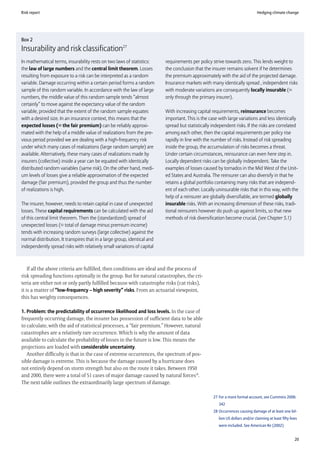
1. Problem: the predictability of occurrence likelihood and loss levels. In the case of
frequently occurring damage, the insurer has possession of sufficient data to be able
to calculate, with the aid of statistical processes, a “fair premium.” However, natural
catastrophes are a relatively rare occurrence. Which is why the amount of data
available to calculate the probability of losses in the future is low. This means the
projections are loaded with considerable uncertainty.
   Another difficulty is that in the case of extreme occurrences, the spectrum of pos-
sible damage is extreme. This is because the damage caused by a hurricane does
not entirely depend on storm strength but also on the route it takes. Between 1950
and 2000, there were a total of 51 cases of major damage caused by natural forces28.
The next table outlines the extraordinarily large spectrum of damage.

                                                                                                   27 For a more formal account, see Cummins 2006:
                                                                                                      342
                                                                                                   28 Occurrences causing damage of at least one bil-
                                                                                                      lion US dollars and/or claiming at least fifty lives
                                                                                                      were included. See American Re (2002)


                                                                                                                                                        20
Risk report                                                                                                       Hedging climate change


Table 3
Historic damage in $ billion US

                                   Earthquakes                     Hurricanes                   Flooding
                                     (6 cases)                     (27 cases)                  (18 cases)


Maximum                                  51.3                         37.0                          25.1

Median                                    2.7                         3.0                           1.6

Minimum                                   0.1                         0.9                           0.1


Source: American Re (2002)


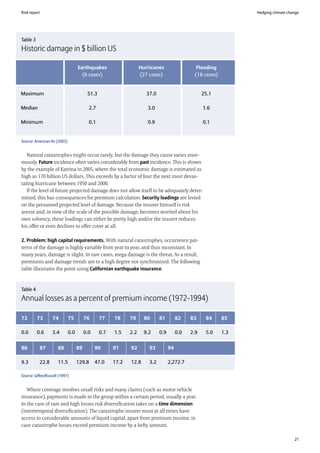
   Natural catastrophes might occur rarely, but the damage they cause varies enor-
mously. Future incidence often varies considerably from past incidence. This is shown
by the example of Katrina in 2005, where the total economic damage is estimated as
high as 170 billion US dollars. This exceeds by a factor of four the next most devas-
tating hurricane between 1950 and 2000.
   If the level of future projected damage does not allow itself to be adequately deter-
mined, this has consequences for premium calculation. Security loadings are levied
on the presumed projected level of damage. Because the insurer himself is risk
averse and, in view of the scale of the possible damage, becomes worried about his
own solvency, these loadings can either be pretty high and/or the insurer reduces
his offer or even declines to offer cover at all.

2. Problem: high capital requirements. With natural catastrophes, occurrence pat-
terns of the damage is highly variable from year to year, and thus inconstant. In
many years, damage is slight. In rare cases, mega damage is the threat. As a result,
premiums and damage trends are to a high degree not synchronized. The following
table illustrates the point using Californian earthquake insurance.


Table 4
Annual losses as a percent of premium income (1972-1994)

72        73      74         75         76      77    78     79      80      81         82    83     84     85

0.0       0.6     3.4        0.0        0.0     0.7   1.5    2.2     9.2     0.9        0.0   2.9    5.0    1.3


86         87         88           89         90      91     92        93          94

9.3        22.8       11.5         129.8      47.0    17.2   12.8      3.2         2,272.7

Source: Jaffee/Russell (1997)


   Where coverage involves small risks and many claims (such as motor vehicle
insurance), payments is made in the group within a certain period, usually a year.
In the case of rare and high losses risk diversification takes on a time dimension
(intertemporal diversification). The catastrophe insurer must at all times have
access to considerable amounts of liquid capital, apart from premium income, in
case catastrophe losses exceed premium income by a hefty amount.

                                                                                                                                     21
Risk report                                                                                                            Hedging climate change


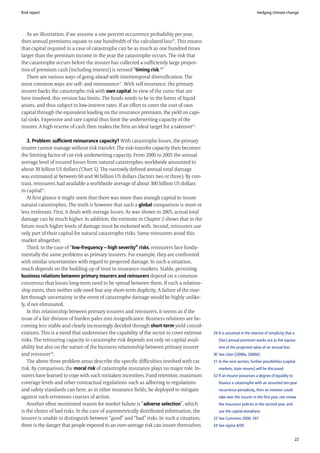
   As an illustration, if we assume a one percent occurrence probability per year,
then annual premiums equate to one hundredth of the calculated loss29. This means
that capital required in a case of catastrophe can be as much as one hundred times
larger than the premium income in the year the catastrophe occurs. The risk that
the catastrophe occurs before the insurer has collected a sufficiently large propor-
tion of premium cash (including interest) is termed “timing risk.30”
   There are various ways of going ahead with intertemporal diversification. The
most common ways are self- and reinsurance31. With self insurance, the primary
insurer backs the catastrophe risk with own capital. In view of the sums that are
here involved, this version has limits. The funds needs to be in the forms of liquid
assets, and thus subject to low-interest rates. If an effort to cover the cost of own
capital through the equivalent loading on the insurance premium, the yield on capi-
tal sinks. Expensive and rare capital thus limit the underwriting capacity of the
insurer. A high reserve of cash then makes the firm an ideal target for a takeover32.

    3. Problem: sufficient reinsurance capacity? With catastrophe losses, the primary
insurer cannot manage without risk transfer. The risk-transfer capacity then becomes
the limiting factor of cat-risk underwriting capacity. From 2000 to 2005 the annual
average level of insured losses from natural catastrophes worldwide amounted to
about 30 billion US dollars (Chart 5). The narrowly defined annual total damage
was estimated at between 60 and 90 billion US dollars (factors two or three). By con-
trast, reinsurers had available a worldwide average of about 300 billion US dollars
in capital33.
    At first glance it might seem that there was more than enough capital to insure
natural catastrophes. The truth is however that such a global comparison is more or
less irrelevant. First, it deals with average losses. As was shown in 2005, actual total
damage can be much higher. In addition, the estimate in Chapter 2 shows that in the
future much higher levels of damage must be reckoned with. Second, reinsurers use
only part of their capital for natural catastrophe risks. Some reinsurers avoid this
market altogether.
    Third, in the case of “low-frequency – high severity” risks, reinsurers face funda-
mentally the same problems as primary insurers. For example, they are confronted
with similar uncertainties with regard to projected damage. In such a situation,
much depends on the building up of trust in insurance markets. Stable, persisting
business relations between primary insurers and reinsurers depend on a common
consensus that losses long-term need to be spread between them. If such a relation-
ship exists, then neither side need fear any short-term duplicity. A failure of the mar-
ket through uncertainty in the event of catastrophe damage would be highly unlike-
ly, if not eliminated.
    In this relationship between primary insurers and reinsurers, it seems as if the
issue of a fair division of burden pales into insignificance. Business relations are be-
coming less stable and clearly increasingly decided through short-term yield consid-
erations. This is a trend that undermines the capability of the sector to cover extreme    29 It is assumed in the interest of simplicity that a
risks. The reinsuring capacity in catastrophe risk depends not only on capital avail-         (fair) annual premium works out as the equiva-
ability but also on the nature of the business relationship between primary insurer           lent of the projected value of an annual loss
and reinsurer34.                                                                           30 See Litan (2006a, 2006b)
    The above three problem areas describe the specific difficulties involved with cat     31 In the next section, further possibilities (capital
risk. By comparison, the moral risk of catastrophe insurance plays no major role. In-         markets, state means) will be discussed
surers have learned to cope with such mistaken incentives. Fund retention, maximum         32 If an insurer possesses a degree of liquidity to
coverage levels and other contractual regulations such as adhering to regulations             finance a catastrophe with an assumed ten-year
and safety standards can here, as in other insurance fields, be deployed to mitigate          recurrence periodicity, then an investor could
against such erroneous courses of action.                                                     take over the insurer in the first year, not renew
    Another often mentioned reason for market failure is “adverse selection”, which           the insurance policies in the second year, and
is the choice of bad risks. In the case of asymmetrically distributed information, the        use the capital elsewhere
insurer is unable to distinguish between “good” and “bad” risks. In such a situation,      33 See Cummins 2006: 347
there is the danger that people exposed to an over-average risk can insure themselves      34 See sigma 4/05


                                                                                                                                                   22
Risk report                                                                                  Hedging climate change


too cheaply. This comes at the expense of people exposed to below-average risk. As a
consequence the insurer is threatened with a concentration of bad risks. In connec-
tion with natural catastrophes, any information advantage can, however, assumed
to be on the side of the insurer. Adverse selection can be said to hardly play a role.
   Overall, this is the picture: The market error we’ve been dealing with here is
directly related to the specific characteristics of natural catastrophes. The high level
of under insurance becomes comprehensible. On one side, many primary insurers,
because of the existent uncertainty in relation to probability of occurrence and level
of damage, are right from the outset opposed to entering the market. On the other,
premiums are high because of loadings (uncertainty, timing problem, and capital
costs) . And, just as in every other market, high prices dampen demand. The event-
driven cycle now makes sense. The intertemporal diversification of low-frequency –
high severity risks is created only with certain difficulties. Serious catastrophes there-
fore usually imply large unexpected losses. This forces the insurer to limit the offer
and demand higher premiums, or to abandon the market altogether (harder market).


                                                                                                                23
Risk report                                                                                                         Hedging climate change


   5
   Path to the future

Climate change has long been a reality. Over the next decades, natural catastrophes
will have an increasingly destructive effect, even if many details are still disputed35.
There can be no doubt that catastrophe risk will increase for millions of people. Which
leads to the question of how the efficiency of markets can be improved to better cope
with these risks.


5.1 Extending the insurability of Cat Risk

    rivate insurers are working at extending insurability borders and thus opening
P   up new avenues for insuring weather-related catastrophes. Two developments in
particular should be mentioned: the construction of catastrophe models and the use
of capital markets for risk diversification.
   As we have seen, weather-related natural catastrophes embody an extreme chal-
lenge for the insurer. The potential damage is very high, and the nature of the event
itself unpredictable. Once, insurers relied mainly on figures derived from experience
to determine projected levels of losses. That changed with Hurricane Andrew. This
caused levels of damage (see Table 1) that, at the time, were not considered possible.
Since then, work on so-called catastrophe models has been intensified. Apart from
the large insurance companies, special firms such as Risk Management Solutions
(Newark, Calif.), Applied Insurance Research (Boston, Mass.), and Eqecat (Oakland,
Calif.) are also involved in this work. The aim is to improve the precision of project-
ing the probability of and the damage caused by certain catastrophes to improve            35 See for example the summary of discussion over
the insurability of these risks.                                                              the causes of hurricanes in Kunreuther/Michel-
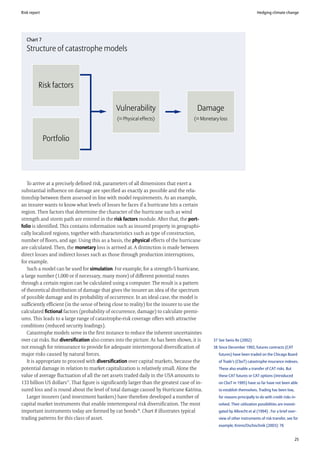
   A catastrophe mode is based on four fundamentals, as shown in Chart 7 36.                  Kerja (2007): 13
                                                                                           36 See Kunreuther/Michel-Kerja (2007)


                                                                                                                                           24
Risk report                                                                                                                Hedging climate change


   Chart 7
   Structure of catastrophe models


          Risk factors

                                               Vulnerability                            Damage
                                                (= Physical effects)                  (= Monetary loss


              Portfolio


   To arrive at a precisely defined risk, parameters of all dimensions that exert a
substantial influence on damage are specified as exactly as possible and the rela-
tionship between them assessed in line with model requirements. As an example,
an insurer wants to know what levels of losses he faces if a hurricane hits a certain
region. Then factors that determine the character of the hurricane such as wind
strength and storm path are entered in the risk factors module. After that, the port-
folio is identified. This contains information such as insured property in geographi-
cally localized regions, together with characteristics such as type of construction,
number of floors, and age. Using this as a basis, the physical effects of the hurricane
are calculated. Then, the monetary loss is arrived at. A distinction is made between
direct losses and indirect losses such as those through production interruptions,
for example.
   Such a model can be used for simulation. For example, for a strength-5 hurricane,
a large number (1,000 or if necessary, many more) of different potential routes
through a certain region can be calculated using a computer. The result is a pattern
of theoretical distribution of damage that gives the insurer an idea of the spectrum
of possible damage and its probability of occurrence. In an ideal case, the model is
sufficiently efficient (in the sense of being close to reality) for the insurer to use the
calculated fictional factors (probability of occurrence, damage) to calculate premi-
ums. This leads to a large range of catastrophe-risk coverage offers with attractive
conditions (reduced security loadings).
   Catastrophe models serve in the first instance to reduce the inherent uncertainties
over cat risks. But diversification also comes into the picture. As has been shown, it is      37 See Swiss Re (2002)
not enough for reinsurance to provide for adequate intertemporal diversification of            38 Since December 1992, futures contracts (CAT
major risks caused by natural forces.                                                             futures) have been traded on the Chicago Board
   It is appropriate to proceed with diversification over capital markets, because the            of Trade’s (CboT) catastrophe insurance indexes.
potential damage in relation to market capitalization is relatively small. Alone the              These also enable a transfer of CAT risks. But
value of average fluctuation of all the net assets traded daily in the USA amounts to             these CAT futures or CAT options (introduced
133 billion US dollars37. That figure is significantly larger than the greatest case of in-       on CboT in 1995) have so far have not been able
sured loss and is round about the level of total damage caused by Hurricane Katrina.              to establish themselves. Trading has been low,
   Larger insurers (and investment bankers) have therefore developed a number of                  for reasons principally to do with credit risks in-
capital market instruments that enable intertemporal risk diversification. The most               volved. Their utilization possibilities are investi-
important instruments today are formed by cat bonds38. Chart 8 illustrates typical                gated by Albrecht et al (1994) . For a brief over-
trading patterns for this class of asset.                                                         view of other instruments of risk transfer, see for
                                                                                                  example, Krenn/Oschischnik (2003): 76


                                                                                                                                                     25
Risk report                                                                                                             Hedging climate change


   If an insurer wants to transfer the catastrophe risks of his portfolio to the capital
markets, he sets up a so-called Special Purpose Vehicle to issue the bond. The income
is invested as safely as possible in securities of the highest credit rating. At the same
time, the investment vehicle insures the insurer against a precisely defined catastro-
phe, for which an annual premium is paid.


   Chart 8
   Cat Bond payment system

                           Insurance                                 One-time capital
                           premiums                                         payment
                                               Investment
              Insurer                                                                   Investors
                                                 vehicle
                                       Cover                        Coupon
                                                                    payments


                                           Nominal           Risk-free
                                             value           interest


                                               Security with
                                               highest credit
                                                   rating


   In most cases, cat bonds are subject to variable interest rates. The coupon payment
emerges from the relevant money market interest (LIBOR) level plus an interest
loading . The investment vehicle finances these interest payments with earnings
from safe bonds (risk-free interest) and insurers’ premiums.
   Embedded in the security is an option on the event. If an event does occur, then,
in the simplest case, the bond plus interest simply expires39. The vehicle immediate-
ly sells the safe bonds and pays the insurer the agreed coverage. If the event does not
occur, the investor gets back the nominal value of the catastrophe bonds at maturi-
ty. This, in turn, is financed through the sale of safe funds.
   After payments have been completed, the investment vehicle is dissolved. Aside
from the legal and taxation advantages of this system, there is another important
advantage. Where the insurer himself is the issuer, investors would be affected by
any possible insolvency of the insurer, and would therefore need to be paid an equiv-
alent amount because of this additional credit risk. But this is here not the case be-
cause the vehicle and the funds it holds are not part of the insurer’s body of assets.
This is also an advantage for the investor because he is now offered the chance of          39 A great number of variations is possible. The
pure play in catastrophe risks40.                                                              coverage can be limited merely to future inter-
                                                                                               est payments and/or part of the nominal value.
The most important cat bond parameter is the trigger event that causes the option. There       Basically what counts is: the smaller the cover-
are various types. Among them41:                                                               age, the better the investment vehicle rating
• Indemnity-based trigger. The trigger here is a certain loss by the insurer’s business.    40 Strictly speaking this is not quite right because
   In this case, there is no basic risk for the insurer. That means that the insurer is        he is still exposed to other risks, although these
   completely safeguarded through the cat bonds because the loss equates precisely             are of a subordinate role: a money market risk
   with the agreed level of coverage. From the investors’ point of view this approach          (LIBOR), a risk of liquidation (either no or a tight
   has the disadvantage that the insurer under certain circumstances can influence             secondary market) and possibly to a currency
   the trigger event to his own advantage. Equivalently large is the investors’ need for       risk
   information in relation to the insurer’s business policies.                              41 See Pensa (2004), 14


                                                                                                                                                   26
Risk report                                                                                                           Hedging climate change


• A market-damage based index. The trigger here is a decline in an index that
  reflects the exposure of a group of insurers. There is no chance of exercising any
  influence. The basic danger can be considerable if the risks or their weight in the
  portfolio vary greatly from those of the group.
• Model losses as trigger. This is where a catastrophe model offered by one of the
  firms specializing in such models are used. In using the parameters of a real
  occurring catastrophe, the calculation is made to assess whether the “model
  damage” exceeds that of the contractually laid-down loss trigger or not. In such a
  case, the basic risk is small (provided, as pointed out above, the portfolio of the
  insurer is adequately taken into account). For investors, this trigger is usually the
  least transparent.
• Physical trigger. The occurrence of a catastrophe is tied to certain objective
  parameter values. For example, a hurricane must reach speeds of at least 200
  km/h to qualify as a catastrophe. The approach is interesting for both investors
  and rating agencies because it is extremely transparent. On the other hand, the
  basic risk can be high.
• Parametric indexes. The majority of today’s cat bonds are based on this trigger
  type, which is a further development of the physical trigger (second generation).
  Objective measurable factors relating to the exposure of insurance in certain
  regions are summarized in an index . When a catastrophe occurs, the level of cov-
  erage is determined by a stipulated formula (Box 3). In an ideal case, the insurer’s
  loss is adequately approximated (small basis risk) while the investors need for
  transparency is taken into account.

As can be seen, the various loss triggers are viewed differently by insurers and in-
vestors. As a rule, there is a discord between, on the one hand, the basic risk of the
insurer and, on the other, the objectivity and transparence of the method.
   On top of that, the characteristic of a catastrophe bond is naturally determined by
the size of the spread. This depends largely on the price of the option. Further risks
such as, for example, a minimal liquidity of a bond or the investment vehicle’s rat-
ing likewise influence the size of the interest loading.
   Regrettably, no generally acceptable valuation formula exists for these catastro-
phe options. Options prices are independent of the dynamic of the so-called under-
lyings. In the case of share options, these are the movement of a relevant share.
Because the dynamics of catastrophe damage is considerably different from assets
traded on the finance markets, proved options price formulas (for example, that of
Black-Scholes) cannot be used. Instead, methods that are tailored to the relevant cat
bonds, such as simulation, are used.

This is however not without problems if the level of information of the involved parties
is either different or not high. Problems can emerge if:
• the insured damage is submitted only after a long delay
• the assets of the catastrophe model are not clearly clarified
• or the know how is concentrated one-sidedly with the insurer

Where is the attraction of cat bonds for the investor? A central role is played by port-
folio aspects. Cat bonds are not regarded in isolation but in relation to the portfolio
of a potential investor. As a rule, they have very advantageous correlation properties.
And even if it cannot be entirely ruled out that the occurrence of a natural catastrophe
will cause a price collapse on capital markets, this is fairly unlikely42. On the other    42 The S&P 500 lost more than 12 percent in five
side, a crash of financial markets cannot cause a natural catastrophe. Cat bonds              trading days after the reopening of the stock
show no (or an extremely small) correlation with financial issues already being               exchange after the attack of September 11
trade by the market. In the jargon of portfolio theory, the beta factor is zero (or very   43 In other words, they can drive their efficient
small)43. Investors can successfully diversify their portfolio by acquiring cat bonds.        frontier upwards and achieve a high portfolio
   A further argument in favor of buying these securities is their attractive yield.          yield with the risk remaining the same. Empirical
Between 2003 and 2006 the spreads of various cat securities amounted to between               examinations confirm this. See Pensa (2004): 19


                                                                                                                                               27
Risk report                                                                                                                                              Hedging climate change


200 and 900 basic points44. This means that catastrophe securities yields are among
the highest. However, in the case of long-term yields, much depends on whether a
large catastrophe occurs. The uncertainty of catastrophe predictions is reflected in
prognoses relating to catastrophe securities.
   Box 3 contains a case study in which the first cat bond issued by Allianz SE is shown.                                   44 See sigma 2/7: 9


Box 3

Marc Hannebert, head of reinsurance strategy at Allianz Global Corporate & Specialty AG
The new Allianz Cat Bond
On April 10, 2007, Allianz Global Corporate & Specialty announced                            in which the expectations of both the sponsor (insurer) and the
the successful offering of an innovative catastrophe security in an                          investor were fulfilled. A sponsor doesn’t want to concede the
amount of 150 million US dollars. The cat bond provides protection                           investor a too-detailed insight into the state of assets, risk manage-
against high severity losses incurred from earthquakes in Canada or                          ment, underwriting or claims settlements, as is necessary in the
the United States, not including California, and river floods in Great                       case of indemnity based trigger. This is why a parametric trigger
Britain. The multi-peril issuance is part of a one billion dollar program                    was selected. The challenge here was to construct an index that
by Blue Wings Ltd, a special purpose vehicle launched by Allianz                             was robust and transparent enough to satisfy both investors and
Global Corporate & Specialty. The emission was fronted by Swiss Re                           rating agencies and, at the same time, to keep within limits the
which also acted as arranger and lead manager. The bonds offer a                             basic risk for the sponsor, Allianz.
return of 3.15 percent over LIBOR and have a Standard & Poor’s                                  The architects of the bond drew up what might be called a “vir-
BB+ rating, and the insurance risk, modeled by Risk Management                               tual infrastructure”. This, administered by the Halcrow Group, a
Solutions (MRS) is 0.54 percent per annum. This means that in-                               British firm of consulting engineers, enables the parties involved to
vestors must reckon with an annual loss of 0.54 percent of their                             measure with a high degree of precision the flood levels in more
invested capital. But in reality there is a high probability that inside                     than 50 places throughout Britain (the system is illustrated in the
the maturity period of six years no triggering event (catastrophe)                           chart). The measurements are fed into the index formula, which
occurs, for which capital from the bond would have to be used. As                            determines if and to what extent the investors lose their invested
a result, the chances of a worst-case scenario in which the invest-                          capital.
ment is totally lost is small. The cover is fully collateralized with                           Likewise new was the readiness of investors to invest in a cat
minimal credit exposure.                                                                     bond, although because of the new infrastructure it was not possi-
   Earthquakes in Canada and the United States – except California –                         ble to ascertain retroactively the performance of the trigger (high
and severe river flooding in Britain were chosen because they                                water index) for any previous periods. Instead, the investors relied
represent high risks that are insufficiently covered by existing rein-                       on an estimated distributive curve within the index that was estab-
surance. The trigger for earthquakes is based on modeled losses                              lished by Risk Management Solutions (RMS) from its still unsur-
using data from the United States Geological Survey. The modeled                             passed flood model for Britain.
insurance risk from earthquakes was 0.43 percent. The trigger for                               The bond found a large resonance in the market. Demand was
severe river flooding is based on a parametric index of the second                           heavy. It is the aim of Allianz Global Corporate & Specialty as well
generation. The modeled insurance risk by river flooding in this                             as the Allianz Group to strengthen their competence in this field
region was 0.11 percent (a total of 0.54 percent).The parametric                             and make available such products to customers both medium and
index trigger for river flooding is the most innovative part of the                          long term.
project. It enabled for the first time an insurer to issue a cat bond


  Vertical distance – reference point flood depth
  Pre-event                                    Post-event                                   For each reference location specified in a measurement notice, the vertical dis-
                      Reference point                           Reference point             tance (v) is the vertical distance (measured by the measurement agent within
                                                                                            the relevant measurement window) between each relevant reference point
                                                  Flood watermark
                            Ground elevation                                                and the corresponding watermark.
                            of reference
                            location                                                        For each reference point satisfying the measurement conditions, the reference
                                                                                            point flood depth (d) is calculated with the formula: d = r – v
                                                                                            Where: r is the difference between the elevation of the reference point and the
                                                                        v
                             r                                                              ground elevation of the corresponding reference location (as measured during
                                                                         } d (calculated)
                                                                                            the establishment of the reference point and listed in a schedule), v is the vertical
                                                                                            distance of the respective reference point
 Source: Swiss Re Capital Markets


                                                                                                                                                                                    28
Risk report                                                                                                                  Hedging climate change


   The next chart shows how the market of Cat Bonds developed until March 2005.


   Chart 9
   Cat Bond issues (1997-2006)
            Volume of Cat Bonds                                                                 Number of
            in $ bn US                                                                           emissions
       5                                                                                                     25

     4.5

       4                                                                                                     20

     3.5

       3                                                                                                     15

     2.5

       2                                                                                                     10

      1.5

       1                                                                                                     5

     0.5

       0                                                                                                     0
                1997      1998      1999      2000    2001      2002       2003   2004   2005    2006                        Source: Marsh & McLen-
                                                                                                                             non Securities (2006):
                       Cat Bonds in $ bn US          Number of emissions
                                                                                                                             The Catastrophe Bond
                                                                                                                             Market at Yearend 2005


   Annual issuing totals of a maximum of 4.7 billion US dollars and in total a volume
of about 15 billion US dollars of issued securities are fairly modest levels45. However,
the trend of emitted cat bonds is showing in an upward direction. Yet, as of today, the
market for cat bonds could not meet all expectations. One reason might be the prob-
lem of valuation. Expected advances in the modeling of catastrophe risks will bring
with them adjustments. Also, some insurers regard the bonds as somewhat expen-
sive. It has been shown that, so far, cat bond spreads lie clearly above reinsurance
premiums.
   Another possible explanation is the high transaction costs, because most of the
time a large number of external experts such as investment bankers, lawyers, spe-
cialist firms, and actuaries are needed. More explanations indicate a low level of
liquidity, a shortage of experience with these securities, and a lack of interest by
investors. In the event, insurance companies in 1999 turned up on a large scale as
buyers of cat bonds (primary insurers with a market share of 30 percent, and rein-
surers with one of 25 percent). So insurers dominated both side of the market, sup-
ply and demand. But by 2004 this had fundamentally changed. Only seven percent
of bond underwriters were now from the insurance industry. The interest among
hedge funds, specialist cat bonds, and other institutional investors had also in-
creased significantly.
   A major part of the problem seemed to be traceable back to typical teething
troubles. The potential of the financial markets in relation to the intertemporal                45 The first large wave of issues was in 1997. The
diversification of cat risks is in any case enormous. Now, it is a matter of improving              current annual volume of issues is a good three
on this potential. Insurers can also contribute to this by , for example, make cat                  billion US dollars
bonds contractually more attractive46. The ability of insurance markets to function              46 Froot (1998) names the following elements that
is not least dependent on the efficiency of capital markets.                                        positively influence the success chances of a
                                                                                                    cat-bond issue: a higher excess, a larger volume
                                                                                                    because of the high fixed costs, transparent
                                                                                                    triggers, and marginal incomes that are not too
                                                                                                    high. Implicit in the last is a low probability of
                                                                                                    loss and an equivalently low bond rating that
                                                                                                    does not justify the issuing price


                                                                                                                                                         29
Risk report                                                                                                               Hedging climate change


5.2 Rethinking the role of the state

   nadequately functioning insurance markets in relation to natural catastrophes
I  serves to put politics under heavy public pressure to become engaged in the field.
When a catastrophe does strike and cause damage, as a rule the state steps in and
makes available a wide range of resources. This ex-post help, while understandable,
is not without problems.
   For a start, it contains considerable fiscal/political risks. In the case of Katrina,
assistance from the US federal government in the form of expenditure and tax relief
amounted to more than 100 billion US dollars. A major part went on compensation
for storm damage that was not covered by insurance, although that would have been
possible47.
   Second, state assistance is unfair, inasmuch as it comes from general taxation and
is thus financed by the entire population. It does not make sense for people who vol-
untarily live in an endangered area to be supported by the rest of the population.
   Third, this form of aid is inefficient, because it creates a false set of incentives. It
leads to a variation of the “samaritan dilemma”: state support after a disaster under-
mines the motivation of people who are potentially affected to carry out risk-reducing
measures in advance of a possible catastrophe. This low level of insurance penetra-
tion in expectation of assistance in turn simply increases the pressure on politics to
extend assistance. This threatens to become an ever stronger self-propelling cycle.
   A higher level of penetration for cat risks is therefore lies in the state’s own inter-
ests. This is hardly a new phenomenon. Many countries run programs to guarantee
the availability of cat insurance in cases where the private sector offers either inade-
quate coverage or no coverage at all 48. Although these programs show significantly
differing financing structures and means of operating, most do pursue similar
aims49.

• Extension of the insurance protection on offer, or even creating an equivalent
  market if no private coverage is available.

• Limitation of household risks to natural catastrophes.

Just as in the private sector, a state insurer can also function basically as either a pri-
mary insurer or a reinsurer. A well-known example of a public primary insurer is the          47 Protection against flood damage was offered
Federal Flood Insurance Program (NFIP) in the USA50. Insurance protection against                by the National Flood Insurance Program. The
flooding was for the first time offered by private firms in the late 18th century. But           insurance penetration among house owners in
heavy losses caused by floods in the Mississippi in 1927 prompted most insurers to               Louisiana communities affected by Katrina var-
pull out of this market. Over the next forty years, insurance coverage against flood-            ied between 57.7 percent (St. Bernard Parish)
ing was limited to a few private firms. The risks, because of the concentration in spe-          and 7.3 percent (Tangipahoa Parish). In Orleans
cific regions, and because of the sheer amount of potential damage, made this mar-               Parish, 40 percent were insured. See Kunreuther
ket appear to be uninsurable.                                                                    (2005): 3/4
   In 1968, Congress approved the National Flood Insurance Program (NFIP) . At the            48 A special role played here in recent times is ter-
moment, the federal government is the primary insurer of coverage against damage                 rorism. Since the September 11 attacks, these
to private houses and small business caused by floods. Private insurers market the               risks also count among major cat risks. State
NFIP and administer claims settlements. Participating communities in endangered                  involvement appears both necessary and sensi-
regions are under obligation to ensure that building plans and safety standards                  ble. First, these risks are not exclusively privately
include factors to mitigate against flood damage. It is also envisaged that the NFIP             insurable. Second, there is here a general overall
will finance itself so that, in the long term, no taxation funds will be needed.                 interest by society that justifies the use of tax
   In August 2006, there were almost 4.6 million insurance policy holders in 20,000              resources. Coverage of terrorist risks often takes
communities in the USA. In the period from 1968 until August 2006, the NFIP paid                 place in the form of partnerships between private
out 14.6 billion US dollars in compensation for insured damage. At first glance, it              enterprise and public authorities. See attachment
seems that the NFIP has been a success. It has meant that the range of insurance on              in sigma 4/2005
offer has been significantly extended.                                                        49 For an overview, see OECD (2005)
                                                                                              50 See Cummins (2006): 357


                                                                                                                                                     30
Risk report                                                                                                          Hedging climate change


   But the truth is that reforms are urgently needed. Premiums are not appropriate
to the risks and coverage is as low as 35-40 percent of expected damage. After the
year of record damage in 2004/5 (Table 1) the NFIP is practically insolvent. About 25-
30 percent of the compensated damage claims fall into the category of “repetitive-
loss properties”, properties for which compensation claims have been settled sever-
al times over. This leads to the conclusion that the incentive to take damage-preven-
tion measures that is meant to be in place simply does not exist. Finally, insurance
penetration is inadequate. Even in the most endangered regions, only 50 percent of
house owners, at best, are insured.
   The faults of the NFIP are not isolated. State primary insurance programs are
often trapped in various forms of inefficiency. Subsidized policies can “crowd out”
private insurers or inhibit their market penetration. Public programs are exposed to
massive lobby interests. Subsidized premiums create “moral hazard” problems.
High administration costs (public servants placed in privileged positions), lack of
know how, and the lax handling of tax money can cause further problems.
   The deficits associated with state-run primary insurance programs can generally
avoided if the following principles are observed51.

1. Private insurers should as far as possible be involved in the state program. State
   insurance programs should back the private market or supplement it, but not
   replace it.

2. If state programs are needed, their design should, as far as possible, imitate the
   proven structure of private markets.

But this results in a paradoxical situation: if an efficient state primary insurance
program against catastrophe risks should imitate as far as possible private market
structures, why have a public program at all? Clearly it would make more sense if
the state in the first place took the trouble to create the basic conditions to enable a
free-market coverage of catastrophe risks. What is needed therefore is not so much
state primary insurance but, instead, appropriate cooperation between private in-
surers and public authorities. The example of Britain shows that flood risks are in
fact insurable on the free market.


                                                                                           51 See Jaffee/Russell (2006)


                                                                                                                                        31
Risk report                                                                                                            Hedging climate change


5.3 Private and public risk partnerships:
the example of flood insurance

     lthough it cannot be expected that every risk is insurable at any given time, a
A    risk partnership between the private insurance business and public authorities
can decisively improve the insurability of these risks. Here, two approaches are rele-
vant to the issue of large risks.
   The first approach involving cooperation between private insurers and public
authorities is based on the obvious fact that public policies can exert considerable
influence over the effects of natural catastrophes. A prime example is the case of
flood risks in Britain52.
   More than two million houses, or 10 percent of the total, are presently exposed
to the risk of flooding. Of those, 400,000 are in highly endangered regions where the
annual occurrence risk of flood damage is 1.3 percent. Long-term, if suitable counter
measures are not taken, the situation could significantly worsen because of the effects
of climate change. This means that the number of buildings vulnerable to risk threat-
ens to rise to 3.5 million.
   After widespread floods in the autumn of 2000 caused by record levels of rainfall,
doubts arose about whether this sort of damage would even be insurable on private
insurance market53. All parties agreed that public infrastructure needed to be funda-
mentally modernized to minimize flood damage. After constructive dialogue be-
tween the government and the Association of British Insurers (ABI)54 it was agreed in
January 2003 that private insurers would continue to offer insurance protection
against flood damage while the government would make available more funds to
improve mitigation efforts in endangered areas and improve its flood risk informa-
tion practices55.
   In November 2005, the partnership was extended. Insurance cover would contin-
ue to be offered to private house owners and small businesses for whom the proba-
bility of flood damage was no higher than 1.3 percent. Premiums were to be calculat-
ed on the basis of the extent of the risk. On top of that, insurance cover remained
available for another 100,000 buildings that within the next five years would be, with
state assistance, brought into the 1.3 percent category. Existing policyholders in
highly endangered regions for whom no risk-mitigation program exists, were to be
dealt with on a case-by-case basis.

Private insurers agreed to take on these obligations on the condition that the government
made progress in five key areas:
• reducing risks over the next three years for 100,000 buildings in endangered areas.
• Establishing adequate investment programs against flood damage, taking into
   account climate change.
• Improving land-use planning to restrict construction of new buildings in risky
   regions.                                                                                 52 See the web site of the Association of British
• Making available more accurate state information to the public about flood risks             Insurers (ABI): www.abi.org.uk/flooding
   and state programs to mitigate these risks.                                              53 The insured damage amounted to more than
• Taking steps to minimize risks posed by drain flooding and flash floods.                     one billion pounds sterling
                                                                                            54 More than 400 insurance companies, or 97
The British example shows that, even under difficult conditions, the insurability of           percent of the British insurance industry, is
cat risks can be warranted. But this is only one, individual, example. The range of            organized under the ABI umbrella
possible cooperation is large and full of possibilities. Areas of cooperation include       55 The funds were initially increased to 394 million
safety standards, construction regulations, area planning, public infrastructure               pounds sterling (2002/3) and then, in stages,
(such as dams and other protective installations), deciding on appropriate tax con-            to 564 million pounds by 2005/6
ditions, and catastrophe protection measures. Public and private risk partnerships          56 Of course policyholders can also contribute by
can help make those effects of climate change that cannot be avoided at least man-             not taking unnecessary risks and by making
ageable from a social point of view56.                                                         available information that is relevant for insur-
                                                                                               ance purposes


                                                                                                                                                   32
Risk report                                                                                                            Hedging climate change


   An important condition for the insurability of major risks is the possibility of
diversification. But in many markets, as we have seen, the opportunities for risk
transfer using reinsurance are limited and the relevant capital-market instruments
under-developed. This is where the second approach comes into play. The insurabil-
ity of risks to natural catastrophes can be improved if state reinsurance exists57.
   Such programs can be arranged in many ways. Of course, the previously men-
tioned construction principles should be used. Specifically these involve observing
the following principles.

First: State reinsurance should only be available for cases of major damage that ex-
ceed a certain level. Where this level is set depends on the relevant market conditions.
Out of this emerges a system of multi-layered liability, as is typical in insurance
markets. The insured damage is spread between policy holder (through an excess
requirement) primary insurers, private reinsurers and capital markets, and, finally,
public authorities.

Second: the private insurance business should always remain involved in cases of
major damage. This, inasmuch as state coverage, by remaining flexible and adjusted
to the relevant market, is limited. Alternatively, a proportional division of coverage –
above that “certain level” – between insurers and state can be agreed on. In this way,
there is an overview of household risks. At the same time, private primary insurers
and reinsurers remain interested in using their own wherewithal to improve the
insurability of risks to natural forces.

Third: Such a program needs to be financed by premiums that are set at levels
appropriate to risk. This is to avoid false incentives being inferred from public rein-
surance. If premiums are too low, the danger is that private insurers will be crowded
out of the market. In addition, the opportunity increases for moral-hazard behavior
by both primary insurers and policy holders. If premiums are too high, there will be
no demand for state reinsurance and they will the program will thus not fulfill its
aim.

If, because of public pressure and political pressure, setting an appropriate premium
level becomes either difficult or impossible, a price can be set at more-or-less mar-
ket conditions with the help of regular auctions. This means that the state auctions
off a limited number of reinsurance contracts at annual auctions where a reserve
price is set at a level that reflects the risk58. Buyers would, in the main, be primary
insurers but, in certain circumstances, other investors as well. Such speculative pur-
chases would be welcome because they would increase liquidity and make it easier
to set prices more efficiently.
    Such a system of state reinsurance has several attractive facets. For a start, it gives
the impression of extending the market without actually entering the private insur-
ance market. It also reduces the timing risk and provides for a commercial environ-
ment which allows the primary insurer to insure cat risks at more attractive condi-
tions. At the same time, it allows policies to remain in force that were completed
with private insurers under conditions containing incentives for policyholders to act
appropriately to the risks. Policyholder would need to continue to accept excess pro-
visions if they are to obtain coverage from a primary insurer. The state benefits from
such a program as its fiscal risks are reduced. But all of society also gains. Having a
more efficient way of dealing with the risks of natural catastrophes is to the advan-         57 Such programs already exist in one form or
tage of everyone.                                                                                another. Prominent examples include the Japan-
                                                                                                 ese Earthquake Reinsurance Company and the
                                                                                                 French Programm Caisse Centrale de Reassur-
                                                                                                 ance (CCR). See Cummins (2006)
                                                                                              58 The Clinton administration intended introducing
                                                                                                 such a system. See Litan (2006b)


                                                                                                                                               33
Risk report                                                                                                      Hedging climate change


Bibliography
P. Albrecht, A. König, H.R. Schradin: Katastrophenversicherungs-Termingeschäfte, Mannheimer Manuskripte
zu Versicherungsbetriebslehre Nr. 72

American Re (2002): Topics – Annual Review of North American Natural Catastrophes 2001

Guy Carpenter (2005):The World Reinsurance Market. New York

K.A. Froot (1998): The Evolving Market for Catastrophic Event Risk, White paper, Guy Carpenter & Company, Inc

K.A. Froot (2001): The Market for Catastrophic Risk, Journal of Financial Economics, 60 (2001) 529-571

H.C. Kunreuther (2005): Has the Time Come for Comprehensive natural Disaster Insurance? in: On Risk and
Disaster: Lessons from Hurrican Katrina, R.J. Daniels u.a. (eds.), University of Pennsylvania Press 2006

H. C. Kunreuther, E. O. Michel-Kerjan (2007): Climate Change, Insurability of large-scale Disasters and the
emerging Liability Challenge, NBER WP 12821

D.M. Jaffee (2006): Commentary, Federal Reserve Bank of St. Louis Review, July/August 2006

D. M. Jaffee, Th. Russell (1997): Catastrophe Insurance, Capital Markets and Uninsurable Risks, in: journal of
Risk and Insurance, Vol 64, Nr. 2, 205-30

D. M. Jaffee, Th. Russell (2006): Should Governments Provide Catastrophe Insurance?
G. Krenn, U. Oschischnig(2003): Systemrelevante Risikofaktoren der Versicherungswirtschaft und Methoden zur
Risikoeinschätzung, in: Stabilitätsbericht 6 (OeNB)

G.C. Lai, R.C. Witt, H-G. Fung, R.D. MacMim (March 1997): On Liability Insurance Crisis
(www.aria.org/rts/proceedings/1997/crisis.pdf)

R.E. Litan (2006a): What is the Appropriate Role of Federal Government in the private Markets for Credit and
Insurance?, Federal Reserve Bank of St. Louis Review, July/August 2006

R.E. Litan (2006b): Sharing and Reducing the Financial Risks of Future “Mega-Catastrophes”, Issues in Economic
Policy, Nr. 4, March 2006

Münchener Rück: Topics Geo – Naturkatastrophen 2006

OECD (2005): Catastrophic Risks and Insurance, Policy Issues in Insurance Nr. 8

P. Pensa (2004): Cat-Bonds (www.wwz.unibas.ch/cofi/publications/papers/2004/06-04.pdf)

G. Pfister (2003): Zur Versicherungsfähigkeit von Katastrophenrisiken, Arbeitsbericht Nr.232
(www.ta-akademie.de)

Swiss Re (2007): sigma 2/07, Natur- und Man-made-Katastrophen im Jahr 2006

Swiss Re (2005): sigma 4/05, Innovationen zur Versicherung unversicherbarer Risiken

Swiss Re (2002): Terrorismus – Umgang mit der neuen Bedrohung. Focus Report


                                                                                                                                    34

Hedging Climate Change

  • 1.
    Risk report Hedging climatechange How insurers can manage the risk of increasing natural catastrophes
  • 2.
    Risk report Hedging climate change Content page 3 page 5 page 10 1 2 Natural catastrophes in the Natural catastrophes Future insurance potential grip of climate change on the march in natural catastrophes page 16 page 19 page 24 3 4 5 Catastrophe risk in im- Are catastrophe risks Path to the future portant markets is heavily capable of being efficiently 1. Extending the insurability of cat risk under-insured insured? 2. Rethinking the role of the state 3. Private and public risk partnerships: the example of flood insurance Bibliography page 34 Imprint Risk report: “Hedging climate change” | Publication: September 2007 | Author: Allianz Dresdner Economic Research, Dr. Helmut Kesting | Published by: Allianz SE Layout: Volk:art 51 GmbH, Munich | Contact: Michael Anthony, Allianz SE, Group Communications/Corporate Affairs, Königinstrasse 28, D-80802 Munich email: michael.anthony@allianz.com 2
  • 3.
    Risk report Hedging climate change Natural catastrophes in the grip of climate change t the beginning of February 2007, the Intergovernmental Panel on Climate Change A (IPCC) published the first part of its Fourth Assessment Report on world climate change.1 On the origins of climate changes, the report finds that: • The main cause is the greenhouse effect which, in the first instance, can be attrib- uted to an increased level of carbon dioxide in the air. This rose by 30 percent between 1900 and 2005. Almost half of the increase has come in the past 25 years. Seventy-eight percent of the higher CO2 concentration has been caused by the use of fossil fuels. Another 22 percent is because of changes in land use (such as in- creases in arable land). • Further causes include rises in the amounts of other significant greenhouse gases such as methane and nitrous oxide. Their combined increase amounts to half the increase in CO2 levels. • By way of comparison, changes in solar radiation have exerted a minimal influ- ence. A broad consensus exists that the main cause of climate change is human activity (especially CO2 emissions). We have ourselves to blame for the rise in global tem- peratures. At the same time, however, this means that we are in a position to influence climate positively. But this means quicker, more effective and globally coordinated efforts. 1 The IPCC was set up in 1998 by the World Mete- At the moment, the concentration of CO2 in the atmosphere is about 400 ppm (parts orological Organization (WMO) and the United per million). The current rate of increase is at least 2 ppm a year. However, this rate Nations Environment Programme (UNEP). is rising because energy and transport needs are increasing worldwide. Even if CO2 As an institution independent of governments, emissions were immediately held to present levels, greenhouse-gas concentrations the organization has the task of assessing on a would still rise to 550 ppm by 2050. The rise in temperatures of the earth’s surface regular basis the state of knowledge of climate would not stop but would, over the next decades, increase by at least half a degree. change and the effects of these changes on The transition to the post-fossil fuel age involves the largest program of renewal human society. More information can be found and restructuring that the world economy has ever seen.2 Especially affected is elec- on the institution’s web site (www.ipcc.ch) tricity generation (power stations), which is responsible for 40 percent of CO2 emis- 2 See essay by Peter Hennicke in Handelsblatt sions, transport (20 percent), industry (18 percent), plus housebuilding, service (20.03.07, 9) 3
  • 4.
    Risk report Hedging climate change industries and agriculture (together about 13 percent). Clearly, this restructuring also involves changes in consumer habits. Climate protection is not just a matter of money. At the same time new markets and opportunities for growth are emerging. The markets for energy efficiency and renewable energy are alone showing a global growth rate of between 10 and 20 percent. Allianz SE has for years been warning – as have other insurers – of the results of unhindered climate change.3 In cooperation with the WWF (World Wide Fund for Nature) over a number of years, Allianz SE has supported many projects and initia- tives to strengthen climate protection. It belongs to the Global Roundtable on Climate Change (GROCC)4 and espouses a broad alliance of all societal forces to work towards a sustainable energy systems capable of achieving economic growth. Other compa- nies within the Allianz Group are also committed to climate protection. Dresdner Bank is the market leader in European Union (EU) Emissions Trading Scheme CO2 certificates. But this is not merely a matter of supporting noble ideals such as the preservation of life’s fundamentals for future generations. For both Allianz and Dres- dner Bank, earth warming has long become a matter of business. Regardless of whether it is insurance, emissions trading, asset management or project financing, many areas of activity need to take into consideration the effects of climate change.5 Further activity involves the effects of climate change on insurance markets. At the core of the issue is to what extent, or under which conditions, catastrophes caused by climate change will be insurable. This is crucial because questions of pros- perity are linked with insurance: entities such as institutions can protect themselves from damage that threatens their existence. At the same time, positive influences on entire economies result when people can act with the backing of insurance – they are more prepared to enter high-risk innovative projects than they would be without insurance. The next part of the report documents the development of damage caused by nat- ural catastrophes. In view of the existing massive under insuring, it investigates why markets cannot function effectively when dealing with catastrophe damage. It con- cludes by discussing private and state initiatives. The study reaches the following main conclusions: • The number of catastrophes caused by natural forces, as well as the extent of the damage, indicates a significantly rising trend (Chapter 1) . • The insurance potential is enormous. Annual expected average total damage be- tween 2010 and 2020 is estimated at 80-120 billion US dollars (in today’s prices). But because of the high degree of variability, the real damage could significantly depart from this figure (Chapter 2). • These risks are greatly under-insured. As a whole, the markets for catastrophe risks do not functions optimally. They are linked with the specific characteristics of such large risks which, among other things, makes their diversification difficult (Chapter 3 and 4). • Innovative developments by insurers such as catastrophe bonds, (cat bonds) which enable risks to be transferred on capital markets, as well as private and public risk partnerships, can help improve the insurability of catastrophe risks (Chapter 5). 3 To examine the activities of the European Insurance and Reinsurance Federation on climate change, see www.cea.assur.org 4 See www.earth.columbia.edu/grocc 5 See www.allianz.com/Klima 4
  • 5.
    Risk report Hedging climate change 1 Natural catastrophes on the march oth the frequency and extent of natural catastrophes have, over recent years, B increased notably. Before taking a closer look at this, some concepts need to be clarified. Where many separate cases of damage have a common cause, they are said to be in a close time and geographical context. If the total amount of damage reaches an extraordinarily high level measured against “normal” conditions, the reference is to a catastrophe.6 But catastrophes occur in different categories. A natural catastrophe is described as one being caused by natural forces. These include flooding, storms, earthquakes, tidal waves, drought/bushfire/heat, cold/frost, hail or avalanches. The extent of the damage depends not only on the strength of the natural force. A role is played by preventive measures as well as technical or organi- zational factors that can help limit the consequences. The overall damage from a 6 What precisely “extraordinarily high” is is obvi- natural catastrophe always has a social dimension. ously an issue of convention. For the reporting Man-made catastrophes are events that are closely associated with human activity. year of 2006, Swiss Re used, among others, the Mostly of the time these involves a large object in a confined space, such as a build- following definition: for insurance losses in ship- ing complex.7 Among such catastrophes are, for example, large fires, explosions, air ping, 16.1 million U.S. dollars; in civil aviation, crashes, or mine disasters. 32.2 million U.S. dollars; and in other areas, 40 Terrorist attacks are a special category of catastrophe risk. They are not due to million U.S. dollars. Smaller claims were there- chance but a result of premeditated human action. In contrast to natural or man- fore not included in the sigma catastrophe data made catastrophes, the probability of occurrence cannot be assessed using the bank. As well as that, adjustments for inflation usual insurance processes. were made to ensure consistency of data The number of natural catastrophes since 1970 is shown in Chart 18. The trend is 7 Wars, including civil wars and events that resem- clearly upwards. The annual number of natural catastrophes has, over the period, ble wars, are excluded continually risen. The representation of the trend as straight (linear function) ac- 8 The sources are the catastrophe data banks of cords with the overall picture of the data. The vast majority of natural catastrophes the two largest reinsurance companies, Swiss Re are weather-related (see Chart 3). This suggests that there is a connection between and Muenchener Rueck. See the equivalent the increases in natural catastrophes and the likewise slow but constantly rising indices from sigma (www.swissre.com) and Top- increases in global temperatures as a consequence of climate change. ics Geo (www.munichre.com) 5
  • 6.
    Risk report Hedging climate change Chart 1 Number of natural catastrophes 180 160 140 120 100 80 60 40 20 0 19 19 19 19 19 19 19 19 19 19 20 20 20 70 73 76 79 82 85 88 91 94 97 00 03 06 Source: sigma 2/07 In contrast, the annual level of claims resulting from natural catastrophes covered by insurers shows from the outset a far higher variation because the total claims in any given year are heavily dependent on whether, in that year, there is one or more large catastrophes. Chart 2 confirms this. The year 1992 was the year of Hurricane Andrew, up until then the second largest natural catastrophe (see Table 1). In terms of claims, the record year was 2005, when Hurricanes Katrina, Wilma and Rita all struck. They stand respectively in places 1, 6 and 7 on the table of the 40 most-expen- sive insurance claims ever. The year 2006, however, shows a relatively low level of claims amounting to just 12 billion US dollars. This is because, with ten storms de- clared, and five of them reaching hurricane strength, the level was merely average because no built-up areas were hit and there was thus little damage9. Chart 2 Insured natural catastrophes ($ billion US) 100 80 60 40 20 0 19 19 19 19 19 19 19 19 19 19 20 20 20 70 73 76 79 82 85 88 91 94 97 00 03 06 Source: sigma 2/07 Chart 2 basically shows the rising trend of damage. The increases are dispropor- tionate. This is clear if the period covered is divided in two. Up until 1988 the total damage exceeded the 10 billion US dollar level only once. But from 1989, the total annual damage is only four times below that level and has exceeded the 15 billion- dollar mark a total of ten times, sometimes considerably. That the differences of claims increases in absolute terms over two successive years suggests the trend is subject to a non-linear function. 9 See Topics Geo – Naturkatastrophen 2006 6
  • 7.
    Risk report Hedging climate change Table 1 indicates the non-linear increase of expected claims levels. Thirty-four (85 percent) of the largest 40 catastrophes happened between 1988 and 2006, while 15 (about 38 percent) happened after 2000. It is also clear that the majority of cases of large claims were, by a long way, related to natural catastrophes. The terror attack of September 11, 2001, is – at least so far – a rare exception. Table 1 The 40 most expensive insurance claims 1970-2006 Insured Losses10 Date Event Country In $ mn US, inflation (Beginning) indexed as of 2006 66,311 25.08.2005 Hurricane Katrina; floods, burst levees, USA, Gulf of Mexico, Bahamas, oil platform damage North Atlantic 22,987 23.08.1992 Hurricane Andrew; floods USA, Bahamas 21,379 11.09.2001 Terror attack on World Trade Center, USA Pentagon, other buildings 19,040 17.01.1994 Northridge Earthquake, LA USA (6.6 on the Richter Scale) 13,651 02.09.2004 Hurricane Ivan; Oil-platform damage USA, Caribbean, Barbados, elsewhere 12,953 19.10.2005 Hurricane Wilma; rain, flooding USA, Mexico, Jamaica, elsewhere 10,382 20.09.2005 Hurricane Rita; flooding, USA, Gulf of Mexico, Cuba Oil-platform damage 8,590 11.08.2004 Hurricane Charley USA, Cuba, Jamaica, elsewhere 8,357 27.09.1991 Typhoon Mireille/Nr. 19 Japan 7,434 15.09.1989 Hurricane Hugo USA, Puerto Rico, elsewhere 7,204 25.01.1990 Winter storm Daria France, UK, Belgium, elsewhere 7,019 25.12.1999 Winter storm Lothar Switzerland, UK, France, elsewhere 5,500 15.10.1987 Storms, Flooding in Europe France, UK, Netherlands, elsewhere 5,485 26.08.2004 Hurricane Frances USA, Bahamas 4,923 25.02.1990 Winter storm Vivian Europe 4,889 22.09. 1999 Typhoon Bart/Nr. 18 Japan 4,366 20.09.1998 Hurricane Georges; flooding USA, Caribbean 4,100 05.06.2001 Tropical storm Alison; flooding USA 4,022 13.09.2004 Hurricane Jeanne; flooding, landslides USA, Caribbean (incl. Haiti), elsewhere 3,826 06.09.2004 Typhoon Songda/Nr. 18 Japan, South Korea 3,512 02.05.2003 Thunder storms, tornados, hailstorms USA 3,415 10.09.1999 Hurricane Floyd; flooding USA, Bahamas, Colombia 3,409 06.07.1988 Explosion on platform Piper Alpha UK 3,315 01.10.1995 Hurricane Opal; flooding USA, Mexico, Gulf of Mexico 7
  • 8.
    Risk report Hedging climate change Insured Losses10 Date Event Country In $ mn US, inflation (Beginning) indexed as of 2006 3,270 17.01.1995 Great Hanshin Earthquake in Kobe; Japan (7.2 on the Richter Scale) 2,905 27.12.1999 Winter storm Martin Spain, France, Switzerland 2,736 10.03.1993 Snowstorms, tornados, flooding USA, Canada,Mexico, Cuba 2,587 06.08.2002 Serious flooding UK, Spain, Germany, elsewhere 2,516 20.10.1991 Urban forest fires, drought, in California USA 2,505 06.04.2001 Hailstorms, tornados, flooding USA 2,364 18.09.2003 Hurricane Isabel USA, Canada 2,331 05.09.1996 Hurricane Fran USA 2,305 03.12.1999 Winter storm Anatol Denmark, Sweden, elsewhere 2,299 11.09.1992 Hurricane Iniki USA, North Pacific 2,217 29.08.1979 Hurricane Frederic USA 2,155 23.10.1989 Petrochemical works explosion USA 2,134 26.12.2004 Earthquake (9 on the Richter Scale), Indonesia, Thailand, elsewhere Tidal wave in Indian Ocean 2,091 19.08.2005 Rain, landslides, flooding Switzerland, Germany, elsewhere 2,044 18.09.1974 Tropical Cyclone Fifi Honduras 2,009 04.07.1997 Flooding after heavy rain Poland, Czech Rep., Germany, elsewhere Source: sigma 2/07 Data analyzed by Muenchener Rueck arrives at similar conclusions11. About 16,000 natural catastrophes from between 1980 and 2005 were examined. The catastrophes were divided into six loss categories: 1. Small Losses; 2. Medium Losses; 3. Medium-to- Serious Losses (totalling more than 60 million US dollars); 4. Serious Losses (more than 200 million dollars); 5. Devastating Losses (more than 500 million dollars); and 6. Huge Natural Catastrophes (extreme losses as defined by the United Nations). When the incidence of catastrophes was worked out, the dominating occurrence with more than 85 percent was weather-related natural catastrophes. This empha- sizes again the central significance of climate change for catastrophe insurance12. The incidence of catastrophes however in percentage terms differ little from one of the three (consolidated) loss categories to another. Earthquake related losses are the 10 Property damage and production breakdown least evenly divided. claims, but not life assurance or third-party liability 11 See www.munichre.com and the NatCatService page 12 However the greatest conceivable insurance losses are connected with earthquakes. A serious earthquake in California and a major earthquake in Tokyo with total losses running into trillions of US dollars would probably cause a world-wide depression. Astronomical events such as the ex- treme case of a collision with a black hole are not, for obvious reasons, taken into account 8
  • 9.
    Risk report Hedging climate change Chart 3 Catastrophes according to category (1980-2005) 45% Temperature extremes, 40% mass motions such as landslides 35% Earthquakes, 30% tidal waves, 25% volcanic eruptions 20% Storms 15% 10% Flooding 5% 0% Category 1+2 Category 3+4 Category 5+6 Source: Muenchener Rueck A completely different picture emerges if the significance of individual categories in relation to total losses is considered. Here, major losses dominate, although they comprise just three percent of all cases. Categories 5 + 6 are responsible for the bulk of all losses and deaths with respectively 80 percent and 86 percent. According to Muenchener Rueck, the geographical distribution of losses is: • With 4,500 disasters, most of the damage is in Asia, the most heavily populated continent with the most cities and conurbations. Although 70 percent of the disas- ters involved small losses, this region was also hit by the highest number of large- scale and devastating disasters (225). • Most of the fatalities were also in Asia, with more than 800,000. Almost 90 percent of these were victims of Category 5+6 occurrences. • By comparison, both Europe and North America (USA and Canada) were hit by an almost equal number of natural catastrophes. Most of those in Europe resulted in small losses while in North America there was a high proportion of major dam- age. Consistent with this is the fact that the total damage in North America was three times as high as in Europe. But in absolute terms, more people died in Europe, mainly because of the heat wave of 2003 which claimed the lives of more than 35,000. Overall, it is clear that over the past decades the insured damage caused by natural catastrophes in relation both to the number of linear occurrences and the non-linear extent of damage have increased. The annual total damage is far and away a conse- quence of large natural catastrophes, which are mainly the result of extremes of weather (various storms, including hurricanes and typhoons, as well as flooding, drought and heat waves). 9
  • 10.
    Risk report Hedging climate change 2 Future insurance potential in natural catastrophes s impressive as the losses are, they cannot be said to reflect the extent of the real A damage. There are various reasons. The report on insured losses put together by Swiss Re does not cover all actual insured losses. The central issues are property damage and production interruptions. Because of slow data accumulation, liability insurance and life assurance were also not included. Non-insured losses are also part of the picture. Apart from private losses, this also includes damage to public infrastructure, which is almost never insured. An important role is played by the way the term “damage” is defined13. Insurers mostly choose a relatively tight interpretation in the interests of topicality, precision, and commercially related reasons that in the first instance aim at defining immedi- ate losses. Broader economic analyses tend to take into greater consideration indirect losses such as consequential damage. In this way, apart from the immediate costs of a loss of production because of damaged manufacturing capacity, projected reduc- tions in growth are also considered. Definitions can, in fact, be so broad that even “non-monetary” damage such as loss of quality of life can be included. However, there are usually insuperable problems in estimating and assessing such losses. The difficulties of arriving at a “quantitatively measurable assessment” were especially clear in the case of the tidal wave that in 2004 was unleashed by a submarine earthquake in the Indian Ocean. In Table 1, it is listed in fourth-to-last-place because, in the first instance, losses in the tourist indus- try were taken into account. The insured losses were estimated at only about two bil- lion US dollars. That is in no way commensurate with a human tragedy that resulted in the deaths of more than 280,000 people and the destruction of the means of exis- tence for innumerable families. 13 It has already bee pointed out that the term This is why the various estimates of total damage are only to some extent compa- “natural catastrophe” is defined differently by rable and need to be interpreted with reference to the methods used in compilation. Swiss Re and Muenchener Rueck. Typically, This means they should be used as a guide only rather than an exact estimate. In Muenchener Rueck’s numbers are smaller spite of these problems, the differences between insured and real losses is relevant because of a tighter definition 10
  • 11.
    Risk report Hedging climate change because the latter can be many times bigger. One spectacular example is that of Hur- ricane Katrina, in August 2005, which is the biggest individual case of loss (see Table 1). The insured losses amounted to 49 billion US dollars whereas the total losses amounted to 144 billion dollars14. This disproportion between total losses and insured losses is greatest in develop- ing countries, where insurance markets are rudimentary. In 1996 flooding in China caused losses of about 24 billion US dollars, of which less than 500 million dollars were covered by insurance – a ratio of 48-to-one, high which ever way it is looked at. Two years later, more flooding in China caused an economic loss of 30 billion dollars. Insurance covered just one billion dollars – a ratio of 30 to one. But cases of extremely high imbalances between total losses and insured losses are also known in industrialized countries. In the Kobe earthquake of 1995, the ratio was 37 to one – 110 billion dollars to just three billion dollars. Normally, this ratio is between 1.5 and 5, depending on the tightness of damage definition. Improved insur- ance options, obligatory safeguards (such as in the case of mortgage credit) and bet- ter provisions against contingencies ensure that at least relatively closely defined total losses do not exceed insured losses by more than a low single figure15. Scientists and specialized companies develop complex catastrophe models to help estimate future losses in natural catastrophes. These models use specific regional influences to predict the consequences of climate change in terms of the respective loss categories. (See Chapter 5.1) Ideally, the accumulation of a wealth of individual factors would then result in a global pattern. Because of the available information, such a bottoms-up approach is however, not really practicable. The catastrophe models are drawn up specifically with the rel- evant risks in mind with the result that an incalculable number of equivalent model results need to be processed. This more-or-less trips up on the fact that free access to most model results is not available. Instead, the alternative here is to estimate pro- jected global losses over the next decade (2010-2019) with the aid of a simple statis- tical process. The trend of insured losses is first extrapolated; this result is then cal- culated into projected total losses. This process is, however, based on the assumption that over the following years, the fundamental cause-effect structure remains essentially the same. This makes sense. At a global level, three main factors are responsible for climate-related natu- ral catastrophes. The first is climate change itself. The temperature rises caused by it have been noticeable in the past few years. According to the World Meteorological Organization, 2006 will probably go down as the sixth warmest year on record. The past six years are now among the seven “record years.”16 Climate change marches on. That is not surprising, because the climate reacts to changed greenhouse-gas emissions very sluggishly and with considerable time delays. In comparison with pre-industrial levels (1750-1850) the global average tem- perature has risen half a degree Celsius. And it is certain that the current greenhouse- 14 Sigma 2/07, 13. The proportion is smaller if the gas concentration in the atmosphere will lead to an increase of at least another half state’s own NFIP National Flood Insurance Pro- degree in the coming decades. gram is considered, because the insured losses The extent of global losses caused by natural catastrophes is influenced by two then rise to 66.3 billion dollars. On the other other main factors: one is worldwide economic growth, and the other is urbanization, hand, the total losses from Katrina are estimated a process that goes hand in hand with flight from the land. In 1950, 2.5 billion people, at up to 170 billion dollars (Kunreuther/Michel- or 30 percent of the world’s population, lived in cities. According to United Nations’ Kerjn, 2007, 22), which increases the difference estimates, by 2025, a total of 8.3 billion people, or 60 percent of the world’s popula- 15 See Kunreuther/Michel-Kerjn, 2007 tion, will be in cities. The number of mega cities with more than 10 million people 16 For a description of the extreme weather condi- will increase from 12 in 1990 to 26 in 2015. Both these factors, growth and urbaniza- tions in 2006, and their position in a larger con- tion, are bringing about an increase in the concentration of assets in endangered text, see Topics Geo (2006), 42 regions17. It is plausible to assume that in the next few years there will be no change 17 In addition, coastal regions such as Florida have in the basic trends – as with climate change. a magnet effect. The population of Florida is ris- This leads to an estimate of average losses for the period 2010-2019. On the basis ing from 6.8 million in 1950 to a projected 19.3 of deducing an average from insured-losses data (see Chart 2) a potential trend func- million by 2010. See Kunreuther/Michel-Kerjan, tion emerges. The determining coefficient of 0.954 shows that the value of the trend 2007 11
  • 12.
    Risk report Hedging climate change curve broadly concurs with the data for the period 1970-2006 (see Chart 4). The right- hand column indicates that this trend will continue. The average annual insured damage over the period 2010-2019 amounts therefore to a projected 41 billion US dollars (in constant prices of 2006). Chart 4 Average insured losses per period ($ billion US) $45 bn $40 bn $35 bn $30 bn $25 bn $20 bn $15 bn $10 bn $ 5 bn 0 1970-79 1980-89 1990-99 2000-06 2010-19 Source: own calculations This extrapolated trend suggests that the average losses in the period 2000-2006 is roughly equivalent to the average losses for the entire period 2000-2010. In order to be able to use the historical values to calculate projected actual losses, the assump- tion must be made that the relation between insured losses and total losses will not significantly change. The assumption over historical values is not as problematic as it might seem at first glance. To take an example, an increased awareness of risk leads to higher in- surance penetration. It is highly probable that this would mean a lower ratio of insured losses to total losses. The overall effect would be small. If such a change in ratio were not lasting, it would not matter, because of the average reading. However, the quality of the prognosis does depend in the first instance on how stable the frame- work conditions remain. Otherwise, there would be no point in calculating a future trend. The following findings emerge: • With a conservative forecast (tight loss parameters) with a factor two it is to be expected that projected average annual total damage in the period 2010 to 2019 will be in the region of a good 80 billion US dollars18. • With a more progressive forecast (broader loss parameters) using a factor of three, the projected annual figure rises to a good 120 billion US dollars. Two things need to be noted about interpreting these figures. First, both estimates are actually conservative inasmuch as a relatively tight loss parameter (low ratio of total to insured losses) is used. From an insurance/technical point of view – bearing in mind that the level of premiums to be calculated needs to be sufficient to cover risks – the expected losses need to be expressed as unambiguous and quantifiably as possible. Second is the fact that this deals with averages. Annual total losses can vary con- siderably up or down from this average. An initial indication of the dimensions of these annual departures from the trend is shown in Chart 2. Over the past 16 years (from 1990 to 2006) insured losses exceeded their trend values seven times. In three 18 In today’s prices. Nominal amounts for, as an of these years, the variations were considerable: in 2004 the insured losses were example 2010, are calculated with an inflation- more than 150 percent of the trend value. In 1992, they were twice as large, and in ary adjustment 12
  • 13.
    Risk report Hedging climate change 2005 more than three times as high. In line with the logic of the method used, it means that annual total losses of up to 400 billion US dollars (progressively calculat- ed) are not merely possible but probable, bearing in mind that the calculations do not even include any extremely rare occurrence. Muenchener Rueck data confirms this conclusion. It finds that between 1975 and 2006, total losses exceeded the respective trend value eight times, and by large amounts: three times well over 150 percent above, three times around 200 percent more, once well over 200 percent greater, and once almost four times as much19. Another indication that extraordinarily high annual losses need to be reckoned with can be seen in Table 2. It uses Swiss Re loss reference figures that in giving an idea of the dimensions of damage potential includes rarer and larger natural 19 Again, Muenchener Rueck and Swiss Re calculate threats. Long recurrent periods have been intentionally chosen because the length using different data limits. But because the of the period under observation the amount of the maximum damage increases. amounts are percentages, the differences do not Such mega damage occurs rarely, but it does occur. matter. See Topics Geo 2006, 47 Table 2 Major natural disasters in selected regions Country Occurrence Review period Total damage % of GDP Uninsured years (approx.) in $ bn US in % Japan Earthquakes 200 500 11.5 0-95 USA Earthquakes in California 200 300 2.3 80-90 USA Hurricanes 200 300 2.3 40-60 Japan Typhoons 200 50 1.1 60-80 Italy Earthquakes 500 50 2.7 70-80 Turkey Earthquakes 500 50 12.6 70-80 Mexico Earthquakes 500 50 5.9 80-90 Portugal Earthquakes 1,000 50 25.9 80-90 Britain Storms 200 30 1.3 10-30 Canada Earthquakes 500 20 1.6 30-50 Australia Earthquakes in Sydney 1,000 20 2.7 30-50 France Storms 200 15 0.7 10-30 Germany Storms 200 15 0.5 40-60 Netherlands Storms 200 7 1.0 10-30 Belgium Storms 200 5 1.3 30-50 Source: sigma 2/07 13
  • 14.
    Risk report Hedging climate change Table 2 shows these damage references in selected countries. It deals with esti- mates for isolated events. Often, these events are not independent of each other. As an example, winter storms in Europe can hit the entire continent and not just individual countries. Swiss Re estimates the 200-year reference damage for Europe at 50 billion US dollars. The future loss potential from natural catastrophes is also notable. Sums of low three-digit billions for annual total losses must be regarded as a rule rather than as an exception. At any given time, a rogue occurrence could push the figures much higher. So the insurance markets are facing future challenges that demand valid parallels from the past. This data also can be placed into another context. The effects of climate change are not exhausted by large natural catastrophes. In October 2006, Sir Nicholas Stern, former chief economist at the World Bank, presented his report, The Stern Review on the Economics of Climate Change, for the British government. It was the first econom- ic investigation to contain a comprehensive quantitative estimate of the long-term consequences of climate change and the possible measures that might be taken20. According to the Stern Report, climate change threatens to become the greatest market failure ever seen . It “threatens the fundamentals of human life in the entire world – access to water, food production, health, and the use of land and the envi- 20 www.hm-treasury.gov.uk/independent_ ronment”. The most important consequences for humans and nature are outlined reviews/stern_review_economics_climate_ in Box 1. change/sternreview_index.cfm Box 1 Global warming has many serious consequences, often involving water: • Melting glaciers bring first an increased risk of flooding, and • Eco systems will be especially vulnerable to climate change, then sharply reduced reserves of water. This would threaten one and a global warming increase of just two degrees Celsius would sixth of the world’s population – mainly on the Indian subconti- be enough to threaten about 15 to 40 percent of species with nent, parts of China, and in the South American Andes. extinction In addition, acidification of the oceans, a direct result of increased carbon dioxide concentrations, would have serious • Declining crop yields, especially in Africa, could mean that repercussions for marine eco systems, with possibly serious con- hundreds of millions of people will be unable to produce or buy sequences for fish reserves. sufficient food. In the medium to high latitudes, crop yields might increase with moderate rises in temperature of between two • Higher temperatures increase the possibility of unleashing and three degrees Celsius, but then go into decline as tempera- abrupt large-scale changes. tures keep climbing. Increases of four degrees and more would probably seriously affect global food production. • Global warming could cause sudden changes in regional weather patterns, such as monsoon rains in south Asia or the • At higher latitudes, the incidence of death linked to the cold El Niño phenomenon. These changes would have serious conse- would increase. Climate change would mean higher death rates quences for the availability of drinking water as well as increas- worldwide because of inadequate nutrition and heat. Diseases ing the likelihood of flooding in tropical regions and threatening such as malaria and dengue fever would spread if no effective the lives of millions of people. preventative measures were taken. • A number of studies indicate that the Amazon rain forests • Rising sea levels would, at temperatures increases of three or four could be susceptible to climate change, and models point to degrees Celsius, mean flooding every year for dozens or even considerable dehydration in the region. One model, for example, hundreds of millions more people. Coastlines in South-East Asia comes to the conclusion that global warming of between two (Bangladesh and Vietnam), of small Caribbean and Pacific islands and three degrees Celsius would be enough to damage Amazon as well as of big coastal cities such as Tokyo, New York, Cairo, and rain forests, perhaps irreversibly. London, would be seriously threatened and pressure to protect them would increase. It is estimated that, by the middle of this • The melting or crumbling of ice layers would threaten land century, 200 million people will be permanently displaced because on which five percent of the human race lives. of rising sea levels, worse flooding, and more intensive drought. Source: Stern Report, Summary, Pages VI/VII 14
  • 15.
    Risk report Hedging climate change Some central findings of the report: • The annual losses by the middle of this century would amount to five percent of global GDP. • If non-monetary factors such as health, the extinction of many species, and other non-market effects, as well as the so-called “feedback mechanisms” (which may mean that as the stock of greenhouse gases increases there is a disproportionate rise in warming with each new increment in emissions) are taken into account, the annual damage could rise to as much as 20 percent of world GDP. • On the other hand, the cost of stabilizing global temperature increases at beneath the dangerous threshold of two-three degrees Celsius above the temperatures of the pre-industrial age would amount to “only” one percent of global GDP by 2050. • If stabilization of temperatures were not successful, costs would increase consid- erably. The report’s conclusions are clear: immediate action is easily the best option. Delayed action would from every perspective be much more expensive. To do noth- ing is not a realistic alternative, because the consequences would be incalculable21. The costs of climate change are geographically unevenly distributed. The threat to developing countries is especially serious: climates there are generally already warmer than in other regions and precipitation levels are highly changeable. Devel- oping countries are heavily reliant on agriculture, which is the sector most vulnera- ble to climate. As well, the low level of economic performance makes it difficult to put through measures to adjust and adapt. 21 Such a complex prognosis over such a long period of time is naturally in many ways chal- lengeable. Some of the objections are certainly justifiable. Some evaluations are objectively not clearly resolvable (What, for example, is the monetary value of an extinct specie?) That as it may be, the merits of the Stern Report lie in the fact that, for the first time, the overall conse- quences of climate change have been scientifi- cally analyzed 15
  • 16.
    Risk report Hedging climate change 3 Catastrophe risk in important markets is heavily under-insured isk-spreading, or general diversification of risk, is among the greatest social R successes of modern society. In view of the damage potential of natural catas- trophes, efficient insurance markets are of especial importance so that both private people and companies can be protected from ruinous damage. A second benefit is to prevent the consequences of such damage from spreading across entire economies. However, empirical surveys suggest that these markets do not function quite as ideally. In cases where actual damage exceeds insured damage by a substantial amount, insurance penetration is small. In other words, risks related to natural catastrophes (cat risks) are highly under insured. There are considerable deficits in coverage, as data compiled by Swiss Re shows (Table 2). Various studies reveal a series of empirical abnormalities, which also indicate that the efficiency of catastrophe-risk markets is not high22: • A large proportion of catastrophe risks are not insured. Large industrial firms tend to insure themselves. Policies that offer cat-risk cover are often inadequately reinsured. In total, risk sharing functions much better with small/medium risks than with major risks. It can be said that the diversification of cat risk is not opti- mal. • Cat risk premiums for both insurance and reinsurance are very expensive in some markets. They can amount to as high as seven times as high as expected losses23. Pricing is sometimes inefficient. • Premium changes depend to a large extent on the appearance of natural catastro- 22 See Froot (2001), Cummins (2006) and phes. After Hurricane Andrew, in August 1992, premiums rose sharply. After the Jaffee/Russell (1997) Northridge (Los Angeles) earthquake in 1994 and when no further major events 23 See Froot (2001): 539. The level of expected occurred, they eased somewhat. (see Chart 5) Demand for cat-risk insurance is losses for each respective period are regarded as also occurrence dependent. a benchmark for a “fair” premium. However This occurrence dependence indicates that the market players do not act rationally there can be objective reasons for surcharges on and/or that mistakes are happening in the market. It is difficult to establish why the premiums. See text for more on this 16
  • 17.
    Risk report Hedging climate change absence of a catastrophe during a relatively short period should result in either a reassessment of projected losses (and thus premiums) or of demand. On the other hand, the appearance of a catastrophe can cause a reassessment of risk provided that new information (over, for example, the level of damage) emerges. But only then. There is no automatic actuarial context between the occurrence of a catastro- phe and changes in premiums. This all goes to show that the global market for cat insurance is decided by oc- currence-driven cycles. Chart 5 appears to confirm this. The Rate-on-Line-Index is a measurement of the tone of the market. It is defined as the relation between insur- ance premiums on the basis of reinsurance policies to the maximum agreed cover- age in those policies. A higher index hints at a “harder” market phase. When big losses occur as a result of a major occurrence, reinsurance capital becomes rarer and reinsurers are pre- pared only to offer a narrow range of coverage. At the same time, awareness of risk, and thus the demand for insurance cover normally rises to a high level. Because of their strong positioning on the market, reinsurers can achieve high premiums for relatively low levels of cover (higher index). If no further catastrophes strike, then, over time, market relations change. Rein- surers have more capital because of profits. Then, lured by attractive conditions, new capital comes to the sector. Awareness of risk declines, and thus the demand for insurance cover. Premiums begin to sink (on average to as low as 50 percent of their peak levels), and the market enters a “soft” phase with low premiums and rela- tively high amounts of cover in money terms (lower index). The ideal type of situation pretty well reflects reality, as is shown in Chart 5. The index rose sharply, principally because of Hurricane Andrew, but then, after 1993, went into a long decline. However, 11 September 2001 and a generally tougher mar- ket conditions at the turn of the century again ushered in a “hard” phase. Chart 5 World Rate-On-Line Index: catastrophe reinsurance 400 350 300 250 200 150 100 50 0 19 19 19 19 19 19 19 19 19 19 20 20 20 20 20 20 90 91 92 93 94 95 96 97 98 99 00 01 02 03 04 05 Source: Carpenter (2005) Similarly, the years 2004/2005 show that this development does not take place automatically and that record catastrophe years do not always lead to ever higher indexes. New insurance capital (Bermuda-registered reinsurers) and general factors such as advances in cat models (ascertaining premiums that are adequate to cover risk) have a dampening effect on the Rate-on-Line Index. 17
  • 18.
    Risk report Hedging climate change Business for primary insurers is even more cyclical. Chart 6 shows the underwrit- ing cycle of United States property insurers. The operational yields (in percent) pro- vide data about the profitability of pure insurance business (underwriting policy) that is determined by the relation of premium income to paid compensation claims. On the other hand, general yields also take into account results from the financial assets. Chart 6 Yields of US property insurers (%) 15 10 5 0 79 81 83 85 87 89 91 93 95 97 99 01 03 -5 19 19 19 19 19 19 19 19 19 19 19 20 20 -10 -15 -20 Source: A.M. Best General yields Operational yields Company, according to Cummins (2006) Here, the influence of major occurrences becomes especially clear. Following on the heels of the big insurance crisis at the beginning of the eighties, a number of losses as a consequence of catastrophes (Andrew in 1992, the Northridge Earth- quake in 1994, and the World Trade Center attack in 2001) ushered in “hard” market phases24. The extent of under insuring as well as an inadequate level of functioning risk diversification raise the entire issue of the insurability of catastrophe risks. Which is dealt with in the next section. 24 For more on the indemnity insurance crisis see Lai and others (March 1997). For an outlines of major insured losses in the USA, see Litan (2006 b): 16 18
  • 19.
    Risk report Hedging climate change 4 Are catastrophe risks capable of being efficiently insured? nsurers take on risks and then diversify by grouping similar risks in a collective. I This spreading of risks in a group works best when it deals with many individual risks of limited extent and not connected with one another. One example of this is motor vehicle insurance. In this case, the total losses vary relatively little from year to year. This enables simple premium strategies. For example, premiums can be adjusted to the average losses of the past three years25. In such situations, the insurer can assume that, in any given period, premium income will essentially be sufficient to cover insured losses. Of course additional capital is required as a buffer just in case total losses in any given year are unexpect- edly high. But this demand for capital is relatively small and visible at a glance be- cause losses and premiums develop overwhelmingly constantly and in accord with one another. These examples allow various criteria that are relevant to the insurability of risks to be elabo- rated (in Box 2, insurability is dealt with using mathematical and statistical yardsticks): • A large number of people need to be exposed to a certain risk. They then form a group within which risk spreading can take place. The insured must be averse to risk. This implies a readiness to use financial means to transfer the risk to a third 25 Of course determining levels of premiums is party. subject to other factors such as the competitive • A private offer to insure these risks comes about when the insuring company is in situation. But on the issue of risk insurability this a position to levy an appropriate premium. The prerequisite is that the probability is a secondary matter of occurrence and the extent of damage can be reliably estimated. This applies 26 An ex-ante moral hazard emerges in the case of particularly in “high-frequency – low-severity” risks (as in the above example). catastrophe risk, for example, if, after an insur- • Occurrence and extent of damage must not be subject to influence by the insured ance policy has been signed, prevention meas- party. If that were the case, the moral-hazard situation might come into play. This ures are not taken. An ex-post moral hazard situ- might take the form, for example, where the insured party is more prepared to ation arises when the insured party desists, after take risks than he or she would be without insurance. The result of this would be the outbreak of a catastrophe, to act to limit the doubts about the calculability of risks26. extent of that catastrophe (Pfister 2003: 12) 19
  • 20.
    Risk report Hedging climate change Box 2 Insurability and risk classification27 In mathematical terms, insurability rests on two laws of statistics: requirements per policy strive towards zero. This lends weight to the law of large numbers and the central limit theorem. Losses the conclusion that the insurer remains solvent if he determines resulting from exposure to a risk can be interpreted as a random the premium approximately with the aid of the projected damage. variable. Damage occurring within a certain period forms a random Insurance markets with many identically spread , independent risks sample of this random variable. In accordance with the law of large with moderate variations are consequently locally insurable (= numbers, the middle value of this random sample tends “almost only through the primary insurer). certainly” to move against the expectancy value of the random variable, provided that the extent of the random sample equates With increasing capital requirements, reinsurance becomes with a desired size. In an insurance context, this means that the important. This is the case with large variations and less identically expected losses (= the fair premium) can be reliably approxi- spread but statistically independent risks. If the risks are correlated mated with the help of a middle value of realizations from the pre- among each other, then the capital requirements per policy rise vious period provided we are dealing with a high-frequency risk rapidly in line with the number of risks. Instead of risk spreading under which many cases of realizations (large random sample) are inside the group, the accumulation of risks becomes a threat. available. Alternatively, these many cases of realizations made by Under certain circumstances, reinsurance can even here step in. insurers (collective) inside a year can be equated with identically Locally dependent risks can be globally independent. Take the distributed random variables (same risk). On the other hand, medi- examples of losses caused by tornados in the Mid West of the Unit- um levels of losses give a reliable approximation of the expected ed States and Australia. The reinsurer can also diversify in that he damage (fair premium), provided the group and thus the number retains a global portfolio containing many risks that are independ- of realizations is high. ent of each other. Locally uninsurable risks that in this way, with the help of a reinsurer are globally diversifiable, are termed globally The insurer, however, needs to retain capital in case of unexpected insurable risks. With an increasing dimension of these risks, tradi- losses. These capital requirements can be calculated with the aid tional reinsurers however do push up against limits, so that new of this central limit theorem. Then the (standardized) spread of methods of risk diversification become crucial. (see Chapter 5.1) unexpected losses (= total of damage minus premium income) tends with increasing random surveys (large collective) against the normal distribution. It transpires that in a large group, identical and independently spread risks with relatively small variations of capital If all the above criteria are fulfilled, then conditions are ideal and the process of risk spreading functions optimally in the group. But for natural catastrophes, the cri- teria are either not or only partly fulfilled because with catastrophe risks (cat risks), it is a matter of “low-frequency – high severity” risks. From an actuarial viewpoint, this has weighty consequences. 1. Problem: the predictability of occurrence likelihood and loss levels. In the case of frequently occurring damage, the insurer has possession of sufficient data to be able to calculate, with the aid of statistical processes, a “fair premium.” However, natural catastrophes are a relatively rare occurrence. Which is why the amount of data available to calculate the probability of losses in the future is low. This means the projections are loaded with considerable uncertainty. Another difficulty is that in the case of extreme occurrences, the spectrum of pos- sible damage is extreme. This is because the damage caused by a hurricane does not entirely depend on storm strength but also on the route it takes. Between 1950 and 2000, there were a total of 51 cases of major damage caused by natural forces28. The next table outlines the extraordinarily large spectrum of damage. 27 For a more formal account, see Cummins 2006: 342 28 Occurrences causing damage of at least one bil- lion US dollars and/or claiming at least fifty lives were included. See American Re (2002) 20
  • 21.
    Risk report Hedging climate change Table 3 Historic damage in $ billion US Earthquakes Hurricanes Flooding (6 cases) (27 cases) (18 cases) Maximum 51.3 37.0 25.1 Median 2.7 3.0 1.6 Minimum 0.1 0.9 0.1 Source: American Re (2002) Natural catastrophes might occur rarely, but the damage they cause varies enor- mously. Future incidence often varies considerably from past incidence. This is shown by the example of Katrina in 2005, where the total economic damage is estimated as high as 170 billion US dollars. This exceeds by a factor of four the next most devas- tating hurricane between 1950 and 2000. If the level of future projected damage does not allow itself to be adequately deter- mined, this has consequences for premium calculation. Security loadings are levied on the presumed projected level of damage. Because the insurer himself is risk averse and, in view of the scale of the possible damage, becomes worried about his own solvency, these loadings can either be pretty high and/or the insurer reduces his offer or even declines to offer cover at all. 2. Problem: high capital requirements. With natural catastrophes, occurrence pat- terns of the damage is highly variable from year to year, and thus inconstant. In many years, damage is slight. In rare cases, mega damage is the threat. As a result, premiums and damage trends are to a high degree not synchronized. The following table illustrates the point using Californian earthquake insurance. Table 4 Annual losses as a percent of premium income (1972-1994) 72 73 74 75 76 77 78 79 80 81 82 83 84 85 0.0 0.6 3.4 0.0 0.0 0.7 1.5 2.2 9.2 0.9 0.0 2.9 5.0 1.3 86 87 88 89 90 91 92 93 94 9.3 22.8 11.5 129.8 47.0 17.2 12.8 3.2 2,272.7 Source: Jaffee/Russell (1997) Where coverage involves small risks and many claims (such as motor vehicle insurance), payments is made in the group within a certain period, usually a year. In the case of rare and high losses risk diversification takes on a time dimension (intertemporal diversification). The catastrophe insurer must at all times have access to considerable amounts of liquid capital, apart from premium income, in case catastrophe losses exceed premium income by a hefty amount. 21
  • 22.
    Risk report Hedging climate change As an illustration, if we assume a one percent occurrence probability per year, then annual premiums equate to one hundredth of the calculated loss29. This means that capital required in a case of catastrophe can be as much as one hundred times larger than the premium income in the year the catastrophe occurs. The risk that the catastrophe occurs before the insurer has collected a sufficiently large propor- tion of premium cash (including interest) is termed “timing risk.30” There are various ways of going ahead with intertemporal diversification. The most common ways are self- and reinsurance31. With self insurance, the primary insurer backs the catastrophe risk with own capital. In view of the sums that are here involved, this version has limits. The funds needs to be in the forms of liquid assets, and thus subject to low-interest rates. If an effort to cover the cost of own capital through the equivalent loading on the insurance premium, the yield on capi- tal sinks. Expensive and rare capital thus limit the underwriting capacity of the insurer. A high reserve of cash then makes the firm an ideal target for a takeover32. 3. Problem: sufficient reinsurance capacity? With catastrophe losses, the primary insurer cannot manage without risk transfer. The risk-transfer capacity then becomes the limiting factor of cat-risk underwriting capacity. From 2000 to 2005 the annual average level of insured losses from natural catastrophes worldwide amounted to about 30 billion US dollars (Chart 5). The narrowly defined annual total damage was estimated at between 60 and 90 billion US dollars (factors two or three). By con- trast, reinsurers had available a worldwide average of about 300 billion US dollars in capital33. At first glance it might seem that there was more than enough capital to insure natural catastrophes. The truth is however that such a global comparison is more or less irrelevant. First, it deals with average losses. As was shown in 2005, actual total damage can be much higher. In addition, the estimate in Chapter 2 shows that in the future much higher levels of damage must be reckoned with. Second, reinsurers use only part of their capital for natural catastrophe risks. Some reinsurers avoid this market altogether. Third, in the case of “low-frequency – high severity” risks, reinsurers face funda- mentally the same problems as primary insurers. For example, they are confronted with similar uncertainties with regard to projected damage. In such a situation, much depends on the building up of trust in insurance markets. Stable, persisting business relations between primary insurers and reinsurers depend on a common consensus that losses long-term need to be spread between them. If such a relation- ship exists, then neither side need fear any short-term duplicity. A failure of the mar- ket through uncertainty in the event of catastrophe damage would be highly unlike- ly, if not eliminated. In this relationship between primary insurers and reinsurers, it seems as if the issue of a fair division of burden pales into insignificance. Business relations are be- coming less stable and clearly increasingly decided through short-term yield consid- erations. This is a trend that undermines the capability of the sector to cover extreme 29 It is assumed in the interest of simplicity that a risks. The reinsuring capacity in catastrophe risk depends not only on capital avail- (fair) annual premium works out as the equiva- ability but also on the nature of the business relationship between primary insurer lent of the projected value of an annual loss and reinsurer34. 30 See Litan (2006a, 2006b) The above three problem areas describe the specific difficulties involved with cat 31 In the next section, further possibilities (capital risk. By comparison, the moral risk of catastrophe insurance plays no major role. In- markets, state means) will be discussed surers have learned to cope with such mistaken incentives. Fund retention, maximum 32 If an insurer possesses a degree of liquidity to coverage levels and other contractual regulations such as adhering to regulations finance a catastrophe with an assumed ten-year and safety standards can here, as in other insurance fields, be deployed to mitigate recurrence periodicity, then an investor could against such erroneous courses of action. take over the insurer in the first year, not renew Another often mentioned reason for market failure is “adverse selection”, which the insurance policies in the second year, and is the choice of bad risks. In the case of asymmetrically distributed information, the use the capital elsewhere insurer is unable to distinguish between “good” and “bad” risks. In such a situation, 33 See Cummins 2006: 347 there is the danger that people exposed to an over-average risk can insure themselves 34 See sigma 4/05 22
  • 23.
    Risk report Hedging climate change too cheaply. This comes at the expense of people exposed to below-average risk. As a consequence the insurer is threatened with a concentration of bad risks. In connec- tion with natural catastrophes, any information advantage can, however, assumed to be on the side of the insurer. Adverse selection can be said to hardly play a role. Overall, this is the picture: The market error we’ve been dealing with here is directly related to the specific characteristics of natural catastrophes. The high level of under insurance becomes comprehensible. On one side, many primary insurers, because of the existent uncertainty in relation to probability of occurrence and level of damage, are right from the outset opposed to entering the market. On the other, premiums are high because of loadings (uncertainty, timing problem, and capital costs) . And, just as in every other market, high prices dampen demand. The event- driven cycle now makes sense. The intertemporal diversification of low-frequency – high severity risks is created only with certain difficulties. Serious catastrophes there- fore usually imply large unexpected losses. This forces the insurer to limit the offer and demand higher premiums, or to abandon the market altogether (harder market). 23
  • 24.
    Risk report Hedging climate change 5 Path to the future Climate change has long been a reality. Over the next decades, natural catastrophes will have an increasingly destructive effect, even if many details are still disputed35. There can be no doubt that catastrophe risk will increase for millions of people. Which leads to the question of how the efficiency of markets can be improved to better cope with these risks. 5.1 Extending the insurability of Cat Risk rivate insurers are working at extending insurability borders and thus opening P up new avenues for insuring weather-related catastrophes. Two developments in particular should be mentioned: the construction of catastrophe models and the use of capital markets for risk diversification. As we have seen, weather-related natural catastrophes embody an extreme chal- lenge for the insurer. The potential damage is very high, and the nature of the event itself unpredictable. Once, insurers relied mainly on figures derived from experience to determine projected levels of losses. That changed with Hurricane Andrew. This caused levels of damage (see Table 1) that, at the time, were not considered possible. Since then, work on so-called catastrophe models has been intensified. Apart from the large insurance companies, special firms such as Risk Management Solutions (Newark, Calif.), Applied Insurance Research (Boston, Mass.), and Eqecat (Oakland, Calif.) are also involved in this work. The aim is to improve the precision of project- ing the probability of and the damage caused by certain catastrophes to improve 35 See for example the summary of discussion over the insurability of these risks. the causes of hurricanes in Kunreuther/Michel- A catastrophe mode is based on four fundamentals, as shown in Chart 7 36. Kerja (2007): 13 36 See Kunreuther/Michel-Kerja (2007) 24
  • 25.
    Risk report Hedging climate change Chart 7 Structure of catastrophe models Risk factors Vulnerability Damage (= Physical effects) (= Monetary loss Portfolio To arrive at a precisely defined risk, parameters of all dimensions that exert a substantial influence on damage are specified as exactly as possible and the rela- tionship between them assessed in line with model requirements. As an example, an insurer wants to know what levels of losses he faces if a hurricane hits a certain region. Then factors that determine the character of the hurricane such as wind strength and storm path are entered in the risk factors module. After that, the port- folio is identified. This contains information such as insured property in geographi- cally localized regions, together with characteristics such as type of construction, number of floors, and age. Using this as a basis, the physical effects of the hurricane are calculated. Then, the monetary loss is arrived at. A distinction is made between direct losses and indirect losses such as those through production interruptions, for example. Such a model can be used for simulation. For example, for a strength-5 hurricane, a large number (1,000 or if necessary, many more) of different potential routes through a certain region can be calculated using a computer. The result is a pattern of theoretical distribution of damage that gives the insurer an idea of the spectrum of possible damage and its probability of occurrence. In an ideal case, the model is sufficiently efficient (in the sense of being close to reality) for the insurer to use the calculated fictional factors (probability of occurrence, damage) to calculate premi- ums. This leads to a large range of catastrophe-risk coverage offers with attractive conditions (reduced security loadings). Catastrophe models serve in the first instance to reduce the inherent uncertainties over cat risks. But diversification also comes into the picture. As has been shown, it is 37 See Swiss Re (2002) not enough for reinsurance to provide for adequate intertemporal diversification of 38 Since December 1992, futures contracts (CAT major risks caused by natural forces. futures) have been traded on the Chicago Board It is appropriate to proceed with diversification over capital markets, because the of Trade’s (CboT) catastrophe insurance indexes. potential damage in relation to market capitalization is relatively small. Alone the These also enable a transfer of CAT risks. But value of average fluctuation of all the net assets traded daily in the USA amounts to these CAT futures or CAT options (introduced 133 billion US dollars37. That figure is significantly larger than the greatest case of in- on CboT in 1995) have so far have not been able sured loss and is round about the level of total damage caused by Hurricane Katrina. to establish themselves. Trading has been low, Larger insurers (and investment bankers) have therefore developed a number of for reasons principally to do with credit risks in- capital market instruments that enable intertemporal risk diversification. The most volved. Their utilization possibilities are investi- important instruments today are formed by cat bonds38. Chart 8 illustrates typical gated by Albrecht et al (1994) . For a brief over- trading patterns for this class of asset. view of other instruments of risk transfer, see for example, Krenn/Oschischnik (2003): 76 25
  • 26.
    Risk report Hedging climate change If an insurer wants to transfer the catastrophe risks of his portfolio to the capital markets, he sets up a so-called Special Purpose Vehicle to issue the bond. The income is invested as safely as possible in securities of the highest credit rating. At the same time, the investment vehicle insures the insurer against a precisely defined catastro- phe, for which an annual premium is paid. Chart 8 Cat Bond payment system Insurance One-time capital premiums payment Investment Insurer Investors vehicle Cover Coupon payments Nominal Risk-free value interest Security with highest credit rating In most cases, cat bonds are subject to variable interest rates. The coupon payment emerges from the relevant money market interest (LIBOR) level plus an interest loading . The investment vehicle finances these interest payments with earnings from safe bonds (risk-free interest) and insurers’ premiums. Embedded in the security is an option on the event. If an event does occur, then, in the simplest case, the bond plus interest simply expires39. The vehicle immediate- ly sells the safe bonds and pays the insurer the agreed coverage. If the event does not occur, the investor gets back the nominal value of the catastrophe bonds at maturi- ty. This, in turn, is financed through the sale of safe funds. After payments have been completed, the investment vehicle is dissolved. Aside from the legal and taxation advantages of this system, there is another important advantage. Where the insurer himself is the issuer, investors would be affected by any possible insolvency of the insurer, and would therefore need to be paid an equiv- alent amount because of this additional credit risk. But this is here not the case be- cause the vehicle and the funds it holds are not part of the insurer’s body of assets. This is also an advantage for the investor because he is now offered the chance of 39 A great number of variations is possible. The pure play in catastrophe risks40. coverage can be limited merely to future inter- est payments and/or part of the nominal value. The most important cat bond parameter is the trigger event that causes the option. There Basically what counts is: the smaller the cover- are various types. Among them41: age, the better the investment vehicle rating • Indemnity-based trigger. The trigger here is a certain loss by the insurer’s business. 40 Strictly speaking this is not quite right because In this case, there is no basic risk for the insurer. That means that the insurer is he is still exposed to other risks, although these completely safeguarded through the cat bonds because the loss equates precisely are of a subordinate role: a money market risk with the agreed level of coverage. From the investors’ point of view this approach (LIBOR), a risk of liquidation (either no or a tight has the disadvantage that the insurer under certain circumstances can influence secondary market) and possibly to a currency the trigger event to his own advantage. Equivalently large is the investors’ need for risk information in relation to the insurer’s business policies. 41 See Pensa (2004), 14 26
  • 27.
    Risk report Hedging climate change • A market-damage based index. The trigger here is a decline in an index that reflects the exposure of a group of insurers. There is no chance of exercising any influence. The basic danger can be considerable if the risks or their weight in the portfolio vary greatly from those of the group. • Model losses as trigger. This is where a catastrophe model offered by one of the firms specializing in such models are used. In using the parameters of a real occurring catastrophe, the calculation is made to assess whether the “model damage” exceeds that of the contractually laid-down loss trigger or not. In such a case, the basic risk is small (provided, as pointed out above, the portfolio of the insurer is adequately taken into account). For investors, this trigger is usually the least transparent. • Physical trigger. The occurrence of a catastrophe is tied to certain objective parameter values. For example, a hurricane must reach speeds of at least 200 km/h to qualify as a catastrophe. The approach is interesting for both investors and rating agencies because it is extremely transparent. On the other hand, the basic risk can be high. • Parametric indexes. The majority of today’s cat bonds are based on this trigger type, which is a further development of the physical trigger (second generation). Objective measurable factors relating to the exposure of insurance in certain regions are summarized in an index . When a catastrophe occurs, the level of cov- erage is determined by a stipulated formula (Box 3). In an ideal case, the insurer’s loss is adequately approximated (small basis risk) while the investors need for transparency is taken into account. As can be seen, the various loss triggers are viewed differently by insurers and in- vestors. As a rule, there is a discord between, on the one hand, the basic risk of the insurer and, on the other, the objectivity and transparence of the method. On top of that, the characteristic of a catastrophe bond is naturally determined by the size of the spread. This depends largely on the price of the option. Further risks such as, for example, a minimal liquidity of a bond or the investment vehicle’s rat- ing likewise influence the size of the interest loading. Regrettably, no generally acceptable valuation formula exists for these catastro- phe options. Options prices are independent of the dynamic of the so-called under- lyings. In the case of share options, these are the movement of a relevant share. Because the dynamics of catastrophe damage is considerably different from assets traded on the finance markets, proved options price formulas (for example, that of Black-Scholes) cannot be used. Instead, methods that are tailored to the relevant cat bonds, such as simulation, are used. This is however not without problems if the level of information of the involved parties is either different or not high. Problems can emerge if: • the insured damage is submitted only after a long delay • the assets of the catastrophe model are not clearly clarified • or the know how is concentrated one-sidedly with the insurer Where is the attraction of cat bonds for the investor? A central role is played by port- folio aspects. Cat bonds are not regarded in isolation but in relation to the portfolio of a potential investor. As a rule, they have very advantageous correlation properties. And even if it cannot be entirely ruled out that the occurrence of a natural catastrophe will cause a price collapse on capital markets, this is fairly unlikely42. On the other 42 The S&P 500 lost more than 12 percent in five side, a crash of financial markets cannot cause a natural catastrophe. Cat bonds trading days after the reopening of the stock show no (or an extremely small) correlation with financial issues already being exchange after the attack of September 11 trade by the market. In the jargon of portfolio theory, the beta factor is zero (or very 43 In other words, they can drive their efficient small)43. Investors can successfully diversify their portfolio by acquiring cat bonds. frontier upwards and achieve a high portfolio A further argument in favor of buying these securities is their attractive yield. yield with the risk remaining the same. Empirical Between 2003 and 2006 the spreads of various cat securities amounted to between examinations confirm this. See Pensa (2004): 19 27
  • 28.
    Risk report Hedging climate change 200 and 900 basic points44. This means that catastrophe securities yields are among the highest. However, in the case of long-term yields, much depends on whether a large catastrophe occurs. The uncertainty of catastrophe predictions is reflected in prognoses relating to catastrophe securities. Box 3 contains a case study in which the first cat bond issued by Allianz SE is shown. 44 See sigma 2/7: 9 Box 3 Marc Hannebert, head of reinsurance strategy at Allianz Global Corporate & Specialty AG The new Allianz Cat Bond On April 10, 2007, Allianz Global Corporate & Specialty announced in which the expectations of both the sponsor (insurer) and the the successful offering of an innovative catastrophe security in an investor were fulfilled. A sponsor doesn’t want to concede the amount of 150 million US dollars. The cat bond provides protection investor a too-detailed insight into the state of assets, risk manage- against high severity losses incurred from earthquakes in Canada or ment, underwriting or claims settlements, as is necessary in the the United States, not including California, and river floods in Great case of indemnity based trigger. This is why a parametric trigger Britain. The multi-peril issuance is part of a one billion dollar program was selected. The challenge here was to construct an index that by Blue Wings Ltd, a special purpose vehicle launched by Allianz was robust and transparent enough to satisfy both investors and Global Corporate & Specialty. The emission was fronted by Swiss Re rating agencies and, at the same time, to keep within limits the which also acted as arranger and lead manager. The bonds offer a basic risk for the sponsor, Allianz. return of 3.15 percent over LIBOR and have a Standard & Poor’s The architects of the bond drew up what might be called a “vir- BB+ rating, and the insurance risk, modeled by Risk Management tual infrastructure”. This, administered by the Halcrow Group, a Solutions (MRS) is 0.54 percent per annum. This means that in- British firm of consulting engineers, enables the parties involved to vestors must reckon with an annual loss of 0.54 percent of their measure with a high degree of precision the flood levels in more invested capital. But in reality there is a high probability that inside than 50 places throughout Britain (the system is illustrated in the the maturity period of six years no triggering event (catastrophe) chart). The measurements are fed into the index formula, which occurs, for which capital from the bond would have to be used. As determines if and to what extent the investors lose their invested a result, the chances of a worst-case scenario in which the invest- capital. ment is totally lost is small. The cover is fully collateralized with Likewise new was the readiness of investors to invest in a cat minimal credit exposure. bond, although because of the new infrastructure it was not possi- Earthquakes in Canada and the United States – except California – ble to ascertain retroactively the performance of the trigger (high and severe river flooding in Britain were chosen because they water index) for any previous periods. Instead, the investors relied represent high risks that are insufficiently covered by existing rein- on an estimated distributive curve within the index that was estab- surance. The trigger for earthquakes is based on modeled losses lished by Risk Management Solutions (RMS) from its still unsur- using data from the United States Geological Survey. The modeled passed flood model for Britain. insurance risk from earthquakes was 0.43 percent. The trigger for The bond found a large resonance in the market. Demand was severe river flooding is based on a parametric index of the second heavy. It is the aim of Allianz Global Corporate & Specialty as well generation. The modeled insurance risk by river flooding in this as the Allianz Group to strengthen their competence in this field region was 0.11 percent (a total of 0.54 percent).The parametric and make available such products to customers both medium and index trigger for river flooding is the most innovative part of the long term. project. It enabled for the first time an insurer to issue a cat bond Vertical distance – reference point flood depth Pre-event Post-event For each reference location specified in a measurement notice, the vertical dis- Reference point Reference point tance (v) is the vertical distance (measured by the measurement agent within the relevant measurement window) between each relevant reference point Flood watermark Ground elevation and the corresponding watermark. of reference location For each reference point satisfying the measurement conditions, the reference point flood depth (d) is calculated with the formula: d = r – v Where: r is the difference between the elevation of the reference point and the v r ground elevation of the corresponding reference location (as measured during } d (calculated) the establishment of the reference point and listed in a schedule), v is the vertical distance of the respective reference point Source: Swiss Re Capital Markets 28
  • 29.
    Risk report Hedging climate change The next chart shows how the market of Cat Bonds developed until March 2005. Chart 9 Cat Bond issues (1997-2006) Volume of Cat Bonds Number of in $ bn US emissions 5 25 4.5 4 20 3.5 3 15 2.5 2 10 1.5 1 5 0.5 0 0 1997 1998 1999 2000 2001 2002 2003 2004 2005 2006 Source: Marsh & McLen- non Securities (2006): Cat Bonds in $ bn US Number of emissions The Catastrophe Bond Market at Yearend 2005 Annual issuing totals of a maximum of 4.7 billion US dollars and in total a volume of about 15 billion US dollars of issued securities are fairly modest levels45. However, the trend of emitted cat bonds is showing in an upward direction. Yet, as of today, the market for cat bonds could not meet all expectations. One reason might be the prob- lem of valuation. Expected advances in the modeling of catastrophe risks will bring with them adjustments. Also, some insurers regard the bonds as somewhat expen- sive. It has been shown that, so far, cat bond spreads lie clearly above reinsurance premiums. Another possible explanation is the high transaction costs, because most of the time a large number of external experts such as investment bankers, lawyers, spe- cialist firms, and actuaries are needed. More explanations indicate a low level of liquidity, a shortage of experience with these securities, and a lack of interest by investors. In the event, insurance companies in 1999 turned up on a large scale as buyers of cat bonds (primary insurers with a market share of 30 percent, and rein- surers with one of 25 percent). So insurers dominated both side of the market, sup- ply and demand. But by 2004 this had fundamentally changed. Only seven percent of bond underwriters were now from the insurance industry. The interest among hedge funds, specialist cat bonds, and other institutional investors had also in- creased significantly. A major part of the problem seemed to be traceable back to typical teething troubles. The potential of the financial markets in relation to the intertemporal 45 The first large wave of issues was in 1997. The diversification of cat risks is in any case enormous. Now, it is a matter of improving current annual volume of issues is a good three on this potential. Insurers can also contribute to this by , for example, make cat billion US dollars bonds contractually more attractive46. The ability of insurance markets to function 46 Froot (1998) names the following elements that is not least dependent on the efficiency of capital markets. positively influence the success chances of a cat-bond issue: a higher excess, a larger volume because of the high fixed costs, transparent triggers, and marginal incomes that are not too high. Implicit in the last is a low probability of loss and an equivalently low bond rating that does not justify the issuing price 29
  • 30.
    Risk report Hedging climate change 5.2 Rethinking the role of the state nadequately functioning insurance markets in relation to natural catastrophes I serves to put politics under heavy public pressure to become engaged in the field. When a catastrophe does strike and cause damage, as a rule the state steps in and makes available a wide range of resources. This ex-post help, while understandable, is not without problems. For a start, it contains considerable fiscal/political risks. In the case of Katrina, assistance from the US federal government in the form of expenditure and tax relief amounted to more than 100 billion US dollars. A major part went on compensation for storm damage that was not covered by insurance, although that would have been possible47. Second, state assistance is unfair, inasmuch as it comes from general taxation and is thus financed by the entire population. It does not make sense for people who vol- untarily live in an endangered area to be supported by the rest of the population. Third, this form of aid is inefficient, because it creates a false set of incentives. It leads to a variation of the “samaritan dilemma”: state support after a disaster under- mines the motivation of people who are potentially affected to carry out risk-reducing measures in advance of a possible catastrophe. This low level of insurance penetra- tion in expectation of assistance in turn simply increases the pressure on politics to extend assistance. This threatens to become an ever stronger self-propelling cycle. A higher level of penetration for cat risks is therefore lies in the state’s own inter- ests. This is hardly a new phenomenon. Many countries run programs to guarantee the availability of cat insurance in cases where the private sector offers either inade- quate coverage or no coverage at all 48. Although these programs show significantly differing financing structures and means of operating, most do pursue similar aims49. • Extension of the insurance protection on offer, or even creating an equivalent market if no private coverage is available. • Limitation of household risks to natural catastrophes. Just as in the private sector, a state insurer can also function basically as either a pri- mary insurer or a reinsurer. A well-known example of a public primary insurer is the 47 Protection against flood damage was offered Federal Flood Insurance Program (NFIP) in the USA50. Insurance protection against by the National Flood Insurance Program. The flooding was for the first time offered by private firms in the late 18th century. But insurance penetration among house owners in heavy losses caused by floods in the Mississippi in 1927 prompted most insurers to Louisiana communities affected by Katrina var- pull out of this market. Over the next forty years, insurance coverage against flood- ied between 57.7 percent (St. Bernard Parish) ing was limited to a few private firms. The risks, because of the concentration in spe- and 7.3 percent (Tangipahoa Parish). In Orleans cific regions, and because of the sheer amount of potential damage, made this mar- Parish, 40 percent were insured. See Kunreuther ket appear to be uninsurable. (2005): 3/4 In 1968, Congress approved the National Flood Insurance Program (NFIP) . At the 48 A special role played here in recent times is ter- moment, the federal government is the primary insurer of coverage against damage rorism. Since the September 11 attacks, these to private houses and small business caused by floods. Private insurers market the risks also count among major cat risks. State NFIP and administer claims settlements. Participating communities in endangered involvement appears both necessary and sensi- regions are under obligation to ensure that building plans and safety standards ble. First, these risks are not exclusively privately include factors to mitigate against flood damage. It is also envisaged that the NFIP insurable. Second, there is here a general overall will finance itself so that, in the long term, no taxation funds will be needed. interest by society that justifies the use of tax In August 2006, there were almost 4.6 million insurance policy holders in 20,000 resources. Coverage of terrorist risks often takes communities in the USA. In the period from 1968 until August 2006, the NFIP paid place in the form of partnerships between private out 14.6 billion US dollars in compensation for insured damage. At first glance, it enterprise and public authorities. See attachment seems that the NFIP has been a success. It has meant that the range of insurance on in sigma 4/2005 offer has been significantly extended. 49 For an overview, see OECD (2005) 50 See Cummins (2006): 357 30
  • 31.
    Risk report Hedging climate change But the truth is that reforms are urgently needed. Premiums are not appropriate to the risks and coverage is as low as 35-40 percent of expected damage. After the year of record damage in 2004/5 (Table 1) the NFIP is practically insolvent. About 25- 30 percent of the compensated damage claims fall into the category of “repetitive- loss properties”, properties for which compensation claims have been settled sever- al times over. This leads to the conclusion that the incentive to take damage-preven- tion measures that is meant to be in place simply does not exist. Finally, insurance penetration is inadequate. Even in the most endangered regions, only 50 percent of house owners, at best, are insured. The faults of the NFIP are not isolated. State primary insurance programs are often trapped in various forms of inefficiency. Subsidized policies can “crowd out” private insurers or inhibit their market penetration. Public programs are exposed to massive lobby interests. Subsidized premiums create “moral hazard” problems. High administration costs (public servants placed in privileged positions), lack of know how, and the lax handling of tax money can cause further problems. The deficits associated with state-run primary insurance programs can generally avoided if the following principles are observed51. 1. Private insurers should as far as possible be involved in the state program. State insurance programs should back the private market or supplement it, but not replace it. 2. If state programs are needed, their design should, as far as possible, imitate the proven structure of private markets. But this results in a paradoxical situation: if an efficient state primary insurance program against catastrophe risks should imitate as far as possible private market structures, why have a public program at all? Clearly it would make more sense if the state in the first place took the trouble to create the basic conditions to enable a free-market coverage of catastrophe risks. What is needed therefore is not so much state primary insurance but, instead, appropriate cooperation between private in- surers and public authorities. The example of Britain shows that flood risks are in fact insurable on the free market. 51 See Jaffee/Russell (2006) 31
  • 32.
    Risk report Hedging climate change 5.3 Private and public risk partnerships: the example of flood insurance lthough it cannot be expected that every risk is insurable at any given time, a A risk partnership between the private insurance business and public authorities can decisively improve the insurability of these risks. Here, two approaches are rele- vant to the issue of large risks. The first approach involving cooperation between private insurers and public authorities is based on the obvious fact that public policies can exert considerable influence over the effects of natural catastrophes. A prime example is the case of flood risks in Britain52. More than two million houses, or 10 percent of the total, are presently exposed to the risk of flooding. Of those, 400,000 are in highly endangered regions where the annual occurrence risk of flood damage is 1.3 percent. Long-term, if suitable counter measures are not taken, the situation could significantly worsen because of the effects of climate change. This means that the number of buildings vulnerable to risk threat- ens to rise to 3.5 million. After widespread floods in the autumn of 2000 caused by record levels of rainfall, doubts arose about whether this sort of damage would even be insurable on private insurance market53. All parties agreed that public infrastructure needed to be funda- mentally modernized to minimize flood damage. After constructive dialogue be- tween the government and the Association of British Insurers (ABI)54 it was agreed in January 2003 that private insurers would continue to offer insurance protection against flood damage while the government would make available more funds to improve mitigation efforts in endangered areas and improve its flood risk informa- tion practices55. In November 2005, the partnership was extended. Insurance cover would contin- ue to be offered to private house owners and small businesses for whom the proba- bility of flood damage was no higher than 1.3 percent. Premiums were to be calculat- ed on the basis of the extent of the risk. On top of that, insurance cover remained available for another 100,000 buildings that within the next five years would be, with state assistance, brought into the 1.3 percent category. Existing policyholders in highly endangered regions for whom no risk-mitigation program exists, were to be dealt with on a case-by-case basis. Private insurers agreed to take on these obligations on the condition that the government made progress in five key areas: • reducing risks over the next three years for 100,000 buildings in endangered areas. • Establishing adequate investment programs against flood damage, taking into account climate change. • Improving land-use planning to restrict construction of new buildings in risky regions. 52 See the web site of the Association of British • Making available more accurate state information to the public about flood risks Insurers (ABI): www.abi.org.uk/flooding and state programs to mitigate these risks. 53 The insured damage amounted to more than • Taking steps to minimize risks posed by drain flooding and flash floods. one billion pounds sterling 54 More than 400 insurance companies, or 97 The British example shows that, even under difficult conditions, the insurability of percent of the British insurance industry, is cat risks can be warranted. But this is only one, individual, example. The range of organized under the ABI umbrella possible cooperation is large and full of possibilities. Areas of cooperation include 55 The funds were initially increased to 394 million safety standards, construction regulations, area planning, public infrastructure pounds sterling (2002/3) and then, in stages, (such as dams and other protective installations), deciding on appropriate tax con- to 564 million pounds by 2005/6 ditions, and catastrophe protection measures. Public and private risk partnerships 56 Of course policyholders can also contribute by can help make those effects of climate change that cannot be avoided at least man- not taking unnecessary risks and by making ageable from a social point of view56. available information that is relevant for insur- ance purposes 32
  • 33.
    Risk report Hedging climate change An important condition for the insurability of major risks is the possibility of diversification. But in many markets, as we have seen, the opportunities for risk transfer using reinsurance are limited and the relevant capital-market instruments under-developed. This is where the second approach comes into play. The insurabil- ity of risks to natural catastrophes can be improved if state reinsurance exists57. Such programs can be arranged in many ways. Of course, the previously men- tioned construction principles should be used. Specifically these involve observing the following principles. First: State reinsurance should only be available for cases of major damage that ex- ceed a certain level. Where this level is set depends on the relevant market conditions. Out of this emerges a system of multi-layered liability, as is typical in insurance markets. The insured damage is spread between policy holder (through an excess requirement) primary insurers, private reinsurers and capital markets, and, finally, public authorities. Second: the private insurance business should always remain involved in cases of major damage. This, inasmuch as state coverage, by remaining flexible and adjusted to the relevant market, is limited. Alternatively, a proportional division of coverage – above that “certain level” – between insurers and state can be agreed on. In this way, there is an overview of household risks. At the same time, private primary insurers and reinsurers remain interested in using their own wherewithal to improve the insurability of risks to natural forces. Third: Such a program needs to be financed by premiums that are set at levels appropriate to risk. This is to avoid false incentives being inferred from public rein- surance. If premiums are too low, the danger is that private insurers will be crowded out of the market. In addition, the opportunity increases for moral-hazard behavior by both primary insurers and policy holders. If premiums are too high, there will be no demand for state reinsurance and they will the program will thus not fulfill its aim. If, because of public pressure and political pressure, setting an appropriate premium level becomes either difficult or impossible, a price can be set at more-or-less mar- ket conditions with the help of regular auctions. This means that the state auctions off a limited number of reinsurance contracts at annual auctions where a reserve price is set at a level that reflects the risk58. Buyers would, in the main, be primary insurers but, in certain circumstances, other investors as well. Such speculative pur- chases would be welcome because they would increase liquidity and make it easier to set prices more efficiently. Such a system of state reinsurance has several attractive facets. For a start, it gives the impression of extending the market without actually entering the private insur- ance market. It also reduces the timing risk and provides for a commercial environ- ment which allows the primary insurer to insure cat risks at more attractive condi- tions. At the same time, it allows policies to remain in force that were completed with private insurers under conditions containing incentives for policyholders to act appropriately to the risks. Policyholder would need to continue to accept excess pro- visions if they are to obtain coverage from a primary insurer. The state benefits from such a program as its fiscal risks are reduced. But all of society also gains. Having a more efficient way of dealing with the risks of natural catastrophes is to the advan- 57 Such programs already exist in one form or tage of everyone. another. Prominent examples include the Japan- ese Earthquake Reinsurance Company and the French Programm Caisse Centrale de Reassur- ance (CCR). See Cummins (2006) 58 The Clinton administration intended introducing such a system. See Litan (2006b) 33
  • 34.
    Risk report Hedging climate change Bibliography P. Albrecht, A. König, H.R. Schradin: Katastrophenversicherungs-Termingeschäfte, Mannheimer Manuskripte zu Versicherungsbetriebslehre Nr. 72 American Re (2002): Topics – Annual Review of North American Natural Catastrophes 2001 Guy Carpenter (2005):The World Reinsurance Market. New York K.A. Froot (1998): The Evolving Market for Catastrophic Event Risk, White paper, Guy Carpenter & Company, Inc K.A. Froot (2001): The Market for Catastrophic Risk, Journal of Financial Economics, 60 (2001) 529-571 H.C. Kunreuther (2005): Has the Time Come for Comprehensive natural Disaster Insurance? in: On Risk and Disaster: Lessons from Hurrican Katrina, R.J. Daniels u.a. (eds.), University of Pennsylvania Press 2006 H. C. Kunreuther, E. O. Michel-Kerjan (2007): Climate Change, Insurability of large-scale Disasters and the emerging Liability Challenge, NBER WP 12821 D.M. Jaffee (2006): Commentary, Federal Reserve Bank of St. Louis Review, July/August 2006 D. M. Jaffee, Th. Russell (1997): Catastrophe Insurance, Capital Markets and Uninsurable Risks, in: journal of Risk and Insurance, Vol 64, Nr. 2, 205-30 D. M. Jaffee, Th. Russell (2006): Should Governments Provide Catastrophe Insurance? G. Krenn, U. Oschischnig(2003): Systemrelevante Risikofaktoren der Versicherungswirtschaft und Methoden zur Risikoeinschätzung, in: Stabilitätsbericht 6 (OeNB) G.C. Lai, R.C. Witt, H-G. Fung, R.D. MacMim (March 1997): On Liability Insurance Crisis (www.aria.org/rts/proceedings/1997/crisis.pdf) R.E. Litan (2006a): What is the Appropriate Role of Federal Government in the private Markets for Credit and Insurance?, Federal Reserve Bank of St. Louis Review, July/August 2006 R.E. Litan (2006b): Sharing and Reducing the Financial Risks of Future “Mega-Catastrophes”, Issues in Economic Policy, Nr. 4, March 2006 Münchener Rück: Topics Geo – Naturkatastrophen 2006 OECD (2005): Catastrophic Risks and Insurance, Policy Issues in Insurance Nr. 8 P. Pensa (2004): Cat-Bonds (www.wwz.unibas.ch/cofi/publications/papers/2004/06-04.pdf) G. Pfister (2003): Zur Versicherungsfähigkeit von Katastrophenrisiken, Arbeitsbericht Nr.232 (www.ta-akademie.de) Swiss Re (2007): sigma 2/07, Natur- und Man-made-Katastrophen im Jahr 2006 Swiss Re (2005): sigma 4/05, Innovationen zur Versicherung unversicherbarer Risiken Swiss Re (2002): Terrorismus – Umgang mit der neuen Bedrohung. Focus Report 34