http://intrbiz.com
chris@intrbiz.com
PostgreSQL for IoT
Chris Ellis - @intrbiz
The Internet Of Strange Things
Postgres London - 2021 - Virtual
http://intrbiz.com
chris@intrbiz.com
Hello!
● I’m Chris
○ IT jack of all trades, studied Electronic Engineering
● Been using PostgreSQL for about 15 years
● Very much into Open Source
○ Started Bergamot Monitoring - open distributed monitoring
● Worked on various PostgreSQL systems
○ Connected TV Set top boxes
○ Smart energy meter analytics
○ IoT Kanban Board
○ IoT CHP Engines
○ Mixes of OLTP and OLAP workloads
○ Scaled PostgreSQL in various ways for various situations
http://intrbiz.com
chris@intrbiz.com
IoT
http://intrbiz.com
chris@intrbiz.com
One size fits all?
http://intrbiz.com
chris@intrbiz.com
It's not one size fits all.
http://intrbiz.com
chris@intrbiz.com
It's not one size fits all.
http://intrbiz.com
chris@intrbiz.com
Why PostgreSQL and not some Time-series DB?
● The same reason I constantly go back to PostgreSQL
○ We don’t call it the `world’s most advanced Open Source
relational database` without just cause
○ It’s flexible
○ It’s extensible
○ It puts up with you
○ It cares
● IoT is not a simple, one size fits all problem
○ It’s not just time series data
○ I find single solution data stores, a bit, pointless
○ Why learn some new, single use, crap query language
http://intrbiz.com
chris@intrbiz.com
Why PostgreSQL and not some Time-series DB?
● PostgreSQL makes it easy to combine your time series data with other data
○ You know: a join!
● Find me the average energy consumption of Shropshire?
● Find me the average energy consumption for 4 bed houses during the
summer?
● Find me the average, min, max energy consumption for 4 bed houses during
summer in Shropshire for a half hourly period?
● Which city has the highest average energy consumption?
http://intrbiz.com
chris@intrbiz.com
Storing Data
http://intrbiz.com
chris@intrbiz.com
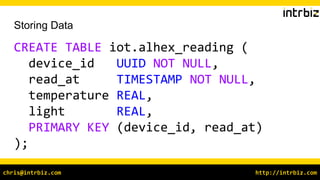
Storing Data
CREATE TABLE iot.alhex_reading (
device_id UUID NOT NULL,
read_at TIMESTAMP NOT NULL,
temperature REAL,
light REAL,
PRIMARY KEY (device_id, read_at)
);
http://intrbiz.com
chris@intrbiz.com
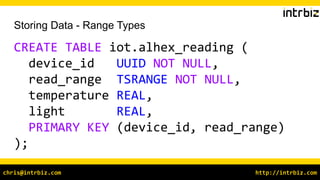
Storing Data - Range Types
CREATE TABLE iot.alhex_reading (
device_id UUID NOT NULL,
read_range TSRANGE NOT NULL,
temperature REAL,
light REAL,
PRIMARY KEY (device_id, read_range)
);
http://intrbiz.com
chris@intrbiz.com
Storing Data - Rolling On Up
CREATE TABLE iot.daily_reading (
meter_id UUID NOT NULL,
read_range DATERANGE NOT NULL,
energy BIGINT,
energy_profile BIGINT[],
PRIMARY KEY (device_id, read_at)
);
http://intrbiz.com
chris@intrbiz.com
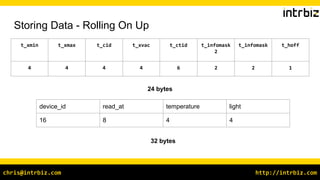
Storing Data - Rolling On Up
t_xmin t_xmax t_cid t_xvac t_ctid t_infomask
2
t_infomask t_hoff
4 4 4 4 6 2 2 1
24 bytes
device_id read_at temperature light
16 8 4 4
32 bytes
http://intrbiz.com
chris@intrbiz.com
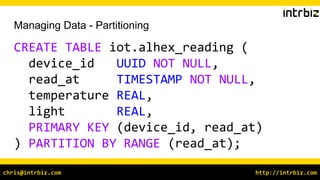
Managing Data - Partitioning
CREATE TABLE iot.alhex_reading (
device_id UUID NOT NULL,
read_at TIMESTAMP NOT NULL,
temperature REAL,
light REAL,
PRIMARY KEY (device_id, read_at)
) PARTITION BY RANGE (read_at);
http://intrbiz.com
chris@intrbiz.com
Managing Data - Partitioning
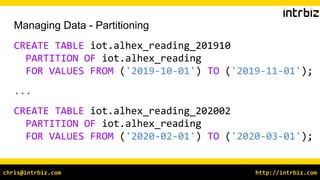
CREATE TABLE iot.alhex_reading_201910
PARTITION OF iot.alhex_reading
FOR VALUES FROM ('2019-10-01') TO ('2019-11-01');
...
CREATE TABLE iot.alhex_reading_202002
PARTITION OF iot.alhex_reading
FOR VALUES FROM ('2020-02-01') TO ('2020-03-01');
http://intrbiz.com
chris@intrbiz.com
Loading Data
http://intrbiz.com
chris@intrbiz.com
Collecting Data - Device ←→ Platform
● Consumer devices might need to be careful of
○ Power, bandwidth constraints
● Devices operating in remote environments
○ Battery, GSM backhaul, reliability, concerns
● Business model
○ IoT products are quite often hero products, one off income (especially in consumer)
○ Yet you have recurring directly coupled costs
● Be selective about how you send data
○ A lot of use cases don’t need low latency real time data feeds
■ Can switch to a fast mode when you need it
○ In the cloud you often get charged per message
■ Cheaper to send 1 big message than lots of small messages
http://intrbiz.com
chris@intrbiz.com
Loading Data - Batching
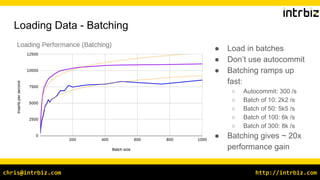
● Load in batches
● Don’t use autocommit
● Batching ramps up
fast:
○ Autocommit: 300 /s
○ Batch of 10: 2k2 /s
○ Batch of 50: 5k5 /s
○ Batch of 100: 6k /s
○ Batch of 300: 8k /s
● Batching gives ~ 20x
performance gain
http://intrbiz.com
chris@intrbiz.com
Loading Data - Batching
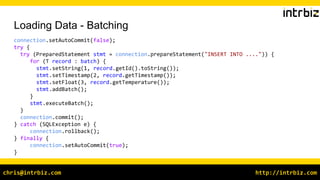
connection.setAutoCommit(false);
try {
try (PreparedStatement stmt = connection.prepareStatement("INSERT INTO ....")) {
for (T record : batch) {
stmt.setString(1, record.getId().toString());
stmt.setTimestamp(2, record.getTimestamp());
stmt.setFloat(3, record.getTemperature());
stmt.addBatch();
}
stmt.executeBatch();
}
connection.commit();
} catch (SQLException e) {
connection.rollback();
} finally {
connection.setAutoCommit(true);
}
http://intrbiz.com
chris@intrbiz.com
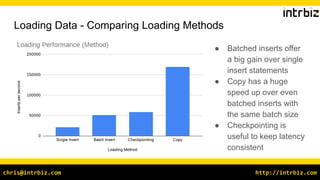
Loading Data - Comparing Loading Methods
● Batched inserts offer
a big gain over single
insert statements
● Copy has a huge
speed up over even
batched inserts with
the same batch size
● Checkpointing is
useful to keep latency
consistent
http://intrbiz.com
chris@intrbiz.com
Loading Data - Never Sleeping
● IoT data is often constant, never sleeping, never lets up
○ Also insert / append only doesn’t trigger AutoVac, your tables don’t get ANALYSEd
■ Where PostgreSQL.version < 13
● This really stresses replication
○ Regardless of sync vs async replication
○ You need to ensure that your replicas can keep up with the constant torrent of data
■ Replication replay is single threaded, this can have a huge impact on lagging
● PG 14 should have improvement around this
● You don’t really get your nightly maintenance window
○ Need to be careful with backups
○ Maintenance jobs might need more planning
http://intrbiz.com
chris@intrbiz.com
Loading Data - When Thing Go Wrong
● Devices should skew times and back off when things go wrong
○ Can be very easy to trigger congestive collapse
■ Only needs a minor trigger
○ Don’t forget this is more about comms, rather than sampling time
● Your devices should still do sensible things without your platform
● Your data loading system should throttle inserts
○ Don’t want impact of devices taking your DB out, and thus most of the platform
○ It’s probably better to drop data or buffer more than fall flat on your face
http://intrbiz.com
chris@intrbiz.com
Processing Data
http://intrbiz.com
chris@intrbiz.com
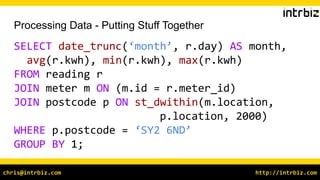
Processing Data - Putting Stuff Together
SELECT date_trunc(‘month’, r.day) AS month,
avg(r.kwh), min(r.kwh), max(r.kwh)
FROM reading r
JOIN meter m ON (m.id = r.meter_id)
JOIN postcode p ON st_dwithin(m.location,
p.location, 2000)
WHERE p.postcode = ‘SY2 6ND’
GROUP BY 1;
http://intrbiz.com
chris@intrbiz.com
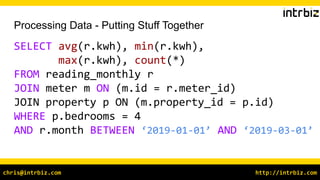
Processing Data - Putting Stuff Together
SELECT avg(r.kwh), min(r.kwh),
max(r.kwh), count(*)
FROM reading_monthly r
JOIN meter m ON (m.id = r.meter_id)
JOIN property p ON (m.property_id = p.id)
WHERE p.bedrooms = 4
AND r.month BETWEEN ‘2019-01-01’ AND ‘2019-03-01’
http://intrbiz.com
chris@intrbiz.com
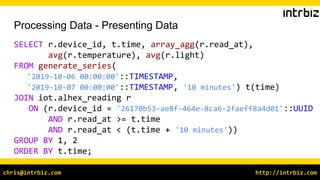
Processing Data - Presenting Data
SELECT r.device_id, t.time, array_agg(r.read_at),
avg(r.temperature), avg(r.light)
FROM generate_series(
'2019-10-06 00:00:00'::TIMESTAMP,
'2019-10-07 00:00:00'::TIMESTAMP, '10 minutes') t(time)
JOIN iot.alhex_reading r
ON (r.device_id = '26170b53-ae8f-464e-8ca6-2faeff8a4d01'::UUID
AND r.read_at >= t.time
AND r.read_at < (t.time + '10 minutes'))
GROUP BY 1, 2
ORDER BY t.time;
http://intrbiz.com
chris@intrbiz.com
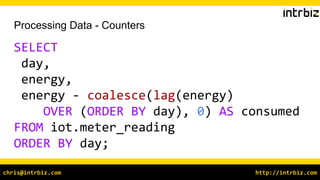
Processing Data - Counters
SELECT
day,
energy,
energy - coalesce(lag(energy)
OVER (ORDER BY day), 0) AS consumed
FROM iot.meter_reading
ORDER BY day;
http://intrbiz.com
chris@intrbiz.com
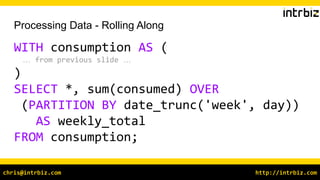
Processing Data - Rolling Along
WITH consumption AS (
… from previous slide …
)
SELECT *, sum(consumed) OVER
(PARTITION BY date_trunc('week', day))
AS weekly_total
FROM consumption;
http://intrbiz.com
chris@intrbiz.com
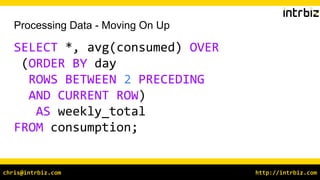
Processing Data - Moving On Up
SELECT *, avg(consumed) OVER
(ORDER BY day
ROWS BETWEEN 2 PRECEDING
AND CURRENT ROW)
AS weekly_total
FROM consumption;
http://intrbiz.com
chris@intrbiz.com
Processing Data - Mind The Gap!
http://intrbiz.com
chris@intrbiz.com
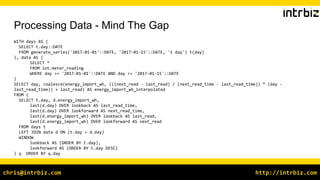
Processing Data - Mind The Gap
WITH days AS (
SELECT t.day::DATE
FROM generate_series('2017-01-01'::DATE, '2017-01-15'::DATE, '1 day') t(day)
), data AS (
SELECT *
FROM iot.meter_reading
WHERE day >= '2017-01-01'::DATE AND day <= '2017-01-15'::DATE
)
SELECT day, coalesce(energy_import_wh, (((next_read - last_read) / (next_read_time - last_read_time)) * (day -
last_read_time)) + last_read) AS energy_import_wh_interpolated
FROM (
SELECT t.day, d.energy_import_wh,
last(d.day) OVER lookback AS last_read_time,
last(d.day) OVER lookforward AS next_read_time,
last(d.energy_import_wh) OVER lookback AS last_read,
last(d.energy_import_wh) OVER lookforward AS next_read
FROM days t
LEFT JOIN data d ON (t.day = d.day)
WINDOW
lookback AS (ORDER BY t.day),
lookforward AS (ORDER BY t.day DESC)
) q ORDER BY q.day
http://intrbiz.com
chris@intrbiz.com
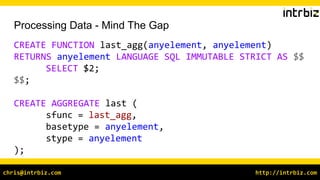
Processing Data - Mind The Gap
CREATE FUNCTION last_agg(anyelement, anyelement)
RETURNS anyelement LANGUAGE SQL IMMUTABLE STRICT AS $$
SELECT $2;
$$;
CREATE AGGREGATE last (
sfunc = last_agg,
basetype = anyelement,
stype = anyelement
);
http://intrbiz.com
chris@intrbiz.com
Processing Data - Mind The Gap
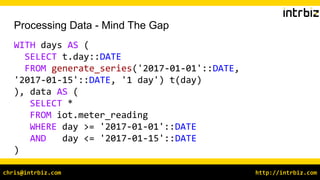
WITH days AS (
SELECT t.day::DATE
FROM generate_series('2017-01-01'::DATE,
'2017-01-15'::DATE, '1 day') t(day)
), data AS (
SELECT *
FROM iot.meter_reading
WHERE day >= '2017-01-01'::DATE
AND day <= '2017-01-15'::DATE
)
http://intrbiz.com
chris@intrbiz.com
Processing Data - Mind The Gap
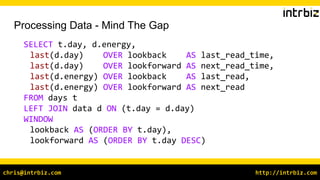
SELECT t.day, d.energy,
last(d.day) OVER lookback AS last_read_time,
last(d.day) OVER lookforward AS next_read_time,
last(d.energy) OVER lookback AS last_read,
last(d.energy) OVER lookforward AS next_read
FROM days t
LEFT JOIN data d ON (t.day = d.day)
WINDOW
lookback AS (ORDER BY t.day),
lookforward AS (ORDER BY t.day DESC)
http://intrbiz.com
chris@intrbiz.com
Processing Data - Mind The Gap
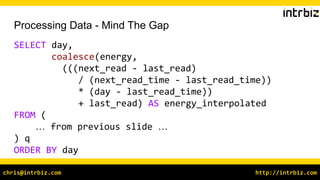
SELECT day,
coalesce(energy,
(((next_read - last_read)
/ (next_read_time - last_read_time))
* (day - last_read_time))
+ last_read) AS energy_interpolated
FROM (
… from previous slide …
) q
ORDER BY day
http://intrbiz.com
chris@intrbiz.com
Extensions - TimescaleDB
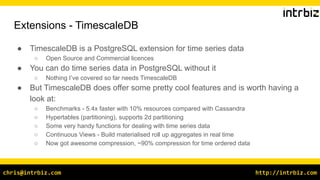
● TimescaleDB is a PostgreSQL extension for time series data
○ Open Source and Commercial licences
● You can do time series data in PostgreSQL without it
○ Nothing I’ve covered so far needs TimescaleDB
● But TimescaleDB does offer some pretty cool features and is worth having a
look at:
○ Benchmarks - 5.4x faster with 10% resources compared with Cassandra
○ Hypertables (partitioning), supports 2d partitioning
○ Some very handy functions for dealing with time series data
○ Continuous Views - Build materialised roll up aggregates in real time
○ Now got awesome compression, ~90% compression for time ordered data
http://intrbiz.com
chris@intrbiz.com
So Long And Thanks For All The Fish
● Thanks for listening
○ I hope I didn’t bore you too much
● Questions?

IOT with PostgreSQL

  • 1.
    http://intrbiz.com chris@intrbiz.com PostgreSQL for IoT ChrisEllis - @intrbiz The Internet Of Strange Things Postgres London - 2021 - Virtual
  • 2.
    http://intrbiz.com chris@intrbiz.com Hello! ● I’m Chris ○IT jack of all trades, studied Electronic Engineering ● Been using PostgreSQL for about 15 years ● Very much into Open Source ○ Started Bergamot Monitoring - open distributed monitoring ● Worked on various PostgreSQL systems ○ Connected TV Set top boxes ○ Smart energy meter analytics ○ IoT Kanban Board ○ IoT CHP Engines ○ Mixes of OLTP and OLAP workloads ○ Scaled PostgreSQL in various ways for various situations
  • 3.
  • 4.
  • 5.
  • 6.
  • 7.
    http://intrbiz.com chris@intrbiz.com Why PostgreSQL andnot some Time-series DB? ● The same reason I constantly go back to PostgreSQL ○ We don’t call it the `world’s most advanced Open Source relational database` without just cause ○ It’s flexible ○ It’s extensible ○ It puts up with you ○ It cares ● IoT is not a simple, one size fits all problem ○ It’s not just time series data ○ I find single solution data stores, a bit, pointless ○ Why learn some new, single use, crap query language
  • 8.
    http://intrbiz.com chris@intrbiz.com Why PostgreSQL andnot some Time-series DB? ● PostgreSQL makes it easy to combine your time series data with other data ○ You know: a join! ● Find me the average energy consumption of Shropshire? ● Find me the average energy consumption for 4 bed houses during the summer? ● Find me the average, min, max energy consumption for 4 bed houses during summer in Shropshire for a half hourly period? ● Which city has the highest average energy consumption?
  • 9.
  • 10.
    http://intrbiz.com chris@intrbiz.com Storing Data CREATE TABLEiot.alhex_reading ( device_id UUID NOT NULL, read_at TIMESTAMP NOT NULL, temperature REAL, light REAL, PRIMARY KEY (device_id, read_at) );
  • 11.
    http://intrbiz.com chris@intrbiz.com Storing Data -Range Types CREATE TABLE iot.alhex_reading ( device_id UUID NOT NULL, read_range TSRANGE NOT NULL, temperature REAL, light REAL, PRIMARY KEY (device_id, read_range) );
  • 12.
    http://intrbiz.com chris@intrbiz.com Storing Data -Rolling On Up CREATE TABLE iot.daily_reading ( meter_id UUID NOT NULL, read_range DATERANGE NOT NULL, energy BIGINT, energy_profile BIGINT[], PRIMARY KEY (device_id, read_at) );
  • 13.
    http://intrbiz.com chris@intrbiz.com Storing Data -Rolling On Up t_xmin t_xmax t_cid t_xvac t_ctid t_infomask 2 t_infomask t_hoff 4 4 4 4 6 2 2 1 24 bytes device_id read_at temperature light 16 8 4 4 32 bytes
  • 14.
    http://intrbiz.com chris@intrbiz.com Managing Data -Partitioning CREATE TABLE iot.alhex_reading ( device_id UUID NOT NULL, read_at TIMESTAMP NOT NULL, temperature REAL, light REAL, PRIMARY KEY (device_id, read_at) ) PARTITION BY RANGE (read_at);
  • 15.
    http://intrbiz.com chris@intrbiz.com Managing Data -Partitioning CREATE TABLE iot.alhex_reading_201910 PARTITION OF iot.alhex_reading FOR VALUES FROM ('2019-10-01') TO ('2019-11-01'); ... CREATE TABLE iot.alhex_reading_202002 PARTITION OF iot.alhex_reading FOR VALUES FROM ('2020-02-01') TO ('2020-03-01');
  • 16.
  • 17.
    http://intrbiz.com chris@intrbiz.com Collecting Data -Device ←→ Platform ● Consumer devices might need to be careful of ○ Power, bandwidth constraints ● Devices operating in remote environments ○ Battery, GSM backhaul, reliability, concerns ● Business model ○ IoT products are quite often hero products, one off income (especially in consumer) ○ Yet you have recurring directly coupled costs ● Be selective about how you send data ○ A lot of use cases don’t need low latency real time data feeds ■ Can switch to a fast mode when you need it ○ In the cloud you often get charged per message ■ Cheaper to send 1 big message than lots of small messages
  • 18.
    http://intrbiz.com chris@intrbiz.com Loading Data -Batching ● Load in batches ● Don’t use autocommit ● Batching ramps up fast: ○ Autocommit: 300 /s ○ Batch of 10: 2k2 /s ○ Batch of 50: 5k5 /s ○ Batch of 100: 6k /s ○ Batch of 300: 8k /s ● Batching gives ~ 20x performance gain
  • 19.
    http://intrbiz.com chris@intrbiz.com Loading Data -Batching connection.setAutoCommit(false); try { try (PreparedStatement stmt = connection.prepareStatement("INSERT INTO ....")) { for (T record : batch) { stmt.setString(1, record.getId().toString()); stmt.setTimestamp(2, record.getTimestamp()); stmt.setFloat(3, record.getTemperature()); stmt.addBatch(); } stmt.executeBatch(); } connection.commit(); } catch (SQLException e) { connection.rollback(); } finally { connection.setAutoCommit(true); }
  • 20.
    http://intrbiz.com chris@intrbiz.com Loading Data -Comparing Loading Methods ● Batched inserts offer a big gain over single insert statements ● Copy has a huge speed up over even batched inserts with the same batch size ● Checkpointing is useful to keep latency consistent
  • 21.
    http://intrbiz.com chris@intrbiz.com Loading Data -Never Sleeping ● IoT data is often constant, never sleeping, never lets up ○ Also insert / append only doesn’t trigger AutoVac, your tables don’t get ANALYSEd ■ Where PostgreSQL.version < 13 ● This really stresses replication ○ Regardless of sync vs async replication ○ You need to ensure that your replicas can keep up with the constant torrent of data ■ Replication replay is single threaded, this can have a huge impact on lagging ● PG 14 should have improvement around this ● You don’t really get your nightly maintenance window ○ Need to be careful with backups ○ Maintenance jobs might need more planning
  • 22.
    http://intrbiz.com chris@intrbiz.com Loading Data -When Thing Go Wrong ● Devices should skew times and back off when things go wrong ○ Can be very easy to trigger congestive collapse ■ Only needs a minor trigger ○ Don’t forget this is more about comms, rather than sampling time ● Your devices should still do sensible things without your platform ● Your data loading system should throttle inserts ○ Don’t want impact of devices taking your DB out, and thus most of the platform ○ It’s probably better to drop data or buffer more than fall flat on your face
  • 23.
  • 24.
    http://intrbiz.com chris@intrbiz.com Processing Data -Putting Stuff Together SELECT date_trunc(‘month’, r.day) AS month, avg(r.kwh), min(r.kwh), max(r.kwh) FROM reading r JOIN meter m ON (m.id = r.meter_id) JOIN postcode p ON st_dwithin(m.location, p.location, 2000) WHERE p.postcode = ‘SY2 6ND’ GROUP BY 1;
  • 25.
    http://intrbiz.com chris@intrbiz.com Processing Data -Putting Stuff Together SELECT avg(r.kwh), min(r.kwh), max(r.kwh), count(*) FROM reading_monthly r JOIN meter m ON (m.id = r.meter_id) JOIN property p ON (m.property_id = p.id) WHERE p.bedrooms = 4 AND r.month BETWEEN ‘2019-01-01’ AND ‘2019-03-01’
  • 26.
    http://intrbiz.com chris@intrbiz.com Processing Data -Presenting Data SELECT r.device_id, t.time, array_agg(r.read_at), avg(r.temperature), avg(r.light) FROM generate_series( '2019-10-06 00:00:00'::TIMESTAMP, '2019-10-07 00:00:00'::TIMESTAMP, '10 minutes') t(time) JOIN iot.alhex_reading r ON (r.device_id = '26170b53-ae8f-464e-8ca6-2faeff8a4d01'::UUID AND r.read_at >= t.time AND r.read_at < (t.time + '10 minutes')) GROUP BY 1, 2 ORDER BY t.time;
  • 27.
    http://intrbiz.com chris@intrbiz.com Processing Data -Counters SELECT day, energy, energy - coalesce(lag(energy) OVER (ORDER BY day), 0) AS consumed FROM iot.meter_reading ORDER BY day;
  • 28.
    http://intrbiz.com chris@intrbiz.com Processing Data -Rolling Along WITH consumption AS ( … from previous slide … ) SELECT *, sum(consumed) OVER (PARTITION BY date_trunc('week', day)) AS weekly_total FROM consumption;
  • 29.
    http://intrbiz.com chris@intrbiz.com Processing Data -Moving On Up SELECT *, avg(consumed) OVER (ORDER BY day ROWS BETWEEN 2 PRECEDING AND CURRENT ROW) AS weekly_total FROM consumption;
  • 30.
  • 31.
    http://intrbiz.com chris@intrbiz.com Processing Data -Mind The Gap WITH days AS ( SELECT t.day::DATE FROM generate_series('2017-01-01'::DATE, '2017-01-15'::DATE, '1 day') t(day) ), data AS ( SELECT * FROM iot.meter_reading WHERE day >= '2017-01-01'::DATE AND day <= '2017-01-15'::DATE ) SELECT day, coalesce(energy_import_wh, (((next_read - last_read) / (next_read_time - last_read_time)) * (day - last_read_time)) + last_read) AS energy_import_wh_interpolated FROM ( SELECT t.day, d.energy_import_wh, last(d.day) OVER lookback AS last_read_time, last(d.day) OVER lookforward AS next_read_time, last(d.energy_import_wh) OVER lookback AS last_read, last(d.energy_import_wh) OVER lookforward AS next_read FROM days t LEFT JOIN data d ON (t.day = d.day) WINDOW lookback AS (ORDER BY t.day), lookforward AS (ORDER BY t.day DESC) ) q ORDER BY q.day
  • 32.
    http://intrbiz.com chris@intrbiz.com Processing Data -Mind The Gap CREATE FUNCTION last_agg(anyelement, anyelement) RETURNS anyelement LANGUAGE SQL IMMUTABLE STRICT AS $$ SELECT $2; $$; CREATE AGGREGATE last ( sfunc = last_agg, basetype = anyelement, stype = anyelement );
  • 33.
    http://intrbiz.com chris@intrbiz.com Processing Data -Mind The Gap WITH days AS ( SELECT t.day::DATE FROM generate_series('2017-01-01'::DATE, '2017-01-15'::DATE, '1 day') t(day) ), data AS ( SELECT * FROM iot.meter_reading WHERE day >= '2017-01-01'::DATE AND day <= '2017-01-15'::DATE )
  • 34.
    http://intrbiz.com chris@intrbiz.com Processing Data -Mind The Gap SELECT t.day, d.energy, last(d.day) OVER lookback AS last_read_time, last(d.day) OVER lookforward AS next_read_time, last(d.energy) OVER lookback AS last_read, last(d.energy) OVER lookforward AS next_read FROM days t LEFT JOIN data d ON (t.day = d.day) WINDOW lookback AS (ORDER BY t.day), lookforward AS (ORDER BY t.day DESC)
  • 35.
    http://intrbiz.com chris@intrbiz.com Processing Data -Mind The Gap SELECT day, coalesce(energy, (((next_read - last_read) / (next_read_time - last_read_time)) * (day - last_read_time)) + last_read) AS energy_interpolated FROM ( … from previous slide … ) q ORDER BY day
  • 36.
    http://intrbiz.com chris@intrbiz.com Extensions - TimescaleDB ●TimescaleDB is a PostgreSQL extension for time series data ○ Open Source and Commercial licences ● You can do time series data in PostgreSQL without it ○ Nothing I’ve covered so far needs TimescaleDB ● But TimescaleDB does offer some pretty cool features and is worth having a look at: ○ Benchmarks - 5.4x faster with 10% resources compared with Cassandra ○ Hypertables (partitioning), supports 2d partitioning ○ Some very handy functions for dealing with time series data ○ Continuous Views - Build materialised roll up aggregates in real time ○ Now got awesome compression, ~90% compression for time ordered data
  • 37.
    http://intrbiz.com chris@intrbiz.com So Long AndThanks For All The Fish ● Thanks for listening ○ I hope I didn’t bore you too much ● Questions?