Michael Desa - Engineering Manager
Intro to InfluxDB
© InfluxData. All rights reserved.
Agenda
By the end of this session, participants should be able to…
● Describe time-series data
● Explain what InfluxDB is in relation to InfluxData
● Understand the InfluxDB Data Model
● Differentiate the Data Model for .x and .x
● Reason about schema decisions
© InfluxData. All rights reserved.
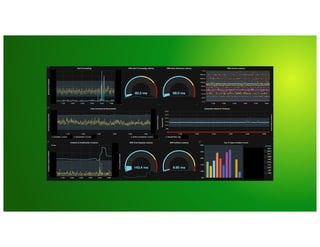
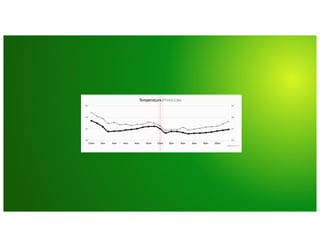
What is time-series data?
© InfluxData. All rights reserved.
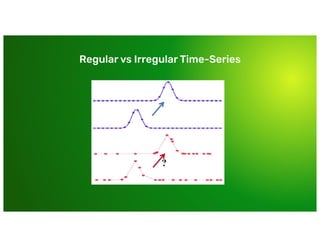
Regular vs Irregular Time-Series
© InfluxData. All rights reserved.
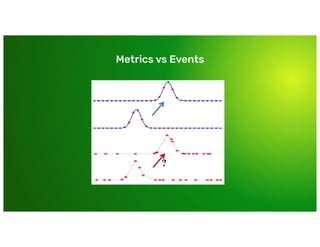
Metrics vs Events
© InfluxData. All rights reserved.
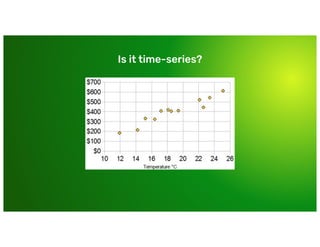
Is it time-series?
© InfluxData. All rights reserved.
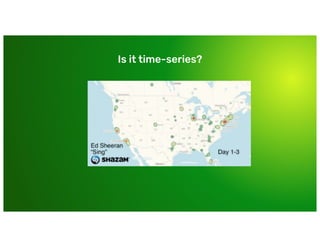
Is it time-series?
© InfluxData. All rights reserved.
Is it time-series?
© InfluxData. All rights reserved.
Is it time-series?
© InfluxData. All rights reserved.
What is a time-series database
(tsdb)
© InfluxData. All rights reserved.
What is a time-series database
(tsdb)
© InfluxData. All rights reserved.
Time-Series Database
● A database where you manage and store
time-series data
● Efficiently handles time-series data
● Supports common time-series data patterns
○ Data retention enforcement
○ Time-based queries
© InfluxData. All rights reserved.
Time-Series Database
● A database where you manage and store
time-series data
● Efficiently handles time-series data
● Supports common time-series data patterns
○ Data retention enforcement
○ Time-based queries
© InfluxData. All rights reserved.© InfluxData. All rights reserved.
© InfluxData. All rights reserved.
Why couldn’t I just use [...]
© InfluxData. All rights reserved.
Why couldn’t I just use [...]
© InfluxData. All rights reserved.
Time-Series is not just a
database problem
© InfluxData. All rights reserved.
Time-Series is not just a
database problem
© InfluxData. All rights reserved.
Time-Series Problems
● Visualize you time-series
● Monitor & Alert on your time-series
● Process your time-series
© InfluxData. All rights reserved.
Time-Series Problems
● Visualize you time-series
● Monitor & Alert on your time-series
● Process your time-series
© InfluxData. All rights reserved.
What is InfluxData/InfluxDB
© InfluxData. All rights reserved.
What is InfluxData/InfluxDB
© InfluxData. All rights reserved.
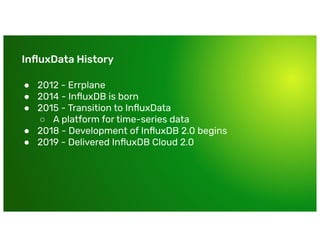
InfluxData History
● - Errplane
● - InfluxDB is born
● - Transition to InfluxData
○ A platform for time-series data
● - Development of InfluxDB . begins
● - Delivered InfluxDB Cloud .
© InfluxData. All rights reserved.
InfluxData History
● - Errplane
● - InfluxDB is born
● - Transition to InfluxData
○ A platform for time-series data
● - Development of InfluxDB . begins
● - Delivered InfluxDB Cloud .
© InfluxData. All rights reserved.
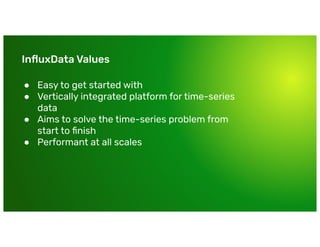
InfluxData Values
● Easy to get started with
● Vertically integrated platform for time-series
data
● Aims to solve the time-series problem from
start to finish
● Performant at all scales
© InfluxData. All rights reserved.
InfluxData Values
● Easy to get started with
● Vertically integrated platform for time-series
data
● Aims to solve the time-series problem from
start to finish
● Performant at all scales
InfluxDB Data ModelInfluxDB Data Model
© InfluxData. All rights reserved.
Canonical Time-Series Line Graph
© InfluxData. All rights reserved.
Canonical Time-Series Line Graph
© InfluxData. All rights reserved.
The Measurement (Label)
© InfluxData. All rights reserved.
The Measurement (Label)
© InfluxData. All rights reserved.
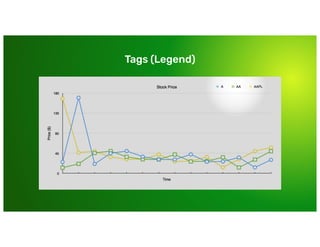
Tags (Legend)
© InfluxData. All rights reserved.
Tags (Legend)
© InfluxData. All rights reserved.
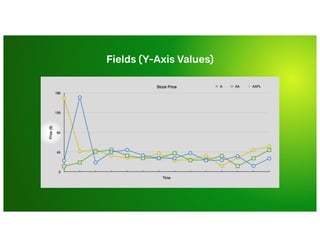
Fields (Y-Axis Values)
© InfluxData. All rights reserved.
Fields (Y-Axis Values)
© InfluxData. All rights reserved.
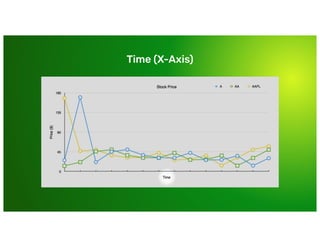
Time (X-Axis)
© InfluxData. All rights reserved.
Time (X-Axis)
© InfluxData. All rights reserved.
Series
stock_price,ticker=A,market=NASDAQ
© InfluxData. All rights reserved.
Series
stock_price,ticker=A,market=NASDAQ
© InfluxData. All rights reserved.
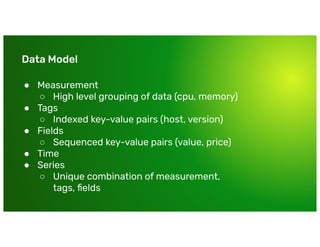
Data Model
● Measurement
○ High level grouping of data (cpu, memory)
● Tags
○ Indexed key-value pairs (host, version)
● Fields
○ Sequenced key-value pairs (value, price)
● Time
● Series
○ Unique combination of measurement,
tags, fields
© InfluxData. All rights reserved.
Data Model
● Measurement
○ High level grouping of data (cpu, memory)
● Tags
○ Indexed key-value pairs (host, version)
● Fields
○ Sequenced key-value pairs (value, price)
● Time
● Series
○ Unique combination of measurement,
tags, fields
© InfluxData. All rights reserved.
How do we express the data?
© InfluxData. All rights reserved.
How do we express the data?
© InfluxData. All rights reserved.
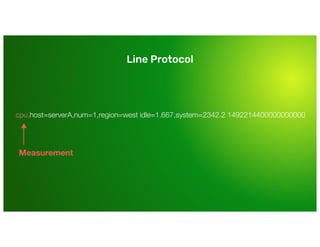
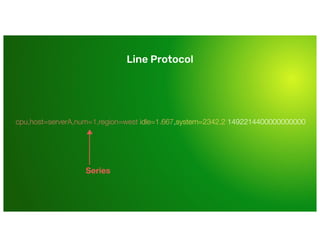
Line Protocol
cpu,host=serverA,num=1,region=west idle=1.667,system=2342.2 1492214400000000000
Measurement
© InfluxData. All rights reserved.
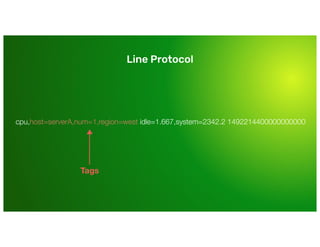
Line Protocol
cpu,host=serverA,num=1,region=west idle=1.667,system=2342.2 1492214400000000000
Tags
© InfluxData. All rights reserved.
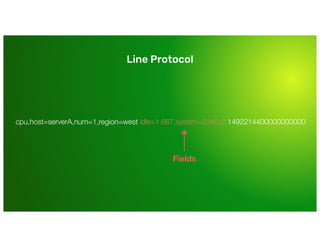
Line Protocol
cpu,host=serverA,num=1,region=west idle=1.667,system=2342.2 1492214400000000000
Fields
© InfluxData. All rights reserved.
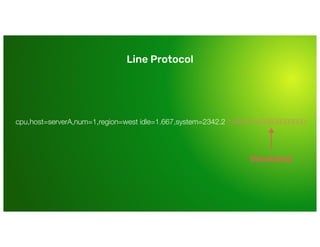
Line Protocol
cpu,host=serverA,num=1,region=west idle=1.667,system=2342.2 1492214400000000000
timestamp
© InfluxData. All rights reserved.
Line Protocol
cpu,host=serverA,num=1,region=west idle=1.667,system=2342.2 1492214400000000000
Series
© InfluxData. All rights reserved.
Line Protocol
cpu,host=serverA,num=1,region=west idle=1.667,system=2342.2 1492214400000000000
Series
© InfluxData. All rights reserved.
Where is the time-series data stored?
© InfluxData. All rights reserved.
Where is the time-series data stored?
© InfluxData. All rights reserved.
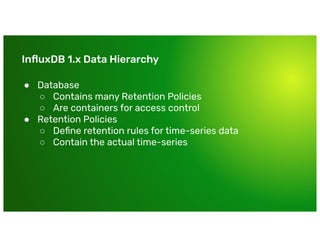
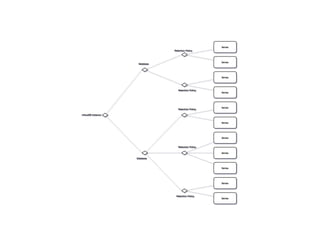
InfluxDB 1.x Data Hierarchy
● Database
○ Contains many Retention Policies
○ Are containers for access control
● Retention Policies
○ Define retention rules for time-series data
○ Contain the actual time-series
© InfluxData. All rights reserved.
InfluxDB 1.x Data Hierarchy
● Database
○ Contains many Retention Policies
○ Are containers for access control
● Retention Policies
○ Define retention rules for time-series data
○ Contain the actual time-series
© InfluxData. All rights reserved.
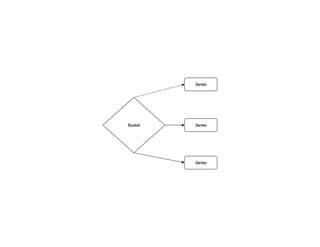
InfluxDB 2.0 Data Hierarchy
● Buckets
○ Are containers for access control
○ Define retention rules for time-series data
○ Contain the actual time-series
© InfluxData. All rights reserved.
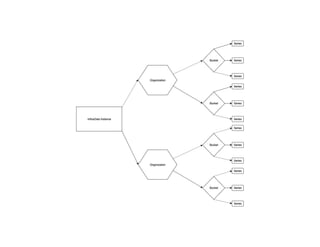
InfluxDB 2.0 Instance Hierarchy
● Organizations
○ Logical groupings of resources
○ Contain Buckets, Dashboards, Tasks, etc...
● Buckets
○ Are containers for access control
○ Define retention rules for time-series data
○ Contain the actual time-series
© InfluxData. All rights reserved.
Querying DataQuerying Data
© InfluxData. All rights reserved.
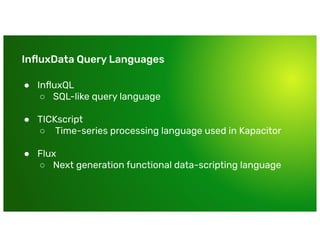
InfluxData Query Languages
● InfluxQL
○ SQL-like query language
● TICKscript
○ Time-series processing language used in Kapacitor
● Flux
○ Next generation functional data-scripting language
© InfluxData. All rights reserved.
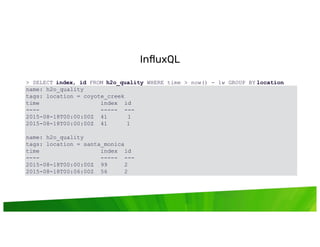
InfluxQL
> SELECT index, id FROM h2o_quality WHERE time > now() - 1w GROUP BY location
name: h2o_quality
tags: location = coyote_creek
time index id
---- ----- ---
2015-08-18T00:00:00Z 41 1
name: h2o_quality
tags: location = santa_monica
time index id
---- ----- ---
2015-08-18T00:00:00Z 99 2
2015-08-18T00:06:00Z 56 2
© InfluxData. All rights reserved.
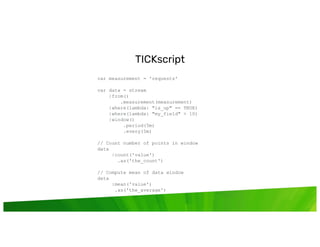
TICKscript
var measurement = 'requests'
var data = stream
|from()
.measurement(measurement)
|where(lambda: "is_up" == TRUE)
|where(lambda: "my_field" > 10)
|window()
.period(5m)
.every(5m)
// Count number of points in window
data
|count('value')
.as('the_count')
// Compute mean of data window
data
|mean('value')
.as('the_average')
© InfluxData. All rights reserved.
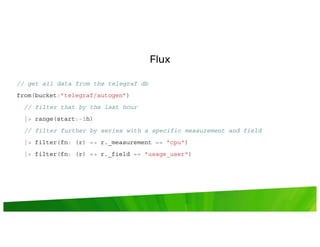
Flux
// get all data from the telegraf db
from(bucket:”telegraf/autogen”)
// filter that by the last hour
|> range(start:-1h)
// filter further by series with a specific measurement and field
|> filter(fn: (r) => r._measurement == "cpu")
|> filter(fn: (r) => r._field == "usage_user")
© InfluxData. All rights reserved.
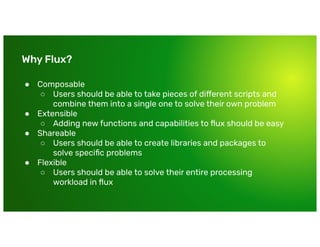
Why Flux?
● Composable
○ Users should be able to take pieces of different scripts and
combine them into a single one to solve their own problem
● Extensible
○ Adding new functions and capabilities to flux should be easy
● Shareable
○ Users should be able to create libraries and packages to
solve specific problems
● Flexible
○ Users should be able to solve their entire processing
workload in flux
© InfluxData. All rights reserved.
Why Flux?
● Composable
○ Users should be able to take pieces of different scripts and
combine them into a single one to solve their own problem
● Extensible
○ Adding new functions and capabilities to flux should be easy
● Shareable
○ Users should be able to create libraries and packages to
solve specific problems
● Flexible
○ Users should be able to solve their entire processing
workload in flux
What not to do
Schema Design
What not to do
Schema Design
© InfluxData. All rights reserved.
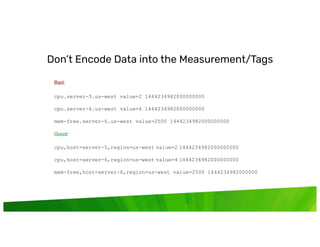
Don’t Encode Data into the Measurement/Tags
Bad:
cpu.server-5.us-west value=2 1444234982000000000
cpu.server-6.us-west value=4 1444234982000000000
mem-free.server-6.us-west value=2500 1444234982000000000
Good:
cpu,host=server-5,region=us-west value=2 1444234982000000000
cpu,host=server-6,region=us-west value=4 1444234982000000000
mem-free,host=server-6,region=us-west value=2500 1444234982000000
© InfluxData. All rights reserved.
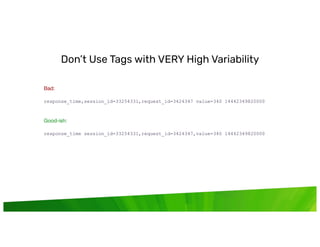
Don’t Use Tags with VERY High Variability
Bad:
response_time,session_id=33254331,request_id=3424347 value=340 14442349820000
Good-ish:
response_time session_id=33254331,request_id=3424347,value=340 14442349820000
© InfluxData. All rights reserved.
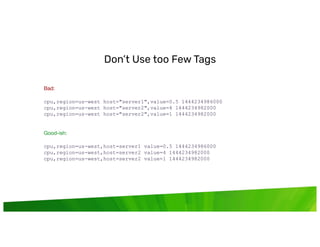
Don’t Use too Few Tags
Bad:
cpu,region=us-west host="server1",value=0.5 1444234986000
cpu,region=us-west host="server2",value=4 1444234982000
cpu,region=us-west host="server2",value=1 1444234982000
Good-ish:
cpu,region=us-west,host=server1 value=0.5 1444234986000
cpu,region=us-west,host=server2 value=4 1444234982000
cpu,region=us-west,host=server2 value=1 1444234982000
© InfluxData. All rights reserved.
What should I do?
© InfluxData. All rights reserved.
What should I do?
© InfluxData. All rights reserved.
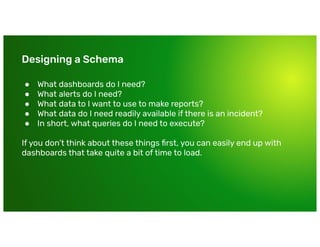
Designing a Schema
● What dashboards do I need?
● What alerts do I need?
● What data to I want to use to make reports?
● What data do I need readily available if there is an incident?
● In short, what queries do I need to execute?
If you don’t think about these things first, you can easily end up with
dashboards that take quite a bit of time to load.
© InfluxData. All rights reserved.
Designing a Schema
● What dashboards do I need?
● What alerts do I need?
● What data to I want to use to make reports?
● What data do I need readily available if there is an incident?
● In short, what queries do I need to execute?
If you don’t think about these things first, you can easily end up with
dashboards that take quite a bit of time to load.
© InfluxData. All rights reserved.
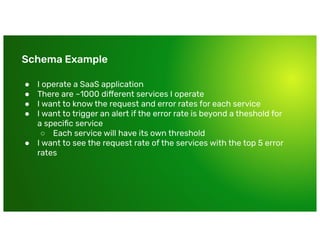
Schema Example
● I operate a SaaS application
● There are ~ different services I operate
● I want to know the request and error rates for each service
● I want to trigger an alert if the error rate is beyond a theshold for
a specific service
○ Each service will have its own threshold
● I want to see the request rate of the services with the top error
rates
© InfluxData. All rights reserved.
Schema Example
● I operate a SaaS application
● There are ~ different services I operate
● I want to know the request and error rates for each service
● I want to trigger an alert if the error rate is beyond a theshold for
a specific service
○ Each service will have its own threshold
● I want to see the request rate of the services with the top error
rates
© InfluxData. All rights reserved.
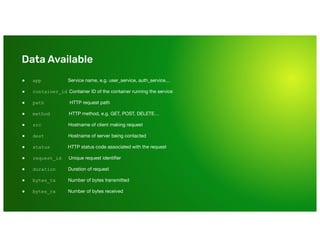
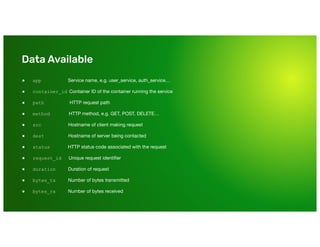
Data Available
● app Service name, e.g. user_service, auth_service…
● container_id Container ID of the container running the service
● path HTTP request path
● method HTTP method, e.g. GET, POST, DELETE…
● src Hostname of client making request
● dest Hostname of server being contacted
● status HTTP status code associated with the request
● request_id Unique request identifier
● duration Duration of request
● bytes_tx Number of bytes transmitted
● bytes_rx Number of bytes received
© InfluxData. All rights reserved.
Data Available
● app Service name, e.g. user_service, auth_service…
● container_id Container ID of the container running the service
● path HTTP request path
● method HTTP method, e.g. GET, POST, DELETE…
● src Hostname of client making request
● dest Hostname of server being contacted
● status HTTP status code associated with the request
● request_id Unique request identifier
● duration Duration of request
● bytes_tx Number of bytes transmitted
● bytes_rx Number of bytes received
© InfluxData. All rights reserved.
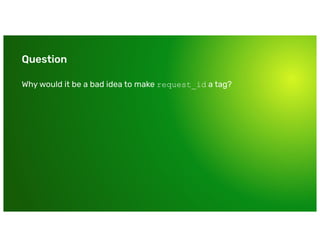
Question
Why would it be a bad idea to make request_id a tag?
© InfluxData. All rights reserved.
Question
Why would it be a bad idea to make request_id a tag?
© InfluxData. All rights reserved.
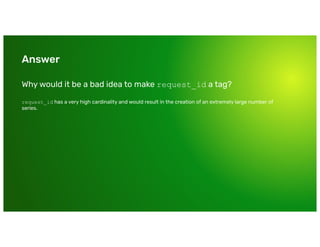
Answer
Why would it be a bad idea to make request_id a tag?
request_id has a very high cardinality and would result in the creation of an extremely large number of
series.
© InfluxData. All rights reserved.
Question
How should we organize our data?
© InfluxData. All rights reserved.
Data Available
● app Service name, e.g. user_service, auth_service…
● container_id Container ID of the container running the service
● path HTTP request path
● method HTTP method, e.g. GET, POST, DELETE…
● src Hostname of client making request
● dest Hostname of server being contacted
● status HTTP status code associated with the request
● request_id Unique request identifier
● duration Duration of request
● bytes_tx Number of bytes transmitted
● bytes_rx Number of bytes received
© InfluxData. All rights reserved.
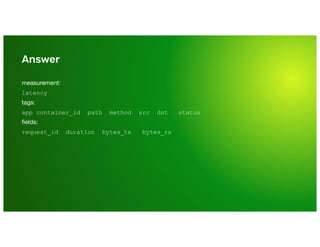
Answer
measurement:
latency
tags:
app container_id path method src dst status
fields:
request_id duration bytes_tx bytes_rx
Thank You!Thank You!Thank You!Thank You!Thank You!Thank You!Thank You!

InfluxDB 101 - Concepts and Architecture | Michael DeSa | InfluxData

  • 1.
    Michael Desa -Engineering Manager Intro to InfluxDB
  • 2.
    © InfluxData. Allrights reserved. Agenda By the end of this session, participants should be able to… ● Describe time-series data ● Explain what InfluxDB is in relation to InfluxData ● Understand the InfluxDB Data Model ● Differentiate the Data Model for .x and .x ● Reason about schema decisions
  • 3.
    © InfluxData. Allrights reserved. What is time-series data?
  • 4.
    © InfluxData. Allrights reserved.
  • 5.
    © InfluxData. Allrights reserved.
  • 6.
    © InfluxData. Allrights reserved.
  • 7.
    © InfluxData. Allrights reserved.
  • 8.
    © InfluxData. Allrights reserved. Regular vs Irregular Time-Series
  • 9.
    © InfluxData. Allrights reserved. Metrics vs Events
  • 10.
    © InfluxData. Allrights reserved. Is it time-series? © InfluxData. All rights reserved. Is it time-series?
  • 11.
    © InfluxData. Allrights reserved. Is it time-series? © InfluxData. All rights reserved. Is it time-series?
  • 12.
    © InfluxData. Allrights reserved. What is a time-series database (tsdb) © InfluxData. All rights reserved. What is a time-series database (tsdb)
  • 13.
    © InfluxData. Allrights reserved. Time-Series Database ● A database where you manage and store time-series data ● Efficiently handles time-series data ● Supports common time-series data patterns ○ Data retention enforcement ○ Time-based queries © InfluxData. All rights reserved. Time-Series Database ● A database where you manage and store time-series data ● Efficiently handles time-series data ● Supports common time-series data patterns ○ Data retention enforcement ○ Time-based queries
  • 14.
    © InfluxData. Allrights reserved.© InfluxData. All rights reserved.
  • 15.
    © InfluxData. Allrights reserved. Why couldn’t I just use [...] © InfluxData. All rights reserved. Why couldn’t I just use [...]
  • 16.
    © InfluxData. Allrights reserved. Time-Series is not just a database problem © InfluxData. All rights reserved. Time-Series is not just a database problem
  • 17.
    © InfluxData. Allrights reserved. Time-Series Problems ● Visualize you time-series ● Monitor & Alert on your time-series ● Process your time-series © InfluxData. All rights reserved. Time-Series Problems ● Visualize you time-series ● Monitor & Alert on your time-series ● Process your time-series
  • 18.
    © InfluxData. Allrights reserved. What is InfluxData/InfluxDB © InfluxData. All rights reserved. What is InfluxData/InfluxDB
  • 19.
    © InfluxData. Allrights reserved. InfluxData History ● - Errplane ● - InfluxDB is born ● - Transition to InfluxData ○ A platform for time-series data ● - Development of InfluxDB . begins ● - Delivered InfluxDB Cloud . © InfluxData. All rights reserved. InfluxData History ● - Errplane ● - InfluxDB is born ● - Transition to InfluxData ○ A platform for time-series data ● - Development of InfluxDB . begins ● - Delivered InfluxDB Cloud .
  • 20.
    © InfluxData. Allrights reserved. InfluxData Values ● Easy to get started with ● Vertically integrated platform for time-series data ● Aims to solve the time-series problem from start to finish ● Performant at all scales © InfluxData. All rights reserved. InfluxData Values ● Easy to get started with ● Vertically integrated platform for time-series data ● Aims to solve the time-series problem from start to finish ● Performant at all scales
  • 21.
  • 22.
    © InfluxData. Allrights reserved. Canonical Time-Series Line Graph © InfluxData. All rights reserved. Canonical Time-Series Line Graph
  • 23.
    © InfluxData. Allrights reserved. The Measurement (Label) © InfluxData. All rights reserved. The Measurement (Label)
  • 24.
    © InfluxData. Allrights reserved. Tags (Legend) © InfluxData. All rights reserved. Tags (Legend)
  • 25.
    © InfluxData. Allrights reserved. Fields (Y-Axis Values) © InfluxData. All rights reserved. Fields (Y-Axis Values)
  • 26.
    © InfluxData. Allrights reserved. Time (X-Axis) © InfluxData. All rights reserved. Time (X-Axis)
  • 27.
    © InfluxData. Allrights reserved. Series stock_price,ticker=A,market=NASDAQ © InfluxData. All rights reserved. Series stock_price,ticker=A,market=NASDAQ
  • 28.
    © InfluxData. Allrights reserved. Data Model ● Measurement ○ High level grouping of data (cpu, memory) ● Tags ○ Indexed key-value pairs (host, version) ● Fields ○ Sequenced key-value pairs (value, price) ● Time ● Series ○ Unique combination of measurement, tags, fields © InfluxData. All rights reserved. Data Model ● Measurement ○ High level grouping of data (cpu, memory) ● Tags ○ Indexed key-value pairs (host, version) ● Fields ○ Sequenced key-value pairs (value, price) ● Time ● Series ○ Unique combination of measurement, tags, fields
  • 29.
    © InfluxData. Allrights reserved. How do we express the data? © InfluxData. All rights reserved. How do we express the data?
  • 30.
    © InfluxData. Allrights reserved. Line Protocol cpu,host=serverA,num=1,region=west idle=1.667,system=2342.2 1492214400000000000 Measurement
  • 31.
    © InfluxData. Allrights reserved. Line Protocol cpu,host=serverA,num=1,region=west idle=1.667,system=2342.2 1492214400000000000 Tags
  • 32.
    © InfluxData. Allrights reserved. Line Protocol cpu,host=serverA,num=1,region=west idle=1.667,system=2342.2 1492214400000000000 Fields
  • 33.
    © InfluxData. Allrights reserved. Line Protocol cpu,host=serverA,num=1,region=west idle=1.667,system=2342.2 1492214400000000000 timestamp
  • 34.
    © InfluxData. Allrights reserved. Line Protocol cpu,host=serverA,num=1,region=west idle=1.667,system=2342.2 1492214400000000000 Series © InfluxData. All rights reserved. Line Protocol cpu,host=serverA,num=1,region=west idle=1.667,system=2342.2 1492214400000000000 Series
  • 35.
    © InfluxData. Allrights reserved. Where is the time-series data stored? © InfluxData. All rights reserved. Where is the time-series data stored?
  • 36.
    © InfluxData. Allrights reserved. InfluxDB 1.x Data Hierarchy ● Database ○ Contains many Retention Policies ○ Are containers for access control ● Retention Policies ○ Define retention rules for time-series data ○ Contain the actual time-series © InfluxData. All rights reserved. InfluxDB 1.x Data Hierarchy ● Database ○ Contains many Retention Policies ○ Are containers for access control ● Retention Policies ○ Define retention rules for time-series data ○ Contain the actual time-series
  • 37.
    © InfluxData. Allrights reserved.
  • 38.
    © InfluxData. Allrights reserved. InfluxDB 2.0 Data Hierarchy ● Buckets ○ Are containers for access control ○ Define retention rules for time-series data ○ Contain the actual time-series
  • 39.
    © InfluxData. Allrights reserved.
  • 40.
    © InfluxData. Allrights reserved. InfluxDB 2.0 Instance Hierarchy ● Organizations ○ Logical groupings of resources ○ Contain Buckets, Dashboards, Tasks, etc... ● Buckets ○ Are containers for access control ○ Define retention rules for time-series data ○ Contain the actual time-series
  • 41.
    © InfluxData. Allrights reserved.
  • 42.
  • 43.
    © InfluxData. Allrights reserved. InfluxData Query Languages ● InfluxQL ○ SQL-like query language ● TICKscript ○ Time-series processing language used in Kapacitor ● Flux ○ Next generation functional data-scripting language
  • 44.
    © InfluxData. Allrights reserved. InfluxQL > SELECT index, id FROM h2o_quality WHERE time > now() - 1w GROUP BY location name: h2o_quality tags: location = coyote_creek time index id ---- ----- --- 2015-08-18T00:00:00Z 41 1 2015-08-18T00:00:00Z 41 1 name: h2o_quality tags: location = santa_monica time index id ---- ----- --- 2015-08-18T00:00:00Z 99 2 2015-08-18T00:06:00Z 56 2
  • 45.
    © InfluxData. Allrights reserved. TICKscript var measurement = 'requests' var data = stream |from() .measurement(measurement) |where(lambda: "is_up" == TRUE) |where(lambda: "my_field" > 10) |window() .period(5m) .every(5m) // Count number of points in window data |count('value') .as('the_count') // Compute mean of data window data |mean('value') .as('the_average')
  • 46.
    © InfluxData. Allrights reserved. Flux // get all data from the telegraf db from(bucket:”telegraf/autogen”) // filter that by the last hour |> range(start:-1h) // filter further by series with a specific measurement and field |> filter(fn: (r) => r._measurement == "cpu") |> filter(fn: (r) => r._field == "usage_user")
  • 47.
    © InfluxData. Allrights reserved. Why Flux? ● Composable ○ Users should be able to take pieces of different scripts and combine them into a single one to solve their own problem ● Extensible ○ Adding new functions and capabilities to flux should be easy ● Shareable ○ Users should be able to create libraries and packages to solve specific problems ● Flexible ○ Users should be able to solve their entire processing workload in flux © InfluxData. All rights reserved. Why Flux? ● Composable ○ Users should be able to take pieces of different scripts and combine them into a single one to solve their own problem ● Extensible ○ Adding new functions and capabilities to flux should be easy ● Shareable ○ Users should be able to create libraries and packages to solve specific problems ● Flexible ○ Users should be able to solve their entire processing workload in flux
  • 48.
    What not todo Schema Design What not to do Schema Design
  • 49.
    © InfluxData. Allrights reserved. Don’t Encode Data into the Measurement/Tags Bad: cpu.server-5.us-west value=2 1444234982000000000 cpu.server-6.us-west value=4 1444234982000000000 mem-free.server-6.us-west value=2500 1444234982000000000 Good: cpu,host=server-5,region=us-west value=2 1444234982000000000 cpu,host=server-6,region=us-west value=4 1444234982000000000 mem-free,host=server-6,region=us-west value=2500 1444234982000000
  • 50.
    © InfluxData. Allrights reserved. Don’t Use Tags with VERY High Variability Bad: response_time,session_id=33254331,request_id=3424347 value=340 14442349820000 Good-ish: response_time session_id=33254331,request_id=3424347,value=340 14442349820000
  • 51.
    © InfluxData. Allrights reserved. Don’t Use too Few Tags Bad: cpu,region=us-west host="server1",value=0.5 1444234986000 cpu,region=us-west host="server2",value=4 1444234982000 cpu,region=us-west host="server2",value=1 1444234982000 Good-ish: cpu,region=us-west,host=server1 value=0.5 1444234986000 cpu,region=us-west,host=server2 value=4 1444234982000 cpu,region=us-west,host=server2 value=1 1444234982000
  • 52.
    © InfluxData. Allrights reserved. What should I do? © InfluxData. All rights reserved. What should I do?
  • 53.
    © InfluxData. Allrights reserved. Designing a Schema ● What dashboards do I need? ● What alerts do I need? ● What data to I want to use to make reports? ● What data do I need readily available if there is an incident? ● In short, what queries do I need to execute? If you don’t think about these things first, you can easily end up with dashboards that take quite a bit of time to load. © InfluxData. All rights reserved. Designing a Schema ● What dashboards do I need? ● What alerts do I need? ● What data to I want to use to make reports? ● What data do I need readily available if there is an incident? ● In short, what queries do I need to execute? If you don’t think about these things first, you can easily end up with dashboards that take quite a bit of time to load.
  • 54.
    © InfluxData. Allrights reserved. Schema Example ● I operate a SaaS application ● There are ~ different services I operate ● I want to know the request and error rates for each service ● I want to trigger an alert if the error rate is beyond a theshold for a specific service ○ Each service will have its own threshold ● I want to see the request rate of the services with the top error rates © InfluxData. All rights reserved. Schema Example ● I operate a SaaS application ● There are ~ different services I operate ● I want to know the request and error rates for each service ● I want to trigger an alert if the error rate is beyond a theshold for a specific service ○ Each service will have its own threshold ● I want to see the request rate of the services with the top error rates
  • 55.
    © InfluxData. Allrights reserved. Data Available ● app Service name, e.g. user_service, auth_service… ● container_id Container ID of the container running the service ● path HTTP request path ● method HTTP method, e.g. GET, POST, DELETE… ● src Hostname of client making request ● dest Hostname of server being contacted ● status HTTP status code associated with the request ● request_id Unique request identifier ● duration Duration of request ● bytes_tx Number of bytes transmitted ● bytes_rx Number of bytes received © InfluxData. All rights reserved. Data Available ● app Service name, e.g. user_service, auth_service… ● container_id Container ID of the container running the service ● path HTTP request path ● method HTTP method, e.g. GET, POST, DELETE… ● src Hostname of client making request ● dest Hostname of server being contacted ● status HTTP status code associated with the request ● request_id Unique request identifier ● duration Duration of request ● bytes_tx Number of bytes transmitted ● bytes_rx Number of bytes received
  • 56.
    © InfluxData. Allrights reserved. Question Why would it be a bad idea to make request_id a tag? © InfluxData. All rights reserved. Question Why would it be a bad idea to make request_id a tag?
  • 57.
    © InfluxData. Allrights reserved. Answer Why would it be a bad idea to make request_id a tag? request_id has a very high cardinality and would result in the creation of an extremely large number of series.
  • 58.
    © InfluxData. Allrights reserved. Question How should we organize our data?
  • 59.
    © InfluxData. Allrights reserved. Data Available ● app Service name, e.g. user_service, auth_service… ● container_id Container ID of the container running the service ● path HTTP request path ● method HTTP method, e.g. GET, POST, DELETE… ● src Hostname of client making request ● dest Hostname of server being contacted ● status HTTP status code associated with the request ● request_id Unique request identifier ● duration Duration of request ● bytes_tx Number of bytes transmitted ● bytes_rx Number of bytes received
  • 60.
    © InfluxData. Allrights reserved. Answer measurement: latency tags: app container_id path method src dst status fields: request_id duration bytes_tx bytes_rx
  • 61.
    Thank You!Thank You!ThankYou!Thank You!Thank You!Thank You!Thank You!