IoT Protocols Integration
Angelo	
  Corsaro,	
  PhD	
  
Chief	
  Technology	
  Officer	
  
angelo.corsaro@prismtech.com
with
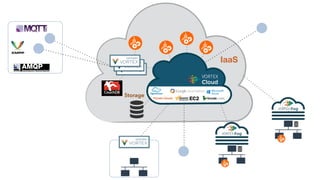
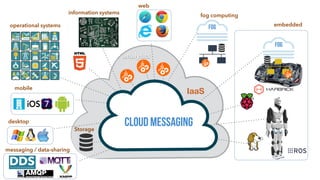
IaaS
analytics
operational systems
information systems
mobile
desktop
web
embedded
fog computing
messaging / data-sharing
Cloud Messaging
Fog
Fog
Storage
IoT Systems are heterogeneous by nature
IoT architectures have to be designed so to
facilitate integration
The danger of O(N2
) integration should be
addressed architecturally
Integration
Stable
Core
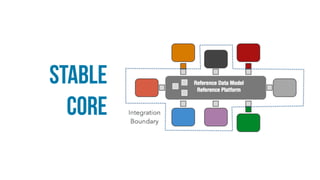
Define a Stable Core made by a
Reference Platform and Data Model.
Integrate always toward the Stable Core
This approach ensure that the integration
problem retains O(N) complexity
Stable
Core
Stable Core withVortex
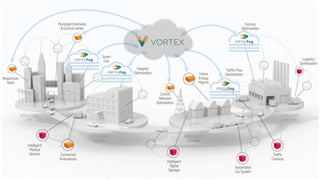
Vortex is a universal data-sharing backbone
CopyrightPrismTech,2015
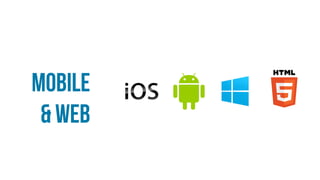
Vortex supports natively a large number of mobile, enterprise,
embedded, cloud, web, and analytics computing platforms
Mobile
& Web
Embedded
General
Purpose
ClouD
Private Cloud
Analytics
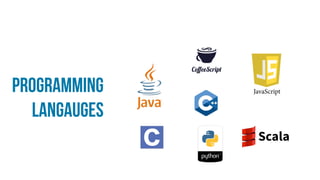
Vortex is programming language independent
Programming
Langauges
Programming
Langauges
import dds
import time


if __name__ == '__main__':

topic = dds.Topic("SmartMeter", "Meter")

dw = dds.Writer(topic)


while True:

m = readMeter()

dw.write(m)

time.sleep(0.1)
import dds._

import dds.prelude._

import dds.config.DefaultEntities._

object SmartMeter {

def main(args: Array[String]): Unit = {

val topic = Topic[Meter](“SmartMeter”)

val dw = DataWriter[Meter](topic)
while (true) {
val meter = readMeter()

dw.write(meter)
Thread.sleep(SAMPLING_PERIOD)
}

}

}
Vortex is data-centric and natively supports the
definition of canonical data models
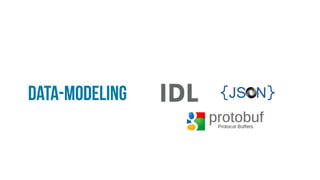
Data-Modeling
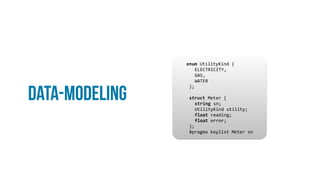
Data-Modeling


  enum	
  UtilityKind	
  {	


  ELECTRICITY,	


  GAS,	


  WATER	


  };	


  struct	
  Meter	
  {	


  string	
  sn;	


  UtilityKind	
  utility;	


  float	
  reading;	


  float	
  error;	


  };	


  #pragma	
  keylist	
  Meter	
  sn	
  
Vortex provide an extremely rich
technological base to define the
infrastructure of an IoT System
Vortex natively supports the definition of
canonical data models
In
Summary
Integration withVortex-Gateway
Vortex integration swiss-army knife
Based on Apache Camel and supporting
200+ connectors to protocols, data stores,
analytics, etc.
Supports protocol, format and encoding
transformation
Extensible to allow quick integration of
proprietary technologies
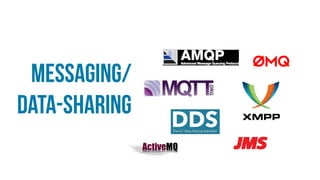
messaging/
Data-Sharing
Data Stores
Putting it all Together
IaaS
Storage
Getting Started with
Vortex-Gateway
CopyrightPrismTech,2015
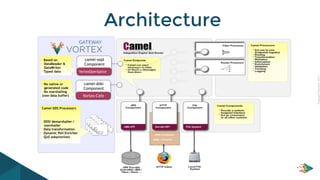
Architecture
camel-ospl

Component
VortexOpenSplice
camel-ddsi

Component
Vortex-Cafe
•
Based on 

DataReader & 

DataWriter
•
Typed data
•
No native or

generated code
•
No marshalling

(raw data buffer)
Camel DDS Processors
•
DDSI demarshaller / 

marshaller
•
Data transformation
•
Dynamic Poll Enricher
•
QoS adaptations 

CopyrightPrismTech,2015
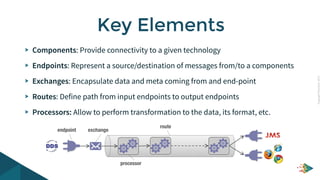
Components: Provide connectivity to a given technology
Endpoints: Represent a source/destination of messages from/to a components
Exchanges: Encapsulate data and meta coming from and end-point
Routes: Define path from input endpoints to output endpoints
Processors: Allow to perform transformation to the data, its format, etc.
Key Elements
endpoint exchange
route
processor
CopyrightPrismTech,2015
A component is a factory of Endpoint instances. Over 200 components are supported
Endpoints are specified using URI:
- dds:TopicName:DomainID/TopicType?QoS
- cometd://host:port/channelname
- jms:[topic:]destinationName
- [tcp|udp|vm]:host[:port]
- xmpp://host:port/room
- …
Components and Endpoints
CopyrightPrismTech,2015
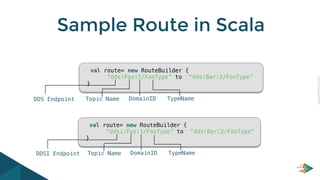
Sample Route in Scala
val route= new RouteBuilder {!
“ddsi:Foo:1/FooType” to “dds:Bar:2/FooType” !
}!
DDSI Endpoint! Topic Name! DomainID! TypeName!
val route= new RouteBuilder {!
“dds:Foo:1/FooType” to “dds:Bar:2/FooType” !
}!
DDS Endpoint! Topic Name! DomainID! TypeName!
CopyrightPrismTech,2015
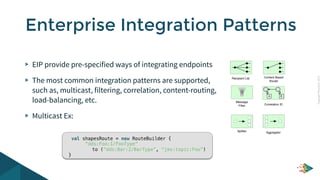
EIP provide pre-specified ways of integrating endpoints
The most common integration patterns are supported,
such as, multicast, filtering, correlation, content-routing,
load-balancing, etc.
Multicast Ex:
Enterprise Integration Patterns
val shapesRoute = new RouteBuilder {!
“dds:Foo:1/FooType” !
"to (“dds:Bar:2/BarType”, “jms:topic:Foo”)!
}!
Recipient List Content Based
Router
Message
FIlter
A B
Correlation ID
Splitter Aggregator
Data Integration
CopyrightPrismTech,2015
Data Integration Patterns are a synthesis of the most commonly used techniques for
integrating systems that don’t share the same representation for some given entities
Some common Data Integration Patterns are
- Content Enricher
- Content Filter
- Type Transformation
- Canonical Data Model
Data Integration Patterns
CopyrightPrismTech,2015
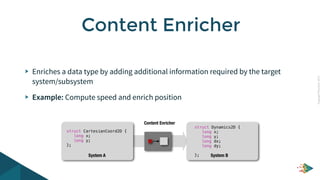
Enriches a data type by adding additional information required by the target
system/subsystem
Example: Compute speed and enrich position
Content Enricher
struct CartesianCoord2D {
long x;
long y;
};
struct Dynamics2D {
long x;
long y;
long dx;
long dy;
};System A System B
Content Enricher
CopyrightPrismTech,2015
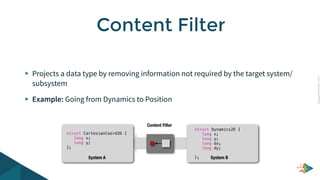
Projects a data type by removing information not required by the target system/
subsystem
Example: Going from Dynamics to Position
Content Filter
struct CartesianCoord2D {
long x;
long y;
};
struct Dynamics2D {
long x;
long y;
long dx;
long dy;
};System A System B
Content Filter
CopyrightPrismTech,2015
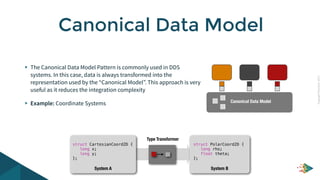
The Canonical Data Model Pattern is commonly used in DDS
systems. In this case, data is always transformed into the
representation used by the “Canonical Model”. This approach is very
useful as it reduces the integration complexity
Example: Coordinate Systems
Canonical Data Model
Type Transformer
struct CartesianCoord2D {
long x;
long y;
};
struct PolarCoord2D {
long rho;
float theta;
};
System A System B
Canonical Data Model
CopyrightPrismTech,2015
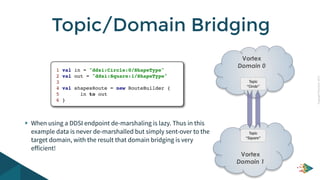
When using a DDSI endpoint de-marshaling is lazy. Thus in this
example data is never de-marshalled but simply sent-over to the
target domain, with the result that domain bridging is very
efficient!
Topic/Domain Bridging
Vortex

Domain 1
Vortex

Domain 0
Topic

“Circle”
Topic

“Square”
1 val in = "ddsi:Circle:0/ShapeType"
2 val out = "ddsi:Square:1/ShapeType"
3
4 val shapesRoute = new RouteBuilder {
5 in to out
6 }
CopyrightPrismTech,2015
process allows to perform arbitrary
modifications to the exchange content
As such it can be used to implement arbitrary
type transformations
Type Transformation
Vortex

Domain 1
Vortex

Domain 0
Topic

“Foo”
Topic

“Bar”
1 val shapeRoute0 = new RouteBuilder {
2 in unmarshal(cdrData) process ({
3 e => foo2Bar(e.getIn.getBody(classOf[Foo]))})
4 to out
5 }
Data Policing
CopyrightPrismTech,2015
Content Router
1 // Define endpoints
2 val inEndpoint = "ddsi:"+ inTopic +":"+ inDomain +"/" + shapeType
3 val outEndpoint1 = "ddsi:"+ outTopic1 +":"+ outDomain1 +"/" + shapeType
4 val outEndpoint2 = "ddsi:"+ outTopic2 +":"+ outDomain2 +"/" + shapeType
5
6 val cdrData = new DataFormatDefinition(new CDRDataFormat)
7 val shapesRoute = new RouteBuilder {
8 inEndpoint unmarshal(cdrData) choice {
9 when ( e => {
10 val s = e.getIn.getBody(classOf[ShapeType])
11 if (s.x > s.y) true else false
12 }) to outEndpoint1
13
14 when (e => {
15 val s = e.getIn.getBody(classOf[ShapeType])
16 if (s.x < s.y) true else false
17 }) to outEndpoint2
18
19 otherwise { to (outEndpoint1, outEndpoint2) }
20 }
21
22 }
Vortex

Domain 2
Vortex

Domain 0
Topic

“Circle”
Topic

“Circle”
Vortex

Domain 1
Topic

“Circle”
if (x >= y) if (x <= y)
CopyrightPrismTech,2015
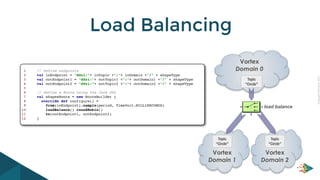
Load Balancing
Vortex

Domain 2
Vortex

Domain 0
Topic

“Circle”
Topic

“Circle”
Vortex

Domain 1
Topic

“Circle”
load balance
1 // Define endpoints
2 val inEndpoint = "ddsi:"+ inTopic +":"+ inDomain +"/" + shapeType
3 val outEndpoint1 = "ddsi:"+ outTopic1 +":"+ outDomain1 +"/" + shapeType
4 val outEndpoint2 = "ddsi:"+ outTopic2 +":"+ outDomain2 +"/" + shapeType
5
6 // Define a Route using the Java DSL
7 val shapesRoute = new RouteBuilder {
8 override def configure() =
9 from(inEndpoint).sample(period, TimeUnit.MILLISECONDS)
10 loadBalance() roundRobin()
11 to(outEndpoint1, outEndpoint2)
12 }
Impedance Adaptation
CopyrightPrismTech,2015
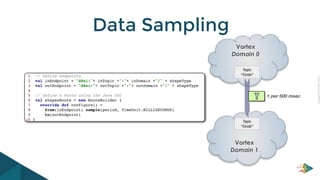
Data Sampling
Vortex

Domain 1
Vortex

Domain 0
Topic

“Circle”
Topic

“Circle”
1 per 500 msec
1 // Define endpoints
2 val inEndpoint = "ddsi:"+ inTopic +":"+ inDomain +"/" + shapeType
3 val outEndpoint = "ddsi:"+ outTopic +":"+ outDomain +"/" + shapeType
4
5 // Define a Route using the Java DSL
6 val shapesRoute = new RouteBuilder {
7 override def configure() =
8 from(inEndpoint) sample(period, TimeUnit.MILLISECONDS)
9 to(outEndpoint)
10 }
Technology Integration
CopyrightPrismTech,2015
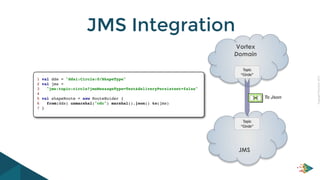
JMS Integration
JMS
Vortex

Domain
Topic

“Circle”
Topic

“Circle”
To Json
1 val dds = "ddsi:Circle:0/ShapeType"
2 val jms =
3 "jms:topic:circle?jmsMessageType=Text&deliveryPersistent=false"
4
5 val shapeRoute = new RouteBuider {
6 from(dds) unmarshal("cdr") marshal().json() to(jms)
7 }
CopyrightPrismTech,2015
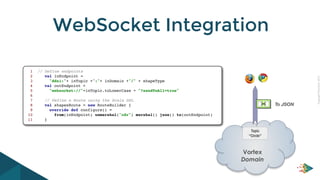
1 // Define endpoints
2 val inEndpoint =
3 "ddsi:"+ inTopic +":"+ inDomain +"/" + shapeType
4 val outEndpoint =
5 "websocket://"+inTopic.toLowerCase + "?sendToAll=true"
6
7 // Define a Route using the Scala DSL
8 val shapesRoute = new RouteBuilder {
9 override def configure() =
10 from(inEndpoint) unmarshal("cdr") marshal() json() to(outEndpoint)
11 }
WebSocket Integration
Vortex

Domain
Topic

“Circle”
To JSON
CopyrightPrismTech,2014
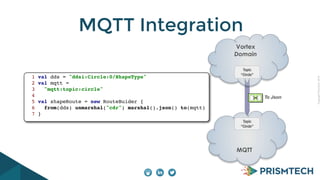
MQTT Integration
MQTT
Vortex

Domain
Topic

“Circle”
Topic

“Circle”
To Json
1 val dds = "ddsi:Circle:0/ShapeType"
2 val mqtt =
3 "mqtt:topic:circle"
4
5 val shapeRoute = new RouteBuider {
6 from(dds) unmarshal("cdr") marshal().json() to(mqtt)
7 }
CopyrightPrismTech,2014
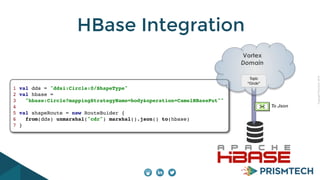
HBase Integration
Vortex

Domain
Topic

“Circle”
To Json
1 val dds = "ddsi:Circle:0/ShapeType"
2 val hbase =
3 "hbase:Circle?mappingStrategyName=body&operation=CamelHBasePut""
4
5 val shapeRoute = new RouteBuider {
6 from(dds) unmarshal("cdr") marshal().json() to(hbase)
7 }
Demo
Vortex provides, probably, the best
technology base for defining the stable core
of an IoT System
Vortex Gateway makes it trivial to integrate
other systems, applications and technologies
Vortex
CopyrightPrismTech,2015

IoT Protocols Integration with Vortex Gateway

  • 1.
    IoT Protocols Integration Angelo  Corsaro,  PhD   Chief  Technology  Officer   angelo.corsaro@prismtech.com with
  • 2.
    IaaS analytics operational systems information systems mobile desktop web embedded fogcomputing messaging / data-sharing Cloud Messaging Fog Fog Storage
  • 3.
    IoT Systems areheterogeneous by nature IoT architectures have to be designed so to facilitate integration The danger of O(N2 ) integration should be addressed architecturally Integration
  • 4.
    Stable Core Define a StableCore made by a Reference Platform and Data Model. Integrate always toward the Stable Core This approach ensure that the integration problem retains O(N) complexity
  • 5.
  • 6.
  • 7.
    Vortex is auniversal data-sharing backbone
  • 8.
  • 9.
    Vortex supports nativelya large number of mobile, enterprise, embedded, cloud, web, and analytics computing platforms
  • 10.
  • 11.
  • 12.
  • 13.
  • 14.
  • 15.
    Vortex is programminglanguage independent
  • 16.
  • 17.
    Programming Langauges import dds import time
 
 if__name__ == '__main__':
 topic = dds.Topic("SmartMeter", "Meter")
 dw = dds.Writer(topic)
 
 while True:
 m = readMeter()
 dw.write(m)
 time.sleep(0.1) import dds._
 import dds.prelude._
 import dds.config.DefaultEntities._
 object SmartMeter {
 def main(args: Array[String]): Unit = {
 val topic = Topic[Meter](“SmartMeter”)
 val dw = DataWriter[Meter](topic) while (true) { val meter = readMeter()
 dw.write(meter) Thread.sleep(SAMPLING_PERIOD) }
 }
 }
  • 18.
    Vortex is data-centricand natively supports the definition of canonical data models
  • 19.
  • 20.
    Data-Modeling          enum  UtilityKind  {            ELECTRICITY,            GAS,            WATER              };                            struct  Meter  {            string  sn;            UtilityKind  utility;            float  reading;            float  error;              };                                      #pragma  keylist  Meter  sn  
  • 21.
    Vortex provide anextremely rich technological base to define the infrastructure of an IoT System Vortex natively supports the definition of canonical data models In Summary
  • 22.
  • 23.
    Vortex integration swiss-armyknife Based on Apache Camel and supporting 200+ connectors to protocols, data stores, analytics, etc. Supports protocol, format and encoding transformation Extensible to allow quick integration of proprietary technologies
  • 25.
  • 26.
  • 27.
  • 28.
  • 29.
  • 30.
    CopyrightPrismTech,2015 Architecture camel-ospl
 Component VortexOpenSplice camel-ddsi
 Component Vortex-Cafe • Based on 
 DataReader& 
 DataWriter • Typed data • No native or
 generated code • No marshalling
 (raw data buffer) Camel DDS Processors • DDSI demarshaller / 
 marshaller • Data transformation • Dynamic Poll Enricher • QoS adaptations 

  • 31.
    CopyrightPrismTech,2015 Components: Provide connectivityto a given technology Endpoints: Represent a source/destination of messages from/to a components Exchanges: Encapsulate data and meta coming from and end-point Routes: Define path from input endpoints to output endpoints Processors: Allow to perform transformation to the data, its format, etc. Key Elements endpoint exchange route processor
  • 32.
    CopyrightPrismTech,2015 A component isa factory of Endpoint instances. Over 200 components are supported Endpoints are specified using URI: - dds:TopicName:DomainID/TopicType?QoS - cometd://host:port/channelname - jms:[topic:]destinationName - [tcp|udp|vm]:host[:port] - xmpp://host:port/room - … Components and Endpoints
  • 33.
    CopyrightPrismTech,2015 Sample Route inScala val route= new RouteBuilder {! “ddsi:Foo:1/FooType” to “dds:Bar:2/FooType” ! }! DDSI Endpoint! Topic Name! DomainID! TypeName! val route= new RouteBuilder {! “dds:Foo:1/FooType” to “dds:Bar:2/FooType” ! }! DDS Endpoint! Topic Name! DomainID! TypeName!
  • 34.
    CopyrightPrismTech,2015 EIP provide pre-specifiedways of integrating endpoints The most common integration patterns are supported, such as, multicast, filtering, correlation, content-routing, load-balancing, etc. Multicast Ex: Enterprise Integration Patterns val shapesRoute = new RouteBuilder {! “dds:Foo:1/FooType” ! "to (“dds:Bar:2/BarType”, “jms:topic:Foo”)! }! Recipient List Content Based Router Message FIlter A B Correlation ID Splitter Aggregator
  • 35.
  • 36.
    CopyrightPrismTech,2015 Data Integration Patternsare a synthesis of the most commonly used techniques for integrating systems that don’t share the same representation for some given entities Some common Data Integration Patterns are - Content Enricher - Content Filter - Type Transformation - Canonical Data Model Data Integration Patterns
  • 37.
    CopyrightPrismTech,2015 Enriches a datatype by adding additional information required by the target system/subsystem Example: Compute speed and enrich position Content Enricher struct CartesianCoord2D { long x; long y; }; struct Dynamics2D { long x; long y; long dx; long dy; };System A System B Content Enricher
  • 38.
    CopyrightPrismTech,2015 Projects a datatype by removing information not required by the target system/ subsystem Example: Going from Dynamics to Position Content Filter struct CartesianCoord2D { long x; long y; }; struct Dynamics2D { long x; long y; long dx; long dy; };System A System B Content Filter
  • 39.
    CopyrightPrismTech,2015 The Canonical DataModel Pattern is commonly used in DDS systems. In this case, data is always transformed into the representation used by the “Canonical Model”. This approach is very useful as it reduces the integration complexity Example: Coordinate Systems Canonical Data Model Type Transformer struct CartesianCoord2D { long x; long y; }; struct PolarCoord2D { long rho; float theta; }; System A System B Canonical Data Model
  • 40.
    CopyrightPrismTech,2015 When using aDDSI endpoint de-marshaling is lazy. Thus in this example data is never de-marshalled but simply sent-over to the target domain, with the result that domain bridging is very efficient! Topic/Domain Bridging Vortex
 Domain 1 Vortex
 Domain 0 Topic
 “Circle” Topic
 “Square” 1 val in = "ddsi:Circle:0/ShapeType" 2 val out = "ddsi:Square:1/ShapeType" 3 4 val shapesRoute = new RouteBuilder { 5 in to out 6 }
  • 41.
    CopyrightPrismTech,2015 process allows toperform arbitrary modifications to the exchange content As such it can be used to implement arbitrary type transformations Type Transformation Vortex
 Domain 1 Vortex
 Domain 0 Topic
 “Foo” Topic
 “Bar” 1 val shapeRoute0 = new RouteBuilder { 2 in unmarshal(cdrData) process ({ 3 e => foo2Bar(e.getIn.getBody(classOf[Foo]))}) 4 to out 5 }
  • 42.
  • 43.
    CopyrightPrismTech,2015 Content Router 1 //Define endpoints 2 val inEndpoint = "ddsi:"+ inTopic +":"+ inDomain +"/" + shapeType 3 val outEndpoint1 = "ddsi:"+ outTopic1 +":"+ outDomain1 +"/" + shapeType 4 val outEndpoint2 = "ddsi:"+ outTopic2 +":"+ outDomain2 +"/" + shapeType 5 6 val cdrData = new DataFormatDefinition(new CDRDataFormat) 7 val shapesRoute = new RouteBuilder { 8 inEndpoint unmarshal(cdrData) choice { 9 when ( e => { 10 val s = e.getIn.getBody(classOf[ShapeType]) 11 if (s.x > s.y) true else false 12 }) to outEndpoint1 13 14 when (e => { 15 val s = e.getIn.getBody(classOf[ShapeType]) 16 if (s.x < s.y) true else false 17 }) to outEndpoint2 18 19 otherwise { to (outEndpoint1, outEndpoint2) } 20 } 21 22 } Vortex
 Domain 2 Vortex
 Domain 0 Topic
 “Circle” Topic
 “Circle” Vortex
 Domain 1 Topic
 “Circle” if (x >= y) if (x <= y)
  • 44.
    CopyrightPrismTech,2015 Load Balancing Vortex
 Domain 2 Vortex
 Domain0 Topic
 “Circle” Topic
 “Circle” Vortex
 Domain 1 Topic
 “Circle” load balance 1 // Define endpoints 2 val inEndpoint = "ddsi:"+ inTopic +":"+ inDomain +"/" + shapeType 3 val outEndpoint1 = "ddsi:"+ outTopic1 +":"+ outDomain1 +"/" + shapeType 4 val outEndpoint2 = "ddsi:"+ outTopic2 +":"+ outDomain2 +"/" + shapeType 5 6 // Define a Route using the Java DSL 7 val shapesRoute = new RouteBuilder { 8 override def configure() = 9 from(inEndpoint).sample(period, TimeUnit.MILLISECONDS) 10 loadBalance() roundRobin() 11 to(outEndpoint1, outEndpoint2) 12 }
  • 45.
  • 46.
    CopyrightPrismTech,2015 Data Sampling Vortex
 Domain 1 Vortex
 Domain0 Topic
 “Circle” Topic
 “Circle” 1 per 500 msec 1 // Define endpoints 2 val inEndpoint = "ddsi:"+ inTopic +":"+ inDomain +"/" + shapeType 3 val outEndpoint = "ddsi:"+ outTopic +":"+ outDomain +"/" + shapeType 4 5 // Define a Route using the Java DSL 6 val shapesRoute = new RouteBuilder { 7 override def configure() = 8 from(inEndpoint) sample(period, TimeUnit.MILLISECONDS) 9 to(outEndpoint) 10 }
  • 47.
  • 48.
    CopyrightPrismTech,2015 JMS Integration JMS Vortex
 Domain Topic
 “Circle” Topic
 “Circle” To Json 1val dds = "ddsi:Circle:0/ShapeType" 2 val jms = 3 "jms:topic:circle?jmsMessageType=Text&deliveryPersistent=false" 4 5 val shapeRoute = new RouteBuider { 6 from(dds) unmarshal("cdr") marshal().json() to(jms) 7 }
  • 49.
    CopyrightPrismTech,2015 1 // Defineendpoints 2 val inEndpoint = 3 "ddsi:"+ inTopic +":"+ inDomain +"/" + shapeType 4 val outEndpoint = 5 "websocket://"+inTopic.toLowerCase + "?sendToAll=true" 6 7 // Define a Route using the Scala DSL 8 val shapesRoute = new RouteBuilder { 9 override def configure() = 10 from(inEndpoint) unmarshal("cdr") marshal() json() to(outEndpoint) 11 } WebSocket Integration Vortex
 Domain Topic
 “Circle” To JSON
  • 50.
    CopyrightPrismTech,2014 MQTT Integration MQTT Vortex
 Domain Topic
 “Circle” Topic
 “Circle” To Json 1val dds = "ddsi:Circle:0/ShapeType" 2 val mqtt = 3 "mqtt:topic:circle" 4 5 val shapeRoute = new RouteBuider { 6 from(dds) unmarshal("cdr") marshal().json() to(mqtt) 7 }
  • 51.
    CopyrightPrismTech,2014 HBase Integration Vortex
 Domain Topic
 “Circle” To Json 1val dds = "ddsi:Circle:0/ShapeType" 2 val hbase = 3 "hbase:Circle?mappingStrategyName=body&operation=CamelHBasePut"" 4 5 val shapeRoute = new RouteBuider { 6 from(dds) unmarshal("cdr") marshal().json() to(hbase) 7 }
  • 52.
  • 53.
    Vortex provides, probably,the best technology base for defining the stable core of an IoT System Vortex Gateway makes it trivial to integrate other systems, applications and technologies Vortex
  • 54.