Angelo Corsaro, PhD
Chief Technology Officer
angelo.corsaro@prismtech.com
Beyond Cloud Messaging…
Cloud
CopyrightPrismTech,2014
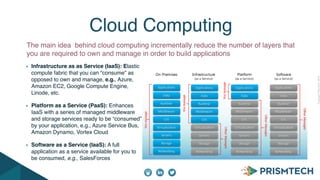
Infrastructure as as Service (IaaS): Elastic
compute fabric that you can “consume” as
opposed to own and manage, e.g., Azure,
Amazon EC2, Google Compute Engine,
Linode, etc.
Platform as a Service (PaaS): Enhances
IaaS with a series of managed middleware
and storage services ready to be “consumed”
by your application, e.g., Azure Service Bus,
Amazon Dynamo, Vortex Cloud
Software as a Service (IaaS): A full
application as a service available for you to
be consumed, e.g., SalesForces
Cloud Computing
The main idea behind cloud computing incrementally reduce the number of layers that
you are required to own and manage in order to build applications
CopyrightPrismTech,2014
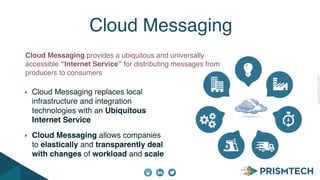
Cloud Messaging replaces local
infrastructure and integration
technologies with an Ubiquitous
Internet Service
Cloud Messaging allows companies
to elastically and transparently deal
with changes of workload and scale
Cloud Messaging
Cloud Messaging provides a ubiquitous and universally
accessible “Internet Service” for distributing messages from
producers to consumers
CopyrightPrismTech,2014
Virtually all the Cloud Messaging implementation available on the market focus on:
Reliable Messaging
Device-to-Cloud communication pattern, i.e., no cloud no communication
Low update rates
Additionally, a large set of Cloud Messaging implementations impose:
HTTP-based communication, e.g. Amazon SQS
Limit on message payload
Limit on deployment across “regions”
Limit on the Deployment/Licensing model, e.g. no OEM options
“Traditional” Cloud Messaging
CopyrightPrismTech,2014
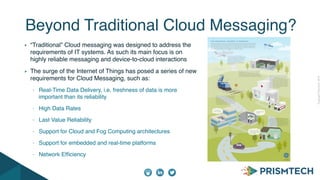
“Traditional” Cloud messaging was designed to address the
requirements of IT systems. As such its main focus is on
highly reliable messaging and device-to-cloud interactions
The surge of the Internet of Things has posed a series of new
requirements for Cloud Messaging, such as:
- Real-Time Data Delivery, i.e. freshness of data is more
important than its reliability
- High Data Rates
- Last Value Reliability
- Support for Cloud and Fog Computing architectures
- Support for embedded and real-time platforms
- Network Efficiency
Beyond Traditional Cloud Messaging?
Vortex Cloud
CopyrightPrismTech,2014
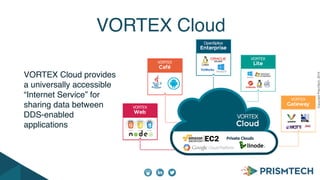
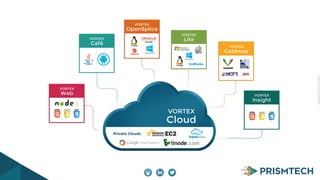
VORTEX Cloud provides
a universally accessible
“Internet Service” for
sharing data between
DDS-enabled
applications
VORTEX Cloud
CopyrightPrismTech,2014
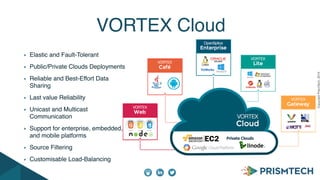
Elastic and Fault-Tolerant
Public/Private Clouds Deployments
Reliable and Best-Effort Data
Sharing
Last value Reliability
Unicast and Multicast
Communication
Support for enterprise, embedded,
and mobile platforms
Source Filtering
Customisable Load-Balancing
VORTEX Cloud
CopyrightPrismTech,2014
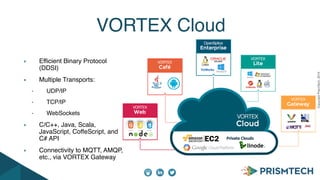
Efficient Binary Protocol
(DDSI)
Multiple Transports:
- UDP/IP
- TCP/IP
- WebSockets
C/C++, Java, Scala,
JavaScript, CoffeScript, and
C# API
Connectivity to MQTT, AMQP,
etc., via VORTEX Gateway
VORTEX Cloud
CopyrightPrismTech,2014
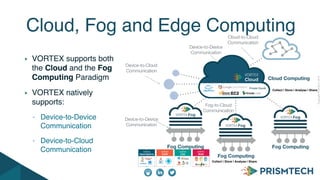
VORTEX supports both
the Cloud and the Fog
Computing Paradigm
VORTEX natively
supports:
- Device-to-Device
Communication
- Device-to-Cloud
Communication
Cloud, Fog and Edge Computing
Cloud Computing
Fog Computing
Device-to-Cloud
Communication
Device-to-Device
Communication
Fog-to-Cloud
Communication
Cloud-to-Cloud
Communication
Device-to-Device
Communication
Collect | Store | Analyse | Share
Fog Computing
Fog Computing
CopyrightPrismTech,2015
Performance
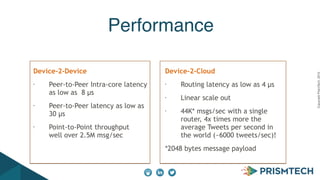
Device-2-Device
• Peer-to-Peer Intra-core latency 

as low as 8 µs
• Peer-to-Peer latency as low as 

30 µs
• Point-to-Point throughput 

well over 2.5M msg/sec
Device-2-Cloud
• Routing latency as low as 4 µs
• Linear scale out
• 44K* msgs/sec with a single
router, 4x times more the
average Tweets per second in
the world (~6000 tweets/sec)!
*2048 bytes message payload
Deployment Models
CopyrightPrismTech,2014
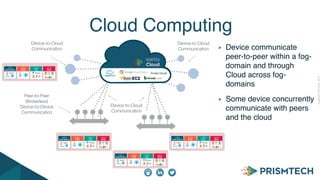
Cloud Computing
Device-to-Cloud
Communication
Peer-to-Peer
(Brokerless)
Device-to-Device
Communication
Device communicate
peer-to-peer within a fog-
domain and through
Cloud across fog-
domains
Some device concurrently
communicate with peers
and the cloud
Device-to-Cloud
Communication
Device-to-Cloud
Communication
CopyrightPrismTech,2014
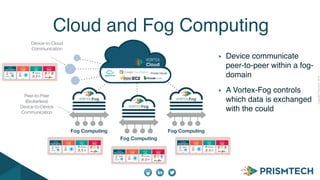
Cloud and Fog Computing
Device communicate
peer-to-peer within a fog-
domain
A Vortex-Fog controls
which data is exchanged
with the could
Device-to-Cloud
Communication
Peer-to-Peer
(Brokerless)
Device-to-Device
Communication
Fog Computing Fog Computing
Fog Computing
CopyrightPrismTech,2014
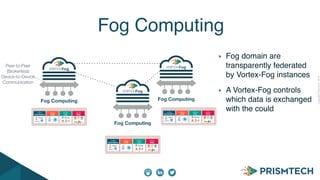
Fog Computing
Peer-to-Peer
(Brokerless)
Device-to-Device
Communication
Fog domain are
transparently federated
by Vortex-Fog instances
A Vortex-Fog controls
which data is exchanged
with the could
Fog Computing
Fog Computing
Fog Computing
Vortex Platform
CopyrightPrismTech,2015
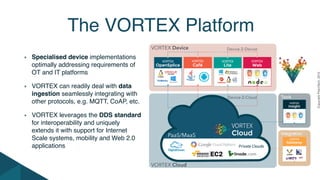
Specialised device implementations
optimally addressing requirements of
OT and IT platforms
VORTEX can readily deal with data
ingestion seamlessly integrating with
other protocols, e.g. MQTT, CoAP, etc.
VORTEX leverages the DDS standard
for interoperability and uniquely
extends it with support for Internet
Scale systems, mobility and Web 2.0
applications
The VORTEX Platform
PaaS/MaaS
Vortex Cloud Abstraction
CopyrightPrismTech,2014
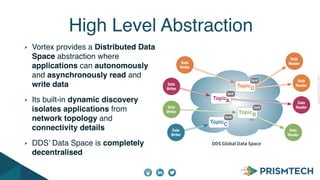
Vortex provides a Distributed Data
Space abstraction where
applications can autonomously
and asynchronously read and
write data
Its built-in dynamic discovery
isolates applications from
network topology and
connectivity details
DDS’ Data Space is completely
decentralised
High Level Abstraction
DDS Global Data Space
...
Data
Writer
Data
Writer
Data
Writer
Data
Reader
Data
Reader
Data
Reader
Data
Reader
Data
Writer
TopicA
QoS
TopicB
QoS
TopicC
QoS
TopicD
QoS
CopyrightPrismTech,2014
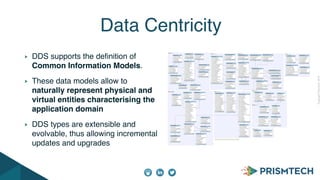
DDS supports the definition of
Common Information Models.
These data models allow to
naturally represent physical and
virtual entities characterising the
application domain
DDS types are extensible and
evolvable, thus allowing incremental
updates and upgrades
Data Centricity
CopyrightPrismTech,2014
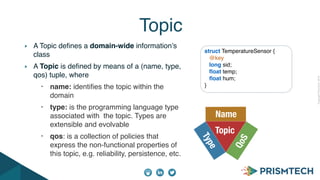
A Topic defines a domain-wide information’s
class
A Topic is defined by means of a (name, type,
qos) tuple, where
• name: identifies the topic within the
domain
• type: is the programming language type
associated with the topic. Types are
extensible and evolvable
• qos: is a collection of policies that
express the non-functional properties of
this topic, e.g. reliability, persistence, etc.
Topic
Topic
Type
Name
QoS
struct TemperatureSensor {
@key
long sid;
float temp;
float hum;
}
CopyrightPrismTech,2014
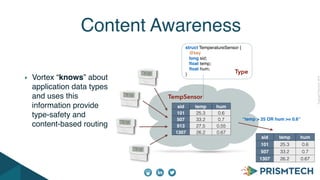
Vortex “knows” about
application data types
and uses this
information provide
type-safety and
content-based routing
Content Awareness
struct TemperatureSensor {
@key
long sid;
float temp;
float hum;
}
sid temp hum
101 25.3 0.6
507 33.2 0.7
913 27,5 0.55
1307 26.2 0.67
“temp > 25 OR hum >= 0.6”
sid temp hum
101 25.3 0.6
507 33.2 0.7
1307 26.2 0.67
Type
TempSensor
CopyrightPrismTech,2014
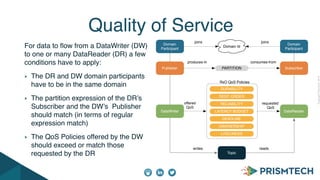
For data to flow from a DataWriter (DW)
to one or many DataReader (DR) a few
conditions have to apply:
The DR and DW domain participants
have to be in the same domain
The partition expression of the DR’s
Subscriber and the DW’s Publisher
should match (in terms of regular
expression match)
The QoS Policies offered by the DW
should exceed or match those
requested by the DR
Quality of Service
Domain
Participant
DURABILITY
OWENERSHIP
DEADLINE
LATENCY BUDGET
LIVELINESS
RELIABILITY
DEST. ORDER
Publisher
DataWriter
PARTITION
DataReader
Subscriber
Domain
Participant
offered
QoS
Topic
writes reads
Domain Id
joins joins
produces-in consumes-from
RxO QoS Policies
requested
QoS
Building App with Vortex
Example1: Strong Typing
and Extensibility
CopyrightPrismTech,2015
The first step required to build a Vortex application is to define the kind of
information associated with a Topic
This can be done using either IDL or Google Protocol Buffer
Topic Definition
CopyrightPrismTech,2015
Temperature Sensor
message TempSensor {

option (.omg.dds.type) = {name: "dds.TempSensor"};

required string sid = 1 [(.omg.dds.member).key = true];

required float temp = 2;

}

struct TempSensor {

string sid;

float temp;

};
#pragma keylist TempSensor sid

IDL Google Protocol Buffer
CopyrightPrismTech,2015
Data Producer


object TempSensorPub {

val builder = TempSensor.newBuilder()


def main(args: Array[String]): Unit = {

if (args.length > 1) {

val sid = args(0)

val period = args(1).toInt


val topic = Topic[TempSensor]("TempSensor")

val dw = DataWriter[TempSensor](topic)


while (true) {

val s = readTempSensor(sid)

dw.write(s)

println(show (s))

Thread.sleep(period)

}

}

else {

println("USAGE:ntTempSensorPub <sid> <period>")

}

}

}

def readTempSensor(sid: String): TempSensor = {

val minTemp = -20

val tdelta = 100;

val minHum = 0.1F

val hdelta = 9


val t = (tdelta*Math.random()).toInt + minTemp

val h = (hdelta*Math.random()).toInt + minHum


builder.setSid(sid)

builder.setTemp(t)

builder.setHum(h)

builder.build()

}

CopyrightPrismTech,2015
Data Consumer


object TempSensorSub {

def main(args: Array[String]): Unit = {


val topic = Topic[TempSensor]("TempSensor")

val dr = DataReader[TempSensor](topic)


dr.listen {

case DataAvailable(_) =>

dr.take()

.filter(s => s.getData != null)

.map(_.getData)

.foreach(ts => println(show(ts)))

}

Thread.currentThread().join()

}

}

CopyrightPrismTech,2015
Suppose that we want now to use a more advanced sensor that provides an
estimate of the humidity in addition to the temperature
At the same time, while extending the type of our Temperature Sensor we
want older application to continue to work seamlessly with the new sensor
Dealing with Type Evolution
CopyrightPrismTech,2015
The humidity attribute is
declared optional to
allow older consumer to
match this type
At the same time, new
consumer will be able to
detect that old
temperature sensor are
not providing humidity
value
Extended Temperature Sensor Type
message TempSensor {

option (.omg.dds.type) = {name: "dds.TempSensor"};

required string sid = 1 [(.omg.dds.member).key = true];

required float temp = 2;

optional float hum = 3;

}

Example2: Real-Time Web
Applications
CopyrightPrismTech,2015
Vortex Cloud provides a very effective way of sharing data between HTML5/
JavaScript Applications
Additionally, Vortex Cloud can be used to seamlessly share data between
Web and embedded applications
Real-Web Apps with Vortex Cloud
CopyrightPrismTech,2014
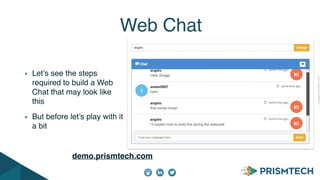
Let’s see the steps
required to build a Web
Chat that may look like
this
But before let’s play with it
a bit
Web Chat
demo.prismtech.com
CopyrightPrismTech,2014
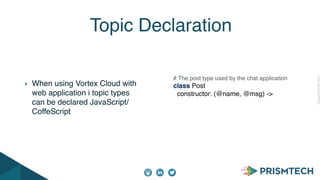
When using Vortex Cloud with
web application i topic types
can be declared JavaScript/
CoffeScript
Topic Declaration
# The post type used by the chat application
class Post
constructor: (@name, @msg) ->
CopyrightPrismTech,2014
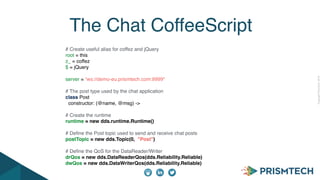
The Chat CoffeeScript
# Create useful alias for coffez and jQuery
root = this
z_ = coffez
$ = jQuery
server = “ws://demo-eu.prismtech.com:9999"
# The post type used by the chat application
class Post
constructor: (@name, @msg) ->
# Create the runtime
runtime = new dds.runtime.Runtime()
# Define the Post topic used to send and receive chat posts
postTopic = new dds.Topic(0, "Post")
# Define the QoS for the DataReader/Writer
drQos = new dds.DataReaderQos(dds.Reliability.Reliable)
dwQos = new dds.DataWriterQos(dds.Reliability.Reliable)
CopyrightPrismTech,2014
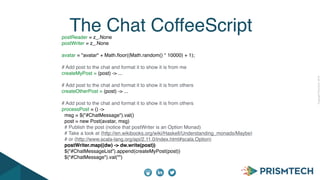
The Chat CoffeeScriptpostReader = z_.None
postWriter = z_.None
avatar = "avatar" + Math.floor((Math.random() * 10000) + 1);
# Add post to the chat and format it to show it is from me
createMyPost = (post) -> ...
# Add post to the chat and format it to show it is from others
createOtherPost = (post) -> ...
# Add post to the chat and format it to show it is from others
processPost = () ->
msg = $("#ChatMessage").val()
post = new Post(avatar, msg)
# Publish the post (notice that postWriter is an Option Monad)
# Take a look at (http://en.wikibooks.org/wiki/Haskell/Understanding_monads/Maybe)
# or (http://www.scala-lang.org/api/2.11.0/index.html#scala.Option)
postWriter.map((dw) -> dw.write(post))
$("#ChatMessageList").append(createMyPost(post))
$("#ChatMessage").val("")
CopyrightPrismTech,2014
The Chat CoffeeScript
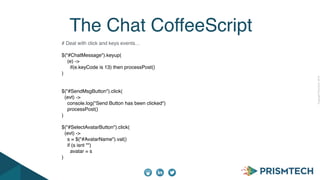
# Deal with click and keys events…
$("#ChatMessage").keyup(
(e) ->
if(e.keyCode is 13) then processPost()
)
$("#SendMsgButton").click(
(evt) ->
console.log("Send Button has been clicked")
processPost()
)
$("#SelectAvatarButton").click(
(evt) ->
s = $("#AvatarName").val()
if (s isnt "")
avatar = s
)
CopyrightPrismTech,2014
The Chat CoffeeScript
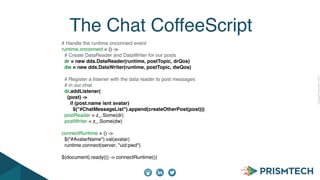
# Handle the runtime onconnect event
runtime.onconnect = () ->
# Create DataReader and DataWriter for our posts
dr = new dds.DataReader(runtime, postTopic, drQos)
dw = new dds.DataWriter(runtime, postTopic, dwQos)
# Register a listener with the data reader to post messages
# in our chat
dr.addListener(
(post) ->
if (post.name isnt avatar)
$("#ChatMessageList").append(createOtherPost(post)))
postReader = z_.Some(dr)
postWriter = z_.Some(dw)
connectRuntime = () ->
$("#AvatarName").val(avatar)
runtime.connect(server, "uid:pwd")
$(document).ready(() -> connectRuntime())
Putting it all Together
CopyrightPrismTech,2014
Vortex Cloud goes beyond traditional Cloud Messaging solutions by providing support
for:
- Real-Time Data Delivery, i.e. freshness of data is more important than its reliability
- High Data Rates
- Last Value Reliability
- Support for Cloud and Fog Computing architectures
- Support for embedded and real-time platforms
- High Network Efficiency
Vortex Cloud is the ideal PaaS infrastructure for Industrial and Consumer IoT
applications
Summing Up
CopyrightPrismTech,2015

Vortex Cloud Beyond Cloud Messaging

  • 1.
    Angelo Corsaro, PhD ChiefTechnology Officer angelo.corsaro@prismtech.com Beyond Cloud Messaging… Cloud
  • 2.
    CopyrightPrismTech,2014 Infrastructure as asService (IaaS): Elastic compute fabric that you can “consume” as opposed to own and manage, e.g., Azure, Amazon EC2, Google Compute Engine, Linode, etc. Platform as a Service (PaaS): Enhances IaaS with a series of managed middleware and storage services ready to be “consumed” by your application, e.g., Azure Service Bus, Amazon Dynamo, Vortex Cloud Software as a Service (IaaS): A full application as a service available for you to be consumed, e.g., SalesForces Cloud Computing The main idea behind cloud computing incrementally reduce the number of layers that you are required to own and manage in order to build applications
  • 3.
    CopyrightPrismTech,2014 Cloud Messaging replaceslocal infrastructure and integration technologies with an Ubiquitous Internet Service Cloud Messaging allows companies to elastically and transparently deal with changes of workload and scale Cloud Messaging Cloud Messaging provides a ubiquitous and universally accessible “Internet Service” for distributing messages from producers to consumers
  • 4.
    CopyrightPrismTech,2014 Virtually all theCloud Messaging implementation available on the market focus on: Reliable Messaging Device-to-Cloud communication pattern, i.e., no cloud no communication Low update rates Additionally, a large set of Cloud Messaging implementations impose: HTTP-based communication, e.g. Amazon SQS Limit on message payload Limit on deployment across “regions” Limit on the Deployment/Licensing model, e.g. no OEM options “Traditional” Cloud Messaging
  • 5.
    CopyrightPrismTech,2014 “Traditional” Cloud messagingwas designed to address the requirements of IT systems. As such its main focus is on highly reliable messaging and device-to-cloud interactions The surge of the Internet of Things has posed a series of new requirements for Cloud Messaging, such as: - Real-Time Data Delivery, i.e. freshness of data is more important than its reliability - High Data Rates - Last Value Reliability - Support for Cloud and Fog Computing architectures - Support for embedded and real-time platforms - Network Efficiency Beyond Traditional Cloud Messaging?
  • 6.
  • 7.
    CopyrightPrismTech,2014 VORTEX Cloud provides auniversally accessible “Internet Service” for sharing data between DDS-enabled applications VORTEX Cloud
  • 8.
    CopyrightPrismTech,2014 Elastic and Fault-Tolerant Public/PrivateClouds Deployments Reliable and Best-Effort Data Sharing Last value Reliability Unicast and Multicast Communication Support for enterprise, embedded, and mobile platforms Source Filtering Customisable Load-Balancing VORTEX Cloud
  • 9.
    CopyrightPrismTech,2014 Efficient Binary Protocol (DDSI) MultipleTransports: - UDP/IP - TCP/IP - WebSockets C/C++, Java, Scala, JavaScript, CoffeScript, and C# API Connectivity to MQTT, AMQP, etc., via VORTEX Gateway VORTEX Cloud
  • 10.
    CopyrightPrismTech,2014 VORTEX supports both theCloud and the Fog Computing Paradigm VORTEX natively supports: - Device-to-Device Communication - Device-to-Cloud Communication Cloud, Fog and Edge Computing Cloud Computing Fog Computing Device-to-Cloud Communication Device-to-Device Communication Fog-to-Cloud Communication Cloud-to-Cloud Communication Device-to-Device Communication Collect | Store | Analyse | Share Collect | Store | Analyse | Share Fog Computing Fog Computing
  • 11.
    CopyrightPrismTech,2015 Performance Device-2-Device • Peer-to-Peer Intra-corelatency 
 as low as 8 µs • Peer-to-Peer latency as low as 
 30 µs • Point-to-Point throughput 
 well over 2.5M msg/sec Device-2-Cloud • Routing latency as low as 4 µs • Linear scale out • 44K* msgs/sec with a single router, 4x times more the average Tweets per second in the world (~6000 tweets/sec)! *2048 bytes message payload
  • 12.
  • 13.
    CopyrightPrismTech,2014 Cloud Computing Device-to-Cloud Communication Peer-to-Peer (Brokerless) Device-to-Device Communication Device communicate peer-to-peerwithin a fog- domain and through Cloud across fog- domains Some device concurrently communicate with peers and the cloud Device-to-Cloud Communication Device-to-Cloud Communication
  • 14.
    CopyrightPrismTech,2014 Cloud and FogComputing Device communicate peer-to-peer within a fog- domain A Vortex-Fog controls which data is exchanged with the could Device-to-Cloud Communication Peer-to-Peer (Brokerless) Device-to-Device Communication Fog Computing Fog Computing Fog Computing
  • 15.
    CopyrightPrismTech,2014 Fog Computing Peer-to-Peer (Brokerless) Device-to-Device Communication Fog domainare transparently federated by Vortex-Fog instances A Vortex-Fog controls which data is exchanged with the could Fog Computing Fog Computing Fog Computing
  • 16.
  • 17.
    CopyrightPrismTech,2015 Specialised device implementations optimallyaddressing requirements of OT and IT platforms VORTEX can readily deal with data ingestion seamlessly integrating with other protocols, e.g. MQTT, CoAP, etc. VORTEX leverages the DDS standard for interoperability and uniquely extends it with support for Internet Scale systems, mobility and Web 2.0 applications The VORTEX Platform PaaS/MaaS
  • 18.
  • 19.
    CopyrightPrismTech,2014 Vortex provides aDistributed Data Space abstraction where applications can autonomously and asynchronously read and write data Its built-in dynamic discovery isolates applications from network topology and connectivity details DDS’ Data Space is completely decentralised High Level Abstraction DDS Global Data Space ... Data Writer Data Writer Data Writer Data Reader Data Reader Data Reader Data Reader Data Writer TopicA QoS TopicB QoS TopicC QoS TopicD QoS
  • 20.
    CopyrightPrismTech,2014 DDS supports thedefinition of Common Information Models. These data models allow to naturally represent physical and virtual entities characterising the application domain DDS types are extensible and evolvable, thus allowing incremental updates and upgrades Data Centricity
  • 21.
    CopyrightPrismTech,2014 A Topic definesa domain-wide information’s class A Topic is defined by means of a (name, type, qos) tuple, where • name: identifies the topic within the domain • type: is the programming language type associated with the topic. Types are extensible and evolvable • qos: is a collection of policies that express the non-functional properties of this topic, e.g. reliability, persistence, etc. Topic Topic Type Name QoS struct TemperatureSensor { @key long sid; float temp; float hum; }
  • 22.
    CopyrightPrismTech,2014 Vortex “knows” about applicationdata types and uses this information provide type-safety and content-based routing Content Awareness struct TemperatureSensor { @key long sid; float temp; float hum; } sid temp hum 101 25.3 0.6 507 33.2 0.7 913 27,5 0.55 1307 26.2 0.67 “temp > 25 OR hum >= 0.6” sid temp hum 101 25.3 0.6 507 33.2 0.7 1307 26.2 0.67 Type TempSensor
  • 23.
    CopyrightPrismTech,2014 For data toflow from a DataWriter (DW) to one or many DataReader (DR) a few conditions have to apply: The DR and DW domain participants have to be in the same domain The partition expression of the DR’s Subscriber and the DW’s Publisher should match (in terms of regular expression match) The QoS Policies offered by the DW should exceed or match those requested by the DR Quality of Service Domain Participant DURABILITY OWENERSHIP DEADLINE LATENCY BUDGET LIVELINESS RELIABILITY DEST. ORDER Publisher DataWriter PARTITION DataReader Subscriber Domain Participant offered QoS Topic writes reads Domain Id joins joins produces-in consumes-from RxO QoS Policies requested QoS
  • 24.
  • 25.
  • 26.
    CopyrightPrismTech,2015 The first steprequired to build a Vortex application is to define the kind of information associated with a Topic This can be done using either IDL or Google Protocol Buffer Topic Definition
  • 27.
    CopyrightPrismTech,2015 Temperature Sensor message TempSensor{
 option (.omg.dds.type) = {name: "dds.TempSensor"};
 required string sid = 1 [(.omg.dds.member).key = true];
 required float temp = 2;
 }
 struct TempSensor {
 string sid;
 float temp;
 }; #pragma keylist TempSensor sid
 IDL Google Protocol Buffer
  • 28.
    CopyrightPrismTech,2015 Data Producer 
 
 object TempSensorPub{
 val builder = TempSensor.newBuilder()
 
 def main(args: Array[String]): Unit = {
 if (args.length > 1) {
 val sid = args(0)
 val period = args(1).toInt
 
 val topic = Topic[TempSensor]("TempSensor")
 val dw = DataWriter[TempSensor](topic)
 
 while (true) {
 val s = readTempSensor(sid)
 dw.write(s)
 println(show (s))
 Thread.sleep(period)
 }
 }
 else {
 println("USAGE:ntTempSensorPub <sid> <period>")
 }
 }
 }
 def readTempSensor(sid: String): TempSensor = {
 val minTemp = -20
 val tdelta = 100;
 val minHum = 0.1F
 val hdelta = 9
 
 val t = (tdelta*Math.random()).toInt + minTemp
 val h = (hdelta*Math.random()).toInt + minHum
 
 builder.setSid(sid)
 builder.setTemp(t)
 builder.setHum(h)
 builder.build()
 }

  • 29.
    CopyrightPrismTech,2015 Data Consumer 
 object TempSensorSub{
 def main(args: Array[String]): Unit = {
 
 val topic = Topic[TempSensor]("TempSensor")
 val dr = DataReader[TempSensor](topic)
 
 dr.listen {
 case DataAvailable(_) =>
 dr.take()
 .filter(s => s.getData != null)
 .map(_.getData)
 .foreach(ts => println(show(ts)))
 }
 Thread.currentThread().join()
 }
 }

  • 30.
    CopyrightPrismTech,2015 Suppose that wewant now to use a more advanced sensor that provides an estimate of the humidity in addition to the temperature At the same time, while extending the type of our Temperature Sensor we want older application to continue to work seamlessly with the new sensor Dealing with Type Evolution
  • 31.
    CopyrightPrismTech,2015 The humidity attributeis declared optional to allow older consumer to match this type At the same time, new consumer will be able to detect that old temperature sensor are not providing humidity value Extended Temperature Sensor Type message TempSensor {
 option (.omg.dds.type) = {name: "dds.TempSensor"};
 required string sid = 1 [(.omg.dds.member).key = true];
 required float temp = 2;
 optional float hum = 3;
 }

  • 32.
  • 33.
    CopyrightPrismTech,2015 Vortex Cloud providesa very effective way of sharing data between HTML5/ JavaScript Applications Additionally, Vortex Cloud can be used to seamlessly share data between Web and embedded applications Real-Web Apps with Vortex Cloud
  • 34.
    CopyrightPrismTech,2014 Let’s see thesteps required to build a Web Chat that may look like this But before let’s play with it a bit Web Chat demo.prismtech.com
  • 35.
    CopyrightPrismTech,2014 When using VortexCloud with web application i topic types can be declared JavaScript/ CoffeScript Topic Declaration # The post type used by the chat application class Post constructor: (@name, @msg) ->
  • 36.
    CopyrightPrismTech,2014 The Chat CoffeeScript #Create useful alias for coffez and jQuery root = this z_ = coffez $ = jQuery server = “ws://demo-eu.prismtech.com:9999" # The post type used by the chat application class Post constructor: (@name, @msg) -> # Create the runtime runtime = new dds.runtime.Runtime() # Define the Post topic used to send and receive chat posts postTopic = new dds.Topic(0, "Post") # Define the QoS for the DataReader/Writer drQos = new dds.DataReaderQos(dds.Reliability.Reliable) dwQos = new dds.DataWriterQos(dds.Reliability.Reliable)
  • 37.
    CopyrightPrismTech,2014 The Chat CoffeeScriptpostReader= z_.None postWriter = z_.None avatar = "avatar" + Math.floor((Math.random() * 10000) + 1); # Add post to the chat and format it to show it is from me createMyPost = (post) -> ... # Add post to the chat and format it to show it is from others createOtherPost = (post) -> ... # Add post to the chat and format it to show it is from others processPost = () -> msg = $("#ChatMessage").val() post = new Post(avatar, msg) # Publish the post (notice that postWriter is an Option Monad) # Take a look at (http://en.wikibooks.org/wiki/Haskell/Understanding_monads/Maybe) # or (http://www.scala-lang.org/api/2.11.0/index.html#scala.Option) postWriter.map((dw) -> dw.write(post)) $("#ChatMessageList").append(createMyPost(post)) $("#ChatMessage").val("")
  • 38.
    CopyrightPrismTech,2014 The Chat CoffeeScript #Deal with click and keys events… $("#ChatMessage").keyup( (e) -> if(e.keyCode is 13) then processPost() ) $("#SendMsgButton").click( (evt) -> console.log("Send Button has been clicked") processPost() ) $("#SelectAvatarButton").click( (evt) -> s = $("#AvatarName").val() if (s isnt "") avatar = s )
  • 39.
    CopyrightPrismTech,2014 The Chat CoffeeScript #Handle the runtime onconnect event runtime.onconnect = () -> # Create DataReader and DataWriter for our posts dr = new dds.DataReader(runtime, postTopic, drQos) dw = new dds.DataWriter(runtime, postTopic, dwQos) # Register a listener with the data reader to post messages # in our chat dr.addListener( (post) -> if (post.name isnt avatar) $("#ChatMessageList").append(createOtherPost(post))) postReader = z_.Some(dr) postWriter = z_.Some(dw) connectRuntime = () -> $("#AvatarName").val(avatar) runtime.connect(server, "uid:pwd") $(document).ready(() -> connectRuntime())
  • 40.
  • 41.
  • 42.
    CopyrightPrismTech,2014 Vortex Cloud goesbeyond traditional Cloud Messaging solutions by providing support for: - Real-Time Data Delivery, i.e. freshness of data is more important than its reliability - High Data Rates - Last Value Reliability - Support for Cloud and Fog Computing architectures - Support for embedded and real-time platforms - High Network Efficiency Vortex Cloud is the ideal PaaS infrastructure for Industrial and Consumer IoT applications Summing Up
  • 43.