Angelo	
  Corsaro,	
  PhD	
  
Chief	
  Technology	
  Officer	
  
angelo.corsaro@prismtech.com
Reactive Data Centric
Architectures with DDS
CopyrightPrismTech,2015
responsive
CopyrightPrismTech,2015
resilient
responsive
CopyrightPrismTech,2015
scalable
resilient
responsive
CopyrightPrismTech,2015
scalable
resilient
responsive
secure
CopyrightPrismTech,2015
scalable
resilient
responsive
extensible
secure
Architectural Trends
Up to recently Reactive Systems were
mainstream only domains such as Industrial,
Military, Telco, Finance and Aerospace
Challenges imposed by the Internet of Things
and Big Data Applications an increasing
number of architects and developers is
recognising the importance of the techniques
and technologies used for building Reactive
Systems
being
reactive
The Importance Of
Reactive
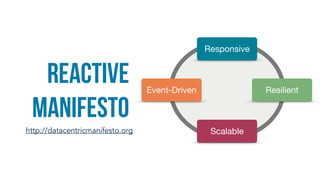
manifesto
http://datacentricmanifesto.org
Responsive
Scalable
Event-Driven Resilient
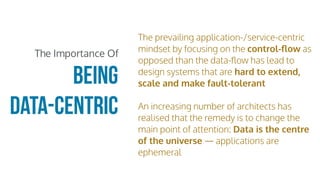
The prevailing application-/service-centric
mindset by focusing on the control-flow as
opposed than the data-flow has lead to
design systems that are hard to extend,
scale and make fault-tolerant
An increasing number of architects has
realised that the remedy is to change the
main point of attention: Data is the centre
of the universe — applications are
ephemeral
being
data-centric
The Importance Of
The data-centric revolution puts
data at the centre of the system
Applications are optional visitors to
the data
data-centric
manifesto
http://datacentricmanifesto.org
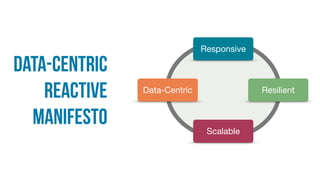
Data-centric
Reactive
manifesto
Responsive
Scalable
Data-Centric Resilient
Data-centric
Reactive
manifesto
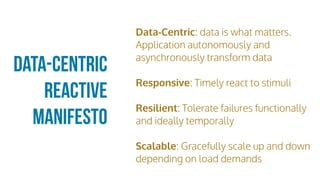
Data-Centric: data is what matters.
Application autonomously and
asynchronously transform data
Responsive: Timely react to stimuli
Resilient: Tolerate failures functionally
and ideally temporally
Scalable: Gracefully scale up and down
depending on load demands
The DDS Standard
Standard
Adoption
CopyrightPrismTech,2015
John Deere’s machinery uses DDS for internal communication as well as for vehicle-to-vehicle
coordination
Telemetry Data is constantly sent to a Cloud for preventive maintenance
In this use case VORTEX enables fog computing as well as cloud computing
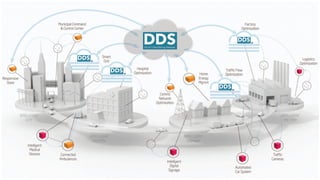
John Deere Autonomous FarmingSmart farming
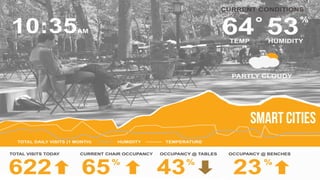
smart cities
Smart Lightbulbs
96Kbytes Memory
Connected Medical Devices
CopyrightPrismTech,2015
Smart grids and power generation
European air traffic control
DDS is the standard recommended by
Eurocontrol/Eurocae for Pan-European
flight data sharing
Reactive Data-Centric
Systems with DDS
Step 1:
Data Centricity in DDS
CopyrightPrismTech,2015
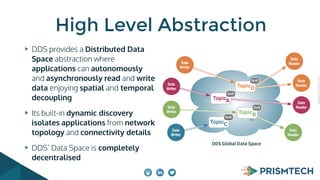
DDS provides a Distributed Data
Space abstraction where
applications can autonomously
and asynchronously read and write
data enjoying spatial and temporal
decoupling
Its built-in dynamic discovery
isolates applications from network
topology and connectivity details
DDS’ Data Space is completely
decentralised
High Level Abstraction
DDS Global Data Space
...
Data
Writer
Data
Writer
Data
Writer
Data
Reader
Data
Reader
Data
Reader
Data
Reader
Data
Writer
TopicA
QoS
TopicB
QoS
TopicC
QoS
TopicD
QoS
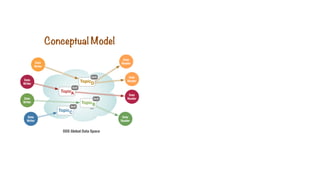
Conceptual Model
DDS Global Data Space
...
Data
Writer
Data
Writer
Data
Writer
Data
Reader
Data
Reader
Data
Reader
Data
Reader
Data
Writer
TopicA
QoS
TopicB
QoS
TopicC
QoS
TopicD
QoS
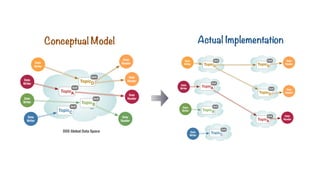
Conceptual Model Actual Implementation
Data
Writer
Data
Writer
Data
Writer
Data
Reader
Data
Reader
Data
Reader
Data
Writer
TopicA
QoS
TopicB
QoS
TopicC
QoS
TopicD
QoS
TopicD
QoS
TopicD
QoS
TopicA
QoS
DDS Global Data Space
...
Data
Writer
Data
Writer
Data
Writer
Data
Reader
Data
Reader
Data
Reader
Data
Reader
Data
Writer
TopicA
QoS
TopicB
QoS
TopicC
QoS
TopicD
QoS
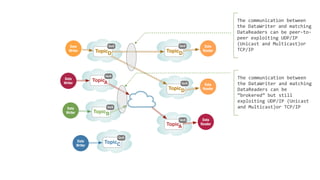
The	
  communication	
  between	
  
the	
  DataWriter	
  and	
  matching	
  
DataReaders	
  can	
  be	
  peer-­‐to-­‐
peer	
  exploiting	
  UDP/IP	
  
(Unicast	
  and	
  Multicast)or	
  
TCP/IP
Data
Writer
Data
Writer
Data
Writer
Data
Reader
Data
Reader
Data
Reader
Data
Writer
TopicA
QoS
TopicB
QoS
TopicC
QoS
TopicD
QoS
TopicD
QoS
TopicD
QoS
TopicA
QoS
The	
  communication	
  between	
  
the	
  DataWriter	
  and	
  matching	
  
DataReaders	
  can	
  be	
  
“brokered”	
  but	
  still	
  
exploiting	
  UDP/IP	
  (Unicast	
  
and	
  Multicast)or	
  TCP/IP
CopyrightPrismTech,2015
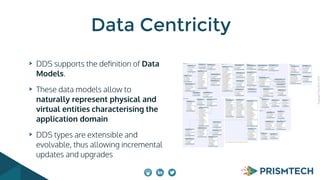
DDS supports the definition of Data
Models.
These data models allow to
naturally represent physical and
virtual entities characterising the
application domain
DDS types are extensible and
evolvable, thus allowing incremental
updates and upgrades
Data Centricity
CopyrightPrismTech,2015
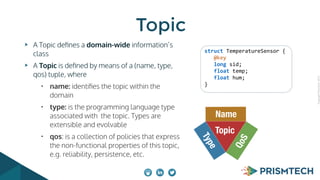
A Topic defines a domain-wide information’s
class
A Topic is defined by means of a (name, type,
qos) tuple, where
• name: identifies the topic within the
domain
• type: is the programming language type
associated with the topic. Types are
extensible and evolvable
• qos: is a collection of policies that express
the non-functional properties of this topic,
e.g. reliability, persistence, etc.
Topic
Topic
Type
Name
QoS
struct	
  TemperatureSensor	
  {	


  @key	


  long	
  sid;	


  float	
  temp;	


  float	
  hum;	
  
}	


CopyrightPrismTech,2015
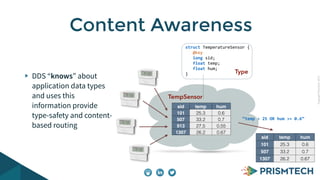
DDS “knows” about
application data types
and uses this
information provide
type-safety and content-
based routing
Content Awareness
struct	
  TemperatureSensor	
  {	


  @key	


  long	
  sid;	


  float	
  temp;	


  float	
  hum;	
  
}	


sid temp hum
101 25.3 0.6
507 33.2 0.7
913 27,5 0.55
1307 26.2 0.67
“temp	
  >	
  25	
  OR	
  hum	
  >=	
  0.6”
sid temp hum
101 25.3 0.6
507 33.2 0.7
1307 26.2 0.67
Type
TempSensor
CopyrightPrismTech,2014
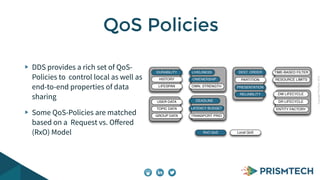
DDS provides a rich set of QoS-
Policies to control local as well as
end-to-end properties of data
sharing
Some QoS-Policies are matched
based on a Request vs. Offered
(RxO) Model
QoS Policies
HISTORY
LIFESPAN
DURABILITY
DEADLINE
LATENCY BUDGET
TRANSPORT PRIO
TIME-BASED FILTER
RESOURCE LIMITS
USER DATA
TOPIC DATA
GROUP DATA
OWENERSHIP
OWN. STRENGTH
LIVELINESS
ENTITY FACTORY
DW LIFECYCLE
DR LIFECYCLE
PRESENTATION
RELIABILITY
PARTITION
DEST. ORDER
RxO QoS Local QoS
CopyrightPrismTech,2015
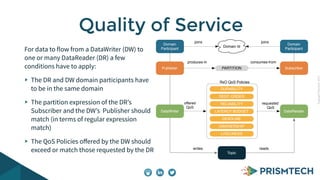
For data to flow from a DataWriter (DW) to
one or many DataReader (DR) a few
conditions have to apply:
The DR and DW domain participants have
to be in the same domain
The partition expression of the DR’s
Subscriber and the DW’s Publisher should
match (in terms of regular expression
match)
The QoS Policies offered by the DW should
exceed or match those requested by the DR
Quality of Service
Domain
Participant
DURABILITY
OWENERSHIP
DEADLINE
LATENCY BUDGET
LIVELINESS
RELIABILITY
DEST. ORDER
Publisher
DataWriter
PARTITION
DataReader
Subscriber
Domain
Participant
offered
QoS
Topic
writes reads
Domain Id
joins joins
produces-in consumes-from
RxO QoS Policies
requested
QoS
CopyrightPrismTech,2015
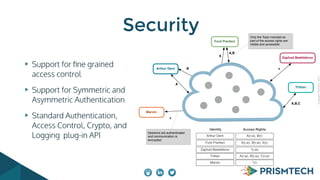
Support for fine grained
access control
Support for Symmetric and
Asymmetric Authentication
Standard Authentication,
Access Control, Crypto, and
Logging plug-in API
Security
Arthur Dent
Arthur Dent
Ford Prerfect
Zaphod Beeblebrox
Marvin
Trillian
A(r,w), B(r)
A(r,w), B(r,w), X(r)
*(r,w)
*(r)
A(r,w), B(r,w), C(r,w)
Ford Prerfect
Zaphod Beeblebrox
Trillian
Marvin
A
B
A,B
X
*
*
A,B,C
Identity Access Rights
Sessions are authenticated
and communication is
encrypted
Only the Topic included as
part of the access rights are
visible and accessible
CopyrightPrismTech,2014
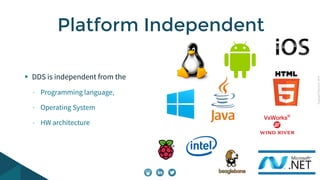
DDS is independent from the
- Programming language,
- Operating System
- HW architecture
Platform Independent
Your First DDS App!
CopyrightPrismTech,2014
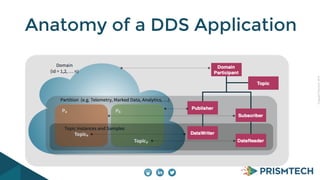
Anatomy of a DDS Application
CopyrightPrismTech,2015
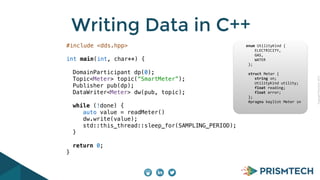
Writing Data in C++
#include <dds.hpp>
int main(int, char**) {
DomainParticipant dp(0);
Topic<Meter> topic(“SmartMeter”);
Publisher pub(dp);
DataWriter<Meter> dw(pub, topic);
while (!done) {
auto value = readMeter()
dw.write(value);
std::this_thread::sleep_for(SAMPLING_PERIOD);
}
return 0;
}


  enum	
  UtilityKind	
  {	


  ELECTRICITY,	


  GAS,	


  WATER	


  };	


  struct	
  Meter	
  {	


  string	
  sn;	


  UtilityKind	
  utility;	


  float	
  reading;	


  float	
  error;	


  };	


  #pragma	
  keylist	
  Meter	
  sn	
  
CopyrightPrismTech,2015
Reading Data in C++
#include <dds.hpp>
int main(int, char**) {
DomainParticipant dp(0);
Topic<Meter> topic(”SmartMeter”);
Subscriber sub(dp);
DataReader<Meter> dr(dp, topic);
LambdaDataReaderListener<DataReader<Meter>> lst;
lst.data_available = [](DataReader<Meter>& dr) {
auto samples = data.read();
std::for_each(samples.begin(), samples.end(), [](Sample<Meter>& sample) {
std::cout << sample.data() << std::endl;
}
}
dr.listener(lst);
// Print incoming data up to when the user does a Ctrl-C
std::this_thread::join();
return 0;
}


  enum	
  UtilityKind	
  {	


  ELECTRICITY,	


  GAS,	


  WATER	


  };	


  struct	
  Meter	
  {	


  string	
  sn;	


  UtilityKind	
  utility;	


  float	
  reading;	


  float	
  error;	


  };	


  #pragma	
  keylist	
  Meter	
  sn	
  
CopyrightPrismTech,2015
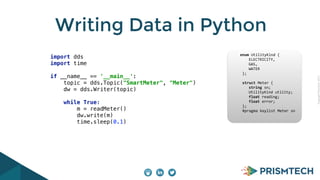
Writing Data in Python
import dds
import time


if __name__ == '__main__':

topic = dds.Topic("SmartMeter", "Meter")

dw = dds.Writer(topic)


while True:

m = readMeter()

dw.write(m)

time.sleep(0.1)


  enum	
  UtilityKind	
  {	


  ELECTRICITY,	


  GAS,	


  WATER	


  };	


  struct	
  Meter	
  {	


  string	
  sn;	


  UtilityKind	
  utility;	


  float	
  reading;	


  float	
  error;	


  };	


  #pragma	
  keylist	
  Meter	
  sn	
  
CopyrightPrismTech,2015
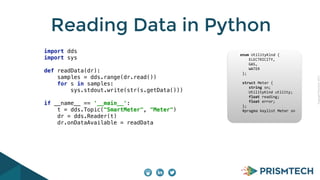
Reading Data in Python
import dds

import sys


def readData(dr): 

samples = dds.range(dr.read())

for s in samples:

sys.stdout.write(str(s.getData()))


if __name__ == '__main__':

t = dds.Topic("SmartMeter", "Meter")

dr = dds.Reader(t)

dr.onDataAvailable = readData


  enum	
  UtilityKind	
  {	


  ELECTRICITY,	


  GAS,	


  WATER	


  };	


  struct	
  Meter	
  {	


  string	
  sn;	


  UtilityKind	
  utility;	


  float	
  reading;	


  float	
  error;	


  };	


  #pragma	
  keylist	
  Meter	
  sn	
  
Step 2:
Reactive Architectures with DDS
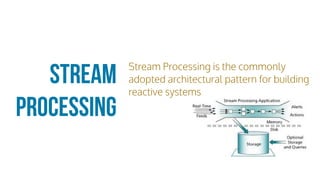
Stream
Processing
Stream Processing is the commonly
adopted architectural pattern for building
reactive systems
CopyrightPrismTech,2015
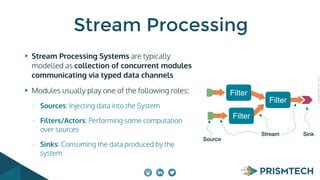
Stream Processing Systems are typically
modelled as collection of concurrent modules
communicating via typed data channels
Modules usually play one of the following roles:
- Sources: Injecting data into the System
- Filters/Actors: Performing some computation
over sources
- Sinks: Consuming the data produced by the
system
Stream Processing
Filter
Source
Filter
Filter
Stream Sink
Stream Processing with
DDS
CopyrightPrismTech,2015
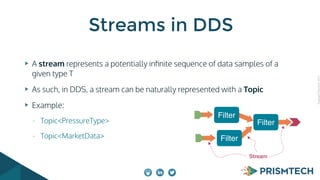
A stream represents a potentially infinite sequence of data samples of a
given type T
As such, in DDS, a stream can be naturally represented with a Topic
Example:
- Topic<PressureType>
- Topic<MarketData>
Streams in DDS
Filter
Filter
Filter
Stream
CopyrightPrismTech,2015
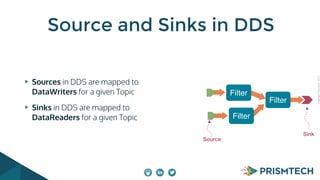
Sources in DDS are mapped to
DataWriters for a given Topic
Sinks in DDS are mapped to
DataReaders for a given Topic
Source and Sinks in DDS
Filter
Source
Filter
Filter
Sink
CopyrightPrismTech,2015
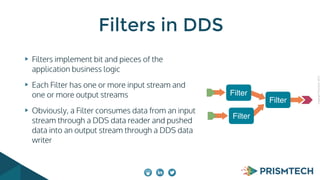
Filters implement bit and pieces of the
application business logic
Each Filter has one or more input stream and
one or more output streams
Obviously, a Filter consumes data from an input
stream through a DDS data reader and pushed
data into an output stream through a DDS data
writer
Filters in DDS
Filter
Filter
Filter
DDS Architectural
Benefits
CopyrightPrismTech,2015
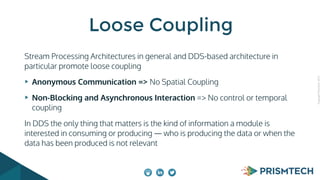
Stream Processing Architectures in general and DDS-based architecture in
particular promote loose coupling
Anonymous Communication => No Spatial Coupling
Non-Blocking and Asynchronous Interaction => No control or temporal
coupling
In DDS the only thing that matters is the kind of information a module is
interested in consuming or producing — who is producing the data or when the
data has been produced is not relevant
Loose Coupling
CopyrightPrismTech,2015
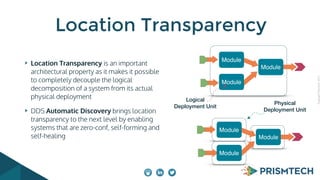
Location Transparency is an important
architectural property as it makes it possible
to completely decouple the logical
decomposition of a system from its actual
physical deployment
DDS Automatic Discovery brings location
transparency to the next level by enabling
systems that are zero-conf, self-forming and
self-healing
Location Transparency
Module
Module
Module
Module
Module
Module
Physical
Deployment Unit
Logical
Deployment Unit
CopyrightPrismTech,2015
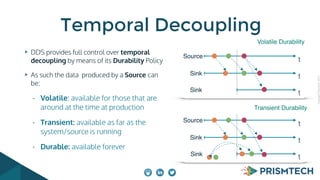
DDS provides full control over temporal
decoupling by means of its Durability Policy
As such the data produced by a Source can
be:
- Volatile: available for those that are
around at the time at production
- Transient: available as far as the
system/source is running
- Durable: available forever
Temporal Decoupling
tSource
t
t
Sink
Sink
Volatile Durability
tSource
t
t
Sink
Sink
Transient Durability
CopyrightPrismTech,2015
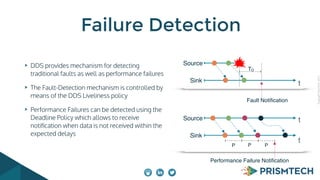
DDS provides mechanism for detecting
traditional faults as well as performance failures
The Fault-Detection mechanism is controlled by
means of the DDS Liveliness policy
Performance Failures can be detected using the
Deadline Policy which allows to receive
notification when data is not received within the
expected delays
Failure Detection
Source
tSink
Fault Notification
TD
Source
t
Sink
Performance Failure Notification
P
t
P P
CopyrightPrismTech,2015
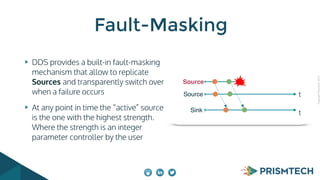
DDS provides a built-in fault-masking
mechanism that allow to replicate
Sources and transparently switch over
when a failure occurs
At any point in time the “active” source
is the one with the highest strength.
Where the strength is an integer
parameter controller by the user
Fault-Masking
Source
tSink
Source t
CopyrightPrismTech,2015
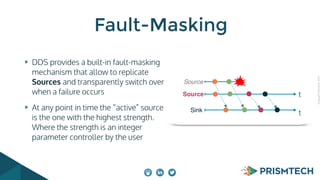
DDS provides a built-in fault-masking
mechanism that allow to replicate
Sources and transparently switch over
when a failure occurs
At any point in time the “active” source
is the one with the highest strength.
Where the strength is an integer
parameter controller by the user
Fault-Masking
Source
tSink
Source t
Putting All Together
CopyrightPrismTech,2015
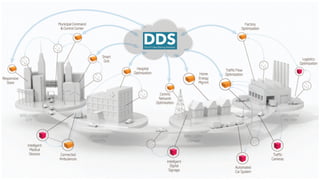
DDS is a standard technology for ubiquitous,
interoperable, secure, platform independent,
and real-time data sharing across network
connected devices
DDS provides a the ideal platform for
architecting and building Data-Centric
Reactive Systems
DDS
CopyrightPrismTech,2015
Reactive Data Centric Architectures with DDS

Reactive Data Centric Architectures with DDS

  • 1.
    Angelo  Corsaro,  PhD   Chief  Technology  Officer   angelo.corsaro@prismtech.com Reactive Data Centric Architectures with DDS
  • 2.
  • 3.
  • 4.
  • 5.
  • 6.
  • 7.
  • 8.
  • 9.
    Up to recentlyReactive Systems were mainstream only domains such as Industrial, Military, Telco, Finance and Aerospace Challenges imposed by the Internet of Things and Big Data Applications an increasing number of architects and developers is recognising the importance of the techniques and technologies used for building Reactive Systems being reactive The Importance Of
  • 10.
  • 11.
    The prevailing application-/service-centric mindsetby focusing on the control-flow as opposed than the data-flow has lead to design systems that are hard to extend, scale and make fault-tolerant An increasing number of architects has realised that the remedy is to change the main point of attention: Data is the centre of the universe — applications are ephemeral being data-centric The Importance Of
  • 12.
    The data-centric revolutionputs data at the centre of the system Applications are optional visitors to the data data-centric manifesto http://datacentricmanifesto.org
  • 13.
  • 14.
    Data-centric Reactive manifesto Data-Centric: data iswhat matters. Application autonomously and asynchronously transform data Responsive: Timely react to stimuli Resilient: Tolerate failures functionally and ideally temporally Scalable: Gracefully scale up and down depending on load demands
  • 15.
  • 16.
  • 17.
  • 18.
    CopyrightPrismTech,2015 John Deere’s machineryuses DDS for internal communication as well as for vehicle-to-vehicle coordination Telemetry Data is constantly sent to a Cloud for preventive maintenance In this use case VORTEX enables fog computing as well as cloud computing John Deere Autonomous FarmingSmart farming
  • 19.
  • 20.
  • 21.
  • 22.
    European air trafficcontrol DDS is the standard recommended by Eurocontrol/Eurocae for Pan-European flight data sharing
  • 23.
  • 24.
  • 25.
    CopyrightPrismTech,2015 DDS provides aDistributed Data Space abstraction where applications can autonomously and asynchronously read and write data enjoying spatial and temporal decoupling Its built-in dynamic discovery isolates applications from network topology and connectivity details DDS’ Data Space is completely decentralised High Level Abstraction DDS Global Data Space ... Data Writer Data Writer Data Writer Data Reader Data Reader Data Reader Data Reader Data Writer TopicA QoS TopicB QoS TopicC QoS TopicD QoS
  • 26.
    Conceptual Model DDS GlobalData Space ... Data Writer Data Writer Data Writer Data Reader Data Reader Data Reader Data Reader Data Writer TopicA QoS TopicB QoS TopicC QoS TopicD QoS
  • 27.
    Conceptual Model ActualImplementation Data Writer Data Writer Data Writer Data Reader Data Reader Data Reader Data Writer TopicA QoS TopicB QoS TopicC QoS TopicD QoS TopicD QoS TopicD QoS TopicA QoS DDS Global Data Space ... Data Writer Data Writer Data Writer Data Reader Data Reader Data Reader Data Reader Data Writer TopicA QoS TopicB QoS TopicC QoS TopicD QoS
  • 28.
    The  communication  between   the  DataWriter  and  matching   DataReaders  can  be  peer-­‐to-­‐ peer  exploiting  UDP/IP   (Unicast  and  Multicast)or   TCP/IP Data Writer Data Writer Data Writer Data Reader Data Reader Data Reader Data Writer TopicA QoS TopicB QoS TopicC QoS TopicD QoS TopicD QoS TopicD QoS TopicA QoS The  communication  between   the  DataWriter  and  matching   DataReaders  can  be   “brokered”  but  still   exploiting  UDP/IP  (Unicast   and  Multicast)or  TCP/IP
  • 29.
    CopyrightPrismTech,2015 DDS supports thedefinition of Data Models. These data models allow to naturally represent physical and virtual entities characterising the application domain DDS types are extensible and evolvable, thus allowing incremental updates and upgrades Data Centricity
  • 30.
    CopyrightPrismTech,2015 A Topic definesa domain-wide information’s class A Topic is defined by means of a (name, type, qos) tuple, where • name: identifies the topic within the domain • type: is the programming language type associated with the topic. Types are extensible and evolvable • qos: is a collection of policies that express the non-functional properties of this topic, e.g. reliability, persistence, etc. Topic Topic Type Name QoS struct  TemperatureSensor  {        @key        long  sid;        float  temp;        float  hum;   }    
  • 31.
    CopyrightPrismTech,2015 DDS “knows” about applicationdata types and uses this information provide type-safety and content- based routing Content Awareness struct  TemperatureSensor  {        @key        long  sid;        float  temp;        float  hum;   }     sid temp hum 101 25.3 0.6 507 33.2 0.7 913 27,5 0.55 1307 26.2 0.67 “temp  >  25  OR  hum  >=  0.6” sid temp hum 101 25.3 0.6 507 33.2 0.7 1307 26.2 0.67 Type TempSensor
  • 32.
    CopyrightPrismTech,2014 DDS provides arich set of QoS- Policies to control local as well as end-to-end properties of data sharing Some QoS-Policies are matched based on a Request vs. Offered (RxO) Model QoS Policies HISTORY LIFESPAN DURABILITY DEADLINE LATENCY BUDGET TRANSPORT PRIO TIME-BASED FILTER RESOURCE LIMITS USER DATA TOPIC DATA GROUP DATA OWENERSHIP OWN. STRENGTH LIVELINESS ENTITY FACTORY DW LIFECYCLE DR LIFECYCLE PRESENTATION RELIABILITY PARTITION DEST. ORDER RxO QoS Local QoS
  • 33.
    CopyrightPrismTech,2015 For data toflow from a DataWriter (DW) to one or many DataReader (DR) a few conditions have to apply: The DR and DW domain participants have to be in the same domain The partition expression of the DR’s Subscriber and the DW’s Publisher should match (in terms of regular expression match) The QoS Policies offered by the DW should exceed or match those requested by the DR Quality of Service Domain Participant DURABILITY OWENERSHIP DEADLINE LATENCY BUDGET LIVELINESS RELIABILITY DEST. ORDER Publisher DataWriter PARTITION DataReader Subscriber Domain Participant offered QoS Topic writes reads Domain Id joins joins produces-in consumes-from RxO QoS Policies requested QoS
  • 34.
    CopyrightPrismTech,2015 Support for finegrained access control Support for Symmetric and Asymmetric Authentication Standard Authentication, Access Control, Crypto, and Logging plug-in API Security Arthur Dent Arthur Dent Ford Prerfect Zaphod Beeblebrox Marvin Trillian A(r,w), B(r) A(r,w), B(r,w), X(r) *(r,w) *(r) A(r,w), B(r,w), C(r,w) Ford Prerfect Zaphod Beeblebrox Trillian Marvin A B A,B X * * A,B,C Identity Access Rights Sessions are authenticated and communication is encrypted Only the Topic included as part of the access rights are visible and accessible
  • 35.
    CopyrightPrismTech,2014 DDS is independentfrom the - Programming language, - Operating System - HW architecture Platform Independent
  • 36.
  • 37.
  • 38.
    CopyrightPrismTech,2015 Writing Data inC++ #include <dds.hpp> int main(int, char**) { DomainParticipant dp(0); Topic<Meter> topic(“SmartMeter”); Publisher pub(dp); DataWriter<Meter> dw(pub, topic); while (!done) { auto value = readMeter() dw.write(value); std::this_thread::sleep_for(SAMPLING_PERIOD); } return 0; }          enum  UtilityKind  {            ELECTRICITY,            GAS,            WATER              };                            struct  Meter  {            string  sn;            UtilityKind  utility;            float  reading;            float  error;              };                                      #pragma  keylist  Meter  sn  
  • 39.
    CopyrightPrismTech,2015 Reading Data inC++ #include <dds.hpp> int main(int, char**) { DomainParticipant dp(0); Topic<Meter> topic(”SmartMeter”); Subscriber sub(dp); DataReader<Meter> dr(dp, topic); LambdaDataReaderListener<DataReader<Meter>> lst; lst.data_available = [](DataReader<Meter>& dr) { auto samples = data.read(); std::for_each(samples.begin(), samples.end(), [](Sample<Meter>& sample) { std::cout << sample.data() << std::endl; } } dr.listener(lst); // Print incoming data up to when the user does a Ctrl-C std::this_thread::join(); return 0; }          enum  UtilityKind  {            ELECTRICITY,            GAS,            WATER              };                            struct  Meter  {            string  sn;            UtilityKind  utility;            float  reading;            float  error;              };                                      #pragma  keylist  Meter  sn  
  • 40.
    CopyrightPrismTech,2015 Writing Data inPython import dds import time
 
 if __name__ == '__main__':
 topic = dds.Topic("SmartMeter", "Meter")
 dw = dds.Writer(topic)
 
 while True:
 m = readMeter()
 dw.write(m)
 time.sleep(0.1)          enum  UtilityKind  {            ELECTRICITY,            GAS,            WATER              };                            struct  Meter  {            string  sn;            UtilityKind  utility;            float  reading;            float  error;              };                                      #pragma  keylist  Meter  sn  
  • 41.
    CopyrightPrismTech,2015 Reading Data inPython import dds
 import sys
 
 def readData(dr): 
 samples = dds.range(dr.read())
 for s in samples:
 sys.stdout.write(str(s.getData()))
 
 if __name__ == '__main__':
 t = dds.Topic("SmartMeter", "Meter")
 dr = dds.Reader(t)
 dr.onDataAvailable = readData          enum  UtilityKind  {            ELECTRICITY,            GAS,            WATER              };                            struct  Meter  {            string  sn;            UtilityKind  utility;            float  reading;            float  error;              };                                      #pragma  keylist  Meter  sn  
  • 42.
  • 43.
    Stream Processing Stream Processing isthe commonly adopted architectural pattern for building reactive systems
  • 44.
    CopyrightPrismTech,2015 Stream Processing Systemsare typically modelled as collection of concurrent modules communicating via typed data channels Modules usually play one of the following roles: - Sources: Injecting data into the System - Filters/Actors: Performing some computation over sources - Sinks: Consuming the data produced by the system Stream Processing Filter Source Filter Filter Stream Sink
  • 45.
  • 46.
    CopyrightPrismTech,2015 A stream representsa potentially infinite sequence of data samples of a given type T As such, in DDS, a stream can be naturally represented with a Topic Example: - Topic<PressureType> - Topic<MarketData> Streams in DDS Filter Filter Filter Stream
  • 47.
    CopyrightPrismTech,2015 Sources in DDSare mapped to DataWriters for a given Topic Sinks in DDS are mapped to DataReaders for a given Topic Source and Sinks in DDS Filter Source Filter Filter Sink
  • 48.
    CopyrightPrismTech,2015 Filters implement bitand pieces of the application business logic Each Filter has one or more input stream and one or more output streams Obviously, a Filter consumes data from an input stream through a DDS data reader and pushed data into an output stream through a DDS data writer Filters in DDS Filter Filter Filter
  • 49.
  • 50.
    CopyrightPrismTech,2015 Stream Processing Architecturesin general and DDS-based architecture in particular promote loose coupling Anonymous Communication => No Spatial Coupling Non-Blocking and Asynchronous Interaction => No control or temporal coupling In DDS the only thing that matters is the kind of information a module is interested in consuming or producing — who is producing the data or when the data has been produced is not relevant Loose Coupling
  • 51.
    CopyrightPrismTech,2015 Location Transparency isan important architectural property as it makes it possible to completely decouple the logical decomposition of a system from its actual physical deployment DDS Automatic Discovery brings location transparency to the next level by enabling systems that are zero-conf, self-forming and self-healing Location Transparency Module Module Module Module Module Module Physical Deployment Unit Logical Deployment Unit
  • 52.
    CopyrightPrismTech,2015 DDS provides fullcontrol over temporal decoupling by means of its Durability Policy As such the data produced by a Source can be: - Volatile: available for those that are around at the time at production - Transient: available as far as the system/source is running - Durable: available forever Temporal Decoupling tSource t t Sink Sink Volatile Durability tSource t t Sink Sink Transient Durability
  • 53.
    CopyrightPrismTech,2015 DDS provides mechanismfor detecting traditional faults as well as performance failures The Fault-Detection mechanism is controlled by means of the DDS Liveliness policy Performance Failures can be detected using the Deadline Policy which allows to receive notification when data is not received within the expected delays Failure Detection Source tSink Fault Notification TD Source t Sink Performance Failure Notification P t P P
  • 54.
    CopyrightPrismTech,2015 DDS provides abuilt-in fault-masking mechanism that allow to replicate Sources and transparently switch over when a failure occurs At any point in time the “active” source is the one with the highest strength. Where the strength is an integer parameter controller by the user Fault-Masking Source tSink Source t
  • 55.
    CopyrightPrismTech,2015 DDS provides abuilt-in fault-masking mechanism that allow to replicate Sources and transparently switch over when a failure occurs At any point in time the “active” source is the one with the highest strength. Where the strength is an integer parameter controller by the user Fault-Masking Source tSink Source t
  • 56.
  • 57.
  • 58.
  • 59.
  • 60.
    DDS is astandard technology for ubiquitous, interoperable, secure, platform independent, and real-time data sharing across network connected devices DDS provides a the ideal platform for architecting and building Data-Centric Reactive Systems DDS
  • 61.