Rohit Mahali
6th Semester
B.Tech (CSE)
Regd. No. 1401105542
Roll No. 33721
1
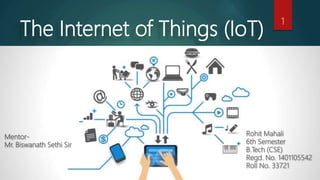
The Internet of Things (IoT)
Mentor-
Mr. Biswanath Sethi Sir
2
OUTLINE
 What is IoT ?
 Why IoT ?
 About
 Applications
 Examples of IoT
 Challenges in IoT
 Conclusion
3
What is IoT ?
 Internet of Things (IoT) is a system of devices connected to the Internet with
the ability to collect and exchange data from users or environment with no
human intervention.
 The device or the ‘thing’ in IoT could be any device embedded with
electronics, software and sensor like a smart refrigerator, a smart air
conditioner, lights in household, connected security systems or even a
person with a heart monitor or an automobile.
4
Why IoT
? We are lazy
 We want to automate everything
 We want to control everything remotely
 We want to see data in real-time
5
 Sensors are fitted everywhere across every
devices collecting real-time data
consistently.
 Every device has its unique id which makes
the communication possible among them.
ABOUT
6
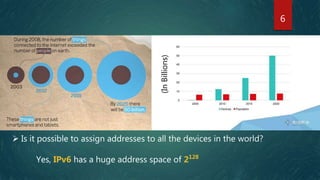
(InBillions)
 Is it possible to assign addresses to all the devices in the world?
Yes, IPv6 has a huge address space of 2128
7
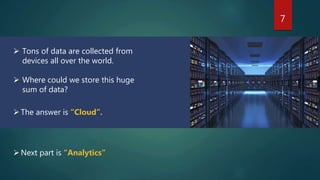
 Tons of data are collected from
devices all over the world.
 Where could we store this huge
sum of data?
Next part is “Analytics”
The answer is “Cloud”.
8
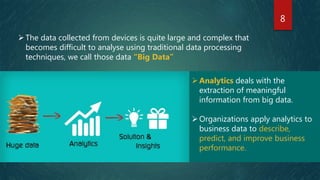
Analytics deals with the
extraction of meaningful
information from big data.
Organizations apply analytics to
business data to describe,
predict, and improve business
performance.
The data collected from devices is quite large and complex that
becomes difficult to analyse using traditional data processing
techniques, we call those data “Big Data”
9
The term "Internet of Things" is coined by Kevin Ashton in
1999.
Early example, 1982, Coke machine at Carnegie Mellon
University was connected to internet which reported its
inventory and temperature.
Little
History
10
APPLICATIONS
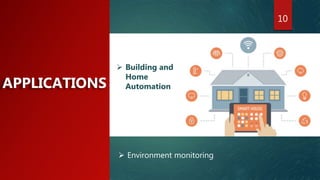
 Building and
Home
Automation
 Environment monitoring
11
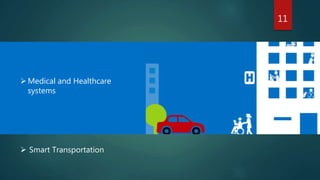
Medical and Healthcare
systems
 Smart Transportation
12
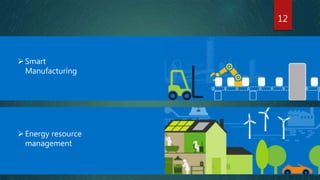
Smart
Manufacturing
Energy resource
management
13
Example
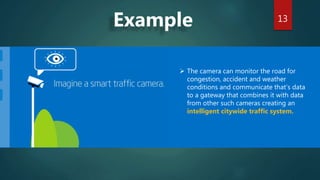
 The camera can monitor the road for
congestion, accident and weather
conditions and communicate that’s data
to a gateway that combines it with data
from other such cameras creating an
intelligent citywide traffic system.
14
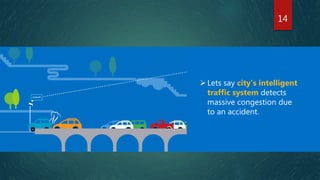
Lets say city’s intelligent
traffic system detects
massive congestion due
to an accident.
15
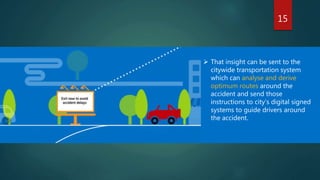
 That insight can be sent to the
citywide transportation system
which can analyse and derive
optimum routes around the
accident and send those
instructions to city’s digital signed
systems to guide drivers around
the accident.
16
CHALLENGES
Sensing a complex environment
Innovative ways to sense and deliver
information from physical world to the
cloud.
Connectivity
Variety of wired and wireless standards
are required to enable different
application needs.
Power
Many IoT applications need to run for
years over battery and reduce the
overall energy consumption.
17
Security
Protecting user’s privacy, manufacturer’s IP and blocking malicious
activity.
Complexity
IoT application development needs to be easy for all developers
not just to experts.
Cloud
IoT applications require end-to-end solutions including cloud
services.
18
CONCLUSION
While IoT is complex and poses some risks and
is still evolving, many pioneers have started
adopting this technology.
IoT can help innovate new process and
initiatives that could transform businesses,
lives and the world.
19
 We are also trying to understand what the many opportunities and
challenges are going to be as more and more devices start to join the
IoT.
For now the best thing that we can do is educate ourselves about what
the IoT is and the potential impacts that can be seen on how we work
and live.
20
REFERENCES
 www.google.co.in
 Internet of things
https://en.wikipedia.org/wiki/Internet_of_things
 IEEE Internet of Things Journal
http://ieeexplore.ieee.org/document/7544470
 Jacob Morgan, A Simple Explanation of 'The Internet
of Things‘
http://www.forbes.com

IoT presentation

  • 1.
    Rohit Mahali 6th Semester B.Tech(CSE) Regd. No. 1401105542 Roll No. 33721 1 The Internet of Things (IoT) Mentor- Mr. Biswanath Sethi Sir
  • 2.
    2 OUTLINE  What isIoT ?  Why IoT ?  About  Applications  Examples of IoT  Challenges in IoT  Conclusion
  • 3.
    3 What is IoT?  Internet of Things (IoT) is a system of devices connected to the Internet with the ability to collect and exchange data from users or environment with no human intervention.  The device or the ‘thing’ in IoT could be any device embedded with electronics, software and sensor like a smart refrigerator, a smart air conditioner, lights in household, connected security systems or even a person with a heart monitor or an automobile.
  • 4.
    4 Why IoT ? Weare lazy  We want to automate everything  We want to control everything remotely  We want to see data in real-time
  • 5.
    5  Sensors arefitted everywhere across every devices collecting real-time data consistently.  Every device has its unique id which makes the communication possible among them. ABOUT
  • 6.
    6 (InBillions)  Is itpossible to assign addresses to all the devices in the world? Yes, IPv6 has a huge address space of 2128
  • 7.
    7  Tons ofdata are collected from devices all over the world.  Where could we store this huge sum of data? Next part is “Analytics” The answer is “Cloud”.
  • 8.
    8 Analytics deals withthe extraction of meaningful information from big data. Organizations apply analytics to business data to describe, predict, and improve business performance. The data collected from devices is quite large and complex that becomes difficult to analyse using traditional data processing techniques, we call those data “Big Data”
  • 9.
    9 The term "Internetof Things" is coined by Kevin Ashton in 1999. Early example, 1982, Coke machine at Carnegie Mellon University was connected to internet which reported its inventory and temperature. Little History
  • 10.
  • 11.
  • 12.
  • 13.
    13 Example  The cameracan monitor the road for congestion, accident and weather conditions and communicate that’s data to a gateway that combines it with data from other such cameras creating an intelligent citywide traffic system.
  • 14.
    14 Lets say city’sintelligent traffic system detects massive congestion due to an accident.
  • 15.
    15  That insightcan be sent to the citywide transportation system which can analyse and derive optimum routes around the accident and send those instructions to city’s digital signed systems to guide drivers around the accident.
  • 16.
    16 CHALLENGES Sensing a complexenvironment Innovative ways to sense and deliver information from physical world to the cloud. Connectivity Variety of wired and wireless standards are required to enable different application needs. Power Many IoT applications need to run for years over battery and reduce the overall energy consumption.
  • 17.
    17 Security Protecting user’s privacy,manufacturer’s IP and blocking malicious activity. Complexity IoT application development needs to be easy for all developers not just to experts. Cloud IoT applications require end-to-end solutions including cloud services.
  • 18.
    18 CONCLUSION While IoT iscomplex and poses some risks and is still evolving, many pioneers have started adopting this technology. IoT can help innovate new process and initiatives that could transform businesses, lives and the world.
  • 19.
    19  We arealso trying to understand what the many opportunities and challenges are going to be as more and more devices start to join the IoT. For now the best thing that we can do is educate ourselves about what the IoT is and the potential impacts that can be seen on how we work and live.
  • 20.
    20 REFERENCES  www.google.co.in  Internetof things https://en.wikipedia.org/wiki/Internet_of_things  IEEE Internet of Things Journal http://ieeexplore.ieee.org/document/7544470  Jacob Morgan, A Simple Explanation of 'The Internet of Things‘ http://www.forbes.com

Editor's Notes